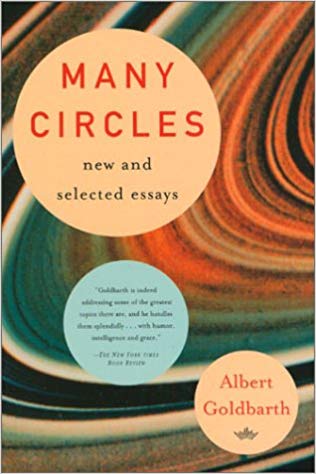
Many Circles: New and Selected Essays by Albert Goldbarth

My word. This is a complicated one.

I admire Albert Goldbarth very much. I’ve read his essay “Fuller” several times now, but I think that’s the only work of his that I’d read before this book. As an overall impression, I am deeply impressed, and challenged. These essays are beautiful and complicated. They are braids of many strands, often organized around an abstract concept, and Goldbarth makes it his job to help us see the connections, which can as well be pretty abstract. In other words, classic essayistic thinking-on-the-page. I’m thinking of the masterful braiding in Jo Ann Beard’s “The Fourth State of Matter,” which I so love, but even more complexly. And long: these essays are 20, 30, 40 and 50 pages long, which can make their braiding quite an organizational feat, and a feat for the reader as well.

They tend to focus on dualities or multiplicities, and profiles of people in history as well as in the present. The amount of information presented in each–scientific, historical–is boggling, and yet each essay makes sense in the end almost despite itself. I want to call the subject matter often obscure, but that’s an issue for each reader to decide, isn’t it; I am not the most well-read person I know, but I am not the least, either, and I certainly found some of the historical figures new to me. (I was fine with Yeats, and Einstein, and the Greek myths, of course; but the archaeologists John Lloyd Stephens* and Augustus Le Plongeon? Millionaire astronomer Pecival Lowell?) Goldbarth himself: extremely well-read and wide-ranging. Reading him is an education.** And I really, really enjoyed reading these essays and learning so much; but they must be taken slowly, to follow and parse all those threads.

Goldbarth is a poet to boot, and adds lyricism and whimsy in where we least expect it, expanding the ways in which he makes connections–imagistic and figurative ones, and wordplay–which make his work so much more beautiful but also that much more complex to follow in his meanings. His images and sentences as well as his essays are surprising, gorgeous, complicated, and rich.

I find his clearest obsession to be the concept of a “sympathy of souls” (the title of an earlier essay collection, many of whose essays reappear here), the interlinking of concepts and images, yes, but also of people. My two favorite examples of this type of essay are “Fuller,” which I’ve read repeatedly and finally begin to grasp, and “After Yitzl.”

The first links Marie Curie with the dancer Loie Fuller. They were contemporaries, and the historical record shows that they met; but much of their touching, close relationship as Goldbarth writes it here is born in his imagination. It’s a stunning piece, first in its portrayal of Marie and Pierre Curie’s passion for their research (and the starry brightness it yielded), and then in its, yes, sympathy between the two women. The narrator’s present life and relationship with his wife sneak in, too. I admired in many essays that the narrator was present as a writer and researcher: this line of poetry he was struggling with and its relationship to the apparently unconnected essay draft, etc.

“After Yitzl” is also a sort of dream sequence, which opens this collection and the earlier Sympathy of Souls. It is about the narrator’s ancestor, his ancestral connections to Jewish immigrants to the United States. It’s brief, and lovely, and as much imagination as anything else, but also research-heavy…

And then there are the longer essays: “Many Circles,” “Worlds,” and “Ellen’s,” which I could read a dozen times and still not grasp all of. It’s about the narrator’s friend Ellen, who is both a genius and mentally ill, and her deep relationship with James Joyce; it’s about Leonardo da Vinci, Dorothy in Oz, and spirals in architecture and nature and imagination. Whew.

Do I recommend this collection? Wholeheartedly, I do; but be ready for a challenge and some slow page-turning, and take notes. I’ll be studying this one for a long time.


Rating: 9 thimbling netsukes, if you’re up for the challenge.

*But then it turned out I did know the archaeologist John Lloyd Stephens: when Goldbarth got to the part about his two-volume work Incidents of Travel in the Yucatán, I looked up and yes, spotted those two volumes on my to-be-read shelf. (Thank you Fil for that perfectly appropriate gift.)


**Stay tuned for a vocabulary lessons post to come on Friday.

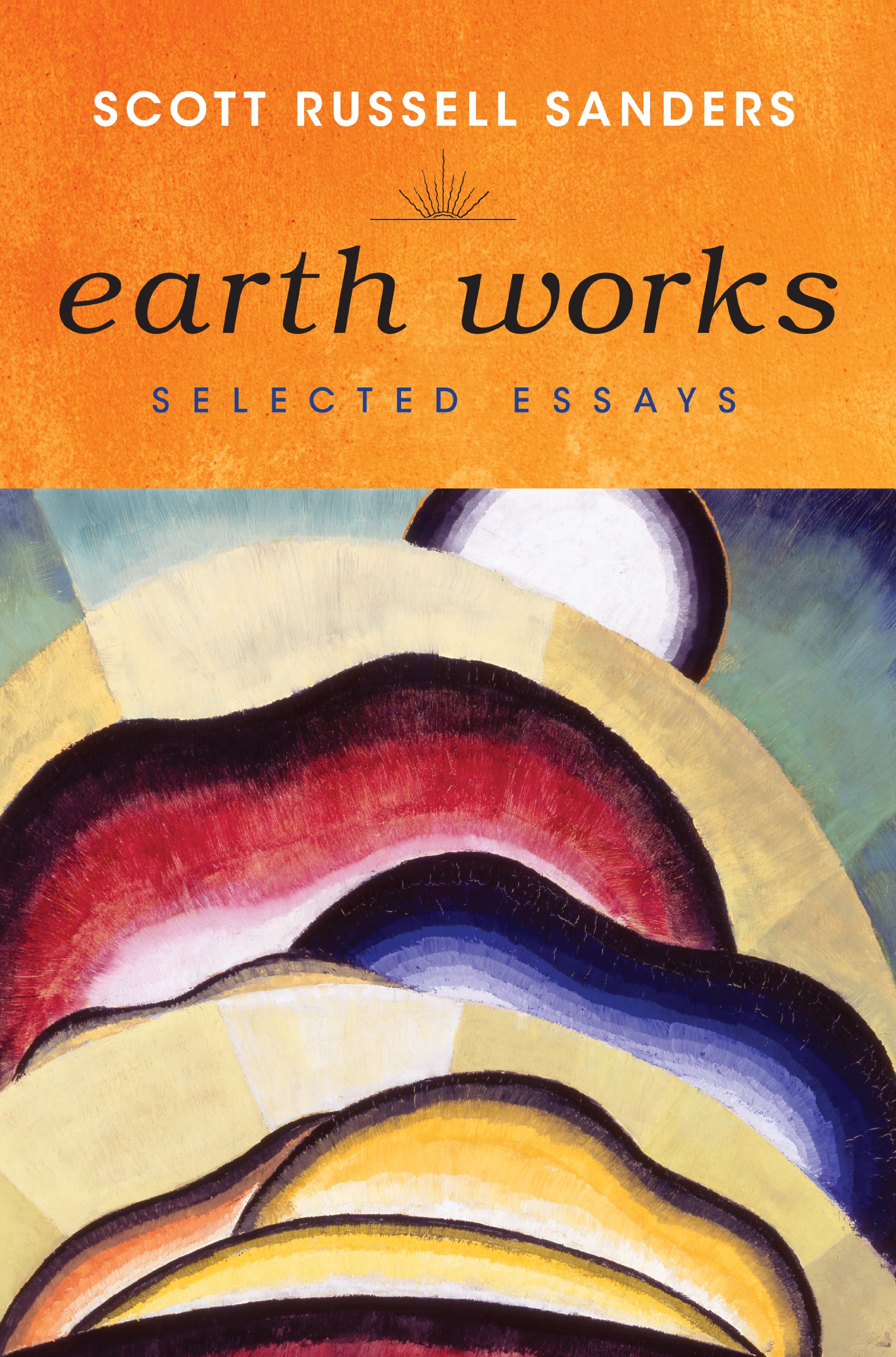
guest review: Earth Works by Scott Russell Sanders, from Pops

I originally reviewed Scott Russell Sanders’s Earth Works in two parts. I also sent a copy to my Pops, because I felt he needed it. I’m glad to have heard back from him now.

Thanks for the book! A few weeks ago I finally dabbled my way through the whole thing. At first I expected to read only those essays that were new to me; but I found the continuous approach irresistible.

As did I, on both counts, actually. A well-organized collection, then!

I blame summer rather than Sanders for taking this long, but Sanders deserves some credit for all the time I took in contemplation and consideration. This collection is indeed challenging in its range and subject matter, but mostly for Sanders’ unguarded candor and intimacy. He is quite simply baring his soul; whether we choose to appreciate what he has to say is up to us. In other words, I had to remember ‘how’ to read him, accepting the variety of both subject matter, and the responses he may arouse for the reader. The wide range of those things is central to the attraction, I think. He is boldly and humbly naked in his writing.

Which is why I wanted to respond to your ‘part one’ blog comments here, because I got as far as “The Men we Carry…” and wish to rise, not to defend him, but explain my reading of it.

Actually, there is no defending, and you did an excellent job of explicating that. And we still don’t know if he has reconsidered his words here. But as I read the essay, his Preface words were fresh in my mind; you quoted those briefly, but here a bit more complete, with my emphasis: “I have refrained from making significant revisions, allowing the essays to remain, for better or worse, essentially as they were when they appeared in print.”

As I suggested earlier, this candor, with all its risk and embarrassment so well exposed, is part of the masala, the potpourri – and the challenge – of reading Sanders essays. In some others earlier, he has already disappointed, frustrated and angered me; I am now unsurprised. I have resolved to consider time and place and context, accept it as material helping me understand this complicated and flawed person (as are we all), whose thoughts I am now invested in.

It’s the difference, if you will, between reading to examine what’s inside an author’s head, versus critique or enjoyment of content only. Increasingly, as my reading has become more intentional, it seems to lean towards the former, while I still enjoy the latter.

Mostly, I appreciate how such dissonance inspires me to better understand my own thoughts and values – for better or worse. Your own thoughtful response to his mansplaining is perhaps an example, with your values now in print with such clarity.

Pleasantly, with Sanders his best are still very rewarding.

FYI: By the numbers:
There are 30 essays here, covering 3 decades;
21 were published in other collections, the others only in periodicals;
I marked 12 favorites out of the lot, including 7 that I had already read elsewhere (including 3 of the 4 from Staying Put.)
But I read every single one, for a complete journey. Favorites tended to be most personal about family and father; nature and its human impacts; existential questioning. Interestingly, the ‘others’ tended to be similar ground but pursued in excess, taking me a bit over the edge, and often simply too personal and intimate – or dissonant.

I love a good numbers round-up, so thanks for that last section!

Glad that my comments made sense to you (I’m not the least bit surprised). From a distance now of nine or ten months, I remember this collection as a whole and as a reading experience, rather than in its particulars, and that overall impression is positive: I would say I like Sanders very much. But I do remember the essay that upset me, too.

The point you make in quoting the Preface is well taken, and I’m glad he made that statement. But I guess the distress and anger I felt in reading that essay was strong enough that I think it should have warranted a response from him – maybe let the essay stand as originally published but write an addendum, letting us know how wrong he got it and how much he’s grown and learned. If Sanders were reading this, that would be my request of him: republish; but now respond to your own writing, too. Well, I won’t hold my breath, but as you said, I’m glad I have gotten my own response out there, however small my platform.

I think there is an ongoing question of how to handle writings that seem wise in many ways but require of us that we make allowances for attitudes like racism, sexism, colonialism, classism, etc. and on and on. To what extent do we accept that something is “dated” and still find a way to enjoy it or to find value? I keep reminding myself that in every era somebody has been enlightened enough to see past the values of the time. It’s something I’m still doing battle with, myself. (Stay tuned, one of these days, for my troubles with Wendell Berry.)

Thanks for yet another thoughtful guest review, Pops.

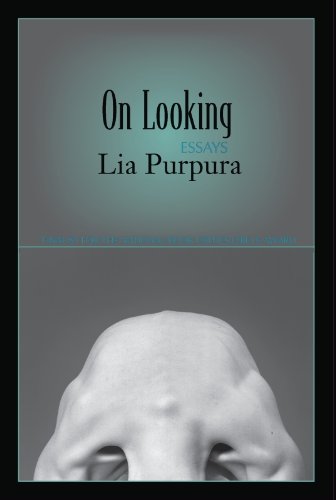
On Looking: Essays by Lia Purpura

I felt I might be tested on the things I saw.

Lia Purpura’s On Looking is an collection of essays that are unrelated, but for their preoccupation with looking and seeing. It’s an interesting look at collecting essays: some of these do not make obvious their obsession, except by proximity with the others. It’s an effect that builds. I like it.

Purpura’s language is lyric, which is often difficult to make clear meaning of – words go together that we don’t expect, which slows down this literal-minded reader. There is undeniable music and rhythm to the language, but also meaning available, if one slows down.

The opening essay, “Autopsy Report,” I’ve read before. It’s beautiful. It is absolutely about looking – a fine way to begin this collection – about really seeing when so many would turn away. (Some readers may wish to turn away. It gives the fine details of bodies literally split open.) This is definitely one of my favorites of the book, and a representative sample, although I suppose it is also clearer in its language than some that follow, and therefore a bit more accessible.

Another favorite was “Sugar Eggs: A Reverie,” which identifies itself as a list essay.

(A list, after all, is an incantation. In a list of likenesses, each element, each peculiarity gathers, leans into and flicks on the light in the room of the next one. The elements loop and knot forth like a net, band as a colony of frost or coral reaching, suggesting not so much a progression as a collective tendency toward. And taken together, the elements offer the assurance of a stance: here is a way to speak of this lightest, barely perceptible–in this case–space. From here I can count and collect that which stirs, and has always stirred me.)

A list inches one closer. Hints along.

Recognize my lists-and-things obsession here, which is of course related to a looking-and-seeing obsession. What follows is a series of spaces and things considered for whether they can count or cannot count as sugar eggs. Sugar eggs for the narrator are sacred spaces… “a space that makes a place for thought, an air considerably pure in which objects–say, sugar bushes, sugar trees–grown precise in their stilled distance.” The specialness of sugar eggs is hard to pin down: Purpura has spent a beautiful essay working on it, and I’m not sure I can sum it up. I’m not even sure I entirely understand it; but I had a lovely time following her parsing of what does and does not qualify.

Another favorite essay was “Coming to See,” which turns out to be a memorial. It’s a series of fragments, about looking through a window and wanting a better, clearer frame for the view (subjects I have played with too); only on the essay’s third page do we learn that the narrator has a friend who is dying. This friend is scarcely mentioned throughout, but it becomes clear that she is what the narrator’s anxiety of seeing is all about. Again, the memorial is something I’ve attempted, but it’s hard to get it right. This is an unusual, touching take on it. By almost entirely eliding the true subject, Purpura gets at the emotional heart without predictable sentimentality or cliché.

There is more, much more; it is so dense. From here I will give you a few favorite lines.

The epigraph, by Goethe:

Every object, well contemplated, creates an organ for its perception.

From “The Pin”:

But while we stayed, we stayed because we were protected by a curiosity so certain of its task, that things–boots, mail, pots, our bodies–offered themselves, first tentatively and then with urgency, as if for us alone, solicitous as all objects of adoration, as all objects in stories lure us, irresistible and catalytic.

All objects in stories lure us. My thesis, if you will.

And finally, from “On Looking Away: A Panoramic,”

I believe in the circle.

It’s funny the things that resonate with us. Another reader would have read this book and marked entirely different lines, I’m sure.

Perhaps this book should be read alongside Mark Doty’s Still Life with Oysters and Lemon, for its attention to attention. And in fact perhaps that comparison is useful: I had to read Doty’s book twice (and repeatedly after that) to begin to get it. These are dense, rich texts, about abstract things even while they’re about very literal, physical things as well.

Worth your time.


Rating: 8 ships in bottles.

The Prairie in Her Eyes by Ann Daum

This is an extraordinary book, one of the most enjoyable reads of the year so far. I took it slowly, out of pure pleasure. Thanks once more to Jessie.

Ann Daum is from a farm-and-ranch in South Dakota’s White River Valley. She left to go to college, but returned every harvest season, and came back after college. She grew up as a ranch hand; her father was the farmer, but her sister and she were ‘cattlemen’ and handlers of horses. As her parents age, and circumstances work against cattle ranching, that part of the family business shrinks and crumbles; they sell off much of their four thousand acres. But Ann’s horse breeding operation does well, and she continues on the family property.

Against this backdrop, The Prairie in Her Eyes is an essay collection and something of a memoir-in-essays. It begins with Ann listening to sandhill cranes passing over her family’s homeplace, in an essay titled “The Habit of Return,” and ends with “The Last Crane,” in which she watches the last sandhill of the season worry itself along. In between, essays consider the history of South Dakota and its farming and ranching cultures; the region’s wildlife; “Silence and Spaces” and “Predators and Prey,” and more. I admire Daum’s titles, which often cue me to follow her subtle braid, as in the essay “Fences,” which deals with boundaries of different sorts, and the variety of effects of literal fences in her region of South Dakota, for good and for ill, and the evolution within her own life of how she sees fences, which is a matter of both her own growth and of changes in the place itself.

Some of this content is hard to take. An account of a difficult foaling had me in tears; the animals (not people!) who hurt and died wrenched me. There is human trauma, as well, that can be difficult to read; interestingly, the human trauma is written about with some distance, less graphically, while the animals’ is more viscerally portrayed. But it’s shown with so much love and grace, and beautiful prose. I’d recommend this book 1,000 times.

These lines open “Silence and Spaces”:

Rain never falls in the South Dakota of my childhood. Wind blows down the valley with the force of locomotives, clouds pile on the horizon, thunder growls from the west. Once, sometimes twice, a summer, lightning sparks prairie fires that crackle and spit, swallow brown summer grasses without tasting. The flames cough embers up like glowing stars and the smoke hangs in cloud. But there is no rain.

This paragraph is about the weather. Fairly dramatic weather, sure. It’s about a lack: no rain. Weather, and an absence. It does not sound like a good recipe for gripping prose. But the fires swallow brown grasses without tasting? Amazing.

Obviously the themes and subject matter of this book spoke to me. It’s about home, what it means to be attached to a place, and how complicated, multifaceted, and imperfect our connections are. I love how deeply the flora, fauna, and history (natural and otherwise) of her region have contributed to making Daum who she is. At the pinnacle of this concept is the essay “Why We Return – The Prairie in Her Eyes,” in which an old woman comes to visit the Daum family property. This woman had never lived there; she’d never seen it before; but her parents had homesteaded there, and an older sibling had been born there. Just like the cranes in “The Habit of Return” (and, obviously, Daum herself), she felt the pull of the place, even though she’d never set foot. “Gertie grew up missing a place she never knew.”

I’m enchanted. I’ll be referring back to this one.


Readalikes: Gretel Ehrlich’s The Solace of Open Spaces and Evelyn Funda’s Weeds: A Farm Daughter’s Lament.


Rating: 9 fading trails.

A Field Guide to Getting Lost by Rebecca Solnit

Another book that came to me at just the right time thanks to Jessie van Eerden. I know of Rebecca Solnit, of course, but I think this is the first of her writing that I’ve read. I really enjoyed it in several aspects: its subject matter is very much in line with that of my thesis (that I’m currently writing); its structure is of interest and also has something to offer my own; the writing is lovely; the content it approaches is wide-ranging, and (as Jessie said early in this semester as we did a manuscript review), “I like to learn stuff.”

That said, it’s not an easy book to sum up. These collected essays are connected, but far from telling a narrative. Solnit is exploring the idea of getting lost and what it has to offer us; and that is ‘getting lost’ in several senses, geographic (I got off the trail and I was lost) and metaphoric (after my mother died I was lost, or I lost several years). Also the sense in which we lose both things and people: lose your keys, lose your mother (to death), lose a boyfriend (when you break up). She sees value in getting lost – sometimes it’s how we find ourselves – and notes that we don’t get lost much anymore. Late in the book, she looks at old maps with their ‘Terra Incognita,’ and observes that we don’t have terra incognita on our maps anymore. We know it all! Right? (Of course, we’ve thought we knew it all before, and been proven wrong.)

I’m using the sense of place tag here although it’s not quite right, which is perhaps a design flaw in my tag. By ‘sense of place,’ I have tended to mean a strong attachment to a certain place; so Jesse Donaldson’s writing about Kentucky, James Lee Burke’s New Iberia, Michael Connelly’s Los Angeles, or Mary Karr’s southeast Texas. That is not what I found with Solnit, so much as a strong feeling about the importance of wandering, losing and finding oneself, in place and in other senses. Place plays an important role here. This book feels like it fits that tag, even though it doesn’t fit the tag as I originally conceived it. (This blog will be eight years old next month. Expect some scope creep.)

Structure-wise: there is a chapter-title refrain, with the heading The Blue of Distance (italicized, where the others aren’t) taking every other place between differently-titled essays. These are not the same essay over and over, but they all meditate on blue and its role in our observation of distance, beginning with the literal meaning (that is, that the sky and deep water both look blue for scientifically observable reasons) and moving through less-literal ones. Distance, it seems, is an inextricable part of one’s ability to get lost. My 600-square-foot house would be much harder to get lost in (tell that to my geriatric dog) than a 20-something room mansion would be. I really appreciated this design, the repeated title for very different essays; it was a succinct cue to the way in which they’re linked.

Another item I found interesting to note was Solnit’s references, the other thinkers she turns to. Some were perhaps unsurprising, as writers cite other writers: Fitzgerald, Nabokov, Katherine Anne Porter, Virginia Woolf, Joseph Conrad. These are joined by Johnny Cash, Patsy Cline, Bobbie Gentry, Yves Klein, Plato, Álvar Núñez Cabeza de Vaca, and Alfred Hitchcock (among many others). A huge number of minds contributed to Solnit’s own thought processes here – which are of course her own – and I was fascinated by the twists and turns. Again (and again), this is something I need in my own writing and that appeals to me. I can’t wait to tell Jessie how right-on she was with assigning me this book.

Obviously this Field Guide‘s usefulness to me is just beginning. You will like it, too, if you like far-ranging considerations of the human condition and where each of us as an individual might be or should be headed, if we’re thinking about it. I found it an engaging and curiously winding path, and I recommend it.


Rating: 8 shades of blue.

The Body: An Essay by Jenny Boully

The Body is an essay in footnotes. Footnotes to a body text which is absent. Just the footnotes.

Pages are often more blank than not, with a line demarcating the footnote section of the page, and then (in rather small font) the text below. Some footnotes are nothing more than Ibid., with a page number. Does this sound infuriating? Yes.

Some of the footnotes are long enough and weird enough to get lost in, themselves; when I consider them poetry and dwell in the moment, there is something to be enjoyed. But overall, not a concept that works for me. Other, better-known writers and readers than I have found much to value here. A meditation on the concept of absence, loss or disappearance, etc. But it was too weird for this reader. I was here for the body, if you will, and not its leavings.

For me a fail, but I’m certainly interested to know if you are differently minded. If any of my readers have enjoyed this book? Please explain.


Rating: 4 quotations.

residency readings, part II


Note: I am just returning from residency this week and slowly reentering regular life (whatever that means). I’ll be back on regular comment response, etc., very soon. Thanks as always for your patience and for reading!


I see a pattern with Richard Schmitt, who tends to teach us about the mechanics of story: process, form, scene, plot, and now dialog. His reading packet was concise, comprising two short stories, by Katherine Mansfield and Sam Shepard respectively. They were excellent reading! I do recommend both: good examples of dialog, yes, but also just fast-paced good reading. I think these are exemplars of what dialog can do for story, and I’m looking forward to this seminar.

Surprise! The poetry segment went fine! Guest poetry faculty Remica Bingham-Risher assigned a packet of ten poems and a micro-essay, and they read easily–musically, of course, but also comprehensibly, which I found a rare treat. Her seminar is on “mining the spark,” or using research to “find inspiration but balance creativity with the facts.” I like this idea: inspiration in research, as well as groundedness and appropriate detail, but retaining the creative flair, too. Perhaps because these poems were so well grounded in reality (history, research, detail), they worked well for me, which you know is somewhat rare. I’m excited.

Nathan Poole (who wrote Father Brother Keeper – talk about making connections) assigned a nice variety of stories starring marginalized characters: Chekhov’s “Gooseberries,” Baldwin’s “Sonny’s Blues,” and Gogol’s “The Overcoat,” all worth reading and studying for their beauty and pain and detail and universality… but oh, the final story, “Kidding Season,” by Lydia Peele. I am nearly dead with heartbreak. I am upset with Peele, and upset with Poole for assigning this story. A fine piece of literature, I’m sure, but not for us tenderhearted people. I can’t take it. I’m devastated.

Nathan Poole, you have some talking to do at residency to make this up to me.

Doug Van Gundy assigned two chapters from Hugo’s The Triggering Town, which I rated highly but on this reading, I must say, I don’t remember there being so many pretty girls, emphasis on the prettiness (or not) of the girls, the importance of prettiness to girls and to men. Aside from that, I believe I can see where Doug is headed and I look forward to hearing more. His packet was completed by a perfectly lovely James Wright poem about places. (Doug’s seminar is “The Line in the Landscape”: right up my alley.)

And finally my dear friend Delaney McLemore, who is graduating at this residency and therefore teaching us a seminar on her way out, assigned a book AND a packet: always the overachiever! (I’m teasing. As she points out at the start of the readings, this book is under 100 pages, with pictures.) I dutifully reread Two or Three Things I Know For Sure, and I think I did get more out of it this time. I marked more lovely lines, like “…the yellow kitchens of our childhood, where Mama hung her flowered curtains every time we moved, as if they were not cotton but spirit.” I noted for the first time that this book began as a performance piece. I made some notes about the placement of pictures, in anticipation of Delaney’s seminar: she’s teaching on “art and artifacts,” and I know she has a special interest in photographs in particular. I didn’t really find that the photographs in this book did much more for me on this read than they did the first time, though: I think I’m liable to glance and skim past them. I’m interested in what she’ll teach us.

The essay she assigned, “Proof of Life: Memoir, Truth, and Documentary Evidence” by Carolyn Kraus, I found fascinating. Kraus writes of her work on a memoir of her father’s life, which was necessarily an act of speculation, because of how little she knew about her father. This gave her discomfort, and she searched first for the concrete, official, public sort of documentation that would both inform her work and give it legitimacy in the age of James Frey; but these documents were nearly nonexistent. She ended up with a collection of far more obfuscating private documents, which informed her work some, but better, gave her confidence. (And, of course, the story of seeking documentation, and the story of what she did and didn’t find and how it all happened, becomes part of the larger story, which is a feature in memoir I always appreciate.) It’s almost as if the mere existence of such documents, even if they don’t give much new information, adds something: look, here is his handwriting. He existed.

Finally, I did read the optional essay as well – “Telling Stories in Dorothy Allison’s Two or Three Things I Know for Sure” – by Tim Dow Adams, and I’m glad I did. He had some thoughts in particular about the photographs that make me feel better prepared for this session.

I got to feeling that I was behind on my reading for this residency, but I wasn’t really – just behind my own usual schedule. By the time you’re reading this, residency has already concluded; but as I’m writing this, I’m really looking forward to it. I’m sure I’ll have a report for you soon, and I’m sure I’ll be enthused again about another semester – my last in this program. Thanks for following along.

residency readings, part I


Note: I am away for my residency period at school for two weeks or so. This is a previously scheduled post. I will respond to comments, but not as quickly as usual. Thanks for your patience, and thanks as always for stopping by.


As I’ve done before, I’m going to run through some of the reading I did to prepare for this summer’s residency. For more information, check out the schedule I’ll be keeping and the seminars I’ll be attending, including some information about assigned readings.

Going in order:

I tackled first Jon Corcoran‘s assigned packet of three stories by Alice Elliot Dark, Ursula K. Le Guin, and Flannery O’Connor. This was an easy, quick, and very enjoyable packet; all three stories were riveting. The O’Connor, “A Good Man Is Hard to Find,” was the only one I was familiar with, and my least favorite of the three, with its unpleasant characters and dark themes; I’m looking forward to having some guidance with this one. The stories by Dark and Le Guin were pure pleasure, even though they too involve some darkness. I loved the realism of “In the Gloaming” contrasted with the fancy of “The Ones Who Walk Away From Omelas,” with its twist at the end. The topic of Corcoran’s seminar is endings, and I struggle with this, myself, so I’m very much looking forward to it. (Although what I write are more essays than stories, less contained narrative – does this make my job harder? will his seminar offer me as much as it does the fiction writer?) Also, Jon Corcoran has been a visiting faculty member at our program before, and I liked him very much when we met last.

Next came Mesha Maren‘s packet for her seminar on language. I’m a fan of Mesha’s, too, and find her reading, speaking, and teaching very poised and impressive; I love language for its own sake, and I love a good neologism like ‘hishing’ (in her seminar’s title), so I came to this with anticipation. The packet opens with a 100-page book excerpt that nearly killed me, though. I think I took a week to read these 100 pages, which began so dry and (as far as I could tell) far from the content of this program that I thought maybe I was being pranked. It got better, but remained a challenge til the end. I am still trying to synthesize what I found in these pages from David Abram’s The Spell of the Sensuous.

This book strikes me as a sort of ecologic philosophy of language and especially of written language: what it means for humans to communicate as we do, in pre-historic/oral times and later, in what Abram calls alphabetic cultures. There are also different kinds of writing, from pictographic to rebuslike to the alphabet we know now, and the significant distinctions here are about how far away from sensorial the letters get: that is, from a pictograph that directly references a paw print or a cloud, to a letter like Q, referencing nothing (until you get into the history of the letter Q, that is). Abram is concerned with how far we get from nature and from a participatory, cooperative relationship with the more-than-human world. It gets to be interesting stuff, for sure, as arguments are presented for how oral versus written languages change how we think, as well as how we relate. In preparing for this seminar, I’ve made notes about the philosophies of Husserl, Merleau-Ponty, Saussure, and Socrates, as Abram presents them. This excerpt was hard to get through because it’s rather academic in tone, and lacked context, starting in the middle as it did–except actually, it starts with chapter 2, on page 31. Maybe I needed whatever introduction Abram originally included. At any rate, I trust in Mesha to lead us through.

The rest of her packet looked up quite a bit. A lovely lyric piece by Susan Brind Morrow; a somewhat academic, impassioned piece on “The Language of African Literature” by Ngũgĩ wa Thiong’o; some extraordinary stories by Ann Pancake, a West Virginia writer who I (shamefully) have still not read outside of assigned excerpts like this one. (From her astonishing “Wappatomaka” comes the title of Mesha’s seminar, “hishing in the riffle.”) Anne Carson’s essays and poetry weirded out on me a little. I think I can remember having trouble with her before. And finally, Raymond Queneau’s exercises in style, which were interesting and, mercifully at the end of this long packet, easy to take in. Wait no, one final piece by Georges Perec, but my brain was too tired for this absurdism. Again, I trust in Mesha, and look forward to her illumination of this wild collection.

Matt Randal O’Wain‘s radio essay assignments were a change. I listen to podcasts when I can (having put audiobooks on hold pretty much for the duration of this MFA program, as my brain can only hold so much), so this was friendly. I appreciated being able to “read” for school while I cleaned the house and cooked and stuff. And six of the seven assigned radio essays I found very enjoyable. In fact, I often forgot to look for craft, finding myself so involved in the stories presented by (for example) This American Life‘s “Unconditional Love,” or Howard Dully’s “My Lobotomy.” I’m really excited about what this seminar has to offer.

Next Jessie van Eerden‘s assigned readings in the epistolary form, which began gently with one I’ve read before, Jane McCafferty’s “Thank You for the Music,” which is lovely. Actually, every item in this packet was lovely, although naturally my comprehension broke down with the poetry midway through (sigh). I didn’t even break stride with the optional reading by Alice Munro, and I recommend that piece (“Carried Away”) as much as any in the packet. Thank you, Jessie, for such a transcendent, and easy to read, experience.

She also assigned some questions to consider while reading and a writing assignment too, though, and I found myself out of practice. But that was probably the point: good to stretch those muscles again, as I head off to school.

I’m going to break this terribly long post here, and continue next week with the rest of the assigned readings. By then I’ll be home from residency, but not yet recovered! so it’ll have to hold you over. Stay tuned for another wide-ranging collection of fiction, nonfiction, poetry, visual art, and sundry. Happy weekend, friends.

The Poetics of American Song Lyrics ed. by Charlotte Pence

This book took me an inordinately long time – weeks – to finish, but not because I didn’t love it. I loved it. It’s just dense, and took a lot of mental energy. And being a collection of discrete pieces, it was easy to take breaks. And it hit just at the end of a wonderful but wearying semester, so my mind was fatigued. [Post about the semester wrap-up to come.]

I’m going to let editor Charlotte Pence introduce this book to you as she did to me.

Not many editors can pinpoint the exact moment a specific project began, but I can say for certain that it was September 12, 2003, the day Johnny Cash died. I was living in Nashville, teaching composition and poetry writing at Belmont University where 27 percent of the entering freshmen are part of the Mike Curb College of Entertainment and Music Business. The university sits on a hill that hovers at the end of Music Row, those legendary two streets that Nashville record labels and studios call home. When students miss class at Belmont, the reason often involves the words “touring schedule.” Essentially, the music business is an extension of the campus, and there I was teaching poetry and having students ask if they could bring their guitars to class for backup as they read their “poems” for the class to critique.

She goes on: when Johnny Cash died, Tennessee senator Lamar Alexander gave a speak on the Senate floor in which he wondered why Tennessee English professors (“including those at Belmont specifically”) didn’t teach lyrics alongside poetry. Pence acknowledges their “differing politics,” but answers the call nonetheless, to explore this question. Poetry professors have a number of quick-and-easy answers to the question of how poetry and song lyrics are different – I’ve had this conversation with my own favorite poetry professor, Doug Van Gundy, who among others things (like citing a lovely quotation from Glyn Maxwell’s On Poetry) recommended this book to me. But Pence understood that it remains a question in many minds, Lamar Alexander’s and her own undergraduates’, and created a course investigating the issue. In seeking assigned readings for this course, she quickly realized that there was a major shortage of articles analyzing the content and techniques of song lyrics. Long story short, this book was born to answer that shortage.

Pence has more than this to say in her introduction, which I read with great interest. She explains the mix of contributors she’s pleased to present: poets and teachers of poetry; literature professors; and music scholars. They write on a wide range of musicians: Johnny Cash, Sam Cooke, Bob Dylan, Michael Stipe, Bruce Springsteen, Okkervil River, Magnolia Electric Co., Leonard Cohen, and a litany of country and rap artists. They generally depart, I venture, from the more standard poetry professor’s position that music and poetry are too different to share the same conversation. Obviously, here they share the room.

Each essay, naturally, varied in how it worked on me. There were a few I ended up skimming past or not finishing; but only a few. Unsurprisingly, many of them tempted me to stop and listen to an album or four before continuing (I mostly did not indulge in this further slowing of my reading, although I found a few single tracks online to aid me). Some of them made points that surprised me or opened my mind.

A few highlights, for me personally:

Pence’s own contribution, “The Sonnet Within the Songs: Country Lyrics and the Shakespearean Sonnet Structure,” was a good discussion of the traditions of a particular poetic form, accessible to my level of knowledge coming in. And it was exciting to see poetry and lyrics lining up.

“Gangsta Rap’s Heroic Substrata: A Survey of the Evidence,” by John Paul Hampstead, was another thrilling example of traditions of one form recognized in another, apparently very different form. Hampstead considers ancient and medieval heroic poetry (Homer, Virgil, and ninth and tenth century Anglo-Saxons) alongside Lil Wayne, Notorious B.I.G., Short Dawg, and a number of others. He finds five common threads: feasting, raiding, treasure, misogyny, and fatalism. I do mean thrilling: it gives me a thrill to see connections like this made.

Pat Pattison’s “Similarities and Differences between Song Lyrics and Poetry” serves as a good overview discussion of, well, the similarities and differences between song lyrics and poetry, and concludes that they are indeed different beasts: a view held in common with my friend Doug and the Maxwell quotation. It’s well defended here but also pulled apart.

I enjoyed David Kirby’s “The Joe Blow Version,” about the various versions of Otis Redding’s song “I’ve Got Dreams to Remember,” and the richness offered by variability, as opposed to a single, definitive, correct version of a song, poem, play, etc. He quotes a textual scholar, Anne Coldiron, who says “The nineteenth century in particular was an age of canon founding,” the establishment of definitive texts; but the Bible, Shakespeare’s plays, Auden’s poetry, and Brecht’s music are all examples of work with variations. Kirby offers that “Some of the songs that get under our skin the most aren’t written so much as assembled,” that differing versions “remove the mystery and, in so doing, heighten the pleasure.” This essay, by the way, is itself a lovely work of art: Kirby’s arguments are packaged within a narrative of his travels in Macon, Georgia, researching a book on Little Richard and visiting with Otis Redding’s widow and daughter. It is a finely crafted essay and a beautifully executed argument about the value of variation in art, and of the transparency of the creative process.

I also responded to essays studying Okkervil River and Magnolia Electric Co. (the latter a band I’m just discovering through a friend, which is a story unto itself, and a synchronicity that strengthens the reading experience). Those essays are by Stephen M. Deusner and Jesse Graves, respectively. And while the two essays studying Michael Stipe and R.E.M. appealed to me less in their particular subject matter, I was enchanted by the idea of “investigat[ing] the assumption that lyrics should provide literal meanings… ultimately inviting listeners to co-create rather than simply receive meaning from the lyrics.” (Jeffrey Roessner’s “Laughing in Tune: R.E.M. and the Post-Confessional Lyric.”)

I’ll stop there for now. I found The Poetics of American Song Lyrics a stirring and challenging read. For one thing, I lack an enormous amount of the vocabulary and background required for literary criticism of poetry; many of the terms confused me at least a little, and although there is a glossary, it didn’t solve all my problems. Maybe I’m holding myself to an unnecessarily high standard, but I don’t feel qualified to fully appreciate the criticism and in-depth critique in these pages. I felt like I was missing a fair amount. However, the most exciting part is that these essays do the kind of work I dream of doing for some of my own favorite musicians and lyricists: Jason Isbell, Guy Clark, Patterson Hood. I’m not much closer to being able to do that work myself, but I can see now that it’s possible to do such work, and that is exhilarating.


Rating: 9 fading trails.

Family Trouble: Memoirists on the Hazards and Rewards of Revealing Family ed. by Joy Castro

Family Trouble is a delightful collection about the challenges of writing nonfiction about family. I loved the wide range here: of experiences related by these established (published) writers; of the advice they have to offer; and in the writers, themselves, who are of diverse ethnicities and backgrounds, sexualities, gender expressions, and life experiences. Editor Castro contributes a pure-gold introduction, which incorporates quotations and references to all her contributors but also manages to offer her own perspective. I was on page 7–yes, in the introduction–when I found my first epiphany.

Essays are sorted into sections by outlook or strategy: “Drawing Lines,” “The Right to Speak,” “Filling the Silence,” “Conversations of Hope.” I have read some of the contributors before: Paul Lisicky, Alison Bechdel, Robin Hemley, Dinty W. Moore, Richard Hoffman, Sue William Silverman (and have attended classes with Karen Salyer McElmurry). Others I knew by reputation: Susan Olding, Susan Ito, Sandra Scofield, Lorraine M. López, and more. I did have favorites, sure, but I emphasize, I most appreciated the interplay, the sum of parts: these diverse voices and perspectives playing off each other. The anecdotes from experiences are valuable (and often entertaining or humorous, although there is much pain here, too). The writing is lovely. It’s a hell of a collection.

Here are a few of my most treasured lessons.

“Good writing must do two things,” contends Vivian Gornick in The Situation and the Story: The Art of Personal Narrative (2001). “It must be alive on the page, and it must persuade the reader that the writer is on a voyage of discovery.” Writing The Truth Book, I truly was on a genuine voyage of discovery, and these two driving questions* helped shape the memoir, guiding my choices about what to disclose and what to omit. If an incident, detail, or family story contributed in some way to the answering of one or both of those questions, then it went onto the page. If it didn’t, I didn’t even draft it.

From Castro’s introduction; and she mentions the *two driving questions earlier in the paragraph, but I submit that they don’t even matter here, for the purpose of the lesson she offers. I’ll try and recapture it: the memoirist must be driven to tell a story in pursuit of discovery or of answering a question or questions. The issue of whether to include certain material (which, I’ve said elsewhere, is a central issue in crafting memoir) then becomes simply an issue of whether it pursues the main question(s), the desired discovery. …This assumes that we know why we’re writing, and I don’t, always. Sometimes I just want to write a thing, without knowing what the burning issue is. So this becomes a multipart problem: figuring out why a story needs writing (what’s the burning question?), and then mindfully allowing that question to sort what needs inclusion and what does not.

This seems, now that I’ve thought it out, plenty obvious. But I had to get there, and Castro helped.

I also really appreciated the concept that the idea of family stories exists on a spectrum, with the immediately, intimately personal (individual) on one end, and a global human community on the other. From Aaron Raz Link:

A writer working with family materials stands in a liminal space where my story meets your story, meets the reader’s story, and becomes our story. Before I became a writer, I was a historian working in public museums. As a result, I see that family assembles our individual stories together to become the fabric we call culture and history. This process gives each of us some sense of belonging to a larger world.

Richard Hoffman’s first memoir helped put the man who raped him in childhood away in prison, and therefore offers a particularly stark example of personal or family stories having larger ramifications. He contributes to the same idea:

The trouble with the view put forth in dozens of books about family “dysfunction,” some of them interesting and helpful, is that it tries to understand the family without its community, without its culture and class, without its history and the relation of that history to–well, History.

Somehow, I feel like this relates back to some comments I made near the end of this post, about interdisciplinarity. Seeing the connections feels like some of the most important learning we can do, ever.

I loved that some essays took different forms, like Susan Olding’s contribution, “Mama’s Voices,” with its stop/play/fast-forward organization, involving tape recordings. I appreciated the far-reaching context and concerns of Faith Adiele’s “Writing the Black Family Home.” And I enjoyed and marveled at Ariel Gore’s “The Part I Can’t Tell You,” in which she does tell us. Or does she?

Much to be admired, and probably of interest to a fan of memoir as well as a hopeful writer of same.


Rating: 8 mournful duets about two people who never should have broken up.