residency readings, part I


Note: I am away for my residency period at school for two weeks or so. This is a previously scheduled post. I will respond to comments, but not as quickly as usual. Thanks for your patience, and thanks as always for stopping by.


As I’ve done before, I’m going to run through some of the reading I did to prepare for this summer’s residency. For more information, check out the schedule I’ll be keeping and the seminars I’ll be attending, including some information about assigned readings.

Going in order:

I tackled first Jon Corcoran‘s assigned packet of three stories by Alice Elliot Dark, Ursula K. Le Guin, and Flannery O’Connor. This was an easy, quick, and very enjoyable packet; all three stories were riveting. The O’Connor, “A Good Man Is Hard to Find,” was the only one I was familiar with, and my least favorite of the three, with its unpleasant characters and dark themes; I’m looking forward to having some guidance with this one. The stories by Dark and Le Guin were pure pleasure, even though they too involve some darkness. I loved the realism of “In the Gloaming” contrasted with the fancy of “The Ones Who Walk Away From Omelas,” with its twist at the end. The topic of Corcoran’s seminar is endings, and I struggle with this, myself, so I’m very much looking forward to it. (Although what I write are more essays than stories, less contained narrative – does this make my job harder? will his seminar offer me as much as it does the fiction writer?) Also, Jon Corcoran has been a visiting faculty member at our program before, and I liked him very much when we met last.

Next came Mesha Maren‘s packet for her seminar on language. I’m a fan of Mesha’s, too, and find her reading, speaking, and teaching very poised and impressive; I love language for its own sake, and I love a good neologism like ‘hishing’ (in her seminar’s title), so I came to this with anticipation. The packet opens with a 100-page book excerpt that nearly killed me, though. I think I took a week to read these 100 pages, which began so dry and (as far as I could tell) far from the content of this program that I thought maybe I was being pranked. It got better, but remained a challenge til the end. I am still trying to synthesize what I found in these pages from David Abram’s The Spell of the Sensuous.

This book strikes me as a sort of ecologic philosophy of language and especially of written language: what it means for humans to communicate as we do, in pre-historic/oral times and later, in what Abram calls alphabetic cultures. There are also different kinds of writing, from pictographic to rebuslike to the alphabet we know now, and the significant distinctions here are about how far away from sensorial the letters get: that is, from a pictograph that directly references a paw print or a cloud, to a letter like Q, referencing nothing (until you get into the history of the letter Q, that is). Abram is concerned with how far we get from nature and from a participatory, cooperative relationship with the more-than-human world. It gets to be interesting stuff, for sure, as arguments are presented for how oral versus written languages change how we think, as well as how we relate. In preparing for this seminar, I’ve made notes about the philosophies of Husserl, Merleau-Ponty, Saussure, and Socrates, as Abram presents them. This excerpt was hard to get through because it’s rather academic in tone, and lacked context, starting in the middle as it did–except actually, it starts with chapter 2, on page 31. Maybe I needed whatever introduction Abram originally included. At any rate, I trust in Mesha to lead us through.

The rest of her packet looked up quite a bit. A lovely lyric piece by Susan Brind Morrow; a somewhat academic, impassioned piece on “The Language of African Literature” by Ngũgĩ wa Thiong’o; some extraordinary stories by Ann Pancake, a West Virginia writer who I (shamefully) have still not read outside of assigned excerpts like this one. (From her astonishing “Wappatomaka” comes the title of Mesha’s seminar, “hishing in the riffle.”) Anne Carson’s essays and poetry weirded out on me a little. I think I can remember having trouble with her before. And finally, Raymond Queneau’s exercises in style, which were interesting and, mercifully at the end of this long packet, easy to take in. Wait no, one final piece by Georges Perec, but my brain was too tired for this absurdism. Again, I trust in Mesha, and look forward to her illumination of this wild collection.

Matt Randal O’Wain‘s radio essay assignments were a change. I listen to podcasts when I can (having put audiobooks on hold pretty much for the duration of this MFA program, as my brain can only hold so much), so this was friendly. I appreciated being able to “read” for school while I cleaned the house and cooked and stuff. And six of the seven assigned radio essays I found very enjoyable. In fact, I often forgot to look for craft, finding myself so involved in the stories presented by (for example) This American Life‘s “Unconditional Love,” or Howard Dully’s “My Lobotomy.” I’m really excited about what this seminar has to offer.

Next Jessie van Eerden‘s assigned readings in the epistolary form, which began gently with one I’ve read before, Jane McCafferty’s “Thank You for the Music,” which is lovely. Actually, every item in this packet was lovely, although naturally my comprehension broke down with the poetry midway through (sigh). I didn’t even break stride with the optional reading by Alice Munro, and I recommend that piece (“Carried Away”) as much as any in the packet. Thank you, Jessie, for such a transcendent, and easy to read, experience.

She also assigned some questions to consider while reading and a writing assignment too, though, and I found myself out of practice. But that was probably the point: good to stretch those muscles again, as I head off to school.

I’m going to break this terribly long post here, and continue next week with the rest of the assigned readings. By then I’ll be home from residency, but not yet recovered! so it’ll have to hold you over. Stay tuned for another wide-ranging collection of fiction, nonfiction, poetry, visual art, and sundry. Happy weekend, friends.

residency readings, part II

Note: I’m out of pocket during my residency period at school. I love your comments! But it may take me several days or a week or more to respond. (As this post was written pre-residency, I’m using a future tense for seminars that have by now taken place.)


Continuing Wednesday‘s post…

I already reviewed Eric Waggoner’s assigned book, Line by Line. In a word, I didn’t find it a very interesting cover-to-cover read! More of a reference book.

Jeremy Jones‘s packet was, I felt, an ideal example of pre-residency reading. For one thing, I appreciate that it was brief! (I was asked to read some 400+ pages for this residency, including my peers’ work that required in-depth response, and watch three movies and view additional material online.) But also, I felt that the selection of works he assigned were an excellent overview to his topic, and read like an introduction to his seminar. This packet, for a seminar on “writing about other people,” includes essays on the topic from a more academic, instructive point of view as well as personal reports by writers with experience writing about close friends and family, and the fallout. The final piece is Jeremy’s own, and I am looking forward to his promise to “talk through changes [he] made and reactions the ‘subject’ had about drafts and the final product.”

I enjoyed that Richard Schmitt’s package was much like him: pithy and to the point. He assigned three enjoyable short stories by Alice Munro, Flannery O’Connor, and Ernest Hemingway, respectively. Richard’s seminar is about “the art of leverage,” or power shifts in narrative, and these three stories look like great examples of that. I can’t wait. Also, I love anyone who requires me to reread Hemingway.

Rebecca Gayle Howell is teaching a seminar on “the documentary imaginary,” and I have no idea at time of writing what that means. She assigned three movies, three websites, and several readings. (You’ve already seen the movies reviewed here.) As I moved from Deliverance to The True Meaning of Pictures, I noted my clear preference (not for the first time) for literal and explicated narratives. I’m thinking about the discomfort that poetry brings me, because I can’t understand exactly what the poet meant at all times; where I love a memoir or an essay in which the narrative voice tells me precisely what she’s up to. In the same way, I guess Deliverance as an assigned viewing offered lots of possibilities for what we’d be discussing in class. But The True Meaning said what it was about. It discussed what it wanted to discuss, right there on the page, if you will. I felt much more comfortable with that content. Sherman’s March was a different experience, as I’ve already said.

The readings that Howell assigned were intriguing. Let me repeat, at the time of writing these lines, I remain confused about the topic of her seminar. Some of this confusion has got to come from the fact that I am in the minority in this program (whose tagline is “write in the heart of Appalachia”) as an outsider to the Appalachian region. I read the first three chapters of a novel called Mothering on Perilous (what a title!!), and I enjoyed them enough to wish I had time to read the rest, although I knew no more than when I’d started about Howell’s seminar. And then I read an essay called “McElwee’s Confessions,” which I commented on briefly in the comments section of my review of Sherman’s March. This essay is an appreciation of McElwee’s work, and while it did not convince me, it does help me to acknowledge–somewhat grudgingly–that there is more to it than I found in the one film. The essay’s author is familiar with the whole body of McElwee’s work, which I’m sure helps. And not everything is for everybody.

Finally, Howell assigned three websites for viewing: an audio interview with James Dickey (poet and author of Deliverance the novel); a gallery of Doris Ulmann’s photography; and the project “Looking at Appalachia.” That last captivated me. I highly recommend taking a good chunk of time to look through these photographs. The concept is dear to my heart, something like what I was up to at Defining Place, which has gone dormant. “Looking at Appalachia” is my new favorite thing.

Finally, Vicki Phillips’ assignment of Jane McCafferty’s brief “Thank You for the Music” was a touching read. I’m still trying to decide which of the graduate seminars to attend in that final slot, and this lovely little story made it that much harder.


Obviously it was a full and enriching experience just preparing for all these classes. And nothing here reflects the fact that I also spent time preparing for workshop: I read about 20 pages each of four of my peers’ work, and submitted about 20 pages of my own, and during residency we’ll be doing in-depth small-group discussion of those pieces (and exchanging written responses and marginalia). It is an intense time, in every sense. Thank you for being patient with me. As of now, I’m back home and readjusting to home and work life, getting to know my little dogs again and doing laundry–and, of course, getting to work on assignments for the semester. I look forward to hearing from you and reengaging. Life is ever a whirlwind. Again, thanks for your patience.

residency readings, part I

Note: I’m out of pocket during my residency period at school. I love your comments! But it may take me several days or a week or more to respond. (As this post was written pre-residency, I’m using a future tense for seminars that have by now taken place.)


I posted last month about the readings (etc.) I’d be doing to prepare for this upcoming semester and residency. As I worked my way through the assignments, I wanted to share a few highlights and my general impressions. Again, you can take a look at the readings and seminar descriptions here.

In order of appearance, and therefore the order in which I read and viewed them:

Because of my longstanding problem with poetry, the packet assigned for Diane Gilliam’s seminar on “reading as a writer” was fairly mysterious to me, though not unenjoyable–I just didn’t know what I was supposed to get out of it. Maybe I’m too much a control freak for poetry. Because the contents of her packet weren’t spelled out at the link above, I’ll just list the poets here. It included works by Louise McNeill, T’ai Freedom Ford, Theodore Roethke, *William Stafford, *Ross Gay, Eavan Boland (author of “The Black Lace Fan” that I remember studying in high school), Li-Young Lee, *Lauren Rusk, W.S. Merwin, Gwendolyn Brooks, *Audre Lorde, Charles Simic, and *Eleanor Wilner. (My favorite poems were by the *asterisked names.)

Jessie‘s assigned readings for “writing in the gaps” included an excerpt from Housekeeping (so at least I was a little familiar, if also ambivalent); a craft essay I really enjoyed by Andrea Barrett that had plenty of personal essay to it as well; and, among other things, Albert Goldbarth’s essay “Fuller.” That last was a reread, and I got so much more out of it this time. Jessie is smart, and deep, and I have no illusions that I am grasping the point of her seminar yet.

Next was Katie Fallon’s packet, which I loved and swooned over, although it was indeed hard emotional stuff. It begins with Maggie Smith’s poem “Good Bones,” a poem I felt I got. Brian Doyle’s “Leap” was a reread but an always-welcome one. “NeVer ForgeT” by Matthew Vollmer resonated with me in many ways, especially when he meditated on the distances we feel from tragedies close to home, and the different ways we mourn. And though I loved everything in between, the final piece, Jo Ann Beard’s “The Fourth State of Matter” always stands out. I’ve read it a number of times now, though I haven’t written much about it. I had such a wild time with it again on this reading that I had to amend my “best of the year” post to put it at the very top. I felt close to Katie as I read this packet, too, knowing her as my first semester’s advisor, and knowing from reading her Cerulean Blues of her own experience with trauma. I am very interested in her seminar on “writing personal responses to public violence,” and I imagine that teaching it will cost her something, but I also know she has a lot to teach.

Jacinda Townsend’s packet of magical realism blew my mind. I guess I should be reading more of this stuff?! I loved Byatt’s “A Stone Woman,” and then the next and the next and the next. This was not the first enjoyable reading of the residency assignments, but it was the first time I lost myself. Go find these stories immediately! Wow. I’m really looking forward to this seminar.


That’s all for now–this began as a single really long post but I’ve taken pity on you. Come back on Friday to read about the rest of my assigned readings for this residency period. Thanks for sticking around!

changes a-coming

I have mentioned before that there are changes afoot around here at pagesofjulia. Now, I’m seeking a little input.

Starting December 30, I will be a student in West Virginia Wesleyan College‘s Master of Fine Arts program studying creative writing, specifically creative nonfiction. This is a full-time commitment, so I’ll be taking my work for Shelf Awareness back to a minimal level: probably one review a month, to start with, while I find out how much free time I have from school.

This means less time (and built-in material) for pagesofjulia, too, obviously. I have found this blog so rewarding and educational an experience, and I’m humbled to have all your follows & comments. I would never want to let this thing go away. But I do have to make more time, and more space in my brain and reading/writing time, for this new priority. I’ve had some thoughts (and some input – thanks Liz) about how I might continue to keep some activity going here, and hopefully keep most of my readers more or less satisfied.

I’m thinking one post a week is a realistic goal, especially if all those posts aren’t wholly new content. And I’m interested in sharing my grad school experience with you, to a certain extent. I thought I could do some combination of reprising older posts, with comments on how my thoughts are changing, or about what books I’m interested in rereading as an MFA student (Joe Gould’s Teeth comes to mind). And I thought I’d do some quick updates on what I’m reading, what I’m writing, and what I’m thinking about on a given day. These would be super short, but hopefully follow the general theme of pagesofjulia. Maybe some teaser-style posts as I find bits of writing I want to share, too. And, the odd review for the Shelf, naturally.

So I would love to know what you’d like to see happen here as life twists and turns. If you could take a minute to answer the poll here, I would be grateful. And of course, if you have further thoughts, please do comment as ever!

The second question is about what day of the week you’d like to see me post. If you have a strong feeling about this, please let me know in a comment. Otherwise, we’ll probably be looking at nice, neutral Wednesdays.

Thanks for your support, friends. And, until the new year begins, don’t worry, I’ll see you back here tomorrow.

how long the lines would be

I’ve said it before. I think I started saying it when I worked as a librarian in the leisure-reading library of a hospital, and people would ask me for reading recommendations: when they insisted on hearing what I would read, I would carefully point out that that’s not necessarily relevant to their needs. We can’t all like the same things in life, and it’s a good thing: imagine how long the lines would be.

I think it’s okay, and even beautiful, that we don’t all like the same things or have the same strengths & weaknesses. As my marriage of almost 8 years now continues to grow and flow, I learn more and more how different Husband and I are, in how our minds work, although we share many tastes & values. It makes us a stronger team, which is something I didn’t consciously recognize when we married. That’s a digression, though. I’m talking about what we all enjoy in life. We like different music, different food, different hobbies and different people – and again, good thing, because it wouldn’t work out well if we all wanted to marry the same person or thought Johnny Cash was the *only* artist worth listening to: how boring.

In books, though, there seems to always be a pressure to recognize one novel by a certain author as her classic work, or to agree that Faulkner is high art and Stephen King is pulp. I confess that some part of me still feels this pressure from time to time (although I think I’ve given up on Faulkner). But I’ve been trying for years to learn for myself, and to assert to any audience I may have, that it’s okay that we have different tastes. It really is.

The other day, I reviewed The Tender Bar, a book I loved. Not everyone will love it, though. For one thing, the author is extremely nostalgic and loving of one bar. This should go without saying, but if you are impatient with nostalgia in general, or opposed to bars in particular, this book will not work for you. I read a review online by a reader who doesn’t drink and doesn’t “get” the love of an individual bar: he didn’t like this book. Surprise, surprise. It’s okay! This just wasn’t a good match.

Further, Moehringer indulges in sentiment. If this is a major turn-off for you, no problem; but you should read elsewhere. We don’t all like that tone. And probably many of us like that tone only when it’s a nostalgia we can share – like, if you’ve loved a bar the way Moehringer loves the Publican, you’ll be better able to tolerate and appreciate his sentimental remembrances than if you have not. This doesn’t mean that I’m wrong, or that that other reader is. There’s room for both of us.

A writer I greatly respect recently expressed surprise that I love Rick Bragg as much as I do. He wrote to me:

I’ve always thought Rick Bragg was a bit of a blowhard. Maybe I’m too northern, or too judgmental when it comes to style. Maybe I just like a cleaner line.

When I read those lines, I immediately felt that I knew exactly what he meant; and I understand his criticisms. I think we are observing more or less the same things, although of course I didn’t describe my observations the way my friend did: I had a different personal reaction to the same writer. Because my friend and I are two different people. And isn’t that as it should be?

When I write book reviews solely for this blog, I am speaking with my personal voice, as Julia, about my personal reactions. When I write for ForeWord, or Shelf Awareness, or other employers, I am supposed to remove the personal: I’m supposed to behave like I did when I was a librarian performing readers’ advisory services. I try to show what the book is about and what strengths it has to offer and, in other words (sometimes explicitly, sometimes not), what kind of reader might enjoy it or be turned off. This is why I (rarely) add an addendum to the published review when I repost it here on my blog. This is also why you might see me rate a book lower than the review seemed to imply. That is to say, this is a good book – for a different reader than I.

As the number of books I read and review continues to grow, I continue to feel lucky to get to do this work. I love learning, I love meeting new people and concepts between the pages, and I love the intellectual as well as the emotional play between the book and myself. And I guess I just wanted at this point to stop and say: we won’t all love the same things, and that’s a beautiful fact. Take my ratings with a grain of salt. Ideally even, learn my tastes so you can recognize where we will and won’t agree. Don’t be afraid to like different things than the next person. I know a lot of people can’t stomach Hemingway, and that doesn’t mean we can’t be friends! Anyway, the lines are shorter this way.

class: Foundations of Creative Nonfiction – B

I took a class from Creative Nonfiction this spring, for 10 weeks from January through March. Foundations of Creative Nonfiction is taught in two sections, A and B, and the difference is in the readings assigned, so that neither is a prereq; rather, it’s basically an opportunity to expand into 20 weeks by taking both, and get more reading-and-discussing out of it. Also, presumably, different instructors. My instructor for this section was Meghan O’Gieblyn.

Let’s see, how to begin? Like many online classes, this one involved reading 3-5 short pieces per week and commenting on them in discussion forums. Meghan posted her written lectures (3-5 pages) for each week, as well as two examples of the writing form in question, and often a few more optional readings. My classmates and I were to post a comment on the week’s readings, and reply to one another’s comments as well. Then there were writing assignments: short, optional ones, and three longer (3,500 word) pieces. These, too, the instructor as well as my classmates responded to.

Now, I got my master’s degree almost entirely through this very format. The difference here is that my classmates and I are here even more by choice: we paid for this class, and it gets us nowhere in terms of a degree or class credit; it’s purely for personal enrichment. (If any of my classmates got a pay raise or a new job out of this, I didn’t hear of it.) If anything, one might expect the discussion to be slightly elevated over my (rather disappointing) graduate school experience. And… I guess it was, a little, but the drawbacks were the same. For one thing, I think online discussions are unavoidably more stilted than live, in-person ones. There’s little chance to speak off the cuff in an online forum; there’s a chance for editing and deleting. Some classmates cited technical difficulties interrupting their comments, too. It’s always rewarding to hear from other human beings about anything you’re reading, writing, or otherwise interesting, so that benefit was present. But I remain unsold on the digital format: if real people are available, in person, in real life, I think they will always be preferable.

I did get a lot out of this class, of course. I got a lot of readings and lectures (all of which I’ve saved for future reference). I got feedback on several short and the three long writing pieces I did. I gained only a little help with the concept of getting my work properly published; but that still feels awfully remote anyway. And to be fair, if it felt closer, the opportunity was present to ask those questions.

Instructor Meghan was excellent: responsive, kind, and full of specific, detailed criticism and advice. Overall, the class may not have been utterly world-changing, but it was worth the time, although I think an in-person class would be better. And if you consider CNF for an online class like this, I’d highly recommend Meghan.

vocabulary lessons: The Voices by F. R. Tallis

If you’re interested: see other vocabulary lessons as well.


photo credit

cornice (photo credit)

Where Grizzly Years taught me technical words for the natural world, The Voices taught me a few architectural ones. (An old, spooky house figures significantly. But of course you’ll have to wait for the review.)

“There were marble fireplaces, carved banisters and exquisitely moulded cornices…” cornice: “1a: the molded and projecting horizontal member that crowns an architectural composition; b: a top course that crowns a wall; 2: a decorative band of metal or wood used to conceal curtain fixtures.”

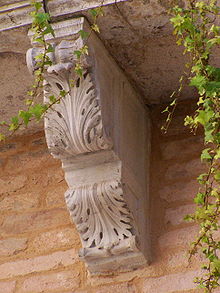
corbel (photo credit)

corbel (photo credit)

“Christopher went over to the fireplace and examined the maculated red marble surround. Even the corbels had been carefully crafted.” maculated: “marked with spots” and corbel: “an architectural member that projects from within a wall and supports a weight; especially one that is stepped upward and outward from a vertical surface.”

“Laura raised her head and looked through the architrave.” architrave: “the lowest division of an entablature resting in classical architecture immediately on the capital of the column; or the molding around a rectangular opening (as a door).” So she looked… through the doorway?

“Every compliment Simon collected seemed to bespatter Christopher’s own achievements with ordure.” ordure: “excrement; or something that is morally degrading.” Mmmm, a fancy word for poo.

“Gilt mirrors, brocade curtains and benighted oil paintings, yards of intricately patterned carpet, chandeliers and classical figures on columns, deeper an deeper, the rooms went on and on.” benighted: “existing in a state of intellectual, moral, or social darkness.” So the oil paintings are… not very good?

“The trees became monochrome as an eldritch dusk intensified.” eldritch: “weird, eerie.” Indeed!


What have you learned in your reading recently?

vocabulary lessons: Grizzly Years by Doug Peacock

If you’re interested: see other vocabulary lessons as well.


grizzlyUnsurprisingly, Peacock taught me a number of new words in this book, generally of the technical & outdoors variety.

“…grizzlies can walk lightly over a thin crust, distributing their weight evenly on their plantigrade feet…” plantigrade: “walking on the sole with the heel touching the ground.” Which makes sense, as Peacock later writes: “I squatted and traced the outline of the grizzly’s rear foot in the crusted mud. How humanlike it was.”

“Not a single tree decorated the lacustrine benches.” lacustrine: “of, relating to, formed in, living in, or growing in lakes.” A parallel to ‘riparian’, then?

“I dropped down to explore the little mountain, half evenly timbered, half steaming rhyolite and broken andesite.” rhyolite: “a very acid volcanic rock that is the lava form of granite”; and andesite: “an extrusive usually dark grayish rock consisting essentially of oligoclase or feldspar.”

“We passed two tiny azure tarns beginning to melt in the weak spring sunlight…” or “I wondered if anyone had ever visited those four lonely tarns.” tarn: “a small steep-banked mountain lake or pool.”

“High above, I saw the broad wings that had startled the bovid…” bovid: ” any of a family (Bovidae) of ruminants that have hollow unbranched permanently attached horns present in usually both sexes and that include antelopes, oxen, sheep, and goats.” I knew ‘bovine’, of course, but was thrown to see ‘bovid’ (here, referring to a mountain goat); I thought bovine meant cows, specifically. I guess this word is a little more inclusive.

“A spine of dolomite ran off the range of peaks and continued down the mountain as a bedrock ridge.” dolomite: “a mineral CaMg(CO3)2 consisting of a calcium magnesium carbonate found in crystals and in extensive beds as a compact limestone.”

“We set up our tent, locating it out of the wind on the carpet of Carex.” Carex: “a vast genus of almost 2,000 species[2] of grassy plants in the family Cyperaceae, commonly known as sedges.”

“On an island to the south, melanism has prevailed in a species of jackrabbit living among gray andesites and scabrous vegetation.” melanism: “an increased amount of black or nearly black pigmentation (as of skin, feathers, or hair) of an individual or kind of organism.”

“Grunion appear on the beaches of the northern Gulf from February to April after the big tides of the full moon.” grunion: “a silverside (Leuresthes tenuis) of the California coast notable for the regularity with which it comes inshore to spawn at nearly full moon.” Okay, but what is a silverside?? The “Concise Encyclopedia” entry, a little further down the same page, is more helpful: “Edible Pacific fish (Leuresthes tenuis) found along the western coast of the U.S. In the warm months, it lays its eggs in beach sand during a full or new moon when the tide cycle is at its peak. The young hatch and enter the ocean on the next spring tide, two weeks later. Grunion reach a length of about 8 in. (20 cm).”


What have you learned in your reading recently?

getting rich writing book reviews


Warning! Long post follows. Sorry.

I have found myself commenting several times lately on the richness of my hobby-and-part-time-job, of reading books and then writing about them. I thought it was time I put this into a coherent statement for you here.

I was always a steady reader, as a child, and through school. I always loved to read. (In one of those blogging memes that went around some time ago, a self-interview sort of thing, I was supposed to give my favorite book as a child. I couldn’t remember, so I asked my mom. Her response was something like, “are you kidding! There was a new one daily!”) As a new librarian, I took a readers advisory class that recommended keeping a book blog as one way of recording one’s reading for reference later on. And that’s how we got to pagesofjulia; and that in turn is how I was able to apply to write for Shelf Awareness, a year or two down the road.

So I’ve always been a reader. And I had some fine English classes (and other social sciences) that trained me to take notes while reading, and to look for themes, leitmotif, stylistic quirks, and the like. But only since becoming a book blogger and paid book reviewer have I really begun to hone the skills of close reading – not for a class assignment (I knew how to do that), but to record my personal reactions, or the qualities that a prospective reader would want to know about. (I also began reading with an eye as to how a book might be improved. But that’s a different topic. Perhaps.)

Another result of reading for the sake of writing about what I’ve read, has been the growing diversity of the books I pick up. My reading volume has increased, is ever increasing, and I need the variety to keep from getting bored. If I read nothing but thrillers, at the present rate, it would be difficult to say something new about each one. And I want to better serve my editor by contributing diverse material. But also, as my reading has expanded, so have my interests, which then expand my reading, and there we have the most delightful self-perpetuating cycle you could imagine.

In the past several years, I have read widely in fiction (lots of mysteries and thrillers, as ever, but a little romance, fantasy, sci fi, historical and literary fiction, classics, and some odd formats, outliers and oddities) and nonfiction (sports and nature, as ever, but also science, history, biography, essays, politics, journalism, and literary criticism). I have tended to read for what I can learn from the book, myself, but also with a wider readership in mind, so that I can write a sale-able review. And a magical thing has come of this wide reading diversity.

I have never learned so much, so richly, as in reading this way. I attended a very fine public high school with a highly regarded International Baccalaureate program, and then a college Honors program, from which I graduated summa cum laude. I have a master’s degree. But I’ve never experienced such an interdisciplinary curriculum as this: read eclectically. Take notes.

The area of my reading that has most surprised me is in science. I never considered myself as having a scientific mind, and I was generally lukewarm on science classes (with a notable exception for chemistry); but with such magnetic titles as The Drunken Botanist and A Garden of Marvels, and biographies of Rachel Carson and Hali Felt, not to mention Annie Dillard‘s breathtaking Pilgrim at Tinker Creek… well, I found it easy and even natural to grow in that direction. (As a flower toward the sun, if you’ll excuse the simile.)

And when I began reading more widely, and repeatedly reading in areas new to me – like science – I noticed another magical thing: I started recognizing concepts. I have written before on what I’m calling synchronicity, the seeming coincidence of discovering a newly learned fact or area of study again and again in a short time. The more I think about it, the more I think my friend Liz is right: it’s not that things actually come to me in threes, but rather that when I’ve recently learned something, I am more able to see it the next few times it crosses my desk (book, mind). These are opportunities to relearn a new concept or fact; and they are opportunities to cross-reference within other disciplines, to reinforce knowledge, to gain a fuller understanding of what a concept or a fact means in historical, cultural, political context.

One area in which I am not an expert is education (or educational theory or design), so I’ll try not to get too far off-track here. But I think we’re probably doing something wrong in our formal education system regarding interdisciplinary learning. I’ve never felt so richly instructed as I do by simply spending all the time I can find in reading, widely and with both eyes wide open. And while a steady diet of bodice-ripping romance novels or pulp might not do it, notice that I’m not recommending reading a bunch of scholarly works, or even all nonfiction. (And some pulp is always welcome, just as you can probably eat a few M&Ms alongside your healthy diet.)

Fiction has a great deal to offer: entertainment, yes, but also the opportunity to get inside someone else’s head, to understand their processes and motivations; or to travel to another time or experience another culture, and likewise to better understand the workings of that time or place or culture. And these are valuable lessons to learn for the important everyday work of being human: the ability to empathize, or to understand or even imagine the motivations of others, makes us better people. (There have been some studies on this. See for example the Guardian here and here.) Fiction is good: I’ve said this before.

To say that reading nonfiction is education is a much more familiar concept; you learn new facts from nonfiction, right? (We could actually argue over this point, but let’s not do it here and now.) But again, I think that reading lots – fiction or non – is far more than the sum of the parts, of having read all those individual books. The more you read, the more you learn, not only from what you’ve read, but from the combined and compounded effects of varied reading. I feel more intellectually stimulated now than I did in high school, college or graduate school. It’s not just that I read a lot of books; I read lots of different kinds of books. Some are silly or pulpy, but as I scan this list, I can’t pick out even one that didn’t teach me something. Some are weird (for example). But put them all together, and they make for a fine education.

Read eclectically. Take notes.

vocabulary lessons: The Fish in the Forest by Dale Stokes

If you’re interested: see other vocabulary lessons as well.


fish forestAs you know, I found the salmon’s story in The Fish in the Forest simply mesmerizing. I also learned a lot – and not just about salmon. Here are some vocabulary words I had to look up.

epiphytes attach to their host plants for support and as a means to reach more sunlight… but are traditionally classified as non-parasitic”: “There are epiphytic plants that grow on trunks and branches high in the forest canopy…”

relict, “a surviving species of an otherwise extinct group of organisms”: “The present salmon populations in the Pacific Northwest stem from relict populations that have been extant since the last ice age…” (I suspected a typo here for “relic” – this being a pre-publication proof edition, typos would not surprise. But no, I learned something new here. “Relict” is perfectly appropriate.)

trophically, “of or relating to nutrition”: “Even when not preying on salmon directly, humpbacks are linked to them trophically because they feed on fishes that compete with salmon for food.” Further explained a little later on within the book itself: “The troph in heterotroph and autotroph implies nourishment…” In other words, what we’re talking about here (in context) is organisms that are linked on the food chain, or the food web. They are trophically linked.(Another that looked like a possible typo; except that “tropically” would have made no sense in context!)

collocate, “to occur in conjunction with something”: “The other two races have overlapping ranges along the coast but seldom interact or collocate.”

semelparous, “reproducing or breeding only once in a lifetime” (or, to put it more bluntly, once they breed, they die): “Their life history of anadromy and semelparity transports millions of tons of salmon flesh into nutrient-poor freshwaters that then shape the entire Salmon Forest.”

gestalt, “the general quality or character of something”: “All living things possess a unique gestalt…”

I had previously come across the concept of anadromy (I don’t recall where) and looked it up (defined: “ascending rivers from the sea for breeding”); but finding it repeatedly in this book made me curious about the pronunciation of anadromous: “…the critical return to freshwater to spawn is called an anadromous life history…”

I like a good vocabulary lesson alongside a fine reading experience – don’t you? Or does reaching for the dictionary frustrate you?