a few short pieces


“A Shirt Full of Bees” by Bill McKibben

My father sent me a copy of this essay, but it’s not shareable under copyright restrictions; and I couldn’t find a publicly accessible version I was happy with. I’m sorry. If you can track down this issue of Utne Reader, through your local library for example, you can read the article yourself.

How strange the way things come together. I’ve just recently been enjoying Annie Dillard’s Pilgrim at Tinker Creek; and my favorite parts of that book are her in-depth, lengthy examinations of parts of nature. One of those subjects she gets good and lost in is newts. And here is Bill McKibben, opening “A Shirt Full of Bees” with an episode starring Terry Tempest Williams (When Women Were Birds; I also loved her Pieces of White Shell) and a newt. Williams crouched on her haunches for half an hour examining the newt, “lost in the world of the newt” in McKibben’s words, and he found himself bored, restless, ready to keep walking, to reach the summit – something we do constantly, of course. And then, on another day, he steps on a yellow jacket nest, and as he erupts in hives and dashes down-mountain for medical aid – “My dog was the best dog I’ve ever had, but I doubted she was up to surgery” – McKibben sees more clearly the beauty around him. That’s the larger point in this short essay: we are always pushing for the summit, and too busy to examine the newts on our path. As I observed in Oil and Honey (the only one of his books I’ve read; but my father is rather an expert), McKibben is a gifted writer. He pulls together two anecdotes – his walk in the the woods with Williams and the newt; his walk in the woods with his dog and the yellow jackets – in a lovely, poignant, meaningful, beautifully written and well-structured essay of three pages. This is the goods, right here.


“Confessions of a Recovering Environmentalist” by Paul Kingsnorth

Pops reminds us that Kingsnorth was the author of “Dark Ecology” that I discussed back in January. This latest is available here.

Kingsnorth opens charmingly with recollections from his youth, ages 12, 19, and 22, in natural settings. These are the experiences that taught him to love “the other-than-human world.” He became an “environmentalist,” that radical thing. And now he laments what “environmentalism” has been bastardized into: a quest for zero-carbon emissions, for alternative energy sources, for sustainability – all good things, doubtless, except that “sustainability,” he argues, is code for finding a different way to do the same things we do now. In other words, we need to release less carbon, so we need to find another energy source so that I can still have my lights and electricity and drive my car and buy my cheaply made clothing at the mall. He points out that we seek a way to sustain our lifestyle – not to sustain the earth, which is sort of what we claim to be seeking. And of course there is the central, painful irony, that “the farmers are being edged out by south-country refugees like me, trying to escape but bringing with us the things we flee from.” He even addresses the touchy subject of “industrial wind power stations (which are usually referred to, in a nice Orwellian touch, as wind ‘farms’)” which McKibben has also struggled with. Are “wind farms” environmentalist?? There is an argument.

Kingsnorth is clever in his criticisms: “these days I tend to consider the entire bird with a kind of frustrated detachment” (that is, the oft-cited bird that has a left wing and a right wing), with which I certainly sympathize; “the colonization of the greens by the reds” characterizes all those myriad left-wingers (“disillusioned socialists, Trots, Marxists, and a ragbag of fellow travelers who could no longer believe in communism or the Labour Party or even George Galloway…”) who’ve taken over his movement. But don’t let his wittiness distract you from the fact that he is right. Again ironically, the problem seems to lie in the success of the “green movement”: save-the-planet is now a perfectly respectable, mainstream concept that you can now find on 3 out of 4 cereal boxes, and that bringing of Kingsnorth’s environmentalism into centrist politics has weakened it, watered it down, naturally, as centrism does.

Like the earlier Kingsnorth piece I read, this one gives quite a dark view in examining “environmentalism.” But like that other pessimistic-or-realistic writer, Derrick Jensen, I see his points, and I’m rather more inclined to follow him than I am to follow McKibben’s optimism.


“A Tough Flower Girl” by Phillip Connors

I am not yet done following Phil Connors. This is not a new piece, but one I’ve had to reread now that I am an affirmed follower of Norman Maclean. Connors’ article is available here.

Another fine piece of writing: Connors explores what we find so moving, timeless, and important in Maclean, but he also creates a piece of art in its own right. This short article is an excellent introduction to Maclean, in his best-known A River Runs Through It (and the two accompanying stories), in Young Men and Fire (better-loved, I think, by both Connors and myself), and in The Norman Maclean Reader (imperative for those of us left wanting more by the first two). It is an incisive piece of literary criticism and appreciation; but it also includes a personal story, as Connors opens by pointing out his biographical similarities to the great Maclean. If it is indeed “uncool to admit an enthusiasm based in part on biography”, call me uncool. Not that I share biographical parallels with my literary idols (ha), but I certainly consider their biographies integral to my appreciation. Funnily, I have just finished searching for a good Maclean biography, and am disappointed by the lack. Somebody please write this book. Phil?

Read this article because it says true things about an amazing writer, but also because it is in itself a sparkling, crystalline beauty.


“Smoke” by Phillip Connors

A new piece from Connors, available here.

I am reminded of how much I love Connors’ voice, that he isn’t afraid to have one, first of all, and that he is both intellectual and casual in it. He acknowledges that “self-quotation is a dishonorable habit, but it sounds a little smug to say I saw it coming and leave it at that,” and so he self-quotes from Fire Season, that book I loved so much, in which he predicts that “the big one” is coming. “If you live on a peak in fire-prone country, as I do every summer in the Black Range of New Mexico’s Gila National Forest, the big one will eventually come for you.” This very short piece is the story of that fire beginning, and beginning to be fought, and its victory: it burned over two hundred square miles, just this past summer of 2013. There is always a conflict in considering these events. Fire is nature, a natural part of a forest’s life cycle, healthy. But we the human influence have thrown that cycle off until the fires we finally earn and reap are less healthy for the world we’ve come to love, and that’s part of the tragedy that Connors has to share. He ends this piece, appropriately, on a conflicted, hopeful, tragic note. At least he has those memories.

I’m looking forward to the next book that he is reportedly working on now.

remarkable bits from Pilgrim at Tinker Creek

Correct: we are still not done with Annie Dillard. I may have to make her a tag as I have done for Abbey and Hemingway. (…Haven Kimmel, Norman Maclean…)

EDIT: here we are.

On top of my reviews, I felt the need to share some of my favorite lines and passages with just a few notes. Enjoy.

There are seven or eight categories of phenomena in the world that are worth talking about, and one of them is the weather.

One wonders very much what else would make her list!!

I want to think about trees. Trees have a curious relationship to the subject of the present moment. There are many created things in the universe that outlive us, that outlive the sun, even, but I can’t think about them. I live with trees. There are creatures under our feet, creatures that live over our heads, but trees live quite convincingly in the same filament of air we inhabit, and in addition, they extend impressively in both directions, up and down, shearing rock and fanning air, doing their real business just out of reach. A blind man’s idea of hugeness is a tree. They have their sturdy bodies and special skills; they garner fresh water; they abide. This sycamore above me, below me, by Tinker Creek, is a case in point; the sight of it crowds my brain with an assortment of diverting thoughts, all as present to me as these slivers of pressure from grass on my elbow’s skin.

I loved this because I, too, love trees; and this is a well-articulated (but still rather charmingly airy, too) explanation why. Also, I enjoy Dillard’s use of the semi-colon, my personal favorite punctuation mark. (Yes. I’m a librarian and a reader and writer. I have a favorite punctuation mark.)

My God, I look at the creek. It is the answer to Merton’s prayer, “Give us time!” It never stops. If I seek the senses and skill of children, the information of a thousand books, the innocence of puppies, even the insights of my own city past, I do so only, solely, and entirely that I might look well at the creek.

“It never stops.” Golly, I hope she’s right. Climate change has us receiving too much rain here and not enough rain there; the forests are burning; the glaciers are melting; I fear the creeks are stopping (and starting up elsewhere). But in 1974, I can understand this thinking.

I suspect that the real moral thinkers end up, wherever they may start, in botany.

This, too, is charming: a nerdy confirmation of the power of trees and other green things (and non-green things as well).

John Cowper Powys said, “We have no reason for denying to the world of plants a certain slow, dim, vague, large, leisurely semi-consciousness.” He may not be right, but I like his adjectives. The patch of bluets in the grass may not be long on brains, but they might be, at least in a very small way, awake.

Who is Dillard to say that he may not be right? Goodness, with all the time travel and metaphoric “patting the puppy” she gushes and coos, why not let trees have a certain semi-consciousness? And those complaints aside, does anyone else hear the Ents walking through those lines? Lovely.

All the green in the planted world consists of these whole, rounded chloroplasts wending their ways in water. If you analyze a molecule of chlorophyll itself, what you get is one hundred thirty-six atoms of hydrogen, carbon, oxygen, and nitrogen arranged in an exact and complex relationship around a central ring. At the ring’s center is a single atom of magnesium. Now: If you remove the atom of magnesium and in its exact place put an atom of iron, you get a molecule of hemoglobin. The iron atom combines with all the other atoms to make red blood, the streaming red dots in the goldfish’s tail.

And that blows my mind: a scientific, tiny-scale, real-life confirmation, like a metaphor but grounded in reality on the molecular level, of our intricate connection as living, breathing, animal things to living, breathing green things. I love that.

vocabulary lessons: Pilgrim at Tinker Creek

Annie Dillard had me quite active with my note-taking for later looking up. I have included only the highlights here for you.

anchorite: “An anchorite’s hermitage is called an anchor-hold; some anchor-holds were simple sheds clamped to the side of a church like a barnacle to a rock. I think of this house clamped to the side of Tinker Creek as an anchor-hold.”

discalced: “[The effort to] gag the commentator, to hush the voice of useless interior babble that keeps me from seeing… marks the literature of saints and monks of every order East and West, under every rule and no rule, discalced and shod.”

spate: “I live for… the moment when the mountains open and a new light roars in spate through the crack, and the mountains slam.”

oriflamme: “The flight [of a flock of starlings] extended like a fluttering banner, an unfurled oriflamme…”

sonant and surd: “The wind shrieks and hisses down the valley, sonant and surd…”

scry: “…I had better be scrying the signs.”

eidetic: “…we have feelings, a memory for information and an eidetic memory for the imagery of our own pasts.”

obelisk: “We run around under these obelisk-creatures, teetering on our soft, small feet.” (She’s referring to trees.) and, 20 pages later: “A tree stands… mute and rigid as an obelisk.”

pavane: “An even frailer, dimmer movement, a pavane, is being performed deep under me now.”

neutrinos: “I imagine neutrinos passing through [a bird’s] feathers and into its heart and lungs…”

racemes: “Long racemes of white flowers hung from the locust trees.”

a two-for-one, etiolated and lambent: “The leaf was so thin and etiolated it was translucent, but at the same time it was lambent, minutely, with a kind of pale and sufficient light.”

eutrophic: “The duck pond is a small eutrophic pond on cleared land…”

phylactery: “…the microscope at my forehead is a kind of phylactery, a constant reminder of the facts of creation that I would just as soon forget.”

cofferdam: “…pouring wet plaster into the cofferdam…”

stet: “If the creature makes it, it gets a ‘stet’.”

shmoo: “Generally, whenever he was out of water he assumed the shape of a shmoo…” (referring to a muskrat).

enow: “The Lucas place is paradise enow.”

lorn: “A bobwhite who is still calling in summer is lorn…”


See other “vocabulary lessons” posts here.

Pilgrim at Tinker Creek by Annie Dillard, part the second

pilgrimattinkercreekI’m afraid I am continuing with my mixed feelings here, as in my first review. Pilgrim at Tinker Creek, for me, comes in sections, or in three parts. As I wrote, the early bits were difficult for me, a little too metaphysical and spiritual. And then, remember how I said that chapter 7 blew me away? Well, chapter 8 is even better.

Chapter 8 is entitled “Intricacy,” and addresses the amazing, extraordinary intricacy, complexity, tiny detail and huge scale and huge scale of tininess in the natural world. Dillard relates statistics that are mind-boggling: “the average size of all living animals, including man, is almost that of a housefly.” “There are… two hundred twenty-eight separate and distinct muscles in the head of an ordinary caterpillar.” “Six million leaves on a big elm.” She writes about the Henle’s loop in the human kidney, the lower lip of the dragonfly nymph. Tiny, infinitely complex things that make our world so strange. She uses this phenomenon to explore the idea of a creator – and here Dillard and I will disagree a little, but that’s okay. “Look… at practically anything… and see that not only did the creator create everything, but that he is apt to create anything. He’ll stop at nothing.” She takes the strange and prolific nature of our world to be proof of a creator – “no claims of any and all revelations could be so far-fetched as a single giraffe” – and I don’t. It’s all right, though; this book is plenty safe for atheists; she’s not preaching. She’s just exploring. And I love the science, all that tiny tiny trivia, the explanations of the human kidney and the aquatic horsehair worm.

Next is chapter 9, “Flood,” and here I am going chapter by chapter – that’s how good this book is. “Flood” addresses Hurricane Agnes, and hurricanes are something we’re increasingly familiar with, not only in Houston but in New York City these days as well. (Which leads me to point out that Dillard is blissfully unaware of climate change and ecological collapse; happy her in 1974.) There is more of what I love in Dillard: detail, observation, science, and a glorious, joyful celebration of the world.

And then it falls off again, descending (or ascending, depending on your feelings) into the spiritual once again. My level of detail falls off here, too, because what can I say? I paid less attention when she zoomed back out into the mistiness. The last few pages of this book were an effort, and I didn’t retain anything I can tell you about now.

Verdict? Rather a difficult one. Liz said, great, I’ll just read those middle chapters! But of course that’s no way to go unless you know your tastes are mine.

I am glad I read this book; it yielded some inspirational moments and great quotations (as you will see). But those came overwhelmingly from the middle portion of the book. Others, I have no doubt, will swoon over the “patting the puppy” and the tree with the lights in it. Discover for yourself; but I do think it’s worth the effort, in the end. If I were to do it again, I would just read the middle parts. Rather like Walden, then, in my final conclusions – just as I thought at the beginning.


Rating: in an attempt to be fair, 6 mushrooms.

Pilgrim at Tinker Creek by Annie Dillard, part the first

Clearly I will need to publish this review in two parts, for the sake of your patience with my long-windedness. Actually I fear three posts. This is a fascinating book about which I have mixed feelings and many tangential thoughts; also at about halfway through, I’ve filled three bookmark slips of paper with notes rather than the average one-or-less-per-book, so there you are. This is my review of roughly half the book.


pilgrimattinkercreekDespite a promising beginning, I am not sure that I love Annie Dillard as much as do many of my favorite authors. Odd, that. In fact, I enjoyed Christine Byl’s Dirt Work far more. And she hasn’t won any Pulitzers (yet).

For one thing, there is too much theology for my taste, and too much metaphysical rambling metaphor: seeing visions, entering the past and seeing the future. Too much philosophy, man’s (“man”! too much “man”! 1974 this was published, by a woman, and still the universal creature is “man” rather than person or even woman for goodness’ sake) …man’s self-consciousness, relativism… and not enough just being. I’d rather spend more time in the picture and less time examining the frame and the picture-maker, if the picture is our world.

Wikipedia brought some interesting thoughts to mind. [I take Wikipedia with salt; but I still find it a useful starting point for general knowledge.] For example: “The author has described [Pilgrim at Tinker Creek] as a ‘book of theology’, and she rejects the label of nature writer.” What is up with people “rejecting the label of nature writer”? Edward Abbey did, too, which rejection I think in turn his readers reject. Of course, Dillard’s point – that this is more theology than nature writing – helps explain part of my problem with it. But then, there is excellent nature writing within it: I love the finely detailed discussion of insect habits. Oh, and while we’re mentioning him: “Edward Abbey in particular deemed [Dillard] Thoreau’s ‘true heir’.” Both these quotations from Wikipedia come sans specific reference, although there’s a solid-looking reference list at the end of the article. So, take that with salt, as I said.

Dillard did remind me of Thoreau, which is both a compliment (obviously) and a qualification, for me personally, as I struggled a little with Walden, too. Walden was apparently the subject of Dillard’s master’s thesis, so we can expect some parallels there. I would call these two books a readalike pair, and recommend the one if you liked the other.

Now, on the Annie Dillard Wikipedia page, I found more useful phrases: “one critic… call[ed] her ‘one of the foremost horror writers of the 20th Century'” for her apt descriptions of the natural world (I imagine that critic had the mating practices of the praying mantis in mind!), which I find delightful, and true in a most positive sense. And “In The New York Times, Eudora Welty said the work was ‘admirable writing’ that reveals ‘a sense of wonder so fearless and unbridled… [an] intensity of experience that she seems to live in order to declare,’ but ‘I honestly don’t know what [Dillard] is talking about at… times,'” which is, again, a great way to put it, and I couldn’t agree with you more on all counts, Ms. Welty. Both these quotations are attributed, by the way: the first, to Dillard’s website, and the second, to the NYT review in question. Not attributed, however, is the assertion that “In 1971 she read an old writer’s nature book and thought, ‘I can do better than this.'” This would seem to belie the phrasing of the Wikipedia Pilgrim article that she “rejected the label of nature writer.”

But oh, then I got to chapter 7, “Spring.” I am entranced! She writes about learning languages and yearning to decode birdsong, about the mockingbird that sings from 2am til 11pm in her chimney in springtime; about newts, to whom “no one pays the least attention… except children”; more about trees (I love it); and then the part about the duck pond, which is hilarious, wise, and again hilarious. This is where we meet the plankton about whom she is rather passionate, and she studies them under the microscope.

I don’t really look forward to these microscopic forays: I have been almost knocked off my kitchen chair on several occasions when, as I was following with strained eyes the tiny career of a monostyla rotifer, an enormous red roundworm whipped into the scene, blocking everything, and writhing in huge, flapping convulsions that seemed to sweep my face and fill the kitchen.

Rather, she does it as a “moral exercise”, because “if I have life, sense, energy, will, so does a rotifer.” In chapter 7, I love this woman and this book. It was in chapter 7 that I got up from my lunch – during my lunch break, I walked away from lunch – to find Liz, who was on duty at the reference desk, to read her a page aloud. (That was the page about the duck pond and the frogs.) So along with my complaints, there is much to love in this book. Take for example the section on the mating habits of the praying mantis: Dillard portrays these practices as horrifying, hilarious, and disturbingly like our own; it is a feat. I think I like her best when she digs into the science and minutia of the natural world, and exclaims in joy, fear, disturbance, or wonder at it. In other words, when she is a nature writer (wink).

Stay tuned for my review, part the second, and we will all find out together what my final feelings for Dillard will be.

book beginnings on Friday: Pilgrim at Tinker Creek by Annie Dillard

Thanks to Rose City Reader for hosting this meme. To participate, share the first line or two of the book you are currently reading and, if you feel so moved, let us know what your first impressions were based on that first line.

pilgrimattinkercreek

I have come across Annie Dillard’s name in enough nature writings I’ve enjoyed – fiction and non – that it’s definitely time to find her myself. I’ve started with her Pulitzer Prize-winner, Pilgrim at Tinker Creek. I’m including the whole first paragraph here because I felt it necessary:

I used to have a cat, an old fighting tom, who would jump through the open window by my bed in the middle of the night and land on my chest. I’d half-awaken. He’d stick his skull under my nose and purr, stinking of urine and blood. Some nights he kneaded my bare chest with his front paws, powerfully, arching his back, as if sharpening his claws, or pummeling a mother for milk. And some mornings I’d wake in daylight to find my body covered with paw prints in blood; I looked as though I’d been painted with roses.

Evocative, isn’t it, the idea of this woman naked, painted in bloody cat prints like roses? Poetic, a little shocking. I like this as a beginning; it certainly gets one’s attention. This is, incidentally, the image referenced in my recent (new favorite) read, Dirt Work: Christine Byl called this a “lyric” defining “wild”. So that’s an auspicious start. Stay tuned.

Dirt Work: An Education in the Woods by Christine Byl

dirt workChristine Byl opens her memoir with the pleasant scene of herself and three fellow crew members, crusty and dirty, having a post-hitch beer at a small-town Montana bar. A young woman approaches and asks how she keeps up with the boys, one of whom volunteers that it’s all they can do to keep up with her.

She then backs up and tells the story of how she got there. Like many young women in our culture, Christine was expected and expecting to go to college, to do cerebral work and keep her hands (literally) clean; but a summer gig held her, and she reveled in physical challenges, in learning new things, in the mechanical world. Eventually she reveled in her hardening muscles and her expertise, in surprising men with her ax-work and in mentoring other young women coming up in the “matriarchy” of trail work (still predominately male) within Glacier National Park.

After six seasons in Glacier, alongside boyfriend and eventual husband Gabe (a delightful character: mostly off screen, but clearly a capable young man in his own right, and clearly happy to stay lovingly out of Christine’s way), she does return to graduate school, in Alaska. But during the summers she still works on building and maintaining trails, this time in Denali. Christine and Gabe come to love Alaska – yes, even the winters: there is a delightful passage arguing that the light summers are in some ways harder than the dark winters, and I made both my parents (recently moved from the Mexican to the Canadian border) read it. They settle a few miles outside the borders of Denali National Park, and Christine finds a balance between the cerebral – she gets an MFA in fiction, and writes this beautiful book; and the physical – she and Gabe now run their own independent trail-building company.

So many things to love in this book; where to begin? As a sometimes volunteer trailworker myself, I don’t pretend to know 2% of what Christine does; but I might know just enough to appreciate what she loves about it, and what a challenge it can be. I still haven’t mastered the efficient, all-day ax swing myself, but I’d like to. Also, I have a friend named Susan who I’ve written about before, who has a great deal in common with this author. (I briefly wondered if “Christine Byl” was a pseudonym.) Susan, like Christine and apparently like many trail workers, has an advanced degree but chooses to labor for a living; she’s a woman in what is clearly a man’s world, and is half of an independent trailbuilding company. I get the impression that while it’s hard work, Susan and her husband Ryan wouldn’t do anything different.

Christine writes beautifully about the phenomenon of choosing to do physical work when she could be keeping her hands soft. She writes about the well-intentioned questions her family asked, about when she was going to get a “real job”: she says that they have confused happiness with orthodoxy. (I can only imagine how many of us can sympathize with that concept!) She writes about the “sorority” of men in trailwork, and the way that pulls women together; she writes about the pride she feels when upending male expectations of her blonde head and small frame. As a writer, and clearly a gifted one, she structures this book as solidly as she would a bridge or retaining wall. Each of 6 chapters is represented by a tool (axe, rock bar, chainsaw, boat, skid steer, shovel), a location (North Fork, Sperry, Middle Fork, Cordova, Denali twice) and a locale (river, alpine, forest, coast, park, home). Within those chapters she roves and rambles, musing on natural phenomena, social relations, her own body and personality, strengths and shortcomings, and then returns to tool and place to ground herself. The structure of this book, then, is both well-anchored and floating, and I found that it worked very well.

I was charmed by Christine Byl’s honesty; her love of place; her range of experiences and understanding of two worlds, that of universities and that of woods; and of course her lovely writing. She’s hard as nails, with two hernia surgeries and a preference for outhouse over indoor plumbing. She’s brash and can tend towards a loud and dirty mouth (that makes two of us), but she’s got a soft core. I like her; I’d like to be her friend, and of course I’d really love to learn from her.


Rating: 10 pulaskis (my personal favorite trailwork tool).

I fear I’m getting out of control with the perfect-10 ratings, friends, but what can I say: it’s been a great year for reading. I will take a little of the credit, in that I think I’m getting better at picking what I’ll like, and not wasting time on what I won’t. But mostly, wow, there are some amazing books out there!

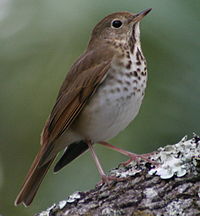
the hermit thrush

My parents have recently moved from Houston to northern Washington state, a scant 20 miles from Canada. Pops wrote me an email the other day which I will share in part, with some locations redacted…

First, I’ll remind you the ringtone I assigned your number on my phone is the Hermit Thrush.

Today I rode a big loop out —- and back along the shore of —-; as I rode a quiet back road bordered by forest, I was climbing a moderate hill at a steady pace, but slow enough on a low-wind morning to enjoy near silence, hearing & seeing detail in the woods as I passed; it was then that the Hermit Thrush sang out as your text came in; and I swear I heard a thrush answer in the forest!

That’s happened before, back in Texas, with the Tufted Titmouse assigned to your mother – but there are no Thrushes in Texas; I haven’t yet determined if the thrush we hear around town here is the Hermit or one of the others. The book makes it hard to tell the difference; but somebody out there liked it today!

I commented that that must be a very high-quality ringtone!

from here

from here

The ringtone is an actual recording of a bird; the small speaker of a phone is naturally more effective with high pitched sounds, like bird songs, so it really is natural sounding and projects well from my jersey pocket.

One way researchers “search” for rare birds is to play recordings of their songs & calls and listening for a response, so we shouldn’t be surprised this works.

Indeed – and that makes sense; but still, who’d have thought? And by the way, according to this range map, the hermit thrush is in fact quite likely to be in my dad’s new neighborhood.

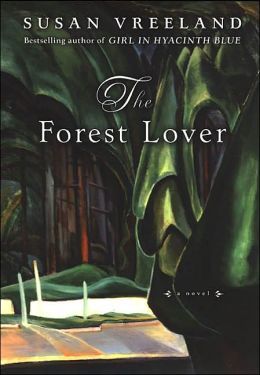
So why I am sharing this on my book blog? Well, I continue to be struck by the episodes of coincidence (if you like) or of synchronicity that inhabit my life, my world, and my reading (and cross over from my reading into my “real” world). The final page of the book I reviewed yesterday, Susan Vreeland’s The Forest Lover, made me think of my father, because it made reference to the song of the hermit thrush:

A hermit thrush spilled one long crystalline note, stilling all the earth to listen, and then poured out an ethereal flute song, over too soon. She closed her eyes, waited. Again, that purest of tones, long-held, chillingly beautiful, and then the cascade of melody like a tumbling stream. A spirit song. For her.

If she could sing like that thrush, what would she sing?

[You can listen to its song here, thanks to the Macaulay Library at the Cornell Lab of Ornithology.]

The next paragraph references, among other trees, the Douglas fir, another species belonging to my parents’ new habitat and appreciated by them. It just goes to show that life really does imitate art, and/or the reverse, and that that’s as it should be.

The Forest Lover by Susan Vreeland

forestloverWhat a lovely book. I recently read and enjoyed Scott Elliot’s Temple Grove enough that I attended to his “Note on Sources,” and requested several from my local library. This was one of those – aided by my enjoyment of Vreeland’s Girl in Hyacinth Blue and Clara and Mr. Tiffany.

Like those two of her books, this is historical fiction dealing with a female artist. [Also think of Tracy Chevalier’s Girl With a Pearl Earring.] The three historical periods, geographic locations, and women in question are quite diverse, but there is a very clear thread connecting them all as female, artists, and historical; I appreciate that showing of diversity in her subjects and also of a singleminded interest. I am safely a Vreeland fan now. Fairly naturally, considering that they deal with female artists of earlier times, her books also address women’s struggle for independence.

Emily Carr, like the subject of Clara and Mr. Tiffany, is a real-life historical figure about whom we don’t know everything; this is a fictionalization of her life. She was born in British Columbia in 1871 to British parents. She showed an inclination for sketching and painting early on, which hobby was encouraged by her father at first, but he expected her to grow out of it in favor of more womanly pursuits (like marriage), and she didn’t. We meet Emily or “Millie” when she’s struggling to make ends meet and trying not to depend too much on the trust fund she shares with 4 sisters, teaching art for a living and befriending local Native Canadian Indians. The sisters mostly do not approve this association. Her favorite subjects are natural scenery and native people and their lifestyles; she travels to islands and outposts for these subjects; again, this is not appreciated by her family. She does enjoy some good female companionship, though: Sophie is an Indian woman and fellow artist (a basketmaker) who befriends her in broken English; Jessica is a less adept painter but rather saucy lady friend; Alice is her “good” and friendly sister; and after Emily musters the courage to travel to Paris to study the “new” art (see below), she meets fellow painter Fanny, a New Zealander and kindred soul.

To give you an idea of the Paris of Emily’s experience, as a moment in time, I share these lines.

“Van Gogh’s been in his grave for twenty years, Cezanne for four, yet art collectors still don’t buy them, and despise what’s new now.”

“What is new now?”

“Their offspring. Léger, Picasso, Braque, Matisse, Modigliani, Derain, Rouault. Many directions.”

Momentous times, then!

Back in Canada, Emily ages as we watch her struggle with art and life. She wants desperately to represent the native people’s lives and art, and the powerful forest surrounding her. Or, as she comes to learn, she wants to more than represent or copy: she wants to communicate what these things make her feel. Her study in Paris under various teachers advances her practice, but still doesn’t get her there. We follow Emily through a series of lifestyles and decisions that form a crooked path but ultimately continue to move her toward a higher form of the art and communication she desires.

There is one man who begins to be a love interest for Emily; but as the title implies, she finds herself unable (for various reasons) to participate in physical, person-to-person, romantic or sexual love with this man. She is not the forest’s lover in a carnal sense – this book is not that weird. And Emily does continue to relate to people. Jessica and her sisters, and most importantly Sophie, retain a hold on her heart; and she forms a new (platonic) relationship with a damaged white man who understands Indians better than whites. But in a very real way, her relationship with the natural world is the most magnetic in her life.

I often observe that I like an author’s earlier (or lesser known) work better than the later. (I hope this is not just me being contrary. I don’t think I do it on purpose.) In this case, though, I think my favorite of her books is still her most recent, Clara and Mr. Tiffany. The earlier two I’ve read are both wonderful; but I sometimes felt this showed its earlier origins. It is occasionally less graceful. While she is mostly “on,” there are some awkward phrases, too. Observe these two single sentences, on two facing pages. I find one smoothly appealing, and the other a bit effortful.

Emily felt as if smelly white scum had eked out her pores.

versus

A breeze shifted the ends of foliage, like the tips of fingers moving.

Do you make the same observation I do? (Which one is which?)

Criticisms aside, though, this novel is far more graceful than not; and while I could pick apart lines like the one above, the sum of its parts is glorious. Vreeland’s greatest strengths are those I recognize from her other books. She understands art, and the artist’s struggle to get it just right. She addresses women’s issues compassionately as a natural part of the story of one woman in history. And unique to this work, the natural world and its beauty, value, power, importance, and scale play a deservingly large role.

Another success for Susan Vreeland.


Rating: 8 smears of viridian.

Teaser Tuesdays: Dirt Work by Christine Byl

Teaser Tuesdays is a weekly bookish meme, hosted by MizB of Should Be Reading. The idea is to open your current read to a random page and share a few sentences. And try not to include spoilers!

dirt work

I am very much excited about this relatively new memoir by a female trailbuilder with experience working for the Parks and Forest Services in Montana and Alaska. It looks to have a good combination of nature writing, memoir, and women’s issues. I have already found several noteworthy passages; but I had to choose…

[If you want a clue about a person’s work]… look at her hands. I trust dirty fingernails. I am drawn to people with that half moon, the sliver of filth that indicates kinetic expertise. Perhaps they do fieldwork – ratty truck, weathered tools. Are they teachers, the ones who kneel next to kids examining earthworms in mud? Potters, naturalists, firefighters, farmers: dirt is a secret code, dusty knuckles the special knock of a fraternal order. I trust this small sign because it implies a tangible relationship. To get dirt under your fingernails, you have to touch the world.

So, yes, lovely writing to boot. Stay tuned for my glowing review.