Teaser Tuesdays: John Muir and the Ice that Started a Fire by Kim Heacox

Teaser Tuesdays is a weekly bookish meme, hosted by MizB of Should Be Reading.

muir ice

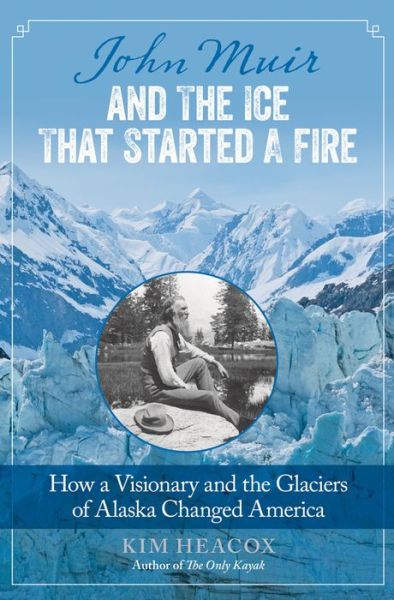
You know I couldn’t pass up a history of John Muir and his role in creating the American conservation movement! I am learning a lot, and not only about Muir and glaciers.

Today’s demographers have estimated that of the roughly 110 billion people who have lived on earth the last 50,000 years, only a small fraction have achieved age fifty and beyond; of those, half are alive today. In other words, Muir was already the beneficiary of a relatively long life.

…although of course, being Muir, he did not go gently into that good night. I am not surprised at these numbers but had never considered such a thing; it’s a little boggling, isn’t it?

This quotation comes from an uncorrected advance proof and is subject to change.

book beginnings on Friday: Turtle Island by Gary Snyder

Thanks to Rose City Reader for hosting this meme. To participate, share the first line or two of the book you are currently reading and, if you feel so moved, let us know what your first impressions were based on that first line.

turtle island

I’m a little out of order, as I’ve reviewed this book already. But for further musing and perspective, I want to share with you a piece of the “Introductory Note” that explains its title.

Turtle Island–the old/new name for the continent, based on many creation myths of the people who have been living here for millenia, and reapplied by some of them to “North America” in recent years. Also, an idea found world-wide, of the earth, or cosmos even, sustained by a great turtle or serpent-of-eternity.

…Anglos, Black people, Chicanos, and others beached up on these shores all share such views at the deepest levels of their old cultural traditions–African, Asian, or European. Hark again to those roots, to see our ancient solidarity, and then to the work of being together on Turtle Island.

I collected turtles in high school. Stuffed, carved, as pendants and pillows. It’s the animal I chose as my own somehow. They still resonate; I don’t have all those turtles any more, but I’ve kept a small group of small ones, which turn out to be (by coincidence? I doubt it; but not on purpose) to be crafted from natural materials: stone, wood, shell. I feel at home here.

Turtle Island by Gary Snyder

turtle island

You all may recall that I am NOT a poetry person. I may be a tad too literal; I loved Shel Silverstein but never graduated from there. Clearly it didn’t help that I attempted Gertrude Stein later in life; her poetry is analogous in my mind to modern abstract art. Either I am a hopeless moronic philistine, or these people are making fun of us to our faces with some of this stuff.

So how did I end up here? I didn’t do my homework. I had heard enough good about Gary Snyder from people I respect for long enough that I finally jumped on a title somebody referenced: Turtle Island. I requested it from my local library. (I LOVE this service.) I went to pick it up when they told me to; and sure enough, on the cover, “Pulitzer Prize for Poetry 1975.” Well, heck, I’ll give it a whirl. (Pops and I are planning a readalong of a Snyder essay collection, Practice of the Wild, coming up, so I’ll get the prose, too.)

Snyder’s poems are short – rarely over one page (in a small format book), and often shorter. They tend towards the natural world and our relationship with it, and these of course were the subjects I was looking for. He’s really pretty accessible – for a poet. I don’t follow the stream-of-consciousness sort of thing very well, but I tried to just let his words float over me when I lost the thread. To mix a metaphor.

I liked several quite well. “Control Burn” (not “controlled”) has a clear message, and one I can get behind; and it read fairly straightforwardly. [Actually, as I look again, it would make for a very coherent sentence if you just took out all the line breaks and added a little punctuation. Look at that. I like poetry when it most resembles prose. sigh] I liked “The Call of the Wild” for its message as well; I appreciated a list of “Facts” (including “General Motors is bigger than Holland.”) but again that’s cheating: it is not a poem. Is it? Hm. If a list of facts can be a poem, maybe I’m a little better off than I thought. “The Wild Mushroom” is a more traditional poem with a recognizable meter, and it rhymes! (I am a philistymes.) It could also serve you as an abridged guide to which wild mushrooms are edible, which poisonous and which might “bring you close to God”; utility in poetry is always welcome, yes please.

“Mother Earth: Her Whales” is a lovely ode to all the earth’s inhabitants and indictment of what we’re doing here. And I love the tale of an ancient turquoise ring from Jemez discovered under the ruins of an apartment complex in Kyoto: “The Jemez Pueblo Ring.” I also like when he writes about his family, mostly his young sons; his tenderness shows clearly through.

But naturally, for me, things really get good when he switches to “Plain Talk” (the final one of the book’s four main sections), which is also known as “prose.” Here Snyder identifies problems with our world – we’re talking about the big problems, like population, pollution, and consumption – and recommends big fixes – with actions organized by social/political, community, and “our own heads.” He is concerned with the relationship of humans to the rest of the world: water, earth, dirt, plants, animals, mountains, air. His prose arguments are beautiful, well thought out, well informed (although brief), and resonate with me perfectly. I suspect that they assume certain things (bison on the plains are a good thing. our kids should play in the dirt) that not everyone agrees with; but I’m on his frequency. The people who think the big car, the big house in the big city, kids who wear designer sneakers, and the fancy career are important goals may not follow along here.

Snyder’s philosophies strike me as abundantly obviously correct, but also (sadly) far too simple and hopeful to work in our complex and stubbornly wrong world. He has all the problems described correctly, except that everything is far worse now than it was when this book was published in 1974. In that respect, it’s not good news, but Snyder shows great foresight in predicting the ways in which we’re doing even more poorly now; and further, I think it’s remarkable how relevant and right he still is in 2014. If you read this book today with no knowledge of its publication date, I think you’d find it intelligent, only understated or optimistic.

This prose conclusion to Turtle Island is absolutely the perfect conclusion to the poetry that precedes it. I confess that if I had to rate the poetry sections, I would probably end up giving this book a bemused 5 feathers or some such, with the qualification that I’m pretty sure there’s more here that I missed. But with this conclusion in “plain talk” to tie it all up for me, Turtle Island becomes a philosophical achievement along the lines of Thoreau, Abbey, Jensen, Dillard, and the like. In fact, I was often reminded of Abbey (as when Snyder refers to growth as a cancer); Jensen (as when he refers to a need for total change and starting over), some thoughts I’ve come up with (“on my own,” in theory, but clearly informed by my reading & discussions), and also with Ken Kesey’s band of Merry Pranksters.

This conclusion to the book bodes extraordinarily well for my shared reading with Pops of Snyder’s essay collection. Stay tuned.


Rating: 9 Ponderosa pines.

Eating Dirt: Deep Forests, Big Timber, and Life with the Tree-Planting Tribe by Charlotte Gill

eating dirtDoubly recommended by the authors of Fire Season and Dirt Work, this one moved to the top of the list.

Eating Dirt is the memoir of a tree planter. Charlotte Gill works seasonally planting trees in the Canadian west. She is employed by a company of tree planters, who contract in turn with big business – mostly logging – to replant sections of clear-cut land, usually. The daily job is to travel out to the plot in question (via beat-up truck, or boat, or by foot), load up one’s bags – a belted & suspendered piece involving two side saddle-bags and one at the rear, at hip height – with seedlings, stomp around on varying surfaces, and use a shovel and one’s hands to repeatedly insert seedlings in soil (clay, gravel, duff). It involves much bending, and the loss of fingernails. They encounter cougars, bears, muck, dirt, rain, bugs, rocks, and unspeakably sore muscles.

Gill has quite a bit in common with Christine Byl of Dirt Work: the dirty, male-dominated outdoor environment, the satisfaction of a job well done in a world populated by trees, twigs, green and brown and wild things. Not to overemphasize these two books’ similarities – because each is unique and lovely on its own and neither is derivative – but they both caused the same combined reaction in me, of yearning jealousy and thankfulness that I don’t do that for a living. What can I say. I love to be outside and wish I spent more days and nights there, but I also fret enough over my bad knees with my office job, and I like taking a shower and feeling clean after being dirty. In fact, the question at the front of my mind as I’ve finished this book is: what did clean mean in those years that make up the majority of human history, in which we didn’t have seemingly endless showers at our command?

Dirtiness aside, Gill writes with humor and wisdom and the kind of occasionally zoomed-out perspective that I like in a nature-based memoir. A little research into the history of earth, trees, and people – and the relationships between them – brings her perspective, that of just one person, into focus within a larger picture. And as a bonus, she’s based in the same general region that my parents recently moved to. We have all been learning about the Pacific Northwest – including the trees of the area – and this book offered some welcome insights to that end.

One of the more surprising subjects of Eating Dirt, for me, was the ambiguous or controversial nature of the work. I read “tree-planting tribe” and expected that it would be all green-ness and good; but as I said in my opening synopsis, Gill’s employers are most often logging companies, banking on the profitability of trees, not their inherent worth as trees themselves.

And we got paid… by the very same business that cut the trees down, which canceled the altruism right out of the equation.

Any good they provide, then, is already offset by those who paid for their planting. It’s not as simple as it seems at first glance, and Gill wastes no time in making that point.

Her voice is gritty, and her perspective not so much unapologetic in general as clear-eyed about its dual nature. She’s funny and clearly likeable – like Byl, someone I’d like to know, although I’d be intimidated by both women’s toughness. I enjoyed what I learned about the world from Gill, but also very much value what she’s encouraged me to think about.

Nature has done its big job. Like a ball thrown up in the air, all has risen, crested, and begun its arc back down into earth. After many years spent outside we come to see this – the parabola – as the contour of life itself. It’s the path the sun takes across the sky. The shape of a story. Ours included. Beginning, middle, and end.

Right up there with some of my favorites of the past few years. Recommended.


Rating: 7 red tree voles.

Teaser Tuesdays: The Ogallala Road by Julene Bair

Teaser Tuesdays is a weekly bookish meme, hosted by MizB of Should Be Reading.

ogallala

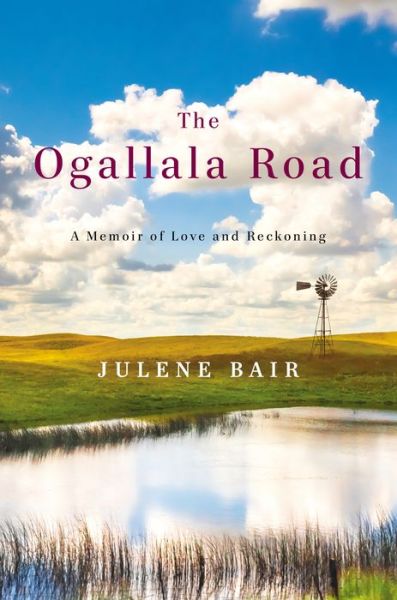
I found very thought-provoking Julene Bair’s memoir of returning with mixed feelings to the family farm. My full review will not be out until a little closer to its March publication date, but for now, a few lines that got me thinking:

Our sense of beauty is a survival instinct, telling us that a place can sustain us for generations to come. I’d always known this in my bones, but it wasn’t until many years after I left Kansas and discovered my passion for wilderness that the intuition became conscious. This creek was now ugly. That didn’t bode well for the underlying aquifer’s ability to support life in the future.

Part of me nods firmly at this, and part of me wonders if beauty is really the same thing as lifegiving. Perhaps it’s all in the eye of the beholder? Please weigh in, Pops.

This quotation comes from an uncorrected advance proof and is subject to change.

book beginnings on Friday: Eating Dirt by Charlotte Gill

Thanks to Rose City Reader for hosting this meme. To participate, share the first line or two of the book you are currently reading and, if you feel so moved, let us know what your first impressions were based on that first line.

eating dirt

This book came recommended from two authors I’ve fallen in love with in recent years: Phil Connors and Christine Byl. That was enough for me. Charlotte Gill begins:

We fall out of bed and into our rags, still crusted with the grime of yesterday. We’re earth stained on our thighs and shoulders, and muddy bands circle our waists, like grunge rings on the sides of a bathtub. Permadirt, we call it. Disposable clothes, too dirty for the laundry.

Hers is a memoir of planting trees, and that’s about all I know so far, but I think I’m going to love it.

Happy Friday and what are you reading this weekend?

The Outermost House by Henry Beston

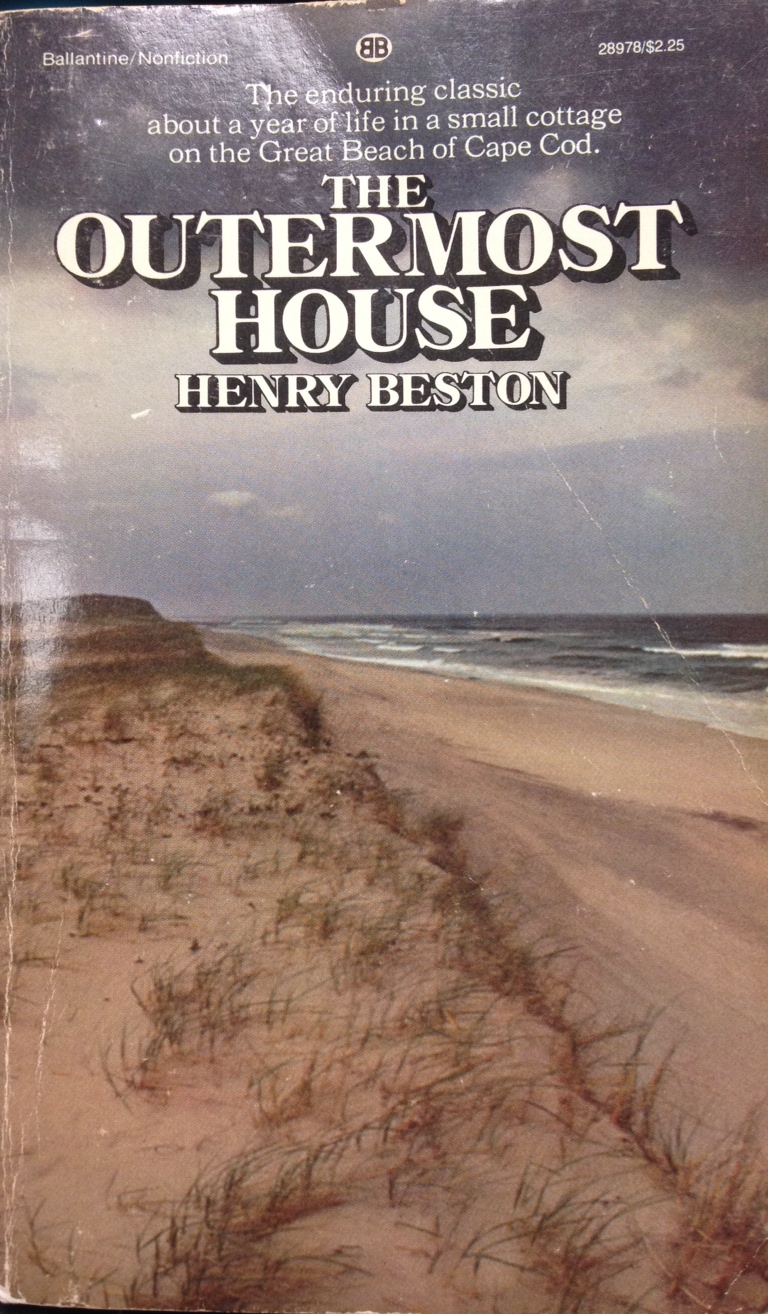
photo (1)This book came to me recommended by Rachel Carson. I’m relatively sure that I came up with this title in my reading of On a Farther Shore, a recent biography of the author of Silent Spring. And by that convoluted path, here we are.

The first thing that struck me about The Outermost House, and certainly the most striking overall, is its similarity to Thoreau’s Walden. I have been describing it as “Walden Pond on Cape Cod.” Henry Beston wrote this book in 1928 about a year he spent, rather by accident, on the island; he had a small, humble cabin constructed on a remote dune for the purpose of visiting more often, and moved in in the fall, thinking he’d be there only a matter of weeks but staying a full year. (My edition also contains a new foreword from 1949.) That Thoreau would be well-known to Beston, his literary descendant of just a few decades in the same region, is clear, even if he weren’t mentioned by name around page 100. The similarities are many (more below), but I don’t mean that to take away from Beston’s work. I think Walden bears some imitation, and Cape Cod is different enough from the Concord locale to justify its own study.

The next thing that struck me is Beston’s comfortable observation that, although “man” has altered & damaged the world mightily, “Nature” is overall impervious, and Cape Cod in specific remains untouched. I congratulate Beston that in 1928 (and ’49) he was able to feel such confidence. Today, sadly, he would not.

Like Thoreau, Beston describes his home in some detail, for its details are hugely relevant to his year on the outer beach. Like Thoreau, he sees his fire as a friend and companion, a major force in withstanding solitude. And like Thoreau, he overstates that solitude, first writing of how very, very alone he was – how very rare was a human face in his year out there in the wild – and in the next breath, shamelessly, noting that he saw his Coast Guard buddies from up the beach almost daily, and walked into town for groceries once or twice a week. Having come to terms with this dissonance in Walden, I just smiled at it. Solitude is clearly relative, and he’s enjoyed far more than I have experimented with.

The Outermost House is perhaps most lyrical and pensive in its contemplation of bird life and waves, and equally thoughtful in its treatment of the Cape Cod locals and the solidarity they feel with wrecked vessels on its shore. He seems to refer to a “god,” although not by name; he is very concerned with “man”‘s relationship to Nature (always the capital N), and how sick we get when we disconnect. These themes are timeless and not dated at all.

For those who enjoyed Walden, this will undoubtedly be a great pleasure. If anything, Beston is less pretentious and self-congratulatory than Thoreau was. His descriptions of the migratory birds of Cape Cod’s seasons are lovely and, I imagine, useful for scientists & natural historians. It’s well-written, short (under 200 pages), and solid.

I will let Beston himself close, with a few of my favorite lines.

Glorious white birds in the blue October heights over the solemn unrest of ocean – their passing was more than music, and from their wings descended the old loveliness of earth which both affirms and heals.

…today’s civilization is full of people who have not the slightest notion of the character or the poetry of night, who have never even seen night. Yet to live thus, to know only artificial night, is as absurd and evil as to know only artificial day.


Rating: 6 tseeps.

The Hunted Whale by James McGuane

An evocative photographic study of historic whaling tools and techniques.

huntedwhale

“The hunt is one of man’s most ancient endeavors,” begins The Hunted Whale. James McGuane’s photographic exploration into the bygone practice of whaling transports the reader back in time, when whale oil lit the streetlights of the world’s major cities and lubricated the burgeoning textile industry. Whaling was a significant economy unto itself, employing countless young men who were convinced to ship out for years at a time by employment agents known as “land sharks.” It was a trade performed by hand, and McGuane examines its many aspects: hunt, ship, whaleboat, crew, whale, tools and more.

McGuane’s text is accompanied by more than 200 fine, detailed color photographs depicting whaling artifacts, including several examples of scrimshaw–the art of painted, engraved or carved whalebone or teeth. Photographs of twisted and mangled–but intact–harpoons give visceral evidence of the whale’s power to resist human efforts, and McGuane details the methods in practice. Also showcased are innovative technologies, such as toggled harpoons or “irons.”

Selections from Logbook for Grace, a diary kept by naturalist Robert Cushman Murphy aboard the whaleship Daisy in 1912, add a valuable firsthand perspective and bring McGuane’s subject to life. With all its salty flavor, The Hunted Whale is an obvious choice for fans of Moby-Dick, but history or naval buffs and fans of pre-mechanized times will be equally charmed by this detailed pictorial view of the ancient industry of whaling.


This review originally ran in the November 5, 2013 issue of Shelf Awareness for Readers. To subscribe, click here, and you’ll receive two issues per week of book reviews and other bookish fun!


Rating: 5 scrimshanders.

art and dirt

[I recently read Theo Pauline Nestor’s Writing Is My Drink, but my review won’t be published at Shelf Awareness for another week or two.]

I remember from Natalie Goldberg this thing that I also recognize in Theo Pauline Nestor: an aversion to the outdoors, a lack of appreciation for nature. It is apparently something to be avoided, cleaned off your shoes if you accidentally step in it, and this is every bit as disturbing to me as the people who react to the idea of exercise by saying that they “don’t like to sweat.” What!! What a bizarre concept, to not like to sweat. Sweat is not the first or primary goal of exercise, I want to tell them, any more than getting dirty is the primary goal of going outside; but both results (and they cross over quite a bit) feel good because they are of the nature of their parent: exercise, and the outdoors.

Nestor writes, of camping: “life’s hard enough; why turn it into a three-ring circus by trying to rub sticks together just so you can boil water for morning coffee?” And then later, in praise of her medium: “writing comes from the wild place, from the home of the undomesticated, the untamed, the feral.” As if that is a good thing. How can the undomesticated, the untamed, the feral, the wild place, be a good thing if camping is a bad thing? And oh how simplistic (and ill-informed) her picture of camping: that it involves rubbing sticks together, for chrissakes, to make coffee!

Why the disconnect? Why does art have to take place in clean and civilized environs? Don’t get me wrong, I like a good coffeeshop too; but I worry that there’s something missing from a person who appreciates art and beauty and yet thinks camping is an unnecessary complication. Some of us feel that camping is a necessary reduction in complications, in fact: think on that for a moment. You can even forgo the coffee and use trees and sky as your stimulant! I want to be clear that I very much enjoyed Goldberg’s Writing Down the Bones and Nestor’s Writing Is My Drink, and I found both useful. But I think I’m bound to identify better with Philip Connors and Christine Byl, artists unafraid to get dirty.

book beginnings on Friday: The Hunted Whale by James McGuane

Thanks to Rose City Reader for hosting this meme. To participate, share the first line or two of the book you are currently reading and, if you feel so moved, let us know what your first impressions were based on that first line.

huntedwhale

The title recalls a certain famous fictional white whale, or is that just me? This is a coffee-table style book, I expect (my copy is pre-publication), and filled with images. It begins:

The hunt is one of man’s most ancient endeavors. One can barely imagine an early time when man was free from the need to find nutritious food or eliminate a dangerous predator. It’s been posited that language itself grew out of the need for precise communication as men stalked and hunted prey.

No argument there, I don’t think. And I like that McGuane pulls language into his opening lines – this being a work of written artistry, after all. But The Hunted Whale promises to star the whale, as well as the hunt, so stay tuned.

These quotation comes from an uncorrected advance proof and is subject to change.