Key Grip by Dustin Beall Smith

Dustin Beall Smith came recommended for his contribution to You. That essay, called “being [t]here,” didn’t particularly grab me (put it up next to Kitchen for being amorphous or abstract, at least too much so for my perhaps overly literal mind). But this book did.

Key Grip is a memoir in essays, in reverse chronological order. The first essay makes up fully a third of the book, followed by eleven shorter ones. The narrator is a risk-taker, a thrill-seeker, with self-destructive behaviors. The book is about those behaviors, about mourning the death of his father, and about art: the lifelong struggle to become a writer, and the decades along the way spent in service to another art form, as a key grip in the movie business. Smith is expert at engaging storytelling, such that the craft appears effortless or invisible. As a classmate once said, the apparently effortless writing is the hardest to achieve. But for me, the most interesting element in this collection was its reverse-chronological organization. That’s what I annotated, for school.

The extra-long opening essay, “Starting at the Bottom Again,” is a hilarious account of a mature Smith (age 57) traveling cross-country with a near stranger, to go on a Lakota vision quest. It is not only hilarious, but also gripping and pathos-ridden, gloriously told. If I have a complaint, it is that we left this absorbing world and did not return to it. I expected to continue chronologically from this point, and perhaps to get sequel vision quests, as Smith’s Lakota spiritual guide suggests to him.

Instead, we go backwards in time, seeing Smith suffer the loss of his father, work as a key grip, get dissipated and wild with drugs etc., become a skydiving instructor, return to childhood. Many of these essays are excellent in their own right. But I remained a little baffled by the departure from that first essay, “Starting.” I think we all generally expect chronological order when we read. We know how to deal with disjointed jumpings around in time; but to start at the end, so to speak, can be a little disorienting.

Nevertheless, once I paid attention to what this backwards-order was doing, I decided I like the way meaning, and characterization of the protagonist, build. For one thing, this is very like how we get to know people in real life: we meet today, in the present, and then (if we get that far) we fill in backstory. We can never know a new acquaintance’s past if we weren’t there for it, but we can listen to the stories.

Smith is a very fine storyteller, and these are amusing, sensational stories he has to tell, always with a note of sadness if not regret. I do recommend his memoir.


Rating: 7 jumps.

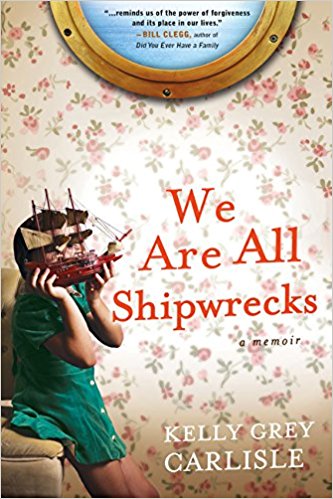
We Are All Shipwrecks by Kelly Grey Carlisle

An unstable childhood on the harbor in Los Angeles yields a wise, contemplative, forgiving memoir by a likable narrator.

A young mother tucked her three-week-old daughter into a drawer in a Hollywood motel room before leaving for the night. A police detective would lift the baby out again, after the mother was murdered. In the opening scene of Kelly Grey Carlisle’s memoir, We Are All Shipwrecks, an eight-year-old Kelly meets that detective for the first time, having just learned how her mother died. It sounds like a sensational beginning, but Carlisle’s measured, wondering tone allows the reader, like the author’s child self, to meet each disorienting new situation with curiosity rather than a sense of spectacle.

Kelly was raised by her maternal grandfather and his much-younger wife, whom she calls Daddy and Mommy. He likes to be called Sir Richard and boasts of a wild and heroic–increasingly incredible–past; her name is Marilyn, and she carries wounds that Kelly will gradually understand. They own a pornography shop near the Los Angeles airport, and for many of Kelly’s formative years, they live on a boat in a marina. Their neighbors are unglamorous down-and-outs, and Kelly is wracked by how normal her childhood isn’t. But in her reflections on the page, she realizes that the adults who surrounded her in her youth played various parts in her unconventional upbringing; many of them were loving, positive figures. We Are All Shipwrecks is a memoir about being adrift and lost on a boat, but also about discovering that we’re all more or less adrift, that yearning is a universal condition.

As she matures and learns more about her grandfather and Marilyn–the nearest to parents that she’ll ever know–Kelly persists in wondering about the mother she lost. Naturally, then, the book follows her progress: from tracking a bewildering childhood to seeking answers about where she’s come from. By the time Kelly becomes a mother, and for some time thereafter, her understanding of her roots continues to evolve. She explores the roles of trauma, love, resilience and forgiveness in shaping a life. “By now, I’ve realized that my grandfather was wrong when he told me, ‘Where you come from is important; it’s who you are,’ because it was only partly true. ‘Who you are’ also happens after you leave home. You are turning into ‘who you are’ your whole life.”

We Are All Shipwrecks is a personal history, a commentary on the experiences of childhood (uncertainty, pain, possible acceptance) and an investigation into what creates us. Readers who appreciate thoughtful memoirs will be charmed by Carlisle’s generosity and easy, open reflections.


This review originally ran in the August 7, 2017 issue of Shelf Awareness for the Book Trade. To subscribe, click here.


Rating: 8 cats on a boat.

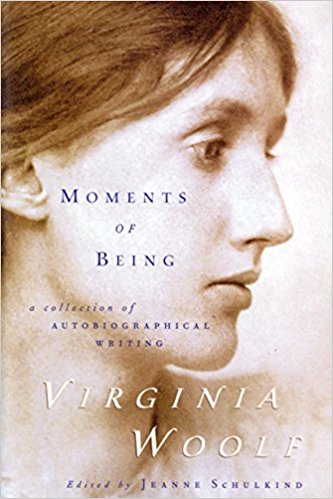
“A Sketch of the Past” by Virginia Woolf

This essay, which I read from the collection Moments of Being, consists of nearly 100 pages of Woolf’s recollections of childhood, recorded journal-entry-style in 1939-40. It introduces Woolf’s concept of “moments of being” and of “non-being,” the latter being the cotton wool in between the important stuff of life/memory. Interesting for organization (or lack thereof); for the layering of time, then and now; and for Woolf’s list-making. It was also unfinished at the time of her death, and somewhat lacking in narrative structure. The editors of this collection make some points about it not being up to VW’s standards for publication, but as this is the first I’ve read of her work, I can’t comment on how not-up-to-standards I find it.

“A Sketch of the Past” is a series of memories of Woolf’s childhood, related when the author is nearly sixty. She begins by worrying over the format of these memoirs, then throwing up her hands to begin with “the first memory.” The form ends up being a sort of journal, with dated entries and a few comments on current events (the coming war). This layered-time effect allows commentary on both the past and the writing-present.

Woolf’s “moments of being” stand in contrast to what she calls “moments of non-being.” I understand these to be the memorable or remembered moments versus those not remembered, or not memorable–which are not necessarily the same thing. Woolf asks, “Why have I forgotten so many things that must have been, one would have thought, more memorable than what I do remember? … Often… I have been baffled by this same problem; that is, how to describe what I call in my private shorthand — ‘non-being.’ Every day includes much more non-being than being.” She likens non-being to cotton wool, or the everyday padding of what is remembered (or, what she wants to write about). She then goes on to call her moments of being “scaffolding in the background” of the real work of her storytelling: these are people, or characters. (The idea of moments of being, or characters, as the central work of storytelling is another concept for potential annotation.) “A Sketch of the Past” proceeds to study characters: Woolf’s mother, father, and a few siblings.

For school, I wrote an annotation on Woolf’s list-making. Several lengthy lists help to accrue either scenes, descriptions or themes in Woolf’s remembering. Certainly, details are part of how she enlivens her storytelling (the flowers on the mother’s dress and the yellow blinds in the nursery, both on the essay’s first page). Sometimes it is the solitary nature of a detail that gives it its power, as with Mr Wolstenholme, who “when he ate plum tart he spurted the juice through his nose so that it made a purple stain on his grey moustache”–it is the nature of this man that “he had only one characteristic,” she says, even as she names others. This cue to the singularity of this detail, along with its vibrant colors and specificity, strengthens it. But when such details are presented in list form, I find them compelling in new ways, greater than the sum of the listed parts.

At the sentence and paragraph level (or list level!) I found things to admire here. But a somewhat archaic style and lack of narrative arc, a certain rambling quality, made this essay hard for me to engage with. I’m not especially excited about this author, lauded though she be.

Final verdict? I am new to Woolf but at this point I find her inarguably skilled, but not terribly to my tastes at present.


Rating: 6 anemones.

reread: The Liars’ Club by Mary Karr

Shortened version: it was excellent and moving, again. (Original review here.)

I will repeat myself (from Wednesday’s review of The Art of Memoir) that one of Mary Karr’s greatest strengths is her voice. Her personality sings or laughs or screams off the page, vernacular and colorful, wise and confused, approachable and authentic and believable. Her story is wild. If it weren’t told in such convincing fashion and with such human wonder by its narrator–in other words, if I tried to tell you here about some of the things that happened to young Mary, less artfully–you wouldn’t believe it. But in this memoir, you do.

Karr grew up in a little east Texas coastal refinery town (here under a fictional name), with a short spell spent in Colorado. Her family was troubled, and gave the neighbors some entertainment (or opportunity for self-righteous head-shaking). But this is not a simple story of hardship and woe. The Karrs are also fiercely loving and loyal, with a capacity for humor. Karr’s narrative voice seeks answers and knows how to criticize, but she loves her flawed people; she’s not out to get them. (This is one of the key tips of The Art of Memoir: write out of love, not hate. Additionally, though this sounds even harder, “as Hubert Selby told Jerry Stahl, ‘If you’re writing about somebody you hate, do it with great love.'”)

From a craft perspective, I suppose I will start by examining the rich inner world Karr relates here, as for example on pages 148-157. In this eventful chapter, Karr’s mother creates a massive bonfire of most of her children’s–that is, Mary and her sister’s–belongings, before threatening their lives with a butcher knife. This scene is described in great detail, meticulously, so that it takes pages for moments to pass. Alongside the scene we get little Mary’s coping mechanism: her imagination supplying parallel events to explain or counter those she is witnessing. There is a backwards-looking perspective provided by the adult Mary writing these lines, but also much of young Mary’s real-time daydreaming. There are flashbacks. It’s an extraordinary sequence, and she uses a similar strategy elsewhere, in other such horrifying, dramatic, traumatic scenes. I know one reader who finds the lengthy, meticulous description of trauma difficult; but I think it’s actually a remarkable way to put us in the scene, as well as paint the child’s surreal experience. (Also, it’s difficult. But there is no way to read about rape that is not difficult. It should be difficult.)

My remarks here just scratch the surface of what The Liars’ Club has to offer. I’m a little confounded by the reviewers who didn’t love this memoir. The “best” criticism I saw was by a reader who believes that memoirs should teach a high moral lesson or reveal an important, famous person’s life. This book perhaps does neither, but I disagree with the premise; and so, thankfully, does Mary Karr.


Rating: 8 electric can openers.

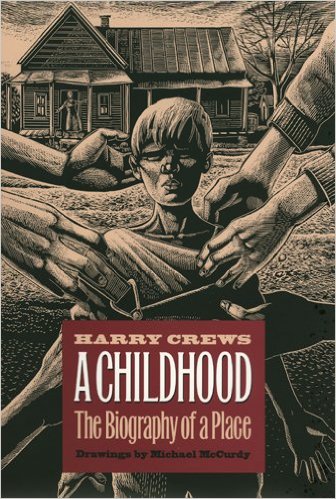
A Childhood: The Biography of a Place by Harry Crews

I’ve been hearing about this one for years, I think first in South Toward Home. While it was already on my semester reading list, I was prompted to put it next in line when I read in Mary Karr’s The Art of Memoir: “[A Childhood] is underrated–virtually unknown–except among the aficionados of the form.” So there. (My reading of The Art of Memoir was interrupted, so its review will follow this one. Preview: I like it.)

This is a memoir of a very short period, when the author is five and six years old, with just a few oblique references to his later life. During these two years, the child Crews becomes aware of himself in the world; he suffers serious injury and illness; his mother leaves his ‘father’ with her two sons, and after a few reunions, splits from him forever; and Crews learns that this was not his biological father, but the brother of that man, who is dead. In his reflections, what motivates the writing of this book is that Crews is haunted by the absence of his late biological father, and by a lack of ties to his home place of rural Georgia.

Both story and prose are tough, muscular, macho, unadorned, laden with violence and hardship; there are lovely lines concealed within, but Crews is most concerned with chronicling his scars. It is a raw and affecting book, and attempting a ‘biography of a place’ through a memoir of just two years is an intriguing strategy. I am fascinated by this idea, that two years of a child’s life can serve to profile a place.

I really appreciate Crews’s voice. This element (combined, obviously, with place and class) reminded me again and again of Rick Bragg. Bragg’s The Prince of Frogtown is on my reading list this semester as well; I hope I get to it in time. Of course I was also drawn (as with Sanders) to Crews’s preoccupation with place, where he’s from and what that means. Another kindred in this way, although his style (and the story he has to tell) differs greatly from my own. Crews is another author that plays with a fluid ‘truth’, which Mary Karr commented on as well: she forgives this favorite memoir because the more imaginative sections are obvious enough to pick out. Those are some of the sensational bits. But really, Crews lets his story stand for itself. His childhood will read as shocking to some of us; but it also reads as very real.


Rating: 8 slisures of grapefruit.

The Mighty Franks by Michael Frank

This memoir of family wounds and favoritism charts dark territory as the author searches for understanding.

the-mighty-franks

“‘My feeling for Mike is something out of the ordinary,’ I overhear my aunt say to my mother one day when I am eight years old… ‘I wish he were mine.'”

Michael Frank comes from an especially close-knit family: his mother’s brother married his father’s sister. He is devoted to his doubly related Aunt Hankie and Uncle Irving. The elder couple is childless, and so they “share” the younger couple’s three sons, of whom Mike is the eldest. The two households are neighbors in Laurel Canyon, in the Hollywood Hills. Both grandmothers live together at the foot of the canyon. It is all very cozy: Aunt Hankie calls them “the larky sevensome,” or “the Mighty Franks.”

And Mike is the luckiest, larkiest one of all, because he is Aunt Hank’s pet. They spend their free time together. She takes him antiquing, and sets out to teach him everything she knows. Hank (a nickname for Harriet) and Irving are successful Hollywood screenwriters, and they have the finest taste in architecture, art, literature, movies, music (nothing after Brahms) and manners. Hank has an overwhelming personality and strong opinions, and when she says that Mike has the eye, the artistic eye for the creative pursuits she prizes above all, he is naturally proud–and motivated.

The Mighty Franks is Michael Frank’s memoir of the relationship he shared with his forceful aunt. While he is favored, his two younger brothers are mostly ignored (Hank sniffs that one has the makings of a scientist, the other, an athlete). He is the modelling clay she plays with, until he begins to awaken to a world larger than Aunt Hank, and forms his own opinions and tastes. She sees this as rebellion, ingratitude or worse. As Mike grows up, Hank seems to break down and the Mighty Franks begin to fissure.

Frank moves between the child’s perspective of events as they unfold and a place of reflection. In writing this story, he seeks a better understanding of his aunt, the imperfect workings of his extended family and his own relationships within and outside it. Hank is firm about hierarchies: the Renaissance over the Middle Ages, Faulkner over Hemingway, Fred over Ginger, early Fellini over late. Similarly: Hank over her younger brother, both of them over their spouses, Mike over his brothers. And always Hank first.

The Mighty Franks is an immediate, gut-wrenching account of events that are often painful for young Mike. While not an easy story to take in, Frank’s ruminations offer some necessary distance. His tone is serious and his prose occasionally verbose, but the saga of this flawed family is deeply involving. Any hint of sensationalism is more than balanced by the psychological insights Frank eventually achieves.


This review originally ran in the April 11, 2017 issue of Shelf Awareness for the Book Trade. To subscribe, click here.


Rating: 6 period pieces.

The Chronology of Water by Lidia Yuknavitch

I gulped down The Chronology of Water like I was drunk on it.

This extraordinary memoir, fragmented and unchronological, charts the life of a former competitive swimmer who experienced many traumas: addiction, abuse, loss of a child, failed relationships, deaths. Water is the overarching metaphor, and references to water, swimming, drowning, and wetness are everywhere. Other recurring images or themes include twins/twinning, fire, hair, death, and sexuality. (Much sex.)

While Yuknavitch’s story is filled with headline-level events and excitements, her prose is every bit as compelling: poetic, rich with imagery and metaphor, but also often swinging back to a very conversational tone. Although the events of her story are terribly tragic, she offers hope, without ending with trite redemption. And she keeps her reader rapt.

As a student, I found this work interesting for both sentence-level prose style and overall organization. I made careful note of where the water/wet references and language sprang up: in fact, I highlighted all such words and phrases, making this the first book I’ve marked up since somebody last made me, in high school. Very few pages went without highlighting, and it was interesting to see where the page really lit up, and where it didn’t. I was also interested in how she uses neologisms, anthimeria and repetition to express a sense of wonder, discovery, and otherworldliness. These moods suit her subjects, for example, drug-induced states, sexual discovery, and extreme grief.

I don’t want to say too much. This is a startling work, and you should dip into it yourself.


Rating: 9 less than merry pranksters.

The Boys of My Youth by Jo Ann Beard

I first read Jo Ann Beard’s essay “The Fourth State of Matter” for school, just a year (or so) ago, during one of my post-bacc courses at Western Washington University. I was floored. If you are unfamiliar, I strongly recommend that you read nothing about the essay, but dive in blindly as I did. You can read it here.

Or you could read this book, a collection of autobiographical essays including that one – which floored me again, even when I knew what was coming, and read differently this time around, of course. It is one of the best, but by no means head-and-shoulders from the rest of the essays. I took pleasure in this read, which wanders through Beard’s childhood and adulthood, jumping in time while focusing on certain characters here and there. I am coming to appreciate a certain balance in my reading for school, which I found here and which is sort of rare: I enjoyed reading this book, even while I was able to keep my eye on the craft side of things, recognizing the beauty in how it was done.

I feel like Beard has a certain tone in common with Haven Kimmel. They both tell childhood stories with the perspective of the time – that is, a child’s perspective – in a way that can be so funny. Beard is a little more self-effacing and wry, and occasionally somber, where Kimmel almost never breaks the construct of that humorous, wondrous sense of discovery and exclamation. But there is a sense of the absurd to the child’s POV, a sort of “oh my gosh, I had no idea the world had this in it!!!” that is just joyful and playful and funny and fun, that they both hit, in slightly different ways. I love that. Part of this, too, is that Beard often writes (especially, I think, earlier in the book) in the present tense, as if these things are just happening now, which gives that feeling of immediacy.

Overall, she shifts quite a bit between tenses and perspectives. She can be very conversational, as when she digresses to give background information and then comes back to the action at hand with a sort of “but anyway, I was telling you about…” kind of phrasing. She also refers to the writing of this book as it’s happening, especially in the final, title essay “The Boys of My Youth,” which shows her struggling to put the thing together, calling an old friend to consult on the details even as she’s sharing those details with us in the essay. I enjoy that transparency to the writing (as a writer, obviously, but also as a reader). As I’ve just finished this book, I have a feeling that it progresses from an innocent early childhood (the preface is a pre-verbal memory) to a more jaded adulthood (we finish with a divorced woman leery of new relationships). Looking again, the essays do progress in chronology; but within each there are huge jumps in time, so we see previews and flashbacks, too. It’s an interesting structure: subtle, but effective. A memoir in essays, and not the first of those I’ve read this semester, which is no mistake; it’s probably the kind I’m writing. Of special interest to me is the essay “Cousins,” a profile of Beard and her cousin Wendell, close friends, told in a series of anecdotes spread over many years, and out of chronological order.

One potentially troubling thing needs noting: Beard is comfortable with a certain amount of imagining in her nonfiction. Probably more comfortable than I am. I remember this objection being raised to “The Fourth State of Matter,” when I hadn’t caught it myself; she includes scenes where she was not present, but I guess I’d assumed she came by the information from other sources, where a closer look shows that to be in some cases impossible. I noticed it even more here, like when she describes in great detail a scene involving her mother and aunt, which took place before the author was born. I don’t know. The generous part of me wants to believe this scene was described to her (in detail! repeatedly!) and she filled in only some minor details (what color pants; what the sky looked like, because she came to know that same sky). But I’m not sure that’s true, and my personal code for nonfiction makes me a little uncomfortable with the possibility that she put her mother and aunt in that flat-bottomed boat, recklessly imagining. Discovering that Annie Dillard had no cat, as described in the opening paragraphs of Pilgrim at Tinker Creek, made me crazy. If she made up a whole cat of whole cloth, what else has she fabricated?! Here, I guess I’m feeling a bit more forgiving, perhaps because it’s a bit more obvious that Beard was not there when her mother was in that boat, pregnant with baby Jo Ann. (Dillard gives no clue that there is no cat.) But it’s not going to be my way.

This is one of the most enjoyable things I’ve read this semester. Easy-reading, entertaining, lovely, finely crafted but accessible.


Rating: 8 bananas.

Ecology of a Cracker Childhood by Janisse Ray

Early in my reading, I was ambivalent about this book, although I cannot now remember why. Did her writing get stronger as the book progressed? Did her vision & thesis take shape and grow on me? Was I just in a mood? By the end, I felt friendly towards the narrator and the book.

Janisse Ray grew up on a junkyard in south Georgia, one of four children. Her family was strictly religious, rural, somewhat isolated, and their lives were simply furnished for both religious and financial reasons, although they were not painfully poor: “We never ever lacked food, but we had few treats.” This book is an essay collection that is two things at once: a memoir; and a naturalist’s description of a nearly-vanished landscape–an elegy. The chapter/essays alternate between Ray’s personal and family story, and the ecological side. In reading this was a little less obvious to me, because I would argue that the ecology bits include some personal, and vice versa; but the table of contents makes this structure clear and intentional: the naturalist chapter titles are italicized, like Latin names of species would be. This is what the title is telling us, that it is both ecology and cracker childhood, and also the ecology of that childhood, and of the cracker people (one of the ecology essays is titled “Crackers,” as they are themselves one of the species at work in the system).

Ray’s homeland was once a longleaf pine forest, and that diverse ecosystem (and the pine savanna that wanders through it) is endangered and precious to her, now, but her upbringing did not emphasize it. The discovery of her homeland as a natural ecosystem, and its loss almost before she knew it, came later. As interesting as her childhood is, and the ecological part too, that young-adult awakening was perhaps the most compelling part of this story for me; maybe that’s part of why it became most appealing to me late in the book, when the awakening is told.

I learned a lot about a place and an ecosystem, and I enjoyed the personal memoir. I was especially fascinated by the strict religion that did not allow girls to wear pants, jewelry or makeup; had them cover their hair to pray; forbade holidays, ball games, parties, television, newspapers, dating, sports, on and on. This stuff is so far from my personal experience as to feel exotic, or weird, so I read it with that added curiosity we feel when we encounter the foreign. And it made Ray’s experience at college so compelling: alcohol, rappelling, skydiving, and simply swimming (something her family’s dress code never allowed), oh my! The parallel discovery, as I’ve said, is of nature as a subject for study, admiration or even just notice. She observes that she had a grandfather who loved the woods, but that her father couldn’t take the time; and a culture of people working to just get by didn’t have the energy to hug trees. It’s a sad story.

Ray does some lovely writing. I love the parallel of restoring a junkyard to a natural ecosystem, and restoring a ’58 Studebaker (with parts, presumably, to be found in the junkyard). I love this grandmother: “Her skin was soft and loose, and her face wrinkled in a beautiful way that showed she had always liked to smile. Her eyes, behind silver glasses that matched the soft halo of her hair, had life in them.” There are several noteworthy characteristics to this book. Its subjects were new to me, at least: that is, the place, the ecosystem, and the upbringing or culture. Its structure is interesting. I’m not sure why it grew on me so slowly, but grow on me it did.


Rating: 7 gopher tortoises.

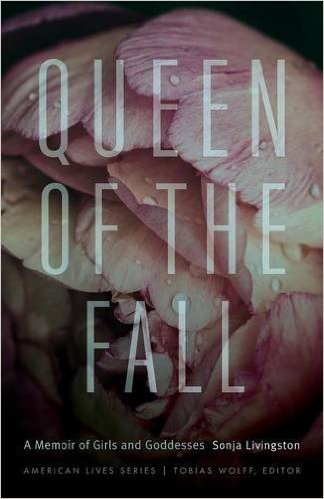
Queen of the Fall by Sonja Livingston

queen-of-the-fallThis is a memoir in the form of collected essays about girls, their experiences and generally a girl’s coming-of-age in New York state in the 1980s and ’90s. The whole book accumulates into something greater than its parts, which is a trick I love. Livingston’s writing is beautiful on the language level as well as in subjects and connections drawn. Her essays include lots of braided pieces, and a fairly heavy emphasis on having babies: avoiding having them too young and yearning for them later.

Livingston’s life is told not as a cohesive story, but in a series of observations and reflections – and anecdotes, but the autobiographical anecdotes feel in service to the reflections, not the other way around. The essays move well beyond Livingston’s autobiography, including studies of women distant to her own experiences: characters from Hollywood movies, television shows, history, the Bible. (Susan B. Anthony, the Virgin Mary, Ally McBeal.) There are also lots of girls and women she does know: her sisters, her mother, a niece; a bride from her childhood neighborhood, Judith Kitchen (briefly, Livingston’s writing instructor), girls she served as a school counselor, a woman she meets at a laundromat. As the subtitle points out, female characters are the unifying theme of this book. There are three sections, unnamed but with epigraphs at their start. They essays they include appear to be in chronological order, although this book in no way feels like a start-to-finish sort of narrative.

I’ve observed examples elsewhere (essays by Jessie Van Eerden and Rebecca McClanahan, Dorothy Allison’s Two or Three Things I Know for Sure) of an author using a single image, object, phrase (etc.), or a structure, to help apparently disconnected stories hold together and achieve a single effect. I’m particularly interested in this book for the way it holds together without quite such an easily identified unifier. To put it another way: Livingston does not quite promise (or deliver) a book “about” herself, her own life, her mother, or anything so straightforward. Instead she muses on “girls and goddesses,” and while I think this book is about herself and her mother and the women in her community, she has plenty of room to roam away from those topics; and the essays that roam still feel like they fit. This is the trick I want for myself: to write about more than just the one thing and still achieve a cohesive collection.

A lovely book to read simply for the experience; also thought-provoking; also plenty to think about from a craft perspective. Win-win-win.


Rating: 8 olive trees.