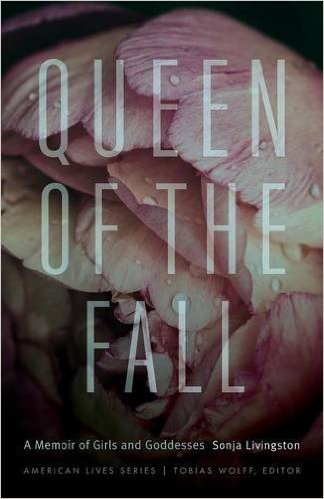
Queen of the Fall by Sonja Livingston

queen-of-the-fallThis is a memoir in the form of collected essays about girls, their experiences and generally a girl’s coming-of-age in New York state in the 1980s and ’90s. The whole book accumulates into something greater than its parts, which is a trick I love. Livingston’s writing is beautiful on the language level as well as in subjects and connections drawn. Her essays include lots of braided pieces, and a fairly heavy emphasis on having babies: avoiding having them too young and yearning for them later.

Livingston’s life is told not as a cohesive story, but in a series of observations and reflections – and anecdotes, but the autobiographical anecdotes feel in service to the reflections, not the other way around. The essays move well beyond Livingston’s autobiography, including studies of women distant to her own experiences: characters from Hollywood movies, television shows, history, the Bible. (Susan B. Anthony, the Virgin Mary, Ally McBeal.) There are also lots of girls and women she does know: her sisters, her mother, a niece; a bride from her childhood neighborhood, Judith Kitchen (briefly, Livingston’s writing instructor), girls she served as a school counselor, a woman she meets at a laundromat. As the subtitle points out, female characters are the unifying theme of this book. There are three sections, unnamed but with epigraphs at their start. They essays they include appear to be in chronological order, although this book in no way feels like a start-to-finish sort of narrative.

I’ve observed examples elsewhere (essays by Jessie Van Eerden and Rebecca McClanahan, Dorothy Allison’s Two or Three Things I Know for Sure) of an author using a single image, object, phrase (etc.), or a structure, to help apparently disconnected stories hold together and achieve a single effect. I’m particularly interested in this book for the way it holds together without quite such an easily identified unifier. To put it another way: Livingston does not quite promise (or deliver) a book “about” herself, her own life, her mother, or anything so straightforward. Instead she muses on “girls and goddesses,” and while I think this book is about herself and her mother and the women in her community, she has plenty of room to roam away from those topics; and the essays that roam still feel like they fit. This is the trick I want for myself: to write about more than just the one thing and still achieve a cohesive collection.

A lovely book to read simply for the experience; also thought-provoking; also plenty to think about from a craft perspective. Win-win-win.


Rating: 8 olive trees.

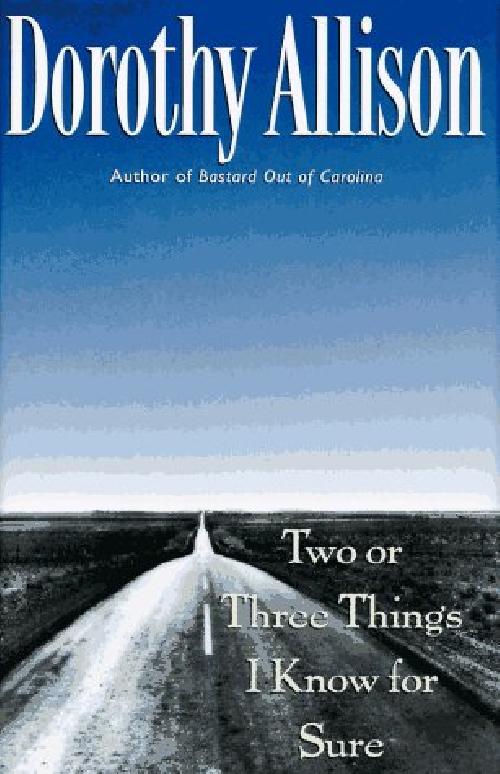
Two or Three Things I Know for Sure by Dorothy Allison

two-or-three-things-i-knowThis is a lovely, very brief but powerfully feeling memoir by the author of Bastard Out of Carolina, which I have not read.

It offers a look at the author’s life, and of the women in her extended family: chronological, but otherwise loosely attached to events, more musing and reflective than reportorial. Allison jumps in and out of time, so although events take place in chronological order, it’s not a straightforward start-to-finish narrative. She also includes family photos, and thus reminds me of Judith Kitchen’s Half in Shade. (This one came first.) Allison is concerned with the challenges these women have faced, and how they’ve handled them, with attention to place, culture, feminism and lesbianism; but family relationships are central. Her second-person address repeats “Let me tell you a story…” and weaves in the title line. This through-line provides another unifying tactic, like those I saw in essays by Van Eerden and McClanahan (here). Like Queen of the Fall (review coming up on Friday), Allison also offers some thoughts, and inspires some thinking, on women’s experiences and place in the world. Specifically in this book, that is the world of poverty-stricken Greenville, South Carolina.

At under 100 pages, this is a super-quick read; maybe too quick. I flashed through it in an evening and am left unsure of what I learned, although I enjoyed the experience. The good news is that a reread would be quick to do, too.


Rating: 7 quarter-miles.

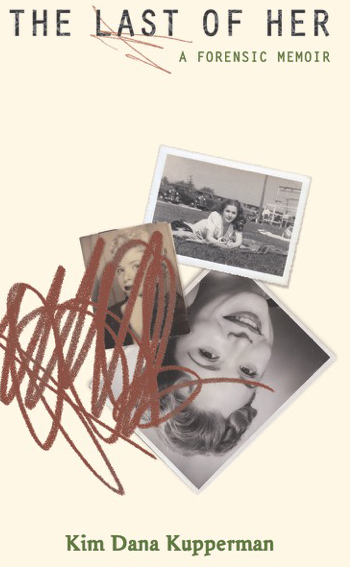
The Last of Her: A Forensic Memoir by Kim Dana Kupperman

Disclosure: Kim is a visiting faculty member in my MFA program, and one I’m looking forward to working with.


“Have a good life,” my mother wrote in March 1989, at the bottom of page four of her nineteen-page suicide letter.

This is a really good beginning, in that it certainly grabs my attention.

the-last-of-herThe Last of Her is Kim Dana Kupperman’s investigation into her mother: who she was, who she wasn’t, why she went.

This mother, Dolores, was a serial liar. She told many, many stories of her own personal history, leaving a real challenge for her only daughter in tracking that history. Kim was 29 when her mother killed herself, apparently to escape being busted for insurance fraud. It took some decades before she was ready to do the work that this book communicates: the research, the travel and the reconsidering of past crimes. Those are literal/legal crimes (Dolores was a junkie, a con artist, an identity thief, and apparently guilty though never convicted of assaulting a [pregnant] romantic rival with a hammer) as well as psychic ones, including mistreating and manipulating her daughter. The adult Kim eventually finds sympathy for this flawed and damaged woman, but it is quite an (understandable) journey to get there.

As a piece of creative nonfiction, The Last of Her is intriguing. The Preface deals heavily in birds, as Kim sketches the trauma of her mother’s suicide and then describes visiting the gravesites of family members she never knew. A few more birds season the rest of the story, although they do not end up playing as large a role as I expected. This lent a feeling, for me, of something larger and less knowable than human nature; not supernatural, but something of the mystery of the natural world, which is often absent (or mere scenery) in human stories.

This is also very much a memoir, not of Kim’s life or Dolores’s, or Kim’s memories of Dolores (although there is some of each), but of Kim’s study of her mother years after her death. In other words, this is the story of her research, including her reading of her father’s giant “Secret File” about Dolores and the custody battle she lost. I am drawn to this kind of story: the story of finding the story, that transparency. Kim’s tone keeps some distance, almost austerely observing the 20-something daughter to which this thing happened. It’s a remarkable piece of writing, on the sentence level (of course). I will also say that the chapter headings (quotations from a wide range of literature) quite baffle me; I need a guide to those.

This is a memoir about a sensational event that never approaches sensationalism, expertly crafted like a long poem, with precise emotional tone. A good study. Keep your eyes open as well for Kim’s (earlier) essay collection, I Just Lately Started Buying Wings, and the work of Welcome Table Press, where she is founding editor.


Rating: 7 phones hung up.

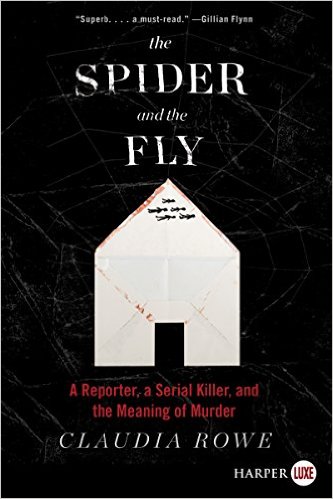
The Spider and the Fly: A Reporter, a Serial Killer, and the Meaning of Murder by Claudia Rowe

A journalist with trauma of her own exchanges a torrent of letters with a serial killer in this absorbing, suspenseful memoir.

the-spider-and-the-fly

Claudia Rowe is a careworn reporter in Poughkeepsie, N.Y., when a local man confesses to the rape and murder of a series of missing women. The case has journalistic potential, but there is more to the story. As Rowe and killer Kendall Francois communicate in letters and phone calls and during prison visits, the journalist’s life goes into a tailspin. Her boyfriend leaves, taking their dog; she moves to the woods and lives in a barn like a hermit. As her obsession with Francois grows, Rowe delves into her own past, a troubled childhood and damaged relationships leading to what she sees as a lifelong fascination with brutality.

Chasing violence and fear has led her to a serial killer who can seem like a big teddy bear as well as a disturbed predator. Rowe yearns to understand where a man like this comes from, how a murderer is made, and the intricacies of race and class in Poughkeepsie and beyond. She puzzles over Francois’s family home, so stuffed with rot and detritus and denial that decomposing bodies went unnoticed. What she learns is that Francois may not be a riddle she can solve.

The Spider and the Fly is a work of personal exploration, as much about Rowe’s growth as an individual as it is about Francois’s crimes. The reflective tone and dogged probing into the ugliest of human behaviors enrich this blend of true crime, memoir and suspense. Looking into darkness, Rowe gains some understanding and some release.


This review originally ran in the February 7, 2017 issue of Shelf Awareness for Readers. To subscribe, click here, and you’ll receive two issues per week of book reviews and other bookish news.


Rating: 7 cans of grapefruit juice.

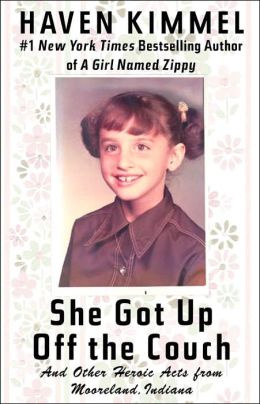
reread: She Got Up Off the Couch by Havel Kimmel

You’ll recall that I really loved this book when I read it in 2013. (First review here.) I reread it recently as part of my first semester reading list (see new tag here, many entries to come!). Students’ reading lists are individual, created by the student and faculty advisor together, so Katie Fallon and I came up with my list as a team.

couchI loved this book again. Havel Kimmel’s mother is far from perfect; she struggles to hold herself together and care for her children and family in a way that her society deems correct; she appears ill-kempt. But in the course of this book, in Kimmel’s youth, she also learns how to drive a car (and buys herself one), enrolls in college and goes on to graduate school, gets a job as a teacher, and goes through a divorce. She struggles, but she keeps it together, accomplishes these large goals, and as this book’s existence shows, her youngest daughter loves her very much through it all. In other words, she’s our favorite kind of hero: challenged, imperfect, but eventually victorious against long odds.

So, a great story. But more than a great story, because Kimmel also presents it cleverly, with enormous humor (even when terrible things happen, like fifth-grade Kimmel’s double compound fracture with shattered bone extruding through the skin) and the kind of detail that makes the whole thing alive to her readers without ever feeling overloaded with descriptions. How does she do it? This is what I’m here to learn on this read. Because my stories are only as great as they are – I can’t control that part – but I can control how I tell them.

I’m still learning this kind of reading, how to read for the craft, to take it apart and see how it works. But here are some things I see:

  • Kimmel’s book is about her mother. The title and Preface make that clear. But many chapters hardly mention her, or don’t mention her at all. Much of Kimmel’s story characterizes mom Delonda without even touching on her. Who she married, what her children and family do when she’s not around, where she isn’t – all these things serve the development of Delonda, which I think is really cool.
  • Kimmel is hilarious. (Here, I don’t have much hope for myself; I’m afraid I’m missing that funny bone…) In the incident I mentioned above, the double compound fracture etc., she uses a totally hilarious doctor to add much of the humor in that scene. Was her doctor really that hilarious? I don’t know. Maybe she was gifted a comic doctor; or maybe she knew how to write his dialog to play that up.
  • Her POV rarely departs from that of the child she was in each scene. She stays in the past tense, but her conclusions, what she sees and what it means to her, stay in character. This often yields humor, because her audience knows more than her narrator does. It can yield poignancy in a way that is just honest without being precious. And it plays up the few moments when adult Kimmel comments on her past: these are rare enough that we pay extra attention.
  • A few chapters take unusual formats. There are lists; a transcript of an audio recording; rules of a game she plays with her friends. This kind of formal play (that is, playing with form) can be dangerous – it can distract, or call attention to itself, as in ‘look how clever I am’ – but I think it serves her well here. For one thing, it’s used sparingly. For another, the formats really do feel like they contribute to the narrative she wants to tell. I think a transcript of an audio recording is a great idea, because it’s in the moment. It’s real.
  • I spent some time focusing on the short chapter “Brother” that biographies her much older, and therefore mostly absent brother Dan. It’s a little bit of a departure from the rest of the book, in tone as well as subject, and I found it a charming encapsulated profile.

This is just the beginning of what I have to learn from Kimmel. Exciting, right? If you haven’t read her work yet, you obviously have my recommendation. I love everything she’s written, in fact, as you can see here.

Stay tuned for more reading-list musings to come.


Rating: still 9 lines to be close-read.

Safekeeping by Abigail Thomas

safekeepingThis book has been recommended to me several times, and now I can see why. It’s a memoir, covering most of Thomas’s life and emphasizing her three marriages and children, especially her second husband who died years after their divorce. But it’s a memoir in fragments. It doesn’t try to be comprehensive, which is a wise choice, since we can never tell all of a life, perhaps least of all our own (hmm). Instead, she gives us a number of crystalline scenes or anecdotes, which together paint a picture, necessarily incomplete but rich.

Thomas’s language is rich, too, lyrical and tangible in its sensory detail, but also rooted in the dirty and the everyday. These details can be sublime, but often aren’t the ones we’d think of when seeking the sublime: “Watermelon rind. Styrofoam. Broken clocks and chair legs.” Mattress shopping, table settings, sawdust on a rug. Chapters shift perspective, using first, second and third person POVs. In the second person, Thomas directly addresses her late second husband. I found it interesting to examine her choice of POV throughout the book and its effect: that second-person addressed to a specific person feels the most intimate, especially since the reader knows that that specific person is absent. Third person feels most remote, and she often uses it when (I interpret) she needs distance from her subject.

Safekeeping is a slim book, easy to read in one sense: you could flash right through it and walk away with a sense of Thomas’s personal history. There is plenty to sink into, though, too, and those may be the best kind.


Rating: 8 apple cakes.

Bonus: here’s a look at my semester’s reading, now that I have it all compiled. Hints of what’s to come!

click to enlarge

click to enlarge

Cerulean Blues: A Personal Search for a Vanishing Songbird by Katie Fallon

Disclosure: Katie Fallon is my faculty advisor this semester, meaning we’ll be working closely together. I read this book just before meeting her.


Mid-April in our southern mountains is a gentle time; blooming forsythia lights up yards like bursts of yellow fireworks, magnolia trees sport gaudy white and pink blossoms, and median strips swell with lilacs and tulips.

cerulean-bluesCerulean Blues is a book about the cerulean warbler, a migratory songbird in danger but not listed as endangered (yet); it is also a book about the author’s becoming a fan and ally of the little bird, a year in her life.

It is organized by seasons: spring, summer and fall. In spring, Fallon discovers the bird and its possibilities for her, and the danger it’s in. This just happens to be as well the spring of 2007, and she is teaching at Virginia Tech when a school shooting takes place there that kills 33. The trauma of these events will shadow everything that follows for her. But she continues on through summer, when she travels to visit the cerulean in its northern habitats near her own Appalachian home, and fall, when she goes further afield to its migratory home in Colombia.

While Fallon is reflective and personal throughout, and the reader gets to know her husband and their rescue dog Mr. Bones as well as the narrator’s own insecurities and grief, this is very much a book about a bird species and its plight. While also showcasing some lovely language (see quotation above), she teaches us a great deal about cerulean warblers and the research (and personalities) that have taught her about them. It’s ultimately a work of science reporting by a non-scientist, as well as a memoir. I found her emotions and minor human flaws easily accessible, and the bird facts equally so. I felt that I got to know her by reading this–which turns out to be particularly applicable to my own studies, but will be rewarding for any reader. The Katie Fallon of these pages is an easy-to-like, easy-to-read instructor, and I think the cerulean warbler will gain more than a few more allies in its readers. (Quick hint: be sure to buy shade-grown and/or bird-friendly coffee!) Nice to meet you, Katie.


Rating: 7 colored bands.

Keep your eyes out for Katie’s next work of nonfiction, available in March of this year. I am especially looking forward to this one, titled Vulture: The Private Life of an Unloved Bird. Vultures are among my favorite birds, as they were Ed Abbey’s.

Take Me to Paris, Johnny by John Foster

This beautifully written memoir of a lover’s life and death will impress readers with its lyricism and emotion.

take-me-to-paris-johnny

Originally published in Australia in 1993, John Foster’s Take Me to Paris, Johnny recounts the life of his lover Juan Céspedes, who died of AIDS in 1987. This Text Classics edition–the first in the United States–includes an introduction by critic Peter Craven and an afterword by Foster’s close friend John Rickard. While these supplementary materials provide context and develop Foster’s character, the original work gleams abundantly without their help.

Juan was a Cuban refugee studying dance in New York City when he met Foster, an Australian history professor, in 1981. A one-night stand became a summer-long affair and then a long-term, long-distance relationship, to Foster’s surprise. As the couple wrangled with the Australian immigration authorities to gain Juan’s permanent residence there, his illness became undeniably serious. He died in a hospital in Melbourne with Foster by his side.

This sensitive, perceptive memoir keeps Juan at its center, outlining his boyhood and escape to the United States before focusing on the love affair and Juan’s death; the final event receives due gravity without defining his life or the book. In a mere 200 pages, Take Me to Paris, Johnny achieves a full emotional range, sketches Juan’s rare and changeable personality and imbues a tragedy with poetry. Foster’s writing is exquisite: thoughtful, lyrical and with an eye for detail. While this is undeniably a sad story, Foster resists wallowing, choosing instead to celebrate Juan and even to laugh at their troubles. Take Me to Paris, Johnny is incisive, wry, loving and deeply lovable.


This review originally ran in the January 10, 2017 issue of Shelf Awareness for Readers. To subscribe, click here, and you’ll receive two issues per week of book reviews and other bookish news.


Rating: 8 red gladiolas.

Teaser Tuesdays: Cerulean Blues: A Personal Search for a Vanishing Songbird by Katie Fallon

Teaser Tuesdays is a weekly bookish meme, hosted by MizB of Books and a Beat.

Teaser

Again for school, I am reading Katie Fallon’s first memoir (she has Vulture: The Private Life of an Unloved Bird forthcoming from University Press of New England in March 2017). I look forward to meeting her in just ten days or so! This is not an assigned book; I’m reading it by choice to get to know her a little better.

cerulean-blues
Her opening lines read,

I stepped onto the tarmac in Bucaramanga, a city of more than five hundred thousand people in northeastern Colombia, and blinked in the fierce October sun. Black vultures lazily circled in the clear blue sky overhead, and swallows chittered to each other as they cut and dove above the Avianca jets idling on the runway.

I like that birds appear in the first two lines, since it is a bird that brings Fallon to these pages. The cerulean warbler does not appear so quickly; that’s a large part of the point of the book. I also enjoy the very full picture she paints in these few lines. Glad to be here with her.

This quotation comes from an uncorrected advance proof and is subject to change.

Brewing Revolution: Pioneering the Craft Beer Movement by Frank Appleton

This personal history of Canada’s craft beer movement, from a distinctive and accomplished participant, amuses as well as instructs.

brewing-revolution

Books on craft beer and the craft beer movement abound, and readers may feel underwhelmed at the prospect of another. But Frank Appleton’s memoir, Brewing Revolution: Pioneering the Craft Beer Movement, is different. For one, his focus is on British Columbia, rather than the much-discussed scene in the United States. And Appleton’s unapologetic, lively personality communicates a story both personal and national, even global, in scope. Brewing Revolution also expands into an impassioned indictment of mass-market adjunct lagers, as well as a manual for the next generation of brewers.

Appleton, a native of Manchester, England, applied his studies in microbiology to food science and later, after immigrating to Vancouver, B.C., to brewing. His science background, appetite for innovation and uncompromising insistence on quality in food and drink led him through an unplanned but inspired career. He began in one of Canada’s “Big Three” brewing conglomerates, where he developed a scorn for adjunct ingredients (or “added junk”) like corn, rice and corn syrup, where traditional, quality brews use only malted grains like barley.

Retiring in frustration to a cabin in the woods, he learns that an article he’d written comparing adjunct lagers with “tasteless white bread and the universal cardboard hamburger,” and calling for a do-it-yourself response, has drawn the attention of an ambitious pub owner. From there, Appleton’s career as a consultant begins. After helping to open the first craft brewery in Canada–which required lobbying for a change in legislation–he consults on the design and launches of dozens of new breweries in Canada, several in the United States and one in France. Along the way, he trains new brewers, invents new equipment and creatively tackles problems in brewing-related architecture, physics, sanitation, welding, human resources and more.

While Appleton is occasionally acerbic in railing against brewing practices and certain former employers, he stops short of bitterness. This distinctive voice may be off-putting for some, but his readers will likely share his disdain for adjuncts and his passion for the details of malt, hops, yeast and water. Enjoying the irreverence of Appleton’s fervent campaigning, craft beer fans will find his character amusing, quirky and sympathetic.

Brewing Revolution tells the story of a country’s craft beer movement and of the author’s life work, but it doesn’t stop there. In his enthusiasm, Appleton can’t help but offer troubleshooting advice for ambitious brewers, and a healthy review of brewing techniques, including the niceties of equipment, yeast cultivation and malting. Humorous asides include Appleton’s dodging of U.S. customs agents and his exasperation with the hired help in Lyon, France. As a history of a movement and a personal memoir brimming with zeal, Brewing Revolution is educational, entertaining and, perhaps most of all, thirst-inducing.


This review originally ran in the November 8, 2016 issue of Shelf Awareness for the Book Trade. To subscribe, click here.


Rating: 7 liters.