Marginalia

Thank you to my mother for sending me this interesting article from the New York Times Magazine. Sam Anderson riffs, “What I Really Want Is Someone Rolling Around in the Text.”

The idea is this: for Anderson, the best and defining part of reading is writing in the margins. He jots notes and underlines and otherwise marks up his texts, which enriches his reading as he goes, as well as his future readings. And he’s concerned that in an age of e-readers, his “‘marginalia’ – a self-consciously pompous Latinism intended to mock the triviality of the form” – will perish. Because you can’t write on an e-reader. Yet.

And then Anderson changes key and explores all the wonderful possibilities the e-reader offers. Surely a stylus that allows one to “write” – handwrite – in the margins of an e-reader isn’t far off (I’m not up on these things, maybe it’s already on). But Anderson theorizes about the shareability of these margin notes, and this is where he catches my imagination.

I’m not a big fan of marginalia, myself. I had an English teacher in high school – a wonderful teacher, who I loved and who taught me so much of the love of literature and the small understanding of it that I enjoy today. She taught margin notes. She took up our personal copies of books we read for class (my first experience with Hemingway, The Sun Also Rises, for example) and actually graded us on the highlighting and margin-note-taking we did. But it didn’t catch on for me. I probably did annotate a few books after being in her class; but then I stopped, and thank goodness. These days it irritates me to no end to find margin notes in a book I’m reading – even if the notes are my own! (They tend to be from high school, which may be part of my irritation.) They distract me from what I’m trying to read – the book itself. I want to hear from the author, who I assume wrote everything she or he wanted to in the text of the dern thing. Footnotes are welcome. But I’m not generally interested in some third party’s footnote, thank you very much.

But. Anderson offers me tantalizing concepts like… “reading, say, Adventures of Huckleberry Finn and touching a virtual button so that — ping! — Ernest Hemingway’s marginalia instantly appears, or Ralph Ellison’s, or Mary McCarthy’s.” Wow! (Okay, maybe he did grab my interest with Hemingway; but the others are almost as tempting :).)

“Old-school marginalia was – to put it into contemporary cultural terms – a kind of slow-motion, long-form Twitter, or a statusless, meaning-soaked Facebook, or an analog, object-based G-chat. (Nevermind: it was social, is my point.)” Well put, sir. I get it now. I get the sharing of margin notes – on purpose, that is. I don’t appreciate the random margin notes of strangers left in public library books I check out, mistakenly correcting a published author’s already-correct grammar, and then being corrected again by the next library patron. I do NOT want that. But Anderson’s way is better: with an e-reader with marginalia-sharing capabilities, I could get only the notes I wanted. And when I wanted – so that I could read a text first unsullied, and then consult my friends or admired (even dead!) authors for their thoughts.

I also appreciate the larger theme that I take away from Anderson’s article, one that librarians (and booksellers, and publishers, and authors…) are discussing a lot these days. Reading and writing are changing; the e-reader format offers a great many reasons for concern – are we going to go out of business? But it also offers opportunities. I can’t begin to think of them all; luckily there’s a lot of thinking going on out there. Our challenge, as librarians, booksellers, publishers, writers, readers, consumers, is to be creative about the ways in which e-readers (and a host of technological changes) can offer us new and positive change, rather than just bemoaning what it’s costing us. So, good job Mr. Anderson, and thanks Mom. 🙂

Crossings.

I have a few things to share with you today. They aren’t books, but you might be interested anyway.

First, last week I discovered a new-to-me concept called postcrossing. (I was alerted to this concept by write meg!. Thank you Meg.) The idea is an international exchange of postcards – yes the really actually hardcopy kind. It’s not pen-pals; you don’t get from the person you give to. But you send postcards to people around the world (and you get a short bio from them so you have something to write about, if you’re having trouble with that part), and then you get them, too! I really like the idea. It means you get snail mail that is pretty, personal, and not bills or catalogs. So, I signed up immediately upon reading Meg’s post and clicking the link; I’m in! And then I sent my first 5 postcards, to Germany, Austria, Ukraine, Taiwan, and Russia. BUT. I didn’t use enough postage, and I didn’t put my return address, either. So guess what? At lunchtime today I’m going to go buy some international postcard stamps and start again :-/ Ah well. I’m still in! And I’m going to get postcards!
So how funny and coincidental that right after discovering postcrossings, I came across a similar project. (Now that I am trying to retrace my steps, I have NO IDEA how I got there. Sorry.) BookCrossing works a lot like postcrossing does: you register and get a unique identifier code for your postcard or book. This allows the postcard or book to be tracked – so if it’s a postcard, you get credit for having sent it, and you get more postcards coming to you. If it’s a book, you can see where its travels take it – if its recipients are logging it on the website, that is. This is much less likely with BookCrossing, it seems to me, because you can just leave books around, wherever, or hand them to random people, who may or may not care to get online and log their receipt of them. I would guess they wouldn’t, very often. Whereas, in postcrossing, the recipient of your card actively requested it, and is actively participating in the same system, whereby one only receives a card if one gets credit for sending cards; therefore I would guess everyone is fairly interested in logging them into the system. (Also, postcrossing recipients, by definition, have internet access and are comfortable with the system. This is not something we can assume when handing out books or leaving them on park benches.)

I think BookCrossing sounds like great fun, but I won’t be joining that one. Why? Several reasons. I think there are a number of similar programs online (PaperBack Swap, for instance), where people can trade and send books around. Another reason that comes to mind was discussed today over at Tales From the Reading Room: people who are not actively seeking out free things (as the postcrossing participants are) don’t necessarily place a high value on them. I think litlove (the above blogger) is right on target when she points out that “free often means without value,” or at least is perceived that way.

But mostly, I guess, I won’t be BookCrossing because it’s sort of what I do for a living, which is a beautiful reason not to play, really. In the hospital where I work, I run a small library that distributes reading materials. We have a nice collection of hardback books that we purchase new, catalog, and circulate just like your local public library; and just like a PL, we want them back and will ask you to pay for them if lost. But we also have a large collection of paperback books, donated by the boxful every day, that freely roam the hospital and beyond. These books are very much playing the BookCrossing game (minus the tracking), and they make a huge difference to our patients, caregivers, visitors, and staff and faculty. It means that there’s always an abundance of free and various reading materials randomly distributed in our little world, and that’s a beautiful thing.

Midweek Miscellany & hemingWay of the Day: on Spanish whisky

I have a sprinkling of things to share with you today.

One. I have updated my blogroll (look right–> and down some) to include all the blogs that I (try to) visit every day. And you will see ABOVE the blogroll, a short list of My Very Favorites. Check ’em out.

Two. I have a very favorite blog post of the day to share with you, too: it’s a review of a book called To Bed With Grand Music by Marghanita Laski and you can find this delightful post here. I am super intrigued by the idea of this book, and it’s completely due to the discussion of it by the Book Snob, so thank you Book Snob! This one goes on the list. Check that out, too.

Three. I am still reading By-Line: Ernest Hemingway, and still loving every minute of it. I may have to put it down at some point to pick up An Incomplete Revenge, the next Maisie book. But fortunately, as a collection of short pieces, By-Line is a pretty good book to put down and pick back up. I should also confess to now being in the middle of no fewer than five books. Hm. (The others are Whatever You Say I Am by Anthony Bozza; The Things They Carried by Tim O’Brien; Dust by Martha Grimes; and The Club Dumas by Arturo Perez-Reverte. Eclectic, a bit.)

Four. Now for my daily quotation out of By-Line.

Beer is scarce and whisky is almost unobtainable. Store windows are full of Spanish imitations of all cordials, whiskies and vermouths. These are not recommended for internal use, although I am employing something called Milords Ecosses Whisky on my face after shaving. It smarts a little, but I feel very hygenic. I believe it would be possible to cure athlete’s foot with it, but one must by very careful not to spill it on one’s clothes because it eats wool.

(from Hemingway’s dispatch on Sept. 30, 1937 from Madrid, in covering the Spanish Civil War. incidentally the subject of perhaps my most favorite novel ever, For Whom the Bell Tolls, for which Hem pretty obviously collected his material during the very time when this dispatch was written.)

Does this make you laugh? It does me. I’m having a good day of laughing while I read; I usually laugh at the posts of Useless Beauty, books i done read, TERRIBLEMINDS, and Hyperbole and a Half, too. It’s a good day when you laugh out loud while reading.

back from the weekend, with very little reading, just a touch of Hemingway.

Hello friends. Thanks for bearing with me. Life is busy. I have this job, see. And I’m taking this class in Database Searching which is fab but takes up time. And I’m trying to be back on this bike and train for the Ouachita Challenge, and we took that vacation, and, and. Thanks for bearing with me.

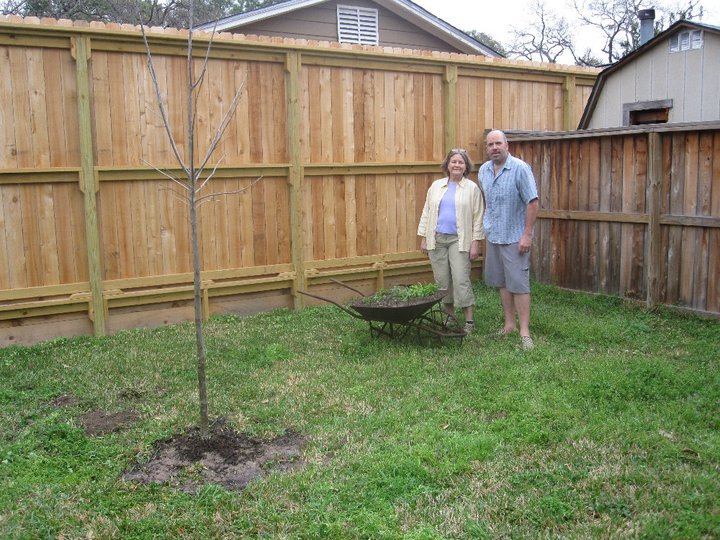
I had a great weekend, very productive. On Saturday I got to ride bikes with the Husband who made it home from Newark earlier than expected; we planted a tree and did some yard stuff; my mother brought us a beautiful quilt she made for us; and I finally photographed for you of a beautiful set of bookshelves the Husband made (several weeks ago now). Pictures:

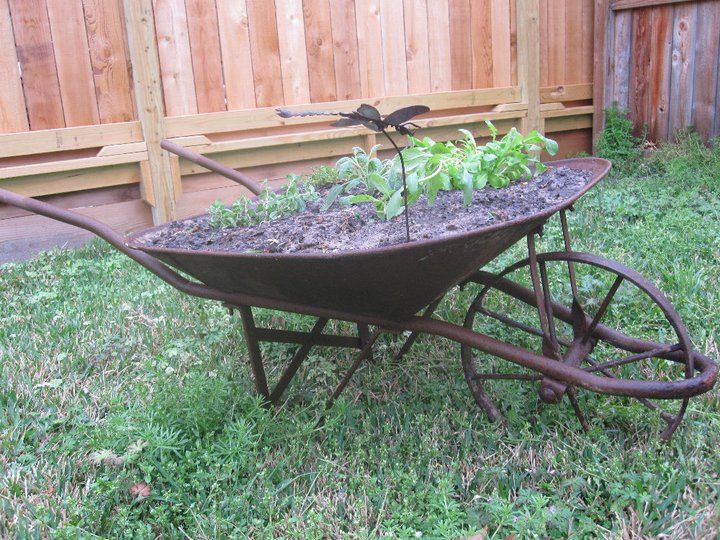
Mother and Husband with swamp cypress oak and whimsical wheelbarrow herb garden


whimsical wheelbarrow herb garden with dragonfly


Encyclopaedia Britannica bookshelves, courtesy of Husband (please ignore electronic mess)


close-up Encyclopaedia Britannica shelves


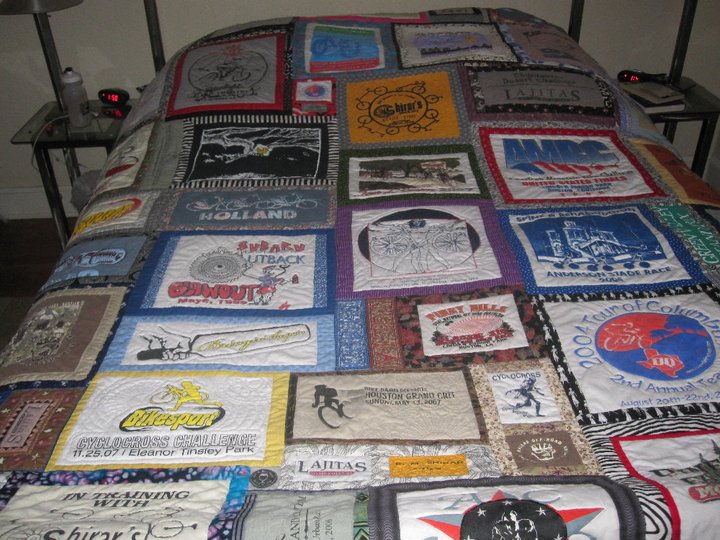
beautiful "union" t-shirt quilt courtesy of Mother


This is an elaborate, beautifully crafted quilt made up of (cycling) event t-shirts belonging to the Husband and myself. It is our wedding gift (we will soon be married 3 years, this is not a fast process) from my Mother and it’s a “union” quilt because it symbolizes our union, combining our two histories of bicycle racing as it does. It’s so lovely, we don’t know what to do with the little dogs who like to muss up bedcoverings.

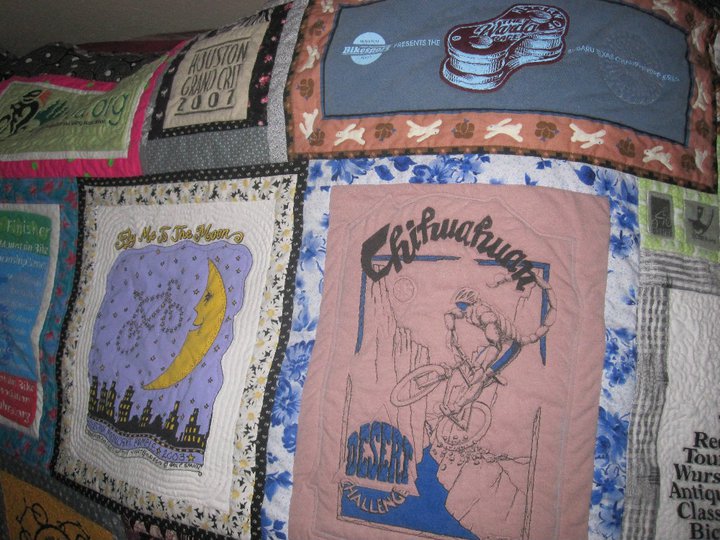
close-up of quilt: notice Chihuahuan Desert Challenge (earlier incarnation of the trip we just took to Big Bend) and above, the Warda Race (earlier incarnation of the race I did yesterday)

Aren’t I a lucky girl? And that was Saturday.

Yesterday – Sunday – I headed out to race Bikesport Presents the Warda Race. Without boring you too much (hopefully), I will say that I have gotten fat & out of shape while being off the bike for an unexpectedly long time this past fall & winter, and I knew this race would be a rude awakening. So, I did the reasonable thing and signed up for not the Category 2 Men, not the Category 1 Women, but the Pro Women’s race. This got me an extra lap of pain and suffering and embarrassment in my currently-undersized spandex. It went as expected. But, this kind of pain and suffering is going to get me back on track. I’m now less than 5 weeks away from the Ouachita Challenge, so it’s time to get to work.

This busy, productive, and happy weekend did not leave time for much reading. I don’t think I did any reading, in fact. So today I’m back on By-Line: Ernest Hemingway, and very happy to be. I shall make a few bookish remarks so this blog doesn’t seem too much a sham, ok?

I really enjoy reading Hemingway’s short articles and dispatches. I can’t believe it took me this long to pick up on this little pleasure. I have always loved him and have devoured all his novels, several of his nonfiction works (and I think you really have to love Hemingway to get through Death in the Afternoon – or bull-fighting, perhaps – but I actually did enjoy it), and I THINK I’ve read all his short stories – I’ve got a collection of collections. But somehow this collection of his journalism has eluded me til now.

These are short pieces of writing, covering his international travels, war and international politics, fishing, hunting, and general lifestyle. It seems that then, as now, this man’s life was of some interest; he had outrageous adventures (how much he’s elaborated or exaggerated them, would be a subject for another post) and saw outrageous sights. Hemingway’s fiction was heavily based on fact, and I fear his journalism might be tinged with fiction, especially where the Exploits of Papa are concerned. This is one of the mysteries and controversies of Hemingway. It may not be a popular feminist position to take, but I adore Hemingway for his work, even if he wasn’t a savory character – let alone a good husband. To any of his wives.

I was contemplating today, as I read some hunting-and-fishing stories he wrote for Esquire, that one of the Hemingway’s most beautiful and rare talents, is that he makes me care about things I don’t care about. I don’t care for hunting or fishing. These activities are not interesting to me; and in some cases I find hunting downright distasteful. But when Hemingway describes the way a fish, or a bird, moves, or the battle between the fisherman and his prey a la The Old Man and the Sea, or when he describes the experience of the bottle of icy cold white wine he’s had stuck down in the cold trout stream all day – I can taste the wine, and I care about the fish. He makes me taste and feel things very vibrantly, even things I’ve never experienced. He’s a very visceral writer.

In the same way, I’ve always said one of my favorite things about the Drive-by Truckers is their ability to make me care about things I don’t care about. For example, car racing is not interesting to me. But just about every time I hear a recording of them playing Daddy’s Cup (and I’ve heard it a lot), I cry. Take a moment and listen, yourself. (The video portion of this video is just filler. You’re there for the audio. Close your eyes.)

I’ve even sent the Husband (who does care about fishing) a short article by Hemingway to read, and the Husband, who doesn’t read, did enjoy it. The Husband prefers to DO things rather than sit around and read about them (we don’t watch movies, because two hours is too long to sit down – I love that he’s a do-er), but perhaps he can appreciate that Hemingway makes his reader feel the action, the doing of it.

I may be moving slowly these days, but a nice compilation like this, of short stories, or newspaper articles, or what have you, is just the thing for a part-time reader. Thanks for bearing with me and my busy life, and have a happy Monday!

Adrian Zavala

On Saturday night this past weekend (Jan. 29) the Husband and I finally went to go see our neighbor play music. We’ve been neighbors for years and friends for the same number of years, and he’s been playing music locally for less time, maybe a bit over a year? since he quit his full-time job to go back to being a professional musician. We have missed his shows many times over, because we spend a lot of time traveling and Being Very Busy, and when we’re not doing those things we like to Sit on the Couch. I feel badly that we have waited this long to see the neighbor play music, because we intend to be more supportive. We trade dog-sitting and watch each other’s homes and trade food and things; we should see him play music, too.

And now that we’ve finally seen him play music, I feel badly that we’ve waited this long, because he’s very good! I was very impressed. The Adrian Zavala Band played at Khon’s, which is a little (little!) coffee shop/bar in the Little Vietnam area of southwest downtown Houston. It was a neat little place – basic but with some good offerings ($2 Lone Star draft!), and the sense to book Adrian.

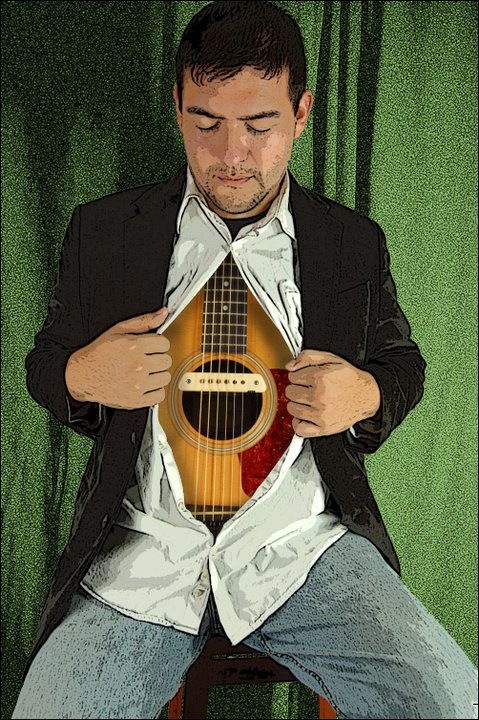
Adrian Zavala

Adrian claims to encompass “Duke Ellington meets Bad Brains”, whatever that means. I was pretty well entranced by the music. It’s a three-piece band – Adrian sings and plays guitar, along with a bassist and a drummer (um, sorry, I think I caught their names but they don’t seem to be available to me just now). I should say that I’m not a musician or a music critic; but I appreciate music, and I like to try to understand how it all comes together. Adrian’s music really spoke to me; it had me reliving old memories seemingly unrelated to the songs I was hearing. I don’t know how to explain that, but I find it obvious (to me at least) that sound is second only to smell in its mnemonic abilities – the ability to take us back in time, to tap into specific memories.

Adrian’s a pretty talented guitar player. I was trying to watch his feet to see what he was doing with the pedals; but most of what I normally think of as pedal effects he was doing with just the strings. (I cannot do this justice. See above comment re: me not being a music critic.) They performed only original music; and each song was satisfying long and complex with lots of bridges (is that right?). Guitar and bass both got to play around and show off some skills. It was fun! I would dance next time, if there were room, and if I were to be perhaps not the only person dancing??

I was musing about the comfort we find in familiarity. At one point one song diverged into a little bit of Rush, and I found myself smiling – not because it’s my favorite music (meh) but because I recognized it. But I loved the original music! I would rather hear original music (at least by Adrian; not necessarily by the next guy!) than Rush. So why smile? I think familiarity makes us comfortable; it makes us smile. I may have been imagining things, but I looked around and thought everybody else was smiling at it, too. I was thinking about the Heights mystery I finished recently, Murder on the Boulevard, which I ended up really enjoying. While not the height (ha) of literary achievement, it was a perfectly fun read; but I think it was heightened (now I’m having fun) by the familiarity of the setting. I think we all enjoy reading (or listening to, or…) things that reference our hometown, home neighborhood, etc. Familiarity is relaxing. And yet, it’s important to get out of our comfort zones, too, in the pursuit of happiness and lots of Other Things.

I’m so glad I got out of the house 🙂 AND our comfort zone, to see some live music. We don’t do enough of that. Thanks Adrian for the performance; hopefully there will be lots more, maybe even in a bigger venue that allows for me moving to the music! Although really Khon’s is a charming little place, I think this band could use more.

Trail work debrief

Unrelated-to-books PSA of the Day.

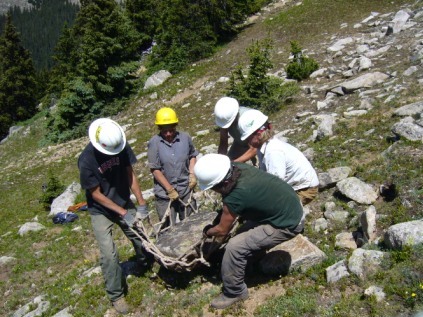
Yesterday I was part of a group – man, there must have been 15-20 of us out there! – doing trail work/repair/maintenance on the mountain bike trails out at Memorial Park. This is a volunteer activity I find to be very important for a variety of reasons, the basic one being that those of us who USE trails – mountain bike, hike, run, walk dogs, etc. – have a responsibility to keep them in good shape. There’s also the political fact that cities, counties, private landowners, or a variety of governmental bodies that house our trails are MUCH more likely to allow us to continue, and maybe even give us new trails, if we’re respectful, responsible users. It’s just a basic concept that you should clean up after yourself, and trail usage necessitates trail maintenance. (I’ve written more on this topic here.)

Yesterday, we were involved in quite a big project, armoring some 20 feet of trail that has been a constant mudpit since Hurricane Ike. It was hard work and involved heavy lifting and extensive digging. It was really GREAT to be part of such a large group; the small turnout I’m more accustomed to just wouldn’t have done it. I’m glad to be a part of these things and don’t regret the sweat (or occasionally the blood) I leave behind. It makes me feel good to be doing my part.

But I was disappointed to hear that several of my friends/riding buddies/fellow racers were out there yesterday riding the trails which were CLOSED due to conditions. When trails are wet and we ride or run or walk them anyway, we do further damage, thus necessitating more of my, and my cohorts’, sweat and blood. It’s a very simple concept, and especially the serious rider-racers I have in mind definitely do know better.

I’ve said it before and I’ll say it again, friends.

PLEASE DON’T

RIDE CLOSED

TRAILS.

(the Husband's portrait of me on break)

Thank you. 🙂

Now get out there and enjoy your outdoor world!

still enjoying Mr. Playboy

It’s a bit odd to not have a new book to tell you about for this long, but Mr. Playboy is such a long one, and I’ve been fairly busy. It was fun to get some engaged responses to Saturday’s post; I was wondering if I might alarm anybody by discussing sex and gender 🙂 but you seem to be a tough bunch. (Or, the offended ones have departed quietly.) Today’s reading proceeded with the battle between Hefner/Playboy and the feminist/women’s lib movement. Watts more or less concludes that Hefner’s camp and the more extreme of the feminists were both a bit far-out in their positions; that nude pictures aren’t as significant a cause for good or evil as was claimed. I don’t know; I think pictures of naked women can be pretty degrading, but I don’t think Playboy does it in a terribly degrading manner. (By which I mean, they go for “pretty” over sordid, and include biographical details, and at least throw a bone towards the idea of these being People, not just bodies.) And most importantly, all the parties involved are consenting adults, and no one is forced to pose OR to look at the stupid pictures, so who cares?

I just wanted to share with you a quotation on this subject, from Joyce Carol Oates. Apparently she was asked by NOW (the National Organization for Women) to avoid boycott publishing in the magazine, which she had done a number of times. This is a somewhat lengthy quote but so professionally done I really do want to share. From page 248-9 of Mr. Playboy by Steven Watts:

I cannot claim to have much interest in the pictorial aspect of PLAYBOY, but I see no reason to focus upon certain pages and deliberately to neglect the very real presence of others. PLAYBOY has published exceptionally fine interviews in recent years (one of them with [feminist] Germaine Greer, who was allowed to be as frank and insulting and critical of PLAYBOY as she pleased), some important articles, and … some very interesting fiction. The stories of mine that appeared in PLAYBOY dealt with male/female conflicts – and in nearly every case, I dramatized the continuing cruelty of the myth of male superiority in such a way that any reader, male or whatever, should have felt some sympathy and understanding for women…

I have never published anything in any magazine on the basis of my agreeing, entirely, with every page of that magazine. In a democratic society, there must by avenues of communication in publications that appeal to a wide variety of people, otherwise writers with certain beliefs will be read only by people with those same beliefs, and change of growth would come to an end. PLAYBOY is astonishingly liberal, and even revolutionary in certain respects…

My personal belief is that worship of youth, flesh, and beauty of a limited nature is typically American and is fairly innocuous … [Y]our anger over PLAYBOY and its hedonistic philosophy is possibly misdirected.

Isn’t she classy? What a great rebuttal, in my opinion. I especially liked her point that diverse publications might get us all reading things that we DON’T agree with, gasp, and what a good idea that is. I’m certainly guilty of reading what I agree with, and I figure we mostly all are. I mean, obviously, what appeals to me is… what appeals to me. But reading the opponents’ position is generally a good idea – maybe you’ll learn something, maybe your mind will be expanded, maybe your mind will be changed ever so slightly, and if not, your own debate points will be strengthened by a familiarity with the opposition’s argument. I think a willingness to read different viewpoints shows intelligence and a comfort with one’s own views. That said, I’m not sure I do a lot of it. :-/ Do you? Do you read ideologies that you disagree with? Could be painful, but it might be brave.

A complicated Saturday of Database Searching and Gender Politics

My word, I don’t know where to begin. It’s been an eventful day.

First the announcement that I am a GEEK. I had the most FABULOUS time today at my first meeting of my Database Searching class today.

(geek)

This is a grad school class I’m taking through my MLS (Master’s of Library Science) alma mater, just for continuing education’s sake. I admit I had some stress about it (and its future impact on my life and free time) this week, but it was a really great way to spend a Saturday morning! I’m excited about the implications of database searching: its logic, the binary nature (of the computerized databases) and creative nature (of the human side: at indexing, and at searching), and our impact, as information professionals, on What The People In General Know. The two instructors in this course (who are both colleagues of mine, lucky me) are remarkable as a teaching team, which is a large part of what makes this course special. They have a really fun rapport: teasing, informal, bantering, intelligent, and expert in the fields of searching and librarianship as well as education. I don’t think I’ve ever seen team teaching done so effectively.

Then I spent several hours with my mother, who hemmed some pants for me (thanks mom, no I still don’t want my own sewing machine, you do a great job). We can never get enough time to catch up. I love you.

Then I came home and the Husband fried some chicken and I read a good bit in Mr. Playboy. (I’m sorry if you’ve been following this blog and waiting for me to move on to a new book. It’s almost 500 pages and I’m now halfway through.)

I still find Hugh Hefner a fascinating and contradictory figure. He’s obviously conflicted within himself; he rebelled against the norms of his youth, and thought he was doing everyone (including women) a great service in liberation. He really DID (I think) do some great services to a number of causes, including (fairly decisively) civil rights, as well as consumerism/materialism (questionable, but the US seems to have accepted this as a Good so who am I to argue), and abortion, divorce, and birth control – perhaps in service of Men Having Sex Freely, but I think he has a point that he’s liberated women somewhat as well. His assistance of women’s lib or women’s rights is a complicated question, though.

I might get a little personal here. Warning.

I was raised by two ardent feminists and children of the 70’s, and COMMUNISTS (omg) among other things. I’m proud of my father for being, still, the greatest male feminist I’ve ever known. My mother, though married (legally, not in a church) still carries her maiden name, as does my secular “god”-mother and two of my three aunts. I support them. When I married, I took the Husband’s name, not because I’m *not* a feminist, but because my path was paved by Karen, Susan, Janet, Laura, and countless of their contemporaries. Through their rebellion, they’ve freed my path to change my last name without feeling that I’ve given up my identity to this Man. (Who was, by the way, surprised that I wanted his name at all.) If I were married in the 1970’s I would have kept my name, I think. My mother and so many other role models have allowed me to complacently take my husband’s name and retain my Self.

So, I read about Gloria Steinem’s exposé in Show magazine of the Playboy clubs. I knew of this in a pop-culture sense: the famous feminist took an undercover position as a Bunny at the NYC club with the purpose of observing and reporting on the objectification of women there. Beware of coming in with a preconceived conclusion: as my Brother Gerber warns me about Barbara Ehrenreich’s Nickel and Dimed: On (Not) Getting by in America, the conclusions are tarnished by the author’s preconceptions. (I LOVED this book and agree with its conclusions, but I share Gerber’s concerns about its mass appeal.) Steinem is an admirable figure. But (says Mr. Playboy by Steven Watts, page 238 and thereabouts) her fellow Bunnies argued that they were liberated, and empowered, by their employment. If sex is power, they were paid to exercise their power, in their own ways. They made money and felt that they chose their own destinies.

I once worked at a local beer bar – which will remain nameless, but my local friends will recognize it. I’m a serious beer enthusiast and have held several beer-expert jobs, and once wrote a local column on the subject. When I served beer at this bar, I wore a plaid miniskirt, knee-high socks, and Mary Janes (later Doc Martens which were also appreciated), and I was told by a manager that “We Sell Sex” which I found very offensive (I am not a prostitute!) but was true in a way. As a tomboy, this was an interesting experience.

(or maybe more like this. librarian style?)

I think I can understand a little bit what the Bunnies meant. In a way, I felt empowered, and excited, by dressing up this way and playing a role. I made some damn good money. I got to talk about beer, over the heads of the men I served. They were impressed. It was fun and profitable and empowering. I also moved on, putting on more clothes by the time I was 24 and finding a professional career well before 30. And, I did this in the 20-oughts (what are we calling those years? 2000-2010), with all the benefits earned by my mother and her contemporaries. We still experienced, and experience, sexual harassment and objectification, but our lives today are easier than my mother’s was in ways I know I can’t imagine.

I think gender politics are extraordinarily complicated. I consider myself one of the easier women I know to understand. I will tell you what I think if you ask. I don’t play any games like saying “nothing” if you ask what’s wrong, when I’m really angry; I don’t encourage the Husband to compliment women I’m jealous of and then punish him for it; I don’t make him guess. (You poor heterosexual men; I think hetero women can be cruelly complicated.) But I’m still complicated: I want to be one of the guys (and I AM a tomboy) and I mostly keep up when we play, but don’t leave me behind and defenseless either, and I want to be a Princess sometimes, too… what’s a poor guy to do? I think that I still sympathize with Hefner. I think he did a lot of good for a number of causes. I think he objectified women, and especially in his private/personal life was rather deplorable in his relationships with women. But a lot of our admirable *public* figures were not admirable private figures; he’s one of these, but not spectacularly so. (I’m a huge admirer of Hemingway. Need I say more?) His impact on Women In Society is very complicated, and that’s all I’m willing to commit to at this time.

(I am not in this picture. It's a concept representation)


I award you a prize if you’ve made it through this post. Sorry for being long-winded! But I found I had a lot to say today.

I’m off to work on our local trails tomorrow. I’ll be putting on gloves and lifting chunks of sidewalk and I still want to be sexy, and the Husband loves me and will be working alongside. Chew on that. 🙂 Enjoy your Sunday.

Daily blog helpers, and bravery.

This morning I discovered, from WordPress, two blogs that offer us help when we’re stumped for a daily post. This is not often my problem, as you may have noticed I sometimes post multiple times in one day… I’m sorry if this is against the rules… I just post when I feel it. Of course, the other side of the coin is, I sometimes don’t post on the weekends or on holidays. I often just have too much going on, involving too much moving around, to sit down in front of the computer! You’re so kind to be patient with me.

For this reason I don’t feel the need to sign up for the Daily Post Challenge, although it’s a nice idea. I do, however, appreciate their starter topics everyday. If a blogger were to have writer’s block, then, there’s a blog for that! I liked a recent topic I found and will respond to it shortly.

First, though, I wanted to tell you about the next daily blog helper. This one is called A Daily Challenge, and the challenges offered are not reading challenges (whew! daily?!) but more like life challenges. Trying one of these tip-of-the-day style challenges would give one something to blog about, is the idea. I’ll hold that one in reserve.

At A Daily Post I found this topic interesting. It asks us to “describe a time when you witnessed bravery: a) in your profession b) with your own eyes c) in someone you admire.” An answer to option a) immediately came to mind. I remember telling the Husband and later parents and who knows who else this story, because it touched me.

I work in a cancer hospital, and I see all sorts of things go on, many of which are not pretty. I see a lot of inspiration and bravery and helpfulness; I see people do good. I also see people behaving in silly, inconsiderate, rude, or nonsensical ways. (I work at forgiving or understanding these behaviors, because gosh knows what people are going through. I do hope we could all maintain enough humanity to be kind to our fellow humans when we’re sick, but who am I to judge? never having been through something this painful.) I see a certain amount of disfigurement and physical unwellness; it took a little practice at first not to blink. I confess that the first time I saw a woman with obviously only one breast, it startled me. (The use of prostheses clearly saves us bystanders from a certain amount of embarrassment; but I think it was brave of that woman to walk around in her body without apologizing.) So, I see a lot of things, happy and sad, loving, brave, and sordid. I try not to judge and I mostly succeed in not bringing it home with me.

However, I saw something, oh, several months ago that sticks with me. I was walking down a hallway, headed to lunch. A youngish couple was walking down the hall, the father pushing their teenage daughter in a wheelchair. (Old enough to have a teenage daughter, but still quite young by cancer-hospital standards.) The girl was hunched over the vomit tray in her lap, with a towel pressed to her mouth. I couldn’t see her face in this position, but something about the set of her shoulders told me she was in pain. Her parents were chatting cheerfully about what the rest of their day held.

This moment in time took my breath away. Such a simple thing. Was it the patient’s youth? I don’t think it was; I do see young patients (much younger than this one) and it’s very sad, but that’s not what made her family special. I think it was her parents’ cheerfulness, their pretense that things were normal and okay. The impression I got from their demeanor was of such bravery. This couple is presumably having their lives torn apart by what’s happening to their daughter and the extreme pain she appeared to be in. And their response was to normalize it and be cheerful. I imagine that this is a special service they’re doing for their daughter. It might be easier to cry and moan and descry the unfairness of it all; but this is the last thing their daughter needs from them. To me, this was a moment of extraordinary bravery and unselfishness, a favor done for a child by her parents. I’m doing a lot of interpreting here; but I saw what I saw. This is what the vignette spoke of to me.

Broadway presents West Side Story: one more thing

Referencing yesterday’s post about West Side Story: I failed to mention the bilingualism. This morning I read a Houston Chronicle article about the production, and it mentioned several changes in this revival tour, including a “grittier” feel with more violent, scruffier gangs, which I think I did observe. It also mentioned the addition of quite a bit of Spanish, and in fact for the tour it said the director returned some lyrics to English to make it more accessible. I feel that he did achieve his goal of creating realism, in that bilingual characters seemed to use Spanish when they would in real life. I’m from Houston, and I don’t know how this change plays everywhere, but Houston is a city accustomed to quite a bit of Spanish. It worked for me. I understood enough of the Spanish to be comfortable; and when I didn’t understand it, I felt at home, because that’s what living in Houston is about. I thought it was a great effect. Just wanted to add that. I’ll be back tomorrow or maybe Tuesday to tell you about finishing Lee Child’s 61 Hours and why I found the ending highly unsatisfying.