Broadway presents West Side Story

Oh my goodness. I had the most fabulous time last night! My wonderful father bought the Husband and I tickets to go see West Side Story here in Houston. It was at the new(ish?) Hobby Center. I was frankly surprised that the Husband was interested, but he had a great time too! (Perhaps he would not say “fabulous.”)

I have to say that my greatest reaction was to be transported back to the first Broadway musical I saw, at age 16 or so, at the Nederlander Theatre on the actual Broadway in NYC. My same wonderful father and I were visiting prospective colleges, including NYU, and he took me to see Rent while we were there. We were really far back, maybe just a row off the back wall, but it was a tiny theatre and the seats seemed to just go straight up – we were fairly far away from the stage but it was all vertical distance, as I remember it. I was just transfixed. The personality and emotion conveyed by the actors was enormous. I guess musical theatre by definition expresses itself through exaggeration, kind of like how the ancient Greek theatre used oversized masks to make emotions and characters extra-obvious to those sitting really far away in the amphitheatre. I felt simultaneously taken in by the characters and their struggles, and interested in the process by which these actors created the characters. I liked thinking about how they did this, the rehearsals, and everything that goes into it.
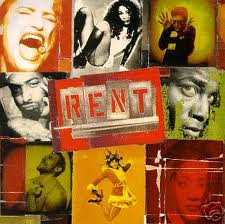
Rent is a powerful story. It’s a rewrite of the opera La Boheme, which I have not seen and do not know much about, but apparently it follows the story quite closely, re-setting the love of Rodolfo and Mimi from 1830’s Paris into 1990’s New York City. The illness originally was consumption (whatever that means) and now is HIV/AIDS. In Rent, then, a group of young, impoverished actors in NYC deal with AIDS’ effect on all of them, although only some are infected.

This story captured me so powerfully at 16. I cried, and I still cry and cry when I hear songs off that soundtrack. It was perhaps one of my more powerful experiences to date at that time. I also had a gay friend who came out to his family around the same time, and I remember being excited to share with him the gay culture I discovered in Rent, in San Francisco, and in Seattle during my travels.

Like Rent, West Side Story is a remake, of Shakespeare’s Romeo and Juliet. Again the story is re-set in a more modern time and place: this time in 1950’s NYC. The Capulets and Montagues have become rival street gangs, the Jets and the Sharks. I had seen the movie years ago, but had forgotten how racially charged and not-PC it was: the Puerto Rican Sharks are reviled by the Irish-Catholic Jets but also by the police lieutenant (who doesn’t completely spare the Jets his racism, either, but being white they get gentler treatment). So that was a little shocking to me. One of the most fun scenes, in which the Shark girls sing back and forth about the charms of the US vs. PR (“América”), plays to some of the stereotypes, too. It’s a great, fun, funny scene, but again not entirely PC (as comedy often isn’t, I suppose). It was interesting to note.

It was such a great, fun play in general. Husband and I were both shocked and impressed at the outrageous dancing the women did in stiletto heels! (I can’t even walk in them, or even stand still!) I find it perfectly acceptable, in theatre, to know the ending; for me, it’s not about being surprised by plot twists, but about seeing a story executed. Still, I was surprised by the ending which diverges slightly but crucially from Shakespeare. For the bulk of it, though, I enjoyed knowing what was coming and appreciating how these incredibly talented actors, singers, dancers take me through a series of emotional reactions. I’m so touched.
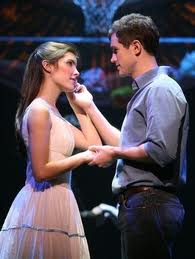
Tony & Maria

And again, I was taken back to that little theatre in NYC when I was 16 and so touched by Rent. What a beautiful experience. There were little parallels: when Tony and Maria touch for the first time, they exchange comments about cold hands;

Roger & Mimi

I can still hear Roger and Mimi singing, “cold hands”… “yours too”… “big… like my father’s… wanna dance?” “with you?” “no… with my father.” These lines are more readily available in my memory than those from last night.

Musical theatre is amazing stuff. What a special treat. Thank you so much, Pops.

a collection of destinations for you

Today I wanted to share with you how I start my day, and where it takes me. Maybe you’ll come along.

When I get to the library in the morning, one of the things I try to do as it fits into other necessary morning tasks, is read my Shelf Awareness email. This is a daily digest for booksellers (or, in my case, librarians) with bookish news. A lot of the news regards the bookselling industry specifically – how Barnes and Noble and Borders are doing, profiles of small or family-owned book stores, market trends, and whatnot. These items are not terribly interesting to me, usually, but I skim them and am sometimes interested. I read it, more, for the book reviews and interesting links. Generally, bookish trends are of interest to me and help me do my job. It does pay for me to know what people want to buy because I buy the books for my library and obviously I try to provide what people are wanting these days. If you’re interested in the emails, you can sign up here.

Today, for example, I learned from Shelf Awareness of the renaming of the Boscobel Aerodrome in Orcabessa, Jamaica as the Ian Fleming International Airport. Ian Fleming wrote the James Bond books, reportedly at a “scenic retreat” nearby. That’s a fun fact.

I also found this teaser: “the Guardian asked readers to check their literary balances with a ‘banking in literature’ quiz”, and I thought, oh boy a literary quiz! but it turned out to be quite specifically a quiz about banking in literature, which turns out to be something in which I am not an expert, so that was kind of a flop, for me personally. Maybe you’ll do better.

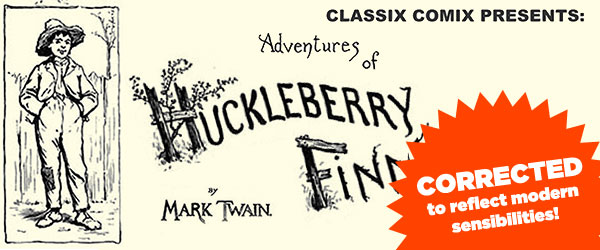
But then I found Tom the Dancing Bug’s classix comix version of the Adventures of Huckleberry Finn (Corrected to reflect modern sensibilities). If you’re reading my reading blog you’re probably the sort of person who is also aware of the general furor regarding NewSouth‘s republication of Mark Twain’s The Adventures of Tom Sawyer and The Adventures of Huckleberry Finn without use of the n-word or “injun”. I will say very briefly that I am scandalized and strongly against this move, for the oft-cited reasons that a) we respect Mark Twain for his original genius and no one should be re-writing him, b) he put those words in on PURPOSE for goodness sake and with a purpose, which included satire and the bringing to our attention that these words are and were overused and wrong, and c) that the use of these very words always incites discussion (as evidenced by this recent furor), which is a good thing. YES these words are offensive, and this offense is still relevent; that’s why we still need Mark Twain’s work as he originally, thoughtfully created it. So. See the above cartoon for what I think is a very clever satire of the republication.

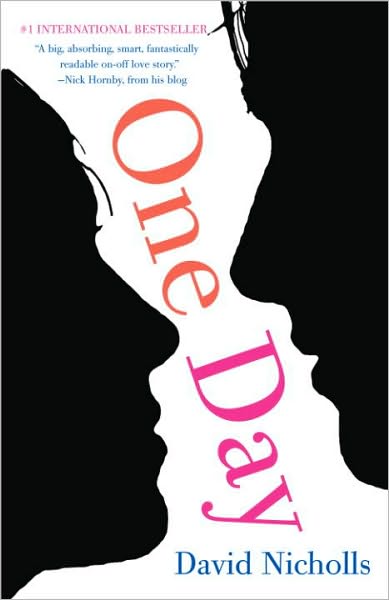
Next, Shelf Awareness tells me that David Nicholls’ book One Day is moving forward and being made into a movie, which was predicted from the very start. I read this book when a patron loaned it to me, and I enjoyed it fine, although I definitely agreed with Publishers Weekly’s view that it was made for the screen. I don’t watch a lot of movies (largely because the Husband doesn’t like to) but I do like Anne Hathaway, who’s in this one, so I may find a way to see it (without the Husband).

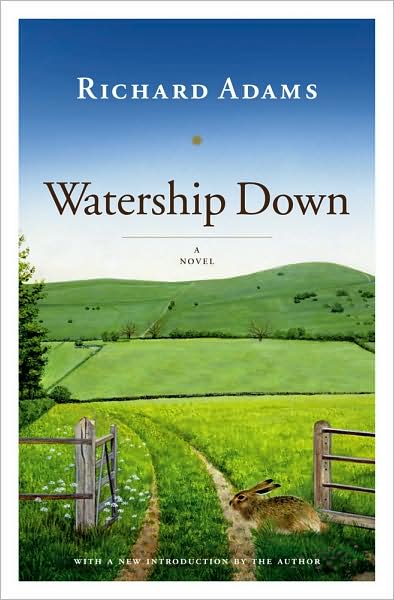
Something else I got out of today’s Shelf Awareness email – and this is a little embarrassing – but when I followed the above link to that ‘banking in literature’ quiz, I found mention of Watership Down as “bucolic children’s fiction”, which didn’t sound familiar to me. I mean, I know the name Watership Down (by Richard Adams), but didn’t think it was a children’s book; I think I had it crossed up in my head with Fahrenheit 451 or Slaughterhouse 5 or something. So I had to go look up Watership Down, and it sounds lovely (and also it turns out that at least somebody on wikipedia agrees with my vague impression that it’s highly allegorical), and now I am determined to read this book because it sounds great. So there you go, after clicking several links and looking things up, I have a new book TBR, and I guess that’s part of what Shelf Awareness is all about.

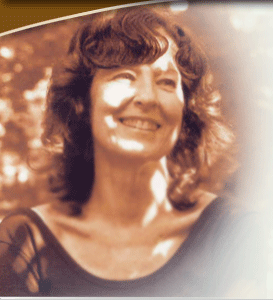
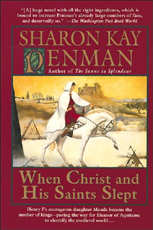
Finally, in my blog explorations, I came across a really, really delightful post today from author Sharon Kay Penman, in which she discusses historical accuracy, her dedication to it (hear hear! something I blogged about earlier), her responsibility to us readers, and some specific challenges. For example, the personalities she writes about, from the Middle Ages, have significantly different values from ours, regarding women’s rights, animal cruelty, conduct in warfare, etc. I highly recommend taking a few minutes to read this post from an author I deeply respect. (Sharon Kay Penman–>)

You’ve just taken a tour through my morning ramblings on the interwebs; hope you’ve found something interesting. 🙂 What do you play with on the internet to find bookish news or tidbits?

just a little musing (little a-musing?)

I was intrigued to read today’s post from Thomas at My Porch about grammar (oh woe) because I was also going to make a language comment in today’s post. Mine is not a complaint, though, more of a musing.

One of my favorite bands is the Drive-by Truckers. The Husband and I are a little bit fanatical about them, in fact. This morning on the way to work I was blessed by the iPod which gave me “Thank God for the TVA”, a Truckers song that was written and performed by Jason Isbell who is no longer in the band. So, we don’t get to see it played live. 😦 But I did hear it in the car, and I love it. Here, I found you this recording of it.

The line I’m most concerned with right now says is, “I wanted her to want me so bad it hurt.” I notice some ambiguity here. Let’s use parentheses in the mathematical way: he could mean “I wanted her (to want me) so bad it hurt.” Or he could mean “I wanted her (to want me so badly it hurt).” Does he want, so badly that it hurts, for her to want him? Or does he want for her desire for him to be painful? (I’m leaving aside the grammatical wrongness of “so bad it hurts” – should be “so badly” – but I can appreciate the southern flavor it gives.) This is the same ambiguity we see in pronoun use such as “Maria gave her mother the card, and her eyes sparkled.” Because Maria and her mother are both female, “her” is ambiguous. Whose eyes sparkled? Maria’s, or her mother’s? I think ambiguity in language is generally a problem. If I came across a sentence like the one I just made up in a book I would be frustrated. The purpose of language, after all, is to communicate.

But I guess there are exceptions to my statements, that language is solely a tool of communication, and that ambiguity is frustrating. Because the above line in the song is poetry; it’s beautiful; and the meaning of the sentence works both ways. I appreciate it. I’m okay with the ambiguity; in fact it adds to the song and, what do I know, may even have been purposeful. When is language not just about communication? When you’re passing the time, when you’re trying to look busy, when you like to hear the sound of your own voice, when you’re stalling, when you’re trying to get something you want without someone else noticing they gave it to you. Etc. But also, when it’s poetry. I think Jason Isbell is a poet, and he’s brought us our musing of the day. Thank you Drive-by Truckers.

admiring Sharon Kay Penman; and, a discussion of historical accuracy

As I near the end of this masterpiece, I’m marveling at author Penman’s ability to keep everything straight. The number of people, castles, battles, the family relationships, the sequence of events, the shifting loyalties – I’m doing okay as the reader at staying clear, but only because I allow myself to drift and be re-seated by my gracious guide every so often; and of course because she’s created strong enough characters that it’s easy to follow each personality. (No one would ever get Henry and Eustace confused.) I wonder just how close to true history she stays? Clearly there’s an unbelievable amount of research involved; but I wonder how truly accurate this novel is. Of course, the devil’s advocate might wonder how truly accurate our “history” books are on this time, too, considering how long ago (the 1100’s) and that history is written by the victor, and all. At any rate, this book has encouraged me to do some research of my own: into Penman herself.

First I went looking for the author’s website; these are often my favorite resources in answering questions about a series, like series order and years of publication, as well as what’s coming out. (I figure generally an author has an interest in promoting upcoming work and in keeping them straight.) Penman lists her books both alphabetically and chronologically, isn’t that helpful of her. And wouldn’t you know, she has a blog! What fun.

The first thing I learned on her website is that I lied when I said I’d only read one book of hers before this one. I read The Queen’s Man several years ago and forgot who the author was. Now that it’s been pointed out to me I do recall that book as being in her style, but call me suggestible. I’m such a haphazard reader: I read the third in one Penman trilogy and am now reading the first in another… no respect for series order. You know, I kind of think it’s the mark of a good book that it stands alone even if it is part of a series. I’m generally not bothered by spoilers or out-of-order reading. Maybe I’m just fortunate to have a short memory; I have certainly reread books (like mysteries) that benefit from surprise plot twists, and been surprised all over again! (I consider this a gift, allowing for repeated enjoyment of the same revelation.) I love Penman and would love to read more; but I’ll most likely just fall upon whatever crosses my path next, without regard for order. With so many wonderful books in the world, I rarely find myself seeking out particular ones; it’s so easy to just read the wonderful book that lands on my desk next.

But my purpose in seeking Penman out was to look into her research methods. The first thing I came upon was her research recommendations, sort of an annotated list with discussion of resources. But I had a lot more fun reading her medieval mishaps, where she confesses to mistakes in historical accuracy, including a number of anachronisms that I, for one, would never in a million years have spotted. Remember, I read historical fiction in part because it teaches me history! …which I love, but I also want to remain aware of the inherent risk of learning something incorrectly as fact. So again, how closely researched? If Penman is concerned about whether or not Stephen’s hunting hawks wore hoods, or the expected life span of an Irish wolfhound in the 1400’s, I can’t believe she’d get the sequence (or victors!) of major battles wrong. But let’s not make assumptions.

According to her blog, Penman’s normal contract for a novel is three years, during which she does research that she repeatedly calls obsessive-compulsive. This is promising. But I’m not sure that reading her own characterization of her research is a fair way to judge; surely any author of historical fiction would claim exhaustiveness? This leads me to look for similar information about Philippa Gregory, another author of historical fiction I’ve enjoyed. A few minutes of internet research makes it easy to see that the internet, at least, gives Penman much more credit for accuracy than Gregory. This doesn’t surprise me too much, as Penman’s books read a bit more “seriously” than Gregory: P spends more time on historical details while G is a bit fluffier, a bit more romance-novel.

I fear that the final conclusion I’m coming to, is that one would have to do considerable research, nearly become an expert oneself, to best judge how accurate Penman’s (or Gregory’s) fiction really is. I’m not interested in that much research just now! Short of such an investment myself, I can only look at the statements made my other readers, who are themselves experts to greater or lesser extents, unknown to me. I found an interesting discussion here from librarything that sort of illustrates my point: it’s open to interpretation, depending on your level of expertise. I guess what I’d most like to read is an article of literary criticism written by an academic scholar of the era of history under discussion; but I don’t think those sorts of scholars tend to spend their time critiquing Sharon Kay Penman.* sigh.

Does it matter how historically accurate a work of fiction is? Yes and no. Historical accuracy does not effect my enjoyment of this book, because I don’t know any better. (If I know better, we’re in a whole new topic; see below.) As a work of fiction, it can be very very strong, both as literary achievement and as entertainment, without being very accurate at all. At some point, of course, it might be best to let it stand as “fiction” rather than claiming to be “historical”; but you get my point. However, there is a real danger in educating ourselves through fiction. Using fiction to learn history requires vigilant attention be paid to historical accuracy. So, it depends on what your purpose is in reading. But awareness is always important in life and in reading: awareness of our purposes in reading; awareness of historical accuracy; awareness of what our reading is convincing us of, regardless of our original purpose.

I especially appreciated a comment on that same librarything discussion, made by margad in message 28: “sometimes small inaccuracies can completely spoil one’s trust in an author.” This is a real concern. I deeply disliked a book called Sophie’s World, by Jostein Gaarder, for a number of reasons, but immediately off the bat I disliked it for a reference to what Homer “wrote.” Homer was prehistory; there was no writing; this is incredibly important in appreciating what he achieved, grumble grumble. Get a fact that I know wrong in the early pages, and you will lose me, immediately and probably irreconcilably.

Have I gotten far enough off topic? My original purpose in writing today was to say wow, Ms. Penman, hats off to you for writing such a lengthy and detailed novel that keeps everything so straight – whether it’s perfectly accurate or not, that’s an achievement, and I’ve enjoyed it mightily, and have no idea how true to fact it is. 🙂


*I did find a little smidge of such criticism, of all things, about Gregory here:

Internationally renowned novel critic Dr. James Higgins (who has a PhD in Historic Literature from the University of Australia) said of Gregory when he reviewed The Other Boleyn Girl: “Philippa Gregory has created a mesmerising work of fiction, seamlessly intertwined with historical fact. While her list of sources may give some reason to believe her novel contains more fact than fiction, it is quite clear to me that Gregory has gained a knowledge of the basic storyline, as well the culture and customs of the Tudor Court, and embellished and dramatised it even more (if that is possible).”

Conclusion? She writes historical fiction. Thank you Mr. Higgins. At least I know such a scholar exists!

edits on an education from James Lee Burke

I need to edit my claim that mysteries don’t make me do research.

First I realized that I’ve needed a reference source a few times while reading Lee Child, on all the guns he writes about and their functions and ability to, for example, withstand torrential rain. However, the Husband has filled this role sufficiently to date, so far, so I haven’t actually *looked up* anything.

I also did some research on the painter Hieronymous Bosch, while getting into Michael Connelly’s series starring a detective protagonist by the same name. This became particularly important when I read A Darkness More Than Night, which deals with painter-Bosch’s work fairly extensively. So here I am coming up with examples that refute my earlier statement; ah well, that’s life.

an education from James Lee Burke

While I am neither the most or the least well- and widely-read person in the world, I do have a graduate degree and do a fair amount of reading; I have a fairly strong vocabulary. I can generally hold my own amongst educated folks. I’m pretty weak on religion, though, which is where most of my questions have come up in The Tin Roof Blowdown. Credit to Burke for making me look up a number of references – something I’m not afraid to do and occasionally relish doing; but it doesn’t happen every day, and very rarely when reading genre fiction!

Today I looked up the Garden of Gethsemane, for example. From page 3, in the intro to the novel and the horrors it offers: “But as I watched Jude grow into manhood, I had to relearn the old lesson that often the best people in our midst are perhaps destined to become sojourners in the Garden of Gethsemane. Ordinary men and women keep track of time in sequential fashion, by use of clocks and calendars. The residents of Gethsemane do not.” What is this garden? Apparently it’s the place where Jesus prayed to his father the night before his arrest and crucifixion. When delving into the symbolism and significance of locating certain characters in Gethsemane I’m a little stumped; it’s like the class on biblical references starts at a higher level than I’m prepared for; I didn’t take the prerequisite. It is suggested that Gethsemane is a symbol for Christ’s controlled and willing submission to his father’s will. It’s also compared and contrasted to that other biblical garden that even I have heard of, Eden. But I find that my internet research (from Wikipedia to the Encyclopedia Britannica and quite a few religious sites) doesn’t yield me a satisfactory understanding of Burke’s mention above.

I also had to look up the Great Whore of Babylon, which Burke writes is the city of New Orleans. This is another enigma to me and I didn’t do much better. Apparently the bible states that the whore offers us false gods and other alternatives to Jesus and what he represents; it’s a Christian allegory for evil and decadence and pleasurable sin. Yep, that sounds like New Orleans, which could be an alternative object of worship, too. But again I think I’m missing some nuances that would require much deeper bible study than I’m interested in right now. I don’t remember this much biblical allusion in Burke.

The next one was secular: John Ehrlichman, used as an example of why military honors do not an honorable man make. Ehrlichman is an easy icon to dissect: he was a Nixon aid and was involved in Watergate. These are symbols I’m familiar with.

Any bible scholars out there who care to explain the first two references to me, please do…

I always find it a refreshing challenge when a book makes me take notes and look things up later. Of course there’s a comfortable limit; running to an encyclopedia or dictionary for every page of text disrupts the flow. But in general I appreciate learning new things when they’re presented to me. It’s not a common experience in mystery novels though! Well played, Mr. Burke.

What have you had to look up lately in conjunction with your reading? Don’t be shy. None of us knows everything.


identifying with the prison librarian

Well, you tell me, does this make me a little nuts, or just mean that Steinberg is a skilled author? It’s occurring to me that our situations are parallel: we both work in “special libraries” (that’s a real term), meaning we’re not in schools, universities, or public libraries. Prisons and hospitals are fairly unique environments. I’m not sure my employer would appreciate the comparison, but both are large institutions, and I have heard my patrons say they feel a little bit like they’re being processed in a machine. I’ve been thanked for using their names instead of 8-digit numerical identifiers. That’s kind of sad. I just had this strange feeling as I walked back from lunch, having reluctantly closed Running the Books, that perhaps it’s weird that I’ve become accustomed to seeing signs on escalators that say “If You Are Feeling Dizzy or Unstable, Please Use the Elevator” and in bathroom stalls that say “If you have had an accident or soiled your clothing and need help, please call XXX.XXX.XXXX.” People here are not necessarily happy to be here. Also, I share with Avi the prison librarian the embargo against connecting with our patrons. There are different reasons – his are a serious security risk, are considered to have lost the privilege of making friends, threaten his job. Mine have a federally protected right to privacy and are going through utterly life-changing events. But they’re all people and we all too easily see ourselves and our loved ones in these strangers. Of course, Avi sees the same people for long periods of time (very much the norm in prison I think) and my people come and go unpredictably (and when they go, I never know why). But I’m getting into this book and identifying with Avi’s workplace conundrums.

readalike: Henrietta Lacks and The Spirit Catches You

The Immortal Life of Henrietta Lacks, by Rebecca Skloot, and The Spirit Catches You and You Fall Down, by Anne Fadiman, read almost like partner volumes to me. These two nonfiction works share author/narrators who get involved in their subjects, spending a great deal of time with the families involved and forming personal bonds. Both Fadiman and Skloot are bothered by a sense of, if not wrongdoing, something having gone awry. The subject of both books is medicine, and the interaction of the institution of western medicine with a culture that doesn’t fully understand it. Humans are important. Ethics are involved, and there are no clear rights and wrongs – or perhaps it would be better to say it’s easy to see where we went wrong, but difficult to see what the right path would have been. Even the structure and tone of the two books are similar: to understand the subject at hand, we are often taken back a step or zoomed out, to a perspective where we can see the history or the culture’s role in a specific situation. The reader learns medicine, science, history without feeling lectured. I strongly recommend both.

Nice to meet you, reader.

I’ve always been a big reader. I ate books up as a kid; I used to get in trouble for having a reading light on way past lights-out, so I could get further into my chapter books. I read at the table; I read while I eat. I LOVE to read; I love a good book; it’s why I became a librarian! Now I’m working at MD Anderson Cancer Center as the Patient/Family Librarian; this means I help provide leisure reading to patients and their families, who often end up with quite a bit of time on their hands.

Now, as a lifelong reader I’ve spent a lot of time on “serious” reading, including classics and nonfiction. But my current library patrons lean towards fiction, and “light” or genre fiction at that, for the most part. And besides, since I finished grad school in December 09, I’ve been leaning towards the light stuff myself. So my most recent fascination is with murder mysteries – long a favorite genre. I’m finally just about caught up on Michael Connelly – there remains only one novel I haven’t read, but I haven’t read any of his nonfiction yet. While reading a biographical blurb on him I discovered that Raymond Chandler was an early inspiration, so I picked him up next, and I can definitely see the relationship. Elizabeth George, James Lee Burker, and Martha Grimes are a couple of favorites as well.

But my latest side-interest is in mysteries related to BOOKS or libraries. first I found The Case of the Missing Books by Ian Sansom; it was fun and funny, really very silly but enjoyable; and I’m now involved in Untitled: a Booklover’s Mystery by Julie Kaewert. It’s back on the shelf for the moment while I immerse myself in books for my readers’ advisory class (more on that in a moment). Next up is Murder Past Due by Miranda James.

So today is the start of my readers’ advisory class (hereby, RA class). It’s taught by a BIG name in the field, Joyce Saricks, author of the textbook used in my grad school RA class, and of course of the text used in this class as well. So that’s exciting. We were given four genre books to read (only had to read one but of course I went for all four!): romance, The Viscount Who Loved Me, Julia Quinn. mystery, The Bootlegger’s Daughter, Margaret Maron. scifi, Ender’s Game, Orson Scott Card. action/adventure, Ice Station, Matthew Reilly.

I’ve read very little romance but they seem harmless. I was happy to tackle the Viscount (no pun intended, ha). I was surprised at how much I enjoyed it. Honestly, it’s not so appealing that I’m going to pick up another romance novel any time soon unless someone insists upon it; but I was surprised at it nonetheless. The characters were cute, if predictable, and I was invested in the plot pretty quickly. I was giggling all along; I have a bad feeling that I was laughing at the book as much as with it, but that works for me too. It’s still entertainment. I really enjoyed The Bootlegger’s Daughter; the characters were fairly real, and diverse, and the small town life drawn by Maron was believable and interesting. I really enjoyed the people, and there was enough sexual tension to be a side entertainment, while not at all taking over (and there was no sex at all in the end, just tension). I’ll be looking for Maron again! Next came Ender’s Game, and here was the real surprise. Even a non-sci-fi-reader like myself recognized the title and author as important in the genre. I loved this book! The fast-paced action drew me along; the characters were surprisingly human and conflicted, not just vehicles for science nerdiness; I really cared what happened. I stayed up til almost 1am, sick, trying to finish (finally had to give up, but eagerly awoke to finish the next morning). I was thoroughly surprised by the surprise towards the end! Very enjoyable. Full credit to Mr. Card.

Now I’m into Ice Station, and it is decidedly fast-paced as well. (In fact, that’s an attribute shared by these 4 books selected for my RA class.) I’m a fan of nonstop action, although some of the tech-y bits are a little contrived: “Please, Ms. Smith, would you demonstrate that again and explain it more fully even though it’s not the least bit necessary to decide my next action? The audience would appreciate it.” That’s ok, I’m forgiving, and I’m enjoying the book. I must say it REALLY reminds me of Dan Brown’s Deception Point, but I point out: Ice Station came out first! Take that, Dan Brown. I’m about halfway through Reilly at the moment, but so far I prefer him over the famous Brown, too.

I’ll keep you posted on Ice Station and anything else I can manage to fit in! Thanks for saying hello!