reread: The Stand by Stephen King

My copy of The Stand runs 1,153 pages, and I have a lot to stay. Sorry for the long review.


I loved this book before, and all over again, although not without qualifications. It took me nearly two weeks to read these ~1,200 pages, but only because I was reading other books at the same time (and teaching three classes) – it was really a handful of nights reading 300+ pages at a go. I loved this book all over again.

The very obvious impetus was the current pandemic, and my curiosity about how well The Stand tells a story that we are now (in some ways) living. The answer is, pretty well, actually. In the real world we don’t have a supernatural evil force in the form of a shapeshifting man with a cadre of more and less intelligent evil-minded followers; but there is plenty of metaphorical material there for those so inclined. I’ll leave that work to each of you. The superflu aka Captain Trip’s infection itself is different from Covid most importantly in the speed and rate of transmission, the death rate, and the speed with which it does its deadly work. It is infectious massively more of the time, and nearly always deadly. Covid is wildly infectious and pretty deadly by real-world standards; Captain Trip’s takes this to a logical extreme, which is often what fiction does, but the parallel is striking and instructive. That it is also wildly fast-acting is an interesting point. In some ways, the slowness with which Covid makes itself known (meaning, we can be infected for days or weeks before we get sick – and we can be infected and not get sick, therefore acting as invisible vectors)… has helped its spread, because we humans have a hard time taking seriously something that we can’t immediately see happening. Captain Trip’s, on the other hand, looks more like this: guy coughs near you; 20 minutes later, you are coughing. You might both be dead in a day or two. This is much easier for people to grasp as a concept; they feel fear and wish to take precautions much more, and much sooner, than we have with Covid. The flip side is that it’s much harder to fight against (especially because if you cough, you die). At least to this lay reader, this difference between reality and fiction feels like a simple difference between two types of virus. To my (again, layperson’s) knowledge, a virus could act as quickly at this one does; we just didn’t happen to get one of those. There would be pros and cons.

Captain Trip’s was also manufactured in a lab as a form of biological warfare which then accidentally escaped. This is not the case with Covid.

Because of the massive death rate of Captain Trip’s, the post-pandemic world looks very different than the one we will be living in the real world. Roughly, let’s flip the numbers of living and dead: the United States in The Stand is populated by some tens of thousands of people. That means their challenges in rebuilding, and in thinking about designing a new world, are very different from the ones we’ll face. Well, I’m trying to write a book review and not entirely a social commentary; but let me say briefly, I think the Covid crisis is highlighting the inequities and injustices we’ve always lived under, and we have a rather special opportunity to do something to fix our systems, with this new (to many of us) vision we’ve been granted. The survivors in this novel, on the other hand, have been left with the “toys” (Glen Bateman’s term) of a previous world, but limited knowledge of how to use them, and the power (etc.) has been turned off. Ideally, they’ll choose what to pick back up (book learnin’, heat in the winter, animal husbandry) and what to leave lying (nuclear weapons). But Glen Bateman is not terribly optimistic. (I must confess, neither am I.)

On to the book review proper. This remains a thoroughly compelling, expertly paced, engrossing story. Characters are delightfully wrought, various and complicated. The sympathy drawn out of us for the Harold Lauders of the world is disturbing as hell; he’s a villain but he’s very human. (The Walkin’ Dude is just evil, and not human.) While there are “types” in Glen Bateman, Larry Underwood, and Stu Redman, they’re convincing human beings at the same time that they’re types. Let’s face it, there are types in the real world, too; that’s where they come from. The momentum with which this plot moves could perhaps not be better executed; Stephen King is a master, and as I said above, I can easily take in 300+ pages in a single sitting (and stay up until 3am, I’m sorry to say), because it’s just all so juicy and absorbing.

That said, I did have a few concerns on this reread that I didn’t have just three years ago. Partly I suspect this is because in reading a print copy, I was able to pay closer attention to certain details. The audio experience I had in 2017 was entertaining, and I certainly followed the story and many of its finer points, but I do feel like I can watch a story more closely when I read it. I can speed up and slow down at my own pace, reread a line if necessary. And I think seeing a word printed imprints it on my mind more thoroughly than a word heard. I don’t know if that’s because I have a certain kind of brain or if it’s relatively universal.

On the other hand, I also think I’ve become more attuned to certain issues and injustices in the world in the last few years. So, on this go-round I noticed a problem in particular with race and ethnicity. King’s characters are almost all white, which doesn’t seem statistically plausible in this country, although I’ll allow that in 1978 (when this novel was originally published) the country probably looked a lot whiter than it looks now – it probably was a little whiter, but it also would have looked a lot whiter, in terms of where society (and therefore Stephen King) directed its gaze. And the few characters of color? Well, we have the “magical Negro” trope, which Stephen King gravitates toward in many of his works. (There’s a decent write-up of the concept in King’s work available here thanks to the Internet Archive’s Wayback Machine.) “Although from a certain perspective the character may seem to be showing blacks in a positive light, the character is still ultimately subordinate to whites. He or she is also regarded as an exception” (source). Mother Abigail is delightful, and she does get her own backstory, but her function in terms of plot seems to fit squarely into “magical Negro” territory. It could be said she also serves as a token. Headline: Black woman character as hero! There are very few other non-white characters, and they’re all problematic: the abominable Rat Man, the heroin addict in the “second epidemic” section, the “black junta” early in the pandemic (they wear loincloths. This is disgusting, SK). But the ending really got me, and take note, writers of all stripes: the end of your book is the taste that is left in your reader’s mouth. At the end of The Stand we get the evil force sometimes known as Randall Flagg reawakening in an unknown place where he is surrounded by brown-skinned men with spears who don’t speak English but worship him. Not cool.

King’s women are sort of up-and-down with me; I rather love Frannie Goldsmith, the pregnant college student who is part scatter-brained and part moral compass, but I’m also getting weary of the pert young thing who lusts after the middle-aged man. And Tom Cullen, the mentally challenged man with occasional rare wisdom who is able to tune into a higher frequency than his peers-of-normal-intelligence – well, he feels a little like the mentally challenged version of the “magical Negro.”

These concerns dismayed me on my second reading, and while I want to be clear that I really enjoyed rereading this book and still find it to be a masterpiece, it is a flawed masterpiece. And I wonder what King would see fit to correct, if he were to edit this novel for a reprint in 2020. He’s still problematic now, as we know, but I think we should ask of our heroes (literary and otherwise) not that they be perfect, but that they be always learning, progressing, and always willing to learn. I’m certainly still learning: for example, it took a second reading for me to track some of the concerning elements of this book.

I still recommend The Stand. In some aspects it nears perfection. In others, cause for concern and fodder for discussion.

I am letting my original rating stand (ha), because I have new observations in both the positive and the negative columns.


Rating: 8 chocolate Payday bars.

Stratford Festival on Film presents King Lear (2015); and my weekly update

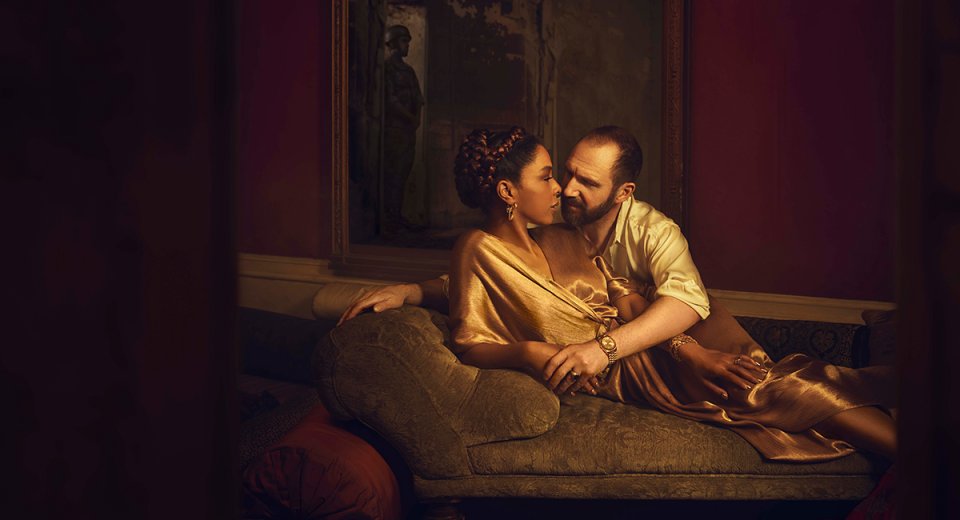
I tried to watch NT Live’s Antony and Cleopatra. I’m far more enamored of Shakespeare’s comedies than his tragedies, and this tragedy/history (with lots of battles and allegiances that I do not find compelling), with which I’m not previously familiar, just didn’t work for me. If you expect a different outcome, by all means give it a look here. I’m sure it’s a fine performance, and Ralph Fiennes looks to be a passionate Antony (who incongruously drinks St. Pauli Girl), and Sophie Okonedo is a powerful Cleopatra. But I couldn’t get into it, and sometimes it works out that way. I’m pretty excited about the next few shows, though! Check those out here.

Antony and Cleopatra: certainly gorgeous.

Happily, my father had just passed on some additional Shakespeare opportunities via Bard on the Beach – truly a wealth of options. I had planned on the Stratford (Ontario) Festival’s production of King Lear until a friend of mine posted up the access to the New York Shakespeare Festival’s production of same – starring James Earl Jones! It’s a strange, Shakespeare-rich pandemic we are living through. I was a little tempted to try to watch both, sort of side-by-side, a few minutes at a time, but questioned whether I had five and a half hours of Lear in me.

Stratford’s Lear and Cordelia

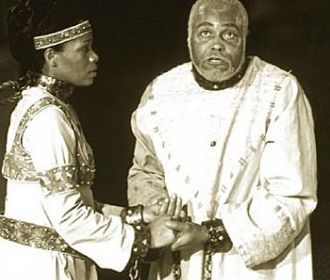
Well, I just couldn’t choose, and so I began with the first half-hour of New York and then the first half hour of Stratford. After that sampling, my judgment was: James Earl Jones is an excellent Lear; Colm Feore was an equally excellent Lear, but the rest of the cast at Stratford won by a landslide. (The latter’s 2015 production date, compared with 1974 in New York, didn’t hurt – the more modern was understandably much more slick and visually appealing, and the sound quality much superior.) I settled in to watch the Stratford production. But I couldn’t leave Jones, either, and so every time Lear had a compelling scene I switched over to see Jones’s version of it. I ended up watching about four and a half hours of Lear after all.

New York’s Lear and Cordelia

…Which puts the lie to my statement that I find Shakespeare’s tragedies less appealing. This is really an outstanding play, and one I hadn’t revisited in many years. It seems questionable, but I remember studying this one in middle school, and watching a film version? I don’t know. I love that this play has it all: comedy, treachery the wise fool, and truly a quintessential tragedy of hubris and temporary blindness (as well as literal blindness). The father/child relationship is explored in several different plotlines, which I found a pleasing but not overdone parallel. It’s also the play that yields such famous Shakespeare lines as

How sharper than a serpent’s tooth it is to have a thankless child!

That way madness lies

I am a man more sinned against than sinning

‘Tis the times’ plague, when madmen lead the blind.

As well as the quotable

Thou art a boil, a plague sore, an embossed carbuncle in my corrupted blood.

I was deeply pleased with the play itself. But also the acting – I was thoroughly absorbed in Feore’s Lear, the compelling Goneril and Regan, and the scheming Edmund. Even Cordelia, who can be a bit prim, was played feelingly by Sara Farb. Albany, Cornwell, and Kent – all memorable roles. The fool was masterful. By contrast, I found the New York company a bit under-dramatic; maybe it was the theatrical fashion of 1974 to downplay the drama. (The Stratford cast was much more white, and I appreciated the diversity in New York’s, but my feeling about the acting remains.) I except Jones from that criticism, of course; he was passionate and resounding, as he is at his best. The two Lears were quite different but both lovely; I loved being able to see them side-by-side. I do recommend this way of immersing yourself in the play, if you’ve the time and inclination! And hey, as usual your mileage may vary as to the relative strengths of each show. Try ’em both. I’m very pleased with how I spent my Saturday night.

In other news, Pops sent me this essay from Orion: “Losers Keepers” by Robert Michael Pyle. I love Bob Pyle, and I love an objects focus (as you may have noticed). This is a beautiful short meditation on objects, loss, and the temporary nature of people and things; he explores the sort of materialism that causes us to love our old and battered possessions even if we maybe don’t entirely fit the standard definitions of materialism. I found the final line spellbinding, and I really enjoyed what felt like revisiting an old friend with this quick read. Thanks, Pops.

Also this week, I attended a Patterson Hood concert on the evening before my birthday (thank you, thank you), livestreamed from his attic. It was very special – he read an excerpt from his memoir-in-progress, and played some deep cuts, and said we should all #runwithMaud, and generally treated us to what felt like a really intimate, personal evening. I loved being able to see this show in my PJs with my dog in my lap, as a special birthday treat.

Patterson Hood in my living room

In other news I’ve been painting and making some solar prints, reading a lot and sort of bouncing off the walls – after a week of up-and-down weather it snowed for two days this weekend, just in case this wasn’t already an exceptionally weird time to be alive. Hops and I will be looking for some good hikes once things clear up again. I’m getting to know my Kindle well. I poked into a few new television series but rejected each of them. I really wish there were more of The Wire. Let’s see… I worked two jigsaw puzzles and I won’t be doing any more of those; I’m too obsessive. In the absence of gym or lap pool, I’ve been doing exercise videos when the weather turns crappy, and Hops gives me the most withering, disgusted looks – I should document his reaction to my workouts for you all! Okay, back to books on Wednesday (and back to NT Live this weekend!). Thanks for bearing with me, all.

best of ENGL 165, and some news

This spring I got to teach a literature course called Short Fiction (ENGL 165), and I loved it. As I said the other day, I’ve also had the chance to work with my friends’ 8th grade daughter: we read one story a week and talk about it on Friday afternoons, as a supplemental to her schooling-from-home. She’s followed along with my college students (freshmen through seniors), and kept up just fine. This was all wonderful: I got to talk about stories I love. (For this class, I made an effort to choose stories from authors of all identities; and I was also careful to only teach stories I like.)

That said, I had some favorites, some stories I can’t get enough of, that are deep and layered and complex enough to bear 10 and 15 readings and hours of discussion, that I can’t stop talking about, that I love to read aloud… and I thought I’d share that shorter list here. (Linked where available.) I have a top three:

And some honorable mentions:

What a privilege, to assign extraordinary literature and to talk about it. And I’ve had some lovely feedback from the students. In fact, maybe it’s time to share this news: I’ve landed the Irene McKinney Fellowship for a second year, and will be teaching again this fall. I’m honored and thrilled. Maybe I’ll get to teach Short Fiction again, or maybe it will be a different lit class… and I’ll have more stories to explore. Lucky, lucky me.

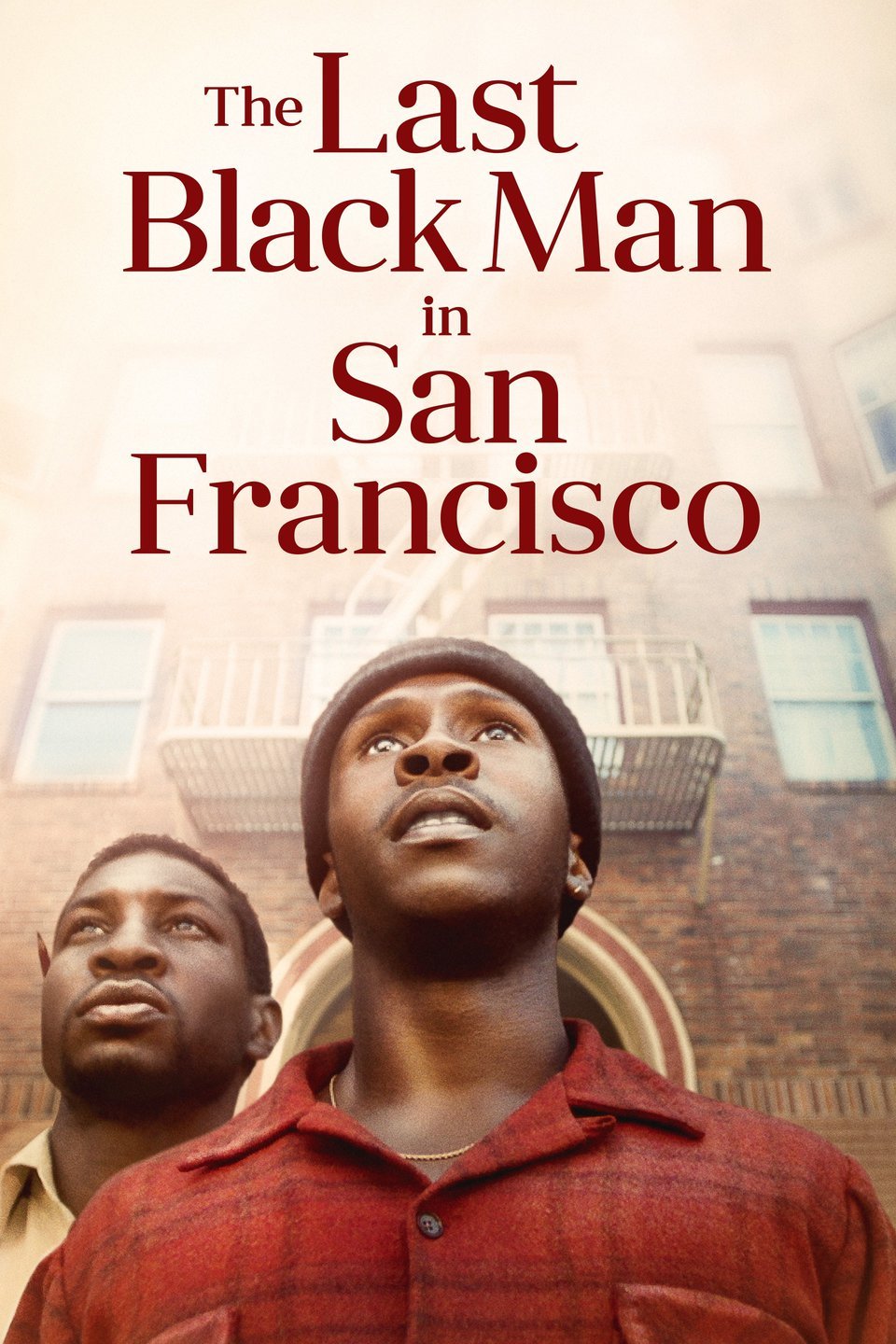
movie: The Last Black Man in San Francisco (2019)

Again thanks to my mother’s urging, I watched this introspective film online the other night. It was odd, slow-moving in that way that art films often are, but visually beautiful, thoughtful and poignant.

Jimmie Fails is a little bit obsessed with the family home – that is, the house that his family lost some years ago. He and his buddy Mont hang around and work on the house when they can get away with it – the white lady who lives in it now is apt to throw croissants when she catches Jimmie touching up the paint on the trim. Jimmie lives with Mont and his blind grandfather as sort of a charity case, in an outlying part of the city. A group of young men hang out on the sidewalk outside Mont’s house, talking shit as the pair comes and goes. There’s less action to this movie than there are scenes, even montages. Mont works at a fishmonger’s; we see him killing and wrapping catfish. Jimmie works at an old folks’ home. They wait on the bus. Jimmie rides a skateboard. The men on the sidewalk talk their shit. And Jimmie worries over the house.

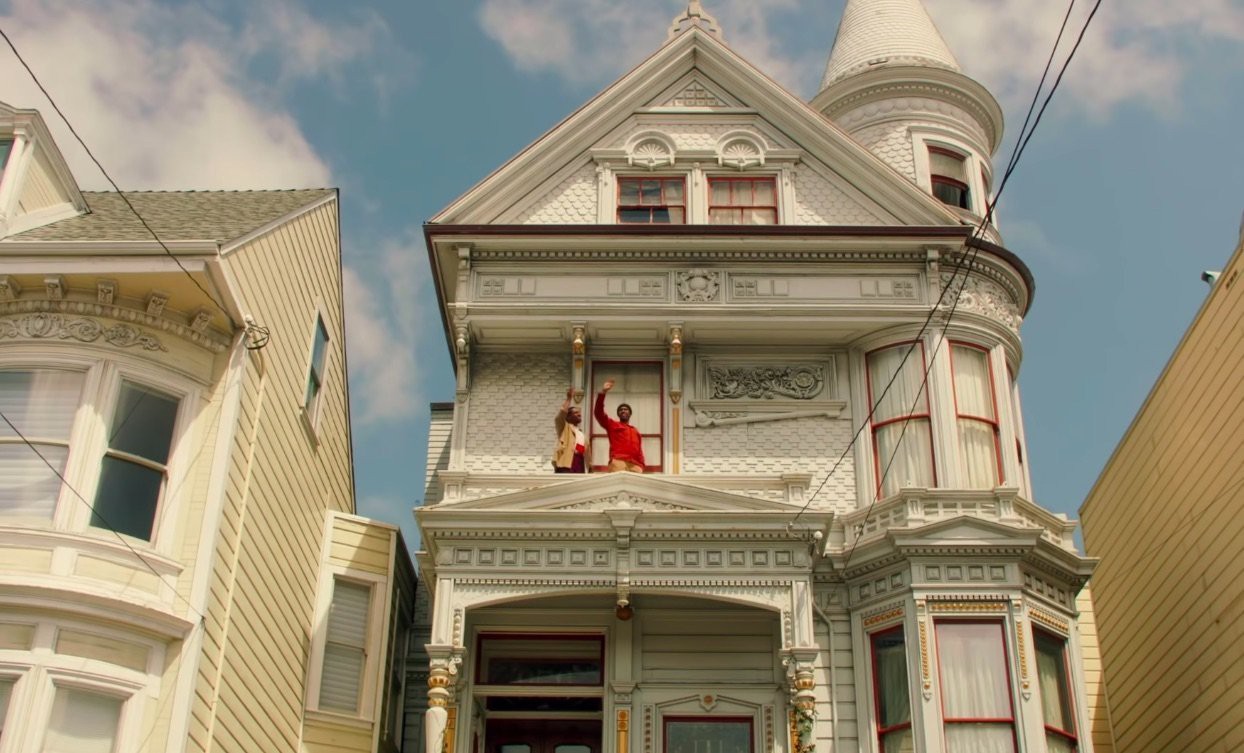
Jimmie’s grandfather built this house – “the stairs, these windows, the columns, the archways, the witch hat, the balustrades, the fish scales, this balcony… all of it by Jimmie Fails the First with his own two hands.”

the house in question (click to enlarge)

And Jimmie’s determined to have it back. Accompanied by the eccentric (but who isn’t?), loyal Mont, he’ll get back there.

The Last Black Man in San Francisco showcases footage of the city and one completely extraordinary house (with a built-in organ in the front hallway, a hidden room behind a bookshelf, and all the flourishes), and takes time and attention with faces and personalities. Again, just visually, it’s a striking series of studies. See the white men in full haz-mat suits cleaning up sidewalks where Black children play among street preachers and those sidewalk loiterers, who form a Greek chorus of sorts… Jimmie and Mont spend as much time standing, sitting, riding, and musing as they spend in action, but their actions are momentous. Jimmie is driven, single-minded. Mont is an artist, a writer, and an unusual soul. When Jimmie asks why he’s lovingly drawing the sidewalk guys, who are basically bullies: “I shouldn’t get to appreciate them… ’cause they’re mean to me?”

Obviously, this movie is a commentary on race relations and on gentrification, the plague on San Francisco in particular but on many or all of the cities in this country. It’s about class and exploitation and how we value history, and family relationships. It’s also about friendship: the friendship between Jimmie and Mont is something really special.

I was fascinated to learn the backstory on this movie. Jimmie is played by the real Jimmie Fails, whose life story closely matches his character’s. (The house is not his family’s house, though.) Director Joe Talbot is his longtime best friend; together the two decided to tell this true story in fictionalized film form, and it’s genius. It also means that actor/character Jimmie has bared his soul in a pretty big way. Mont is played by Yale-trained Jonathan Majors, and I’ve seen indication in two different places that he both is and is not based on a real-life friend of Jimmie’s. Whatever the case, he’s an indispensable part of this story, as Jimmie’s foil, and partner both in musings and in action. His artistic inclinations move the plot along and allow for important commentary.

I’d say the only criticism to be made here is pacing, and that’s a qualified criticism; it’s just got that art-film thing where there’s plenty of space and time for ideas to expand, which is not for every viewer. But this movie is beautiful, thought-provoking, important, wise, and funny. I do recommend. Bonus points for SF lovers, of course; and for those of us with strong commitments to place, check out Jimmie’s line: “you don’t get to hate [the city] unless you love it.” Indeed.


Rating: 8 brush strokes.

National Theatre Live at Home presents Frankenstein (2011); and my weekly update

Last week’s NT Live release was 2011’s Frankenstein, which is viewable here until this Thursday night, when we get a chance to see Antony and Cleopatra.

Well, it had to happen: there had to be an NT Live production I was less taken by. I found less to revel in here than usual. I’m sure the acting was very fine, but it felt a little indulgent, in terms of theatricality. Opening scenes in which the Creature discovers himself and the world around him went on a little long for my patience. The pacing in general felt a bit draggy, and the themes of trying-to-be-god and man-is-monster not terribly uplifting… which might have been my feelings about the novel, too, actually. Benedict Cumberbatch and Jonny Lee Miller alternate playing the two lead roles, Victor Frankenstein and the Creature; this film version offers Cumberbatch as the Creature. Again, very good acting I’m sure, but I often felt a little impatient; I didn’t buy into the drama as I usually do. This production also included just a few musical sequences and the odd spot of comedy, both of which felt a bit out of place in a story that’s otherwise, well, quite serious. If you love Frankenstein, do check this out, of course, and I’d be interested in your take. This one was not so much for me. Ah, well. This week will be better.

In other news, since around the beginning of shelter-in-place orders, I’ve been having weekly literature talks (by phone) with the 8th-grade daughter of some friends of mine. We are heading into our seventh week together. L has mostly read short stories that I’ve also taught to my Short Fiction class (semester wrap-up coming later this week!), and our discussion follows what I’ve done in class; I’ve found her to be at least as ready as my college students (freshmen through seniors) to handle the elements of fiction and the real-world implications of the themes of these stories. It’s been an absolute pleasure – and now that my own semester has ended but my chats with L continue, I’m still more grateful for this small-scale opportunity for a little teaching, a little talking, a little contact with a lovely, clever young woman. Last week I asked her to assign me a reading, based on our recent discussion of dystopian fiction (following stories by Shirley Jackson, Ursula Le Guin, and Lidia Yuknavitch), so we discussed chapter 3 of The Hunger Games. And now I’m going to be reading that book. Good job, L.

In other news, I have been sorry to learn that my book review gig with Shelf Awareness will be moving to a digital reading format due to the pandemic and resulting difficulties with printing galleys and ARCs… it all makes perfect sense and there are far bigger issues to be sad about, but still I was sad to realize that all my reading-for-review will be moving away from hard-copy. My first e-reader arrived in the mail last week, and I’ve been loading my e-galleys and DRCs (that’s digital review copies, previously advanced review copies which were printed) onto it and doing my first reading. The Kindle Paperwhite is much smaller than I’d expected. But it’s pretty easy to use, once I got it set up, and the small, lightweight physicality of it is nice, I admit. I guess I’m torn between feeling grumpy about this new development, and committing myself to liking this, since it’s going to happen regardless. I’m trying hard to commit myself to liking it. And to be fair, nothing about the reading experience is hateful so far – although I definitely miss the feel of pages and the ability to take my notes on a bookmark and even underline passages on real paper. (I’m aware that the e-reader has highlighting & note-taking functions. It’s not the same; and it’s not nearly as easy.) Well, we’ll see, but I’m trying to get happily on board.

In other news, let’s see… I’ve enjoyed a few TV series online in the last two months (already!) of work-and-everything-else-from-home. I fell in love with Luther and then even more in love with The Wire – I may very well turn around and watch the latter again. I ripped through season six of Bosch, and was glad to see that my enjoyment of that series has not suffered from my recent disappointment with a Connelly novel on audiobook (that review to come).

Spring is off-and-on here in central West Virginia, and when it’s on, Hops and I walk miles and I ride my bike on the local trails, which have been mucky for weeks and weeks but are super fun nonetheless; I’ve also put in some trailbuilding & maintenance with my new friends here. Oh, that’s right: I’ve begun a new little project via a new Instagram account, wvwildlifewanderer, where I document the plants and animals (mostly plants, much easier to observe and photograph) that I see around here. I’m trying to learn how to recognize trees and flowers, which does not come easily to me, but it’s been a rewarding process so far.

What have you seen, onscreen or in the world, that intrigued you lately?

did not finish: Not a Gentleman’s Work: The Untold Story of a Gruesome Murder at Sea and the Long Road to Truth by Gerard Koeppel

I quit just over halfway through this work of history/investigative writing/true crime. In 1896, a small sailing ship left Boston headed for Argentina with a cargo of lumber. There were twelve people aboard: the captain and his wife, a paying passenger, and a small crew. Within the first week, three of the twelve had been hacked to death with an axe. One of the crew was convicted and served time and was later pardoned. Koeppel leans heavily toward the paying passenger as the true murderer: a silver-spoon Harvard dropout and drunk with some odd behaviors. But in the end, the ‘long road to truth’ remains unfinished; we don’t know what really happened on board the Herbert Fuller.

It sounded up my alley, but this slim history threw me in a couple of ways. Koeppel’s tone varies from the meticulously detailed chronology to the sensationalist crowing of what can only have been. Here is neither Erik Larson’s novelistic telling of well-documented histories, nor the measured and transparent speculations of literary writers like Kushner, Kupperman, Monroe, and Wood.

Koeppel’s standard of proof is not my own. For my money, he puts rather too much faith in the eyewitness accounts of discombobulated sailors, chicken-scratched down by their fellows, none of whom spoke English as a first language, and now viewed at a distance of more than a century. Eyewitness testimony is notoriously inaccurate in any case. To point to inconsistencies in records such as these and claim them as proof of dishonesty seems unreasonable. I was bemused by a preoccupation with who had children and whether they in turn had children: the continuing line of the key players seems important to Koeppel in a way I don’t comprehend.

As usual, your mileage may vary, but this is not for me.


No rating.

Luncheon of the Boating Party by Susan Vreeland (audio)

Hello, yes, it’s Wednesday! With school just about done, I’m returning to book reviews as a more-or-less full-time venture, and social distancing is still in full effect, so it seems I’ll be producing plenty of blog content for the summer and we’re going back to a three-day-a-week schedule. Thanks for tuning in.


I have loved Susan Vreeland’s ekphrastic fiction for years now. In spirit of Tracy Chevalier’s Girl With a Pearl Earring or Vreeland’s Girl in Hyacinth Blue, this 2007 novel fictionalizes the story of the real-life painting Le déjeuner des canotiers (Luncheon of the Boating Party) by Pierre-Auguste Renoir.

It opens with Renoir riding his three-wheeled steam-cycle to a village on the Seine outside of Paris to paint. We immediately meet several of the characters who will become models for his ground-breaking painting; and it does revolve around characters. While this is in part the story of the painting itself coming into being, issues of composition and light and technique, it is most about people. Renoir chases women; he is obsessed with beauty and must “love” (read: make love to) all his female models. He is also committed to “the impressionists” as a group and a movement. After reading Émile Zola’s indictment of the impressionists, that they “are inferior to what they undertake. The man of genius has not yet arisen,” Renoir knows he must get ambitious. He plans an enormous painting that will be landscape, figure painting, study of light and personality all in one. This novel follows him from discontent and conception through to the end of the painting, plus a years-later epilogue-style reflection.

But again: people. Renoir selects his models carefully, and then navigates their comings and goings; several bow out and new ones must join; he agonizes over the problem of having 13 around a dinner table (an unacceptable reference to the Last Supper), and must make a number of replacements. (Vreeland’s Author’s Note explains that all the models in her novel are the true and established models of Renoir’s painting, with the exception of the 14th, a brief glimpse of a man whose identity is unknown.) These changes in lineup, as well as the luncheons where the modeling and painting actually takes place, are the drama and plot of the novel. Over eight Sundays (the limited span of painting opportunity, because of seasonally changing light), the party meets to flirt and drink and joke and laugh and love. They take boating trips, of course, and several boat races close out the season. Part of the overall feel of the novel is this laughter, love, and conviviality. Partly too it is stressful and sad, but Renoir is always chasing joy.

Most of the story is told from a limited-third-person perspective that follows Renoir, but a handful of chapters track a few of the models. I think these might have been my favorites, actually: Renoir is engaging, and it makes sense that he forms the heart of this story in some sense, but he can be a bit exasperating (especially in his womanizing), and I loved getting to know some of his models a little better. The chapter that followed Angèle might have been my favorite departure from Renoir’s self-absorption. He is an engaging character in his own right, but not always very likeable.

The general feeling is indeed one of the appreciation of beauty, joy, and living in the moment, which (at least as portrayed here) are pillars of Renoir’s own worldview. I enjoyed being immersed in such appreciations, and in the love of lines, colors, light, and brushwork. I genuinely liked almost every character we met, and it felt like escaping into something lovely to rejoin this audiobook. (As I’m saying about everything I read and take in these days, I can’t separate the experience of this book from the pandemic. This one took me longer than usual because I usually listen to audiobooks in the gym and while driving, and midway through this book I lost access to the gym and had nowhere to go. It was a delicious escape, though, when I did get into it.) There was also an elegiac tone to things, especially late, and especially in the character of Alphonsine, who closes things out for us. She’s a somewhat tragic figure who I would happily spend more time with. In fact, I loved the women of this story most of all. I think Vreeland does women beautifully, especially in my favorites of hers, The Forest Lover and Clara and Mr. Tiffany.

Karen White’s reading of the audiobook feels right to me, and I greatly appreciate having all that French spoken aloud for me; it is a language I find confounding, and I can’t imagine how I would have heard all the names and vocabulary in my head if I’d read it off the page myself. I’m so glad I found this book in this format. I learned some things about art, about impressionism, and about period France; in the author’s note, Vreeland notes where she stuck to the historical record and where she diverged, and I feel pretty good about historical accuracy here. (Divergences were minor enough, and my retention vague enough, that I don’t think I’m leaving with any meaningful misinformation.) I’m still a fan of this author, who, incidentally, I just learned died in 2017. Luckily there are still a number of her novels that I haven’t yet read; I will look forward to those.

Lovers of historical fiction, art and ekphrasis, human dramas, and beauty for its own sake should take note.


Rating: 8 canotiers.

National Theatre Live at Home presents Twelfth Night (2017); and my weekly internet roundup

This week on NT Live at Home: Twelfth Night, viewable for free here until this Thursday night, when we lose Twelfth Night and gain Frankenstein (with Benedict Cumberbatch). Lucky us!

And you’ll be shocked to hear it’s another excellent one. This is a great play, and I love the casting and the acting here. Viola/Cesario and Sebastian are Black; Malvolio, Fabian and Feste the fool are women (Malvolia, Fabia and… I think just Fool); and the whole thing has been recast in, what, 1930s-ish trappings? There’s no modernization of the dialog, thankfully, just the visual effects. I love the gender play, and what could make more sense in a play where a woman dresses up as a man to woo another woman on behalf of another man, than to mess about with gender roles a bit more? Malvolia is as ridiculous as ever; the lesbian twist on her desire for her boss is only natural. I think this may be the best Malvolio I’ve seen (although he was memorable in that movie version). I think the best chemistry of the whole production was that between Viola/Cesario and Duke Orsino. Sebastian is hot, and I loved the moment with Orsino gets confused one more time at the end and kisses the wrong twin; but the Viola + Orsino scenes have something going on that no other prospective couple achieves.

This one also features another creative set design, circular and moveable-changeable. While not all reviewers loved the drag/fetish club scene, I thought it was great fun. Again they had me guffawing out loud and startling a sleeping old dog (sorry, Hops). I was all-around entertained. I think Twelfth Night might be one of Shakespeare’s most accessible plays to follow, and there is fun here for anyone, promise. I’d watch it again in a heartbeat and heartily recommend it all around, as usual for everything NT Live offers.


Rating: 8 hot tubs.

Continuing my new pandemic tradition of reviewing other cool stuff on the web: I was so pleased with this astonishing performance (via a link from Mark Doty, so thank you for that, sir) that I’ve watched it several times now. It’s tableaux vivants of Caravaggio paintings, performed to Mozart; but beyond the classical tableau vivant which is a stationary performance, these are shown in setup and takedown as a whole moving theatre. The addition of movement helps me to appreciate the physical strength of the players, making it athletic as well as dramatic as well as a visual art form – plus the music – really a revelation.

A couple of nights ago I “attended” a 50th anniversary show for KPFT, Houston’s Pacifica public radio station, and got to see performances by nearly three dozen artists with ties to my hometown, including a couple of old favorites and a few I didn’t know but was really drawn to. Hayes Carll made me cry unexpectedly. Other highlights included BettySoo, Ruthie Foster, Shinyribs, and Lisa Morales. I don’t think this is available anywhere now, but it was a real treat for me, and since then I’ve been spending some time on Carolyn Wonderland’s YouTube page.

Finally, and while we’re thinking about Shakespeare, I dug this Guardian article about the question of reading drama versus watching it performed onstage. I guess I’ve always assumed that theatre performances were the highest actualization of any piece of written drama – why write a play but to have it performed? But there are some good points here. I’ve certainly enjoyed reading drama, and while there’s a special place in my heart for the stage, it’s nice to be reminded that we can all bring Shakespeare (and others) home with us as well. The timely article is about bringing him home now when we can’t get out to the theatre, but of course, thank dog for NT Live! Yes, you can have it all!

I watched a great movie the other night too but that one gets its own review, of course. I think this is the week that pagesofjulia will have to return to thrice-weekly posts… so much goodness in the world, in terms of art and entertainment. Plenty of bad, too, but so much good.

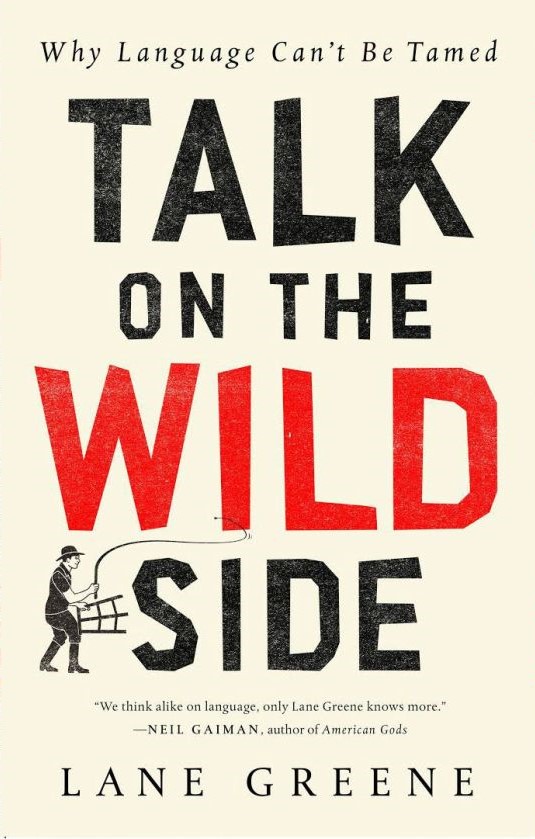
Talk on the Wild Side: Why Language Can’t Be Tamed by Lane Greene

It’s not really true that if you boil a frog slowly it won’t notice and will never try to escape. But if a lot of speakers very gradually inch a vowel forward or back, up or down in the space in the mouth, without even knowing, then over time a major change can set in without anyone acting in time to stop it. That is because vowel-boiling, unlike frog-boiling, is painless and victimless.

Another winner from Liz! I loved this book. It has just the right mix of expert, researched history and linguistics information, and irreverent, populist sense of fun and utility. In fact, utility is part of the central lesson of this book. Using English should be about effective communication; one can be correct, eloquent, elegant, without being snooty about it; correctness is relative and subject to context; the language is tough and durable, and doesn’t fall apart just because we slip up on the distinction between ‘who’ and ‘whom.’ (‘Whom’ plays a large-ish role in the book, to great effect.)

Lane Greene is an editor, a linguist, and a columnist on language. He’s originally from Atlanta, Georgia, but now lives in England with his Danish wife, and speaks nine languages. He has a deeply impressive grasp of the history and trends of the English language and of linguistics; he is an expert in these areas and easily wins my trust. And it’s refreshing to meet an expert who is not purist or snobbish about his field – although as Greene points out, the more expert the linguist, the less purist they’ll be.

He begins with the basics: the difference between prescriptivist and descriptivist linguistics. Descriptivism observes how language is used and has been used, and makes recommendations for how we use language based on how it’s been and is being used. Prescriptivism tries to make rules based on some sense of what is correct – it tries to prescribe, rather than observe. Prescriptivists believe there is what Greene calls One Right Way to do things, which is an inherently problematic concept. Greene knows how to set and follow rules; in one of his roles, he works as an editor, so he knows about the application of standards. (Particularly for a certain publication, for example, a “house style” sets rules.) But he is at heart a descriptivist. “To sum up: language is not so much logical as it is useful. It is not composed; it is improvised. It is not well behaved; it is resourceful. It is not delicate; it is hardy. It is not always efficient, buts redundancy makes it robust. It is not threatened; it is self-renewing. It is not perfect. But it is amazing.”

The book-length metaphor at work here is evident in the title. Language is wild, not to be tamed, and doesn’t take to prescriptivism’s puritanical tendencies. It is always changing, and it takes care of itself; it doesn’t actually need guarding or protecting. Greene proves this via a number of case studies and fascinating histories, including the Great Vowel Shift and shifts in the meanings of individual words: “In the Middle English era, manners dictated that a girl was expected to be silly and buxom, but never nice” (because each of those words meant something very different then than they do now). He relates humanity’s adventures in language, including the design of purely logical languages (never caught on) and attempts to teach computers natural language, which doesn’t work because “the rules are too many, the exceptions too manifold.” He studies language as a political tool (less powerful than some think).

And in my favorite chapter (six), “Whom in a biker bar,” he handles questions about register and the limited necessity for ‘proper’ English. “The choice of [register] allows a speaker or writer a valuable second channel of communication, alongside the literal meaning of the words and grammar that (hopefully) add up to a clear proposition, command, question or request. … To restrict yourself only to Formal – to buy into the One Right Way fallacy – is to leave a valuable and versatile tool lying on the ground.” I had been wondering, throughout this spirited and convincing defense of descriptivism over prescriptivism, why indeed I am teaching my students to avoid comma splices (etc.), and chapter six answered it for me. There is still a utility for a ‘proper’ English in certain settings, but the grammar police of the world (and those whom Greene calls ‘language tamers’) take undue pleasure in correcting us when in fact we could stand to relax in most settings – especially in spoken language. “Insisting that speech – a live activity, always changing, a biological behavior – must imitate writing – which is fixed – is a bit like insisting that people should continue to look like an old photo of themselves.”

This book is a joy for anyone who loves language, its niceties and nuances and finer points, its ever-changing, exciting, shape-shifting utility and its fascinating history. It’s certainly for anyone who is still hung up on correcting other people’s grammar, and it is certainly for anyone (like an editor or an English teacher) whose job it is to do so. If you’re unconvinced that prescriptivism doesn’t serve us, please read this book. If you love words, read Lane Greene. I think I know of some students who will be assigned excerpts this coming fall semester!


Rating: 9 prepositions at the ends of sentences.

National Theatre Live at Home presents Treasure Island (2015), and the other stuff I’m watching online

This week’s edition of NT Live at Home is another repeat for me, but one I was glad to be able to revisit. Treasure Island can be viewed here until Thursday, when we’ll get access to Twelfth Night. I’m looking forward to it!

This was the first NT Live show I ever saw, with my father, in Bellingham, WA at their outstanding Pickford Theatre. It’s as delightful as I remember. The talented Patsy Ferran plays Jim, who’s a girl in this version – I love a little gender-twist to a classic, and the empowerment that comes with it in a case like this. While it’s not such a big deal as to steal the show, she gets in a few lines about how girls can have adventures too. (Likewise, a few female crew members and pirates draw the odd remark – acknowledged, but not earth-shaking.) Ferran’s Jim is expressive and fun. Arthur Darvill’s Long John Silver is perfect: charming, and terrifying. I love the scene where his one-leggedness is revealed. And I like how they managed the one-leggedness onstage. I see in my original review that I was bothered by certain aspects of the adaptation from Robert Louis Stevenson’s novel; I am unbothered on this go-round, by more distance from reading the novel, for one thing, but also by appreciation for the theatre. Still impressed by the modular set! This is a great show.

Otherwise, this weekend I’ve been catching up on some of NPR’s excellent Tiny Desk Concerts: Bob Weir and Wolf Bros., Chika, Megan Thee Stallion, Rising Appalachia, Los Lobos, Sheryl Crow, Café Tacvba… and the odd Tiny Desk (Home) Concert, like one from Tank (from Tank and the Bangas). There are so many great ones to dig into.

I am also reading my way right through nearly 1,200 pages of The Stand and grading hundreds of pages of student essays.

Put NT Live on your schedule, if you haven’t already!