author interview: Paul Lisicky

Following my review of Later: My Life at the Edge of the World, here’s Paul Lisicky: Turning Up the Volume on the Everyday.


Paul Lisicky‘s work has appeared in the Atlantic, Conjunctions, the New York Times, Ploughshares, Tin House and many other publications. He was a 2016 Guggenheim Fellow, and has received awards from the National Endowment for the Arts, the James Michener/Copernicus Society and the Fine Arts Work Center in Provincetown, Mass., where he has served on the Writing Committee since 2000. He is the author of Lawnboy, Famous Builder, The Burning House, Unbuilt Projects, The Narrow Door: A Memoir of Friendship and Later: My Life at the Edge of the World, available now from Graywolf Press. Lisicky teaches in the MFA program at Rutgers University and lives in Brooklyn, N.Y.

How do you write a memoir about events nearly 30 years ago?

photo: Beowulf Sheehan

In many ways I’ve been writing this story over and over. At the center of my first two books is the prospect of AIDS and HIV. My third book is about characters who are dealing with an unnamed illness, the fourth is about dementia, and the fifth has cancer at the center of it. I think this material has been a part of my imagination for my entire adult life, and there came a point where it seemed crucial to get it to the page. I don’t think that those early years in Provincetown ever felt very far away to me. My friend Polly and I continue to talk about those events with regularity. Honestly, I think those days are firmer and more precise in my imagination than any other time before or since. If you asked me to write about Provincetown from 1996 onward, after protease inhibitors changed the landscape of AIDS for people who could afford them, my memories would be far more diffuse. But there was something about that window of time between 1991 and 1994 that continues to be sharp and bright and italicized to me. It’s so fascinating how memory works, and how much more is stored and alive in the imagination than you know.

How do you navigate writing about the lives of other people?

I don’t write about anyone who I don’t love very deeply, even though it might not always look like it. I’m drawn to people who are super vivid and complicated. I think it’s a sentence-by-sentence matter. If I’m aware of saying something that feels like it has more power over the subject than I should have, then I stop and process and think. There isn’t a simple answer, because largely it’s about paying attention to my intuition. It also involves showing the work to the people who appear in the pages. At least three of the people who appear in the book have seen the book and have vetted and approved everything I’ve written. It’s important to tell people, Look, I really love you. Some of the material here might be difficult, it might feel like it invades your privacy or puts down observations you don’t want to hear, but we can talk about that. It’s a matter of conversation first.

Is there a trick to writing beautifully about sad subject matter?

It’s not even something I think about. I could not write this book without folding in the landscape of Provincetown. Not just the topographical landscape, but the people on the streets, their interest in clothing, display, performance–all of that feels like it’s a part of this story. I think when one is writing about illness one is also writing about life. Life at the precipice can be super intense: it turns up the volume on the everyday. And that might be experienced as beauty by the reader, but as I’m writing I’m not terribly conscious of that quality.

It’s a book about surviving day to day, and how people take care of each other and check in on one another. And joy did not at all feel slight in those times. Joy was an aspect of participation, and those people in that community felt the need to draw life and joy and community out of one another. I think that’s one of the reasons why I felt compelled to write the book, because community and belonging got people through those times.

The book has a life of its own. I want to write something that feels more acute, more conscious than my usual everyday thinking mind. I’m trying to write something that teaches me as I write it.

How is writing your sixth book different from writing your first or second?

The first or second felt so tentative. I had no structural confidence. I didn’t know how to think about my work outside of the landscape of the individual sentences. And I don’t think that’s necessarily a bad thing, but over the years I’ve developed some chops in terms of how to think about how one scene may dialogue with the scene after it. I’m aware of building a conversation from passage to passage over the book, developing a passage around an image or metaphor that might speak to one that follows. I feel I have much more structural confidence and much more awareness of the book, any book, as a whole. I’m as excited about the macro elements of putting a book together as I am the sentences.

I learned a lot from The Narrow Door, which couldn’t follow a linear structure. When I tried to write that book in a linear fashion, it simply didn’t work. It wasn’t able to hold the simultaneous stories that that fed one another in my imagination. I had to write that in a way that was faithful to how my mind moved. That was tremendously freeing and an educational experience. It was teaching me how it needed to be written.

Is this a timely book?

I hope it is. I’m still taken with the idea of community at the center of this book. I don’t feel like I’m in a world where community takes care of me the way it took care of me then. It was a world that instantly felt welcoming, and not too much. In a world before social media, faces and gestures and simple kindnesses did a lot to sustain life. Life has not been that way for me since, and I suspect it isn’t that way for most of us. Most of our casual interactions happen through social media, the world of online. I wanted to write a book that thought about what we don’t have right now. And that’s not in any way to idealize the world at the center of Later, because that’s a world that was under siege day by day–it would be wrong to sentimentalize that period and think about it with nostalgia, because those were rough, rough times. But they were also times of deep tenderness and affection and looking out for one another. I needed to examine that world and bring it to the page, and offer readers another possibility of living. What don’t we have in our lives right now, and what could we have if we were lucky enough to organize them around a participatory life?

What’s next?

I’m working on a book about my father, or fathers in general. He’s a vivid and complicated character–you got to see a little about him in Later–kind of scary and loving and completely unpredictable. Still thought of himself as young when he was 90 years old. He became more open, gentler, as he grew older, but not in a Pollyanna-ish way. A lot of life in that human. For a while that book was braided with Later but I realized that it needed a separate life. So I have a lot of material: it goes back to the structural question. I don’t right now know how to shape it. It needs some boundaries to give it some cohesiveness. I have some ideas about it, but I’m excited about the fact that I still don’t know, that I haven’t found its glue. I have a kind of faith that I might not have had with earlier books. Once I find out the answer to this simple question, it’s all just going to fall into place.


This review originally ran in the April 14, 2020 issue of Shelf Awareness for Readers. To subscribe, click here, and you’ll receive two issues per week of book reviews and other bookish news.


In case it’s not clear, this interview took place “before COVID,” and I think Paul’s answer to the question of timeliness, about community, offers an interesting glimpse into the near past, across this great new divide. I said just the other day that Paul’s perspectives have aged well in ways that not all writing has. In mere weeks, some of our writings and perspectives have come to sound silly, near-sighted, insipid, frivolous. I think Paul Lisicky’s wisdom holds fast in what Paul Kingsnorth calls the Great Strangeness.

National Theatre Live at Home presents Jane Eyre (2015), and other online events

Week two of NT Live at Home! This was a repeat viewing for me – I saw Jane Eyre when it was a new production, and loved it. I was perfectly happy and grateful to see it again. And again, to remind you: this production is viewable for free but for a limited time, until the next show goes up on Thursday, so do go see it here asap. This week’s release will be Treasure Island, another outstanding production. Put it on your calendar!

So, Jane Eyre as repeat: still outstanding. I think I loved it even more this time around, although I see I originally rated it a 10, so I can’t do better than that! I am impressed all over again with the set – so simple, and yet used to convey so much movement and so many different sets; the movement of people, including the lovely, clever form of travel in a carriage left to the imagination but fully communicated by the actors; the use of actors as set (as a doorknob, for example) and (I still love this) the actor who plays a dog. And the bird. Each actor, excepting Jane herself, plays multiple roles, with few but meaningful costume changes, and yet they’re not a bit hard to keep straight. Minimalism is the thing all around: set, costuming, cast (in numbers only) are spare. But the acting is superb.

I had forgotten the musical numbers entirely! And while they contribute something (and are stunningly performed), they are not the most important element. What I remembered best about this play – minimalism and extraordinarily great acting – are still the best parts. I didn’t remember it being so passionate – I don’t remember Jane being so passionate, even when she was a child. As my mother would say, this character has an overdeveloped sense of justice. (I won’t say whom my mother has said that about!) That’s interesting, because in my interview with author Erin Blakemore, I recall she and I agreeing that Wuthering Heights is the novel of passion where Jane Eyre is the novel of reason – but this is surely a story of passion! at least in the stage version. Another new observation: on this go-round I badly want to reread the novel, which I haven’t read since high school. Maybe I can straighten all that out.

I was really stunned and deeply impressed with this re-viewing. Don’t miss it. My previous rating, 10 fires burning brightly, stands.

In other news, and continuing my feeling of overwhelm at all the lovely art & culture available online these days, I’ve seen some additional great stuff the last few days, including a Drive-By Truckers concert (from Pickathon 2017), a Jason Isbell & Amanda Shires jam session and fireside chat, and an author reading by Paul Lisicky and Carter Sickels at the Blue Stoop in Philly. (This was an event I’d originally planned to see in person – I had a dogsitter lined up and everything. But instead I got to attend with a whiskey in hand and dog in lap.)

This was the third time I’ve gotten to hear Paul’s voice in recent months. I interviewed him about his recent Later (that interview will be here on Friday), and I attended (online) another recent reading. He’s made me cry all three times; I don’t know what to tell you about that, but it’s a moving book and I’m a fan. Actually, Carter’s reading made me cry as well; they were both lovely, beautiful readings as well as beautiful books. (I haven’t read Carter’s, but I’ve since preordered it through Taylor Books.) There was some question of how new releases are reading, now, in the pandemic – because the books that are being released now of course date from before COVID ruled our lives. And while some have not profited by the change, sounding frivolous or tone-deaf in the new landscape, both of these books have aged well, if you will. Both are about sickness, which of course is creepy in its own way, but both have intelligent things to say about contagion, isolation, and how illness and death are in some ways confirmations of life.

having a whiskey with Paul Lisicky

Just last night I reveled in this Tank and the Bangas concert. There are concerts and plays coming out fast and thick – and I’m also reading three books at once and teaching a couple of college courses! Whatever else may be true in social isolation, bored I am not. I’ll say it again: the pandemic is a terrible thing. But there are some bright points of light in this darkness: art.

movie: Fantastic Fungi (2019)

Thanks, Mom, for making sure I took a look at this delightful documentary. In the age of work-from-home and social distancing, the days of the week have begun to run together, and I’ve decided to view something special each Friday night to mark the beginning of the weekend, lest I miss the occasion altogether. Fantastic Fungi kicks off my new tradition.

This film is visually stunning, and there are other benefits, but I think this might be the headline. Gorgeous! (Check out the trailer at the Fantastic Fungi website – you can also watch the whole movie from there for $5.) The sped-up/time-lapse film of mushrooms growing and spreading is mesmerizing, beautiful, and surprising: you may find that mushrooms come in far greater variety than you ever realized. And fungi, of course, of which mushrooms are only a subset.

Besides those magnificent visuals, there is plainly-stated science for laypeople – chiefly, the revelation that massive networks of mycelium make up part of the earth under our feet, wherever we go. The interconnectedness of fungi is one of their coolest features. Mushrooms have medicinal properties, make good food, and can be used to filter water; and we understand but the merest bit of them.

And then there is the magic of mushrooms. The film features a series of personalities, mycologists and mushroom-lovers, scientists and entrepreneurs, and of course there are some personalities in this part. When we get to the psychedelics, I’d say it gets a bit carried away and cult-like (and I say this as someone who is totally fine with y’all tripping on mushrooms if you want to, please understand). But there are some great points made about the weird prejudices we (the U.S.) hold as a country and as a society, the setbacks in research in this field, and the very cool recent research in the last 20 years into how psilocybin might could help cancer patients and those who suffer from depression and PTSD. Good information, but a bit mystical and awed. That said, this beautiful film would probably be enjoyable while eating the magic mushrooms, too.

The NYT calls it “informative and kooky,” and I think that’s about right. If you’re not already moderately mushroom-expert, this documentary will teach you something, and it will certainly stun and sooth your eyeballs. I rather agree with the reviewer that “I could have done without Brie Larson’s cutesy narration,” offering the fungi’s collective point of view. But cutesy is part of the shtick here. And I’m unconvinced by the idea that mushrooms will help us – with technology, of course – to save the world, but that’s a matter of my worldview, and your mileage, as usual, may vary. Worth $5 and 80 minutes of my life? Heck, yes. I’d love to have that time-lapse fungi playing on a loop, in fact. Enjoy.


Rating: 7 spores.

National Theatre Live at Home presents One Man, Two Guvnors (2011)

PSA: The amount of arts & culture that has become available online, in our homes, for free during this pandemic is glorious and frankly, overwhelming. (The pandemic is a horror, but let’s still recognize a boon when it occurs. And let’s please note the clear importance of the arts, and keep that lesson in mind ever after. Fund the arts! Support artists!) I am impressed and humbled and glad; also overwhelmed. But for me at least, the best thing to come along yet is this: National Theatre Live At Home. Every Thursday night for at least the next several weeks (and, I’d imagine, to continue beyond that), they’ll show one of their greatest productions on YouTube, free to stream until the following Thursday night. That means that the first free production, reviewed here, will stay available at this link until this Thursday night when we get a new one. Oh joy! Do take advantage. (And if you’re able, you might consider making a donation to support NT Live, too.)

One Man, Two Guvnors premiered at the National Theatre’s Lyttelton Theatre in 2011. The play is an adaptation of the commedia dell’arte Servant of Two Masters, resetting the plot in 1960s Brighton, England. It has many classic elements of comedic theatre, not to say Shakespeare: a woman disguises herself as her own twin brother (gender-bending); mistaken identities lead to heartbreak (love triangles and squares); abundant slapstick/physical humor; and the servant with two masters, which is reminiscent of the twin bosses and twin servants of The Comedy of Errors. I’ve said it before and I’ll say it again: it all brings me back around to Shakespeare. There’s also an actor playing a character who wants to be an actor (and thereby making fun of actors), and I’m always tickled by meta-humor like that.

Quick plot run-down: Francis Henshall has taken on two jobs at once, gofer for both gangster Roscoe Crabbe and upper-crusty Stanley Stubbers, and he has to keep them both unawares. Except Roscoe is really Rachel disguised as her twin, who is dead, murdered by Rachel’s boyfriend, who is Stanley. Roscoe is gay, but engaged to the daughter of another criminal type, Mr. Duck, even though said daughter would rather marry a (terrible) aspiring actor. Francis attempts to court Mr. Duck’s bookkeeper, but his chief concern is food: the chubby “man with two guvnors” hasn’t eaten all day and he’s famished. Key scenes include the one in which he must act as waiter to both “Roscoe” and Mr. Duck (in one room) and Stanley (in the other). This one involves a geriatric waiter-in-training and Francis’s scheme to waylay as much food as possible for himself. There’s another in which Francis’s good and bad angels (if you will) get into an altercation, so that he flails and rolls around the stage, a one-man fistfight. The ending I’ll just say is also typical of Shakespeare.

While I’ll confess this play started off a little slowly for me, it soon had me laughing so hard I cried, and at one point snorted beer on a sleeping dog who was most displeased. The acting was excellent: James Corden deserves the accolades he’s received for the role of Francis, which he fully embodies. Musical acts between scenes add to the period feel, in the style of early Beatles (whom Francis claims to have assisted in their founding); the musicians are joined by various cast members.

It’s also worth nothing that, not without its problems, this play engages in the odd bit of racism and plenty of sexism and even a rape joke – that last I would take right out. We make certain allowances for period drama, but I don’t think there’s any excuse for rape jokes.

One of the most remarkable elements of this play is that the fourth wall is thoroughly broken down; actors look to the audience for effect and pause mid-dialogue for laughter, which only increases it. Most importantly, there are several points at which audience members are solicited for sandwiches or dragged onstage to participate in the action. One such participant, “Christine Patterson,” gets quite deeply involved, and winds up, well, the brunt of some physical humor herself, shall we say. (I’m quite sure she was a plant, but the others, I’m unclear.) This was perhaps the best and cleverest bit of the whole thing. It was the Christine sequence that had me snorting beer.

I had a massively fun time watching Corden’s antics and the quite silly but thoroughly amusing plot of One Man, Two Guvnors. And for free! Thoroughly recommended (although future productions will be just fine without the rape joke).


Rating: 8 soup tureens.

Dog Years by Mark Doty

Love for a wordless creatures, once it takes hold, is an enchantment… This is why I shouldn’t be writing anything to do with the two dogs who have been such presences for sixteen years of my life. How on earth could I stand at the requisite distance to say anything that might matter?

How indeed?

I love Doty, as you know, and this book is an excellent example of some of the qualities of his work that I love best. He is thoughtful, meandering, wise, self-deprecating, shows his thinking transparently on the page, and has the most precise and loving eye for beauty; he turns most every observation of the world into ekphrasis somehow, by which I mean that he turns the same active, joyful, inquisitive observation to the Massachusetts shoreline or a NYC sidewalk that he turns to a museum-quality painting.

This review is a trigger warning of sorts. I love Doty, and I love this book, and I’m glad I read it, but it was also painful as hell. Dog Years is about beloved pet dogs who die (as they do), and it’s about 9/11, and it’s about death and loss. It is also absolutely relevant that I read this during the pandemic of the spring of 2020, and everything feels a bit more raw these days, the angst a bit closer to the surface than usual; and I have in no way recovered from my dear Ritchey dying more than a year and a half ago now, and my dear Hops is not even 12 yet but he shows his age. This book was beautiful and transcendent and really hard on me. I mean it as a compliment – this book comes with a warning because it’s so well done.

Because, you know, a book about a beloved pet dog dying could easily be (and they usually are) insipid, overly sentimental, a cheap shot. And I think telling the story of 9/11 (or Katrina, I think about that one a lot too) is awfully hard to do in a way that’s not going to sound like anybody could have told it. (This is true of the pandemic of 2020, too. Who will tell that story well? Will it be Doty? I’d buy that book. See also Paul Lisicky’s excellent recent release, Later. A little awkward: Paul Lisicky appears in Dog Years as Doty’s husband, which is no longer the case.) In other words, Doty has undertaken an ambitious book, which aims to do a couple of things at once that look nearly impossible to do well, even individually. But of course he’s knocked it out of the park. (It is a sign of my faith in him that I undertook to read a book about dogs dying. Whew.)

The dogs in question are Arden, a black long-haired retriever, and Beau, a golden retriever(ish). They are very specific beasts, individuals, as dogs are. Arden belonged to Mark Doty and his partner, Wally, in Provincetown, Mass., where Wally sickened and eventually died of AIDS, but not before Mark brought home Beau to join the family as well. “My friends think I’ve lost my mind: You’re taking care of a man who can’t get out of bed and you’re adopting a golden retriever? They do have a point, but there’s a certain dimension of experience at which the addition of any other potential stress simply doesn’t matter anymore.” (That is a golden retriever puppy, I would add.) Widowed, Mark (and Arden and Beau) will eventually form a new family with Paul, and it is in this shape that they make their way to the end of both dogs’ lives, eventually, after much travel and moving around – including living in New York City in September of 2011… I have seen Doty handle grief and loss before (although I’ve not yet read Heaven’s Coast, so there is still that), most recently of course with What Is the Grass, where death forms one of the five sources of Whitman’s genius. And Doty’s, I’d say. The way that these strands are intertwined is lovely and perfect.

When the towers fall, the enormity of all that loss and death and threat to the world is too much to conceive. “With the world in such a state, isn’t it arrogance or blind self-absorption to write about your dogs?” But Doty knows that “we use the singular to approach the numberless,” and this echoes one of the lines I most obsess over in Still Life With Oysters and Lemon, about “the strangeness and singularity of things…” (There is again an echo of the thread in Still Life that is about reflection, in all its senses: “We know ourselves by how we’re known, our measure taken by the gaze of the outsider looking in.”) The singular losses of Arden and Beau offer Doty a way to write about 9/11 and about topics larger than them. The unique to communicate the universal, and the personal to illuminate the public.

For me, what is perhaps the crux of this book came early. “To attach, to attach passionately to the individual, which is always doomed to vanish–does that make one wise, or make one a fool?” This is a more personal review than usual, but here we are. This is something I’ve been wrestling with, the enormity of loving again after the pain of loss, and I can’t quite believe that either way, the yes or the no, is the right thing. But I always feel I’m in good hands with this writer. Maybe I’ll figure something out if I keep reading.

Of course you known as well that I love Doty’s detailed lists of things, his descriptions (ahem) and the simple fact of his attention turned to all the humble things… the soup Arden smells on that sidewalk. “Of Franco’s retail experiment, there remained for several years an odd little lamp beside his old shop door marked with a thirtiesish design that would have held no meaning if you didn’t know what it had illuminated–but now that’s gone, too.” Things and meaning and the spaces they held, left behind.

Oh! I nearly forgot to mention structure, which absolutely needs mentioning here. Longer, numbered (untitled) chapters do the work of memoir, of memory, not entirely chronological but at least following life in some form; some of them take the form more of essay than of strict narrative, like in chapter three, when he lists and details seven “aspects to our delight” in dogs. Between these are spliced shorter pieces headed Entr’acte (an interval between two acts of a play or opera; a piece of music or a dance performed during an entr’acte), titled and not numbered. These generally take the present tense, and range as widely in content and theme as the rest of the book… and wouldn’t you know, my MFA thesis took the same structure, longer memoiristic essays with short lyric pieces in between… There is also a good bit of Emily Dickinson in this book, and I think my new approach to poetry is just to let Mark Doty tell me about it.

This is a writer I return to for guidance, and this book is an exemplar of what I appreciate about him, but (if you love a dog) it may hurt you, too.

Rambling review brought to you by the pandemic and my difficulty focusing, and the pain that this beautiful book brought me.


Rating: 9 obstreperous things.

What Is the Grass: Walt Whitman in My Life by Mark Doty

What Is the Grass is literary criticism and explication, memoir and meditation, and the kind of fine, evocative, thoughtful prose that Mark Doty does best.


It was part of Walt Whitman’s extraordinary innovation with Leaves of Grass to close time and space, to bring his observations and a sense of intimacy to each reader who finds him. It feels perfectly natural that acclaimed poet and memoirist Mark Doty (Dog Years; Still Life with Oysters and Lemon; Deep Lane) chooses to receive, interpret and muse upon these transmissions with What Is the Grass: Walt Whitman in My Life.

Doty, like Whitman, is gifted with words, a lover of beauty and of men, a New Yorker. He feels haunted by the elder poet, sees and smells him in the museum of Whitman’s home, again encounters his ghost “above the shoulders of a bedmate on a winter afternoon early in the twenty-first century, in an apartment tower in Hell’s Kitchen.” What Is the Grass is a close reading of Whitman’s great work, but also of American poetry, same-sex love, the exuberance of the physical body, myriad cultural shifts and Doty’s own life.

As is his habit, Doty’s mind on the page wanders widely. Considering a “weird period piece of art porn,” he realizes that “even in the imagined paradise of limitless eros, there must be room for death.” Indeed, death is the fifth of five sources Doty identifies for Whitman’s genius, by which he organizes this book. First, “an experience… of transforming character, loosening the doors from their jambs,” some life-changing moment or moments in Whitman’s life. The second source, “The Unwriteable,” is vigorously, jubilantly celebrated queer sexuality; here and throughout, Doty considers his loves and lovers, relationships and travels.

Next the very city, the “great stream and pulse of life” that is Manhattan, and then language itself, the lovely trips and surprises and sensuous effects and all the multitudinous details to be found in the Crystal Palace exhibition, “at which examples of practically everything human endeavor had created up to 1853 were on display.” Add to this slang and regionalisms, and “these words splash onto the page in Whitman’s first edition, as if a dam holding back a flood of new speech had been dynamited, all at once, by the force of a single poem.”

The fifth source of Whitmanian genius is death, “that strong and delicious word,” which Doty as well must wrestle with. “I’ve seen a man I loved die, and it seemed to me a pure liberation.” But “time avails not, distance avails not,” as Whitman and Doty each repeat, and the latter helps navigate the former. Readers should be prepared to dig out a copy of Leaves of Grass (or find one: “there is a copy of the Leaves in every used bookstore, everywhere in the nation, count on it”) upon reading this book, which makes an indispensable companion and guide. Arriving finally at “the poet’s greatest glory, and the exegete’s inescapable defeat,” in the end, Doty reminds us that Whitman’s “words accomplish what words cannot,” and exits quietly.


This review originally ran in the March 20, 2020 issue of Shelf Awareness for the Book Trade. To subscribe, click here.


Rating: 8 lines I’d consider tattooing on my body.

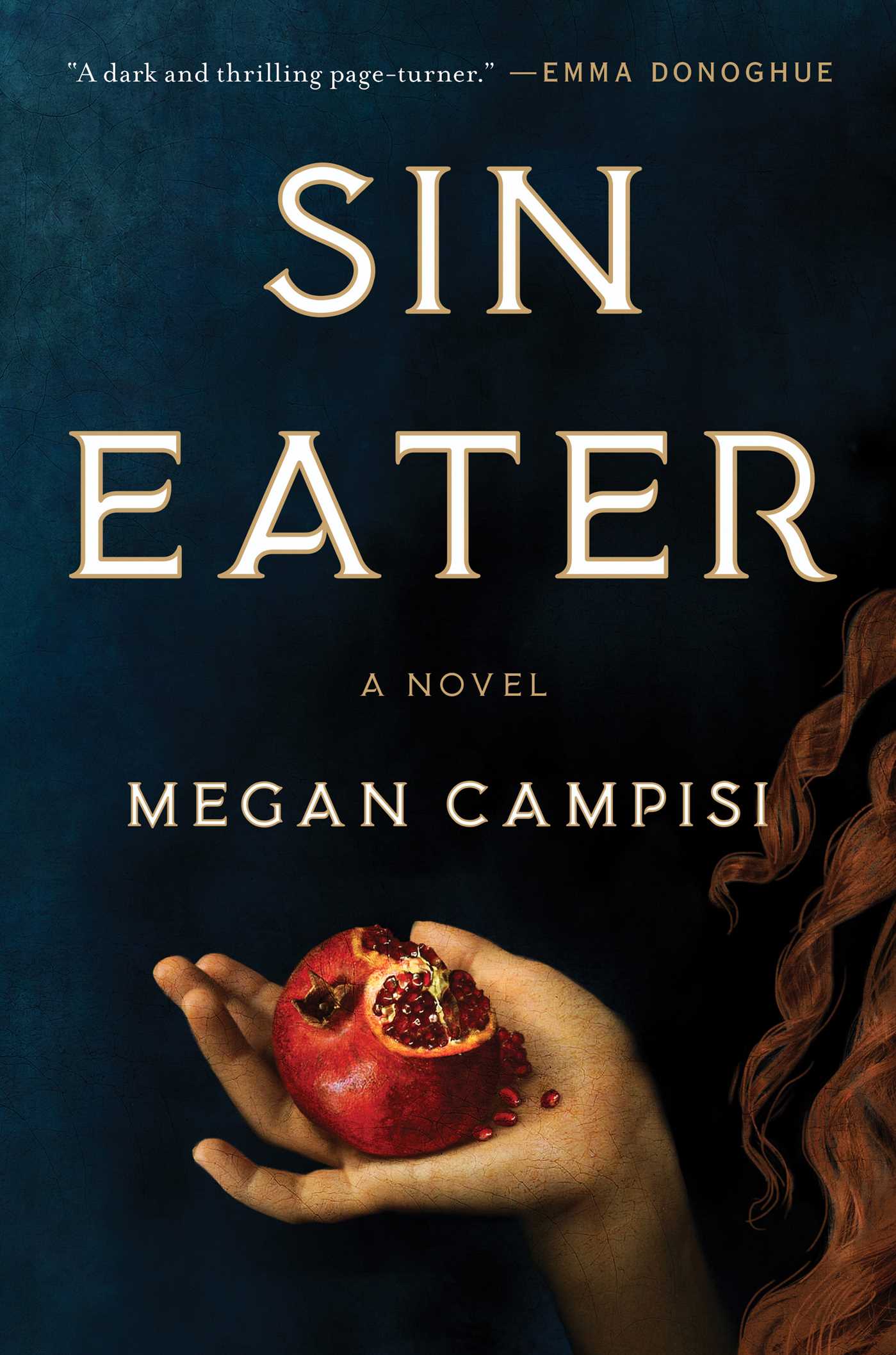
Sin Eater by Megan Campisi

In this enchanting alternate history, a Sin Eater consumes the misdeeds of others, and may have a chance to right some wrongs.

Megan Campisi’s Sin Eater opens with a 14-year-old girl named May being arrested for stealing a loaf of bread, in an alternate version of Elizabethan England. The royal family of Angland is entangled in court intrigue and murders, including of babes, to secure favored heirs to the throne, even considering marriage to the hated Northern lords. Common people work hard for a meager living; some starve unless given special permission from the queen to beg in the street. The penalties for petty crimes are high: vagrants have a hole “burned through the gristle of [the] ear with a hot iron as thick as a man’s thumb.” The penalty for a second offense is death.

In this cruel world, below even dung men and woad dyers in the social order, lies a cursed role: that of the Sin Eater. “It’s always women who eat sins, since it was Eve who first ate a sin: the Forbidden Fruit.” Marked by the iron collar locked around her neck and her tattooed tongue, she may be neither seen nor heard. She is called to deathbeds to hear the Recitation, a confession of sins; she translates these sins into foods, which the family will prepare for the Eating. By taking the sins of others into herself, the Sin Eater absolves the deceased. Every child in the street knows the basics. “Salt for pride. Mustard seed for lies. Barley for curses.” When a deer’s heart appears on a noblewoman’s coffin, the city’s older Sin Eater will not eat it, for the terrible sin it refers to was never confessed. She is tortured and killed, leaving May on her own to wrestle with a deadly royal plot.

Recently orphaned and terribly talkative, May is now forbidden to speak. Her apprenticeship as Sin Eater was both silent and short; she’s still learning which foods match the more esoteric crimes. In her favor, May discovers the strange power of the Sin Eater: afraid to touch her, people move out of her way, granting her access to prison cells and royal bedchambers. Chance introduces her to a group of fellow misfits, including a disfigured man, a leper and a roguish theater player. But she must solve the royal mystery alone and, just maybe, create a new fate for herself.

Sin Eater is a fully fleshed work of speculative fiction, abundant with the fine details of Elizabethan life and, of course, food. May is a damaged and sympathetic heroine, at once intelligent and innocent. This is an opulently imagined debut, horrific and weirdly beautiful, filled with earnest feeling as well as cruelty. Set aside time to read this engrossing novel in one go.


This review originally ran in the March 16, 2020 issue of Shelf Awareness for the Book Trade. To subscribe, click here.


Rating: 7 small loaves of bread.

wild times, and a reading

Posts have been continuing as normal here, but I just wanted to pause and acknowledge that the world is turning upside down and all is not “normal.” I’m safe, as much as anyone is these days I think, but I’m… disrupted and upset and frightened. The college where I teach held our last day of in-person classes on March 12, and then sent all students home from the dorms, took a few days’ break, and reopened with online classes on March 18. So, a semester and a half into my teaching career, I’ve been undertaking a new format. It’s been a bit hectic. I’m worried for my students. I’m readjusting to a life lived in my house, in my laptop, and in round-the-clock contact with Hops (he is thrilled).

just as long as we’re together

I am lucky and privileged to be as safe and secure as I am, which is not entirely, but better off than many. This post is not meant to be self-pitying. But I needed to pause, as I said, my usual programming to say: we are all topsy-turvy. If you still want book reviews, they will still be here twice a week. They do get a little harder to produce, though, I confess.

If you are like me and you’re luckier than most, think about what you can do to help. I like the Book Industry Charitable Foundation, which supports booksellers in times of crisis. We want independent booksellers to survive! I’m also looking into options like the Restaurant Workers’ Community Foundation and USBG National Charity Foundation for food & beverage service workers, whose work I so appreciate and who are mostly or entirely out of income just now. (Bars and restaurants have been closed in the state of West Virginia, and in many states and communities, and probably more will be closing; where they are allowed to be open, business is obviously slow.)

(I have loved some bars.)

If you can help someone else, do so. And obviously, please, isolate and take precautions – not just for yourself, but for others and for community.


And now, a reading. If you’re here, maybe, like me, you’ll appreciate a restorative by way of Paul Kingsnorth, whom I love. I find his truths to be beautifully expressed, painful, and exquisitely true. So “in the time of the great, strange plague,” here is “Finnegas” (h/t Pops for finding this). I find it comforting, and beautiful. “We should be saying: stories were the problem. We should be saying: no more stories, not from us.” (Shades of Savage Gods.) Read, and be safe. Book reviews will be back on Friday. Take care of each other. Thank you.

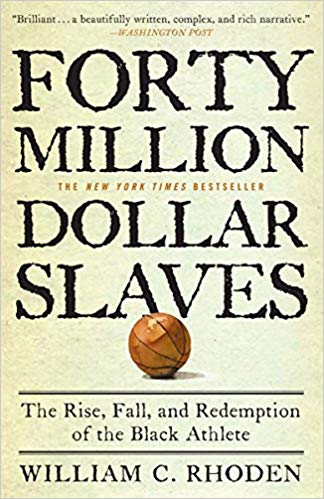
Forty Million Dollar Slaves: The Rise, Fall, and Redemption of the Black Athlete by William C. Rhoden

I had my composition students read this excellent article by Jemele Hill at The Atlantic, as we discussed issues in higher education and the rhetorical tools that make for good argument. I felt the memorable book title mentioned, Forty Million Dollar Slaves, rang a bell. I was motivated enough to go looking for a copy; I ended up getting it through interlibrary loan (ILL) at the college library, which fit neatly into our library instruction period – I got to show the students how to make the request, and I brought it to class when it arrived, so we could see how far it had traveled (just down the highway from Morgantown’s West Virginia University) and how long I’d get to keep it (sixteen weeks!). After all that, I was interested enough to read it, too.

William C. Rhoden’s deliberately provocative title comes from a racist comment made by a white fan at a Lakers game, and refers to the problematic relationship between Black labor and white profits. There’s a paradox at work here: the highest-paid Black athletes in professional sports pull truly unimaginable sums of money, but they still lack power over their own circumstances in some vital ways, and the owners, coaches, and powers-that-be in sports are still overwhelming white. It might seem counterintuitive to call someone a ‘slave’ who makes tens of millions, but Rhoden has some strong arguments to make about power dynamics. His book is partly a history of Black American athletes since the beginning of commercial sports in this country, and even before that. It is also partly a call to action: Black athletes have contributed for too long to the enrichment of white authority figures.

Because I’ve been trying to teach my students the strategies of argument this semester, I thought of this book in those terms. Rhoden has a strong thesis; we know from the outset his position on the question of Black athletes in the contemporary American sports scene. He offers substantial and substantive evidence, throughout history and in examining several perspectives (athletes, agents, parents, coaches, owners). Some of my students balk at arguments that voice a strong opinion; they have gotten it into their heads somewhere that ‘neutrality’ is desirable, but I argue that neutrality is first of all dishonest, and secondly, how will you ever convince anyone of anything if you are afraid to take a stand? Yes, Rhoden’s stance is clear from the start. And it’s worth noting that, as his audience in this instance, I was prepared to follow him: I was predisposed in his favor. But I think I can still say that his evidence, and the means and organization of his audience, were well-designed.

I learned a lot of history from this book. Major Taylor I knew, of course, but I did not know Isaac Murphy (horse jockey), Moses Fleetwood Walker (baseball), or Jack Johnson (boxer from Galveston). I knew Jackie Robinson, but not Curt Flood or Rube Foster. Althea Gibson and Wilma Rudolf were vaguely familiar at best. A number of individual stories, these and many more, I found fascinating, so involving that I was in danger of heading down a rabbithole until Rhoden brought me back to the larger picture. Also, I learned in this book that the alley-oop originated not in basketball but in football!

Chapters are named for the dilemmas he identifies as running through history: the dilemma of illusion, the dilemma of physical bondage, of exclusion, of inclusion without power, of neutrality, of the double burden (being both Black and female), etc. He coins the term “Jockey Syndrome,” for what happens when those in power change the rules in order “to maintain control in the face of a perceived challenge to white supremacy.” As the term suggests, this began with horse racing. When I read about this concept, I immediately thought about the unspoken ‘rule’ and general resistance against the jump shot, early in basketball history, and the NBA’s official rule against the slam dunk in the 60s and 70s. (Tell me that wasn’t racist.) He comments meaningfully on the “Conveyor Belt” that carries young Black talent from lower-income or at-risk areas through college and into professional sports, all the while impressing upon them that they should feel grateful for the opportunity, and meanwhile capitalizing on their skills. He decries Michael Jordan’s neutrality on social and political issues – race issues – as a lost opportunity. “Black athletes like Jordan have abdicated their responsibility to the community with an apathy that borders on treason.” He criticizes Bob Johnson, founder of BET (later owner of the Charlotte Bobcats), for using race and Black culture to make his billions but failing to deliver much in return.

At the center of the problem he identifies is the relationship of Black Americans to the larger American culture and socioeconomic systems in which they live. It’s vital that he takes this longer-term historical perspective, beginning with slavery and following through Jim Crow, the civil rights movement, and whatever we’re going to call this present ugliness we’re living. Had the first Black owner of a major sports team come a generation earlier, Rhoden argues, the community would have celebrated; it would have meant the beginning of substantive change in power structures. But the success of integration, he writes, has led to the disintegration of Black communities and a certain sense of solidarity. What we have in place of a more segregated but more self-sufficient Black community is the Bob Johnson model. For example, the integration of Southern minor-league baseball meant the dissolution of the Negro Leagues. “A pattern was set: A black institution was dead, while a white institution grew richer and stronger. This was the end result of integration.” Johnson’s mentality, “of using backness as a way to get a piece of the pie without necessarily feeling any reciprocal responsibility to sustain black institutions… was the natural outcome of a half-finished mission.” That half-finished mission was integration, perfectly represented by highly-paid but powerless professional athletes. In other words, Rhoden’s argument about Black athletes is about something much larger than sports.

Rhoden has been a sports journalist since I was born, credited with elegantly handling the intersection of race, sports, and social history. This book was proposed in 1996 and published in 2006, and feels a bit dated already, in some of its details; but the essence of the problems he identifies has absolutely not changed. It’s an important argument; these are important conversations to have. Recommended.


Rating: 8 dollars.

Maximum Shelf author interview: Kawai Strong Washburn

Following Friday’s review of Sharks in the Time of Saviors, here’s Kawai Strong Washburn: That Isn’t the Way the World Works.


Kawai Strong Washburn was born and raised on the Hamakua coast of Hawai’i. His short fiction has appeared in McSweeney’s, Electric Literature and The Best American Nonrequired Reading, among others. He has received scholarships from the Tin House and Bread Loaf writers’ workshops and has worked in software and as a climate policy advocate. He lives in Minnesota with his wife and daughters. Sharks in the Time of Saviors (MCD/Farrar, Straus & Giroux, March 3, 2020) is his first novel.

How does a story with multiple protagonists come to be?

photo: Crystal Liepa

I think a lot of writers gravitate toward what they love, and I love books in which you get to think into multiple consciousnesses. You get to expand your initial impressions. And it’s possible to do this with a third-person perspective, but it can feel less rich, or it can move me less that way.

I knew early on that it was going to be about a family, and I really wanted to dive into each person and challenge myself to create characters that would have perspectives that were nothing like mine. With all the different family dynamics involved, pushed in different directions, each has their own blind spots and their desires and their failures. It was a challenge, but one I wanted to try, because I felt it made for a richer experience as a reader, and so I wanted that as a writer as well.

How do you handle the storytelling challenge of shifting points of view?

For me it is very hard, partly because none of them are based on me. I read a section a few years ago, that was excerpted in Electric Literature, in which Dean hits his mother. Somebody came up to me after I read that and said, oh, you’re so brave to write about having hit your mother! And I said, this is not my life! None of these characters are me, or my family. They’re not based on anyone I know. With Dean, the challenge was to write a character who would have tried to beat me up in high school. If I encountered him in most walks of life, he would feel like an antagonist. Is there a way that I can write this character and understand what makes him tick with a sense of empathy but without letting him off the hook for his faults? Create this whole character who has problems and stupidities and issues with anger management, but in a way that challenges me to think about how he might justify his feelings to himself.

I love language. I really love it when writers take risks with language and render a new way of speaking and thinking that I haven’t experienced before. It takes me to a new place. I wanted to do that with the characters as well, and so in addition to creating these different psyches, I then had to create a different language for each, so that they each felt like a different consciousness. There were so many revisions to get sentences right. Given a thought that might be the same for Kaui and Dean, how would that feeling play itself out in different sentences? What would their voices feel like in their head? It was a ton of work. It was awful. I would never do it again. If I’d known at the time what a challenge I was setting for myself, I probably would have been like, no. But once I was in there, that was the work that was before me.

So this is not autobiographical.

I share very little with the characters. All the locations where all the scenes happen are places I have been. I could draw on my own experiences in those places to describe the smells and the ambient details. And there are times when I indirectly brought in observations that I had, as someone from Hawai’i moving [to the mainland], the cultural dissonance. Observationally I drew upon that, but there are almost no experiences in the book that I drew from my personal life directly. Having lived and grown up in Honaka’a, I experienced the place long enough that I had an innate sense of the culture and how most people think and feel and act.

I wrote a first novel that will never see the light of day. I think that that’s where I got the classically autobiographical elements out. In this book, in any moment when I felt like a character was doing something that I would have done, or when I winced at their decision-making or their biases or their thoughts or feelings because those were not thoughts or feelings I would have, or they made me uncomfortable, I would push toward those things and away from things that felt like me, in a conscious attempt to move away from the autobiographical.

What aspects of the book required research?

When you come from what is traditionally an underrepresented perspective and an underrepresented place, you carry this burden of authenticity that some writers don’t have to grapple with as much. When I wrote earlier in my career, I didn’t write about Hawai’i, partly because I was scared that it would be autobiographical. Or there was an expectation that because I’m from Hawai’i I should write about Hawai’i. But also I was scared, because there wasn’t a lot of literature out there based in Hawai’i, that I would fail to present the sort of universal feeling or experience of people from the island.

I spent a lot of time doing research into the mythology and native Hawai’ian religion that I had passing knowledge of, being born and raised there. You remember those things, but not fully or accurately enough to be a cultural ambassador. So I went back and spent a lot of time researching Hawai’ian culture and folklore and knowledge and history, because I had just enough incomplete knowledge to be dangerous if I just wrote from what I knew.

Do you have a favorite character?

I do. I don’t know if you’re supposed to say that, it’s like a kid. But I really enjoyed Kaui.

I see the novel as a kind of metaphor for the Big Man theory of history. All the great inventions, the important moments in the collective history of this country, are almost always filtered through the lens of a particular actor, usually a man. That’s what Nainoa came to represent to me, the Big Man theory of the events early in their lives. Particularly Malia is really invested in the idea of Nainoa as some sort of savior. He’s going to be this special, important Big Man. As I was working through revisions, Kaui became the answer to that. I believe that most positive change that has happened in the world has come about because of collective action and a lot of small, simple sacrifices in ways that no one ever sees or celebrates. The right person happens to be in the right place at the right time and gets on the apex of that groundswell, and they’re the one that gets the credit for it. Kaui embodied an answer to that. She’s back in Hawai’i and she has to learn to accept that she’s made mistakes, but the way forward is to reconnect with her family and the land. She has to give up a sense of complete individuality, something that Nainoa was reaching for incorrectly, that was placed on him as a burden. He’s supposed to be something so big that he can fix everything. And to me, Kaui’s reckoning in the latter third of the book is a sort of answer, that that isn’t the way the world works.

I really like the idea of having her be an engineer, having her build things with her hands and be a very physically grounded character, as a woman. I don’t think women necessarily get rendered in literature and in pop culture in a way that I kept wishing they would. I tried to not direct my gaze too much at the body. The way some male writers talk about female bodies can be really creepy and gross. When I was writing Kaui, I wanted her to not be some idealized femme fatale. She was living in a body that was strong and that she was comfortable in. She didn’t have anything to do with beauty or the standard female values that are upheld in a lot of pop culture. She was more driven by friction and velocity and fear, and a lot of things that don’t get associated with female characters. It became a lot of fun and that’s one of the reasons I enjoy her as a character.

What are you working on next?

I’ve started another novel. It has to do with climate change, has some elements of reincarnation, it spans around 200 years, there’s a band of female pirates: it’s cool. I’m enjoying it. It tries to blend a couple of genres, and celebrate both the internality of the human experience and the things I love about plot.


This interview originally ran on March 4, 2020 as a Shelf Awareness special issue. To subscribe, click here, and you’ll receive two issues per week of book reviews and other bookish fun.