movie: The Great Gatsby (2013)

Well, we finally got around to it! Sadly, my friend Justin and I missed this one in theaters; I think it would have been oustanding on the big screen, but Justin has a large-ish screen at home too, so we did okay.

My first comment on this movie is that it is wildly visually pleasing, and impressive, and extravagant – much like the Roaring 20’s.

photo credit (click to enlarge)

photo credit
(click to enlarge)


The spirit of Gatsby’s parties, the lavish lifestyle, is well evoked. Actually, I am impressed with the faithfulness to the book in story, too; it’s been years since I’ve read it, so I may be missing the minor details, but the feel was right. Perfectly rendered are the beautiful women in outrageous costumes, with a tendency to turn their heads just so to catch their lovely profiles; Gatsby’s larger-than-life personality and biography, and his arresting discomfort in the shadow of Daisy’s presence; and Nick’s own retiring persona. There is a framing element added to the movie that was not present in the book; it’s a little unsettling for us book-purists, but minimally so, and I think I can understand how it felt necessary, to explain Nick’s narration.

And oh, did I mention the visual appeal? The women, the clothing, and the outrageous parties – not to mention Leonardo DiCaprio himself as Gatsby – are positively eye candy. Leo is at his best, exhibiting the boyish, almost childlike charm we knew him for in earlier years (singularly in the scene involving the shirts – “they’re such beautiful shirts”), an older man’s brooding, and all the rest of his handsome faces. It was easy to get lost in some of the scenes and scenery. The film is clearly color-enhanced; I’m no expert and can’t explain this, but the color is clearly doctored. This adds to a fairy-tale-like feeling throughout, which is not faithful to the book, but somehow works. In this different medium, the larger-than-life effect feels like the proper analogy to Fitzgerald’s book. Towards the sad ending, the movie transitions to the disaffected tone of the book with perhaps some abruptness. But really, it’s a damn fine job – and gorgeous.


Rating: 8 beads.

remarkable bits from Pilgrim at Tinker Creek

Correct: we are still not done with Annie Dillard. I may have to make her a tag as I have done for Abbey and Hemingway. (…Haven Kimmel, Norman Maclean…)

EDIT: here we are.

On top of my reviews, I felt the need to share some of my favorite lines and passages with just a few notes. Enjoy.

There are seven or eight categories of phenomena in the world that are worth talking about, and one of them is the weather.

One wonders very much what else would make her list!!

I want to think about trees. Trees have a curious relationship to the subject of the present moment. There are many created things in the universe that outlive us, that outlive the sun, even, but I can’t think about them. I live with trees. There are creatures under our feet, creatures that live over our heads, but trees live quite convincingly in the same filament of air we inhabit, and in addition, they extend impressively in both directions, up and down, shearing rock and fanning air, doing their real business just out of reach. A blind man’s idea of hugeness is a tree. They have their sturdy bodies and special skills; they garner fresh water; they abide. This sycamore above me, below me, by Tinker Creek, is a case in point; the sight of it crowds my brain with an assortment of diverting thoughts, all as present to me as these slivers of pressure from grass on my elbow’s skin.

I loved this because I, too, love trees; and this is a well-articulated (but still rather charmingly airy, too) explanation why. Also, I enjoy Dillard’s use of the semi-colon, my personal favorite punctuation mark. (Yes. I’m a librarian and a reader and writer. I have a favorite punctuation mark.)

My God, I look at the creek. It is the answer to Merton’s prayer, “Give us time!” It never stops. If I seek the senses and skill of children, the information of a thousand books, the innocence of puppies, even the insights of my own city past, I do so only, solely, and entirely that I might look well at the creek.

“It never stops.” Golly, I hope she’s right. Climate change has us receiving too much rain here and not enough rain there; the forests are burning; the glaciers are melting; I fear the creeks are stopping (and starting up elsewhere). But in 1974, I can understand this thinking.

I suspect that the real moral thinkers end up, wherever they may start, in botany.

This, too, is charming: a nerdy confirmation of the power of trees and other green things (and non-green things as well).

John Cowper Powys said, “We have no reason for denying to the world of plants a certain slow, dim, vague, large, leisurely semi-consciousness.” He may not be right, but I like his adjectives. The patch of bluets in the grass may not be long on brains, but they might be, at least in a very small way, awake.

Who is Dillard to say that he may not be right? Goodness, with all the time travel and metaphoric “patting the puppy” she gushes and coos, why not let trees have a certain semi-consciousness? And those complaints aside, does anyone else hear the Ents walking through those lines? Lovely.

All the green in the planted world consists of these whole, rounded chloroplasts wending their ways in water. If you analyze a molecule of chlorophyll itself, what you get is one hundred thirty-six atoms of hydrogen, carbon, oxygen, and nitrogen arranged in an exact and complex relationship around a central ring. At the ring’s center is a single atom of magnesium. Now: If you remove the atom of magnesium and in its exact place put an atom of iron, you get a molecule of hemoglobin. The iron atom combines with all the other atoms to make red blood, the streaming red dots in the goldfish’s tail.

And that blows my mind: a scientific, tiny-scale, real-life confirmation, like a metaphor but grounded in reality on the molecular level, of our intricate connection as living, breathing, animal things to living, breathing green things. I love that.

book beginnings on Friday: Z: A Novel of Zelda Fitzgerald by Therese Anne Fowler

Thanks to Rose City Reader for hosting. To participate, share the first line or two of the book you are currently reading and, if you feel so moved, let us know what your first impressions were based on that first line.

I have been on quite a kick lately! Between the Hemingway-Fitzgerald-and-Faulkner class (final wrap-up here); The Other Typist; and The Great Gatsby movie (review to come), I am all wrapped up in the 1920’s these days.
z

Therefore, in the spirit of The Paris Wife and Loving Frank, and because I am a Fitzgerald fan as well as a fan (who isn’t?) of the flamboyant flappers’ era, of course I had to get my hands on this new “novel of Zelda Fitzgerald.” I had a tip that I should do it on audio, since Zelda’s South twang is so charmingly performed. So here we are. The book begins with a short letter from Zelda to Scott, which I would like to think is real but a few sources say isn’t. Ah well.

December 20, 1940

Dear Scott,

The Love of the Last Tycoon is a great title for your novel. What does Max say?

I’ve been thinking that maybe I’ll brave an airplane ride and come to see you for New Year’s. Wire me the money, if you can. Won’t we be quite the pair?– you with your bad heart, me with my bad head. Together, though, we might have something worthwhile. I’ll bring you some of those cheese biscuits you always loved, and you can read me what you’ve written so far. I know it’s going to be a wonderful novel, Scott, your best one yet.

This is short so I can send it before the post office closes today. Write me soon.

Devotedly,

Z~

I find the beginning enjoyable, although I already have a few concerns. For one thing, I note a suspiciously strong feeling of deja vu: is this Scarlett O’Hara I see here, only having won her Ashley Wilkes this time around? She even puts on a green dress for the purposes of charming her beaux, although it’s possible this is a confirmed historical fact. (Not worth my research at this point in time.) And while there are some charming turns of phrase, there is also the reference to “eyes as green and expressive as the Irish Sea” – which, ostensibly coming from a 17-year-old lifetime resident of Montgomery, Alabama, doesn’t feel like quite the right choice of words. For now, though, I will suspend these quibbles and lose myself in Zelda’s gushings.

And what are you reading this week?

vocabulary lessons: Pilgrim at Tinker Creek

Annie Dillard had me quite active with my note-taking for later looking up. I have included only the highlights here for you.

anchorite: “An anchorite’s hermitage is called an anchor-hold; some anchor-holds were simple sheds clamped to the side of a church like a barnacle to a rock. I think of this house clamped to the side of Tinker Creek as an anchor-hold.”

discalced: “[The effort to] gag the commentator, to hush the voice of useless interior babble that keeps me from seeing… marks the literature of saints and monks of every order East and West, under every rule and no rule, discalced and shod.”

spate: “I live for… the moment when the mountains open and a new light roars in spate through the crack, and the mountains slam.”

oriflamme: “The flight [of a flock of starlings] extended like a fluttering banner, an unfurled oriflamme…”

sonant and surd: “The wind shrieks and hisses down the valley, sonant and surd…”

scry: “…I had better be scrying the signs.”

eidetic: “…we have feelings, a memory for information and an eidetic memory for the imagery of our own pasts.”

obelisk: “We run around under these obelisk-creatures, teetering on our soft, small feet.” (She’s referring to trees.) and, 20 pages later: “A tree stands… mute and rigid as an obelisk.”

pavane: “An even frailer, dimmer movement, a pavane, is being performed deep under me now.”

neutrinos: “I imagine neutrinos passing through [a bird’s] feathers and into its heart and lungs…”

racemes: “Long racemes of white flowers hung from the locust trees.”

a two-for-one, etiolated and lambent: “The leaf was so thin and etiolated it was translucent, but at the same time it was lambent, minutely, with a kind of pale and sufficient light.”

eutrophic: “The duck pond is a small eutrophic pond on cleared land…”

phylactery: “…the microscope at my forehead is a kind of phylactery, a constant reminder of the facts of creation that I would just as soon forget.”

cofferdam: “…pouring wet plaster into the cofferdam…”

stet: “If the creature makes it, it gets a ‘stet’.”

shmoo: “Generally, whenever he was out of water he assumed the shape of a shmoo…” (referring to a muskrat).

enow: “The Lucas place is paradise enow.”

lorn: “A bobwhite who is still calling in summer is lorn…”


See other “vocabulary lessons” posts here.

Pilgrim at Tinker Creek by Annie Dillard, part the second

pilgrimattinkercreekI’m afraid I am continuing with my mixed feelings here, as in my first review. Pilgrim at Tinker Creek, for me, comes in sections, or in three parts. As I wrote, the early bits were difficult for me, a little too metaphysical and spiritual. And then, remember how I said that chapter 7 blew me away? Well, chapter 8 is even better.

Chapter 8 is entitled “Intricacy,” and addresses the amazing, extraordinary intricacy, complexity, tiny detail and huge scale and huge scale of tininess in the natural world. Dillard relates statistics that are mind-boggling: “the average size of all living animals, including man, is almost that of a housefly.” “There are… two hundred twenty-eight separate and distinct muscles in the head of an ordinary caterpillar.” “Six million leaves on a big elm.” She writes about the Henle’s loop in the human kidney, the lower lip of the dragonfly nymph. Tiny, infinitely complex things that make our world so strange. She uses this phenomenon to explore the idea of a creator – and here Dillard and I will disagree a little, but that’s okay. “Look… at practically anything… and see that not only did the creator create everything, but that he is apt to create anything. He’ll stop at nothing.” She takes the strange and prolific nature of our world to be proof of a creator – “no claims of any and all revelations could be so far-fetched as a single giraffe” – and I don’t. It’s all right, though; this book is plenty safe for atheists; she’s not preaching. She’s just exploring. And I love the science, all that tiny tiny trivia, the explanations of the human kidney and the aquatic horsehair worm.

Next is chapter 9, “Flood,” and here I am going chapter by chapter – that’s how good this book is. “Flood” addresses Hurricane Agnes, and hurricanes are something we’re increasingly familiar with, not only in Houston but in New York City these days as well. (Which leads me to point out that Dillard is blissfully unaware of climate change and ecological collapse; happy her in 1974.) There is more of what I love in Dillard: detail, observation, science, and a glorious, joyful celebration of the world.

And then it falls off again, descending (or ascending, depending on your feelings) into the spiritual once again. My level of detail falls off here, too, because what can I say? I paid less attention when she zoomed back out into the mistiness. The last few pages of this book were an effort, and I didn’t retain anything I can tell you about now.

Verdict? Rather a difficult one. Liz said, great, I’ll just read those middle chapters! But of course that’s no way to go unless you know your tastes are mine.

I am glad I read this book; it yielded some inspirational moments and great quotations (as you will see). But those came overwhelmingly from the middle portion of the book. Others, I have no doubt, will swoon over the “patting the puppy” and the tree with the lights in it. Discover for yourself; but I do think it’s worth the effort, in the end. If I were to do it again, I would just read the middle parts. Rather like Walden, then, in my final conclusions – just as I thought at the beginning.


Rating: in an attempt to be fair, 6 mushrooms.

The Other Typist by Suzanne Rindell (audio)

typistThis book reminds me very much of Rules of Civility by Amor Towles, with similarities extending to the audio narration, as well. And considering how much I loved that book, and narration, this is a high compliment. They share a setting in New York City early in the 20th century (in this case, Prohibition era), a concentration on class differences, a slinky sensual tone, and an appreciation for the finer things in life. The final shared characteristic is a major plot twist late in the book, here subtly foreshadowed from early on. And that is where I struggle a little with this review: I don’t want to spoil the surprise for you, because it makes the book. Read on safely; I’ll be careful.

Meet Rose Baker, our narrator. She was raised in a Catholic orphanage and now works as a typist in a precinct office of the New York Police Department. The book opens with a discussion of the controversy surrounding young women working as typists at all, let alone in the “rough” environs Rose inhabits: she frequently witnesses and transcribes the confessions of murderers and rapists (gasp). That opening passage helps establish the setting, along with a following reference to the Volstead Act (which prohibited alcohol in the United States).

And now, meet Odalie Lazare, the “other typist.” There were already two typists besides Rose at the precinct, but Odalie is a different sort. Glamorous, seductive, and strangely well-off for someone who would work as a police department typist, Rose is bewitched from the first. The two become “bosom friends,” and Rose becomes… devoted? obsessed? It all depends upon your definitions, of course.

Suzanne Rindell’s construction and development of Rose Baker as an unreliable narrator is delicious. We know Rose for a great many pages as a sober, morally upright young lady and professional; she describes Odalie’s entrance into her life with a sense of foreboding, but with no clue as to what has happened between them. And then there is the first, very brief, reference to Rose’s doctor. Later, there is another flashing reference to the “incident.” Thus, our sober and reliable narrator is undermined, but just so swiftly and for just a moment – did we even see it at all? And I’m left, as the reader, wondering about this incident and why Rose needs a doctor; and then I’m back in Rose’s story, seeing her as the responsible character again. It is a masterful building of tension and questions; I ate it up.

One of the many strengths of this story is in its strong sense of time and place. Prohibition New York is colorful; one can hear and smell and taste its flavors. I will have to leave it to another, older reader to speak to its authenticity, but I am certainly convinced. The writing style, and Gretchen Mol’s reading style, contribute to the feel of an earlier time; sentences are a little long and formal, in a way that just creates more atmosphere.

Rindell’s fine sense of pacing, the doling out of detail and prolepsis, is adept. It is not everyday that I am this drawn in and enchanted by a story; I couldn’t wait to hear what would happen next; I was guessing and second-guessing. As a thriller, The Other Typist evoked some of Tana French’s best work (as here).

Although I was captivated by the swirling mists of speakeasies and Odalie’s wily ways as the femme fatale, I think my favorite part of this experience was the buildup to the big reveal, and the mystery left therein. The Other Typist was a pleasurable rush and romp, and has left me wanting more of Suzanne Rindell’s magic. Reader Gretchen Mol was perfect and not to be missed: do find this one on audio if you can.


Rating: 8 champagne cocktails.

pagesofjulia now ad-free

Just a quick note to say that I finally spent the money to keep this blog ad-free. I’m sorry about the ads, y’all! WordPress says that they use the ads to keep afloat, which I understand, but I found them annoying (as I’m sure you did, too). I should have done this sooner, but I never see them – I guess because I’m logged in? so they ran below my radar for quite a while. My apologies. From now on, they tell me, my own $$ will keep WordPress afloat and you can read pagesofjulia in all its unadulterated bookishness, and nobody will tell you what to buy. Thank you.

Holy Orders by Benjamin Black

Black’s series, set in 1950s Dublin, continues with a gloomy mystery that offers occasional bright points of light.

holyorders

Melancholy Dublin pathologist Quirke returns in Holy Orders, the sixth novel in a series of mystery novels by Benjamin Black (the pen name for Man Booker Prize winner John Banville). Fans of the series will easily slip into the larger plot arc, in which Quirke’s daughter, Phoebe, gradually grows closer to him and outwards into her world, despite the tragedy at the center of this story: the body that turns up on Quirke’s autopsy table in the opening pages is that of Phoebe’s red-headed friend Jimmy Minor.

Quirke teams up with Inspector Hackett to follow the clues from the newspaper where Minor worked, to the priest he was bent on interviewing, to a tinkers’ camp outside town. As Quirke continues to combat his alcoholism and possible hallucinations, a previously unknown relative of Jimmy’s surfaces and Phoebe will make a surprising discovery about herself. Within the darkness of this tale of murder, she finds dazzling possibility.

The strengths of Black’s methodically paced mystery series echo Quirke’s own personality traits. The 1950s Dublin setting is murky and depressed; the Catholic Church is over-powerful and corrupt. Quirke wrestles most of all with a feeling of detachment from the living players in his life. He worries that childhood trauma–also at the hands of the church–and his medical career working exclusively with dead clients make him inaccessible to family, friends, and lovers. Phoebe’s personal growth threatens to steal the stage in Holy Orders, which will leave Black’s readers eager for the next installment in Quirke’s sad but engaging story.


This review originally ran in the August 27, 2013 issue of Shelf Awareness for Readers. To subscribe, click here, and you’ll receive two issues per week of book reviews and other bookish fun!


Rating: 5 confessions.

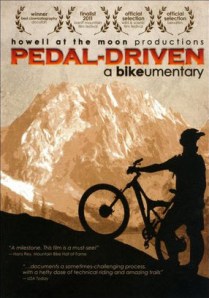
movie: Pedal-Driven: A Bikeumentary (2011)

pedaldrivenI can’t remember who told me I needed to see this film. Thank you, whoever you are.

Pedal-Driven is a documentary about the relationship between mountain bikers and the US Forest Service, regarding the former’s right or privilege to recreate on public lands. The conflict is fairly well summed up early on: public lands are our lands, so we want access to do what we like on them; but on the other hand, we (mountain bikers or mtbers) are not the only user group in “the public,” and even beyond present-day users, the USFS (Parks services, etc.) feel a responsibility to a future public as well. Therefore the needs/wants of today’s users (mtbers and others) are balanced against a need for conservation and preservation.

The USFS doesn’t want to be entirely anti-mtber, but they can’t condone the practice of building trails on public land without permission; this is illegal. But what is a mtber to do? To go through the proper channels is a 5, 10, or even 15 year process; at some point, we’re building trails for our kids to ride, which is nice for them, but who knows if we will get to ride those trails at all. Then again, builders of illegal trails risk having their work torn down at any moment.

While I’m not particularly on the side of illegal activities – and illegal building of anything on public land rubs me the wrong way – I sympathize with the mtbers, obviously, as I am one myself and understand the desire for trail to ride. Without trail, we can’t be mountain bikers. As I summarized them in my first paragraph, all those user groups indeed deserve their rights and their voices being heard. It’s a sad quandary. This film was in danger of just depressing me, early on, with the stalemates portrayed (centrally in Leavenworth, Washington, not far from where my parents have recently settled; also in the loss of trail systems in Montana). But it does circle back around to success stories like those in Oregon; hope is not lost.

I will say that, for me, one weakness in this film is in its specificity to freeriders. Freeride is mountain biking that involves jumps, tricks and stunts; it generally requires what we call “structures” (bridges, dirt jumps, big constructed berms, skinnies, teeter-totters), and structures are a good part of the USFS’s problem with illegal builders. Don’t get me wrong; they wouldn’t let you build natural-surface trail, either, but I think it would be less offensive than the construction in question. To give you some idea:

freeride(photo credit)

freeride, from the film (photo credit)


bridge work (photo credit)

bridge work (photo credit)


wooden berm (photo credit)

wooden berm (photo credit)


Talking about building freeride-style trail with structures, then, is a certain kind of conversation. And it has left out the even larger group of cross-country (XC) mountain bikers: this activity is performed generally on natural-surface trails (bridges thrown in for function – to cross a stream or gulley – rather than for the chance to catch air), and keeps the rider mostly on the ground or close to it. XC riders look different from free-riders: no full-face helmets, different bikes, even sometimes brightly-colored spandex. These are generalizations, and there are exceptions, and there’s crossover between the two groups; but the point I’m trying to make is that as an XC rider, myself, I felt a little left out of the story that this film tells. And that’s a shame; because really, we face the same challenges in using public land, in trail construction and access and our relationship to the public and the government. I would have appreciated a little more inclusive story being told here. On the other hand, maybe there isn’t such a story about XC riders – maybe our conflicts haven’t been played out so dramatically or on such a scale, or such a stage. I’m honestly not sure. And I haven’t been deeply involved in advocacy battles as of yet (except on a local scale where I’ve done some volunteer trail work), so I want to be clear, I’m not criticizing the fine folks portrayed in this movie. Their work can only benefit my kind of rider, too. And you never know, I may find myself in a full-face helmet high up in the air one of these days too! Who knows what the future holds?

As a film, I found Pedal-Driven to be very well put together and visually impressive. I had a few minor gripes with the soundtrack (some of it was great!), but you can’t please them all in that respect! I enjoyed seeing the riding, and I ended up on the hopeful side regarding access and advocacy issues. Most of all, I’m super glad that these issues are being discussed. So thank you, Howell at the Moon, for this movie! It makes me want to ride my bike!


Rating: 7 feet of air, of course.

Writing Down the Bones by Natalie Goldberg

bonesI bought this pocket-sized book on the recommendation of one of Haven Kimmel’s fictional characters, if you believe it. That’s the most common cover at left; mine is pleasingly worn and small (see below), and I appreciated that about it. I carried it around off and on for about six weeks before I finished it, including on an overnight backpack in Colorado. It is an instructive work on writing, with chapters just a few pages long, so one doesn’t feel that she has to read it cover to cover or as one piece. I will be referring back to it. photo

Natalie Goldberg is foremost a poet, it seems to me, although she has written one novel and other how-to-write books as well; she teaches writing in various formats. She is also a Buddhist, and her meditation practice and study with a Zen master (I hope I’m saying that right) are quite central to her message here; she is big on letting go of the self, of self-criticisms, and letting the writing flow out of oneself; writing is, for her, a form of meditation. She is very serious about a writing “practice,” which I interpret in several ways: it is a practice like meditation or yoga is a practice; also one has to practice it in the way one practices anything to improve at it. She counsels a regular writing schedule, even just ten minutes a day – keep the hand moving for ten minutes, don’t cross anything out, don’t edit.

Her advice seems to be most aimed at creative writers, perhaps most of all at poets, but I think (and I think she thinks) it is also useful for any kind of writer. Partway through my reading, I recommended this book to a friend’s nephew who wants to be a sports journalist. On the face of it, sports journalism is pretty far from poetry, but I think Goldberg’s advice (immersion in the form; daily practice; exercises on set topics) would still serve.

One of the greatest gifts I feel that I’ve taken away from reading this little book is the message that I am a writer, already, and should own that and move forward in it. I’m not waiting to be a writer when I can do it full-time, or when I’m published, or anything silly like that. (Although those milestones will/would be nice!) I’m a writer, now; I just need to do more of it.

The message I take with greatest caution, on the other hand, is her exhortation to write by hand. She talks about the usefulness of a computer (or typewriter), but feels strongly about handwriting. She writes about what kind of pen, paper, notebook a person might should use. I wonder if her advice would be any different today – this book was originally published in 1986 – but I suspect not much. My problem is that I have done the bulk of my writing on a keyboard and am much, much faster at that than at handwriting! I’m of the generation that had a computer fairly young. For me, handwriting means slowing down, and it means cramps. On the other hand, I could write a book on a keyboard without much stress. If she’s preaching a fast, obstacle-free flow of words out of my head and onto the page (screen), shouldn’t I type? But then, perhaps the more mechanical relationship to those words is something that should be cultivated. (What about the cramps??)

Either way, I found this book inspirational and full of thought-provoking little tips, not to mention a few writing prompts I will need to follow. I am pleased. Not dated in the least (with the possible exception of the handwriting issue!), I find Writing Down the Bones to be a fine assistant to the aspiring writer.


Rating: 8 minutes.



