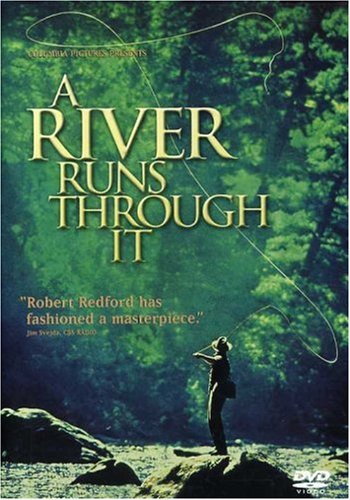
movie: A River Runs Through It (1992)

rivermovieI was pleased when Husband found this movie for me the other night. I enjoyed the book by Maclean so much, and I had heard good things about the movie. Robert Redford’s involvement speaks well, too.

First of all, this film is very visually pleasing; the scenery is lovely (IMDB says it was shot in Montana and Wyoming – not onsite in Missoula, but convincingly nearby), the fishing scenes are appropriately peaceful, and the actors are attractive. Thank you, Hollywood, for a typical, unrealistic portrayal! Although Paul Maclean in particular was supposed to be a very good-looking young man; and whatever your feelings about Brad Pitt, I don’t think you can argue that his role as Paul is less than gorgeous. (See below.) Also pleasing are the glimpses of 1920’s flapperdom, particularly in the character of Jessie Burns (later Maclean’s wife), who is charmingly represented.

young Brad Pitt

young Brad Pitt

The film opens and closes with Norman Maclean as an old man, fly-fishing, accompanied by a voiceover (by Robert Redford) quoting from the book. This is appropriate, and effective. Otherwise, the film’s connection to the book comes and goes. The Maclean family onscreen is quite faithful to the Maclean family of the novella (although I found the Reverend a little friendlier in the book than in the movie), but the action diverges often. I missed the couple that happen upon Paul’s masterful fishing in the book, but at least the scene is represented in the film. I was perhaps most thrown by the scene in which the Maclean brothers take a daring whitewater trip in a “borrowed” boat; I could feel how disconnected this section was from Maclean’s own writing, and indeed, it felt out of character with the brothers as I knew them from the page. Coming early in the movie as it did, it was even more disjointed for me. When the fishing trips (two of them) with Jessie’s brother take place in the book, Norman and Jessie are already married; in the movie, they’ve just begun dating, and there’s only one scene. It is, however, well represented with both humor and outrage.

As of course is standard in book-to-movie adaptations, we get less in the film than we did on the page. Naturally I missed the parts we lost, because I loved the book so. This is to be expected. Part of what I missed was the immersion (no pun intended) in the world of fly-fishing that Maclean brings so fully to life, in such an interesting manner even to those of us who don’t care much for fishing. The depth of all the characters also naturally loses some development in a 2-hour movie. All things considered, this was an enjoyable movie – for its natural landscapes, peaceful yet tortured tone, and familiarity with the Maclean family of whom I cannot get enough. It doesn’t do the book justice, but no movie could, so I won’t hold much of a grudge for that.


Rating: 6 trout.

The Handoff: A Memoir of Two Guys, Sports, and Friendship by John “JT the Brick” Tournour

An earnest remembrance of a friend and the wisdom he passed on to a sports talk radio anchor.

handoff2

After a fun-filled, full-speed youth as president of his fraternity and, later, working as a professional cold-calling stockbroker, John Tournour finds his true calling: sports talk radio. He starts out as a listener calling in, then gets his own show but has to pay for airtime, gradually working his way up until one day he gets a fateful call. Andrew Ashwood mentors John, now known on the air as “JT the Brick,” through an ascending career, and they become the closest of friends. When Andrew is diagnosed with cancer, JT naturally gets the call to be his chemo buddy and “main go-to guy.”

Though The Handoff begins with JT’s childhood, we know from the beginning that Andrew will be its focal point. JT failed to take notes on Andrew’s every word in those final months, realizing only in hindsight that he was not only modeling how to live–and how to die–but also sharing all his life lessons, on and off the air.

JT may be macho and manly–this is smack-talk sports radio, after all–but he is heartfelt and emotional in relating his love for Andrew and his appreciation of everything his friend had to offer. Although sports radio is JT’s passion and the background for his friendship with Andrew, his readers need not know or even much care about sports (or radio) to empathize. The Handoff is a memoir of life and loss, but foremost of friendship.


This review originally ran as a *starred review* in the August 23, 2013 issue of Shelf Awareness for Readers. To subscribe, click here, and you’ll receive two issues per week of book reviews and other bookish fun!


Rating: 6 callers.

The Happy Atheist by PZ Myers

The creator of the popular Pharyngula blog makes a funny, impertinent and highly intelligent argument for atheism and happiness.

happyatheist

PZ Myers is serious and unapologetically funny at the same time–and, despite 15 churches in his immediate neighborhood and their fellows worldwide, he is indeed a happy atheist.

The Happy Atheist is irreverent in every sense of the word, experimentally seeking creative acts of sacrilege and poking fun at religion from diverse angles. Short chapters make for quick, easy reading: “The Great Desecration” relates Myers’s project of desecrating communion wafers, which inflamed the public to a degree that flabbergasted him.

He offers other reasons for the religious to be offended as he describes “the proper fate for a holy book” and instructs us to “take pride in the example of Eve–she is the author of a real promise of a great humanity.” But even in making fun–and he assures us that laughter is the greatest weapon we can wield against religion–Myers is loving and compassionate, and it is clear that he aims to increase everyone’s happiness by converting the wayward to atheism. Trusting in his expertise as a biology professor, he moves from more lighthearted larks toward a more serious scientific examination of the shortcomings of religion, especially by comparison. “Science,” he quotes Richard Feynman, “is what we do to keep from lying to ourselves.”

The Happy Atheist finishes with a heartfelt discussion of The Epic of Gilgamesh on a hopeful and inclusive note. Far from being out simply to insult, Myers genuinely wishes to improve humankind and our lot here on earth. But some hilarity along the way can’t hurt.


This review originally ran in the August 20, 2013 issue of Shelf Awareness for Readers. To subscribe, click here, and you’ll receive two issues per week of book reviews and other bookish fun!


Rating: 6 plain old crackers.

A Wrinkle in Time by Madeleine L’Engle (audio)

wrinkleWhat fun to dig back into this children’s classic. I only vaguely remembered enjoying this as a kid, and I got to rediscover it via this audiobook, read by the author. My memory didn’t provide much: I think I was most familiar with the opening scene, in which Meg Murry is awake and frightened in her attic room alone by a storm outside. She is grumpy, frustrated with her family: her father for being away for so long; her baby brother Charles Wallace for not feeling her pain and coming to her as he usually does.

Next, of course, Meg and Charles Wallace meet the not-quite-mortal Mrs. Whatsit, Mrs. Who, and Mrs. Which, and an unusual boy from Meg’s school named Calvin. This unlikely team will adventure together via the “tesseract” – a wrinkle in time and space as well, if you will – to try and find Mr. Murry, and save him, and save the world (and all the worlds) from the Black Thing.

This is a children’s chapter book. Madeline L’Engle notes in an introductory section that publishers thought it would be too hard for children; but her own kids loved it, and as it turns out, so does the world. It’s won several awards including a Newberry, and remains popular today. (Originally published in 1962 and still in print.) I can see how it would be “hard” for children, particularly the physics bits; but then, we don’t have to understand it fully to enjoy it, do we? And lots of adults are puzzled by physics too! This book has appeal for adults – perhaps obviously, here I am, and I don’t read a whole lot of children’s books. It still rings like a kids’ book, but I found the characters and the plot both engaging. I have a slight criticism that Meg occasionally sounds a little adult for her age; she does whine appropriately, but sometimes her observations are startlingly astute. It’s a common complaint with young characters in books. But only slightly, here.

Meg, Charles Wallace, and Calvin are all likeable but human; their parents are similarly well-rounded, sympathetic characters. The Mrs’s are charming, and the world-building – in the world of Aunt Beast, for example – is well done. I like that Meg grows some in the course of the story; and L’Engle certainly leaves us open for a sequel, what with the possibility of a burgeoning romance, and the happily-ever-after-at-least-for-now ending (with the Black Thing still looming). Mostly I was just disappointed that it was over so quickly! (Another feature of children’s books.)

I was a little surprised to find religious references within; I didn’t remember those. Not many, but a few mentions of having God on one’s side, or being the chosen ones, fighting for good. It got me thinking. I’m not particularly good at spotting religious allusions, not having been raised in church or on the bible. They mostly pass me by. But spelling out G-O-D will catch my eye every time! It’s not a technique that appeals to me but it wasn’t a central enough theme here that it threw me off much, either. A theme that is central is a good-versus-evil dichotomy, which of course could be interpreted as being religious; but the book-banners have protested certain aspects of this story, too – including the grouping of Jesus with mortal fighters-for-good such as Da Vinci, Michelangelo, Shakespeare, Pasteur, Einstein, Gandhi, Beethoven, Copernicus and a lone woman, M. Curie. So there you are: all matters of interpretation.

In a nutshell, I found this book a delightful, too-brief romp in another world. I am tempted to pursue further work by L’Engle; four books follow this in a quintet, and others of her oeuvre reference the same characters. Realistically, I don’t know if I’ll get to them. But this was an enjoyable read, and not just for children.


Rating: 7 pairs of spectacles.

The Boy Who Could See Demons by Carolyn Jess-Cooke

A haunting haze between reality and apparition with a troubled child psychiatrist at the center.

demons

The Boy Who Could See Demons is Alex, aged 10. He began seeing his own particular demon, named Ruen, when he was five, on the day his father was declared “gone.” Anya is the new child psychiatrist in town, having returned to her home in Belfast hoping to help patch up children and families damaged by Northern Ireland’s “Troubles.” Perhaps she should be more concerned about troubles of her own: the day she gets the call about Alex is the four-year anniversary of her daughter’s death. Now she sees her daughter, Poppy, in Alex, who may have the same sickness, and she is clearly in danger of getting too close to this case. Worse, the boundaries begin to blur between what is real and what is not, as Anya wonders if Ruen may have a place in the tangible world.

Carolyn-Jess Cooke (The Guardian Angel’s Journal) creates in Alex and Anya sympathetic characters, and the traumatized Belfast she evokes comes alive on the page. Child psychology plays an important role, with its questions of medication and whether and when to separate a family. With a suicidal mother, a suicidal child, delusions and possible schizophrenia all jumbled up together, it’s no wonder Anya becomes a little unglued. The reader will have as much trouble as Anya does discerning fact from mirage as the story unfolds. The Boy Who Could See Demons is riveting and increasingly fast-paced, as it forces the reader to question everything that seemed secure from page one.


This review originally ran in the August 20, 2013 issue of Shelf Awareness for Readers. To subscribe, click here, and you’ll receive two issues per week of book reviews and other bookish fun!


Rating: 7 onions.

Teaser Tuesdays: The Other Typist by Suzanne Rindell

Teaser Tuesdays is a weekly bookish meme, hosted by MizB of Should Be Reading. The idea is to open your current read to a random page and share a few sentences. And try not to include spoilers!

typist

I have discovered an awesome new book on audio that I want you to know about. Set in 1920’s New York City, The Other Typist‘s first-person narrator is Rose Baker, an orphan employed as (yes) a typist at a precinct police department. She is entranced by a new hire named Odalie, who exerts a magnetic pull on everyone, it seems, but most especially Rose herself. Here’s your teaser:

She was never once rebuffed, and the man – I say man here generically, because there were several – invariably introduced himself and reached into his pocket to fish out a lighter and a replacement cigarette, while Odalie puffed on her pilfered prize and regarded the gentleman with a sly, delighted expression, as if to suggest nothing he could pull out of his pocket could sufficiently replace the unique and spectacular treasure she had just stolen.

I just love this line, read masterfully by Gretchen Mol, with its subtly suggestive reference to what a generic man might pull out of his pocket to impress Odalie. She, the other typist, is a classic, manipulative femme fatale; but then again, there are some unanswered questions to ask about our narrator Rose, too. And that’s the kind of set-up I like. Stay tuned…

Pilgrim at Tinker Creek by Annie Dillard, part the first

Clearly I will need to publish this review in two parts, for the sake of your patience with my long-windedness. Actually I fear three posts. This is a fascinating book about which I have mixed feelings and many tangential thoughts; also at about halfway through, I’ve filled three bookmark slips of paper with notes rather than the average one-or-less-per-book, so there you are. This is my review of roughly half the book.

pilgrimattinkercreekDespite a promising beginning, I am not sure that I love Annie Dillard as much as do many of my favorite authors. Odd, that. In fact, I enjoyed Christine Byl’s Dirt Work far more. And she hasn’t won any Pulitzers (yet).

For one thing, there is too much theology for my taste, and too much metaphysical rambling metaphor: seeing visions, entering the past and seeing the future. Too much philosophy, man’s (“man”! too much “man”! 1974 this was published, by a woman, and still the universal creature is “man” rather than person or even woman for goodness’ sake) …man’s self-consciousness, relativism… and not enough just being. I’d rather spend more time in the picture and less time examining the frame and the picture-maker, if the picture is our world.

Wikipedia brought some interesting thoughts to mind. [I take Wikipedia with salt; but I still find it a useful starting point for general knowledge.] For example: “The author has described [Pilgrim at Tinker Creek] as a ‘book of theology’, and she rejects the label of nature writer.” What is up with people “rejecting the label of nature writer”? Edward Abbey did, too, which rejection I think in turn his readers reject. Of course, Dillard’s point – that this is more theology than nature writing – helps explain part of my problem with it. But then, there is excellent nature writing within it: I love the finely detailed discussion of insect habits. Oh, and while we’re mentioning him: “Edward Abbey in particular deemed [Dillard] Thoreau’s ‘true heir’.” Both these quotations from Wikipedia come sans specific reference, although there’s a solid-looking reference list at the end of the article. So, take that with salt, as I said.

Dillard did remind me of Thoreau, which is both a compliment (obviously) and a qualification, for me personally, as I struggled a little with Walden, too. Walden was apparently the subject of Dillard’s master’s thesis, so we can expect some parallels there. I would call these two books a readalike pair, and recommend the one if you liked the other.

Now, on the Annie Dillard Wikipedia page, I found more useful phrases: “one critic… call[ed] her ‘one of the foremost horror writers of the 20th Century'” for her apt descriptions of the natural world (I imagine that critic had the mating practices of the praying mantis in mind!), which I find delightful, and true in a most positive sense. And “In The New York Times, Eudora Welty said the work was ‘admirable writing’ that reveals ‘a sense of wonder so fearless and unbridled… [an] intensity of experience that she seems to live in order to declare,’ but ‘I honestly don’t know what [Dillard] is talking about at… times,'” which is, again, a great way to put it, and I couldn’t agree with you more on all counts, Ms. Welty. Both these quotations are attributed, by the way: the first, to Dillard’s website, and the second, to the NYT review in question. Not attributed, however, is the assertion that “In 1971 she read an old writer’s nature book and thought, ‘I can do better than this.'” This would seem to belie the phrasing of the Wikipedia Pilgrim article that she “rejected the label of nature writer.”

But oh, then I got to chapter 7, “Spring.” I am entranced! She writes about learning languages and yearning to decode birdsong, about the mockingbird that sings from 2am til 11pm in her chimney in springtime; about newts, to whom “no one pays the least attention… except children”; more about trees (I love it); and then the part about the duck pond, which is hilarious, wise, and again hilarious. This is where we meet the plankton about whom she is rather passionate, and she studies them under the microscope.

I don’t really look forward to these microscopic forays: I have been almost knocked off my kitchen chair on several occasions when, as I was following with strained eyes the tiny career of a monostyla rotifer, an enormous red roundworm whipped into the scene, blocking everything, and writhing in huge, flapping convulsions that seemed to sweep my face and fill the kitchen.

Rather, she does it as a “moral exercise”, because “if I have life, sense, energy, will, so does a rotifer.” In chapter 7, I love this woman and this book. It was in chapter 7 that I got up from my lunch – during my lunch break, I walked away from lunch – to find Liz, who was on duty at the reference desk, to read her a page aloud. (That was the page about the duck pond and the frogs.) So along with my complaints, there is much to love in this book. Take for example the section on the mating habits of the praying mantis: Dillard portrays these practices as horrifying, hilarious, and disturbingly like our own; it is a feat. I think I like her best when she digs into the science and minutia of the natural world, and exclaims in joy, fear, disturbance, or wonder at it. In other words, when she is a nature writer (wink).

Stay tuned for my review, part the second, and we will all find out together what my final feelings for Dillard will be.

book beginnings on Friday: A Wrinkle in Time by Madeline L’Engle

Thanks to Rose City Reader for hosting this meme. To participate, share the first line or two of the book you are currently reading and, if you feel so moved, let us know what your first impressions were based on that first line.

wrinkle

I am just as pleased as can be to experience again a book I enjoyed in childhood, a book that won several awards including a Newberry. Madeline L’Engle’s A Wrinkle in Time begins:

It was a dark and stormy night.

In her attic bedroom Margaret Murry, wrapped in an old patchwork quilt, sat on the foot of her bed and watched the trees tossing in the frenzied lashing of the wind.

L’Engle is winking at us, I believe, when she uses this well-worn literary opening line; but it works beautifully, don’t you think? It’s atmospheric, and if it’s “pre-owned,” I find it still effective. It brings to mind the attic reading scene in The NeverEnding Story, which I also loved.

I’m just a few minutes into this audio recording, read by the author, but I’m glad to be back in L’Engle’s world. Happy weekend!

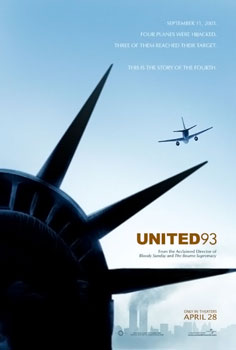
movie: United 93 (2006)

I hesitated to contemplate before writing this movie review. 9/11 remains a charged, sensitive, and controversial subject in the United States; I believe the same is true worldwide, although presumably in a different sense and perhaps to a lesser degree. I can only speak for myself and, less so, for the country where I live; less still for the rest of the world. I’ll do my best here.

United 93 was released in 2006 and tells the story of United flight 93, the 4th hijacked airplane on 9/11, which was taken down by the passengers in a field in Pennsylvania. It shows the first three planes go down, and then follows UA93 in real time up to the finish. As Rotten Tomatoes notes, it’s “even more gut-wrenching because the outcome is already known.” If nothing else, a far less impressive movie than this one would be emotionally harrowing for anyone who can remember that day, I think, regardless of your politics or complicated reactions to the unfolding and varied understandings of what’s happening in our world and why; I believe a basic human reaction is horror.

I’ll say in a nutshell: I think the movie is well done. There are qualifications coming, but to start, it is a moving experience, the acting is convincing, and the drama is fully wrought.

My greatest concern while watching this movie – about which I knew nothing; I wasn’t even aware it existed until Husband put it on – was the level of respect given to surviving families, and the faithfulness to the real people involved. My brief research after viewing* indicates that director Paul Greengrass (great name) put in some effort to authenticate his characters, working out clothing and reading material and giving actors opportunities to study their characters’ lives and habits. This is good; this is what I was looking for. It won’t be perfect, of course. This being Hollywood, all the people are more or less beautiful (they don’t seem to produce a great many ugly actors), which I doubt (with all respect) was true of the real passengers on that plane. And Wikipedia states that ” there are some notable exceptions” to the victims’ families’ cooperation with the film; however, the source cited for that line of text says that “filmmakers said ‘Flight 93’ had the cooperation of all the families of the passengers who died on the flight.” So, I’m confused. Who cooperated and who didn’t? I don’t know and I’m not trying to make this into a research project; I’m simply pointing out some ambiguity. Further, there’s the controversy over the German passenger’s portrayal: read about it here.

Another chief concern is the commercialism: this movie was made to turn a profit, right? IMDB notes in its trivia section that “the filmmakers donated a percentage of the opening weekend proceeds to the Flight 93 memorial near Shanksville, Pennsylvania. The actual amount donated turned out to be $1.15 million.” However, I would bet that somebody still made a buck; and that obviously leads us to some concern. On the other hand, what’s more American than making a profit from every last thing that happens to us or anybody else?

What I’m getting at is this: to make a movie about 9/11 is a wildly challenging, potentially dangerous undertaking, bound for controversy. I find it a curious phenomenon. A number of movies have been made; this is the only one I’ve seen. (I’m going to read Extremely Loud and Incredibly Close one of these days, though.) I’d like to go back to my nutshell statement that this is a moving and well-done movie, not without some concerns, and owing much of its moving nature to its subject; but it earns the “well-done” part itself. I would recommend it with some reservations to someone interested in watching a movie about 9/11, but not everyone will be. I am about as removed from this tragedy as an American can be – I didn’t lose anyone I knew; I don’t even think anyone I know lost anyone – and I still found it pretty painful. So, exercise caution.

Finally, and I think this is obvious, this movie assumes that Americans are good and the passengers that wrestled the plane to the ground were heroes. The second assumption is pretty firmly rooted; the first offers room for debate. Within the United States, we’re so numb to these assumptions that we hardly notice them; but the comments on IMDB, for example, make clear that different parts of the world quite naturally react differently to 9/11 and to this movie. Noted. The world is a complicated place and very few things are cut’n’day or black’n’white. You can take it from there, I think.


Rating: 7 audio transmissions.

*Rotten Tomatoes, IMDB, Wikipedia, The New York Times, Atlantic Review

hemingWay of the Day: as an archivist

Oh my word, Liz does it again. Never was there an article more designed to make me sigh and daydream. From PRI’s The World comes

This came to me from Liz, who got it in turn from Jessamyn West (blogtwitter). A solid pedigree right there. I swoon; this is my dream job.