Teaser Tuesdays: Go Tell It on the Mountain by James Baldwin

Teaser Tuesdays is a weekly bookish meme, hosted by MizB of Should Be Reading. The idea is to open your current read to a random page and share a few sentences. And try not to include spoilers!

go tell it

I just couldn’t pass up the opportunity to share this passage with you.

He left Fifth Avenue and walked west towards the movie houses. Here on 42nd Street it was less elegant but no less strange. He loved this street, not for the people or the shops but for the stone lions that guarded the great main building of the Public Library, a building filled with books and unimaginably vast, and which he had never yet dared to enter. He might, he knew, for he was a member of the branch in Harlem and was entitled to take books from any library in the city. But he had never gone in because the building was so big that it must be full of corridors and marble steps, in the maze of which he would be lost and never find the book he wanted. And then everyone, all the white people inside, would know that he was not used to great buildings, or to many books, and they would look at him with pity. He would enter on another day, when he had read all the books uptown, an achievement that would, he felt, lend him the poise to enter any building in the world.

Libraries; books; the intimidation of buildings, books, and the grandeur of the New York Public Library; and the power available to a young man who could read all the books uptown. Lovely, and moving.

The Edge of Normal by Carla Norton

A true-crime journalist shifts to fiction with a disturbing and authentic tale of kidnapping–and recovery.

normal
The Edge of Normal, Carla Norton’s fiction debut, clearly draws upon the expertise she gained writing Perfect Victim, a 1988 true-crime book about a survivor of kidnapping and captivity. In the novel, kidnapping victim Reeve LeClaire has spent the six years since her escape in therapy and is progressing in tiny, painful increments. The family of Tilly Cavanaugh, another rescued abductee, asks for Reeve’s help in beginning their own process of recovery. This mentorship looks like the most challenging task she’s been offered in years, but will turn out to be the beginning of another nightmare.

Tilly’s kidnapper is behind bars, so why is Tilly still so skittish? What is she not telling the police and district attorney who want to prosecute her case? Pulled into a confidence that may break her, Reeve becomes the only person who can help Tilly and two girls who are still missing.

The reader is privy to the inner workings not only of Reeve’s tortured mind, but that of Tilly’s kidnapper, so there is less mystery in The Edge of Normal than sheer terror and wild, horrified urgency. Norton’s sense of pace is perfect, and her characters draw upon readers’ sympathies skillfully. Norton’s expert understanding of captivity syndromes goes far beyond Stockholm Syndrome (which, she writes, “isn’t actually in the diagnostic manuals”); she renders Reeve and Tilly’s experiences visceral and believable, as The Edge of Normal indulges in all the action and adrenaline thriller fans crave before building to an explosive finish.


This review originally ran in the September 13, 2013 issue of Shelf Awareness for Readers. To subscribe, click here, and you’ll receive two issues per week of book reviews and other bookish fun!


Rating: 6 scars.

book beginnings on Friday: The Hunted Whale by James McGuane

Thanks to Rose City Reader for hosting this meme. To participate, share the first line or two of the book you are currently reading and, if you feel so moved, let us know what your first impressions were based on that first line.

huntedwhale

The title recalls a certain famous fictional white whale, or is that just me? This is a coffee-table style book, I expect (my copy is pre-publication), and filled with images. It begins:

The hunt is one of man’s most ancient endeavors. One can barely imagine an early time when man was free from the need to find nutritious food or eliminate a dangerous predator. It’s been posited that language itself grew out of the need for precise communication as men stalked and hunted prey.

No argument there, I don’t think. And I like that McGuane pulls language into his opening lines – this being a work of written artistry, after all. But The Hunted Whale promises to star the whale, as well as the hunt, so stay tuned.

These quotation comes from an uncorrected advance proof and is subject to change.

from NYT magazine: “Stephen King’s Family Business”

Thanks to my mom for sharing this fun article by Susan Dominus, “Stephen King’s Family Business“, in which she sits down with the family – Stephen, Tabitha, their three children Naomi, Joe and Owen, and Owen’s wife Kelly. This crowd of six boasts five novelists, a hefty feat: Dominus calls them “as close to a first family of letters as America is likely to have,” and I think she makes a fair case.

It’s a pleasure to step inside the lives of Stephen King and his family. I am only a beginner-fan, having read, oh, 7 or so of his many many books; but I am a fan, and even at my beginner level, was aware that the King family talent extends beyond Stephen himself. The people portrayed in this article are down-to-earth and likeable, and come across as both a tight-knit family and as distinct individuals at the same time.

Go check it out. I, for one, was already watching my local library for NOS4A2 on audio, but have now requested Heart-Shaped Box as well. Who knows what you’ll find?

Z: A Novel of Zelda Fitzgerald by Therese Anne Fowler (audio)

zThis is a fictionalization of the life of Zelda Fitzgerald, wife to F. Scott Fitzgerald. The main events of their lives are fairly well-known: married in 1920, Fitzgerald was a professional writer who never saw the success in his own lifetime that his friend Hemingway did; the couple lived back-and-forth in France and the US; Zelda was “the first flapper” according to Scott; they were famously wild partiers, alcoholics, and rather nut jobs; Zelda was eventually institutionalized, and died in a mental hospital. They had one daughter. These main events are followed in the novel, which is told first-person by Zelda herself.

It started well. I really did love Zelda’s voice – as written by Fowler, and as read by Jenna Lamia. She’s spunky and irreverent, and likeable. She reminded me of Scarlett O’Hara from the very beginning, which is both a compliment and a caution: is she entirely original? I enjoyed what Fowler created in her fictionalized Zelda Fitzgerald, but I worried that she was overly informed by hindsight. Scott talks like he writes; Zelda speaks as if aware of her audience, aware of the legacy she’ll leave behind – which she wouldn’t have been, regardless of her faith in her husband, because his fame as we know it today came largely after both their deaths.

Ernest Hemingway likewise speaks in a caricatured version of one of his own heroes. This is a common technique when writing Hemingway into fiction: I recognize it from Midnight in Paris. I’m comfortable with people criticizing, even despising Hemingway; he’s my hero, but I certainly see his flaws. But I wish they wouldn’t make him into a cartoon, because that, I think, he wasn’t. He could be ridiculous, and he definitely overdid the machismo, but he was a complex human being, troubled, tortured, insecure, boastful and antagonistic; wouldn’t it be more fun, and more satisfying for a novelist, to write him as a full person than as a cartoon version of his own fiction? Ah well.

Expand this concept to apply to Scott Fitzgerald, too. I’m less qualified to speak about his life, having read much less about him than I have about Hemingway. However, I feel confident that neither Scott nor Zelda could have been as black-and-white as Fowler’s fictional characters are here. Scott Fitzgerald is a monster in this novel! Despicable, horrendous, a nightmare. I suspect that in life, he was, like Hemingway, capable of monstrosities, but also a full human being, with likeable bits alongside the flaws. Such a well-loved and artistically accomplished alcoholic would seem to have to be conflicted, ambiguous, and – importantly – multi-facted. Fowler’s characters lack facets. Similarly, though I have read still less about Zelda, my general understanding of her was that her dissipated party-girl period lasted well out of her early 20’s. The fictional Zelda we meet here becomes rather saintly after giving birth to her daughter. She is the squeaky-clean foil to Scott’s ogre; and I suspect that the one is as realistic as the other.

In contrast to this novel, I am simultaneously reading the yet-to-be-published The Trip to Echo Spring: On Writers and Drinking by Olivia Laing. Z suffers by comparison; Laing’s (nonfiction) work is very well researched, beautifully written (although I’ll try not to turn this into a review of her book!), and, to my point here, respects the dueling forces for good and evil in her subjects, including F. Scott Fitzgerald. (And Hemingway.) Possibly I would have appreciated Z more if it were presented not as historical fiction but as alternate history, since I am increasingly concerned that it’s not true to the history of the Fitzgeralds as we know it. Even then, however, fully developed characters should have complexity rather than read as saints and devils, so my concern remains.

The net effect of having read this book in the end is that I feel the need to go read up on Zelda a little more thoroughly; I’ll be looking for a biography next. She always struck me peripherally as a colorful, conflicted character: just the kind I like, that is. I’m always most interested in those individuals who offer both sympathetic and distasteful qualities in the same package; they’re so engrossing that way. One of Fowler’s major flaws, then, would be in having omitted my favorite character feature: ambiguity.

I began by enjoying this book, and Zelda’s voice and personality. Much of the middle troubled me, as the black-and-whiteness of the characters emerged. Scott was such a terrible husband that I was just frustrated and angry with him; and while these can be useful emotions to evoke in your reader, Fowler didn’t take me anywhere interesting or cathartic or instructive with them. Zelda briefly considers leaving Scott (because she is, after all, a saint and a martyr) and then realizes she can’t afford to support herself as a single woman, so she decides to stay. Very cut and dried, you see. Towards the end, when the couple is separated by Zelda’s incarceration in various mental institutions, I liked it a little better again; maybe removing the hateful Scott cheered me. But then it was disappointing to end with Scott’s death – Zelda lived another 8 years! but those years are handled only in an epilogue. Why couldn’t she have continued to speak in her own voice until she died? Perhaps this novel should have been called Z: A Novel of F. Scott Fitzgerald told through the eyes of Zelda. Hmph.

In closing, clearly, my concerns were many. I credit Fowler for entertaining me (at least early and late) with a likeable Zelda in a spunky Southern drawl, well read by narrator Lamia. But I was dissatisfied with many aspects of the art of the novel as executed here. Subjects like the Fitzgeralds offered so much opportunity for nuance, and catharsis, and analysis, that was not undertaken. Complex characters were flattened into single dimensions. And my limited knowledge of their lives makes me hesitant, but I worry about the historical accuracy, and I wish more information were given to indicate where the fiction begins. Several letters from Zelda to Scott and other friends are quoted; are these real letters? I don’t know; and I’d like to know. Credit Fowler with inspiring some further reading; but this experience in itself was less than satisfying. I can’t recommend that you spend your time on this book. There are lots of books written about the Fitzgeralds; start elsewhere. Me, I’m considering Tennessee Williams’s play, Clothes for a Summer Hotel.


Rating: 4 fingers.

a few short pieces


“A Shirt Full of Bees” by Bill McKibben

My father sent me a copy of this essay, but it’s not shareable under copyright restrictions; and I couldn’t find a publicly accessible version I was happy with. I’m sorry. If you can track down this issue of Utne Reader, through your local library for example, you can read the article yourself.

How strange the way things come together. I’ve just recently been enjoying Annie Dillard’s Pilgrim at Tinker Creek; and my favorite parts of that book are her in-depth, lengthy examinations of parts of nature. One of those subjects she gets good and lost in is newts. And here is Bill McKibben, opening “A Shirt Full of Bees” with an episode starring Terry Tempest Williams (When Women Were Birds; I also loved her Pieces of White Shell) and a newt. Williams crouched on her haunches for half an hour examining the newt, “lost in the world of the newt” in McKibben’s words, and he found himself bored, restless, ready to keep walking, to reach the summit – something we do constantly, of course. And then, on another day, he steps on a yellow jacket nest, and as he erupts in hives and dashes down-mountain for medical aid – “My dog was the best dog I’ve ever had, but I doubted she was up to surgery” – McKibben sees more clearly the beauty around him. That’s the larger point in this short essay: we are always pushing for the summit, and too busy to examine the newts on our path. As I observed in Oil and Honey (the only one of his books I’ve read; but my father is rather an expert), McKibben is a gifted writer. He pulls together two anecdotes – his walk in the the woods with Williams and the newt; his walk in the woods with his dog and the yellow jackets – in a lovely, poignant, meaningful, beautifully written and well-structured essay of three pages. This is the goods, right here.


“Confessions of a Recovering Environmentalist” by Paul Kingsnorth

Pops reminds us that Kingsnorth was the author of “Dark Ecology” that I discussed back in January. This latest is available here.

Kingsnorth opens charmingly with recollections from his youth, ages 12, 19, and 22, in natural settings. These are the experiences that taught him to love “the other-than-human world.” He became an “environmentalist,” that radical thing. And now he laments what “environmentalism” has been bastardized into: a quest for zero-carbon emissions, for alternative energy sources, for sustainability – all good things, doubtless, except that “sustainability,” he argues, is code for finding a different way to do the same things we do now. In other words, we need to release less carbon, so we need to find another energy source so that I can still have my lights and electricity and drive my car and buy my cheaply made clothing at the mall. He points out that we seek a way to sustain our lifestyle – not to sustain the earth, which is sort of what we claim to be seeking. And of course there is the central, painful irony, that “the farmers are being edged out by south-country refugees like me, trying to escape but bringing with us the things we flee from.” He even addresses the touchy subject of “industrial wind power stations (which are usually referred to, in a nice Orwellian touch, as wind ‘farms’)” which McKibben has also struggled with. Are “wind farms” environmentalist?? There is an argument.

Kingsnorth is clever in his criticisms: “these days I tend to consider the entire bird with a kind of frustrated detachment” (that is, the oft-cited bird that has a left wing and a right wing), with which I certainly sympathize; “the colonization of the greens by the reds” characterizes all those myriad left-wingers (“disillusioned socialists, Trots, Marxists, and a ragbag of fellow travelers who could no longer believe in communism or the Labour Party or even George Galloway…”) who’ve taken over his movement. But don’t let his wittiness distract you from the fact that he is right. Again ironically, the problem seems to lie in the success of the “green movement”: save-the-planet is now a perfectly respectable, mainstream concept that you can now find on 3 out of 4 cereal boxes, and that bringing of Kingsnorth’s environmentalism into centrist politics has weakened it, watered it down, naturally, as centrism does.

Like the earlier Kingsnorth piece I read, this one gives quite a dark view in examining “environmentalism.” But like that other pessimistic-or-realistic writer, Derrick Jensen, I see his points, and I’m rather more inclined to follow him than I am to follow McKibben’s optimism.


“A Tough Flower Girl” by Phillip Connors

I am not yet done following Phil Connors. This is not a new piece, but one I’ve had to reread now that I am an affirmed follower of Norman Maclean. Connors’ article is available here.

Another fine piece of writing: Connors explores what we find so moving, timeless, and important in Maclean, but he also creates a piece of art in its own right. This short article is an excellent introduction to Maclean, in his best-known A River Runs Through It (and the two accompanying stories), in Young Men and Fire (better-loved, I think, by both Connors and myself), and in The Norman Maclean Reader (imperative for those of us left wanting more by the first two). It is an incisive piece of literary criticism and appreciation; but it also includes a personal story, as Connors opens by pointing out his biographical similarities to the great Maclean. If it is indeed “uncool to admit an enthusiasm based in part on biography”, call me uncool. Not that I share biographical parallels with my literary idols (ha), but I certainly consider their biographies integral to my appreciation. Funnily, I have just finished searching for a good Maclean biography, and am disappointed by the lack. Somebody please write this book. Phil?

Read this article because it says true things about an amazing writer, but also because it is in itself a sparkling, crystalline beauty.


“Smoke” by Phillip Connors

A new piece from Connors, available here.

I am reminded of how much I love Connors’ voice, that he isn’t afraid to have one, first of all, and that he is both intellectual and casual in it. He acknowledges that “self-quotation is a dishonorable habit, but it sounds a little smug to say I saw it coming and leave it at that,” and so he self-quotes from Fire Season, that book I loved so much, in which he predicts that “the big one” is coming. “If you live on a peak in fire-prone country, as I do every summer in the Black Range of New Mexico’s Gila National Forest, the big one will eventually come for you.” This very short piece is the story of that fire beginning, and beginning to be fought, and its victory: it burned over two hundred square miles, just this past summer of 2013. There is always a conflict in considering these events. Fire is nature, a natural part of a forest’s life cycle, healthy. But we the human influence have thrown that cycle off until the fires we finally earn and reap are less healthy for the world we’ve come to love, and that’s part of the tragedy that Connors has to share. He ends this piece, appropriately, on a conflicted, hopeful, tragic note. At least he has those memories.

I’m looking forward to the next book that he is reportedly working on now.

Oil and Honey by Bill McKibben

Highly literate and expert musings on climate change, from home to the global theatre.

oil
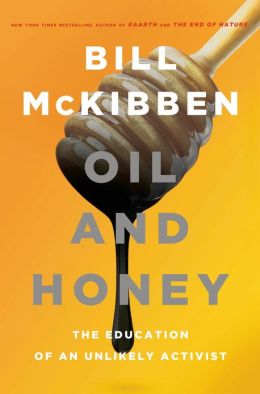
Oil and Honey centers partly on climate change, a subject on which Bill McKibben (The End of Nature; Eaarth; founder of 350.org) is expert; but it is also personal in nature, a dualism reflected by the title. McKibben is concerned simultaneously with oil–representing fossil fuel industry practices and climate change–and honey. Having entered into a land-share agreement with his friend, beekeeper Kirk Webster, McKibben finds his home and Webster’s apiaries exerting a gravitational pull just as his political activism draws him far and wide. These two sides of his life–personal and political, local and global, analog and digital–are the focus of this combination memoir and call to action.

The subtitle refers to his journey from writer to activist, by way of 350.org and the Keystone Pipeline–a trip he did not intend but found obligatory. Activist though he may be, McKibben remains a fine writer, evocative, articulate, clever and humble in examining his mistakes. In piercing prose, McKibben unites his longstanding authority on climate change with his novice stature in the world of beekeeping. He muses on the small-scale and private implications of our changing world, which incline him to work with his family and Kirk’s bees in his beloved local community in Vermont; and likewise on the necessity for global action to combat the continuing quest for fossil fuels. Oil and Honey travels the world but always cycles back, like the seasons, to McKibben’s Vermont home, likening global systems to beehives in a manner both profound and lyrical–and important.


This review originally ran in the – issue of Shelf Awareness for Readers. To subscribe, click here, and you’ll receive two issues per week of book reviews and other bookish fun!


Rating: 8 degrees.

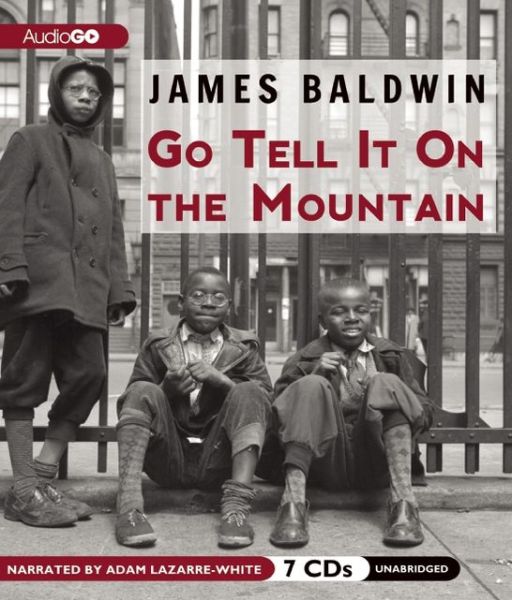
book beginnings on Friday: Go Tell It On the Mountain by James Baldwin

Thanks to Rose City Reader for hosting this meme. To participate, share the first line or two of the book you are currently reading and, if you feel so moved, let us know what your first impressions were based on that first line.

go tell it

I had a heck of a time getting this electronic audiobook from my local public library onto my iPod, but I have succeeded and thus well earned this listen. I started off with James Baldwin’s Notes of a Native Son, which I enjoyed; but it made me want to go back to the beginning of his work, and Go Tell It On the Mountain is his most famous novel, so here we are. It begins:

Everyone had always said that John would be a preacher when he grew up, just like his father. It had been said so often that John, without ever thinking about it, had come to believe it himself.

I think these are strong starting lines. They tell us who our protagonist is; they tell us his family background, and they both name an expected fate for John, and imply that this expectation will not be fulfilled. It also bears noting that on the first page, there is also reference to John’s father fondling one of his daughters, implying that this preacher is not as virtuous as we’d expect. It’s a very casual mention, downplaying the import of this fact. To me, this says that the family doesn’t think much about it; or maybe they don’t know yet. At any rate, it’s disconcerting to have molestation treated so lightly, and I think Baldwin makes a real impact by introducing such disturbing information so off-handedly.

Please note that I have only just begun this book, so I don’t know yet if my interpretations here are correct! Stay tuned…

Weeds: A Farm Daughter’s Lament by Evelyn Funda

A memoir about the loss of the family farm, and everything it means to the child of immigrant farmers–and to us all.
weeds
Evelyn Funda’s mother escaped Nazi-occupied Czechoslovakia in a wine barrel, eventually landing in the United States. Her father was the son of Czech immigrants, early homesteaders who sought to make farmland of the Idaho desert. The family farm never felt like it would be Evelyn’s: this “farm daughter,” unwelcome among the tractors and irrigation pipes, would leave to become a college professor. Her musing memoir opens in the fall of 2001 with a triple tragedy: the sale of the family farm; her father’s cancer diagnosis; and her mother’s death, closely followed by her father’s.

Weeds is an elegy, an academic’s personal tale of research and disillusionment, and Evelyn’s own story–with hints of a botanist’s or social historian’s study. (The chapters are named for weeds, beginning with dodder, which she long misheard as “daughter,” when her father cursed the unwelcome growth.) The pursuit of her mother’s joyful youth in a series of cities and countries, of the truth of her grandfather’s apocryphal tales, of her parents’ romance and of the history of her own hometown takes Evelyn to dusty library stacks and to small Czech villages, where she meets dozens of cousins and examines old bones.

Meditative and lyrical, Weeds smoothly braids weeds with family. Funda is sometimes frustrated along the way, but finally satisfied with the personal history she builds for herself–and the conclusion that, even in exile, one can find a sense of place and of belonging.


This review originally ran in the September 6, 2013 issue of Shelf Awareness for Readers. To subscribe, click here, and you’ll receive two issues per week of book reviews and other bookish fun!


Rating: 7 kolaches.

The Last Winter of Dani Lancing by P.D. Viner

lancingThe Last Winter of Dani Lancing involves three individuals dealing with loss: Jim and Patty are the parents, now separated, of the titular Dani, who disappeared during her first year of college and later turned up dead; Tom was her high school sweetheart. Each has dealt differently with Dani’s death: Jim withdraws into himself, immersed in memory, and lives with her ghost for a full time companion. Patty, formerly an investigative journalist, is obsessed with the case in all its gruesome details, and still seeks revenge on the unknown killer(s). Tom became a police detective hoping to solve crimes like the one that took Dani. When the book opens, over 20 years have passed, and events have broken open the coping mechanisms of all three living characters. They are brought back into contact, and the case comes back to life.

As a thriller, Dani Lancing hums and thrums for a good 70% of the book, with questions buzzing about who really felt and did what while Dani was alive. Told in flashbacks, memories, and jumps in time, the reader learns about her life and final months in bits and pieces and out of chronological order. Dani’s relationships with Jim, Patty, and Tom are likewise doled out in false starts, and ambiguities abound. This is a strong structure.

And then at about page 270, things fall apart. There arises a strong resemblance to Go Ask Alice. Unlikely coincidences and uncharacteristic corruptions appear; repeated confessions to the same crime shift blame so many times and so quickly that the reader’s head spins. Little old ladies overpower strong young men, and criminal kingpins do cops favors out of the goodness of their hearts. The implausible is paramount, and this in a world I had bought into. Before that point, I believed in Jim, Patty, and Tom; I believed in Dani; they felt real. But the absurd and the far-fetched abruptly become the standard, and I reeled in disgust.

I’m assuming Viner wanted to give us a *big reveal* there at the end, a big surprise; but I felt that he upended the world he’d built and drawn me into. I think he confused surprise with disjointedness. You can disturb and terrify your reader, and demolish everything she thought she knew, without resetting the rules of the world of your own creation; just look at Koren Zailckas. In other words, Viner had already established this as a world of realism, with fully developed characters, and to then reestablish it as fantasy did not work for me

This was a terribly disappointing experience for me, and I’m sorry I wasted my reading time on it. Such a promising beginning and middle, too; such a building of suspense, that I had to finish it out. Turns out that the finish wasn’t worthy of the first 250+ pages, though. On to the next one.


Rating: 3 fixed stares.