Teaser Tuesdays: The Cormorant by Chuck Wendig

Teaser Tuesdays is a weekly bookish meme, hosted by MizB of Should Be Reading.

cormorant

Warning: slight raunchiness follows.

I wanted to share these lines because they are so perfectly Miriam (and/or Wendig). I realize they tell you nothing about the plot of this story, but that’s okay. I’ll tell you that other stuff later; for now, check out the style.

“…I always wondered if maybe you had a thing for the bearded taco.”

“For the record,” Miriam says, “I’m a supremely vulgar human being and even I think bearded taco is a disgusting term. My vagina is a beautiful flower, thank you very much, not a pube-shellacked burrito. Ugh.”

Well done, Miriam.

Also, aren’t the covers on these books amazing? Go here for a large version – which still doesn’t let you see additional detail on the back cover. Good stuff. Keep up the good work, Author Wendig and Cover Designer Joey Hi-Fi.

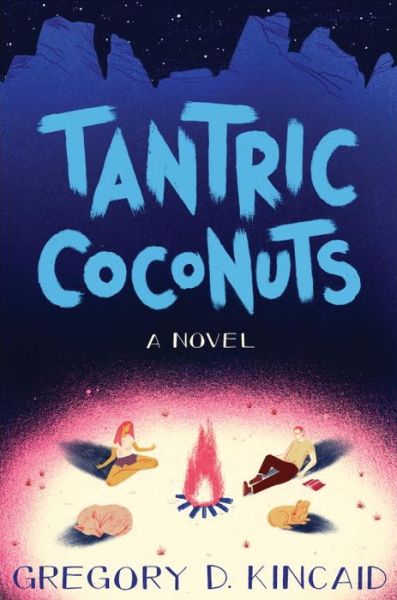
did not finish: Tantric Coconuts by Gregory D. Kincaid

tantricOh dear. I had such high hopes for this one. And with such a great title!

Ted Day is a workaholic small-town Kansas lawyer who gets carsick. Wild Bill Raines, Ted’s grandfather, demanded that Ted finally take a vacation – and then died suddenly, leaving Ted his old beat-up RV. Against his better judgment, Ted resigns himself to a road trip with his elderly terrier, Argo.

Angel Two Sparrow is a spiritual consultant whose father fears she has inherited the “loco gene” of the women in their Lakota family. She has just inherited No Barks, a half-wolf dog, and a converted Bookmobile (converted into what, it is unclear) from her father’s Aunt Lilly – not upon that lady’s death but upon her imprisonment, having shot and killed her ex-husband because a bear told her to in her dreams. Angel’s ambition is to be a traveling spiritual consultant, so No Barks will accompany her in the Bookmobile.

The two bump into each other, hard, and literally, at a campground in New Mexico. They exchange a few witty and vaguely flirtatious lines and then get into the meat of it: Ted agrees to be Angel’s student (her first, though he doesn’t know this), and he and Argo join her and No Barks in the Bookmobile for a two-week course of study. At which point this intriguing and charmingly odd (if slightly over-cute and dialog-challenged) story takes a turn for the worse. I was dismayed to find myself reminded of Sophie’s World all over again: Ted and Angel turn out to be mere vehicles for the expression of simplified spiritual philosophies, and the dialog becomes downright atrocious. (“I’m glad you mentioned this, and I want you to know I’ve taken your observation very seriously,” intones Angel on page 85, as if she had just completed a series of classes in management-speak. I made it five more pages before quitting on page 90.) Author Kincaid also includes the occasional footnote recommending further reading, including one pointing his reader to the Wikipedia page on neuroplasticity.

I was taken by Ted and Angel’s contrasts and the possibility for a rather silly romance, which may indeed be where they are heading, but terrible dialog and a transparent use of these characters to teach Philosophy 101 will not allow me to follow them there. Best of luck to them, and the dogs too.

book beginnings on Friday: The Cormorant by Chuck Wendig

Thanks to Rose City Reader for hosting this meme. To participate, share the first line or two of the book you are currently reading and, if you feel so moved, let us know what your first impressions were based on that first line.

cormorant

Following on Blackbirds and Mockingbird, Chuck Wendig returns us to the strange and darkly wonderful world of Miriam Black with The Cormorant. I like cormorants (we have them in the bayous ’round here) and I like Wendig’s weird sense of humor. First, the dedication: “To all the foul-mouthed miscreants and deviants who are fans of Miriam, and who make this book possible.” Thank you, sir.

It begins:

“And the Lord said, let there be light.”

A flutter of black fabric, and the hood is gone.

Miriam winces.

Right on schedule.

The Falling Sky by Pippa Goldschmidt

My father also reviewed this book here.


An astronomer’s professional and personal journey, both eased and challenged by her scientific mind.

falling sky

Pippa Goldschmidt’s The Falling Sky revolves around Jeanette, a young astronomer deeply dedicated to her work but uninspired by the competitive bureaucracy of postdoctoral research. The stars and galaxies make sense to her in a way that people do not; she is a talented and intelligent scientist whose rational lens often fails her in navigating the world of human relationships. In a Chilean observatory, she makes a discovery that could turn the scientific world on its head; what she will do with this new and disruptive evidence will similarly upend her personal life. Amid the commotion, a new love affair with an old friend and the disorder of her professional ambitions combine to reawaken a childhood trauma, a tragedy from which her family has never recovered.

The Falling Sky incorporates hard science (Goldschmidt is an astronomer as well as an accomplished writer) with the story of a young woman struggling to find and establish her own place in the world. Artists, romantics, philosophers, mystics, feminists, photographers and scientists will all identify with aspects of Jeanette’s journey. Those familiar with the Edinburgh setting will be pleased by its evocation. But perhaps the most remarkable and unusual element of Goldschmidt’s striking debut novel is Jeanette’s perspective: the reader sees her world as she does, with an emphasis on objectivity, data points, the relativity of time and space, and the search for connections between distant galaxies. As Jeanette sighs, “the lack of information is appalling,” but her story comes around to a satisfying conclusion nonetheless.


This review originally ran in the May 20, 2014 issue of Shelf Awareness for Readers. To subscribe, click here, and you’ll receive two issues per week of book reviews and other bookish fun!


Rating: 6 connections.

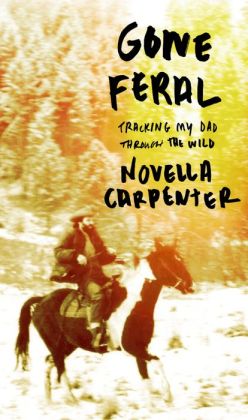
Gone Feral: Tracking My Dad Through the Wild by Novella Carpenter

Back-to-basics urban farmer Novella Carpenter investigates family in her second contemplative memoir.

gone feral

When Novella Carpenter was 36, her father went missing. It turned out to be a false alarm, but the threat of losing him helped Novella realize that, if she was ever to get to know George Carpenter, she might be running out of time, since their relationship had been stuck somewhere between uneasy and estranged for years. Gone Feral: Tracking My Dad Through the Wild charts her journey home.

After a romantic meeting in 1969 San Miguel de Allende, Mexico, her parents embarked on an idealistic European tour before settling on a farm in Idaho in “voluntary poverty.” But the marriage ended when Novella and her sister were five and seven, and their mother moved them to Washington State; Novella didn’t see much of her father after that. Now, three decades later, she has a small urban farm in Oakland, Calif., which she documented in her memoir Farm City. When she and her boyfriend, Bill, decide to try to get pregnant, she wonders about her own genetic legacy. Breeding ducks, chickens and milk goats has taught her the importance of the stock line. In working to become a parent herself, after the scare of George going missing, she goes in search of her father, hoping to build the relationship they never had.

George is still scraping by near the Idaho farm where Novella was born. He’s a regular backwoods curmudgeon, making a meager living by logging and cutting firewood and sharing his cabin with wild animals. She hopes they’ll go fly-fishing, re-creating the romance of A River Runs Through It. Maybe they’ll forage for wild foods or he’ll teach her how to fell a tree perfectly. Instead, he rants about the devils that possess the old family farm and exhibits previously unnoticed signs of post-traumatic stress disorder (the legacy of his service in the Korean War). Novella is disturbed, angered all over again at what she sees as his abandonment, and concerned about the genes she’ll pass on to a child, if she ever succeeds in getting pregnant.

Gone Feral is reflective, as Novella ponders the paradoxes of her upbringing–for example, the liberal hippie value system (hers and her mother’s) that rejects her father the mountain man–and wonders what it is she really wants for her own child. Traveling through the country and her own past teaches her about herself, her origins, and how to build a future that includes father as well as child.


This review originally ran in the May 20, 2014 issue of Shelf Awareness for the Book Trade. To subscribe, click here.


Rating: 5 babies.

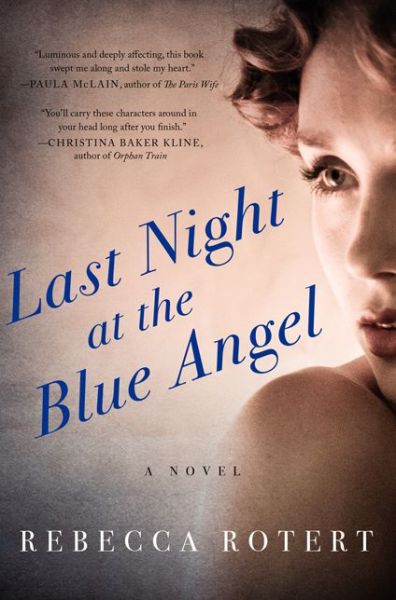
Teaser Tuesdays: Last Night at the Blue Angel by Rebecca Rotert

Teaser Tuesdays is a weekly bookish meme, hosted by MizB of Should Be Reading.

last night

This lovely novel set in Chicago’s jazz scene in the 1960’s stars a heartbreaking ten-year-old girl, backed up by her mother, a self-absorbed but sympathetic aspiring singer. Their relationship is rendered perfectly.

Mother’s feelings are the curb I walk, trying to keep my balance, and I get tired of it, being careful, and mad at her at the same time. But then she takes my hand and smiles at me.

And on the next page,

When she notices me, all the times she doesn’t notice me get erased.

We learn a great deal there, don’t we? The rest of the book is written with equal skill, and the mother is far more complex than these lines might indicate. Do check it out.

This quotation comes from an uncorrected advance proof and is subject to change.

guest review: The Worst Hard Time: The Untold Story of Those Who Survived the Great American Dust Bowl by Timothy Egan, from Mom (audio)

Thanks Mom for sending these reading notes.

I’m reading a Playaway version of Worst Hard Times. I picked it up because it’s a World Book Night item, on display at the library when I went to pick up my box of Catch 22 to give away. I was most interested in this audio player-book just sitting on the shelf. (Add earbuds, battery, and stir.)
worsthardtime
It’s a pretty grim picture. Worst Hard Times is the dust bowl story, and follows people’s stories in several of the farms & towns of the worst areas. Egan writes for the NY Times, and recently wrote a scathing attack on the idea that the landslide in Oso was one of those “acts of God” that are so unfortunate but . . . . (Actually there was lots of warning by geologists, an earlier landslide in the last decade, with the logging of the hilltop as the coup de gras).

The Dust Bowl is called the worst man-made disaster of the U.S., and easily understood in hindsight as a tragic result of lack of understanding of natural forces, as well as grasping for even more wealth when the land was giving its riches reliably during the wet years of the Twenties. He gives more details than can be born, almost: the dust swirling, no plates set out until time to use them, wet bedsheets hung up over windows every night, people dying of “dust pneumonia.” The old cattlemen said it was a crime to uproot the prairie grass, and that the land would be ruined – more importantly, to them, even than the loss of the land for cows.

This area, which was called the Great American Desert, was given to the Apaches. When the government decided to give the land to settlers, Texas, especially, made every effort to eradicate the buffalo in order to drive off the Indians.

So, a good story. The reader, not so much. (He’s “an accomplished actor, director and combat choreographer” according to the audio blurb. Huh?) He put a little too much hick into the voices when he quotes them, and, like some readers I’ve noticed, makes women’s voices especially irritating, with a too-high intonation. The most irritating, though – a subjective reaction, I know – is his pronunciation of Boise City as /boyZAY/. Really?

Oh, Mom, I do so get it! The pronunciations from my recent read of Bryson’s A Walk in the Woods are fresh in my mind – unfortunately the only one I can cite specifically is urinal as “your-RYE-null” (very strange!) but there were others, equally odd & distracting. I think I’m more upset by the overly hick accents and the obnoxious women’s voices, though.

Does Egan overtly make the comparison between our hubris & lack of foresight with the Dust Bowl, and same with the recent mudslide (etc. etc.)? Or leave us to figure it out? If the latter, readers like yourself make the connection without difficulty; but I always appreciate the former. If you have a statement, go ahead and make it, please! Stand up for what you think.

I would say yes. I’m not through yet, but he lets a lot of characters say this. He also writes of the preachers who said that people are being punished for some sin, or that prayer & positive thinking will make it all better.

The sodbusters are all from the devil, according to the cattlemen. The saddest part of that is not that they are right, but that the dust dunes and drought ends up killing even the grass that remains.

There’s a scientist who explains it perfectly, and after Roosevelt’s election, he gets put in some government function to help solve the problems. There’s a town where the people agree to follow this guy’s recommendations for saving the land. Don’t remember the details, but hope to see this followed up in a later chapter.

There’s a newspaper owner (Dalhart or Boise City) who stops reporting all the bad stuff. Then he decides the people just need to embrace the situation. Look at the black clouds, the wind, the dead earth, and see the majesty of nature. Nuts! He doesn’t mention embracing all the death.

So I think Egan will have a strong conclusion to this effect.

The roaring boom of prosperity and the miracle of turning land into wheat (=$$) is a big theme. Plain people learning that they could have become rich if they planted every acre. They couldn’t tear up the prairie fast enough. We even have what he calls suitcase farmers, entrepreneurs who come to town and pay someone to rent their land and plant wheat. They just wait around for the harvest and the profits. After the bust and the drop in wheat prices, off they go, with no more interest in the land they have mined. How much hubris can you stand?

This does sound like a good story – though decidedly grim, as you say. I’d like to put it on the (long) list… Thanks for sharing!

Illuminations: A Novel of Hildegard von Bingen by Mary Sharratt (audio)

illuminationsHildegard von Bingen was a real-life woman; a brief glance at the Wikipedia page under her name indicates that this novel is faithful to the general shape of the historical figure’s life. (Consulting Wikipedia is not a high standard, but it’s all I felt necessary to my review of this book. And really, we can’t ask for much accuracy when dealing with a mystic from the 1000’s, can we we?)

First question: what led me to a book about a religious figurehead? I’m not entirely sure. I don’t have a great deal of patience for Christian subjects of books in general; but this woman was a writer and something of a rebel, and I decided to give it a try. I could always put it down. My whim was rewarded: I enjoyed Hildegard’s story.

The book is narrated by Hildegard herself (and to reduce confusion, I’ll also say that this audio edition was narrated by Tavia Gilbert, on whom more in a moment), beginning in her old age and then quickly flashing back to her childhood. We spend the vast majority in this lengthy flashback, and thus see her life chronologically.

Hildegard was very young when she began seeing the visions she would be famous for; she saw a lady of light that she came to believe was god, or the church, and her mother disapproved. Partly for this reason, and partly because there were so many children to provide for, her mother gave her to the church – or specifically, to a wealthy young woman from a good family who devoted her own life to god and needed an attendant. Hildegard was only eight when she and Jutta were bricked into the monastery at Disibodenberg to serve as anchorites; and this is the first, but not the last, time I exclaimed at the cruelty of the church.

Hildegard spends a number of years bricked in with Jutta, who is strict, joyless and loveless. She does make a friend in a monk named Volmar, however, who speaks with the women through a little window, and brings gifts of potted plants and books. Eventually the walls will be torn down so that two more young girls can be bricked in, as well, enlarging their tiny convent somewhat; the newcomers are Adelheid and Guda, the latter of whom is even younger than Hildegard was when she was imprisoned. Hildegard had been planning an escape when the two children were brought; but she can’t leave them to her fate, and she stays.

When Jutta dies (after starving herself), years later, Hildegard and her two younger proteges make a plea to be allowed to live in the monastery in relative freedom – they will retain their rooms as before but not be bricked back in. Due to Hildegard’s political maneuverings and performance before important visitors, this request is granted, but grudgingly. She has continued to cause trouble. She still has her visions, although she has learned to keep them to herself; but she is less obedient and more questioning than the monks appreciate. She has also, however, come to serve as a mother or leader to the younger women, who are now joined by a newcomer named Richardis, daughter of Hildegard’s powerful sometimes-ally. Richardis will become Hildegard’s special friend. Such a relationship is actually forbidden by the Benedictine order, but the two women can’t help loving each other. (To be clear, there is no sexual relationship here, and only the slimmest of hints about sexual attraction.)

The novel follows Hildegard’s growth, and her continuing efforts to live beyond the monastery. Her flock of “daughters” grows, and she will finally petition the Archbishop of Mainz, and successfully establish her own monastery at Rupertsberg, accompanied by her nuns and her old friend, Volmar. One of her greatest controversies is her writing: it takes ten years, but she will write a book of her visions, illustrated (or “illuminated”) by Richardis and transcribed by Volmar; the Pope himself confirms that her visions are holy rather than evil, although the abbot at Disibodenberg will never be entirely satisfied on that point. She also composes music, grows herbs and mixes remedies (and writes medical texts), and studies plants in the natural world; she is in fact a Renaissance woman, in an age when women were supposed to be silent nuns or wives. Again, the particulars of her life represented in this fictionalization may not be perfectly accurate. But the broader strokes are true: Hildegard was an author, an abbess, a composer, an outspoken leader.

In other words, Hildegard von Bingen was bigger than her world normally allowed women to be; and this after being buried alive in childhood as an anchorite. This novel of her life tells that story beautifully. It goes pretty light on the parts about god and religion, which was a major plus for this reader; those more interested in the religious side of her life might be disappointed, but I enjoyed being able to read about her accomplishments, her struggles, and her personality without being subjected to too much preaching. The Hildegard in this book loved people, and wanted the best for her daughters; god was almost incidental to her, and that worked well for me. Although it is her visions of that that made her famous in the first place, the god she sees in them is both notably female, and a god of love and freedom rather than rules.

Her story is compelling, and I appreciated her frustrations and enjoyed her personality. The narration by Tavia Gilbert felt right; I liked the old woman’s voice she uses at the very end, but her characterization was mostly invisible, just felt like Hildegard herself were speaking, and that is as it should be.

For a historical story of women’s rights in the church and in society in the 1000’s and 1100’s, I do recommend Illuminations.


Rating: 7 beautiful women.

Animal Farm by George Orwell

animal farmOn my way out the door headed for the airport, I realized at the last minute that I might not have enough reading material for a medium-long flight to Seattle. I’m so glad I grabbed this slim volume – the closest appropriately-sized book to hand, off my TBR shelf. I did indeed finish the one book and start and finish this one on that flight; and I enjoyed it very much and found it thought-provoking.

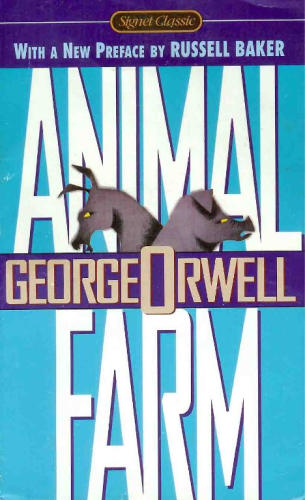
Animal Farm is a classic, chilling allegory from the author of 1984, whose voice I most definitely recognized in this earlier novel. My 50th anniversary edition, from Signet Classic in 1996 (pictured), includes a preface by Russell Baker (new in 1996) and a 1954 introduction by C. M. Woodhouse of The Times Literary Supplement. I found these starting pieces noteworthy. I know a little about Orwell, have read 1984 several times, and am familiar with other early dystopian novels like Brave New World, which Baker refers to (he calls these authors pessimists), so I had a little background. Interestingly, Baker makes the very optimistic statement that the pessimists were wrong, that our current leaders (in 1996) did not resemble dictators, that technology has been a liberating force. I think there is some validity to the last argument; but there is plenty of room to criticize the power of the state today, and I find Baker a trifle breezy in his reassurances. To be fair, he is right to point out that the state has turned out to be less efficient than Orwell feared: drones and wiretaps today do not approach the effectiveness of Big Brother in 1984. At least, that’s what we think… I don’t consider myself a conspiracy theorist, but I’m not particularly optimistic about the virtues of our government leaders.

Woodhouse’s introduction is more straightforwardly academic in its analysis of Animal Farm as literature and in culture and politics, and of Orwell as an artist. He considers him a prose poet, in fact. This article was informative and critical but still accessible, and I recommend it. (I recommend Baker’s preface, too, but with salt.) The most useful part, for me, was the specific placement of Animal Farm in time: it was published in August of 1945, the same month as the bombings of Hiroshima and Nagasaki, but Orwell had begun writing it in 1943, following his disquieting experience in the Spanish Civil War in the late 1930’s. As a criticism of Stalin’s Soviet Union, Animal Farm was not particularly welcome in the Britain of the early 1940’s.

And now the novel itself. Orwell (or rather Eric Blair, who used a pen name) calls it a fairy story; but I find the allegory blaring through loud and clear. Mr. Jones is a drunken farmer who does not always treat his farm animals with great respect or tenderness. An elder statesman of a pig (no, literally) makes a speech shortly before his death in which he predicts to his fellow four-legged residents an uprising of the animals against the people. This prediction will be carried out by the animals of Manor Farm: they kick Mr. Jones off, rename their property Animal Farm, and begin working for themselves, cooperatively. Aside from the anthropomorphism of the animals, it’s a straightforward and absolutely real tale. The pigs are the smartest – are in charge – assisted by the dogs; horses & a donkey are thinkers as well, while the birds and the sheep are followers. They come up with a list of Seven Commandments: no animal shall wear clothes, no animal shall sleep in a bed, etc. and finishing with “All animals are equal.” They make committees and call one another “comrade.” Two pigs, Snowball and Napoleon, struggle for power; Snowball is a better speaker, but Napoleon marshals the power of a few big, strong, brainwashed dogs, and eventually runs Snowball off the farm. The pigs begin to relish their power and to take advantage. Gradually, the rules of Animal Farm change; the Seven Commandments are amended (“no animal shall sleep in a bed with sheets”), but because very few of the subjects are literate, the pigs in charge have little trouble changing history too. Thus, it’s not that the state has changed its policies; these have always been the policies of the state. This is precisely the case in 1984 as well, where

Oceania was at war with Eurasias: therefore Oceania had always been at war with Eurasia. The enemy of the moment always represented absolute evil, and it followed that any past of future agreement with him was impossible.

Chilling, I say!

Also, credit Animal Farm with the oft-quoted amendment to the final Commandment: “All Animals Are Equal. But Some Animals Are More Equal Than Others.”

This is a short book, just over 100 pages, and easily read in just a part of my flight. And in the “fairy story” about the animals on the farm, it’s fairly straightforward, too. But the underlying message, which doesn’t lie so far beneath the surface at all, is terrifying – and also fairly straightforward, in fact. From a historical perspective, that almost makes it that much more frightening, that these things really happened, right under people’s eyes, and not so long ago either. It’s disconcerting how easily people can be convinced to disbelieve their own minds and memories.

I continue to be a fan of Orwell, of both 1984 and Animal Farm, and despite Baker’s characterization of Orwell and Huxley as “pessimists”, I think these are important books to read today. (To be fair, he agrees: “Orwell left us a lesson about the human contribution to political terror that will always be as up-to-date as next year’s election.”) Also, the writing is pretty wonderful.

Shivers! And go read!


Rating: 9 readjusted rations.

habits passed along

As I’ve done in summers past, I was looking forward this summer to seeing some Shakespeare dramatized at Miller Outdoor Theatre, where we can sit outside under the stars and bring dogs & food & drink along, and all the performances are free. This is a summer activity I grew up with and still enjoy. Part of my tradition also involves reading or rereading the plays ahead of time so I’ll be ready to fully enjoy what I see. Therefore, I started checking the website for information on the Houston Shakespeare Festival early this summer, to see what plays they’d be putting on (there is always one comedy and one tragedy or history), with the intention of getting my hands on a copy of each if I didn’t already own them.

This year’s history is Henry IV, 1, which I requested from my local public library. The comedy is The Two Gentlemen of Verona, and I was pretty sure I owned a copy, since I saw it as a child with my grandparents in southern California. I went home to check, and sure enough, my 1964 “general readers” edition from the Folger Library was there on the shelf. I pulled it out and put it in the stack.

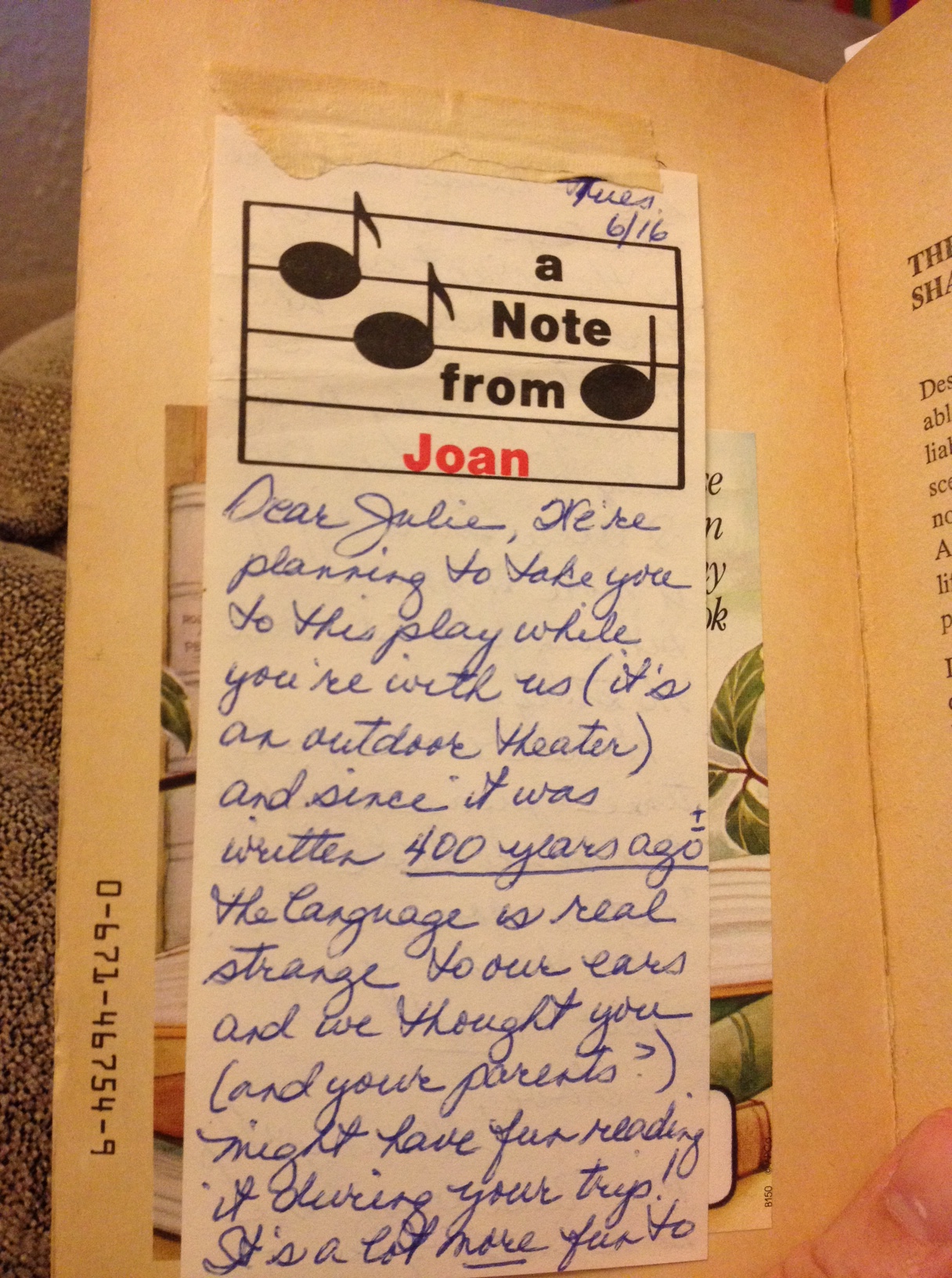
I was not prepared for the surprise I got when I opened it up, though. This note is taped into the inside cover:

photo 2 (1)
From my grandmother:

Dear Julie,

We’re planning to take you to this play while you’re with us (it’s an outdoor theater) and since it was written 400 years ago (+/-) the language is real strange to our ears and we thought you (and your parents?) might have fun reading it during your trip! It’s a lot more fun to see it ’cause there are no stage directions in the script so it’s hard to imagine all the action. It is a comedy – really kinda silly, I suppose. But I know you’ll enjoy it more if you’re a bit acquainted with the story…

Have a wonderful time & please give our love to all those nice sisters & cousins & all.

Can’t wait for your visit to us!

Love, Grammy & Pop

P.S. Please bring the book with you!

Can you just believe! This is the very copy provided by Grammy & Pop for me to read before seeing what I’m sure was my first Shakespeare performance ever; and I’ve still got it, and here I am however many years later, going back to see the same play and preparing for it in the same way, by rereading this very copy. It got me thinking about where I got these habits. Grammy puts it in this note in almost the exact way I put it to my friends: “this play will be a lot more enjoyable if you know a little bit about the story ahead of time.” I think I can see who I have to thank for my playgoing practices!

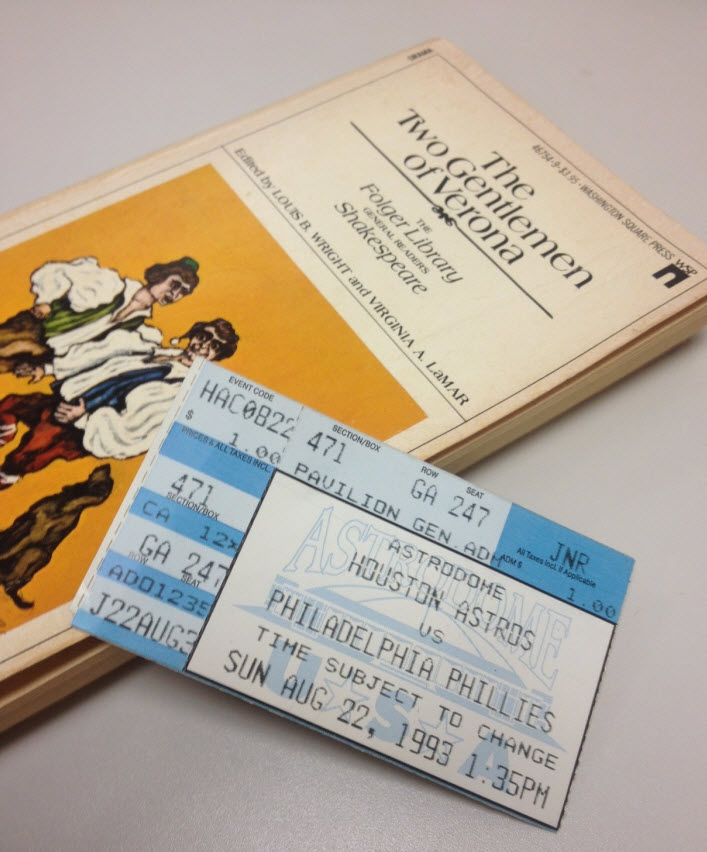
I’m wondering about the year, of course. You can see Grammy dated it with day, month and date – no year, but the day-to-date question, combined with her mention of our other travels that summer, put me at just past my 10th birthday for this event. I also found tucked away a ticket to an Astros game (at the Astrodome! against Philadelphia) from the following summer. And my father’s and grandmother’s memories put it around the same time, so I think we’ll call this my ten-year-old introduction to live performances of Shakespeare. (I might have read some before.)

astro
Finding this note inside this book was a real treat for several reasons. For one thing, it’s always nice to hear from my Grammy, who still sends me newspaper clippings with appended notes like this one! And I am looking forward all the more to seeing The Two Gentlemen of Verona performed this summer, because I’ll be thinking back to that summer more than 20 years ago. But most of all, I think it’s charming to consider where we get our habits from. I guess I’ve just always been a person who enjoyed theatre, and enjoyed reading the written drama beforehand; but of course nothing happens in a vacuum, so it’s really fun to see this clear indication of where I come from. Thanks, Grammy.