The Two Gentlemen of Verona by William Shakespeare

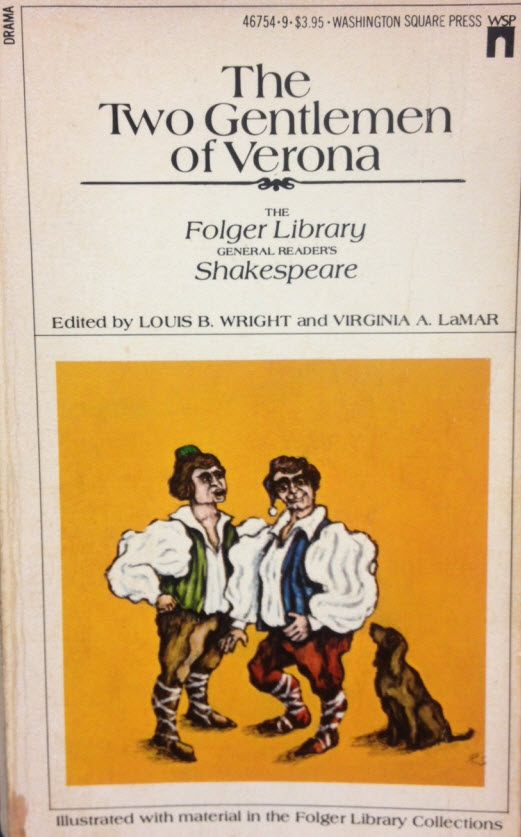
veronaI had a pleasant reread of this early Shakespeare comedy in preparation for the Houston Shakespeare Festival this summer. Of course you saw my post the other day about what a special copy of the book this is…

The Two Gentlemen of Verona is an earlier and a lesser-known Shakespeare play, but I think it’s still excellent in all the usual ways: clever wordplay, mild bawdiness, romantic wafflings or confusions that may threaten our modern sensibilities just a touch, but overall, with the potential to be wildly entertaining in the right hands. I remember the performance I saw as a youngster being accessible (having read the play beforehand helps, of course).

The two gentlemen are Valentine and Proteus, and they are best friends. Valentine is prepared to leave Verona to seek his fortune in Milan; Proteus stays behind because he is in love with Julia, and determined to win her. Valentine finds his love in Sylvia, daughter to the Duke of Milan; and Proteus’s father is convinced to send his son away, separating him from Julia just as they declare their love for each other. Proteus is sent to join his friend Valentine, which should be a happy reunion; but fickle Proteus falls for his friend’s betrothed, betraying both his friend Valentine and his own love, Julia. Determined to win Sylvia away, Proteus reveals Valentine and Sylvia’s elopement plan. The Duke has Valentine banished; and the action of the play moves to the woods.

In what might be seen as a vague early shadow of A Midsummer Night’s Dream, the woods are host to a banished Valentine and his servant Speed – who are taken in by a host of bandits – and who are pursued by a grieving Sylvia and her faithful servant – who are pursued by a love-stricken Proteus, her father the Duke, and the Duke’s intended son-in-law Thurio – who are accompanied by Julia, serving as a page (in male drag of course) to Proteus, thereby in pursuit of her love. If you had trouble following that, all is as it should be.

You might recognize a few lines:

What light is light, if Sylvia be not seen?
What joy is joy, if Sylvia be not by?
Unless it be to think that she is by,
And feed upon the shadow of perfection.

Or:

It is the lesser blot, modesty finds,
Women to change their shapes than men their minds.

Speed, servant to Valentine, and Launce, servant to Proteus, have their share of buffoonery, great scenes with wordplay and witticisms that are typical of Shakespearean comedy. All ends well (although we sniff at the treatment of certain female characters, and the slurs upon Jews. Time-typical Shakespeare, again); and the play is, indeed, funny.

I look forward to seeing this summer’s live performance.


Rating: 7 gift-dogs.

The Vacationers by Emma Straub

An eccentrically fun family vacation, with far more style and spunk than your average beach read.

straub

The Vacationers by Emma Straub (Laura Lamont’s Life in Pictures) is peopled by charming, funny, expertly portrayed characters who feel very real and yet slightly fantastical.

The Post family is headed from Manhattan to Mallorca for a two-week vacation, ostensibly to celebrate: Franny and Jim are approaching their 35th anniversary, and their daughter, Sylvia, has just graduated from high school. Joining them will be their son, Bobby, with his girlfriend, Carmen, and Franny’s BFF Charles and his husband, Lawrence. However, Jim has recently left his decades-long career at Gallant magazine amidst shame and scandal, and his transgressions at work have followed him home. Sylvia’s big goal of the summer is to lose her virginity before starting college in the fall. Charles and Lawrence’s is to adopt a baby–a plan they haven’t yet shared with the Posts. Bobby and Carmen are on uneven ground; they have a secret to break to his parents, and it doesn’t help that the Posts have never liked Carmen. More secrets and scandals, new and old, will come to light under the Spanish sun.

Straub’s greatest strengths are her endearingly quirky protagonists and a plot with more twists than a European mountain road, but her secondary characters are also cleverly wrought. The Posts’ absent hostess, Gemma, is Charles’s second-best friend; Franny tries not to let that annoy her. Sylvia’s local Spanish tutor, Joan (“pronounced Joe-ahhhn”), is a delectable temptation for both Sylvia and Franny, but it’s a retired tennis pro who really turns Franny’s head. Luckily, a motorcycle-riding pediatrician becomes Jim’s ally in trying to re-win his wife’s heart. Despite the considerable dysfunction of this family, this tale about them has a surprisingly happy ending.


This review originally ran in the May 30, 2014 issue of Shelf Awareness for Readers. To subscribe, click here, and you’ll receive two issues per week of book reviews and other bookish fun!


Rating: 9 olives.

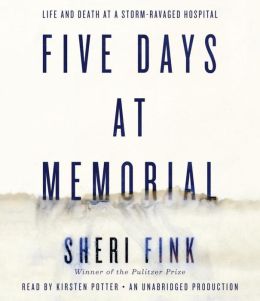
book beginnings on Friday: Five Days at Memorial: Life and Death in a Storm-Ravaged Hospital by Sheri Fink

Thanks to Rose City Reader for hosting this meme. To participate, share the first line or two of the book you are currently reading and, if you feel so moved, let us know what your first impressions were based on that first line.

five days

I have been intrigued by the idea of this book for some time now. I have some perspective on Katrina, to begin with. Not that my personal life was profoundly effected, but Houston residents saw the consequences come our way. For one thing, in the form of Katrina evacuees, and for another, because when Hurricane Rita was forecast for us just a few months later, the response was quite different than it might have been if our neighbors to the east had not just been so badly beaten. And then I suppose my interest is piqued as well because I work at a hospital now. Finally, I got to see Anna Deavere Smith perform last month (at the Medical Library Association Annual Conference in Chicago), and she did a short piece on the conditions at Charity Hospital in New Orleans that was – naturally – very moving. So here we are, finally.

Five Days at Memorial begins with an Author’s Note in which Fink describes her research methods (lots of interviews & other primary & secondary materials) and notes that she wasn’t at Memorial during the storm, although she visited later. She makes it clear that this is a journalistic work, and that she has been faithful to what she learned in her research – all dialog in quotations comes from interview, etc. – and that she has made an effort to keep her own reactions (“any book reflects the interwoven interpretations and insights of its author”) clearly delineated from the facts. I appreciate this.

I’d like to share two bits for your book beginning today. First of all, “Part I: Deadly Choices” begins with a quotation:

Blindness was spreading, not like a sudden tide flooding everything and carrying all before it, but like an insidious infiltration of a thousand and one turbulent rivulets which, having slowly drenched the earth, suddenly submerge it completely. – José Saramago, Blindness

And then the Prologue:

At last through the broken windows, the pulse of helicopter rotors and airboat propellers set the summer morning air throbbing with the promise of rescue. Floodwaters unleashed by Hurricane Katrina had marooned hundreds of people at the hospital, where they had now spent four days.

And that, I think, says enough for today.

A Swiftly Tilting Planet by Madeline L’Engle (audio)

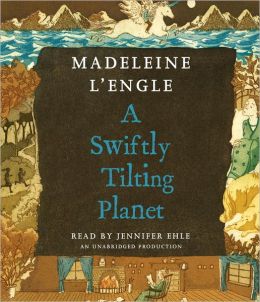
swiftly tiltingThis is book 3 in a series, following A Wrinkle in Time and A Wind in the Door.

In this episode of the Murrys’ lives, Meg is an adult, recently married to Calvin and pregnant. This makes for a change: no one is really a child any more (well, Charles Wallace is 15. But he’s an odd one, isn’t he). However, the voice of the characters is not noticeably more mature. (She uses rather big words! But simple sentences.) On the one hand, this means that L’Engle’s novels remain accessible to the youthful population she intended. On the other, it does feel like children’s or young adult lit. Just a note. I’m still enjoying.

Where A Wrinkle in Time dealt with hard science and Meg’s social awkwardness, and A Wind in the Door emphasized the importance of all the parts of the world, large and small, A Swiftly Tilting Planet expands on that concept of interconnectedness and applies it to international politics and the possibility of nuclear war. An added element of fun and fascination is provided by time travel: Charles Wallace has a unicorn friend named Gaudior this time as his guide, and they travel through time to visit Calvin O’Keefe’s forebears throughout history. The unicorn, and the different historical settings, were excellently done, in my opinion; I was almost sorry when we returned to the present. But not to worry: the Murrys’ present makes up a smallish minority of this book’s focus; we spend most of our time immersed in history, from ancient times through the early New England settlers and the US Civil War.

On Thanksgiving, Calvin’s mother and therefore Meg’s new mother-in-law, Mrs. O’Keefe, is present when the family receives word from the President (Mr. Murry is an important man) that nuclear war is imminent. The normally antisocial Mrs. O’Keefe pipes up to charge Charles Wallace with preventing it, and this is when he meets Gaudior and they travel through the centuries. L’Engle employs the classic time traveler’s hope, to change the present and future by going back and changing some detail of the past. (The butterfly effect is entirely ignored.) During these travels, Charles Wallace has to learn to deemphasize his intellect, not rely on his IQ, but go with the flow. This is an interesting lesson for our boy genius.

A Swiftly Tilting Planet is a departure from the first two books, which concentrated on science (and science starring a young girl!); this one is more social science, you might say, or the nature and effects of relationships (familial and otherwise) and the bonds of society. Readers looking for the science might be disappointed. But I found the fantasy of time travel via flying unicorn, and the chance to meet individual characters in history (a fictional, but realistic, history), very engaging and entertaining.

I missed L’Engle’s narration of this audiobook, as I’d enjoyed the author’s own voice in the first two in this series; but I must say that Jennifer Ehle’s reading was quite similar. (She is a little less gruff.) If we have to change narrators mid-series, at least let them be like enough that I don’t feel jolted; so well done on that count. And Ehle’s narration was fine in itself. I will be listening to the final two books in turn – already have them loaded. I still recommend L’Engle’s work.


Rating: 7 letters.

The Cormorant by Chuck Wendig

cormorantThis is the third in a series, preceded by Blackbirds and Mockingbird, which I enjoyed.

Miriam Black is back, in disjointed chronology, still battling her demons and the curse of her “gift” of seeing how and when people die. She has moved on from stealing from the dead, and trying to prevent deaths through various means, to the only way she’s found that works: she can prevent deaths only when she kills the killer. She has broken with Lou, good old Lou from books 1 and 2, and has been on something of a mission. When the book opens, she’s being held in a room by two… possible FBI agents, but possibly something else. The split chronology takes us backward in time, explaining how she got there. I’ll use the present tense for this past, as the book does.

Miriam receives an offer: $5000 to tell a guy how he dies. She has tried to sell this talent before, but this is the biggest number she’s seen, and comes just as she’s evicted from a bad living situation; so Miriam buys a cheap car and heads for Florida. She carries three phone numbers with her there: that of the man hiring her, Lou’s, and her mother’s. These are the three folks she knows (so to speak) in Florida.

But when she appears at the man’s house and touches him, the death scene she sees involves her – is a message for her, in fact. A threat from her past resurfaces; and suddenly everyone she’s come in contact with is in danger, and Miriam is set on a path again.

Miriam is still a great character: foul-mouthed and tough, yet vulnerable and even, occasionally, compassionate. I love her personality; and she has another …maybe love interest is the wrong term, but she has another encounter in this book which keeps things interesting. I like the bird theme, too; look out for the powers of the gannet as well as the cormorant here.

Wendig’s unique writing style continues to amuse. He’s almost over-the-top with his odd metaphors:

Those things taste like cough syrup that’s been fermenting in the mouth of a dead goat, but shit, they work.

Eventually, her bladder is like a yippy terrier that wants to go out.

But I like it. Remember you can always get your daily fix (more or less) at his blog, too.

The nice people in Wendig’s books are a nice touch, and a realistic one. You can sense his descriptions approaching a world that is all evil – but he holds back, and I applaud him for it. The evil bits are all the more poignant when we get to see that there are good people in Miriam’s world, too. Sometimes she’s even one of them.

I continue to look out for the next Miriam Black novel, which is to be titled Thunderbird. Still recommended.


Rating: 7 gold watches.

Teaser Tuesdays: The Practice of the Wild by Gary Snyder

Teaser Tuesdays is a weekly bookish meme, hosted by MizB of Should Be Reading.

wildFrom essay #3, “Tawny Grammar.”

I always liked libraries: they were warm and stayed open late.

(Here in Houston we might point out instead that libraries are cool.)

Oh, if only this were still the case. City and county budget cuts mean that libraries are decidedly not open late any more, at least not where I come from. Do you have a local public library that stays open late? Speak up!

Keep up with my reading of this essay collection:

  1. “The Etiquette of Freedom”
  2. “The Place, the Region, and the Commons”
  3. “Tawny Grammar,” coming soon.

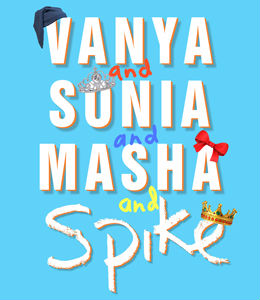
Alley Theatre presents Vanya and Sonia and Masha and Spike

vanya

Husband was kind enough to accompany me to the theatre again, our second play at the Alley this year. (See Fool from a few months back.)

Vanya and Sonia and Masha and Spike references Chekhov; but no familiarity with his work is required to enjoy this one. Vanya and Sonia are aging siblings – she’s adopted, they will remind you a few times – still living together in the family home, mostly bickering with one another and dissatisfied with their lives (particularly Sonia, who is casually mentioned as being bi-polar). Their sister Masha is a successful actor – less so on the stage, more so in the movies, particularly sexy slasher flicks; but she is aging, too, and feeling less secure about her sex appeal and professional future. When Masha comes to visit this time, she brings Spike: a much younger aspiring actor and a hot piece of male flesh inclined towards taking his clothes off. This habit is the source of some laughs, as everyone onstage is entranced by his beauty (Vanya as well as his sisters is attracted to men); but as Nina points out late in the play (I paraphrase): Spike is beautiful; it’s a shame about his personality.

Oh yes, Nina. The cast of six is rounded out by a beautiful young neighbor girl, Nina, also an aspiring actor and a huge fan of Masha’s; and the housekeeper, Cassandra. Cassandra is a real hit: like her Greek namesake, she is cursed to make predictions that are… often right, more or less; but that are disregarded. She is a strong personality and a great stage presence, and provides still more comic relief. The play is not short on laughs, in fact, despite some heavy subject matter: depression and late-life regrets; family dynamics; climate change and politics; a rapidly changing and-not-always-for-the-better world. I was struck by a line (again I paraphrase) about how there are now 900 (or some such number) television channels available, and you can always find a news channel that tells you what you already believe. Late in the final act we are treated to that classic, the play-within-a-play, written by Vanya and performed by Nina, which takes place in the post-climate-change-apocalypse, when humans are extinct.

It got a little long-winded here and there, I confess; I think Husband appreciated the fart jokes and lighter, always-accessible humor of Fool better than this one. There were some tangents. But I appreciated every one! I highly recommend this mashup of serious topics, comic relief, and plentiful references to literature and the arts. The actors were strong, too. I heard a few missed lines – just a few, just barely – but was still very impressed by the personalities. Cassandra and Sonia were real standouts; I was especially struck by the arc achieved by Sonia, from dumpy house-bound depressive through an exhilarating costume party to actually making plans to go out on a date. I cheered her on. And Spike’s portrayal in the near-nude was both hilarious and, yes, attractive.


Rating: 8 molecules.

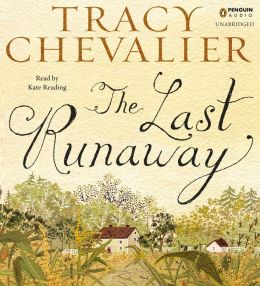
The Last Runaway by Tracy Chevalier (audio)

runawayFrom the author of Girl with a Pearl Earring (which I read pre-blog, and loved), another historical novel of women’s lives. I recently tried reading Chevalier’s The Lady and the Unicorn, but I found I couldn’t appreciate it. No such problem with The Last Runaway.

Honor Bright is a small-town British Quaker in 1850, a young woman recently abandoned by her fiance, her future uncertain. Her sister Grace will soon be departing for the New World to marry; Honor decides, somewhat impetuously, to accompany her and find a different life. She can always come back home, right? But the sea voyage – heralded as the shortest and easiest passage possible – nearly kills her, she is so seasick. When she finally sets foot in America, she knows that, no, she can never go home.

On the overland trip to Ohio (by coach – their plan to take riverboats being prevented by Honor’s seasickness), where Grace’s fiance awaits, Grace falls sick and dies. Honor will arrive alone, and ahead of the letter announcing her coming, so that the fiance, Adam, expects one sister but finds another. His brother has likewise died, leaving him now with a widowed sister-in-law as well as this almost-sister-in-law. Honor’s place is decidedly uncertain, and uncomfortable. The new Ohio Quaker community of Faithwell does not look approvingly upon Adam’s strange household. The pressure is on, therefore, for Honor to find herself a husband; but she is without even a friend in her new hometown.

She does have a friend a day trip away, however, in Wellington: Belle Mills, of Mills Millinery, who nursed Honor through an illness and sheltered her, and gave her work. Honor is a gifted seamstress and quilter, and her skills were appreciated in Belle’s shop. Quakers can’t wear colorful or decorative hats, but Honor enjoyed making them for others; and Honor got along with Belle, although the non-Quaker’s coarse speech and whiskey drinking were new to Honor. (Honor’s sewing and quilting are a strong framing element throughout the story: quilts in the English and the new American styles are described, and provide examples of Honor’s homesickness, and her new community’s intolerance of her English traditions. I thought of my mother, the quilter, who I think would appreciate these details.) Also simultaneously fascinating and disturbing is Belle’s brother, Donovan, a slave-hunter; and this is where the conflict of the novel begins.

As a Quaker and as a moral being, Honor is naturally repelled by slavery; but it is easier to abhor the peculiar institution from England, where it is distant and (forgive the phrase) black-and-white. In Ohio, Honor sees black people for almost the first time, and encounters runaway slaves who she is naturally inclined to help; she also sees Donovan working to re-enslave them. When she does marry local dairy farmer Jack Haymaker, Honor finds not a soulmate or even companion; but she does find a nasty mother-in-law and sister-in-law. When they discover that Honor has been offering minor assistance to runaways – food, water, directions to the next stop on the Underground Railroad, in Oberlin – they forbid her to help further.

The issue, then, is between obedience to her new (if unlikeable) family, versus her feelings about slavery. Honor will grow as she has to form new relationships, and not always easy ones: alliances with a black woman in Oberlin named Mrs. Reed, and with the colorful Belle Mills; and she has to find a way to relate to her new husband and in-laws that will work for each of them.

I noticed I was approaching the end of this audiobook and things felt so up in the air I couldn’t believe they’d be wrapped up in time. And indeed, the reader would appreciate a sequel to find out what finally becomes of Honor’s new family; but they are sent on their way in good time, with no loose ends, at least. Honor’s character sees a satisfactory arc: she grows, expands, speaks up for herself, considers different positions and stakes her own. And her new life is indeed established in the end.

I thought the Underground Railroad was ably portrayed, if only simplistically; the runaway slaves have some personality, and Belle Mills is a great hit. The quilting element, as I said, was an added appeal as well. But it’s Honor herself who stars, rightfully. I think Tracy Chevalier still has it here, and would recommend this novel. It’s somewhat lightweight in the issues it addresses, perhaps, but it makes its points, and is more accessible than novels on this subject sometimes are, so it will appeal to the popular reader.

The audio performance by Kate Reading (great name, that!) is fine as well. I liked the different accents she used; they provided real color and personality. I would happily recommend this format.


Rating: 7 tin cups.

Maximum Shelf author interview: Terry Hayes

Following Wednesday’s review of I Am Pilgrim, here’s Terry Hayes: On Breadth of Scope.


Terry Hayes was born in Brighton, England, migrated to Australia as a child, was based in New York as foreign correspondent at 21, and produced a current affairs radio program before moving to Los Angeles to work as a screenwriter. He has written numerous screenplays and mini-series, and has received two international Emmy nominations. His credits have included Payback with Mel Gibson, From Hell with Johnny Depp and Vertical Limit with Chris O’Donnell. I Am Pilgrim is his first novel. He lives in Switzerland with his wife, Kristen, and their four children.

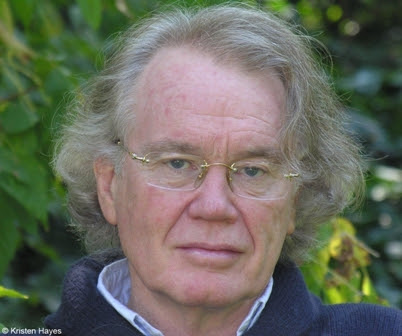
photo: Kristen Hayes

photo: Kristen Hayes

I Am Pilgrim travels through many complex spheres in numerous countries. How much research was required for this book? How did you go about it, and did you enjoy that part of the creative process?

The short answer is: an enormous amount of research. When I started I had no idea just how challenging it would be–which was probably just as well, otherwise I might not have even started. I did have a couple of advantages. With the exception of Afghanistan and Saudi Arabia, I had either lived in, or visited for extended periods, all of the countries where the plot takes place. The race against time criss-crosses continents, and ranges from the Lower East Side of Manhattan to Damascus in Syria, from Santorini in the Greek islands to a Bulgarian border post. My own wanderings lessened the research load and, I hope, allowed me to bring the novelist’s eye for detail to those locales. The second advantage I had was that I had once been a journalist and foreign correspondent, so I am accustomed to efficient and focused research and interviews. I approached the material as if I was a journalist on assignment–I admitted to myself I had a lot to learn. The one thing that I found the most difficult was the science. The plot involves a lot of biological detail, and I wanted that to be as accurate as possible. When I was at high school, several of my science teachers told me that I was very lucky I was good at English and history! Still, I have an enormous curiosity and am happy to read and interview widely, so I eventually managed to wrestle that part of the subject to the ground.

In a practical sense, it would not have been possible without the Internet. Such a vast array of information, so readily accessible, I believe is changing the nature of writing, especially of something like an international spy thriller. You can find out exactly how public beheadings are conducted in Saudi Arabia, how much a gene sequencing machine costs on eBay, or many of the latest tradecraft habits of covert intelligence agents operating in hostile territory. It gives an enormous grounding to the rest of the research. I did enjoy it, most of the time. I am lucky to have an overwhelming curiosity and a pretty good memory, so the research, whether it was about the Islamic faith or the design of a Roman coliseum called the “Theatre of Death,” was really a great experience. Of course, I worried that I had made a mistake–which I am sure I probably have–but I reminded myself that the book was not a documentary. It was, beyond everything else, a work of fiction.

You have created an extraordinarily intricate plot, with lots of characters and lots of detail. Can you tell us a little about the note-taking, outlining or whatever method you used to keep everything straight?

This is the type of book I have always loved–big, epic stories that you can really lose yourself in. The ones that affect you in a very emotional way and also, hopefully, teach you something on the journey. That was the sort of novel I tried to write. Part of that ambition was to interweave a major plot with a number of subplots and somehow try to make it all “of one piece.” Basically, how I did it was to keep telling myself the story. Or, better still, telling it to my wife on long car rides! I think, by the end, she was glad to hear the last of Pilgrim. Of course, you have to have some major stepping stones, or turning points, along the way. The biggest of these was the ending. Whether it is a screenplay, a piece of journalism, or the novel–I have always had to know how it was going to finish. So, once I had an idea of the character and an ending, I could start to embellish it. “Okay,” I would ask myself. “Where do we meet him?” “Why is he there?” “What does he want, what is his objective?” On and on and on. Slowly, the blanks would start to get filled in, and in order to do that, you have to have Pilgrim–or whatever his real name is–interact with other people. It’s funny, but you don’t forget a good run of events in the story, or ideas of how to do it. Bad ideas don’t last a single sleep. Time after time, I would start at the beginning again and tell myself (or my long-suffering wife) the story. When the detail became too much, I started to make notes and, naturally, I had to do that while I was researching the more difficult sections of the story–the things like the biology of viruses or the exact methods used in waterboarding. As the story grew, I started to use what people in movies call “beat-sheets”–one-line notes detailing each “beat” of the story, each significant development of the plot or important moment for a character. Toward the end, the problem became finding the exact research note I knew I had made months earlier. “I know I wrote that down somewhere….”

In the past, you have written in a number of formats, including screenplays, television and journalism. How was writing this novel familiar, and in what ways was it new and challenging?

Well, it is all story-telling. Whether it is a feature article for a newspaper or a screenplay for an action movie, you are always trying to take the reader–or viewer–through a sequence of steps, or events, which are believable and arresting. There is always that struggle to find the right word, the memorable phrase, the clearest way of expressing something. So those things were extremely familiar. The major difference is that in writing movies or long-form TV, the script is part of a manufacturing process–it is a step along the way to creating the finished episode or movie. In a novel, it is the finished article. So the pressure on crafting the words and paragraphs is that much greater. Sometimes a little paralysing! The other major difference is that in movies or TV you can’t tell the audience what a character is thinking–you have to rely on the actor to try and convey that. Of course, in a novel those internal thought processes are easily conveyed, so it is much easier to explain why a character follows a certain course of action. After years of writing for the screen, I found that completely liberating. I loved having the ability to say in the novel “He thought such and such… so he did this and this.” Because you can’t do those internal thoughts in a screenplay, I always think writing a movie is like fighting with one hand tied behind your back: it’s a real skill, but it sure makes things hard.

Pilgrim, like many of fiction’s most compelling heroes, struggles with his own past and demons. If anything he becomes more human, and less perfect, as the novel develops. Did he develop this way for you, too?

Yes, he sure did. I think it’s a little like life itself–the more you get to know somebody, the more you learn about their flaws and the wounds they carry. It doesn’t mean you like them any less; to the contrary, you often end up admiring them even more. So it was with Pilgrim. Most of us, I think, are damaged in some way, but Pilgrim–as you point out, like so many heroes in fiction–is more damaged than most. On one level, the novel is about him confronting and dealing with those issues and demons from his past–a different sort of pilgrimage, I guess. Despite his failings, despite his flaws, he never gives in. He knows that he has to endure an enormous amount of anguish and pain, but he finds the courage and resolve to see his mission through to the end. The fact that he is prepared, if necessary, to sacrifice himself in the pursuit of something far more important than himself makes him a true hero, in my mind. There seems to be a prevalent view, especially in movies, that heroes should have some sort of super-powers. I don’t agree. I think it is the very human things, faults and failings included, that make a true hero. Especially if he or she can overcome them and show us what great courage and commitment really mean.

And then there’s your antihero, the Saracen, who is Pilgrim’s genius-counterpart but approaching total evil. Do you think of them as two sides of the same coin?

They have so many things in common–especially an anguished childhood–that I certainly see them like that. If this were Star Wars, I would say one turned to the dark side, the other to the light. Although born on completely opposite sides of the earth, they both experienced the death of a parent in horrific circumstances, they are both extremely intelligent, have undertaken medical degrees, and are loners, complete outsiders in the world. They both go on a great journey, a pilgrimage, where the fate of people and nations hangs in the balance. At one stage Pilgrim describes his adversary as a “ghost”–spectral, hidden and barely glimpsed–but Pilgrim could just as easily be describing himself. These two men, who have spent all their lives living in the shadows–one hell-bent on cataclysmic revenge, the other a covert intelligence agent–move ever closer to each other. When they finally step out of the shadows and meet in a place called the Theatre of Death, their battle relies more on intelligence than it does on weapons. It is an epic struggle between two men trying to outsmart each other. In order to do that, they have to know an enormous amount about each other. I have always thought that, because of his own background and experiences, Pilgrim understands his adversary better than any man on earth.

What do you have in mind next? Avoiding spoilers, of course: is there room for a sequel here?

Well, in my fevered mind, Pilgrim was always the first part of a trilogy. On the last page of the last novel we discover what his real name is, and I don’t think it is giving away too much to say that he walks up the front steps of a house and we know that he has found safe harbor at last. As you can probably tell, I have the next two books outlined–which I had to do in order to set up a lot of things in the first novel that I would pay off in the later volumes. However, as I was not certain if I Am Pilgrim would meet with any success, I did not want to launch into writing the second volume if nobody had read the first! Therefore I am in the midst of writing a book tentatively called The Year of the Locust, which is another thriller, partly set in the intelligence world. It also involves “just over the horizon” science and pits a man and his wife against seemingly impossible odds. I like the story very much and, as much as is possible while wrestling with words every day, I am really enjoying it. I hope, when it is finished, other people will feel the same!


This interview originally ran on May 27, 2014 as a Shelf Awareness special issue. To subscribe, click here, and you’ll receive two issues per week of book reviews and other bookish fun!

Maximum Shelf: I Am Pilgrim by Terry Hayes

Maximum Shelf is the weekly Shelf Awareness feature focusing on an upcoming title we love and believe will be a great handselling opportunity for booksellers everywhere. The features are written by our editors and reviewers and the publisher has helped support the issue.

This review was published by Shelf Awareness on May 27, 2014.


I am pilgrimA woman is found dead in a ratty New York City hotel. Despite the outward hallmarks of a “simple” murder–one motivated by rage, sex or money–it quickly becomes clear that this is an intelligent and carefully planned crime. The room is awash in sulfuric acid, and the victim has been stripped of her face, fingerprints and teeth. A powerful antiseptic has been used to destroy all DNA on the scene. Detectives link the crime to a borrowed library book about investigations, written by one of the world’s best professional investigators, a man who doesn’t officially exist. The author of that book happens to be present at the crime scene: he is the unnamed narrator of I Am Pilgrim, an intricately plotted thriller of global proportions, and the debut novel by screenwriter Terry Hayes.

Hayes has made an inspired choice in selecting an unnamed narrator to tell this story–information can be meted out methodically, with all the oblique references and foreshadowing one might expect from a secret agent. We learn from the man who eventually consents to the code name “Pilgrim” that he has a complicated past in many cities and countries around the world, including the small Turkish town of Bodrum, which is improbably linked to the murdered woman in New York City. When detectives learn that the hotel room in question had been occupied since the morning of September 11, 2001, more questions are raised–who checks in to a NYC hotel on that morning?–and international implications begin to be theorized. Pilgrim planned to be on hand at the scene only as a consultant, to assist his friend, NYPD homicide detective Ben Bradley. But perhaps he belongs there after all.

As it turns outs, the nameless murder victim in New York City is the least of Pilgrim’s concerns.

On the other side of the world, years ago, a young boy watched his father’s beheading at the hands of the Saudi Arabian government. That boy has grown up to become a mujahid and go to war in Afghanistan against the Soviets, and has now taken on a false Lebanese identity while hatching a grand plan to take down the “far enemy,” the Western world as embodied by the United States. This unnamed man is nicknamed “the Saracen,” as our narrator is called Pilgrim, and the central plot of I Am Pilgrim is the buildup to their final standoff.

A retired chief of the most secret intelligence agency in the United States, Pilgrim is called in by the President himself after three bodies with various nationalities are found, scorched and disintegrating, in a grave of quicklime in a deserted village in the Afghani desert. The Saracen has been hard at work for decades. No crude airplane hijackings for him: the destruction of the Western world will require brilliance, finesse and absolutely thorough preparation. With his test run in the desert complete, he’s ready for the biggest scheme of all. And as good at his job as Pilgrim is, the Saracen is his match.

The coincidence of Pilgrim’s presence in the N.Y.C. hotel room will ease his transition back to full-time work on a seemingly unrelated assignment, and he reenters the underground world easily enough. Disguised as just another FBI agent, he’s sent to Turkey, ostensibly to investigate the suspicious death of a young American billionaire there. In reality, he’s hunting the Saracen. One of the many successes of I Am Pilgrim is that within 600-plus pages of mysteries within mysteries, a plethora of subplots all link together smoothly. In seeking the Saracen, Pilgrim hopes for no less than to save the world, but he is also concerned with his cover mysteries, including the death of the American billionaire in Turkey–despite local investigators having ruled it accidental, and having tried to close the case–and the murder of the still-anonymous woman in the shabby hotel in New York.

Within this elaborately plotted thriller of international espionage, Hayes inserts a charmingly detailed past and personal story for Pilgrim and his supporting characters, including Detective Ben Bradley and the U.S. director of national intelligence, who is nicknamed the Whisperer. (Hayes has a fondness for aliases.) Pilgrim’s childhood, Bradley’s heroism and modesty, and the Whisperer’s rise through the ranks of secret government agencies are realistic and enthralling. I Am Pilgrim not only circumnavigates the globe but also reveals an appreciation for and study of fine art, and references world history in building its background. In these ways, whimsy and realism are advanced in parallel by the rich context, strong characters and framing elements Hayes employs.

This debut novel is lengthy, but uses every line to full effect; the page count is necessary to pursue the involved and involving story Hayes has planned. Fully wrought characters and an ambitious, but impeccably designed plot are unfurled at a breakneck pace; the reader’s only problem will be finding time to race through I Am Pilgrim in as few sittings as possible.


Rating: 8 doses.

Come back for my interview with Hayes later this week!