book beginnings on Friday: The Delicacy and Strength of Lace, letters between Leslie Marmon Silko and James Wright

Thanks to Rose City Reader for hosting this meme. Participants share the first line or two of the book we are currently reading and comment on any first impressions inspired by that first line.

And so begins graduate school: with advanced reading to prepare for the winter residency I’ll be attending in West Virginia in just a few weeks. I chose to begin with this collection of letters, which will inform a seminar entitled “Another Voice at the End of the Line: Correspondence Between Writers.”

Here’s a confession: I’ve never read any Silko or Wright before.

the delicacy and strength of laceWe begin:

Misquamicut
Rhode Island
August 28, 1978

Dear Mrs. Silko,
I trust you won’t mind hearing from a stranger.

And so began a strong friendship. I’ve really been enjoying this, actually, although I wasn’t sure at first that there would be enough to grasp onto, between two writers I was not familiar with. I’m also looking forward very much to this seminar, which I think speaks to some of the challenges of being a writer, let alone in a low-residency program; and it is taught by a faculty member I very much enjoyed meeting last summer, Doug Van Gundy. Plenty to go on there.

Happy Friday, friends.

Yokainoshima: Island of Monsters by Charles Fréger

A rich collection of photography explores the Japanese mythology that both celebrates and protects longstanding traditions.

yokainoshima

Yokainoshima is a lushly beautiful collection by photographer Charles Fréger (Wilder Mann: The Image of the Savage), with commentary by experts on his Japanese subjects. Yōkai are “spirits, ghosts and other monsters,” or, literally, “bewitching apparitions.” On Yokainoshima, the “island of monsters,” and in Japanese culture, these gods and ghosts emphasize links to other worlds, in which humans are not the only inhabitants.

The bulk of Yokainoshima is filled with nearly 200 glossy color images of masked and costumed performers representing specific yōkai in grassy fields, beaches, forests and snowfields. Standing alone, these powerful, vibrant photographs offer stories and evoke emotions. Descriptions of the depicted characters, groups and customs (located at the back of the book) elucidate the mysteries offered by the images: seasonal rites requesting fertility, abundance and protection. Short essays portray a culture defined by its spirits, monsters and connections, enriching Fréger’s striking visual art.


This review originally ran in the November 22, 2016 issue of Shelf Awareness for Readers. To subscribe, click here, and you’ll receive two issues per week of book reviews and other bookish fun!


Rating: 8 pieces of straw.

Paul Smith’s Cycling Scrapbook

In this love letter to professional cycling, a fashion luminary expresses his passion with visual pop.

cycling-scrapbook

British fashion designer Paul Smith once aspired to be a professional cyclist, and his love for the sport has persisted over the decades. Paul Smith’s Cycling Scrapbook presents assorted ephemera accompanied by Smith’s casual commentary, with a brief foreword by Scottish cyclist David Millar.

Smith has an impressive collection of cycling jerseys, pennants, advertisements and publications specific to professional road and track racing. Chapter headings present themes and artifacts, including racing personalities, events like grand tours and one-day classics, Smith’s own bicycles and what he refers to as “the look.” He admires the individual histories of heroes like Fausto Coppi, Jacques Anquetil and Eddy Merckx, and Smith’s friends among contemporary racing stars, including Mark Cavendish and Bradley Wiggins. Throughout, Smith’s tone is conversational and self-effacing, even as he is honored to design the 2013 Giro d’Italia’s maglia rosa (leader’s jersey).

Visually stunning and wide-ranging, Paul Smith’s Cycling Scrapbook elegantly marries Smith’s admiration for the heroes of road and track cycling with his passion for design.


This review originally ran in the November 22, 2016 issue of Shelf Awareness for Readers. To subscribe, click here, and you’ll receive two issues per week of book reviews and other bookish fun!


Rating: 7 polka dots.

Teaser Tuesdays: The Stand by Stephen King (audio)

Teaser Tuesdays is a weekly bookish meme, hosted by MizB of Books and a Beat.

Teaser

Yes, it’s true. In the middle of new work for graduate school and all, I have begun a new audiobook, and it is (of course) a whopping Stephen King novel, my buddy Jack’s favorite of all the Kings. (My iTunes usually tells me how long a book is in hours. This one it says is 1.9 days long.) So here we are. I’ve chosen a teaser for you that I especially enjoyed.

the-stand

Dr. Emmanual Ezwick still lay dead on the floor, but the centrifuge had stopped. At 1940 hours last night, the centrifuge had begun to emit fine tendrils of smoke. At 1945 hours, the sound pickups in Ezwick’s lab had transmitted a whunga-whunga-whunga sort of sound that deepened into a fuller, richer and more satisfying ronk! ronk! ronk! At 2107 hours, the centrifuge had ronked its last ronk and had slowly come to rest. Was it Newton who had said that somewhere, beyond the farthest star, there may be a body perfectly at rest? Newton had been right about everything but the distance, Starkey thought.

I liked these lines for the awesome use of onomatopoeia (a word I never spell without help) and sense of plain fun that King inserts into even the direst or goriest of situations. I love this guy.

Stick around, and maybe I’ll be ready to review this mammoth in a month or three.

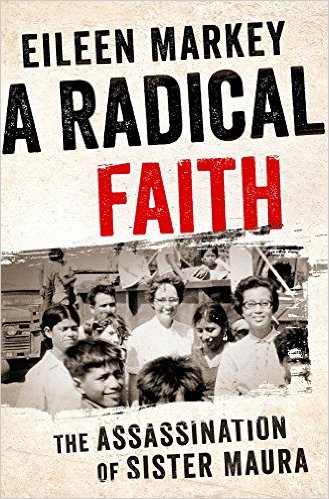
A Radical Faith: The Assassination of Sister Maura by Eileen Markey

One of the four churchwomen murdered in 1980 El Salvador is honored with a detailed biography.

radical-faith

In 1980, four United States churchwomen in El Salvador were raped and murdered by members of the U.S.-trained National Guard, calling into question U.S. support for the right-wing military dictatorship and leading to several high-level and international investigations. The four were treated as symbols and martyrs; journalist Eileen Markey wanted to make them individuals again. A Radical Faith: The Assassination of Sister Maura pursues that goal by examining the life of Maura Clarke.

Markey follows Maura from a close-knit Irish Catholic family in Rockaway, N.Y., to a Maryknoll convent at 19 in 1950, part of a staunchly anti-communist Catholic Church. Maura served in the Bronx, and then for 17 years in Nicaragua, where she was horrified by poverty and want. She gradually experienced a massive transformation of worldview, eventually becoming an outspoken activist, even as Markey outlines a parallel if gentler shift at the Church’s highest levels. When assigned to El Salvador, Maura worked a few short months before her murder.

A Radical Faith is not an objective inquiry: it assumes that Maura had few flaws and that missionary work in cultures abroad is good work. Markey nevertheless powerfully establishes Maura as an individual, and animates the story of her death. Her work brings an extraordinary level of detail, from Maura’s own journals and correspondence as well as redacted government documents, to a decades-old crime with higher-level instigators who have not been brought to justice. Though not impartial, A Radical Faith is a carefully researched and flattering portrait, moving and evocative.


This review originally ran in the November 18, 2016 issue of Shelf Awareness for Readers. To subscribe, click here, and you’ll receive two issues per week of book reviews and other bookish news.


Rating: 6 flights.

book beginnings on Friday: The Signal Flame by Andrew Krivák

Thanks to Rose City Reader for hosting this meme. Participants share the first line or two of the book we are currently reading and comment on any first impressions inspired by that first line.

A new novel for the weekend.

the-signal-flame

A fire in the great stone fireplace was as constant in the house as the lengthening days when Easter was early and spring was late. But on the morning after his grandfather died, Bo Konar took the logs and the log rack in the living room out to the barn, swept the bricks clean of ash, and dusted the andirons so that they looked like thin faceless centaurs of black.

These are good, if not simple, opening sentences. I lingered over the first one, its concept of the constancy of lengthening days when… there’s a lot to take in there. The second is much simpler, concrete and physical: logs, log rack, barn, bricks, ash, andirons–and then that fine simile, the faceless centaurs of black, which seem so appropriate to the grief we are witnessing. In just these two sentences, I felt like I was in the hands of a skilled writer with a story I would care about. So far, this is so.

This quotation comes from an uncorrected advance proof and is subject to change.

changes a-coming

I have mentioned before that there are changes afoot around here at pagesofjulia. Now, I’m seeking a little input.

Starting December 30, I will be a student in West Virginia Wesleyan College‘s Master of Fine Arts program studying creative writing, specifically creative nonfiction. This is a full-time commitment, so I’ll be taking my work for Shelf Awareness back to a minimal level: probably one review a month, to start with, while I find out how much free time I have from school.

This means less time (and built-in material) for pagesofjulia, too, obviously. I have found this blog so rewarding and educational an experience, and I’m humbled to have all your follows & comments. I would never want to let this thing go away. But I do have to make more time, and more space in my brain and reading/writing time, for this new priority. I’ve had some thoughts (and some input – thanks Liz) about how I might continue to keep some activity going here, and hopefully keep most of my readers more or less satisfied.

I’m thinking one post a week is a realistic goal, especially if all those posts aren’t wholly new content. And I’m interested in sharing my grad school experience with you, to a certain extent. I thought I could do some combination of reprising older posts, with comments on how my thoughts are changing, or about what books I’m interested in rereading as an MFA student (Joe Gould’s Teeth comes to mind). And I thought I’d do some quick updates on what I’m reading, what I’m writing, and what I’m thinking about on a given day. These would be super short, but hopefully follow the general theme of pagesofjulia. Maybe some teaser-style posts as I find bits of writing I want to share, too. And, the odd review for the Shelf, naturally.

So I would love to know what you’d like to see happen here as life twists and turns. If you could take a minute to answer the poll here, I would be grateful. And of course, if you have further thoughts, please do comment as ever!

The second question is about what day of the week you’d like to see me post. If you have a strong feeling about this, please let me know in a comment. Otherwise, we’ll probably be looking at nice, neutral Wednesdays.

Thanks for your support, friends. And, until the new year begins, don’t worry, I’ll see you back here tomorrow.

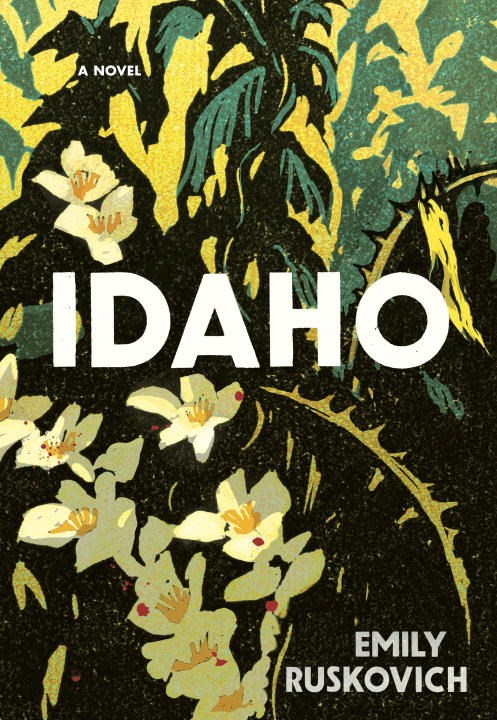
Idaho by Emily Ruskovich

This tremendous novel about what can be torn apart in an instant, and rebuilt over lifetimes, displays writing as scintillating as its plot.

idaho

Idaho, the first novel by O. Henry Award winner Emily Ruskovich, is a gorgeously designed immersion into the best and worst of life. In rural Idaho, a jumbled family rearranges itself painfully, trying to live on after a great loss. In 2004, Ann Mitchell surveys the Idaho farmstead she shares with Wade, her husband of eight years. Her recollections introduce the reader to their marriage–troubled by the diminishing strength of Wade’s memory and a terrible tragedy at the beginning of their relationship. She plays the piano; he makes finely crafted knives by hand. They tiptoe around the past.

In 2008, a woman studies her new cellmate at the Sage Hill Women’s Correctional Center. Jenny Mitchell doesn’t talk much. Neither of them has much future, with one distant chance at parole between them. Tentatively, they explore friendship, but Jenny doesn’t talk about her marriage to Wade, or her daughters. Then, Idaho flashes back to the 1980s and ’90s, when Wade was still married to Jenny and both of their daughters were still alive.

As decades are revealed, Wade’s family lives through happy, tragic and minute experiences. In layers of disjointed chronology and varied perspectives, the reader slowly picks apart the story: Wade’s love for one woman and then another; his luckless family history; the moment in time, the loss of control, that redirected these lives and more.

Ruskovich’s prose is exquisite. Music halts “like an animal at a gate, a child at a word it doesn’t know.” Her expressions of love, in its clean and messy incarnations, are singular, and she handles Wade’s mental decline and a child’s piano lesson with equal care and clarity. “On a sunny fall day, she lay next to him on the ground, and as he dozed she felt his old life, his memories, radiate off his skin. She felt everything leave him but her. She shed her own life, too, to match him. They lay there together like a point in time.” That point in time is what Ruskovich does best: sharp, clear moments alongside emotional enormities so great they can only be felt, not explained. This care, detail and realism applies to the novel’s background as well as to its stars. For example, a side plot involving an artist who paints meticulous age-progressions of missing children offers poignancy and attention to detail, and is worthy of its own novel.

With lovely language and piercing pathos, Idaho focuses on the power of love and the possibilities of forgiveness and memory. This debut novel deals blows as large as life.


This review originally ran in the November 18, 2016 issue of Shelf Awareness for the Book Trade. To subscribe, click here.


Rating: 8 gloves.

Teaser Tuesdays: Talking Back, Talking Black: Truths About American’s Lingua Franca by John McWhorter

Teaser Tuesdays is a weekly bookish meme, hosted by MizB of Books and a Beat.

Teaser

Linguistics, race, and what is weirdly unique about the United States: I was drawn to this book for its subjects. It’s just a slim little thing, too. Here’s a teaser for you:

talking-back

When humans move, or are moved, in large numbers and have to pick up a language quickly, typically their version of the language is more streamlined than the original one. This is worldwide linguistic reality, not special pleading for the speech of black people in the United States. We know this from Modern English itself, as well as, if anyone asks, from Mandarin Chinese compared to other Chineses like Cantonese, Persian compared to languages related to it, like Pashto and Kurdish, Indonesian, Swahili, and many, many others.

There is some ambiguity in those final clauses: are we to understand that Indonesian and Swahili are similar to Persian, too, or just the Pashto-and-Kurdish phrase? (I think the latter. Maybe some semicolons would help!) But the overall point is well taken. It’s been an interesting & informative read; I hope you’ll join me.


This quotation comes from an uncorrected advance proof and is subject to change.

Maximum Shelf author interview: Malin Persson Giolito

Following last Thursday’s review of Quicksand, here’s Malin Persson Giolito: A Small and Scattered World.


Malin Persson Giolito was born in Stockholm in 1969, and grew up in Djursholm, Sweden. She holds a degree in law from Uppsala University and has worked as a lawyer for the biggest law firm in the Nordic region and as an official for the European Commission in Brussels, Belgium. She is now a full-time writer and has written four novels; Quicksand is her English-language debut. Persson Giolito lives with her husband and three daughters in Brussels.

photo: Viktor Fremling

photo: Viktor Fremling

Was it the crime that sparked this novel for you, or Maja herself, or something else?

I couldn’t stop thinking about the crime. But it’s quite a difficult subject to write about, especially if you want to write a book people actually enjoy reading. I didn’t get anywhere until Maja came along. And I think the reason I wanted to write about a school shooting was not particularly the crime itself but the environment, that is, the school. It’s a very closed kind of environment. I think the book is about situations that you can’t control, and closed rooms. Maja was the key to the story. The first idea was the school shooting, but I didn’t know what to do with it until Maja came along.

It’s quite funny: as a writer, you’re probably the least capable of talking about your novel. You don’t really know what you’re doing. For the longest time you’re doing this puzzle upside down, so to speak, and then when the book is done hopefully you will see what the puzzle looks like, or perhaps one of the readers will tell you. There is something about this closed room that must have intrigued me, because we have not only the school but also the courtroom and the neighborhood where she grows up, which is an upper-class, very closed neighborhood–they’re very isolated from other parts of the Swedish society. Also, being a teenager is being isolated. You live in your own world of black and white, right and wrong, love and hate… teenagers are lovely. I have two. But they’re also quite isolated in their own minds, in their own day-to-day world.

You write the voice of this teenager so convincingly.

I have a tendency to say this was the easy part, but that’s not really true. It took me a lot of time to get to her. But once I had her, that was the best part, just living inside her head, with her rage and her judgments. She’s an enraged teenager. She’s a very privileged teenager that has gone through this tragedy, and now she’s put in a place where she has absolutely no control over her situation anymore. And we learn that during the year that led up to these events, this tragedy, she also lost control of her life. So how does she react? Well, one of the reactions is this rage. She hates everyone. And funnily enough, that was when I liked her. I think there must be an enraged teenager within me.

I think we all can relate to this loss of empowerment when we look at the world around us right now. One of the things I really liked was that I didn’t have to be this thoughtful adult who sees the good in people–I could just let go of everything and just be her. Which is not the same as saying that I agree with her. Her way of judging people around her is not something that I necessarily share. But it was still surprisingly easy, once I was there, to just do that. Once in a while you just want to let it go, to quote a famous Disney princess. I really liked that with Maja.

One of the tricks, when you write suspense novels, is to use the unreliable narrator. And when I started writing I knew from the beginning I didn’t want that. I didn’t want her to turn out to be someone else, didn’t want her to wake up after having had an alcohol-related dementia, or whatever. I wanted her to be reliable narrator, in the purest sense of the term. But I didn’t think of the fact that she’s a teenager, and if you look up “unreliable narrator,” I think you’ll see a picture of a teenager. But she’s just her, and that was very important. That’s what made me really love her. She just wants to get through this. She’s a survivor, in more ways than one.

What in your background prepared you to write this story?

The fact that I’m a lawyer prepared me a little too well, I think. There are parts of courtroom procedure that interest a lawyer that are not interesting for anyone else. It’s easy to take certain things for granted, certain principles. But once I had Maja, this was an advantage. Because she could ask all those questions that lawyers are supposed to have moved away from. Maja’s first big question is, how can you say that you’re innocent until you’re proven guilty? That is absurd. Either you’re guilty from the beginning or you didn’t do it. That’s not something that a court can change. Obviously this is a core problem. These are the Ten Commandments for a lawyer. Maja made me question my own Ten Commandments, which is fantastic.

When it comes to growing up in Djursholm–and it could be any rich neighborhood because they all more or less look the same, I think–I grew up there with a single mom who worked as a nurse. I’m not saying I had a hard childhood. I was privileged. But we didn’t have the economy of my classmates, so to speak. I think that the fact that I grew up there not as a rich kid has made me a good observer. Or I hope so. I knew that I wanted to write a story about the way that our society looks today, with all the differences and the inequalities, and the growing gap between the people who are the richest and those who have the least, and I knew that this was my angle.

A lot of people ask me if I’ve eavesdropped on my own teenagers, but I don’t think that you can. They helped with music, and Snapchat, and whatever, but I’ve tried to avoid naming all those things anyway, because they change so quickly. Obviously it helped that she was in isolation, in jail. It was good for many literary reasons, actually. If you want to write about the life of a teenager one of the problems is they have so many friends and they do so many things. I just said that their world is very small, but it’s also true that their world is very… scattered. And I didn’t have to worry about that while she was in jail.

You speak English very well. How does translation work when you are proficient in both languages?

I was lucky to be translated by Rachel; she’s absolutely fantastic. It’s one thing to speak a language–I can see that this is a very good translation–but I’m not an English speaker. We would have a discussion to find something equivalent or take it out entirely, which we did in a few instances. I think it worked very well. There are actually two versions, the same English translation, but one is more British. And maybe because I’m more Americanized than I am British, it feels strange to hear Maja speak British English. I don’t know why. I can see her as an American teenager. It doesn’t strike me as odd.

I’m involved, but more as an observer than as a translator. I can’t translate my own text, but I can applaud.

Is this novel a departure from your previous work?

Quicksand stands out because it’s Maja’s book, it’s so much just her, she’s the only voice that we hear. All of my previous three novels have lawyers as main characters. The first one is not a suspense novel; it’s about a woman who works in the biggest law firm in the Nordic area and she gets fired when she’s expecting her third child. And I wrote that novel, coincidentally, just after being fired from the biggest law firm in the Nordic area, while expecting my third child.

My third book is about a man that has been convicted of murdering a 15-year-old girl, and he’s been in prison for 11 years when he gets a new lawyer–my main character–and she tries to get him off. That is more traditionally court-related, more like this one in that sense. The other is about a lawyer representing a seven-year-old boy who is cared for by the state’s social authorities. Very sad story. I have readers who say, do you ever write anything where children are not hurt? Nope. Always very depressing. I don’t know what it is. I always say to myself that the next one is going to be a fun, lighthearted, feel-good novel, but it never works.

What are you working on next?

I’m in that phase where still everything is possible, like I think that I can write the great novel that will reveal the truth about everything. I don’t know, I have this idea about trying to place the novel in Brussels, because I live in Brussels, but I also knew that I’m not going to write about terrorism. And writing about Brussels today without writing about terrorism, well–so I guess it’s going to be another feel-good, lighthearted novel about terrorism. I seriously don’t know. I think I know who it is about, which I won’t tell you. But I think that I’m onto something.


This interview originally ran on November 16, 2016 as a Shelf Awareness special issue. To subscribe, click here, and you’ll receive two issues per week of book reviews and other bookish fun!