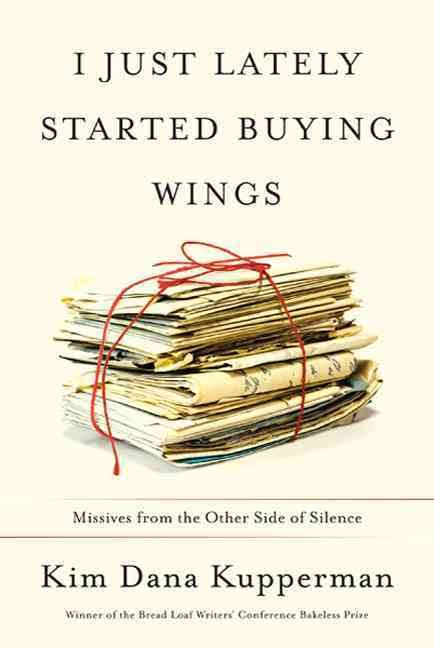
I Just Lately Started Buying Wings: Missives from the Other Side of Silence by Kim Dana Kupperman

Where I recall feeling both impressed and flummoxed by The Last of Her, this earlier essay collection feels more accessible to me. The Last of Her is a story about Kim’s mother (or about Kim’s investigating her mother), a single cohesive storyline – not that there aren’t other storylines as well! But I Just Lately Started Buying Wings is a collection that ranges widely in subject. Allowing each essay to tackle its own beast has a different result. Somehow I felt more comfortable with this book, more like I was able to grasp the whole. All of this sounds more like a criticism of The Last of Her than I want it to be; I enjoyed reading that book and am wowed by the writing and the organization within; it’s just that I didn’t finish feeling like I understood everything that went on. I enjoyed both reading experiences, but felt more settled, contained within this one. I wonder if reading them in the order they were published – this one first – would have helped.

I Just Lately Started Buying Wings is a lovely series of meditations. I want to call it comforting, which is a strange adjective to choose, since many of its subjects are uncomfortable or painful ones: deaths of family members, romantic and marital strife, domestic violence, nuclear fallout (literally), personal uncertainties. But Kim Kupperman’s approach to these is so easy to relate to, so honest and open, and so thoughtful. She made me feel supported as (I felt) we entered these tough places together.

I read the title essay, a very short one at just two pages, a year or so ago, when I was considering attending WVWC’s MFA program. (One of the toughest pieces of advice I got in considering programs was to read the work of faculty members. If each program has an average of 8 faculty and they’ve published an average of 3 books each, and I’m starting with a long list of 15 schools, I’m supposed to read 360 books? So a nice short essay here and there…) It stuck with me. First, the lovely title, “I Just Lately Started Buying Wings”… it has such a dreamy sound, so many figurative possibilities; but it turns out it’s a direct quotation, spoken by a woman applying the prosaic, literal meaning. She’s just recently started buying chicken wings; she used to stick to breasts and short thighs. This turn, from lyric to literal, is the kind of surprise I savor.

Not that the symbolic wing is ignored, though. In this collection, I found that wings were a major theme: “Wings over Moscow,” most obviously, deals with a number of wings (airplanes, birds), but other essays as well see dropped wings, grounded airplanes, a father compared to Daedalus, “the maker of wings.” In the closing essay, Kim’s mother leaves secret treasures for her young daughter to discover: a list of these items includes a moth wing, and a blackbird feather. Secrets or silence (as in the subtitle) form another leitmotif. Likewise the body, meaning the physical: Kim’s own, and the bodies of three immediate family members (mother, father, brother) she cared for after death. Lovers, and the women and children she tries to help at a shelter for victims of domestic violence. When she seeks her grandmother’s mysterious personal history,

I sense in this silence my grandmother’s decision to sever herself from a body politic she adored but could not bear. Perhaps it is from her that I inherited this yearning to return, which might explain why, when she died, I wanted so badly to go back to her homeland. I was coming into my body–breasts budding, hips widening–as her physical familiarity and its comfort ceased to exist.

Note the two different uses of ‘body,’ and think about the meanings of ‘bear,’ as in the “body politic she adored but could not bear”: think about a woman bearing children, which this grandmother did, by definition.

This kind of recurring theme or image defines the book as a whole, as well as nearly every individual essay. This is the kind of trick I am strongly drawn to (I’m remembering Eula Biss’s Notes from No Man’s Land). There is much to praise here, in sentence-level writing, as Kim shifts from the starkly sensual to the lyrical and back again. She has a razor-sharp eye for detail, an uncanny gift for noticing and recalling the physical world, something I’m not so great at. But what I’m most excited about, most wonder at, is the tying together of theme and image within and across essays. It never feels forced: these are the things that make sense together, and also they match.

Kim Kupperman clearly has several strengths. I think she must see the essay form as flexible and beautiful and serious. She observes the world with great attention. She is thoughtful, and opens herself to criticism (for example in the hospital scene when her father is dying and his survivors are fighting). She has an ear for language and an eye for parallels. I can’t wait to get to know her better: her writing, her editing (I’m looking forward to her small press’s anthology You), and hopefully her teaching.


Rating: 9 segments of orange.

reread: The Liars’ Club by Mary Karr

Shortened version: it was excellent and moving, again. (Original review here.)

I will repeat myself (from Wednesday’s review of The Art of Memoir) that one of Mary Karr’s greatest strengths is her voice. Her personality sings or laughs or screams off the page, vernacular and colorful, wise and confused, approachable and authentic and believable. Her story is wild. If it weren’t told in such convincing fashion and with such human wonder by its narrator–in other words, if I tried to tell you here about some of the things that happened to young Mary, less artfully–you wouldn’t believe it. But in this memoir, you do.

Karr grew up in a little east Texas coastal refinery town (here under a fictional name), with a short spell spent in Colorado. Her family was troubled, and gave the neighbors some entertainment (or opportunity for self-righteous head-shaking). But this is not a simple story of hardship and woe. The Karrs are also fiercely loving and loyal, with a capacity for humor. Karr’s narrative voice seeks answers and knows how to criticize, but she loves her flawed people; she’s not out to get them. (This is one of the key tips of The Art of Memoir: write out of love, not hate. Additionally, though this sounds even harder, “as Hubert Selby told Jerry Stahl, ‘If you’re writing about somebody you hate, do it with great love.'”)

From a craft perspective, I suppose I will start by examining the rich inner world Karr relates here, as for example on pages 148-157. In this eventful chapter, Karr’s mother creates a massive bonfire of most of her children’s–that is, Mary and her sister’s–belongings, before threatening their lives with a butcher knife. This scene is described in great detail, meticulously, so that it takes pages for moments to pass. Alongside the scene we get little Mary’s coping mechanism: her imagination supplying parallel events to explain or counter those she is witnessing. There is a backwards-looking perspective provided by the adult Mary writing these lines, but also much of young Mary’s real-time daydreaming. There are flashbacks. It’s an extraordinary sequence, and she uses a similar strategy elsewhere, in other such horrifying, dramatic, traumatic scenes. I know one reader who finds the lengthy, meticulous description of trauma difficult; but I think it’s actually a remarkable way to put us in the scene, as well as paint the child’s surreal experience. (Also, it’s difficult. But there is no way to read about rape that is not difficult. It should be difficult.)

My remarks here just scratch the surface of what The Liars’ Club has to offer. I’m a little confounded by the reviewers who didn’t love this memoir. The “best” criticism I saw was by a reader who believes that memoirs should teach a high moral lesson or reveal an important, famous person’s life. This book perhaps does neither, but I disagree with the premise; and so, thankfully, does Mary Karr.


Rating: 8 electric can openers.

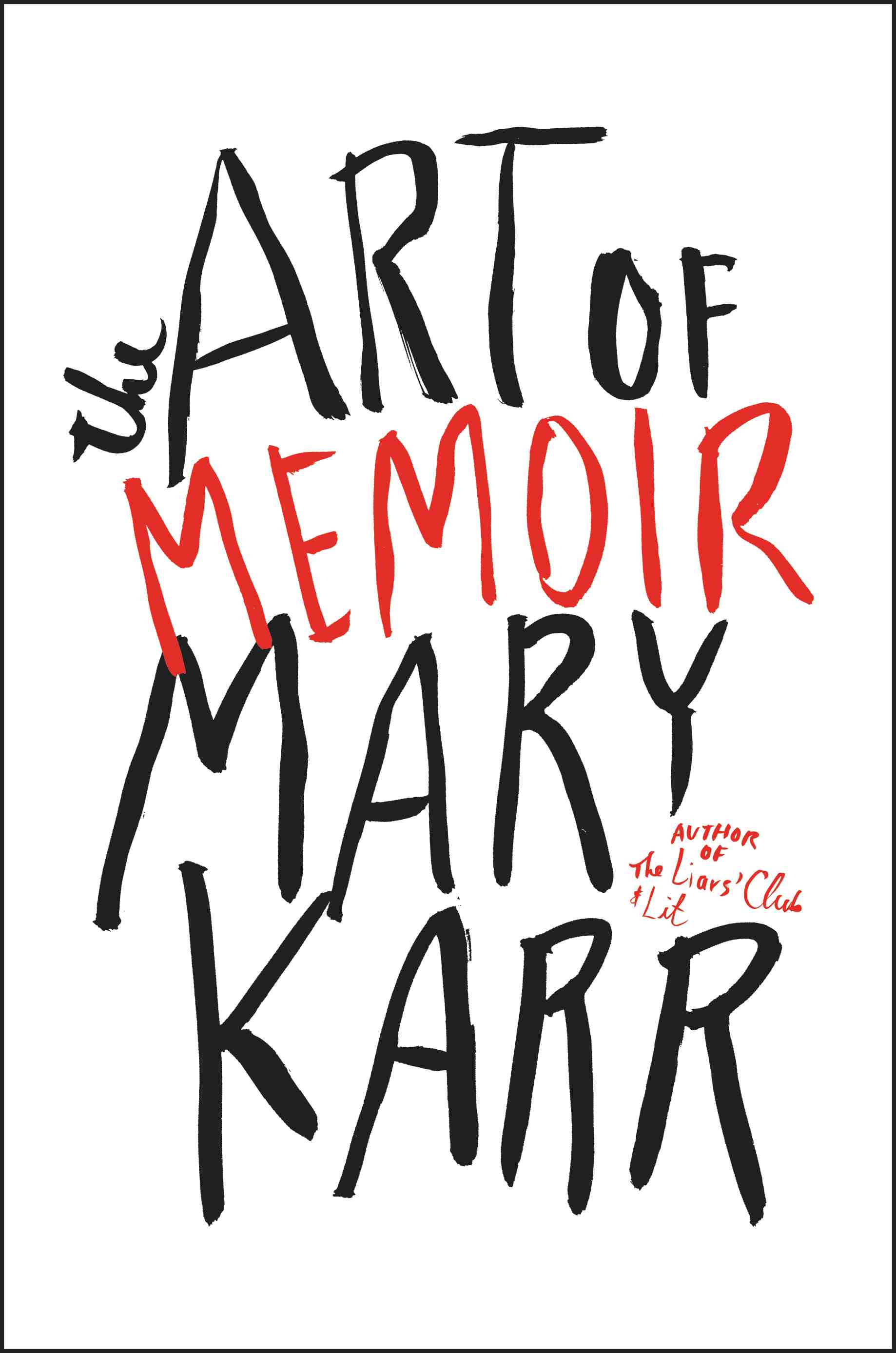
The Art of Memoir by Mary Karr

Another gem from Mary Karr. As a craft book, this one has it all (that is, all the things I like): a friendly, approachable, authentic-feeling voice; lots of references to other books with succinct, clear commentary; a balance between practical advice, appreciation, and commiseration; a humble, self-deprecating approach from a well-respected author. Also, I just really like Mary Karr.* Her on-the-page personality comes through so clearly and feels so much like someone I’d like to know. (Our hometowns, though very different, are less than 100 miles apart. My affinity for place makes me wonder how much this contributes to my feeling of kinship.)

The Art of Memoir is just over 200 pages long, including a 6-page, densely-packed reading list* (always exciting, and intimidating!). It begins with Karr’s “Caveat Emptor,” a disclaimer in which she writes, “no one elected me the boss of memoir.” One of the recurring concepts in this book is Karr’s reluctance to take up the mantle of expert; but she does acknowledge her “fifty-plus years of reading every memoir I could track down and thirty teaching the best one (plus getting paid to bang out three)”. She then takes us through a study of some of her favorite memoirists–Nabokov, Harry Crews, Maxine Hong Kingston, Kathryn Harrison, Michael Herr–and, with apologies (“if I didn’t have to pay out the wazoo to quote from better books than my own, I’d have way more Nabokov in here”), her own work. She offers chapters with titles like “Why Not to Write a Memoir” and “How to Choose a Detail,” and focuses on carnality (“sensory impressions, not sexual ones”), lies, individual talents, how to deal with loved ones, blind spots and false selves, exaggeration, and so much more. Unsurprisingly, she places early and heavy significance on the subject of voice, and there may be no writer more qualified. It’s one of the things Karr does best, in my opinion.

Perhaps for that reason, I was especially charmed at what she had to say about Harry Crews’ A Childhood: The Biography of a Place:

At the time I came across A Childhood, I was an academically uncredentialed former redneck Texan trying to pass myself off as a poet in hyperliterary Cambridge. Crews had lost time trying to hide his own cracker past, and then he’d written about that milieu in a book that would serve as my lodestar. How good it is, I can no longer gauge. But it helped to guide me out from my biggest psychological hidey-holes. Reading Crews, I found the courage to tell the stories I’d been amassing my whole life. I include so much of him here to underscore how mysterious a single influence can be if he shares a novice’s foibles. Were I a tattoo-getting individual, I’d owe him some fleshly real estate.

That kind of enthusiasm is catching, of course, and I was convinced to go straight to Crews; in fact, I had to put this book down to read that one (for reasons of school schedules). In case you missed my review of that book, here it is. And directly after, I turned back to Karr for a reread of The Liars’ Club. (Fresh review coming up on Friday.) I have yet to find my way to her acclaimed memoirs Cherry and Lit, but I think they’ll be on the list.

Like the best craft books, this one makes good reading in itself.* It’s not a manual. Karr’s personality on the page is worth spending time with, and she makes the appreciation of good writing more accessible. She writes for general readers (and warns them, when things are about to get technical, that they might skip the next few pages). There are also passages specifically for writers: a list of “old-school technologies for the stalled novice,” for example, that does not rely on writing exercises. In short: there is much to love here. Not least, Mary Karr herself.


Rating: 8 inner enemies.

*These are all things I could have written about Stephen King’s On Writing as well, and they would have been equally true. It’s no coincidence that I enjoyed both of these books. If you like one, do go find the other.

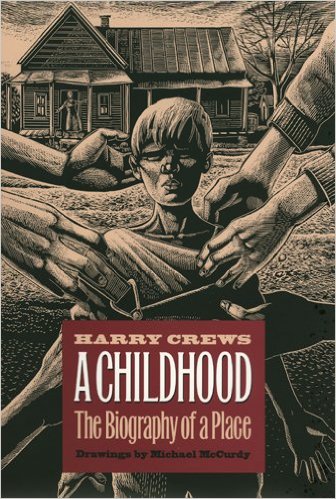
A Childhood: The Biography of a Place by Harry Crews

I’ve been hearing about this one for years, I think first in South Toward Home. While it was already on my semester reading list, I was prompted to put it next in line when I read in Mary Karr’s The Art of Memoir: “[A Childhood] is underrated–virtually unknown–except among the aficionados of the form.” So there. (My reading of The Art of Memoir was interrupted, so its review will follow this one. Preview: I like it.)

This is a memoir of a very short period, when the author is five and six years old, with just a few oblique references to his later life. During these two years, the child Crews becomes aware of himself in the world; he suffers serious injury and illness; his mother leaves his ‘father’ with her two sons, and after a few reunions, splits from him forever; and Crews learns that this was not his biological father, but the brother of that man, who is dead. In his reflections, what motivates the writing of this book is that Crews is haunted by the absence of his late biological father, and by a lack of ties to his home place of rural Georgia.

Both story and prose are tough, muscular, macho, unadorned, laden with violence and hardship; there are lovely lines concealed within, but Crews is most concerned with chronicling his scars. It is a raw and affecting book, and attempting a ‘biography of a place’ through a memoir of just two years is an intriguing strategy. I am fascinated by this idea, that two years of a child’s life can serve to profile a place.

I really appreciate Crews’s voice. This element (combined, obviously, with place and class) reminded me again and again of Rick Bragg. Bragg’s The Prince of Frogtown is on my reading list this semester as well; I hope I get to it in time. Of course I was also drawn (as with Sanders) to Crews’s preoccupation with place, where he’s from and what that means. Another kindred in this way, although his style (and the story he has to tell) differs greatly from my own. Crews is another author that plays with a fluid ‘truth’, which Mary Karr commented on as well: she forgives this favorite memoir because the more imaginative sections are obvious enough to pick out. Those are some of the sensational bits. But really, Crews lets his story stand for itself. His childhood will read as shocking to some of us; but it also reads as very real.


Rating: 8 slisures of grapefruit.

The Chronology of Water by Lidia Yuknavitch

I gulped down The Chronology of Water like I was drunk on it.

This extraordinary memoir, fragmented and unchronological, charts the life of a former competitive swimmer who experienced many traumas: addiction, abuse, loss of a child, failed relationships, deaths. Water is the overarching metaphor, and references to water, swimming, drowning, and wetness are everywhere. Other recurring images or themes include twins/twinning, fire, hair, death, and sexuality. (Much sex.)

While Yuknavitch’s story is filled with headline-level events and excitements, her prose is every bit as compelling: poetic, rich with imagery and metaphor, but also often swinging back to a very conversational tone. Although the events of her story are terribly tragic, she offers hope, without ending with trite redemption. And she keeps her reader rapt.

As a student, I found this work interesting for both sentence-level prose style and overall organization. I made careful note of where the water/wet references and language sprang up: in fact, I highlighted all such words and phrases, making this the first book I’ve marked up since somebody last made me, in high school. Very few pages went without highlighting, and it was interesting to see where the page really lit up, and where it didn’t. I was also interested in how she uses neologisms, anthimeria and repetition to express a sense of wonder, discovery, and otherworldliness. These moods suit her subjects, for example, drug-induced states, sexual discovery, and extreme grief.

I don’t want to say too much. This is a startling work, and you should dip into it yourself.


Rating: 9 less than merry pranksters.

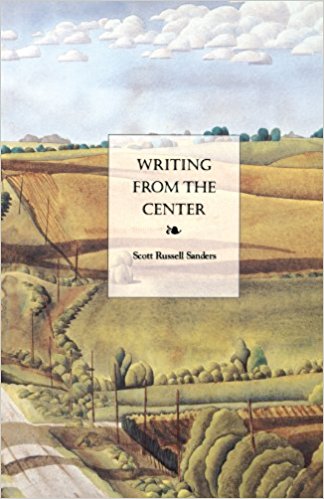
Writing from the Center by Scott Russell Sanders

I already admired Scott Russell Sanders for two essays I’d previously read a la carte: “Buckeye” and “The Inheritance of Tools.” Among other things, I love that both these essays do concentrate on “things,” that is, concrete physical objects that hold meaning. Also, his prose is lovely; he is thoughtful, and methodical in recording his thought processes; and he is concerned with the significance of place, and people’s ties to place. This last I mostly knew by reputation before reading this collection.

Sanders was already well-established and prolific when he released this essay collection, which has sort of a retrospective gaze. Essays focus on place, and the need for people (and writers) to be centered in place, and the author’s own underrated place, the Midwest. There is also some focus on humans’ role in a larger network of biological relationships, and a writer’s life and work, including literary studies. The opening essay “Buckeye” is the clear standout; I also really enjoyed “Writing from the Center” and “Letter to a Reader,” which come at the end. Some of the middle of the book faded out a little for me, though.

Writing from the Center moved a little slowly for me, in fact. There is much to praise here, but it’s quiet and ruminative, and I sometimes struggled to stay engaged, especially because many of the essays seemed to hit the same notes (same subjects, same points, same rhythms) again and again. There is an accumulative effect that is worthwhile, though. Sanders’s prose is quiet, straightforward, articulate but unadorned.

Of course I share Sanders’s concern with place and with staying put (Staying Put is another title of his I need to look into, in fact). It’s a little odd that I didn’t find this one more compelling, as I appreciated his points so much. He can do some extraordinarily beautiful writing. I loved this line:

A few turkey vultures perch on one of the crossbeams, their wings splayed to catch the early sun, like a row of black shirts hung out to dry.

I saw parallels from Kathleen Dean Moore’s “Stalking Seals” through Annie Dillard’s “Living Like Weasels” through the otters in Sanders’s “Voyageurs.” And I made notes of the best points about place: these may be jumping-off points for my own writing.

I may have just been in a reading funk when I hit this book. But I think it’s also true that the pacing and the prose are measured and meditative, and that several of these essays address the same points. This may be a liability when putting together a collection of related works.

The next two books I read for school electrified me, by contrast. Those reviews are up soon: Lidia Yuknavitch’s The Chronology of Water and Harry Crews’s A Childhood: The Biography of a Place.


Rating: 7 quasars.

The Boys of My Youth by Jo Ann Beard

I first read Jo Ann Beard’s essay “The Fourth State of Matter” for school, just a year (or so) ago, during one of my post-bacc courses at Western Washington University. I was floored. If you are unfamiliar, I strongly recommend that you read nothing about the essay, but dive in blindly as I did. You can read it here.

Or you could read this book, a collection of autobiographical essays including that one – which floored me again, even when I knew what was coming, and read differently this time around, of course. It is one of the best, but by no means head-and-shoulders from the rest of the essays. I took pleasure in this read, which wanders through Beard’s childhood and adulthood, jumping in time while focusing on certain characters here and there. I am coming to appreciate a certain balance in my reading for school, which I found here and which is sort of rare: I enjoyed reading this book, even while I was able to keep my eye on the craft side of things, recognizing the beauty in how it was done.

I feel like Beard has a certain tone in common with Haven Kimmel. They both tell childhood stories with the perspective of the time – that is, a child’s perspective – in a way that can be so funny. Beard is a little more self-effacing and wry, and occasionally somber, where Kimmel almost never breaks the construct of that humorous, wondrous sense of discovery and exclamation. But there is a sense of the absurd to the child’s POV, a sort of “oh my gosh, I had no idea the world had this in it!!!” that is just joyful and playful and funny and fun, that they both hit, in slightly different ways. I love that. Part of this, too, is that Beard often writes (especially, I think, earlier in the book) in the present tense, as if these things are just happening now, which gives that feeling of immediacy.

Overall, she shifts quite a bit between tenses and perspectives. She can be very conversational, as when she digresses to give background information and then comes back to the action at hand with a sort of “but anyway, I was telling you about…” kind of phrasing. She also refers to the writing of this book as it’s happening, especially in the final, title essay “The Boys of My Youth,” which shows her struggling to put the thing together, calling an old friend to consult on the details even as she’s sharing those details with us in the essay. I enjoy that transparency to the writing (as a writer, obviously, but also as a reader). As I’ve just finished this book, I have a feeling that it progresses from an innocent early childhood (the preface is a pre-verbal memory) to a more jaded adulthood (we finish with a divorced woman leery of new relationships). Looking again, the essays do progress in chronology; but within each there are huge jumps in time, so we see previews and flashbacks, too. It’s an interesting structure: subtle, but effective. A memoir in essays, and not the first of those I’ve read this semester, which is no mistake; it’s probably the kind I’m writing. Of special interest to me is the essay “Cousins,” a profile of Beard and her cousin Wendell, close friends, told in a series of anecdotes spread over many years, and out of chronological order.

One potentially troubling thing needs noting: Beard is comfortable with a certain amount of imagining in her nonfiction. Probably more comfortable than I am. I remember this objection being raised to “The Fourth State of Matter,” when I hadn’t caught it myself; she includes scenes where she was not present, but I guess I’d assumed she came by the information from other sources, where a closer look shows that to be in some cases impossible. I noticed it even more here, like when she describes in great detail a scene involving her mother and aunt, which took place before the author was born. I don’t know. The generous part of me wants to believe this scene was described to her (in detail! repeatedly!) and she filled in only some minor details (what color pants; what the sky looked like, because she came to know that same sky). But I’m not sure that’s true, and my personal code for nonfiction makes me a little uncomfortable with the possibility that she put her mother and aunt in that flat-bottomed boat, recklessly imagining. Discovering that Annie Dillard had no cat, as described in the opening paragraphs of Pilgrim at Tinker Creek, made me crazy. If she made up a whole cat of whole cloth, what else has she fabricated?! Here, I guess I’m feeling a bit more forgiving, perhaps because it’s a bit more obvious that Beard was not there when her mother was in that boat, pregnant with baby Jo Ann. (Dillard gives no clue that there is no cat.) But it’s not going to be my way.

This is one of the most enjoyable things I’ve read this semester. Easy-reading, entertaining, lovely, finely crafted but accessible.


Rating: 8 bananas.

Ecology of a Cracker Childhood by Janisse Ray

Early in my reading, I was ambivalent about this book, although I cannot now remember why. Did her writing get stronger as the book progressed? Did her vision & thesis take shape and grow on me? Was I just in a mood? By the end, I felt friendly towards the narrator and the book.

Janisse Ray grew up on a junkyard in south Georgia, one of four children. Her family was strictly religious, rural, somewhat isolated, and their lives were simply furnished for both religious and financial reasons, although they were not painfully poor: “We never ever lacked food, but we had few treats.” This book is an essay collection that is two things at once: a memoir; and a naturalist’s description of a nearly-vanished landscape–an elegy. The chapter/essays alternate between Ray’s personal and family story, and the ecological side. In reading this was a little less obvious to me, because I would argue that the ecology bits include some personal, and vice versa; but the table of contents makes this structure clear and intentional: the naturalist chapter titles are italicized, like Latin names of species would be. This is what the title is telling us, that it is both ecology and cracker childhood, and also the ecology of that childhood, and of the cracker people (one of the ecology essays is titled “Crackers,” as they are themselves one of the species at work in the system).

Ray’s homeland was once a longleaf pine forest, and that diverse ecosystem (and the pine savanna that wanders through it) is endangered and precious to her, now, but her upbringing did not emphasize it. The discovery of her homeland as a natural ecosystem, and its loss almost before she knew it, came later. As interesting as her childhood is, and the ecological part too, that young-adult awakening was perhaps the most compelling part of this story for me; maybe that’s part of why it became most appealing to me late in the book, when the awakening is told.

I learned a lot about a place and an ecosystem, and I enjoyed the personal memoir. I was especially fascinated by the strict religion that did not allow girls to wear pants, jewelry or makeup; had them cover their hair to pray; forbade holidays, ball games, parties, television, newspapers, dating, sports, on and on. This stuff is so far from my personal experience as to feel exotic, or weird, so I read it with that added curiosity we feel when we encounter the foreign. And it made Ray’s experience at college so compelling: alcohol, rappelling, skydiving, and simply swimming (something her family’s dress code never allowed), oh my! The parallel discovery, as I’ve said, is of nature as a subject for study, admiration or even just notice. She observes that she had a grandfather who loved the woods, but that her father couldn’t take the time; and a culture of people working to just get by didn’t have the energy to hug trees. It’s a sad story.

Ray does some lovely writing. I love the parallel of restoring a junkyard to a natural ecosystem, and restoring a ’58 Studebaker (with parts, presumably, to be found in the junkyard). I love this grandmother: “Her skin was soft and loose, and her face wrinkled in a beautiful way that showed she had always liked to smile. Her eyes, behind silver glasses that matched the soft halo of her hair, had life in them.” There are several noteworthy characteristics to this book. Its subjects were new to me, at least: that is, the place, the ecosystem, and the upbringing or culture. Its structure is interesting. I’m not sure why it grew on me so slowly, but grow on me it did.


Rating: 7 gopher tortoises.

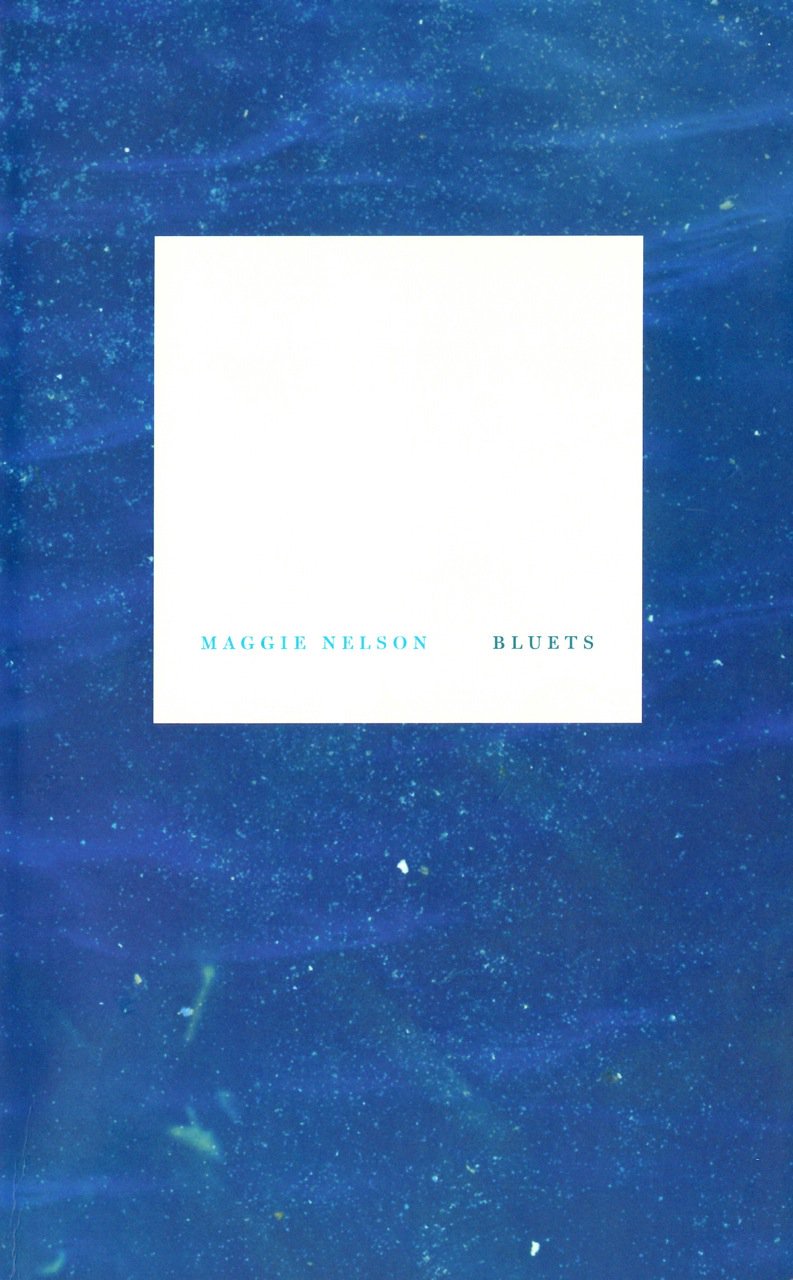
Bluets by Maggie Nelson

Ah, Maggie Nelson. I’ve been hearing about this writer for a while, and have had her Argonauts on my shelf for a year or more, but someone (I’m sorry, I can’t recall which fine mind) at WVWC said Bluets would be a better place for me to start. I can’t recall, either, whether that was a comment personal to my work or generally about Nelson’s. (Sorry!) Also, at winter residency, visiting writer Nickole Brown gave an awesome seminar titled “Learning by Design: Using Imitation in Creative Writing,” using the first proposition of Bluets as an exercise that was, for me, fruitful. So here I am with Maggie Nelson.

Bluets is an extremely unusual book. It is about Nelson’s obsession with, love for, the color blue; it is also about a love affair that has ended; it is also about Nelson’s life, in a jumping-in-and-out way. It is about pain and loss, and always about blue. It takes the form of 240 “propositions,” which are numbered, and a great revelation came for me with this one:

184. Writing is, in fact, an astonishing equalizer. I could have written half of these propositions drunk or high, for instance, and half sober; I could have written half in agonized tears, and half in a state of clinical detachment. But now that they have been shuffled around countless times–now that they have been made to appear, at long last, running forward as one river–how could either of us tell the difference?

Emphasis mine–because I felt rocked by this idea, that all these numbered propositions had been shuffled. This either confirms and validates my feeling of being adrift in Nelson’s lovely but often bewildering language, or… what? Means that they make sense in this order in some larger way that I am too dim to grasp? And I am desperate to know how she shuffled: by trial and error, randomly, with design? At any rate, it explains a certain disjointedness. Some of the proposition appear to pick up in the middle of a thought or a sentence. Their shuffled-ness explains that somewhat. An out-of-the-blue (ha) reference on page 14 to “the expert on guppy menopause, whose office is across from mine at the Institute,” leaves us wondering: guppy what? At what Institute? Etc.

Nelson shifts perspectives, sometimes using the second person to refer (apparently) to the reader, sometimes back to herself. Sometimes we get the sense that she is merely note-taking and will follow these thoughts later, as in “Does the world look bluer from blue eyes? Probably not, but I choose to think so (self-aggrandizement).” That parenthetical feels very much like a marginal note, to me.

There is lots of lovely language here, and some deep thought-provoking, and emotional material: loss of love, lots of sex, all kinds of blues in every sense… these is also a fair amount of material brought in from other texts, including Goethe’s Theory of Colours, Derek Jarman’s Chroma, and Wittgenstein’s Remarks on Colour. I think she’s a synesthete on some level, right? It jogged my brain when she referred to smell for (I think) the first and only time, on page 32, when an apartment was right for her because its hallway was painted baby blue, even though “my friends all told me it smelled as bad there as it did in the last one.” Frankly, I am afraid I finished no wiser than I started, although something of Nelson’s tone and atmosphere, at least, has leaked into my head despite her theory being too smart for me. I feel I’ve just talked myself in a circle and still don’t understand this book. And sometimes when that’s the case I’m grumpy or underwhelmed; but here I am impressed with this work even though I didn’t understand it. For better or worse, I leave you with that.


Rating: 7 or 8 questions, who knows?

The Pine Island Paradox: Making Connections in a Disconnected World by Kathleen Dean Moore

pine-island-paradoxThis is a complexly put together collection. These are essays, both personal/memoir and nature writing, based on islands, organized by disconnections (see the subtitle): human/nature, near/far, sacred/mundane. Back-of-book blurbs variously characterize these essays as being about nature; ecology; family; and philosophy. But I think they are about connections/disconnections and most of all about boundaries. Where does island end and sea begin, for example, if the tides change? Moore uses lovely, musical language; precise, apt images; and communicates emotion and intellectual difficulties nicely. From a craft perspective, this is a dense book; but it is easy to read for the simple experience.

It is Moore’s thesis, stated in her prologue, that our Western understanding of the world is based on divisions, on separating things and experiences out into categories. (She is a philosophy professor.) She sets out to take apart three of those separations: human/nature, near/far, and sacred/mundane. These are the three sections of the book; but also, each is set or at least organized around a specific island. After beginning and ending her prologue with the concept of geography, or mapmaking, she begins each main section with a page-and-a-half titled “Geography,” in which she describes these islands: Pine Island well off the Pacific coast of Alaska; a gravel island in the Willamette River in Oregon (near Moore’s home); and a volcanic sea stack off the Oregon coast. All of these organizational tools, taken in with her title, subtitle and explicit plans laid out in the prologue, combine to form complex but clear structure, focus and themes. Connections and disconnections; islands; boundaries; and the paradoxes implied. An important sub-theme involves Moore’s close relationship with her family: husband, two children, and eventually a daughter-in-law, who is called her third child in her acknowledgements. This is just another form of connection, so a sub-theme rather than an additional or secondary one.

Some of you will recall that less than a year ago I lived in the Pacific Northwest, too. I recognized much of what Moore described: the wet drippingness of the world for so many months, relief at seeing the sun, the importance of salmon. Some of this was hard for me to read: that pervasive wet really got under my skin (maybe even a little literally). I had some strong reactions to some of what I read here, which is a good thing: Robin Hemley wrote, “You should always be prepared to argue with a good book.”

This is not my new favorite piece of writing: there are a few places where I’d have enjoyed seeing things done a little differently. But it was very moving many times over; many individual essays were fantastic; I think (as a personal preference) I’d rather there had been a little more subtlety to the overall message. This was a bit too much explicit “I am writing this to make you care more about the natural world,” especially in the prologue. But again, that’s a personal reaction, and there’s no arguing Moore’s skill with words (musical language), images, her expertise and her use of emotion (nor do I doubt her sincerity). And if she inspired me to some argument, that’s useful, too.


Rating: 8 wet words.