Soulstar by C. L. Polk

Book three of the Kingston Cycle does not disappoint. It did feel somewhat like a shift in tone for me, and changed up my pacing. But I am a big fan of Polk and hope they’re at work on more like this.

In this installment we see a new protagonist again: Robin Thorpe, who we knew in the first two books as a nurse, Miles’s dear friend, and a witch of the less-privileged, illegal sort. She is also an activist and an important member of the movement to free the witches from asylums and gain some basic human rights for all citizens. She was suspicious of Grace at first (for which I don’t blame her), but also a big enough person to remain open-hearted and learn to trust. (This process we also saw with Grace learning to accept Tristan over her original prejudices.) We’re building communities and coalitions: Robin working with her people, including the Solidarity movement, and their elected official; Robin, Miles, Tristan, and Grace working together and with the Amaranthines for the good of Aeland and its people. Trust has to develop slowly and naturally in several of these relationships; the process is slow and messy, but it’s working.

Early in the book, we have a bit of a revelation. One of the freed witches is Robin’s spouse, Zelind. Mere kids when they married in secret, they are now reunited, but only after decades of separation and trauma. Robin will now navigate the political activist roller coaster she’s entered into, while also trying to reintegrate a longed-for relationship with some profound challenges. Zelind of course turns out to have some talents to offer as well, aside from being Robin’s love.

It was my feeling that Soulstar takes a darker turn than the previous two books. The stakes are getting higher, or the problems the reader is aware of are getting bigger – they’re not new, but we’re getting deeper into this world and learning more. As I’ve said before, this world’s problems are easily seen as analogous to our own.

Grace led us through the gilded reception hall, looking neither left nor right at the people lifting priceless works of art from the walls. It pricked my conscience until I turned my face up to behold our reflections in the mirrored tiles in the ceiling fixed together by gold moldings. Solid gold, I remembered from the time we trooped into the palace as schoolchildren to stare at all the finery I now understood to be hoarded wealth. The taxes of five hundred clan houses held those mirrors together. The wealth in that ceiling could fed the entire country for a year. This ostentation and greed had to end.

The dream team our leaders are putting together is up for this dismantling if anyone is, but the bad guys’ power is considerable and they’re not giving up easily. There was one special challenge mounted late in the book that about broke my will, although luckily these characters are tougher than I am.

Race has been a sort of understated issue throughout the trilogy. Class and privilege make up an obvious one, and climate change, and politically, we’re moving towards self-determination and communal systems of support. The issue of race is less clear: characters are sometimes noted as being Black or white, or described in terms that imply race (blonde, dreadlocked, dark skin), and privilege sometimes lines up with race, but I think not always. I’m not certain how this is meant to be read, whether we’re looking at a mostly-race-stratified society or simply a diverse one. Queer relationships have also been centered throughout. Book one saw a romance between two men, book two featured one between two women, and in book three, Robin is rejoined to her nonbinary spouse. (We also see a triangle marriage buck against Aeland’s societal norms, although it’s not unusual in Samindan culture.) Queerness seems to encounter some raised eyebrows, but not enormous resistance (the triangle marriage is much less accepted).

As another note, now that I’ve got all three books in me, I want to appreciate the covers, which are visually pleasing and offer some clue as to setting, and feature modes of transportation associated with the protagonist of each: a man on a bicycle for Miles on the cover of Witchmark; two figures in a coach for Grace (Stormsong); and now a couple skating for Robin in Soulstar. It’s a neat nod to the world Polk has built here.

As a trilogy: fantasy, world-building, romance, allegory, lovely writing and beautiful details, easy immersion. This writer is a great talent. I hope there is so much more to come, whether in Aeland or anywhere else Polk chooses to take me.


Rating: 8 sweaters.

Stormsong by C. L. Polk

Book two in the Kingston Cycle is every bit as riveting and delicious as the first, and I immediately opened book three upon its conclusion, so fair warning there. As is my practice, this review will contain mild spoilers for book one but not this book.

Witchmark‘s narrator and protagonist was Miles, but having seen him through danger and triumph and into the beginning of a delightful new romance, we are moving on to a new central character: Miles’s sister the indomitable Dame Grace Hensley narrates and stars in Stormsong. I was only sad for a moment; Grace is an exciting woman to follow, and anyway Miles is still on the scene, and his partner Tristan plays at least as big a role. (Miles is recuperating from injuries sustained in the big crescendo finish to Witchmark.) Many common threads continue: political intrigue as well as familial, as Grace and Miles’ family is one of the most powerful in the land. Romance, as Grace finds her own love, although she must navigate it amid all that intrigue. Self-actualization. “You make me want to be better… you know exactly who you are, even if it’s not what you’re supposed to be.” There are some neat instances of thinly veiled reference to our real world, as with worsening weather patterns (and the people demanding the government control the weather – which in this case is possible, because witches), and labor and civic unrest. Crime and punishment, just government and revolution, compromise and how to best run a country: it’s huge stuff, but it’s also still a sweet story of relationships, romantic love and siblinghood and respectful alliances. Oh, and I think I failed to say with book one, Polk writes really tantalizing food and the details of things like fashion which don’t usually interest me but do here. But especially food.

These books have momentum and atmosphere. The world-building is well thought out, which I think is evident for any series that shifts its focus between protagonists with each novel. They are sumptuous stories to get lost in, while dealing with serious themes. I’m impressed. And I’m already well into book three, so stay tuned.


Rating: 8 outfits on the bed.

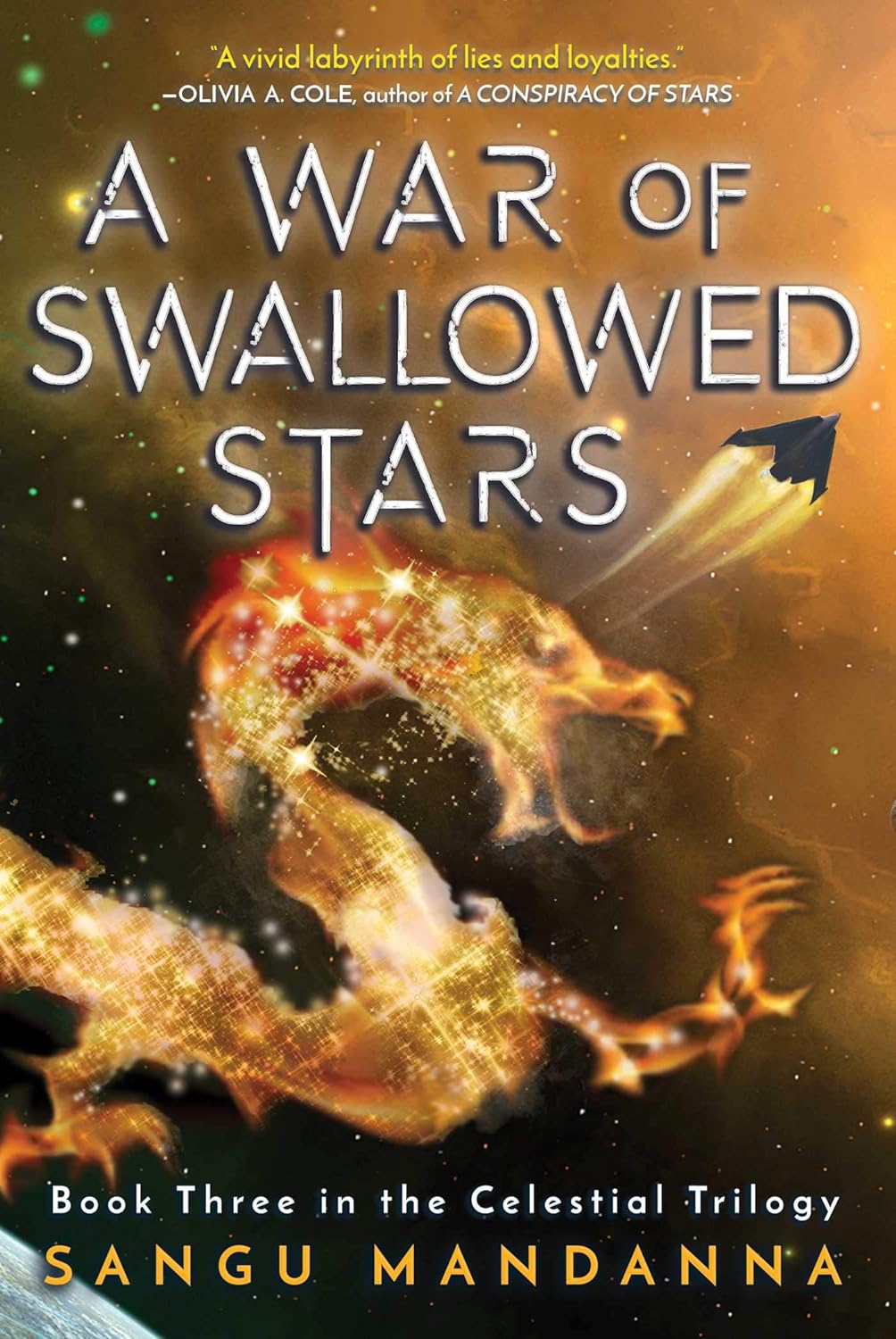
A Spark of White Fire by Sangu Mandanna

A very fun sci fi novel and first in a trilogy. Aimed at younger readers, it still has plenty of plot and character to engage us kids-at-heart.

I’d call this ‘light’ sci fi in that the science isn’t ‘hard’ and doesn’t contribute crucially to any plot points. You might call it speculative fiction instead: political and familiar intrigues, with coming-of-age issues and romance, set in a world that is not quite like our own. Esmae has grown up in the spaceship kingdom of Wychstar, but she belongs on Kali. By winning an archery contest, and therefore winning a gods-blessed undefeatable warship, she is able to return to the home she’s never known; but reuniting her fractured family and putting the rightful heir back on the throne may be a bigger job than she’s realized.

Esmae is a teenager who’s lived most of her life appearing as an unremarkable orphan, although she also enjoys the close friendship of Wychstar’s youngest prince Rama. He’s a true and lovely friend. Secretly, she has also enjoyed training under a famous warrior named Rickard, who is bound to teach no one but the offspring of Kali’s late king. Rickard and the gods are the only ones who know Esmae’s true identity at the novel’s start.

So, like I said: speculative fiction, at the juncture of fantasy and sci fi, with political intrigue and the challenges of coming of age. Esmae’s troubles winning a kingdom may be outside the experiences of most young readers, but exploring the larger world and finding one’s place in it, struggling to find one’s truest identity, making friends and feeling attraction and navigating conflicting loyalties – all these are absolutely universal. I think it’s a very accessible story for young readers.

I read this book for my own pleasure, absolutely, but also because I was hoping to pass it on to my favorite almost-12-year-old, and for that reason I paid more attention than usual to anything that might cause concern for the younger set. There’s some very mild bloodshed, and some intro-to-sexual content: basically a quick but passionate kiss, and some reference to wanting hands on one’s body and feelings of warmth. By my standards, this is plenty appropriate for a middle schooler. I pointed these passages out to my friend’s parent, and we agreed that she’d be fine. (You know I’m not inclined to censorship, and I was reading far spicier stuff at a younger age. And sometimes confused by it! I also appreciate that this kid is doing other reading about bodies, and doing a fair amount of reading with her parents. All solid.)

Fully invested in books two and three. I’ll read more by this author, too.


Rating: 7 birds of feathers and buttons.

Witchmark by C. L. Polk

I really enjoyed this magical alternative history or speculative fiction, with mystery, intrigue, romance, and bicycles! What a treat. Happily, it’s first in a trilogy. I’ve already purchased books two and three.

I was calling this setting Victorian-esque, in my head; the back of the book calls it Edwardian, which is a smallish distinction (the two eras abut), and this is not really my area of expertise, and anyway this is an alternative world, without an Edward or a Victoria at the helm. In a British-type major city called Kingston, Miles Singer, a veteran of the ongoing war, works as a psychiatrist at a veterans’ hospital. We meet him as he’s asked to send 16 patients home to free up their beds for the next round of returning soldiers. This is an impossible task for Miles; his patients are suffering and cannot yet care for themselves. He’s been working to discover the nature of the dangerous sickness that plagues them. And oh yes, he has to hide his magical powers and his true identity. Miles has been on the run for years from his powerful family of mages, who would enslave him to use his lesser powers to support those of his sister. They are involved in some national- and world-scale political connivings that he’d rather have nothing to do with, although he does miss his sister. A strange man brought to the hospital on the brink of death, a handsome stranger, and an unfortunate surprise at a donors’ dinner together offer a major disruption to Miles’s quiet life. He has a dangerous mystery to solve, patients to care for, his own need for privacy to attend to. But there might be more still.

Miles rides a bicycle! And the rules and etiquette for bicycles on the busy Kingston streets are elaborate. There is one remarkable bicycle *chase* that I’m still thrilled about. This feels like a period-appropriate detail and obviously pleases me immensely.

I love the world-building here, and how class plays into the significance of different types of magic. And the slow-burn love affair is stimulating, both for plot and world-building and for the reader who simply wants to see good-hearted Miles happy and comfortable. The story has momentum; I could easily have stayed up all night in a delicious binge session (instead I took three rapid days). Witchmark ends on a high, hopeful note, leaving me excited for book two. C.L. Polk is one to watch. Please join me.


Rating: 8 egg knots.

The Jinn Daughter by Rania Hanna

A jinn with the power to help souls into death’s final rest struggles to keep her daughter safe in this lively, vivid debut.

Rania Hanna’s first novel, The Jinn Daughter, is a moving, imaginative tale of magic, myth, life and death, and a mother’s love. Appropriately, the power of storytelling is central.

Nadine is a jinn, and serves as Hakawati to her village and community. Every morning, she gathers the pomegranate seeds that have fallen overnight outside her modest cabin: these are the souls of the recently deceased. She presses these seeds into a juice and drinks it to experience the stories of the dead, sometimes with honey to cut the bitterness, sometimes “settling sweet on my tongue.” It is in the telling of these stories that souls might pass from the Waiting Place “to final–and hopefully, peaceful–death.”

This is important and meaningful work, but Nadine’s life is not easy; almost all of her kind were killed or banished when she was very young, her training incomplete, and she is ostracized by the people whose souls she lives to assist into final death. She is nearly alone but for her beloved and cherished daughter, and the equally cherished ghost of that daughter’s father, Illyas. Layala, at 14 years old, is beginning to test the limits of their austere life. Illyas had been a human, and Nadine desperately wants their child to be without magic–safer that way. But jinn, despite their many powers, don’t have control over their children’s destinies.

Layala seeks a more meaningful existence than the quiet life allowed her as her mother’s daughter. Dangers press in from outside, too: the villagers’ animosity toward jinn, and a cascade of secrets from Nadine and Layala’s past, threaten their tenuous safety. They receive death threats from the human villagers, and then a visit from Death herself. Nadine must make unusual alliances and travel further into the realm of death than she ever has, to make a bid for her daughter’s safety. Her recurring prayer: “Keep her safe. Keep her happy. Let her find good love. Let her know peace. Let her know her heart and mind. Let her be.” But Layala may not want the same peace for herself that her mother wishes.

Hanna’s prose sparkles with color and detail, imbued with a mother’s deathless devotion to her child. The Jinn Daughter, drawing upon pre-Islamic Arabic mythology, engages with concepts of grief, loss, acceptance, self-determination, and the will to live. Hanna emphasizes the potential for stories and storytelling to explain life’s mysteries, to communicate, and to survive. Readers will find Nadine’s quest poignant, and Layala’s growth inspirational, in this journey of love, life, and death.


This review originally ran in the February 6, 2024 issue of Shelf Awareness for the Book Trade. To subscribe, click here.


Rating: 7 clay shards.

Mr. Fox by Helen Oyeyemi

Of the Oyeyemis, this one leans toward the more accessible for me, which is not to say I entirely understood what was going on, but I had a lower rate of whaaat?? than in some cases. I’m still not sure what it is about this author that although she frequently bewilders me I’m still on board.

Mr. Fox is, in most cases, a writer. Mary Foxe is his creation: a fictional character, or a muse, or an imaginary friend. There is also a Mrs. Fox, Daphne, who is married to Mr. Fox in the (if you will) real world; in some versions she is his third wife. She is jealous of Mary Foxe, whose existence is often in some question. There are various iterations of these circumstances throughout the book; it claims to be a novel (it’s right there on the cover!) but I would buy it as a collection of linked stories. Sometimes there are literal foxes. Often there is some reference, if oblique, to fairy tales. I don’t entirely agree with the back-of-book blurb’s description of what happens here, which is interesting. It is possible that one of us is wrong, of course, me or the blurb-writer–likely me, although I’ve seen the other happen!–but I think it’s possible that Oyeyemi has left things a bit up in the air.

I thought we had an organizing principle, briefly, in the idea that Mary was pushing Mr. Fox to do less killing off of his characters, particularly his female characters. (He is not an especially likeable man, and this is one manifestation of something unpleasant about his attitude toward women.)

What you’re doing is building a horrible kind of logic. People read what you write and they say, ‘Yes, he is talking about things that really happen,’ and they keep reading, and it makes sense to them. You’re explaining things that can’t be defended, and the explanations themselves are mad, just bizarre–but you offer them with such confidence. It was because she kept the chain on the door; it was because he needed to let off steam after a hard day’s scraping and bowing at work; it was because she was irritating and stupid; it was because she lied to him, made a fool of him; it was because she had to die, just had to, it makes dramatic sense; it was because ‘nothing is more poetic than the death of a beautiful woman’; it was because of this, it was because of that. It’s obscene to make such things reasonable.

I would have been interested in this guiding principle for the novel, but that is not this novel. It’s only a thread.

I’m going to stop saying much about Oyeyemi’s books. I more or less understood this one and it was an interesting ride. I’ll read another. If you know of a class I could sign up for online to help these books make more sense, I would pay for such a class (no joking).


Rating: 8 fountain pens.

The Other Valley by Scott Alexander Howard

Alongside her coming-of-age, a teenaged girl must wrestle with when it is appropriate to influence the past and the future in this remarkably imaginative debut.

Scott Alexander Howard’s first novel, The Other Valley, is a lyrical, thought-provoking coming-of-age story that probes the question of self-determination.

“That fall I was sixteen and the course of my life was ready to be determined. My class had reached the apprenticeship level,” at which young people choose a professional path. Odile’s mother has always intended that she try for a conseiller’s post, which is ambitious for a kid from the village’s north end, let alone one as socially outcast as Odile, but she dutifully tries.

Odile lives in a village in a valley bookended by villages in valleys identical to hers, with an important difference: to the east lies her village 20 years in the future. To the west, 20 years in the past. The Conseil governs the rare and tightly controlled visits from one valley to another. Coinciding with her bid for a conseiller position, Odile witnesses a visitor from the east. From what she has seen, she understands what is to come, and has the opportunity to influence events–but the Conseil teaches that she must not. Intervention, it is well understood, leads to catastrophe. “A person… interferes, and then new time rolls over him like a wave, leaving nothing behind. It’s as simple and ruthless as that.”

At the same time, Odile suddenly finds herself part of a group of friends for the first time: a fivesome of boys and girls her age, all struggling with choices about their future lives, including budding romance. She develops concurrent loyalties to the Conseil and to her friends, and these quickly clash. The nature of the valleys implies preordination, but her actions are her own. What if she could save a life? What if she had to sacrifice her own?

Howard’s style is quietly lovely, drawing attention to the starkness of a harsh landscape, a culture with little tolerance for difference, Odile’s loneliness, and her emotional range. “What I felt was a kind of thrilling sadness, something I have since experienced when looking out over other open spaces and lonely boundaries: an emotion that lives on the desolate edge of the known.” Indeed, landscape vistas offer rich commentary on the themes at play in The Other Valley: what may be seen and what is obscured, who is allowed to look. “All I saw were future griefs.” The novel’s tone is somber, but there is hope in the way Odile’s story pushes against the concept of predestination in favor of free will.

The premise is strikingly unusual and provocative; the climax, after a long, subtle build, is electrifying. With beautiful prose, a compelling protagonist, and serious fodder for thought, The Other Valley is a remarkable debut.


This review originally ran in the December 8, 2023 issue of Shelf Awareness for the Book Trade. To subscribe, click here.


Rating: 7 peach trees.

The Opposite House by Helen Oyeyemi

I am a glutton for punishment, if that’s what this is (it isn’t). I’m a glutton for keeping myself slightly confused? Considering the challenge I generally feel when I read Oyeyemi, a sense of something unfinished and not entirely understood, it seems a little odd that I keep doing this; but the enjoyment frequently makes the unsettled feeling worthwhile. Sometimes more than others – I think Gingerbread (the first I read) was my favorite, with The Icarus Girl least rewarding. I remember feeling very pleased recently by that story collection, although I see I rated it no higher than Icarus, so what does that mean? At any rate. The challenge and (often) frustration I feel seems to still balance against what I’m getting out of these. I have another waiting on the shelf now.

The Opposite House holds together in that I’m always fairly sure what’s going on: a good start. There are two young women in this plot, whose worlds we alternate between. One is more or less a mortal human in a world I recognize as my own; the other, less so. Yemaya Saramagua lives in the somewherehouse. “A somewherehouse is a brittle tower of worn brick and cedar wood, its roof cradled in a net of brushwood… The basement’s back wall holds two doors. One door takes Yemaya straight out into London and the ragged hum of a city after dark. The other door opens out onto the striped flag and cooking-smell cheer of that tattered jester, Lagos–always, this door leads to a place that is floridly day.” Other people (?) live in the somewherehouse, too, seemingly unrelated and not especially in touch with Yemaya (frequently just Aya).

And then there is Maja, who lives in London with her boyfriend, Aaron. She is newly pregnant with the son she has always known she would someday have. She was born in Cuba to Black Cuban academics; her mother is also a Santería priest (rare for a woman). Maja has a younger brother named Tomás, nicknamed “the London baby” because he was born there. (Maja believes “there’s an age beyond which it is impossible to lift a child from the pervading marinade of an original country, pat them down with a paper napkin and then deep-fry them in another country, another language like hot oil scalding the first language away. I arrived here just before that age.” She was seven.) She has a best friend, Amy Eleni. Together, this crew navigates Maja’s pregnancy (though few know about it within this novel’s timespan) and other challenges.

Meanwhile, Aya struggles to inhabit her identity as spirit / god alongside the people / gods she relates to in various cultures… in this world, the deities of Yoruba and Santería faiths move around, as their congregants do, which is why she is disjointed, and why the confusion of the other residents of the somewherehouse. This part is a bit squishy for me (not least because I’m not particularly familiar with any faith traditions). The Yoruba gods get crossed with Catholic ones, going underground at some points in cultural & regional history for safety’s sake. Are Maja and Aya linked? Are they… the same woman? I don’t think so, but I wouldn’t swear to it.

Maja’s rather more rooted, human life makes more sense to me than Aya’s does, but the uncertainty of the two threads are working for me here, better than they sometimes do.

Lovely; I will certainly keep up with my muddled studies in the Oyeyemi worlds.


Rating: 8 wet flowers.

The First Fifteen Lives of Harry August by Claire North (audio)

I am doing the unfortunate thing where I’ve waited too long since I listened to this one. In my defense, it was a whirlwind two-week road trip that allowed me to listen to several (!) audiobooks.

Another recommendation by Liz, this one’s pretty mind-bending. Harry August narrates the story of his lives himself, beginning with the first time, when he lived unremarkably. He was born in a train station washroom in 1919, and was then adopted but didn’t know it; his adoptive mother died when he was young, and his adoptive father remained distant; he served in World War II and then returned to the estate where his father had served as a sort of maintenance man, which role Harry takes over until his own death in old age. Ho hum. Then… it all starts over again. In his second life, he does not handle well the knowledge that this has all happened once before. In his third life, he uses what he knows of the war (for example) to his advantage, staying away from high-casualty battles and the like. With each life, he gains a little better understanding of what he’s experiencing. But he struggles to make meaning of it all, even as he meets others like himself: ouroborans, they call themselves, or kalachakras. Until, that is, he meets one man in particular, a fellow ouroboran who will become perhaps his greatest friend and nemesis.

I’ve already said too much, and will let you discover Harry’s many lives and acquaintances for yourself from here.

It’s quite a thought-provoking concept, and a new twist on time travel and the tricky question of the butterfly effect. (Would you kill Hitler? What if he’s only replaced by something worse?) The novel is not plot-driven, precisely, and it’s not character-driven at all. Harry has remarkable drive to learn, understand, and explain; this intrigues me about him, but he’s a bit short on actual personality (and has more of it than anyone else in the book). So, a concept-driven novel, which is a change. I found it perfectly absorbing, one to get lost in, and to occasionally pause and ponder. I will say, there weren’t characters I liked, and that can make it a little tough to hook in. I was very intrigued, but often bemused too.

The audiobook was a strong production on the whole. Peter Kenny does a wide range of voices, which are often pleasing, but I must say his American accents are not convincing.

It will be interested to see how this one sticks with me.


Rating: 7 beakers.

The Second Sight of Zachary Cloudesley by Sean Lusk

An exceptional boy in a loving, if odd, family, surrounded by automatons, must adventure into historical Constantinople to save his father in this debut novel of love and whimsy.

Sean Lusk’s debut novel, The Second Sight of Zachary Cloudesley, is a strange, spellbinding, imaginative work of magical realism set in 1700s London and Constantinople, exploring Pinocchio-esque questions about what is real, and the many forms of love. It contains no shortage of tragedy, but always retains a charming sense of wonder.

In London in 1754, Abel Cloudesley anxiously paces outside the birthing chamber where his beloved wife, Alice, labors. Zachary Cloudesley’s life begins with his mother’s death; Abel will be a loving father, but at first the experience is clouded by grief.

Abel is a clockmaker, but clocks are only the beginning of his artistry: he creates clockwork creatures, automatons that move and communicate like the real-life animals and humans they mimic. In Abel’s workshop, Zachary suffers a life-changing injury, resulting in the treasured son being sent away to be raised in the safety of his eccentric great-aunt Frances’s home in the country. Zachary’s no-nonsense nurse, Mrs. Morley, and the staunchly feminist Frances round out an unusual family for a very unusual boy. Zachary is a genius, precocious in everything, a great reader and nature lover. He also knows things–the past, the future–that he should not be able to know. When Abel is sent away to distant Constantinople on an odd and dangerous mission, seven-year-old Zachary says, “You should not go, Papa. You know that, don’t you?” Abel knows, but sail he does.

Years later, a teenaged Zachary will set out to rescue his father–believed to be long dead–from imprisonment in the Ottoman court. Zachary is still a deeply intelligent young man, but his studies have been conducted from the English countryside, and these travels will be eye-opening. Readers will delight in following the devoted son as he learns about a broader world, encounters romance, and seeks family. Through these pages are woven the clockwork wonders that have gotten Abel into this mess, and may yet get him out.

The Second Sight of Zachary Cloudesley is enchanting. Abel and Zachary are sensitive, compelling characters; Mrs. Morley and Aunt Franny are stalwart and impressive female heroes in two very different styles; Mrs. Morley’s daughter (raised alongside Zachary nearly as a sister) offers her own development and young romance; and Abel’s gifted employee Tom, an indispensable friend to the family, is not quite what he appears.

Lusk’s engrossing novel wraps a coming-of-age narrative in a historical setting, with lovable characters and dreamlike twists. Don’t miss Lusk’s memorable, sweet, original debut.


This review originally ran in the October 12, 2023 issue of Shelf Awareness for the Book Trade. To subscribe, click here.


Rating: 8 peacock feathers.