Witchmark by C. L. Polk

I really enjoyed this magical alternative history or speculative fiction, with mystery, intrigue, romance, and bicycles! What a treat. Happily, it’s first in a trilogy. I’ve already purchased books two and three.

I was calling this setting Victorian-esque, in my head; the back of the book calls it Edwardian, which is a smallish distinction (the two eras abut), and this is not really my area of expertise, and anyway this is an alternative world, without an Edward or a Victoria at the helm. In a British-type major city called Kingston, Miles Singer, a veteran of the ongoing war, works as a psychiatrist at a veterans’ hospital. We meet him as he’s asked to send 16 patients home to free up their beds for the next round of returning soldiers. This is an impossible task for Miles; his patients are suffering and cannot yet care for themselves. He’s been working to discover the nature of the dangerous sickness that plagues them. And oh yes, he has to hide his magical powers and his true identity. Miles has been on the run for years from his powerful family of mages, who would enslave him to use his lesser powers to support those of his sister. They are involved in some national- and world-scale political connivings that he’d rather have nothing to do with, although he does miss his sister. A strange man brought to the hospital on the brink of death, a handsome stranger, and an unfortunate surprise at a donors’ dinner together offer a major disruption to Miles’s quiet life. He has a dangerous mystery to solve, patients to care for, his own need for privacy to attend to. But there might be more still.

Miles rides a bicycle! And the rules and etiquette for bicycles on the busy Kingston streets are elaborate. There is one remarkable bicycle *chase* that I’m still thrilled about. This feels like a period-appropriate detail and obviously pleases me immensely.

I love the world-building here, and how class plays into the significance of different types of magic. And the slow-burn love affair is stimulating, both for plot and world-building and for the reader who simply wants to see good-hearted Miles happy and comfortable. The story has momentum; I could easily have stayed up all night in a delicious binge session (instead I took three rapid days). Witchmark ends on a high, hopeful note, leaving me excited for book two. C.L. Polk is one to watch. Please join me.


Rating: 8 egg knots.

The Jinn Daughter by Rania Hanna

A jinn with the power to help souls into death’s final rest struggles to keep her daughter safe in this lively, vivid debut.

Rania Hanna’s first novel, The Jinn Daughter, is a moving, imaginative tale of magic, myth, life and death, and a mother’s love. Appropriately, the power of storytelling is central.

Nadine is a jinn, and serves as Hakawati to her village and community. Every morning, she gathers the pomegranate seeds that have fallen overnight outside her modest cabin: these are the souls of the recently deceased. She presses these seeds into a juice and drinks it to experience the stories of the dead, sometimes with honey to cut the bitterness, sometimes “settling sweet on my tongue.” It is in the telling of these stories that souls might pass from the Waiting Place “to final–and hopefully, peaceful–death.”

This is important and meaningful work, but Nadine’s life is not easy; almost all of her kind were killed or banished when she was very young, her training incomplete, and she is ostracized by the people whose souls she lives to assist into final death. She is nearly alone but for her beloved and cherished daughter, and the equally cherished ghost of that daughter’s father, Illyas. Layala, at 14 years old, is beginning to test the limits of their austere life. Illyas had been a human, and Nadine desperately wants their child to be without magic–safer that way. But jinn, despite their many powers, don’t have control over their children’s destinies.

Layala seeks a more meaningful existence than the quiet life allowed her as her mother’s daughter. Dangers press in from outside, too: the villagers’ animosity toward jinn, and a cascade of secrets from Nadine and Layala’s past, threaten their tenuous safety. They receive death threats from the human villagers, and then a visit from Death herself. Nadine must make unusual alliances and travel further into the realm of death than she ever has, to make a bid for her daughter’s safety. Her recurring prayer: “Keep her safe. Keep her happy. Let her find good love. Let her know peace. Let her know her heart and mind. Let her be.” But Layala may not want the same peace for herself that her mother wishes.

Hanna’s prose sparkles with color and detail, imbued with a mother’s deathless devotion to her child. The Jinn Daughter, drawing upon pre-Islamic Arabic mythology, engages with concepts of grief, loss, acceptance, self-determination, and the will to live. Hanna emphasizes the potential for stories and storytelling to explain life’s mysteries, to communicate, and to survive. Readers will find Nadine’s quest poignant, and Layala’s growth inspirational, in this journey of love, life, and death.


This review originally ran in the February 6, 2024 issue of Shelf Awareness for the Book Trade. To subscribe, click here.


Rating: 7 clay shards.

Mr. Fox by Helen Oyeyemi

Of the Oyeyemis, this one leans toward the more accessible for me, which is not to say I entirely understood what was going on, but I had a lower rate of whaaat?? than in some cases. I’m still not sure what it is about this author that although she frequently bewilders me I’m still on board.

Mr. Fox is, in most cases, a writer. Mary Foxe is his creation: a fictional character, or a muse, or an imaginary friend. There is also a Mrs. Fox, Daphne, who is married to Mr. Fox in the (if you will) real world; in some versions she is his third wife. She is jealous of Mary Foxe, whose existence is often in some question. There are various iterations of these circumstances throughout the book; it claims to be a novel (it’s right there on the cover!) but I would buy it as a collection of linked stories. Sometimes there are literal foxes. Often there is some reference, if oblique, to fairy tales. I don’t entirely agree with the back-of-book blurb’s description of what happens here, which is interesting. It is possible that one of us is wrong, of course, me or the blurb-writer–likely me, although I’ve seen the other happen!–but I think it’s possible that Oyeyemi has left things a bit up in the air.

I thought we had an organizing principle, briefly, in the idea that Mary was pushing Mr. Fox to do less killing off of his characters, particularly his female characters. (He is not an especially likeable man, and this is one manifestation of something unpleasant about his attitude toward women.)

What you’re doing is building a horrible kind of logic. People read what you write and they say, ‘Yes, he is talking about things that really happen,’ and they keep reading, and it makes sense to them. You’re explaining things that can’t be defended, and the explanations themselves are mad, just bizarre–but you offer them with such confidence. It was because she kept the chain on the door; it was because he needed to let off steam after a hard day’s scraping and bowing at work; it was because she was irritating and stupid; it was because she lied to him, made a fool of him; it was because she had to die, just had to, it makes dramatic sense; it was because ‘nothing is more poetic than the death of a beautiful woman’; it was because of this, it was because of that. It’s obscene to make such things reasonable.

I would have been interested in this guiding principle for the novel, but that is not this novel. It’s only a thread.

I’m going to stop saying much about Oyeyemi’s books. I more or less understood this one and it was an interesting ride. I’ll read another. If you know of a class I could sign up for online to help these books make more sense, I would pay for such a class (no joking).


Rating: 8 fountain pens.

The Other Valley by Scott Alexander Howard

Alongside her coming-of-age, a teenaged girl must wrestle with when it is appropriate to influence the past and the future in this remarkably imaginative debut.

Scott Alexander Howard’s first novel, The Other Valley, is a lyrical, thought-provoking coming-of-age story that probes the question of self-determination.

“That fall I was sixteen and the course of my life was ready to be determined. My class had reached the apprenticeship level,” at which young people choose a professional path. Odile’s mother has always intended that she try for a conseiller’s post, which is ambitious for a kid from the village’s north end, let alone one as socially outcast as Odile, but she dutifully tries.

Odile lives in a village in a valley bookended by villages in valleys identical to hers, with an important difference: to the east lies her village 20 years in the future. To the west, 20 years in the past. The Conseil governs the rare and tightly controlled visits from one valley to another. Coinciding with her bid for a conseiller position, Odile witnesses a visitor from the east. From what she has seen, she understands what is to come, and has the opportunity to influence events–but the Conseil teaches that she must not. Intervention, it is well understood, leads to catastrophe. “A person… interferes, and then new time rolls over him like a wave, leaving nothing behind. It’s as simple and ruthless as that.”

At the same time, Odile suddenly finds herself part of a group of friends for the first time: a fivesome of boys and girls her age, all struggling with choices about their future lives, including budding romance. She develops concurrent loyalties to the Conseil and to her friends, and these quickly clash. The nature of the valleys implies preordination, but her actions are her own. What if she could save a life? What if she had to sacrifice her own?

Howard’s style is quietly lovely, drawing attention to the starkness of a harsh landscape, a culture with little tolerance for difference, Odile’s loneliness, and her emotional range. “What I felt was a kind of thrilling sadness, something I have since experienced when looking out over other open spaces and lonely boundaries: an emotion that lives on the desolate edge of the known.” Indeed, landscape vistas offer rich commentary on the themes at play in The Other Valley: what may be seen and what is obscured, who is allowed to look. “All I saw were future griefs.” The novel’s tone is somber, but there is hope in the way Odile’s story pushes against the concept of predestination in favor of free will.

The premise is strikingly unusual and provocative; the climax, after a long, subtle build, is electrifying. With beautiful prose, a compelling protagonist, and serious fodder for thought, The Other Valley is a remarkable debut.


This review originally ran in the December 8, 2023 issue of Shelf Awareness for the Book Trade. To subscribe, click here.


Rating: 7 peach trees.

The Opposite House by Helen Oyeyemi

I am a glutton for punishment, if that’s what this is (it isn’t). I’m a glutton for keeping myself slightly confused? Considering the challenge I generally feel when I read Oyeyemi, a sense of something unfinished and not entirely understood, it seems a little odd that I keep doing this; but the enjoyment frequently makes the unsettled feeling worthwhile. Sometimes more than others – I think Gingerbread (the first I read) was my favorite, with The Icarus Girl least rewarding. I remember feeling very pleased recently by that story collection, although I see I rated it no higher than Icarus, so what does that mean? At any rate. The challenge and (often) frustration I feel seems to still balance against what I’m getting out of these. I have another waiting on the shelf now.

The Opposite House holds together in that I’m always fairly sure what’s going on: a good start. There are two young women in this plot, whose worlds we alternate between. One is more or less a mortal human in a world I recognize as my own; the other, less so. Yemaya Saramagua lives in the somewherehouse. “A somewherehouse is a brittle tower of worn brick and cedar wood, its roof cradled in a net of brushwood… The basement’s back wall holds two doors. One door takes Yemaya straight out into London and the ragged hum of a city after dark. The other door opens out onto the striped flag and cooking-smell cheer of that tattered jester, Lagos–always, this door leads to a place that is floridly day.” Other people (?) live in the somewherehouse, too, seemingly unrelated and not especially in touch with Yemaya (frequently just Aya).

And then there is Maja, who lives in London with her boyfriend, Aaron. She is newly pregnant with the son she has always known she would someday have. She was born in Cuba to Black Cuban academics; her mother is also a Santería priest (rare for a woman). Maja has a younger brother named Tomás, nicknamed “the London baby” because he was born there. (Maja believes “there’s an age beyond which it is impossible to lift a child from the pervading marinade of an original country, pat them down with a paper napkin and then deep-fry them in another country, another language like hot oil scalding the first language away. I arrived here just before that age.” She was seven.) She has a best friend, Amy Eleni. Together, this crew navigates Maja’s pregnancy (though few know about it within this novel’s timespan) and other challenges.

Meanwhile, Aya struggles to inhabit her identity as spirit / god alongside the people / gods she relates to in various cultures… in this world, the deities of Yoruba and Santería faiths move around, as their congregants do, which is why she is disjointed, and why the confusion of the other residents of the somewherehouse. This part is a bit squishy for me (not least because I’m not particularly familiar with any faith traditions). The Yoruba gods get crossed with Catholic ones, going underground at some points in cultural & regional history for safety’s sake. Are Maja and Aya linked? Are they… the same woman? I don’t think so, but I wouldn’t swear to it.

Maja’s rather more rooted, human life makes more sense to me than Aya’s does, but the uncertainty of the two threads are working for me here, better than they sometimes do.

Lovely; I will certainly keep up with my muddled studies in the Oyeyemi worlds.


Rating: 8 wet flowers.

The First Fifteen Lives of Harry August by Claire North (audio)

I am doing the unfortunate thing where I’ve waited too long since I listened to this one. In my defense, it was a whirlwind two-week road trip that allowed me to listen to several (!) audiobooks.

Another recommendation by Liz, this one’s pretty mind-bending. Harry August narrates the story of his lives himself, beginning with the first time, when he lived unremarkably. He was born in a train station washroom in 1919, and was then adopted but didn’t know it; his adoptive mother died when he was young, and his adoptive father remained distant; he served in World War II and then returned to the estate where his father had served as a sort of maintenance man, which role Harry takes over until his own death in old age. Ho hum. Then… it all starts over again. In his second life, he does not handle well the knowledge that this has all happened once before. In his third life, he uses what he knows of the war (for example) to his advantage, staying away from high-casualty battles and the like. With each life, he gains a little better understanding of what he’s experiencing. But he struggles to make meaning of it all, even as he meets others like himself: ouroborans, they call themselves, or kalachakras. Until, that is, he meets one man in particular, a fellow ouroboran who will become perhaps his greatest friend and nemesis.

I’ve already said too much, and will let you discover Harry’s many lives and acquaintances for yourself from here.

It’s quite a thought-provoking concept, and a new twist on time travel and the tricky question of the butterfly effect. (Would you kill Hitler? What if he’s only replaced by something worse?) The novel is not plot-driven, precisely, and it’s not character-driven at all. Harry has remarkable drive to learn, understand, and explain; this intrigues me about him, but he’s a bit short on actual personality (and has more of it than anyone else in the book). So, a concept-driven novel, which is a change. I found it perfectly absorbing, one to get lost in, and to occasionally pause and ponder. I will say, there weren’t characters I liked, and that can make it a little tough to hook in. I was very intrigued, but often bemused too.

The audiobook was a strong production on the whole. Peter Kenny does a wide range of voices, which are often pleasing, but I must say his American accents are not convincing.

It will be interested to see how this one sticks with me.


Rating: 7 beakers.

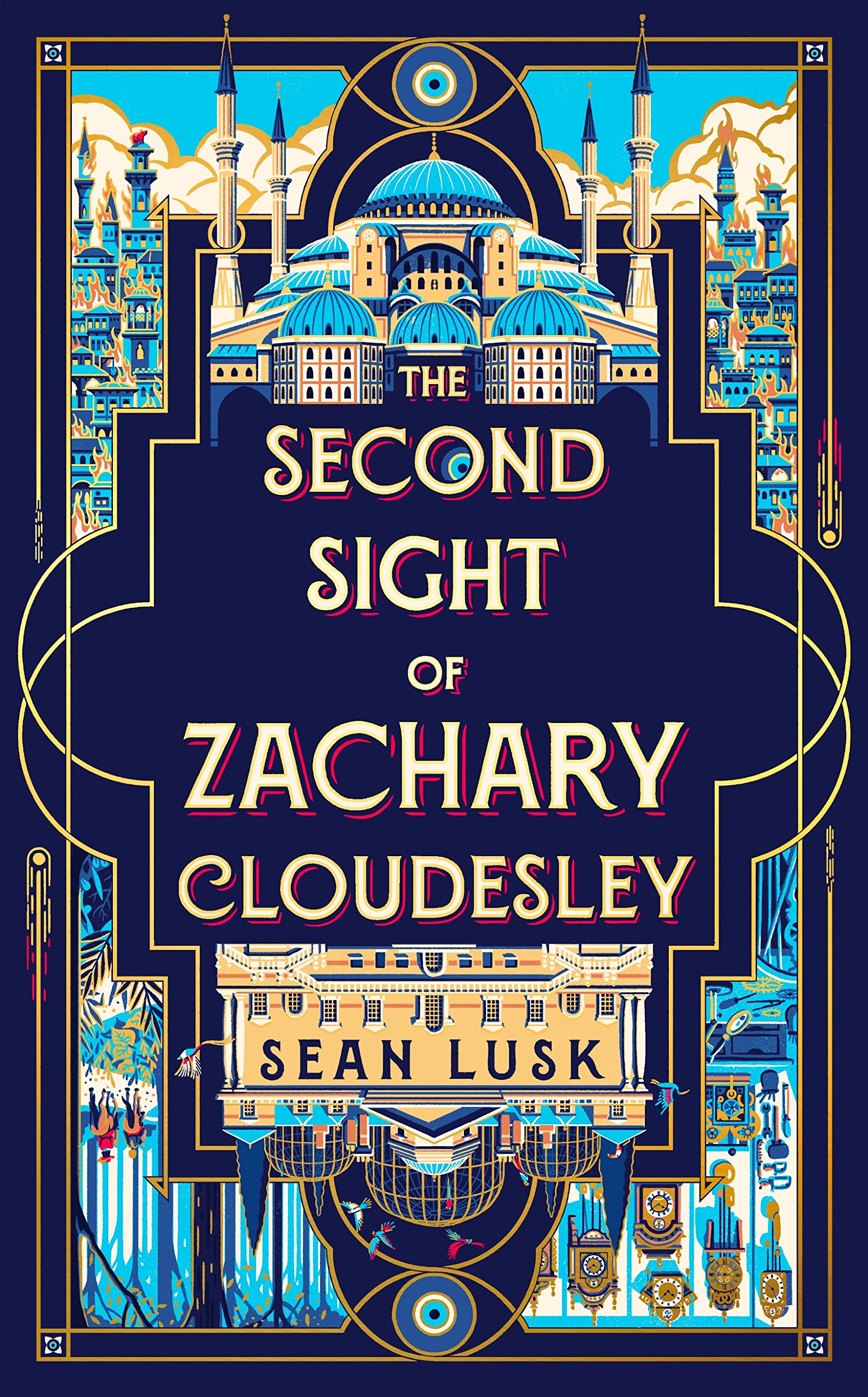
The Second Sight of Zachary Cloudesley by Sean Lusk

An exceptional boy in a loving, if odd, family, surrounded by automatons, must adventure into historical Constantinople to save his father in this debut novel of love and whimsy.

Sean Lusk’s debut novel, The Second Sight of Zachary Cloudesley, is a strange, spellbinding, imaginative work of magical realism set in 1700s London and Constantinople, exploring Pinocchio-esque questions about what is real, and the many forms of love. It contains no shortage of tragedy, but always retains a charming sense of wonder.

In London in 1754, Abel Cloudesley anxiously paces outside the birthing chamber where his beloved wife, Alice, labors. Zachary Cloudesley’s life begins with his mother’s death; Abel will be a loving father, but at first the experience is clouded by grief.

Abel is a clockmaker, but clocks are only the beginning of his artistry: he creates clockwork creatures, automatons that move and communicate like the real-life animals and humans they mimic. In Abel’s workshop, Zachary suffers a life-changing injury, resulting in the treasured son being sent away to be raised in the safety of his eccentric great-aunt Frances’s home in the country. Zachary’s no-nonsense nurse, Mrs. Morley, and the staunchly feminist Frances round out an unusual family for a very unusual boy. Zachary is a genius, precocious in everything, a great reader and nature lover. He also knows things–the past, the future–that he should not be able to know. When Abel is sent away to distant Constantinople on an odd and dangerous mission, seven-year-old Zachary says, “You should not go, Papa. You know that, don’t you?” Abel knows, but sail he does.

Years later, a teenaged Zachary will set out to rescue his father–believed to be long dead–from imprisonment in the Ottoman court. Zachary is still a deeply intelligent young man, but his studies have been conducted from the English countryside, and these travels will be eye-opening. Readers will delight in following the devoted son as he learns about a broader world, encounters romance, and seeks family. Through these pages are woven the clockwork wonders that have gotten Abel into this mess, and may yet get him out.

The Second Sight of Zachary Cloudesley is enchanting. Abel and Zachary are sensitive, compelling characters; Mrs. Morley and Aunt Franny are stalwart and impressive female heroes in two very different styles; Mrs. Morley’s daughter (raised alongside Zachary nearly as a sister) offers her own development and young romance; and Abel’s gifted employee Tom, an indispensable friend to the family, is not quite what he appears.

Lusk’s engrossing novel wraps a coming-of-age narrative in a historical setting, with lovable characters and dreamlike twists. Don’t miss Lusk’s memorable, sweet, original debut.


This review originally ran in the October 12, 2023 issue of Shelf Awareness for the Book Trade. To subscribe, click here.


Rating: 8 peacock feathers.

Maximum Shelf: A Short Walk Through a Wide World by Douglas Westerbeke

Maximum Shelf is the weekly Shelf Awareness feature focusing on an upcoming title we love and believe will be a great handselling opportunity for booksellers everywhere. The features are written by our editors and reviewers and the publisher has helped support the issue.

This review was published by Shelf Awareness on October 12, 2023.


Douglas Westerbeke’s debut novel, A Short Walk Through a Wide World, is a wild romping adventure, a poignant tale of relationships and interconnectedness, and a compelling journey of self-discovery. The worldwide (and possibly beyond) travels of Aubry Tourvel have something for every reader, with a momentum that’s impossible to turn away from.

“The paper is clean and white–she hasn’t drawn her first line–so when the drop of blood falls and makes its little red mark on the page, she freezes. Her pencil hovers in her hand. Her heart, like it always does, gives her chest an extra kick.” With these opening lines, readers meet Aubry mid-scene, in a marketplace in Siam. Her illness has returned. First the blood, “And then the pain strikes–a terrible, venomous pain–a weeping pain, like a nail through a rotten tooth.” The first pages are adrenaline-fueled, as Aubry runs for her life.

Aubry recounts her past in fragments to people she meets along the way. In early chapters, she narrates the beginning of this singular illness, this mysterious curse that appeared when she was nine years old in 1885, where her family lived in Belle Époque Paris. She ran, and “Every step made her breath flow easier, made the pain slip a little farther away. She knew this would be her strategy from now on. She would outrun it.” Precocious Aubry quickly intuits the inexplicable rules of her condition: she can never revisit the same place twice, can never retrace her steps, can stay in one place only two to three days, four at the most, before she must move on. And so begins a life of constant travel. From a privileged, spoiled childhood, Aubry becomes resourceful, wary, self-sufficient, standoffish, and eventually a kind–but always watchful–wanderer.

Aubry fashions a spear and becomes adept with it. She travels mainly on foot and by boat, doing odd jobs, fishing and hunting. Her relationships, while often meaningful, last only days. One of her most significant love affairs lasts a whole week, aboard a moving train, until the train breaks down and she must leave her lover behind. A few acquaintances try to travel with Aubry, but it becomes increasingly clear that she is special, able to withstand more than the average human. On foot, she crosses the Himalayas, and the Calanshio Sand Sea in the Libyan desert. She finds libraries filled with wordless books containing only pictorial storytelling–to overcome language barriers–and discovers that these libraries, perhaps a little magic, are for her alone.

The workings of Aubry’s unique, global-scale library are never clear, even to her. There, she finds everything she needs: sustenance, warmth, information. “It comforts her that for every path she’s taken during her many revolutions around the world–for every individual footstep, it seems–there’s a story. Something once happened, a past that is not hers.” This is what library-lovers everywhere have long known, but it is also a device that allows for one of the more magical elements of Aubry’s strange travels. “‘It seems,’ said [one brief acquaintance], ‘that the world you travel through is not the same world we travel through.’ My God, thinks Aubry. My God.”

It is a lonely life. People she meets tend to “romanticize her illness. They imagine an eternal holiday, which is ludicrous, of course. Does anyone really want an eternal holiday? A holiday is a temporary break from the routine, a chance to shake off the dust of habit, to experiment with new foods and customs, but then to return, perhaps borrowing from the outside, perhaps rejecting it–but either way, a return.”

Westerbeke’s imagination is prodigious, and the details with which he fleshes out this absorbing tale are equally abundant. A Short Walk Through a Wide World abounds in the tastes, smells, textures, and sensations of a woman who lives almost from moment to moment. Her haphazard travels, rarely planned, are always in response to a sharp pain or a nosebleed, or worse. She stays just a half-step ahead of the illness which she’s come to personify. “It clung to her back, fingers and toes screwed into her bones, gasping and grinning at all the places she went, a happy demon mounted forever on her shoulders.” She speaks to it, and it responds.

Aubry’s travels arrange themselves into a moving story, often sad, but also filled with joy and fun. Aubry has a special weakness for children, and delights in engaging with them wherever she goes, from a ferry in Siam to a tribe in the Congo. This expansive tale offers new ways of looking at the world–wise, questioning, as rich in emotional depth as it is in detail. The characters she meets are numerous and diverse: New Zealanders rescue her in Siam; an Ottoman fisherman encourages her to gain a meaningful skill; an Indian prince befriends her; a Tibetan nomad invites her to hunt a mysterious beast; a Mexican journalist tracks her down in Alaska. A Short Walk Through a Wide World is utterly engrossing, a world–worlds–to get lost in. In these riveting, swashbuckling adventures, tender meditations on relationships, and philosophical musings about travel and home, every reader will find something to love.


Rating: 9 horned cucumbers.

Come back Monday for my interview with Westerbeke.

How Long ’til Black Future Month? by N.K. Jemisin

This book took me on such journeys and brought me so much joy and enjoyment and laughter and more difficult but also rewarding feelings; I have long felt that Jemisin is a rare master, but this may be the pinnacle. I love this book. I was once mildly disappointed with novella-length versions of her world; but here she clearly perfected the short story. And I was so pleased with the wide variety of worlds we got to dip into. Every story is unmistakably Jemisin, but each is also so different. They range in the impressions they give of settings in time and in space, from recognizably referring to our world to being fairly far afield; some are set in the worlds of her novels, some stand alone, and a few closely answer another author’s work (more on that in a minute). Some, similarly, seem to fit into a timeline of our own world, while others stand apart. But they all have the flavor. I went back to immediately reread one story in particular as soon as I finished the book, and that’s a rare move.

How Long opens with an author’s introduction in which she shares her coming-of-age as a writer, her growth as a short story writer, and the struggle of being a Black woman in fantasy and science fiction, among other things. “The stories contained in this volume are more than just tales in themselves; they are also a chronicle of my development as a writer and as an activist.” For this reader, at least, it felt right to come to this collection after having read all the novels (I haven’t read all her work as published in various places, but I’ve read all the books); I felt familiar with the writer now offering a look back across those years. Such a treat. Also, I hope she lives to write many books for a long, long time more.

The first story in the collection is “The Ones Who Stay and Fight,” which is quite explicitly a response to Ursula Le Guin’s “The Ones Who Walk Away From Omelas.” This was, again, a real treat for me; I’ve read “Omelas” for a couple of classes in which I was a student and also taught it for several years, so I’ve looked pretty closely at its concepts as well as its sentences, and that was an excellent preparation to appreciate Jemisin’s strong response in both its concepts and its sentences. To match the voice and style of another writer is not ‘mere’ imitation but a serious accomplishment in itself, and this story does that well. Jemisin has a fiery answer to Le Guin’s troubled false utopia; her Um-Helat is not “that barbaric America” nor “Omelas, a tick of a city, fat and happy with its head buried in a tortured child.” She’s got a different idea, and exhorts the reader to come along, “get to work.” (The direct address comes from Le Guin, but Jemisin grasps it firmly.) I was so delighted with this opening story, I could hardly stand it.

Other favorites include “Red Dirt Witch,” “L’Alchimista,” “The Effluent Engine,” “The Evaluators,” “Henosis,” and “The Elevator Dancer” – is Orwell just this much in our society, or in my head (recently Julia), or is this an explicit play on 1984? To emphasize the range of these stories, I will attempt a few one-line description/summaries:

  • “Red Dirt Witch”: The White Lady threatens Emmaline’s family, but she knows the red dirt of Alabama, and the magic it holds, too well to go down easily.
  • “L’Alchimista”: As a professional chef, Franca has fallen far, but she can’t resist a challenge; when a mysterious stranger shows up at her little kitchen in Milan, she will discover her art holds even greater power than she knew.
  • “The Effluent Engine”: In historical New Orleans, a Haitian spy looks for technological advantage and finds also love. (Jemisin’s website calls it “a swashbuckling adventure-romance set in 1800s New Orleans with secret societies, derringers, and bustles.” Love!)
  • “The Evaluators”: Human contact with alien species is highly regulated; why is this one trade contract being rushed? Danger! (Strong hints of Octavia Butler’s Lilith’s Brood series.)
  • “Henosis”: In out-of-order chapters, a famous author is kidnapped by his biggest fan.
  • “The Elevator Dancer”: Security guard secretly, shamefully, watches a subversive act of dance.

Bonus: many of these stories are available elsewhere, linked from Jemisin’s site, if you’d care to go hunting that way.

This book has left my mind changed, and I’ve stepped away and back to it. Strongly recommend.


Rating: 10 frava roots.

What Is Not Yours Is Not Yours by Helen Oyeyemi

I continue to wrestle with Oyeyemi, whom I admire but who leaves me confused as often as she leaves me delighted. I think this is the one I like best (of whose I’ve read), alongside or just below Gingerbread. It definitely had its more challenging stories, but finished strong, and maybe that’s the win: leave me on a high note.

What Is Not Yours Is Not Yours is, first of all, a great title; it is also a short story collection whose contents I thought unconnected until rather late in the game. There are a few recurring characters, actually, but their relationships across stories are limited. It’s mostly disconnected. There is a linking subject or theme: keys, and locks. In some stories they are literal and physical, in some more metaphoric, and in a few the reader has to think a bit to make the concept fit (like an ill-fitting key, ha), but it will. I like that as a through-line.

“books and roses” introduces a couple who are lost to each other, whose keys open doors to a garden of books and a library of roses. “‘sorry’ doesn’t sweeten her tea” contains many fascinating ideas and sub-stories, but it’s mercurial in its focus, quickly shifting which character we seem to be watching; I was actually charmed throughout, but left pretty baffled, too… unlike some stories, it at least left me in a place that felt like an ending. “is your blood as red as this?”, the longest story in the collection, left me less satisfied – like, what just happened? I can handle feeling this way occasionally, but if it gets too frequent I’ll become frustrated or lose interest.

But soon came “presence,” which also put its reader through some fast switches, but left me again in a place I felt a little surer footing. “a brief history of the homely wench society” and “dornička and the st. martin’s day goose” were both downright delightful, leaving me giggling and tickled and thought-provoked. The first sets out the history of two gender-based rival clubs at Cambridge, and the latter offers a twist on Little Red Riding Hood. After one odder one, we finish with “if a book is locked there’s probably a good reason for that don’t you think,” which felt like the perfect note to end on: a little shape-shifting as its setting moves from a realistically boring workplace drama to something decidedly metaphysical, with a neat fable built in, and a magical flourish of an ending. With that taste in my mouth, I feel good about this collection. My overall impression remains that Oyeyemi may be much smarter than I am.

I confess I’m a little comforted that a Guardian reviewer found these stories somewhat uneven; that makes me feel better, like maybe I missed some things because the stories weren’t quite perfect? But I always doubt myself, because Oyeyemi seems to have so much going on. I’m afraid it’s me. I don’t always relish an author making me feel not so smart, but I don’t think that’s what she’s out to do here, and so I don’t hold it against her. I think her imagination may be a bit wider and more flexible than mine. She’s pretty special, and I’ve just ordered the rest of her books that aren’t yet on my shelf, so you can stay tuned and expect that we’ll use the Oyeyemi tag some more.


Rating: 7 comments.