The Grace of Wild Things by Heather Fawcett

Another hit by Fawcett; I’ve just checked to be sure that *all* of her books are either here or on their way to me.

The Grace of Wild Things is based on Anne of Green Gables, loosely enough that all of its parts move freely, but with enough connection to be recognizable if you know the original. Of course, no knowledge of the earlier classic is required here, and I think Fawcett’s telling will be more accessible to modern young readers, and possibly younger ones. As much as I love Montgomery’s original, I suspect her writing style would be a little harder for my favorite rising eighth grader to take in. This book is absolutely headed to her bookshelf next.

We meet twelve-year-old Grace as she gazes out of the dark woods at the witch’s cottage. Accompanied by her crow friend, Windweaver, she has made a remarkable overland journey to get here, despite hearing about the witch’s evils (including cooking children in her oven and eating them, à la “Hansel and Gretel”). Grace has spent her life at an orphanage featuring no great abuse but a pattern of rejection, loneliness, friendlessness, and a lack of appreciation for her unique qualities, which include talking too much, a love of poetry (shared by Windweaver), an excess of imagination, and oh yes, magic. She is here to apprentice herself to the witch and try to find a home and a life where she can be accepted for who she is.

The first day’s cycle is rough: the witch pretends to welcome her, throws her in the oven and tries to roast her, then, thwarted, rejects her once again: “tomorrow you will go back to that orphanage, if I have to drag you there by your hair.” Grace decides she’d rather be eaten. And she really did love the witch’s cottage, and the perfect little bedroom there that she’d hoped to call her own. But in a combination of cleverness, determination, and dumb luck – or is it magic? – she meets a fairy and saves his life, and impresses the witch with a gift sufficiently that the witch agrees to let Grace attempt a challenge. If Grace can cast every spell in the witch’s first grimoire, from her own childhood, before a venerable cherry tree blooms the next spring, she will become the witch’s apprentice. If she fails, she will give up her magic to the witch. This also means losing Windweaver, her only friend in the world, who the witch says is Grace’s familiar: she never realized.

What else is there to do? Grace agrees. But there are 100 1/2 spells in the grimoire – the last one is incomplete – and they appear increasingly impossible to her untrained eye. (The witch refuses to help.) Luckily, our plucky protagonist quickly makes a friend, Sareena, a clever, no-nonsense neighbor girl who pledges lifelong loyalty. The fairy boy she’d saved, Rum, is bound to come at Grace’s command for three years, the deal they’d cut; but he also insulted her and she desires never to speak to him again. (Some readers will recognize the reworked Diana and Gilbert.) As the always-game Sareena and the increasingly devoted Rum dedicate themselves to helping Grace gather the impossible ingredients for the witch’s spells (a piece of the moon, a pitcher of midnight, three left footprints of a deer, a day lasting twenty-five hours), their little group grows, until Grace is overwhelmed by kindness and friendship. Even the prickly old witch softens slightly, and more disturbingly, sickens. When an outside force threatens their idyllic cottage and garden in what locals have long known to be the witch’s woods, Grace may have even bigger problems than the grimoire. But her powers are growing, too.

Anne-with-an-e is definitely alive and well here, with the imagination, the verbosity, the flair for drama, the questions, the enthusiasm and the emotions. “I never thought witches would be so leaky,” Sareena says of Grace’s disconcerting habit of expressing feelings through tears. We’ve identified Diana and Gilbert; the raspberry cordial episode is reworked, more magically, and that of saving Sareena’s beloved younger sister. The witch makes a fine Marilla, grumpy but secretly charmed by her unwanted orphan girl; she even has a brother, although he’s a bit less corporeal than Matthew was. Prince Edward Island remains the setting, and I am inclined to trust (but did not fact-check) that the many botanical details and spell ingredients are appropriate.

But Grace is also a lovely invention. She struggles with wanting to do good in the world while embracing her true identity and powers, which she takes for granted must be associated with evil. She feels gratitude and loyalty to the witch who gave her a home, even though she can see the witch’s wrongdoings (although we also benefit from learning more about her long and adventurous life). She learns the big lessons. “…the witch had said in one of her few helpful moments that many spells had more than one use. Since then, Grace had come to think of magic like poetry–a poem, after all, could mean more than one thing, or mean different things to different people.” Upon achieving a spell for wisdom: “Being wise, apparently, was not knowing a lot of things, but knowing all the things you didn’t know. It was dreadful. She felt very sorry for all the wise people of the world.” And of course, she has every bit as much gumption and potential as Anne Shirley ever did.

I am devoted to this author. Loved every page, can’t get enough.


Rating: 9 buckets of ice cream.

VenCo by Cherie Dimaline

I waited too long to get to this one that was recommended by Liz. Punch line: I think the title’s ‘Co,’ which felt corporate to me, turned me semi-consciously away from this book for a while. (I’ve had it on the shelf for maybe years, since Liz told me I should read it.) And… that’s very much the point, in the novel. As the cover shows (I’ve been looking at just the spine all this time!), ‘VenCo’ is a hidden-in-plain-sight reworking of CoVen. As in witches. Hidden behind a corporation. Very clever. So clever I missed out on reading this great book for longer than I should have. (Facepalm.)

I also read this book immediately following one called Lessons in Magic and Disaster, which is yet to be published so you haven’t seen my review yet, but keep your eyes peeled, because the two books back-to-back could not have been more perfectly paired. Chef’s kiss.

Okay, so here we are in VenCo, beginning with a prologue, “The Oracle Speaks.” Three women in three luxury vehicles pull up outside an understated building in Los Angeles. We get descriptions as they head inside, and the descriptions are a juicy, lovely start. They are the Maiden, the Crone, and the Mother, and together they form the Oracle. They are concerned about time; it’s running out; the circle must be formed under tight deadlines, but the sixth witch is a doozy, they assure each other. Cut to chapter one, “The Legacy of Lucky St. James.” Here we meet Lucky, who is struggling in Toronto. The orphaned (adult) child of an absent father and an alcoholic, but compelling, mother, Lucky lived with and was cared for by her lovely grandmother Stella until the roles reversed and now it would be more accurate to say that Stella, with dementia, lives with and is cared for by Lucky. The younger woman is scraping by, about to be evicted, dubiously employed, unsure how she’ll continue to provide for Stella. Cut again, in chapter 3, to Meena Good, a witch and leader of a coven-to-be, in Salem, Massachusetts. (Yes, we do see how predictable that sounds, but bear with us.) Meena’s group of five witches is introduced from here, until their path intersects with that of Lucky (who reminds me very much of someone Chuck Wendig would create), and the delightful, messy Stella. Every one of these characters is an absolute joy. Even though their story has much darkness and cynicism, they are steeped in and practicing love, just as hard as they can. Except for the one really evil character, who I haven’t mentioned at all yet.

It’s expansive and wonderful: I love how the magic fits neatly into a world we mostly recognize as absolutely and realistically our own. (I love the way Salem, Mass. is handled, the self-aware nod to what a perfect town this is for witch-hunting, ha, but also really.) The stakes are sky-high, the women are doing their best with conflicting goals, they are balancing loyalties and loves and basic survival needs. The future (we hope) coven is something we’re all rooting for.

I found this an easy world to get lost in and felt genuinely sad when the pages closed. I’ve already ordered more from the same author.


Rating: 7 spoons.

The Library of the Dead by T.L. Huchu

I forget where I came across this first in a series, but I’m glad I gave it a go. Set in a magical post-apocalyptic Edinburgh, The Library of the Dead stars Ropa, a teenaged ghosttalker: she is licensed to visit with the dead, a rare skill, and carry their messages back to the living, for a fee. She can also help (or force) ghosts to move along to “the place with long grass,” where we’re all headed once we find the peace to go. Ropa considers herself unsentimental: this is all about earning a living, which she uses to support not just herself but her younger sister Izwi and her beloved Gran, a more powerful magical practitioner but who these days is mostly reduced to knitting in their cara (caravan, or what we’d call in the US a trailer). Their existence is tenuous, which is why Ropa at first refuses when she meets a ghost who asks for her help but cannot pay.

At Gran’s insistence, Ropa eventually agrees to help Nicola (dead) solve the mystery of her missing young son Oliver (not dead, yet). As she takes a break from paying work to investigate, she’s glad to have the reluctant help of her old friend Jomo, who now works at a library that he doesn’t want to talk about. Jomo is from a better-off family: he’s been able to stay in school, for one thing. Ropa is a serious autodidact, listening to audiobooks as she makes her rounds; she is forever exclaiming that school doesn’t matter and she’s not the least bit sorry, but the reader can tell how much she feels the lack. We also observe what a clever self-study she is, however, as she repeatedly quotes Sun Tzu and summarizes and meditates upon the philosophies of magic she gains new access to…

…because Jomo’s secret new workplace is the library of the dead. When he sneaks Ropa in and they get caught, the consequences are dire – she is initially sentenced to hang from the neck until she is dead, but (in a whirlwind scene) instead gets drafted as a scholar, with the privilege of book borrowing. That, and she makes a new friend, Priya, a far more advanced student of magic. With two friends behind her now, but still very much with her own life (and livelihood) on the line, Ropa follows the cold trail of Oliver’s disappearance to some surprising and disturbing intrigues and evils.

Ropa is a certain kind of heroine: actually quite caring, although she wouldn’t want you to know it, and deeply committed to her family and friends, she rides a bicycle (when it’s not been stolen) and plays the tough, but really just wants to snuggle up on her berth with Izwi and Gran and watch some good telly. She carries a katty (or slingshot – I finally figured out that this is short for catapult!) and a dagger, has a pet fox named River, and she can take a punch. Priya is a delightful addition to her crew who I hope we’ll hear more from. Jomo is perhaps a bit bumbling, but very loyal. Their world is a bit mysterious: they have electrical power, but not running water or sewage; they have cell phones (and can talk to ghosts!) and television, but not climate control. They are ruled by a king. It sounds like there was an event that broke the world, leaving us with a before and an after, but we haven’t yet learned what that was.

The worldbuilding may be less thoroughly detailed than some in some fantasies; but maybe I just haven’t gotten there yet. At any rate, I’m engaged by the strongly-felt characters and their values, the magic, and Gran’s knitting. This is book 1 of 4 and I am ready for more.


Rating: 7 desiccated ears.

The Bones Beneath My Skin by TJ Klune

Just out from TJ Klune, The Bones Beneath My Skin is a standalone adult novel with loneliness, yearning, darkness, sweetness, queer love and sex, and discovery of new forms of family. There is a bit of a formula here in terms of the combination of those elements, but I don’t intend any of the negative connotation that often accompanies the idea of a formula. I appreciate that I can turn to Klune for a familiar blend of heartbreak and happy ending with characters who are messy but also the kinds of people I’d like to call friends.

In his Author’s Note, Klune calls this an ‘action movie in book form.’ A former publisher accused this manuscript of being different and weird: “but then, I’m the guy who made a socially anxious vacuum cleaner named Rambo into a main character” (check it out).

Nate Cartwright is on the road. The reader learns gradually: that he is driving the old truck recently inherited from his father, to the cabin recently inherited from his mother, both of whom just died of a murder-suicide after a lengthy estrangement from Nate, who they disowned when they discovered he was gay. He has lost his job and everything else that mattered to his old life in Washington, D.C. (not much); he’s headed to the cabin, lakeside in rural Oregon, without much of a plan but to unplug and regroup. But when he arrives at Herschel Lake, the cabin is not unoccupied. Instead, he finds a huge, intimidating man with a huge gun, accompanied by a tiny, lovely, friendly, extremely strange little girl. The man is Alex. The little girl is Art, short for Artemis Darth Vader. Nate tells her that’s not a real name. She corrects him.

This odd trio joins up. Art and Alex have already bonded firmly as allies, against long odds; Nate is late to the party, but fits in, as a lonely oddball with a tendency toward deeply felt loyalties. In a series of extremely unlikely events, Nate learns that his new… friends?… may not be all that they appear. But still he chooses to go all in.

With hints of Men in Black and ET, Nate, Alex, and Art go rocketing across the country, fleeing shadowy government forces and conspiracy theorists, harboring secrets beyond the theorists’ imagining, wanting only to be safe and together with those they love. Klune’s website calls it “a supernatural road-trip thriller featuring an extraordinary young girl and her two unlikely protectors on the run from cultists and the government.” I love Klune’s rather trademark focus on protecting kids as a central, undeniably wholesome focus, even amid some very adult concerns (and passions). As with other recent novels of his that I’ve enjoyed, this one left me looking for more featuring these flawed but loveable characters. I really loved the ending. Still following this author anywhere.


Rating: 8 slices of bacon.

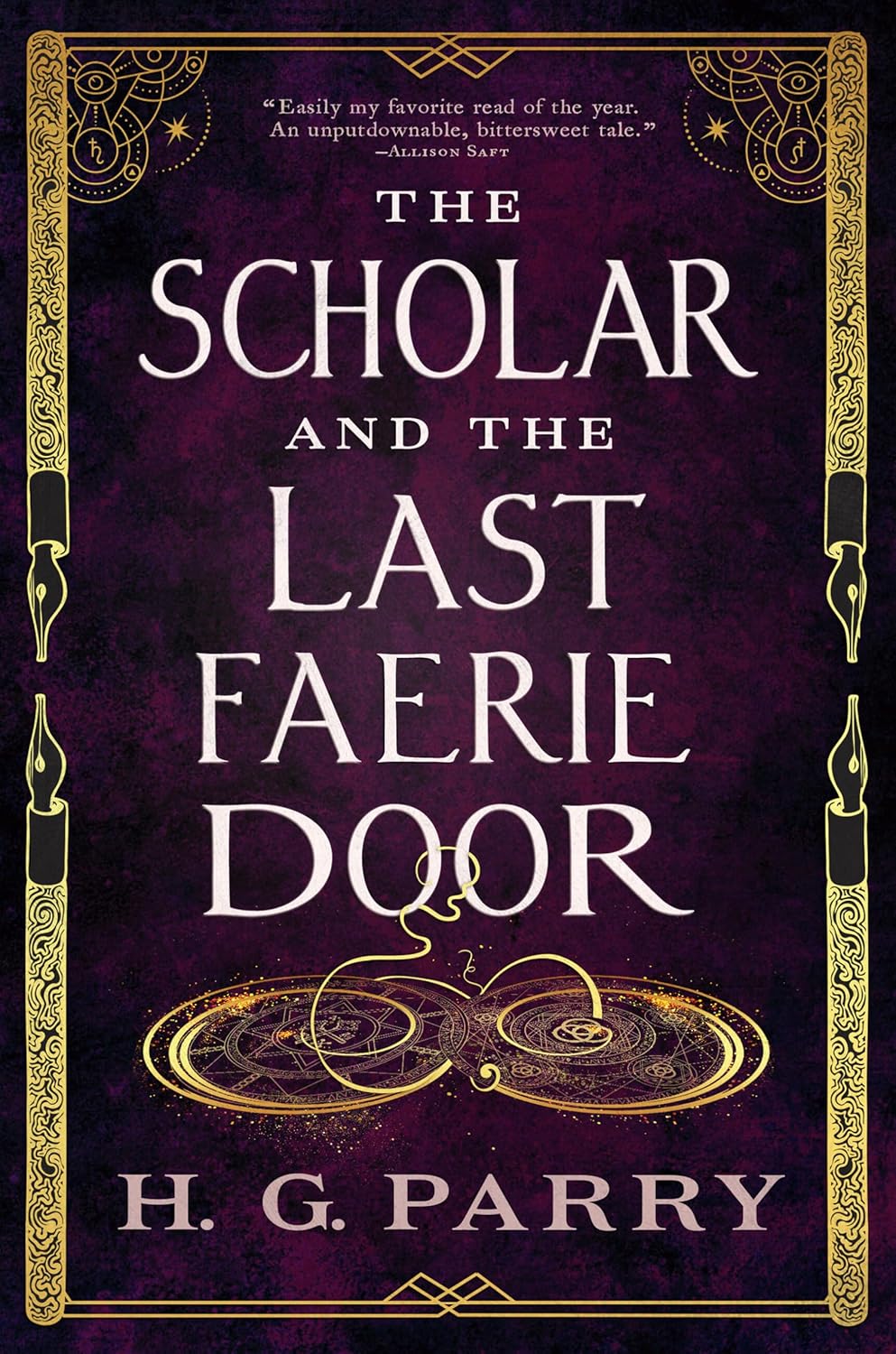
The Scholar and the Last Faerie Door by H. G. Parry

H. G. Parry continues to impress me deeply (see previous reviews here). I think this might be my favorite of her books, although The Magician’s Daughter was a feat. (This is not the first year I’ve given two books from the same author a perfect 10 rating: Alix Harrow, Stephen King, and Norman Maclean have each held this spot. Still.)

The book opens with a fateful meeting of the narrator, Clover Hill, with a person who will become one of the most important figures of her life. Chapter 2 rewinds to how she got there. “If it hadn’t been for the Great War, I would never have gone to Camford University of Magical Scholarship. I would never have known it existed.” Clover comes from a farm near a tiny village in Lancashire, a humble family background. She was very close to her older brother Matthew, despite five years of age difference, and it was Clover who helped convince their mother to let Matthew go to war, with some misgivings on Clover’s part. And so she carries the predictable guilt when he returns to them after four long years, alive, but scarcely recognizable. His homecoming is preceded by a visit from a fellow soldier who tells the family a wild and unbelievable story: Matthew’s is no ordinary war wound. He has been the victim of a faerie curse.

Families like Clover’s aren’t normally made aware of this fact, but magic is alive and well in the world she inhabits. Its study and practice, however, are reserved for select few magical Families (always capitalized), who possess great wealth and privilege as well as inherited, secret powers. Matthew suffers terribly. His life is in danger. And young Clover, already an ambitious girl who’d hoped to escape the family farm by way of teachers’ college, decides that she will pursue magic instead. A very, very tiny number of students are accepted to England’s university of magical scholarship, if their entrance exam scores are exemplary. Perhaps a tinier number of students even from the great Families are women. Clover will need to be very good indeed. But with the hopes of recovering Matthew’s health – even saving his life – to motivate her, Clover can do great things.

Camford University is located (as you might guess) in a mysterious space accessed by two enchanted doors in Cambridge and Oxford Universities, respectively. It’s a charmed and charming place, and upon first sight, Clover wants only to be a part of the place. Her desperation to save her beloved brother is quickly paralleled by her passion for magical scholarship (at which she excels, despite the oft-repeated claim that only members of Families should be so talented) and her desire to belong to Camford. Her heart leaps further when she clicks into place as part of a foursome of close friends: Hero Hartley, a lovely, glamorous girl, socially gifted and a serious scholar in her own right. Eddie Gaskell, awkward, shy, deeply devoted to plants and the natural world. And Alden Lennox-Fontaine, the golden boy of their year at Camford and beyond. He is physically stunning, impossibly wealthy, clever, graceful – “he was like a burning sun.” In Alden in particular, Clover finds a partner in the study of faerie spells and magic, which has been outlawed since the sensational wartime accident that changed Matthew’s life. The foursome make a project of studying what has been forbidden. Clover wants to save her brother. Hero wants to achieve the kind of academic success that will justify her career as a scholar so that she doesn’t have to marry a rich bore like her father intends for her. Eddie wants to please his friends. It’s not clear what drives Alden to study the fae.

The novel is historical fiction, in that it takes place just before, during and after World War I, reestablishing those events in a world with secret magic held by a chosen few. It’s about academia, the ivory tower that elevates and excludes, while offering a thrilling search for truth and self-betterment. It’s very much about friendship: the less-literal ‘magic’ of finding one’s people after a young life spent feeling alone – the magic of friendship, belonging, fellowship – is atmospheric and thick and real, evoked here in a way that it took me a while to realize reminded me of Tana French’s work in The Likeness or The Witch Elm or maybe The Secret Place. (There are also obvious parallels to the Scholomance series by Naomi Novik.)

As is often true in Parry’s work, there is metaphor available, if one considers that Clover is an outsider by gender, by class, and by not coming from a magical Family – England having a nuance of caring not just about class but about family and ‘breeding.’ We can think of the inherited ability to do magic as another manifestation of class or caste. And it is revealed late in the book (spoiler appears here in white text; highlight to read) that it is not Family at all that confers ease of magical learning, but the inhalation of magical pollen at the various universities of magic around the world. The Families know this, and purposefully keep that pollen to themselves, feeding it (as it were) to only their own, to keep alive an appearance of difference and superiority where there is none. It’s like giving multivitamins to your kids and then pretending they’re inherently better than those lousy malnourished kids down the street. That’s a whole ‘nother level of ugliness.

These issues of caste and injustice, and the idea of who is worthy and who is harmed by being kept out, are revealed and considered in layers as the story progresses. After a youth of yearning to be let in, to belong to Camford, Clover achieves what she seeks, more or less: in later, fast-forwarded sections of the novel, she is a PhD candidate and professor at her alma mater. But continuing injustices will eventually force her to realize that nothing has been resolved by her own promotion except her own personal success (which is tenuous). “The only difference was that the door had let me in, and so I hadn’t questioned who else it was keeping out and why.”

As you might be gathering, Clover and her friends and their secret work on faerie magic wind up involved in larger issues than they originally expect: not only Matthew’s fate but the very world around them are at stake. They must navigate split loyalties, major sacrifices, and big questions of right and wrong. Secrets also exist in layers: the magical world mostly a secret from the larger mundane one that Clover is native to; her studies with her friends on faeries, necessarily a secret from Camford and the magical world; and each of the friends, perhaps, keeping secrets from each other. There is heartbreak in the development and breaking of the friendship bond. More so in the possible breaking up of the world.

I think this is the most brilliant of H. G. Parry’s work yet.


Rating: 10 roses.

Lines by Sung J. Woo

Disclosure: I was sent an advanced review copy of this book in exchange for my honest review.


This book came to me in an unusual way, and I just happened (entirely by accident, as far as I’m aware with my conscious brain!) to pick it up a few days before its publication date, and finished reading it on the very eve. So, happy birthday to this book just published on Tuesday (October 29, 2024). And a brilliant book it is: deeply beautiful, full of tragedy and pain but also awe and even bliss and the exaltation of quiet, daily acts of love and creation.

Lines contains two parallel stories. A prologue sets the hinging scene: early on a foggy Saturday morning in New York City, two locals walk in opposite directions near the entrance to Washington Square Park. Joshua Kozlov is forty years old, and not thrilled about his daily grind, nor his recent birthday. Abby Kim is twenty-nine, a working artist and a distance cyclist. They bump into each other, a full-on collision, ending in an unintended hug, laughter, coffee, and a lightning-quick rush to marry just two months later. Or, they walk past each other in the fog.

The rest of the novel follows both storylines, “Apart” and “Together,” in chapters that feature parallel events in the lives of two Abbys and two versions of the man called Josh or Joshua. Josh(ua) is an aspiring novelist in both lines, Abby always a painter with a passion for miniatures. They have the same friends and colleagues. They are recognizable but very different versions of themselves. In the first and greatest subversion of my expectations, the “Apart” narrative thread is not an absence of romance, a tragic missed-connection sort of story. Both Abby and Josh have found meaningful love, for one thing, with other partners. They have fulfilling lives in many ways. But they still find each other: searching for a birthday gift for his beloved wife, Josh is drawn to a hand-painted locket of Abby’s. He becomes a patron, and she becomes a muse, as he writes a series of flash fiction pieces based on miniature paintings of scenes from one of Abby’s solo European cycle-tours. They share a deep connection.

The title of Lines, I think, has several meanings. You could think of the two parallel stories as threads, or lines. Josh(ua) writes in lines, of course, and Abby draws with them. The concept implies connection, ties. Like much about the novel, its title is subtle, a whisper.

This book is definitely about possibilities, and multiplicities. What if there were another version of my life, my choices, my loves? It’s about art, inspiration, the balance between creative work for pay and for pure creative joy. It’s about the different kinds of love and commitment that exist in the world, about births and deaths. Neither version of this story is without pain, but there is wonder and sweetness even in the tragic moments. I’m not sure there is a final “right” place for either Abby or Josh(ua) to be, and that’s an artistic choice on Woo’s part that I respect deeply. Simple, clean-cut, black-and-white solutions are easier to write but feel less true.

My copy of Lines (an ARC, of course), came with a glossy, full-color insert featuring the 16 miniature paintings that star in the story – they are Abby’s, in the fictional version, and in real life are credited to Dina Brodsky. Josh tells Abby in the book (in their “Apart” line) that he’s working on a novel about their story, but will swap their ethnicities: he’ll make the female character Belarusian and the man, Korean. Sung J. Woo is Korean-American. Brodsky is a cyclist as well as a painter. This reader, at least, cannot help but be curious about the lines drawn between life and art! Brodsky’s paintings are indeed hypnotic, and I feel happily lost in the layers of ekphrasis: a novel about writing about painting… the images themselves, the writing by Josh, within the writing by Woo. I’m writing this review within minutes of finishing the book, and I’m sure I’m missing so much. But I also know I’ll be thinking about it for a long time.

I feel so lucky to have this book come across my desk, and to have opened it almost eight months later, to finish it (quite by accident) on the eve of its publication – what are the chances? It’s nearly as magical as what’s inside.

Check it out. And thank you so much for reaching out, Sung.


Rating: 9 flights.

I Made It Out of Clay by Beth Kander

As Eve’s life devolves into crisis, she creates a golem to solve it all, in this lovely, absorbing novel of grief, dark humor, and love and friendship, with a dash of magic.

Beth Kander’s I Made It Out of Clay is a lovely, absorbing novel of grief, dark humor, and love and friendship, with a dash of magic.

In contemporary urban Chicago, as the holiday season approaches, Eve is struggling: she’s about to turn 40 years old, and she’s nowhere near done grieving her beloved father, who died just over a year ago. Eve and her father always loved Christmas–a guilty pleasure in their Jewish family not shared by the surviving members. Layoffs are threatened at work, her best friend has been distant, she’s had some disturbing encounters on the train recently, and she’s begun hallucinating her dearly departed grandmother, a Holocaust survivor who seems to be trying to warn Eve of something. Eve is not close to her mother (overbearing) or her younger sister Rosie (overly perfect), who’s scheduled her wedding for Eve’s 40th birthday weekend. Eve has (foolishly) promised to bring a plus one to Rosie’s wedding, but she’s so far failed to find a date. Unfortunately, her neighbor crush doesn’t seem to get her jokes or her cringeworthy attempts at flirtation.

In desperation, late at night and rather drunk, Eve recalls a story told by her grandmother, ventures into the dank corners of her apartment’s basement, and builds herself a golem out of foundation clay. A golem serves as protector and companion in Jewish tradition, and she feels in dire need of both. The next morning, a hungover Eve wakes up to find a handsome (and very naked) man in her apartment. She is horrified, in disbelief, attracted to him, and a little disgusted with herself. Is Eve’s golem a figment of her imagination? A monstrosity? Or the answer to her fondest wishes? Heading into Rosie’s wedding, all of Eve’s crises–work, friendships, the absence of romance, family strife, civil unrest in the wider world–crash and crescendo together. A golem is either the best or worst idea she’s ever had.

I Made It Out of Clay is a charming rework of a traditional tale. Frequently grim, it explores some of the darker elements of modern life: depression, loneliness, grief, bigotry. But it’s also sweet and very funny, especially in the moments when Eve lets her friends and, eventually, family into her life, and finds that they may have some of their own struggles. Kander gifts her readers with a novel that is often serious and sad, but ultimately uplifting, as Eve learns, “This isn’t the end of anything. It’s just one more beginning, like every damn day can be if we just let it.”


This review originally ran in the October 4, 2024 issue of Shelf Awareness for the Book Trade. To subscribe, click here.


Rating: 7 bagels.

A Declaration of the Rights of Magicans by H. G. Parry

A sprawling epic by one of my new favorites, A Declaration of the Rights of Magicians combines history–the 1770s-1790s Age of Enlightenment in England, France and Saint-Domingue–with fantasy. In this alternate history, magical powers are relatively common, but only permitted in Aristocrats. Commoners with a magical Inheritance must be registered and wear a bracelet that will burn them painfully if they use their forbidden powers. The idea of a more equitable world, “one whose Commoners could use their magic freely, not to steal to feed their children but for their own education and enlightenment,” fires the imagination of several reformers the novel will follow in both England and France; chief among these are real historical figures like William Wilberforce, William Pitt the Younger, and Maximilien Robespierre. The abolition of slavery (the recognizable, historical practice of stealing and trading in African people) is a parallel issue for many of the same men. Meanwhile, in modern-day Haiti, an enslaved woman named Fina learns that she holds extraordinary powers of her own, which she will use to advance the cause that is most important to her and her friends: their freedom to move and speak and act, let alone to use magic. In this world, slaves are spellbound by their so-called owners: fed a certain elixir, they are unable to disobey orders, unable even to move or speak of their own volition.

It is an important facet of this story that characters with great and noble values and aims must confront questions about what means are justified by what ends. There is an introduction of dark magic of a kind that has been outlawed – and supposedly eradicated – for generations. There are questions of sticking to one’s principles in the face of certain defeat, versus compromising in profound ways to achieve interim goals. This intersection, again, of fantasy with real history (and very real human struggles) is exceptionally well done.

In over 500 pages, the reader gets to know Pitt and Wilberforce and their friends in London; Robespierre and his in Paris; and Fina and her fellows, before and after Saint-Domingue’s famous slave rebellion. Parry’s setting and characters may be based on history, but she’s absolutely doing in-depth worldbuilding all the same; she has laid out not only the ‘rules’ of this world in terms of its realities (how magic works, who has it) but the laws to be obeyed or broken (who is permitted magic, how the bracelets work, how the court systems function). The relationships – in particular the friendship between Pitt and Wilberforce, which I found the most compelling of the book – are involved and engrossing. The personalities – especially poor, despicable, manipulated Robespierre – are complex. I found Fina to be the least developed of the lead characters, which is an absolute shame; to be clear, she gets the least screen time (cause or effect, chicken or egg?), but still concerning. (I have a vague impression this is somewhat corrected in book two of the duology.) The historical content feels right, and a few quick googles reinforce that impression, but by no means am I sufficiently up on my Enlightenment history to judge. The fantasy is intricate and satisfying. Parry’s greatest strength is in her characters. It only hit me after I finished reading that there is a shortage of women in this story; I am a bit sad about that, too.

I don’t often get excited about an expansive, wide-ranging saga, but if anyone can keep me page-turning for 500 pages, it’s this author. I’ll be reading book two. I’d be even more stoked for more of Uriah Heep or the Daughter, though.


Rating: 7 birds.

The Unlikely Escape of Uriah Heep by H. G. Parry

A booklover’s dream, this astonishingly great debut novel focuses on family and the power of story in a world of magic, imagination, and serious literary criticism. In Wellington, New Zealand, Rob Sutherland is a hardworking lawyer with a lovely partner, Lydia, and a trying younger brother, Charley, known to his colleagues as Dr. Charles Sutherland. Rob is longsuffering: Charley keeps calling him, often in the middle of the night, to come up to work (Charley teaches at Prince Albert University) and help him catch the characters he’s accidentally released from books so he can put them back. Rob has always had complicated feelings for Charley: he loves his little brother and wants to keep him safe, but he definitely stays annoyed with him much of the time, too. Though four years younger, Charley was a prodigy, who went off to Oxford University the same year that Rob went off to Prince Albert. Rob would have been considered intelligent in most families, but felt overshadowed by a child who read Dickens when he was two years old. One of this novel’s central threads is the challenge of an adult relationship between brothers, with a touch of sibling rivalry, many old wounds, and a persistent bond of love, loyalty, and protectiveness that runs in both directions.

So: Charley is a genius, of the scattered, distant, dreamy type, who keeps accidentally bringing fictional (and nonfictional!) characters out of books. It can get messy. Rob is the exasperated big brother who keeps helping clean up messes – not always in the best of humors. Then the messes get much bigger, beyond anything that Rob or Charley is prepared to deal with – out of their control, and, it eventually becomes clear, outside of Charley’s causing. But Charley, and eventually Rob, do decide that it’s within their responsibility to try to save Wellington, or the world.

This is a story filled with vibrant characters, and that plays with the layers of what ‘character’ can mean. Some are Parry’s (her characters’) interpretations of those written by others, including the title character, Uriah Heep, who comes from David Copperfield and is thus originally Dickens’s, now read by Charley (and Parry). Some are Parry’s originals but, within this book, credited to another (fictional) author. [The indomitable Millie Radcliffe-Dix comes from The Adventures of Millie Radcliffe-Dix, Girl Detective, which unfortunately do not exist in this world I’m out here living in.] And some, like Charley himself, are the inventions of this book. It quickly gets to be a lot, but gosh, in the most fun ways. Again: there was never such a booklover’s book.

The title of The Unlikely Escape of Uriah Heep refers to a character who is not even one of the top five or ten most important in the book – although he is the character at large in the opening scene, when Charley calls Rob in the middle of the night (again). He will reappear periodically. In some ways, Dr. Charles Sutherland is the main character of the book – he has the splashiest powers, and the central conflict rages around him; mysteries wreathe his past; he will have great choices to makes. But it is Rob who narrates the bulk of the book (with a few interludes as exception). In part, I think this is because there is a heavy emphasis, in this world and in this telling, on how one person’s “reading” of another impacts the person being read. Rob’s perspective on Charley matters a great deal. I think Parry’s choice of Rob as narrator is interesting; it shifts the reader’s reading, in similar ways. Whose stories do we matter in? As Dr. Frankenstein tells us: “What you need to understand about protagonists… is that we’re all busy with our own plots. We can’t help it; we’re not used to sharing our stories.” If that’s not a lesson for the real world, I don’t know what is.

I’m still reeling and will enjoy thinking about what this book has shown me as I move through my world and reading. I think it has the potential to be one of those that shifts how I think about it all – which is a big accomplishment. Also, everything Parry writes plunges me deeply and pleasurably into other worlds, which I love. I finished this book and dived directly into another big thick one of hers. Do recommend.


Rating: 9 doors.

Mexican Gothic by Silvia Moreno-Garcia

I really enjoyed Gods of Jade and Shadow, with the caveat for sensitive readers to beware a certain amount of gore and darkness. This one is imaginative, compelling, and surely fulfills its claims to the horror genre; but some of those more horrifying elements started to push my tolerances, which are famously high (though not limitless). I’d thought about putting this in white text, like I do spoilers, but I think it deserves a proper trigger warning: this novel not only deals in sexual contact without consent, but those scenes were heightened – at least in my feelings – by a mind-control element that caused the nonconsenting party to enjoy what was happening, as it was happening (although not before or after). This gave me a unique ‘ick’ I’d perhaps not encountered before. And in considering the book now, I find that part of the experience is overshadowing the rest for me.

It’s a good story, and well executed. I like the setting – beginning in 1950s Mexico City and then moving to a classically disturbing, possibly haunted, gothic mansion in disrepair, high in the misty rural Mexican hills. I like the details, including society’s dos and don’ts and the dresses and accessories of a popular, pretty, privileged young woman, our protagonist, Noémi Taboada. She’s plucky, thinks for herself, is unwilling to settle for a young woman’s few destined roles. These days, she’s thinking she’d like to study anthropology in graduate school. She’s well read, and also loves a party, a nice dress, and a fawning young man (and preferably a new one on a regular schedule). I like her.

Her cousin Catalina is a bit different, more demure, a few years older, enchanted by fairy tales and romance, which is how she ends up married to the enigmatic Virgil Doyle. Married, and spirited away to the yet more enigmatic estate known as High Place, on an abandoned silver mine. Where Noémi is to visit, and perhaps to rescue her.

High Place is bad news, its residents sinister (and dedicated to eugenics, ick again), its history very mysterious. Noémi is up for a lot, but this place may get the best of her. There’s always Francis, a Doyle cousin who might – on and off – be an ally. There’s a creepy old cemetery (of course), and something strange going on with the mushrooms. There are actually some really interesting ideas at play. But, like I said, the special ick I found here challenged me quite a bit.

I’ve left the rating at a 7. It’s a well-done story. But it’s left me feeling not so great. I’m intrigued enough to keep on checking out Moreno-Garcia’s backlist.


Rating: 7 cards.