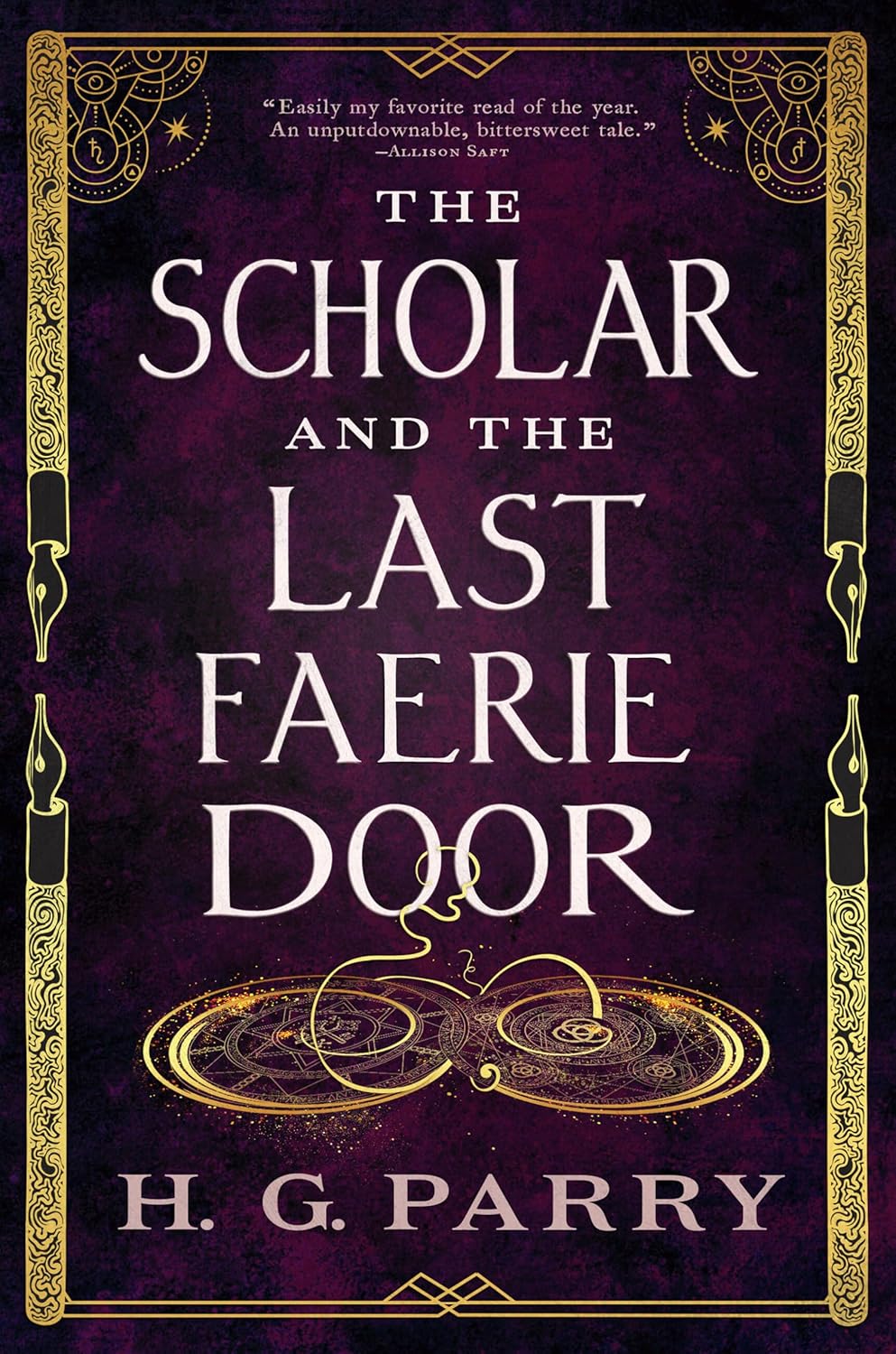
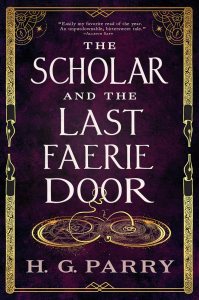
 H. G. Parry continues to impress me deeply (see previous reviews here). I think this might be my favorite of her books, although The Magician’s Daughter was a feat. (This is not the first year I’ve given two books from the same author a perfect 10 rating: Alix Harrow, Stephen King, and Norman Maclean have each held this spot. Still.)
The book opens with a fateful meeting of the narrator, Clover Hill, with a person who will become one of the most important figures of her life. Chapter 2 rewinds to how she got there. “If it hadn’t been for the Great War, I would never have gone to Camford University of Magical Scholarship. I would never have known it existed.” Clover comes from a farm near a tiny village in Lancashire, a humble family background. She was very close to her older brother Matthew, despite five years of age difference, and it was Clover who helped convince their mother to let Matthew go to war, with some misgivings on Clover’s part. And so she carries the predictable guilt when he returns to them after four long years, alive, but scarcely recognizable. His homecoming is preceded by a visit from a fellow soldier who tells the family a wild and unbelievable story: Matthew’s is no ordinary war wound. He has been the victim of a faerie curse.
Families like Clover’s aren’t normally made aware of this fact, but magic is alive and well in the world she inhabits. Its study and practice, however, are reserved for select few magical Families (always capitalized), who possess great wealth and privilege as well as inherited, secret powers. Matthew suffers terribly. His life is in danger. And young Clover, already an ambitious girl who’d hoped to escape the family farm by way of teachers’ college, decides that she will pursue magic instead. A very, very tiny number of students are accepted to England’s university of magical scholarship, if their entrance exam scores are exemplary. Perhaps a tinier number of students even from the great Families are women. Clover will need to be very good indeed. But with the hopes of recovering Matthew’s health – even saving his life – to motivate her, Clover can do great things.
Camford University is located (as you might guess) in a mysterious space accessed by two enchanted doors in Cambridge and Oxford Universities, respectively. It’s a charmed and charming place, and upon first sight, Clover wants only to be a part of the place. Her desperation to save her beloved brother is quickly paralleled by her passion for magical scholarship (at which she excels, despite the oft-repeated claim that only members of Families should be so talented) and her desire to belong to Camford. Her heart leaps further when she clicks into place as part of a foursome of close friends: Hero Hartley, a lovely, glamorous girl, socially gifted and a serious scholar in her own right. Eddie Gaskell, awkward, shy, deeply devoted to plants and the natural world. And Alden Lennox-Fontaine, the golden boy of their year at Camford and beyond. He is physically stunning, impossibly wealthy, clever, graceful – “he was like a burning sun.” In Alden in particular, Clover finds a partner in the study of faerie spells and magic, which has been outlawed since the sensational wartime accident that changed Matthew’s life. The foursome make a project of studying what has been forbidden. Clover wants to save her brother. Hero wants to achieve the kind of academic success that will justify her career as a scholar so that she doesn’t have to marry a rich bore like her father intends for her. Eddie wants to please his friends. It’s not clear what drives Alden to study the fae.
The novel is historical fiction, in that it takes place just before, during and after World War I, reestablishing those events in a world with secret magic held by a chosen few. It’s about academia, the ivory tower that elevates and excludes, while offering a thrilling search for truth and self-betterment. It’s very much about friendship: the less-literal ‘magic’ of finding one’s people after a young life spent feeling alone – the magic of friendship, belonging, fellowship – is atmospheric and thick and real, evoked here in a way that it took me a while to realize reminded me of Tana French’s work in The Likeness or The Witch Elm or maybe The Secret Place. (There are also obvious parallels to the Scholomance series by Naomi Novik.)
As is often true in Parry’s work, there is metaphor available, if one considers that Clover is an outsider by gender, by class, and by not coming from a magical Family – England having a nuance of caring not just about class but about family and ‘breeding.’ We can think of the inherited ability to do magic as another manifestation of class or caste. And it is revealed late in the book (spoiler appears here in white text; highlight to read) that it is not Family at all that confers ease of magical learning, but the inhalation of magical pollen at the various universities of magic around the world. The Families know this, and purposefully keep that pollen to themselves, feeding it (as it were) to only their own, to keep alive an appearance of difference and superiority where there is none. It’s like giving multivitamins to your kids and then pretending they’re inherently better than those lousy malnourished kids down the street. That’s a whole ‘nother level of ugliness.
These issues of caste and injustice, and the idea of who is worthy and who is harmed by being kept out, are revealed and considered in layers as the story progresses. After a youth of yearning to be let in, to belong to Camford, Clover achieves what she seeks, more or less: in later, fast-forwarded sections of the novel, she is a PhD candidate and professor at her alma mater. But continuing injustices will eventually force her to realize that nothing has been resolved by her own promotion except her own personal success (which is tenuous). “The only difference was that the door had let me in, and so I hadn’t questioned who else it was keeping out and why.”
As you might be gathering, Clover and her friends and their secret work on faerie magic wind up involved in larger issues than they originally expect: not only Matthew’s fate but the very world around them are at stake. They must navigate split loyalties, major sacrifices, and big questions of right and wrong. Secrets also exist in layers: the magical world mostly a secret from the larger mundane one that Clover is native to; her studies with her friends on faeries, necessarily a secret from Camford and the magical world; and each of the friends, perhaps, keeping secrets from each other. There is heartbreak in the development and breaking of the friendship bond. More so in the possible breaking up of the world.
I think this is the most brilliant of H. G. Parry’s work yet.
Rating: 10 roses.
Filed under: book reviews | Tagged: fairies, fantasy, historical fiction, speculative fiction | 1 Comment »