The Edge of Normal by Carla Norton

A true-crime journalist shifts to fiction with a disturbing and authentic tale of kidnapping–and recovery.

normal
The Edge of Normal, Carla Norton’s fiction debut, clearly draws upon the expertise she gained writing Perfect Victim, a 1988 true-crime book about a survivor of kidnapping and captivity. In the novel, kidnapping victim Reeve LeClaire has spent the six years since her escape in therapy and is progressing in tiny, painful increments. The family of Tilly Cavanaugh, another rescued abductee, asks for Reeve’s help in beginning their own process of recovery. This mentorship looks like the most challenging task she’s been offered in years, but will turn out to be the beginning of another nightmare.

Tilly’s kidnapper is behind bars, so why is Tilly still so skittish? What is she not telling the police and district attorney who want to prosecute her case? Pulled into a confidence that may break her, Reeve becomes the only person who can help Tilly and two girls who are still missing.

The reader is privy to the inner workings not only of Reeve’s tortured mind, but that of Tilly’s kidnapper, so there is less mystery in The Edge of Normal than sheer terror and wild, horrified urgency. Norton’s sense of pace is perfect, and her characters draw upon readers’ sympathies skillfully. Norton’s expert understanding of captivity syndromes goes far beyond Stockholm Syndrome (which, she writes, “isn’t actually in the diagnostic manuals”); she renders Reeve and Tilly’s experiences visceral and believable, as The Edge of Normal indulges in all the action and adrenaline thriller fans crave before building to an explosive finish.


This review originally ran in the September 13, 2013 issue of Shelf Awareness for Readers. To subscribe, click here, and you’ll receive two issues per week of book reviews and other bookish fun!


Rating: 6 scars.

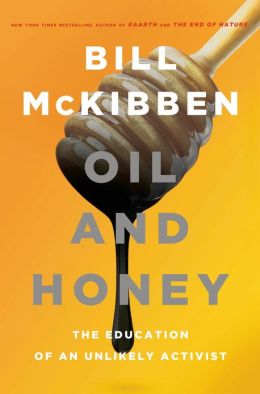
Oil and Honey by Bill McKibben

Highly literate and expert musings on climate change, from home to the global theatre.

oil
Oil and Honey centers partly on climate change, a subject on which Bill McKibben (The End of Nature; Eaarth; founder of 350.org) is expert; but it is also personal in nature, a dualism reflected by the title. McKibben is concerned simultaneously with oil–representing fossil fuel industry practices and climate change–and honey. Having entered into a land-share agreement with his friend, beekeeper Kirk Webster, McKibben finds his home and Webster’s apiaries exerting a gravitational pull just as his political activism draws him far and wide. These two sides of his life–personal and political, local and global, analog and digital–are the focus of this combination memoir and call to action.

The subtitle refers to his journey from writer to activist, by way of 350.org and the Keystone Pipeline–a trip he did not intend but found obligatory. Activist though he may be, McKibben remains a fine writer, evocative, articulate, clever and humble in examining his mistakes. In piercing prose, McKibben unites his longstanding authority on climate change with his novice stature in the world of beekeeping. He muses on the small-scale and private implications of our changing world, which incline him to work with his family and Kirk’s bees in his beloved local community in Vermont; and likewise on the necessity for global action to combat the continuing quest for fossil fuels. Oil and Honey travels the world but always cycles back, like the seasons, to McKibben’s Vermont home, likening global systems to beehives in a manner both profound and lyrical–and important.


This review originally ran in the – issue of Shelf Awareness for Readers. To subscribe, click here, and you’ll receive two issues per week of book reviews and other bookish fun!


Rating: 8 degrees.

Weeds: A Farm Daughter’s Lament by Evelyn Funda

A memoir about the loss of the family farm, and everything it means to the child of immigrant farmers–and to us all.
weeds
Evelyn Funda’s mother escaped Nazi-occupied Czechoslovakia in a wine barrel, eventually landing in the United States. Her father was the son of Czech immigrants, early homesteaders who sought to make farmland of the Idaho desert. The family farm never felt like it would be Evelyn’s: this “farm daughter,” unwelcome among the tractors and irrigation pipes, would leave to become a college professor. Her musing memoir opens in the fall of 2001 with a triple tragedy: the sale of the family farm; her father’s cancer diagnosis; and her mother’s death, closely followed by her father’s.

Weeds is an elegy, an academic’s personal tale of research and disillusionment, and Evelyn’s own story–with hints of a botanist’s or social historian’s study. (The chapters are named for weeds, beginning with dodder, which she long misheard as “daughter,” when her father cursed the unwelcome growth.) The pursuit of her mother’s joyful youth in a series of cities and countries, of the truth of her grandfather’s apocryphal tales, of her parents’ romance and of the history of her own hometown takes Evelyn to dusty library stacks and to small Czech villages, where she meets dozens of cousins and examines old bones.

Meditative and lyrical, Weeds smoothly braids weeds with family. Funda is sometimes frustrated along the way, but finally satisfied with the personal history she builds for herself–and the conclusion that, even in exile, one can find a sense of place and of belonging.


This review originally ran in the September 6, 2013 issue of Shelf Awareness for Readers. To subscribe, click here, and you’ll receive two issues per week of book reviews and other bookish fun!


Rating: 7 kolaches.

Holy Orders by Benjamin Black

Black’s series, set in 1950s Dublin, continues with a gloomy mystery that offers occasional bright points of light.

holyorders

Melancholy Dublin pathologist Quirke returns in Holy Orders, the sixth novel in a series of mystery novels by Benjamin Black (the pen name for Man Booker Prize winner John Banville). Fans of the series will easily slip into the larger plot arc, in which Quirke’s daughter, Phoebe, gradually grows closer to him and outwards into her world, despite the tragedy at the center of this story: the body that turns up on Quirke’s autopsy table in the opening pages is that of Phoebe’s red-headed friend Jimmy Minor.

Quirke teams up with Inspector Hackett to follow the clues from the newspaper where Minor worked, to the priest he was bent on interviewing, to a tinkers’ camp outside town. As Quirke continues to combat his alcoholism and possible hallucinations, a previously unknown relative of Jimmy’s surfaces and Phoebe will make a surprising discovery about herself. Within the darkness of this tale of murder, she finds dazzling possibility.

The strengths of Black’s methodically paced mystery series echo Quirke’s own personality traits. The 1950s Dublin setting is murky and depressed; the Catholic Church is over-powerful and corrupt. Quirke wrestles most of all with a feeling of detachment from the living players in his life. He worries that childhood trauma–also at the hands of the church–and his medical career working exclusively with dead clients make him inaccessible to family, friends, and lovers. Phoebe’s personal growth threatens to steal the stage in Holy Orders, which will leave Black’s readers eager for the next installment in Quirke’s sad but engaging story.


This review originally ran in the August 27, 2013 issue of Shelf Awareness for Readers. To subscribe, click here, and you’ll receive two issues per week of book reviews and other bookish fun!


Rating: 5 confessions.

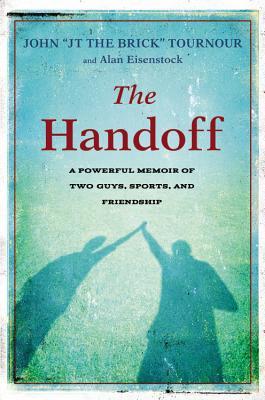
The Handoff: A Memoir of Two Guys, Sports, and Friendship by John “JT the Brick” Tournour

An earnest remembrance of a friend and the wisdom he passed on to a sports talk radio anchor.

handoff2

After a fun-filled, full-speed youth as president of his fraternity and, later, working as a professional cold-calling stockbroker, John Tournour finds his true calling: sports talk radio. He starts out as a listener calling in, then gets his own show but has to pay for airtime, gradually working his way up until one day he gets a fateful call. Andrew Ashwood mentors John, now known on the air as “JT the Brick,” through an ascending career, and they become the closest of friends. When Andrew is diagnosed with cancer, JT naturally gets the call to be his chemo buddy and “main go-to guy.”

Though The Handoff begins with JT’s childhood, we know from the beginning that Andrew will be its focal point. JT failed to take notes on Andrew’s every word in those final months, realizing only in hindsight that he was not only modeling how to live–and how to die–but also sharing all his life lessons, on and off the air.

JT may be macho and manly–this is smack-talk sports radio, after all–but he is heartfelt and emotional in relating his love for Andrew and his appreciation of everything his friend had to offer. Although sports radio is JT’s passion and the background for his friendship with Andrew, his readers need not know or even much care about sports (or radio) to empathize. The Handoff is a memoir of life and loss, but foremost of friendship.


This review originally ran as a *starred review* in the August 23, 2013 issue of Shelf Awareness for Readers. To subscribe, click here, and you’ll receive two issues per week of book reviews and other bookish fun!


Rating: 6 callers.

The Happy Atheist by PZ Myers

The creator of the popular Pharyngula blog makes a funny, impertinent and highly intelligent argument for atheism and happiness.

happyatheist

PZ Myers is serious and unapologetically funny at the same time–and, despite 15 churches in his immediate neighborhood and their fellows worldwide, he is indeed a happy atheist.

The Happy Atheist is irreverent in every sense of the word, experimentally seeking creative acts of sacrilege and poking fun at religion from diverse angles. Short chapters make for quick, easy reading: “The Great Desecration” relates Myers’s project of desecrating communion wafers, which inflamed the public to a degree that flabbergasted him.

He offers other reasons for the religious to be offended as he describes “the proper fate for a holy book” and instructs us to “take pride in the example of Eve–she is the author of a real promise of a great humanity.” But even in making fun–and he assures us that laughter is the greatest weapon we can wield against religion–Myers is loving and compassionate, and it is clear that he aims to increase everyone’s happiness by converting the wayward to atheism. Trusting in his expertise as a biology professor, he moves from more lighthearted larks toward a more serious scientific examination of the shortcomings of religion, especially by comparison. “Science,” he quotes Richard Feynman, “is what we do to keep from lying to ourselves.”

The Happy Atheist finishes with a heartfelt discussion of The Epic of Gilgamesh on a hopeful and inclusive note. Far from being out simply to insult, Myers genuinely wishes to improve humankind and our lot here on earth. But some hilarity along the way can’t hurt.


This review originally ran in the August 20, 2013 issue of Shelf Awareness for Readers. To subscribe, click here, and you’ll receive two issues per week of book reviews and other bookish fun!


Rating: 6 plain old crackers.

The Boy Who Could See Demons by Carolyn Jess-Cooke

A haunting haze between reality and apparition with a troubled child psychiatrist at the center.

demons

The Boy Who Could See Demons is Alex, aged 10. He began seeing his own particular demon, named Ruen, when he was five, on the day his father was declared “gone.” Anya is the new child psychiatrist in town, having returned to her home in Belfast hoping to help patch up children and families damaged by Northern Ireland’s “Troubles.” Perhaps she should be more concerned about troubles of her own: the day she gets the call about Alex is the four-year anniversary of her daughter’s death. Now she sees her daughter, Poppy, in Alex, who may have the same sickness, and she is clearly in danger of getting too close to this case. Worse, the boundaries begin to blur between what is real and what is not, as Anya wonders if Ruen may have a place in the tangible world.

Carolyn-Jess Cooke (The Guardian Angel’s Journal) creates in Alex and Anya sympathetic characters, and the traumatized Belfast she evokes comes alive on the page. Child psychology plays an important role, with its questions of medication and whether and when to separate a family. With a suicidal mother, a suicidal child, delusions and possible schizophrenia all jumbled up together, it’s no wonder Anya becomes a little unglued. The reader will have as much trouble as Anya does discerning fact from mirage as the story unfolds. The Boy Who Could See Demons is riveting and increasingly fast-paced, as it forces the reader to question everything that seemed secure from page one.


This review originally ran in the August 20, 2013 issue of Shelf Awareness for Readers. To subscribe, click here, and you’ll receive two issues per week of book reviews and other bookish fun!


Rating: 7 onions.

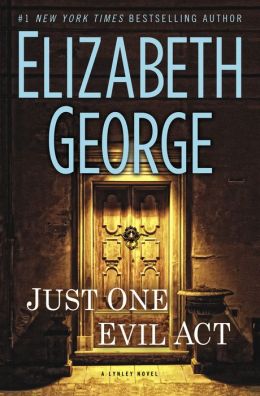
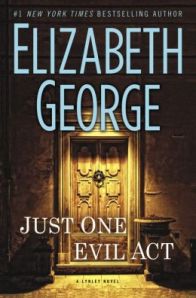
Just One Evil Act by Elizabeth George

evilElizabeth George’s 18th novel starring Detective Inspector Thomas Lynley and Detective Sergeant Barbara Havers of Scotland Yard will be published in mid-October of this year. This series dates back to 1988, and I was introduced to it by my mother; we have both been great fans.

Series readers will of course recognize the two familiar main characters, joined by the likeable Detective Constable Winston Nkata, sundry less sympathetic Scotland Yard superiors, and Barbara’s neighbors, Taymullah Azhar and his daughter Haddiyah. Simon St. James and his wife Deborah, sadly, barely cross the stage in this novel; and of course those readers who have been keeping up with the last 3-4 books in the series will know about the death of Lynley’s wife Helen, whom he is still grieving. As with most series, I think, an integral part of the reader’s enjoyment is in recognizing characters as old friends, and in that sense, it felt good to be back in the company of Lynley – upper class but down-to-earth, flawed and suffering, but trying to make a go of it with a new woman; and Havers – lower class and struggling all around, socially awkward, but devoted to Azhar and Haddiyah.

A brief plot introduction, and then I’ll avoid spoilers as this book is not yet published. Haddiyah’s mother Angelina is back on the scene just long enough to lull Azhar into complacency, and then she takes Haddiyah and runs. Azhar and Barbara together hire a private investigator to try to track the missing daughter, but his rights are limited: he was never listed on her birth certificate, never married her mother, and his paternity is unproven. Then Angelina turns up in Italy with a new beau, distraught that Haddiyah has been kidnapped from her. Naturally, Azhar is a subject; just as naturally, Barbara is committed to proving his innocence and bringing Haddiyah home.

From a thoroughly charming opening scene in which Lynley tries to charm his new girl by showing up at her roller derby match (!), we mostly stick with Barbara, who is at the zenith of her anti-authoritarianism. Consistently poorly-dressed and disrespectful, and usually described by her superiors as unprofessional, she outdoes herself here. While these are central tenets of Barbara’s character, her total flouting of law and order and disregard for keeping her own job in pursuit of Azhar and Haddiyah’s best interests gets a little outrageous. In prior books I felt that her devotion to the job was also an important part of her character; here, not so much. Her single-minded and, yes, stupid behaviors are at best an abrupt turn in her character’s development, and at worst, inconsistent with the Barbara we’ve come to love.

My criticisms continue. There is an utterly unbelievable beating; an unlikely mix-up of victims; and an indictment of prejudice which is nevertheless upheld, thus seeming to discredit the indictment in the first place. What had been a promising long-term relationship between well-loved characters, building in this series through many books, is thrown out the window in a flash – much like the sudden murder of Helen Lynley a few books ago, leading me to suspect that Elizabeth George enjoys wrenching some of her readers’ favorite characters away from them. Perhaps most infuriatingly, a promising beginning to a romance is left unresolved. This may be intended to keep us hanging on edge for the next book. However, all it did was make me mad. I actually, literally threw this book upon finishing it. (You can ask Husband.) I don’t think I’ve done that before. I’m no reader of romance novels, but I do enjoy a good, realistic, even sappy romantic thread in my thrillers or what have you. I have been teased and disappointed here, and I resent it. I had been doubting and hoping against doubt that George would pull this one through when she dropped the budding love affair, and I am now done with her.

Furthermore, I am not the only one to note that George’s books have been getting longer, and this, I believe, is her longest yet. That’s my awesome editor at the above link, noting that Just One Evil Act weighs in a good bit over 2 pounds. Now, page count is not always a problem – I would like to point to Stephen King’s outstanding 11/22/63 at 850 – but here, George could have written this plot up in 400 pages rather than more than 700, and I think it would have been better done. Her sentences, too, are overlong. Again, you know I have no inherent problem with long sentences. Take my word then when I say that George lost track of her editor in this work.

I regret this loss of a long-term love, but I don’t think I’ll be able to follow Havers and Lynley where they next tread.


Rating: 3 rambling plot threads.

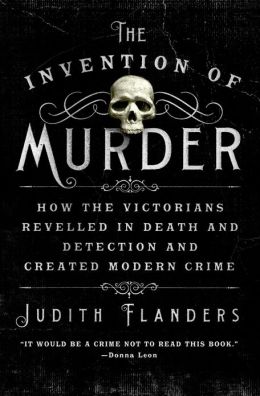
The Invention of Murder: How the Victorians Revelled in Death and Detection and Created Modern Crime by Judith Flanders

An exhaustive, engaging examination of how murder and the murder mystery novel infiltrated our modern world by way of 19th-century Britain.

murder

Judith Flanders (A Circle of Sisters) tackles an unwieldy subject in The Invention of Murder, telling the tale admirably well, even entertainingly.

The Victorian British, Flanders tells us, were the first to identify murder as an object of fascination–inspiring in turn a passionate interest in trials, executions, motives and, eventually, the developing profession of solving crimes. The action opens in 1811 with the murdered Marr family, and quickly moves to 1820s Edinburgh, where Burke and Hare infamously killed so they could to sell the corpses to doctors as medical specimens. Flanders introduces a lengthy list of famous (and obscure) murderers and serial killers, culminating, of course, with Jack the Ripper. Alongside the killers and their victims, she presents Thomas Hardy, George Eliot and many contributions by Charles Dickens to illustrate her thesis that murder in life inspired murder in art. Fictional murderers and detectives play a role equal to their real-life counterparts, as Sweeney Todd and Sherlock Holmes take the stage.

Flanders also tracks the evolution of the police force from a force of deterrence to an investigative organization, along with the parallel development of murder and detection in literature and on the stage. The penny-blood (or penny-dreadful), a cheap booklet telling a sordid and often illustrated tale of horror, morphs into the detective novel (and play), as the public shifts its interest from bloody murder to the newly invented and increasingly sympathetic crimesolvers we know and love today.


This review originally ran in the August 2, 2013 issue of Shelf Awareness for Readers. To subscribe, click here, and you’ll receive two issues per week of book reviews and other bookish fun!


Rating: 6 dismembered parts.

Light of the World by James Lee Burke

Dave Robicheaux and Clete Purcel are joined by their daughters as they battle evil in the hills and valleys of Montana.

lightoftheworld
Light of the World, James Lee Burke’s 20th novel starring Louisiana detective Dave Robicheaux, returns to the Montana hill setting of 2008’s Swan Peak. Fans will be thrilled to find Robicheaux and Clete Purcel joined by their respective adult daughters in a hard-hitting, intense battle between good and evil. Burke’s writing is poetic–reverential in praise of natural beauty, contemplative of human nature–and invokes a strong sense of place. Clete, the rough-and-ready, hard-drinking, softhearted private investigator, is lovable as ever; Robicheaux is the flawed hero who has charmed us from the first, fighting his demons and protecting his clan.

Years ago, Dave’s daughter, Alafair, visited serial killer Asa Surette in prison to interview him for a book she never wrote. Instead, she published a condemning series of articles advocating the death penalty. Later, Surette was killed in a collision with a gasoline tanker. So why is he now lurking around the cabins in Big Sky Country where Robicheaux, Clete and their families are trying to relax? The evil in this powerful story of suspense has supernatural undertones, as wolves skulk in the woods above the ranch and planes fall out of the sky. Alafair teams up with Clete’s daughter, the reforming New Orleans hitwoman Gretchen Horowitz, and they make as remarkable a pair as their fathers. As the story unfolds, a rodeo cowboy who speaks in tongues, a serial killer who should be dead, ex-cons, rapists, bear traps and evil that dwells in caves in the hills all come together in perhaps the greatest showdown of Burke’s career.


This review originally ran in the July 30, 2013 issue of Shelf Awareness for Readers. To subscribe, click here, and you’ll receive two issues per week of book reviews and other bookish fun!


Rating: 8 howls.