The Handoff: A Memoir of Two Guys, Sports, and Friendship by John “JT the Brick” Tournour

An earnest remembrance of a friend and the wisdom he passed on to a sports talk radio anchor.

handoff2

After a fun-filled, full-speed youth as president of his fraternity and, later, working as a professional cold-calling stockbroker, John Tournour finds his true calling: sports talk radio. He starts out as a listener calling in, then gets his own show but has to pay for airtime, gradually working his way up until one day he gets a fateful call. Andrew Ashwood mentors John, now known on the air as “JT the Brick,” through an ascending career, and they become the closest of friends. When Andrew is diagnosed with cancer, JT naturally gets the call to be his chemo buddy and “main go-to guy.”

Though The Handoff begins with JT’s childhood, we know from the beginning that Andrew will be its focal point. JT failed to take notes on Andrew’s every word in those final months, realizing only in hindsight that he was not only modeling how to live–and how to die–but also sharing all his life lessons, on and off the air.

JT may be macho and manly–this is smack-talk sports radio, after all–but he is heartfelt and emotional in relating his love for Andrew and his appreciation of everything his friend had to offer. Although sports radio is JT’s passion and the background for his friendship with Andrew, his readers need not know or even much care about sports (or radio) to empathize. The Handoff is a memoir of life and loss, but foremost of friendship.


This review originally ran as a *starred review* in the August 23, 2013 issue of Shelf Awareness for Readers. To subscribe, click here, and you’ll receive two issues per week of book reviews and other bookish fun!


Rating: 6 callers.

The Happy Atheist by PZ Myers

The creator of the popular Pharyngula blog makes a funny, impertinent and highly intelligent argument for atheism and happiness.

happyatheist

PZ Myers is serious and unapologetically funny at the same time–and, despite 15 churches in his immediate neighborhood and their fellows worldwide, he is indeed a happy atheist.

The Happy Atheist is irreverent in every sense of the word, experimentally seeking creative acts of sacrilege and poking fun at religion from diverse angles. Short chapters make for quick, easy reading: “The Great Desecration” relates Myers’s project of desecrating communion wafers, which inflamed the public to a degree that flabbergasted him.

He offers other reasons for the religious to be offended as he describes “the proper fate for a holy book” and instructs us to “take pride in the example of Eve–she is the author of a real promise of a great humanity.” But even in making fun–and he assures us that laughter is the greatest weapon we can wield against religion–Myers is loving and compassionate, and it is clear that he aims to increase everyone’s happiness by converting the wayward to atheism. Trusting in his expertise as a biology professor, he moves from more lighthearted larks toward a more serious scientific examination of the shortcomings of religion, especially by comparison. “Science,” he quotes Richard Feynman, “is what we do to keep from lying to ourselves.”

The Happy Atheist finishes with a heartfelt discussion of The Epic of Gilgamesh on a hopeful and inclusive note. Far from being out simply to insult, Myers genuinely wishes to improve humankind and our lot here on earth. But some hilarity along the way can’t hurt.


This review originally ran in the August 20, 2013 issue of Shelf Awareness for Readers. To subscribe, click here, and you’ll receive two issues per week of book reviews and other bookish fun!


Rating: 6 plain old crackers.

The Boy Who Could See Demons by Carolyn Jess-Cooke

A haunting haze between reality and apparition with a troubled child psychiatrist at the center.

demons

The Boy Who Could See Demons is Alex, aged 10. He began seeing his own particular demon, named Ruen, when he was five, on the day his father was declared “gone.” Anya is the new child psychiatrist in town, having returned to her home in Belfast hoping to help patch up children and families damaged by Northern Ireland’s “Troubles.” Perhaps she should be more concerned about troubles of her own: the day she gets the call about Alex is the four-year anniversary of her daughter’s death. Now she sees her daughter, Poppy, in Alex, who may have the same sickness, and she is clearly in danger of getting too close to this case. Worse, the boundaries begin to blur between what is real and what is not, as Anya wonders if Ruen may have a place in the tangible world.

Carolyn-Jess Cooke (The Guardian Angel’s Journal) creates in Alex and Anya sympathetic characters, and the traumatized Belfast she evokes comes alive on the page. Child psychology plays an important role, with its questions of medication and whether and when to separate a family. With a suicidal mother, a suicidal child, delusions and possible schizophrenia all jumbled up together, it’s no wonder Anya becomes a little unglued. The reader will have as much trouble as Anya does discerning fact from mirage as the story unfolds. The Boy Who Could See Demons is riveting and increasingly fast-paced, as it forces the reader to question everything that seemed secure from page one.


This review originally ran in the August 20, 2013 issue of Shelf Awareness for Readers. To subscribe, click here, and you’ll receive two issues per week of book reviews and other bookish fun!


Rating: 7 onions.

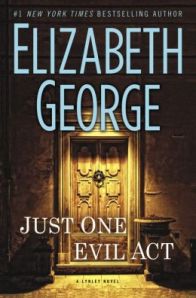
Just One Evil Act by Elizabeth George

evilElizabeth George’s 18th novel starring Detective Inspector Thomas Lynley and Detective Sergeant Barbara Havers of Scotland Yard will be published in mid-October of this year. This series dates back to 1988, and I was introduced to it by my mother; we have both been great fans.

Series readers will of course recognize the two familiar main characters, joined by the likeable Detective Constable Winston Nkata, sundry less sympathetic Scotland Yard superiors, and Barbara’s neighbors, Taymullah Azhar and his daughter Haddiyah. Simon St. James and his wife Deborah, sadly, barely cross the stage in this novel; and of course those readers who have been keeping up with the last 3-4 books in the series will know about the death of Lynley’s wife Helen, whom he is still grieving. As with most series, I think, an integral part of the reader’s enjoyment is in recognizing characters as old friends, and in that sense, it felt good to be back in the company of Lynley – upper class but down-to-earth, flawed and suffering, but trying to make a go of it with a new woman; and Havers – lower class and struggling all around, socially awkward, but devoted to Azhar and Haddiyah.

A brief plot introduction, and then I’ll avoid spoilers as this book is not yet published. Haddiyah’s mother Angelina is back on the scene just long enough to lull Azhar into complacency, and then she takes Haddiyah and runs. Azhar and Barbara together hire a private investigator to try to track the missing daughter, but his rights are limited: he was never listed on her birth certificate, never married her mother, and his paternity is unproven. Then Angelina turns up in Italy with a new beau, distraught that Haddiyah has been kidnapped from her. Naturally, Azhar is a subject; just as naturally, Barbara is committed to proving his innocence and bringing Haddiyah home.

From a thoroughly charming opening scene in which Lynley tries to charm his new girl by showing up at her roller derby match (!), we mostly stick with Barbara, who is at the zenith of her anti-authoritarianism. Consistently poorly-dressed and disrespectful, and usually described by her superiors as unprofessional, she outdoes herself here. While these are central tenets of Barbara’s character, her total flouting of law and order and disregard for keeping her own job in pursuit of Azhar and Haddiyah’s best interests gets a little outrageous. In prior books I felt that her devotion to the job was also an important part of her character; here, not so much. Her single-minded and, yes, stupid behaviors are at best an abrupt turn in her character’s development, and at worst, inconsistent with the Barbara we’ve come to love.

My criticisms continue. There is an utterly unbelievable beating; an unlikely mix-up of victims; and an indictment of prejudice which is nevertheless upheld, thus seeming to discredit the indictment in the first place. What had been a promising long-term relationship between well-loved characters, building in this series through many books, is thrown out the window in a flash – much like the sudden murder of Helen Lynley a few books ago, leading me to suspect that Elizabeth George enjoys wrenching some of her readers’ favorite characters away from them. Perhaps most infuriatingly, a promising beginning to a romance is left unresolved. This may be intended to keep us hanging on edge for the next book. However, all it did was make me mad. I actually, literally threw this book upon finishing it. (You can ask Husband.) I don’t think I’ve done that before. I’m no reader of romance novels, but I do enjoy a good, realistic, even sappy romantic thread in my thrillers or what have you. I have been teased and disappointed here, and I resent it. I had been doubting and hoping against doubt that George would pull this one through when she dropped the budding love affair, and I am now done with her.

Furthermore, I am not the only one to note that George’s books have been getting longer, and this, I believe, is her longest yet. That’s my awesome editor at the above link, noting that Just One Evil Act weighs in a good bit over 2 pounds. Now, page count is not always a problem – I would like to point to Stephen King’s outstanding 11/22/63 at 850 – but here, George could have written this plot up in 400 pages rather than more than 700, and I think it would have been better done. Her sentences, too, are overlong. Again, you know I have no inherent problem with long sentences. Take my word then when I say that George lost track of her editor in this work.

I regret this loss of a long-term love, but I don’t think I’ll be able to follow Havers and Lynley where they next tread.


Rating: 3 rambling plot threads.

The Invention of Murder: How the Victorians Revelled in Death and Detection and Created Modern Crime by Judith Flanders

An exhaustive, engaging examination of how murder and the murder mystery novel infiltrated our modern world by way of 19th-century Britain.

murder

Judith Flanders (A Circle of Sisters) tackles an unwieldy subject in The Invention of Murder, telling the tale admirably well, even entertainingly.

The Victorian British, Flanders tells us, were the first to identify murder as an object of fascination–inspiring in turn a passionate interest in trials, executions, motives and, eventually, the developing profession of solving crimes. The action opens in 1811 with the murdered Marr family, and quickly moves to 1820s Edinburgh, where Burke and Hare infamously killed so they could to sell the corpses to doctors as medical specimens. Flanders introduces a lengthy list of famous (and obscure) murderers and serial killers, culminating, of course, with Jack the Ripper. Alongside the killers and their victims, she presents Thomas Hardy, George Eliot and many contributions by Charles Dickens to illustrate her thesis that murder in life inspired murder in art. Fictional murderers and detectives play a role equal to their real-life counterparts, as Sweeney Todd and Sherlock Holmes take the stage.

Flanders also tracks the evolution of the police force from a force of deterrence to an investigative organization, along with the parallel development of murder and detection in literature and on the stage. The penny-blood (or penny-dreadful), a cheap booklet telling a sordid and often illustrated tale of horror, morphs into the detective novel (and play), as the public shifts its interest from bloody murder to the newly invented and increasingly sympathetic crimesolvers we know and love today.


This review originally ran in the August 2, 2013 issue of Shelf Awareness for Readers. To subscribe, click here, and you’ll receive two issues per week of book reviews and other bookish fun!


Rating: 6 dismembered parts.

Light of the World by James Lee Burke

Dave Robicheaux and Clete Purcel are joined by their daughters as they battle evil in the hills and valleys of Montana.

lightoftheworld
Light of the World, James Lee Burke’s 20th novel starring Louisiana detective Dave Robicheaux, returns to the Montana hill setting of 2008’s Swan Peak. Fans will be thrilled to find Robicheaux and Clete Purcel joined by their respective adult daughters in a hard-hitting, intense battle between good and evil. Burke’s writing is poetic–reverential in praise of natural beauty, contemplative of human nature–and invokes a strong sense of place. Clete, the rough-and-ready, hard-drinking, softhearted private investigator, is lovable as ever; Robicheaux is the flawed hero who has charmed us from the first, fighting his demons and protecting his clan.

Years ago, Dave’s daughter, Alafair, visited serial killer Asa Surette in prison to interview him for a book she never wrote. Instead, she published a condemning series of articles advocating the death penalty. Later, Surette was killed in a collision with a gasoline tanker. So why is he now lurking around the cabins in Big Sky Country where Robicheaux, Clete and their families are trying to relax? The evil in this powerful story of suspense has supernatural undertones, as wolves skulk in the woods above the ranch and planes fall out of the sky. Alafair teams up with Clete’s daughter, the reforming New Orleans hitwoman Gretchen Horowitz, and they make as remarkable a pair as their fathers. As the story unfolds, a rodeo cowboy who speaks in tongues, a serial killer who should be dead, ex-cons, rapists, bear traps and evil that dwells in caves in the hills all come together in perhaps the greatest showdown of Burke’s career.


This review originally ran in the July 30, 2013 issue of Shelf Awareness for Readers. To subscribe, click here, and you’ll receive two issues per week of book reviews and other bookish fun!


Rating: 8 howls.

The Fame Thief by Timothy Hallinan

Timothy Hallinan’s quirky thief/detective (last seen in Little Elvises) is forced to delve into long-past Hollywood scandals by a nonagenarian crime boss.

famethief
The Fame Thief is Timothy Hallinan’s third novel starring Junior Bender, a professional burglar with a second calling as a crook’s detective–because bad guys need their mysteries solved, too. Irwin Dressler, no less powerful a crime boss for his 93 years of age, hires Junior against his will for a strange 60-year-old case, the theft of a Hollywood actress’s most valuable asset: her fame.

Dolores La Marr was a kid from Scranton, scarcely beginning to make it big in 1940s Tinseltown, when her association with that era’s fashionable gangsters landed her in a nasty, full-color scandal. Strangely, no one but Dolly took the fall, and all these decades later, Dressler still wants to find out who set her up. Junior quickly learns that this mystery is not as dead as it seems, and that some dangers only increase with age.

The refreshingly unassuming Junior is a fun riff on the typical private investigator: his specialty–committing crimes, rather than solving them–brings him an unusual perspective. The elderly Dressler is a fabulous, deadpan wiseguy in “eye-agonizing” golf pants, backed up by two unusually domestic versions of the standard muscled goon. And Junior’s own domestic concerns–a teenage daughter, her jokester boyfriend, an ex-wife and a randy new girlfriend–fill out the eccentric, likable cast. Fast-paced action and a building body count pair nicely with humor in this series, bound to keep the reader coming back for more.


This review originally ran in the July 12, 2013 issue of Shelf Awareness for Readers. To subscribe, click here, and you’ll receive two issues per week of book reviews and other bookish fun!


Rating: 6 slow-speed car chases.

Temple Grove by Scott Elliot

A subtle, brooding novel of environmentalism and human complexities set in the Pacific Northwest.

templegrove

In Temple Grove, Scott Elliot (Coiled in the Heart) considers the Olympic Peninsula and its human and nonhuman inhabitants with nuance. A young Native American woman, ambivalent toward her two-month-old son, hikes along a lovely river. Eighteen years later, that son, Paul, hikes back into the woods to engage in what will be called eco-terrorism: spiking trees to discourage their being logged. Simultaneously, a man named Bill returns from a lengthy exile in Alaska, grateful to find work logging in the woods of his homeland. Parallel to these two men–who, like magnets, attract and repel one another–Paul’s mother, Trace, ruminates on her disconnection from her husband and her son.

Paul roams the Olympic forests with his mentor, an aging environmental activist, not entirely aware of why his connection to this place is so strong. Upon his homecoming, Bill remembers (and is disturbed by) past mistakes. The only flaw in this profound and sensitive novel is a potentially upsetting and controversial resolution to one of the plot’s surprises.

Human concerns are embedded within the rhythms of nature, and the traditions of Trace’s Makah tribe resonate within her and her son as in Elliot’s writing. Contemplative, secretive, a novel of the earth, its people and filial relationships, Temple Grove presents a surprisingly broad cast of ordinary men and women representing all walks of life, all sharing the fact of inner conflict.


This review originally ran in the July 9, 2013 issue of Shelf Awareness for Readers. To subscribe, click here, and you’ll receive two issues per week of book reviews and other bookish fun!


Rating: 7 ambivalences.

Maximum Shelf author interview: Koren Zailckas

This interview was published by Shelf Awareness here in an abridged format due to space constraints. This is the full interview.

Following Monday’s review of Mother, Mother, then, here’s the lovely Koren Zailckas!


Koren Zailckas: On Mothers

Koren Zailckas is the author of two memoirs, Smashed and Fury, and lives in New York’s Hudson Valley with her husband and three children. Mother, Mother is her first novel. She recently tweeted: “33 with 3 books and 3 kids. #birthdaysymmetry.”

Where did you get the idea for this distressing mother figure?

korenI really wanted to challenge the cultural assumption that all mothers are inherently selfless. We’re living in an era of baby-bump obsession, in a don’t-speak-badly-of-your-momma culture. Read an Angelina Jolie profile or watch TLC and you’d think women enter delivery rooms as laboring heffalumps and exit as Battista Salvi’s Madonna and Child. But the word “mother” isn’t synonymous with Mother Theresa, and having a child doesn’t make a woman a mom any more than owning a paintbrush makes her Frida Kahlo.

This idea that all mothers are naturally patient, forgiving and self-sacrificing isn’t just sappy-sweet, it’s callous. It’s dangerous. It discounts experiences by those of us who were raised by women whose genetics and early life traumas permanently altered their brains and made them incapable of empathy.

Here’s the sick truth: Some mothers aren’t naturals. I’d always suspected that as a kid, but I learned it for certain when I moved from Brooklyn to the Catskills. Last lambing season, I was in a New Paltz knitting supply shop, surrounded by beautiful, hand-dyed yarn, when the farmer clomped inside in rubber overalls and announced her sad morning. “The ewes gave birth last night,” she said, darkly. “And two of them just weren’t naturals. They left their newborns to freeze to death on the side of the barn.” Some mothers, no matter how well intentioned, just can’t see their kids as anything other than tools, hindrances or extensions of themselves. Other mothers can’t consider their children at all.

Mother, Mother’s Josephine Hurst isn’t just a critical or controlling mom. She’s a narcissistic mother, and she’s in good company. Loads of women–one out of ten Americans, according to new studies–have Narcissistic Personality Disorder, which many shrinks consider untreatable. Medication rarely helps. Therapy doesn’t do much either.

I hope Josephine will give shivers of recognition to anyone out who grew up with a narcissistic mother. I hope those readers will recognize her neediness, her manipulative nature, her grandiose sense of self-importance, her tendency to play favorites between her children and pit her family against one another, and I hope they seek some small comfort in it. Maybe that sounds crazy, but I really mean it. I hope Josephine puts a name–NPD–to longstanding patterns of maternal chaos. I hope some readers have a light-bulb “this is a syndrome!” moment. (You see: also in the narcissistic mother’s repertoire is “gaslighting.” They’re great at making their victims doubt themselves and question what’s real.)

As for those lucky folks who grew up with the mother of Mother’s Day Cards, I hope Mother, Mother gives them at least a glimmer of the fear that resides in the hearts of kids like Will Hurst. As humans, we are born utterly helpless–dependent on our mothers much longer than any other species on Earth. If mothers are our first teachers, then having a narcissistic mother teaches you that the world is a fucking terrifying place, where the rules change constantly and punishment is the only constant.

You wrote two memoirs before this novel. Was this your first try at fiction?

Yep, this was my first attempt at fiction. Mother, Mother brought me back to Smashed in that way. Smashed was my first prose. Before that, I’d only poetry and interoffice memos.

And how was it different?

mother motherFiction required a lot more restraint than memoir. By design, memoir is an exercise in over-sharing. You’re giving the reader way too much information to begin with, confiding things you wouldn’t tell to just the casual stranger while you’re waiting side-by-side for a bus: “Warm today, isn’t it?… Let me tell you about that time I staggered, drunk, lost and naked down the halls of a fraternity.” You wouldn’t do that. No emotionally healthy person would do that.

I think I gravitated to memoir because I had my fair share of damage. I grew up in a family a lot like the Hursts, where you weren’t allowed to express emotion, speak openly, talk about why your mom is a radically different person in public, talk about why Dad lives in another state for weeks and months at a time. You bottle all that stuff up over a long period of time and it eventually just explodes all over some poor, unsuspecting victim, no matter who they are, no matter how briefly you’ve happened to know them. I think, to begin with, I wrote Smashed and Fury because I was suffering from what Zbignew Herbert called “suffocation from formlessness.” I was smothering under the weight of all the memories I hadn’t put into words. When I was finally ready to name those experiences (addiction, anger over ongoing family dysfunction) the stories came out, fast, in reams.

In my memoirs, I’ve always tried to best to be as self-aware as I can. To own my shadows. To be ten-times harder on myself than I am on anyone else in the story. But no matter how you slice it, it’s still exhibitionistic. It’s still a bit like being a trench-coat flasher: “Here I am, all at once! Here are my stories! I know they’re flabby in some parts, but I can’t change them–they’re real!”

Maybe the cheap analogy would be: fiction feels like a strip tease. But it’s more than that. Fiction feels like real intimacy. Especially when it comes to psychological thrillers, suspense stuff. You reveal things slowly to the reader, over the course of your time together. Not every character has to be hyper self-aware all the time, owning every character flaw, aware of their deeper motivations. You can gently fold in a hint, here and there. Teaspoon of backstory. Foreshadowing, to taste.

I still find that really difficult from time to time. My husband’s pet name for me is “Spoiler Alert.” He always tells me I say way too much when I’m making movie or book recommendations. My brother-in-law will never forgive me for ruining the grand finale of The Sopranos for him.

I might well have told you how the Hursts end up in Mother, Mother’s first chapter were it not for my long-suffering editor. She probably has carpal tunnel from all the times she went back to the manuscript to slash out obvious clues.

Did you do research into Asperger’s syndrome in order to get it exactly as right as you got it? Did any other aspects of this novel require research?

I did a little bit of research. But mostly, I manifested Will’s Aspergers in a way I could relate to.

Will’s intense focus, his “Aspie interest,” is language. He’s like a collector of rare and precious objects, and in this case, those objects are unusual and arcane words. Autotonsorialist: one who cuts their own hair. Misodoctakleidist: someone who hates practicing piano. Awkwardness ensues whenever Will uses them in spoken conversation, but he just can’t help himself. He’s addicted.

Over the course of Mother, Mother, I think Will’s relationship to language changes. Words stop being a mode of connection. Instead, they become more like trophies, accolades. He trots them out to impress, intimidate or prove his worth. It’s a really narcissistic use of language. It worsens Will’s social functioning, heightens his loneliness and drives him deeper inside himself.

Aspergers? Maybe. The side effect of a dysfunctional family? Possibly. Or maybe, for Will, it really is a burgeoning writer thing. As a writer, you spend so much time alone, trying to think of funny and fresh ways to describe every day things. Then, when it’s time to go out into public, you forget that you don’t have to agonize over word choices. When you’re chatting about weather with your neighbors at the farm stand, you can just say, “It’s pouring.” People look at you funny when you go all Du Maurier and say, “Can you believe this lashing, pitiless rain?”

Two of your main characters share similar experiences but head in very different directions towards the end. Did they always go that way, or did you have to go along for the ride to learn the fates of your characters?

I think I knew from the first word that Violet and Will had very divergent ideas about their family. Any therapist will tell you, siblings can be raised by the exact same people and still have totally different mothers and fathers.

This is especially true in narcissistic families, where the narcissist picks one kid to be the golden child (the person who earns added prestige for the narcissist) and another to be the scapegoat (the person the narcissist projects her own negative self-image onto).

In the Hurst’s case, I think Will is quite genuine in his confusion over his sister. He doesn’t have any clue why Violet’s so angry. Her drug use, her rebelliousness… It seems really irrational to him, especially with his mother right there in his ear, telling him, “Your sister’s crazy.”

And for her part, Violet doesn’t understand why Will is so fearful and reserved. He seems to have his mother’s unconditional approval. Josephine’s love seems to come so naturally to him.

With that dynamic in place, I think I did go along for the ride. When I began, I didn’t quite know what would happen to Will or Violet.

Will, in particular, shocked the hell out of me. It was kind of thrilling to watch him unfold. Especially because he’s at this very pivotal year. He’s twelve when the book begins and really on the brink of adolescence. A transformation happens. One I never saw coming.

Transformations fascinate me, especially where psychology is concerned. That’s what everyone who’s hooked on psychology wants to know: How does change occur? How do good people turn evil? Or, how do kids grow up?

Can you tell me how there came to be humor in such a very dark book? How would you characterize your style of humor?

I suppose I’ve always had a touch of gallows humor. That self-lacerating, inverted kind. Also, a bit of that bone-dry, stuff-your-feelings, British humor too. (Maybe that’s why I married an Englishman.) Also factor in a little bit of defeatist attitude. I’ve always related to that George Bernard Shaw quote: “If you can’t get rid of the family skeleton, you might as well make it dance.”

I’m glad you think this book is funny. I think it’s really important for dark, scary books to be funny. Every few pages, I really wanted there to be at least a restorative chuckle, something to lighten the mood from jet-black to slate.

I think the biggest laughs in life are usually tinged with relief. They’re a kind of collective, hissing sigh: “Wheew, look at us, joking about this really delicate, uncomfortable, offensive topic! We’re really skating on thin ice here, aren’t we? But it’s fun! Hold my hand. Did that sound like a crack?”

Some of the creepiest ladies in the history of literature are also the funniest. Shirley Jackson is fucking hilarious. I wish she were still around today, if not only so her mommy-memoirs could be optioned for a self-starring reality show. Take Life Among the Savages… Beginning each morning with the very real fear that you will slip on a Matchbox car or doll’s broken arm and break your neck on the stairs is morbidly priceless.

In my experience, once you become a mother everything is doubly terrifying and laughable. It only seems natural to mix the two together. (Although, that could just be the sleep deprivation talking.)

The dual first-person perspectives are very unsettling (in a good way). How did you choose that format?

I think sheer panic drove me to tell the story from two perspectives. When I first started thinking about fiction, many years ago, I told Crown’s Molly Stern, “I’m going to write a first-person, one-perspective novel.” Just like that. All fresh-faced bravado. Molly wasn’t discouraging, but she reminded me just how tricky that is. It’s hard to keep the plot constantly pounding when you have just one protagonist.

Initially, with Mother, Mother, I thought (quite cowardly) that I’d hedge my bets between Will and Violet. I thought: double the characters, double the action. Never a dull moment. From there, it became a much more strategic, much more about how “family,” as a concept, is a bit like “car crash.” Everyone experiences it from a different perspective. So why not let the reader get two points of view on the Hursts?

Since you came from writing memoirs, I wonder how present you are in Mother, Mother. Did you have to fight putting yourself in this book, or was it a relief?

I think there are snippets of myself and my childhood all over this book. That said, the Hursts are a prime example of writing what you know, then taking it to a level that is psycho-extreme.

For instance, I always felt like my mom was a little possessive of me when I was a kid, and I tried to go to friend’s houses as opposed to bringing them home to mine, where my mom talked down to them and slated them behind their backs. I was in my thirties when I got a Facebook message from a woman I used to play with when I was seven. “I was sooo afraid of your mom!” She wrote. “She used to call us brats and hooligans. We were only allowed one juice box no matter how thirsty we were!” I think I sort of exorcised some of that in Mother, Mother, and took it to a scarier extreme. I mean, Josephine homeschools Will because she’s so keen to have him to herself.

I’ve been reading Eric Booth’s The Everyday Work of Art, and he has a great line about how the word “art” in its infancy was a word that meant “to put things together.” And the process of writing Mother, Mother really felt like that. Marrying personal experience to the psychological profile of narcissistic mothers. Piecing together recurring nightmares with irrational fears, Frankenstein-ing in ordinary scenes from a modern, American, family life.

You know, it was a relief. I feel like doctors should prescribe thriller-writing to anyone with anxiety or PTSD. You get to be in charge of your fear. And of course, you get to change the outcome. In real-life dysfunctional families, roles shift, but there’s not much change.

What have you read and loved lately?

This is really the golden age of women’s psychological fiction, and for the past few years I’ve been gobbling up everything by Tana French, Gillian Flynn, Laura Lippman, Megan Abbott, Kelly Braffet. It’s just too exciting to look away.

That said, I have three children under four, so I’ve also have Mo Willems on heavy rotation. That’s my life at the moment: Murder and The Pigeon Finds a Hot Dog.


Don’t you just love how very funny she is? Thanks, Koren, for taking the time to share so much with us. I certainly enjoyed it!


This interview originally ran on June 26, 2013 as a Shelf Awareness special issue. To subscribe, click here, and you’ll receive two issues per week of book reviews and other bookish fun!

Maximum Shelf: Mother, Mother by Koren Zailckas

Maximum Shelf is the weekly Shelf Awareness feature focusing on an upcoming title we love and believe will be a great handselling opportunity for booksellers everywhere. The features are written by our editors and reviewers and the publisher has helped support the issue.

This review was published by Shelf Awareness on June 26, 2013.


mother mother
Mother, Mother opens on a quiet Saturday morning in a small town north of New York City. A young boy wakes up with his mother standing over him, waiting to start their day. He is a little odd–we soon learn he’s been recently diagnosed with Asperger’s syndrome and epilepsy–and his mother seems to be wound a little tight, but she’s also concerned and loving. Next, the perspective shifts to that of his older sister, a rebellious teen who has just been placed in a local mental hospital. The father is cheating. The eldest daughter ran away with a boyfriend several years ago.

These are the perceptions presented in the first few pages of Koren Zailckas’s startling debut novel. Do you believe everything you’ve just read?

As the story of the Hurst family unfolds, the reader will learn to question every “fact” exhibited. The youngest child, Will, and the middle daughter, Violet, continue to trade off the first-person relating of their family drama. One is on the autism spectrum and the other is drug-addled; thus the reader has to parse not one unreliable narrator but two. Will both loves his mother and fears her, and is constantly struggling to determine what exactly it is she wants so that he can please her. He is home-schooled, because of the Asperger’s: Is this the cause or the effect of their unusually close relationship? Josephine, the titular mother, starts off coldly Stepford-like and quickly takes a turn toward chilling. Violet, who has been observing Sallekhana (a form of Jainist ritual starvation), recently took psychedelic morning glory seeds and came home to her family out of her mind, hallucinating and violent. Now Josephine is adamantly opposed to Violet coming home from the hospital, ostensibly because of the threat she poses to her little brother. The absent eldest daughter, Rose, remains ghostlike and disembodied for most of the book. Her past is enigmatic and her current location unknown–but unexpectedly, she writes to Violet in the hospital, after years of silence. And while their father, Douglas, is physically present, he has problems of his own that make him self-centered and ineffectual.

Much of Mother, Mother‘s mystery revolves around the night when Violet, in a haze induced by near starvation coupled with the psychedelic seeds, brandished a knife at her family, harming Will. A drunken Douglas drove her to the psych ward. But as it turns out, neither Will nor Violet has a clear memory of what happened on that night. Then Child Protective Services enters the scene, in the form of a case worker surprisingly sympathetic to Violet. This engages Josephine’s protective instincts, and the reader must struggle alongside CPS to discern the truth about where–or from whom–Will suffered his injuries. From the start, the reader is kept off-balance by Will and Violet’s constantly shifting, conflicting, inconsistent narratives. Josephine’s contributions, which come in dialogue form through Will or Violet’s observations, only serve to muddy the waters. From the start, the reader senses that something is amiss, but will have to puzzle for a time over which of these troubled characters to trust.

As the action unfolds, Violet remains institutionalized, but the details of the night in question begin to reveal themselves. Will and Violet both begin to regain their memories, but they continue to interpret those recollections in very different ways. Even as the source of the true evil begins to become clear, the reader is kept guessing as to everyone’s final fates until the closing pages, and the surprises keep coming until the very end.

Koren Zailckas is the bestselling author of two memoirs, Smashed and Fury. Her first attempt at fiction will not disappoint her fans, as she continues to exhibit a nuanced understanding of psychological drama, combined with a wry tone that brings surprising humor to such an unnerving story. Zailckas reveals and conceals fact and rumor in this complex tale with deliciously deceitful cleverness: readers should beware the seemingly straightforward narrative as told by Will and Violet. Take, for example, Will’s placement on the autistic spectrum. In some ways, it is very apt: his obsession with obscure, little-known vocabulary words will of course charm the booklover; but on the other hand, he is awfully good at reading emotions.

Mother, Mother is unsettling, even frightening, and perhaps what makes its atmosphere so successfully compelling is that it is so very domestic and ordinary. The Hursts not only appear outwardly normal, they may be our role models–the perfect family next door. What Zailckas has accomplished is most disturbing because it is so close to home.


Rating: 7 not-so-loving looks.

Come back tomorrow for my interview with Zailckas!