The Bind by William Goldsmith

This graphic novel celebrates sibling rivalry and the art of bookbinding in a sepia-toned historic London.

the-bind

The illustrations and imagination of William Goldsmith (Vignettes of Ystov) adorn a story of bookbinding and family history with The Bind.

This graphic novel opens in 1912, as the ghost of Garrison Egret tours his family business, Egret Bindings, now run by his sons, Victor and Guy. Garrison is frustrated by the way they’ve “tarted it up,” and by the way Guy overworks himself without taking enough credit while Victor takes too much credit without doing the work. Their latest project will showcase the Egrets’ finest talents, and test both their skills and their relationship; it is a poetry collection called A Moonless Land, jewel-encrusted, hand-tooled with leather inlays and gold leaf. Victor, the high-maintenance artist, pulls out all the stops while business-minded Guy worries about the bottom line. Will “the most expensive book in existence” prove to be too much for the most prestigious bookbinding firm in London?

Goldsmith’s illustrations in black and gray, rust and rose, are understated and beautifully evocative. Characterization is accomplished through detail, like a carnation in Victor’s lapel, and the finer points of Egret Binding’s products. In large format on heavy stock, with bonus foldout panels, The Bind is as impressive a physical object as the Egrets’ great creation–minus the rubies and topazes. This carefully presented ode to the craft of bookbinding is also a story of family dynamics and the dilemma of faithfulness to artistry in a modernizing world: a special treat for booklovers, and a lovely work of art.


This review originally ran in the November 15, 2016 issue of Shelf Awareness for Readers. To subscribe, click here, and you’ll receive two issues per week of book reviews and other bookish news.


Rating: 7 counterfeits.

Brewing Revolution: Pioneering the Craft Beer Movement by Frank Appleton

This personal history of Canada’s craft beer movement, from a distinctive and accomplished participant, amuses as well as instructs.

brewing-revolution

Books on craft beer and the craft beer movement abound, and readers may feel underwhelmed at the prospect of another. But Frank Appleton’s memoir, Brewing Revolution: Pioneering the Craft Beer Movement, is different. For one, his focus is on British Columbia, rather than the much-discussed scene in the United States. And Appleton’s unapologetic, lively personality communicates a story both personal and national, even global, in scope. Brewing Revolution also expands into an impassioned indictment of mass-market adjunct lagers, as well as a manual for the next generation of brewers.

Appleton, a native of Manchester, England, applied his studies in microbiology to food science and later, after immigrating to Vancouver, B.C., to brewing. His science background, appetite for innovation and uncompromising insistence on quality in food and drink led him through an unplanned but inspired career. He began in one of Canada’s “Big Three” brewing conglomerates, where he developed a scorn for adjunct ingredients (or “added junk”) like corn, rice and corn syrup, where traditional, quality brews use only malted grains like barley.

Retiring in frustration to a cabin in the woods, he learns that an article he’d written comparing adjunct lagers with “tasteless white bread and the universal cardboard hamburger,” and calling for a do-it-yourself response, has drawn the attention of an ambitious pub owner. From there, Appleton’s career as a consultant begins. After helping to open the first craft brewery in Canada–which required lobbying for a change in legislation–he consults on the design and launches of dozens of new breweries in Canada, several in the United States and one in France. Along the way, he trains new brewers, invents new equipment and creatively tackles problems in brewing-related architecture, physics, sanitation, welding, human resources and more.

While Appleton is occasionally acerbic in railing against brewing practices and certain former employers, he stops short of bitterness. This distinctive voice may be off-putting for some, but his readers will likely share his disdain for adjuncts and his passion for the details of malt, hops, yeast and water. Enjoying the irreverence of Appleton’s fervent campaigning, craft beer fans will find his character amusing, quirky and sympathetic.

Brewing Revolution tells the story of a country’s craft beer movement and of the author’s life work, but it doesn’t stop there. In his enthusiasm, Appleton can’t help but offer troubleshooting advice for ambitious brewers, and a healthy review of brewing techniques, including the niceties of equipment, yeast cultivation and malting. Humorous asides include Appleton’s dodging of U.S. customs agents and his exasperation with the hired help in Lyon, France. As a history of a movement and a personal memoir brimming with zeal, Brewing Revolution is educational, entertaining and, perhaps most of all, thirst-inducing.


This review originally ran in the November 8, 2016 issue of Shelf Awareness for the Book Trade. To subscribe, click here.


Rating: 7 liters.

Speaking American: How Y’all, Youse, and You Guys Talk: An Illustrated Guide by Josh Katz

Regional linguistic patterns in the U.S. are explained with intelligence, whimsy and visual aids.

speaking american

In December 2013, the New York Times published an online dialect quiz that became the paper’s most-viewed page. Times graphics editor Josh Katz expands that quiz’s contents and the powerful response it elicited with Speaking American: How Y’all, Youse, and You Guys Talk: An Illustrated Guide.

This large-format book organizes United States dialect patterns by subject matter: how we live, what we eat, where we go and more. Two-page color-shaded maps visually communicate regional usages, like the predilection for “rummage sale” in southeastern Wisconsin, over “garage sale” and “yard sale.” Maps and text zoom in for unusual local outliers, like Pittsburgh’s distinctive use of “yins” for the plural “you.” Katz notes the rare case where gender is predictive of usage (women are more likely than men to say “bless you,” or anything at all, when someone sneezes) as well as the “linguistic fault line running from Texas up through Arkansas, then tracking the Ohio River… toward the Mason-Dixon line,” credited to white settlers’ expansion patterns. Besides seriously investigating the questions of sneaker vs. tennis shoe, doodle bug vs. roly-poly, semi vs. 18-wheeler and more, Katz clearly enjoys his subject: especially amusing are the “How to Pretend You’re From…” sections. For Nebraska, you might pick up some “pickles” at the store–not pickled cucumbers, but a form of legal gambling.

Offering some new material since the famous quiz and elucidating the original, Speaking American is a fascinating survey of U.S. dialects as well as a fun, humorous exploration of a nation.


This review originally ran in the November 4, 2016 issue of Shelf Awareness for Readers. To subscribe, click here, and you’ll receive two issues per week of book reviews and other bookish news.


Rating: 8 potato bugs.

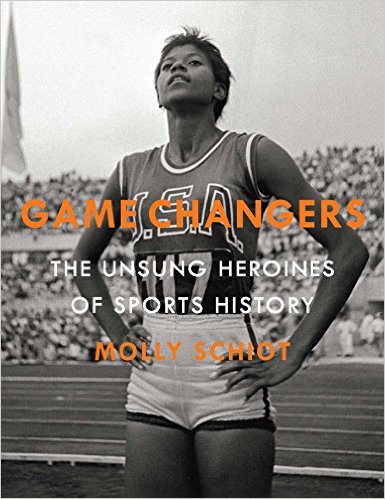
Gamechangers: The Unsung Heroines of Sports History by Molly Schiot

This photographic survey of trailblazing female athletes through history celebrates a diverse range of inspirational talents.

gamechangers

Molly Schiot created the Instagram account @theunsungheroines to celebrate pioneering female athletes the world has scarcely heard of. Game Changers expands that concept: a collection of historic photos Schiot found in libraries and archives, paired with short narratives of a page or less, tell the stories of groundbreaking and little-known female athletes.

The women featured here include some better-known names like Kathrine Switzer, Wilma Rudolph, Billie Jean King and Nadia Comăneci. These are joined by early mountaineer Annie Smith Peck, powerboat racer Betty Cook, judo champion (and mother to Ronda Rousey) AnnMaria De Mars, the “Sea Women” of the Korean island of Jeju and many more: boxers, billiard players, swimmers, skateboarders, players of team sports, Olympians, referees and umpires, sports journalists, coaches and policy makers (for example, the legislators behind Title IX). While women from the United States dominate these pages, every continent is represented except Antarctica. Women of color and those of non-binary genders are given special consideration as well. Among the strange and wonderful, don’t miss the first woman to hike the Appalachian Trail’s entire length in one season: she was 67 years old at the time.

These stories are brief but breathtaking. Not only athletes, these women were often activists and advocates as well as accomplished in business and the arts. Their photographs, naturally, speak volumes on their own. To be read in small pieces or cover-to-cover, Game Changers is an obviously indispensable choice for athletes, fans, parents or anyone else stirred by courage, talent and determination.


This review originally ran in the October 28, 2016 issue of Shelf Awareness for Readers. To subscribe, click here, and you’ll receive two issues per week of book reviews and other bookish news.


Rating: 6 balls.

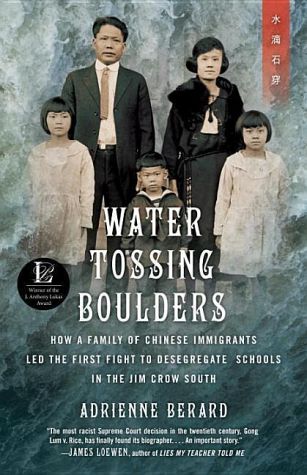
Water Tossing Boulders: How a Family of Chinese Immigrants Led the First Fight to Desegregate Schools in the Jim Crow South by Adrienne Berard

Chinese immigrants to Mississippi challenged school segregation a generation before the famous Brown v. Board of Education case.

water tossing boulders

Thirty years before the Brown v. Board of Education decision made school segregation unconstitutional, a case originated in small-town Mississippi to challenge the same injustices. Journalist Adrienne Berard’s Water Tossing Boulders reveals the little-known experience of the Mississippi Delta Chinese population, including the Lum family, whose two daughters were sent home from the local white school they attended in Rosedale, Miss. The resulting case, Gong Lum v. Rice (1924), made it as far as the United States Supreme Court, but failed.

Berard has done rigorous research, as detailed in her author’s note, and offers a storytelling style with momentum. She expertly evokes her characters. Jeu Gong Lum and his wife, Katherine Wong, were Chinese immigrants who met and married in the Delta; their daughters had divergent personalities, Berda rebellious and Martha an ardent scholar. Their lawyer, Earl Brewer, spent his career fighting for social reforms. Ultimately an anti-lynching campaign would take his attention away from the Lums’ case, perhaps ruinously. Other legal players are profiled, including Supreme Court Justice Louis D. Brandeis and Chief Justice William Howard Taft, who penned the Court’s unanimous decision in favor of segregation. This is the story of the Fourteenth Amendment to the United States Constitution and the tortured arguments of eugenics, racism and segregation as much as it is the story of a family who simply wanted a decent education for their children. Told with precision, sympathy and context, Water Tossing Boulders is a brief but incisive history of great significance.


This review originally ran in the October 28, 2016 issue of Shelf Awareness for Readers. To subscribe, click here, and you’ll receive two issues per week of book reviews and other bookish news.


Rating: 7 children.

Gone ‘Til November: A Journal of Rikers Island by Lil Wayne

Lil Wayne’s prison diary gives a day-to-day account of his time in Rikers Island and a taste of the rapper’s offstage voice.

gone til november

In 2010, Lil Wayne entered New York’s Rikers Island Prison Complex to serve a yearlong sentence for illegal possession of a firearm. The New Orleans rapper was in the midst of a record-breaking career: multiple platinum records, Grammy Awards and financial success. In the eight months he spent in Rikers, Wayne kept a slim journal, published as Gone ‘Til November.

Wayne repeats himself: what he eats day to day varies little (the theme is burritos filled with chicken, rice, noodles, Doritos or Ruffles, beef jerky), and each night he does pushups, prays, reads his Bible and listens to ESPN. This monotony is to be expected in a prison diary, and is broken by the minor dramas of Wayne’s visitors, fellow inmates and the corrections officers he befriends. While the odd mention is made of violence occurring in other wings, the celebrity rapper has a relatively safe experience, plagued mostly by boredom. Entries are undated, requiring close attention to mark the time Wayne was incarcerated, from March through November. His slangy, informal tone shines vibrantly throughout.

A diary in which not much happens may sound less than gripping: this memoir will appeal most to Wayne’s many fans, who will find references to other rappers, future projects and Wayne’s lovers and children. But as an account of daily life in prison and its discontents, and as an exhortation to avoid incarceration, Gone ‘Til November offers a rare perspective for general readers as well.


This review originally ran in the October 25, 2016 issue of Shelf Awareness for Readers. To subscribe, click here, and you’ll receive two issues per week of book reviews and other bookish news.


Rating: 6 burritos.

Upstream: Selected Essays by Mary Oliver

In a collection of prose, a Pulitzer Prize-winning poet ruminates joyfully on art and nature.

upstream

Pulitzer Prize-winning poet Mary Oliver should also be known for her prose: thoughtful, joyful and wise, always sparkling with characteristic energy. Upstream collects previously published essays and one new piece, skillfully grouped to chart a philosophical journey and “felt experience” much like that which she attributes to Walt Whitman.

Oliver revisits her childhood, and early instances of the sense of wonder so integral to her poetry, which she has often found in nature. The essay “My Friend Walt Whitman” speaks of a youthful and persistent literary affinity. Others explore natural places and creatures–spider, puppy, bear, bird–and the pleasures of artistic work. The middle of the collection contains slightly longer pieces of literary criticism–rediscovery of and praise for Edgar Allan Poe, Ralph Waldo Emerson, Whitman and William Wordsworth. Poets and the natural world mingle as Oliver invokes Percy Bysshe Shelley while hunting for turtle eggs. Finally, the previously unpublished essay, “Provincetown,” honors the Massachusetts fishing town where Oliver lived for many years. Brief but redolent, this love letter to a place in the passage of time tends to look backward, as do several of the essays immediately preceding it, so that the collection moves toward retrospection.

Upstream serves as an excellent, accessible introduction to Oliver’s work, and despite its largely previously published contents, will satisfy her fans with its fresh arrangement and feeling of movement. These meditations are evocative, lovely and of course poetic, charming in small pieces and as a whole.


This review originally ran in the October 25, 2016 issue of Shelf Awareness for Readers. To subscribe, click here, and you’ll receive two issues per week of book reviews and other bookish news.


Rating: 8 rumors of total welcome.

A Very English Scandal: Sex, Lies, and a Murder Plot in the Houses of Parliament by John Preston

John Preston energetically recounts extraordinary crimes of British political high society.

very english

Novelist John Preston turns to nonfiction with A Very English Scandal: Sex, Lies and a Murder Plot in the Houses of Parliament. In this thrilling story, a member of Parliament almost gets away with murder.

Jeremy Thorpe was an MP for the Liberal Party in the 1960s and ’70s, became his party’s leader and looked poised to lead a coalition government. His charisma enchanted everyone he met. But he had secrets. When the battle to legalize homosexuality was being fought, Thorpe had affairs with other men, harassed and abused them, and eventually–when one young man wouldn’t go quietly–conspired to have him killed. After years of posturing and payoffs, and a final dramatic scene of attempted murder worthy of fiction, Thorpe faced charges of conspiracy and incitement to murder at London’s Old Bailey.

Preston tells this salacious tale with a mostly straight face. The characters he portrays are often ridiculous: Thorpe’s relentless optimism and self-importance is countered by his victim Norman Scott’s sad struggles with mental illness, and the worshipful devotions of Thorpe’s friend and helper, David Holmes. Preston’s central source, Peter Bessell, is a fellow MP and fervent friend deeply mired in Thorpe’s intrigues. Bessell is perhaps the most vulnerable character in this drama: a bit absurd, but earnest, he is powerless to resist Thorpe’s magnetism. A Very English Scandal is a story of human weaknesses and outrageous spectacle. Preston’s play-by-play will captivate readers of true crime, British upper-crust history and classic tragedy alike.


This review originally ran in the October 25, 2016 issue of Shelf Awareness for Readers. To subscribe, click here, and you’ll receive two issues per week of book reviews and other bookish news.


Rating: 6 letters.

One Life by David Lida

A Mexican national facing the death penalty and the investigator who hopes to save her become hopelessly entwined.

one life

In journalist David Lida’s first novel, One Life, two lives are featured, although only one is apparently threatened.

Richard is a mitigation specialist. A gringo based in Mexico City, he investigates the backgrounds of Mexican nationals accused of capital offenses in the United States, hoping to dig up enough ugliness and trauma for the courts to consider a lesser sentence–like life without parole. Esperanza came to south Louisiana for the rumored bounty of well-paid jobs cleaning up after Hurricane Katrina. She now faces the death penalty for killing her infant daughter. Richard has always maintained walls between the tragedies he studies professionally and his own life; he is expert at enjoying what he thinks of as stolen moments of happiness. But as he learns about Esperanza’s background, living in a dusty village to the rough side of Ciudad Juarez, her stoicism and mystery destroy his detached calm.

One Life‘s perspective shifts between a third-person view of Esperanza’s life and Richard’s first-person voice, speaking from a murky future. The reader therefore knows more than either protagonist, although the novel’s central secret is reserved for the final pages. Neither a mystery nor a thriller, this story is briskly paced but not rushed: there is time for Richard to mull the emotional holes in his own life, and for Esperanza and secondary characters to consider and reconsider their limited options. Poignant and exquisitely detailed, One Life brings nuance and a personal voice to a deeply tragic story.


This review originally ran in the October 21, 2016 issue of Shelf Awareness for Readers. To subscribe, click here, and you’ll receive two issues per week of book reviews and other bookish news.


Rating: 7 cans of Coke.

Bellevue: Three Centuries of Medicine and Mayhem at America’s Most Storied Hospital by David Oshinsky

This fascinating history of New York’s famous public hospital provides a microcosm of national and worldwide medical history.

bellevue

Bellevue is one of the oldest and most famous names in United States hospitals, known for housing violent criminals and mental health patients, the homeless and sufferers of rare and exotic diseases. The incredible, multi-layered history told by David Oshinsky in Bellevue: Three Centuries of Medicine and Mayhem at America’s Most Storied Hospital covers medical and general history both national and global. This thorough narrative is wide-ranging and endlessly gripping.

The institution began in 1736 as an almshouse, where the indigent were housed and given rudimentary medical care. From these earliest days, “Bel-Vue” had a reputation for dealing with society’s unwanted. And as Oshinsky shows, in its many incarnations, this reputation is intact. The flipside is that this public hospital has always attracted service-minded professionals pursuing innovation. Before modern considerations of medical ethics, this often meant experimenting on Bellevue’s impoverished patients and their diverse range of ailments: in exchange for charity medical aid, the thinking went, they offered themselves for clinical trials–as painful and medieval as they could be at times. Nevertheless, the hospital became central over the years in battling the yellow fever epidemic of the 1790s, the “Great Influenza” of the 1910s, the AIDS crisis of the 1980s, the September 11 attacks and Superstorm Sandy. Bellevue would see hospitals shift from being considered a last resort, only for those too poor to afford a private doctor’s home visits, to becoming the best medical care available (the development of anesthesia, germ theory and infection control being crucial).

The hospital has enjoyed affiliations with several medical schools, among the U.S.’s earliest and best, including its continuing relationship with New York University. NYU students get training in a premier teaching hospital that still treats an enormous and diverse patient population, while Bellevue gets talented, passionate residents and interns, many of whom remain and make their careers there. The history of Bellevue reflects social struggles, as women, Jews and African Americans gradually gained access to the medical profession, and anti-immigrant vitriol was aimed in turn at Irish, Italian and Jewish populations, among others, as waves of struggling immigrants contributed to Bellevue’s patient population. Bellevue successfully treated New York’s sole Ebola patient in 2014. Its tenuous funding situation (mostly public, and always under attack), high standards of care and public service mission continue.

Bellevue’s beauty and staggering scope lies in these historic, social and interdisciplinary connections. William Burroughs, Sylvia Plath, Charlie Mingus and Lead Belly passed through Bellevue’s history; its physicians have traveled the world and played roles in the scientific advances that have shaped modern medicine. Bellevue hosted the invention of forensic medicine, and major developments in medical photography, child psychiatry and AIDS treatments. Oshinsky (Pulitzer Prize-winner for Polio: An American Story) generally adheres to an impersonal, journalistic style, but his moving portrayal can’t hide his admiration for this longstanding institution. Bellevue is that rare, page-turning history: engaging, smart, clearly written and of broad general interest.


This review originally ran in the October 14, 2016 issue of Shelf Awareness for the Book Trade. To subscribe, click here.


Rating: 9 five-gallon containers of fuel.