Monday’s Not Coming by Tiffany D. Jackson

This is the story of how my best friend disappeared. How nobody noticed she was gone except me. And how nobody cared until they found her… one year later.

Our narrator is Claudia, who returns home to Washington, D.C. from Georgia (where she spends summers with her grandmother) to enter eighth grade, and finds her best friend Monday has vanished. Monday hasn’t returned Claudia’s letters all summer, and now she can’t track her down by phone or at home. The timeline shifts between a few points before Monday’s disappearance – so that the readers gets to see their friendship – and the time after. Claudia’s first-person narration is heart-breaking: her angst, the drama and despair of teenagerhood, her isolation after losing her only friend (otherwise, social settings like school are not particularly kind to her, at least in her own view), and feels authentically like a fourteen-year-old’s voice. I found it a well-written book in general, with good pacing and tension and a sense of momentum; these 400+ pages flipped easily by.

The story of Monday’s disappearance is a mystery, even though the opening lines (quoted above) foreshadow at least one important element of the final solution. Monday’s Not Coming could fit into a few genres, including amateur detective story, as Claudia searches relentlessly for her friend even when everyone around her encourages her to give up. She begs her parents for help, tries a police detective – even Monday’s older sister tells her to just leave it. The reader slowly becomes aware of some issues Claudia herself faces, which bear on the unique relationship between the two girls – almost a codependence, in fact. Where we come to see that Monday was a strong student, Claudia struggles with her schoolwork, but has an intuitive feeling for color and design; she is a dancer, an artist and a creative thinker. “We lived in our own world,” she recalls, “with our own language and customs. We lived inside a thick, shiny bubble that no needle was sharp enough to pop.” A few reveals keep the plot moving neatly along. I have to say, though, that a final big reveal in the book’s last 50 pages felt like one step too many for this reader. I think it was gripping enough and this may have taken it a hair into the incredible. I don’t think the story needed that final complication.

Back-cover blurbs and promotional copy for this novel point out that its plot is “straight from the headlines,” in which girls of color do indeed disappear with scarcely a ripple in cities like D.C. In this regard, Monday’s Not Coming is firmly rooted in fact. How does a teenaged girl truly vanish without anybody noticing? Well, for one thing, it’s not quite that nobody notices as much as nobody seems to care, which is not less horrifying. It is to Jackson’s credit that the unbelievable is made believable in this narrative (even if I wasn’t a fan of the final wrinkle).

Claudia is a very real and painfully struggling young person, and a compelling narrator; it was an excellent choice to make hers the perspective for this story. Monday is a little bit of a shifting target. We mostly see her, obviously, through Claudia’s eyes, and Claudia comes to doubt her own truth; we are offered an idea that there was another version of Monday than the one Claudia knew (which I think is generally true of humans). Regardless of the ability of a teenaged girl – or any of us – to present multiple faces, Monday is a tragic figure and one we will mourn alongside her best friend. I was disappointed with some of the adults in this story (unavoidably), but they felt real, too. It certainly sheds a light on a very sad real-world issue, as intended. Alongside society’s failings of young women of color, Monday’s Not Coming touches on issues of class, gender representation, sexuality, and various cultural norms. I think it’s a strong choice for discussion groups (classrooms, book clubs) for these reasons.

I really enjoyed reading this one – well, ‘enjoy’ may be the wrong word for such a sad story, but I admired Jackson’s work.


Rating: 7 shades of red.

The People Could Fly: American Black Folktales told by Virginia Hamilton, illus. by Leo and Diane Dillon

I got this title from Well-Read Black Girl, although the cover was familiar enough that I wonder if I had it as a child at some point. (I definitely recognized some of the characters, like Brer Rabbit and the Tar Baby, if not these particular stories.) In a larger format, with a number of rich, grayscale illustrations, it offers a selection of folktales passed down as oral tradition from the Americas’ earliest Black residents: enslaved Africans and their descendants. Virginia Hamilton has done good work in compiling these stories, of course, but an equally important contribution is her brief notes about what each one represents and where it falls in the larger scheme of storytelling traditions in time and geography. (I really appreciated the occasional personal note, too.) She notes the families each story falls into and her choice to use more or less dialect, and the global traditions that contribute to each.

These stories appear in sections, headed by a title story and then grouped by type: animal stories, tales of the supernatural, tales of the real, extravagant, and fanciful, and slave stories of freedom. This last section finishes with the title story, “The People Could Fly,” and I think it’s the right note to end on. The illustrations really did add something – just look at that cover, where I find the facial expressions evocative; I feel like it conveys the movement and inspiration of the title story.

I love the animal stories, which perhaps felt most familiar – not only do I know Brer Rabbit, as mentioned, but these recall Aesop’s fables and many other storytelling traditions. I do love a tall tale, like “Papa John’s Tall Tale.” And I was pleased by the “grisly realism” of “The Two Johns” – just as a matter of personal taste, I suppose. There’s a general sense of rural settings close to nature, that I think comes of the enslaved experience (as Hamilton notes about the animal tales in particular); there’s a feeling common to all folktales and traditional storytelling, of trying to explain the world through stories. There’s something comforting about that effort, even when the resulting explanation is discomfiting.

I enjoyed the stories, but I think what makes this book special is Hamilton’s work, in her footnotes, to put them in context. I especially enjoyed the geography, or the references to global patterns in storytelling – that the opening story, “He Lion, Bruh Bear, and Bruh Rabbit,” for example, “ranges throughout North and South America, Europe, and Africa.” It’s pretty wild to think about how stories can encompass so much of the world: that they are that important and elemental.

With its moving illustrations, excellent and concise footnoting, and its range of fine stories, I think this is an essential book for any home library – for children and adults. Glad I came across it.


Rating: 7 clever rabbits.

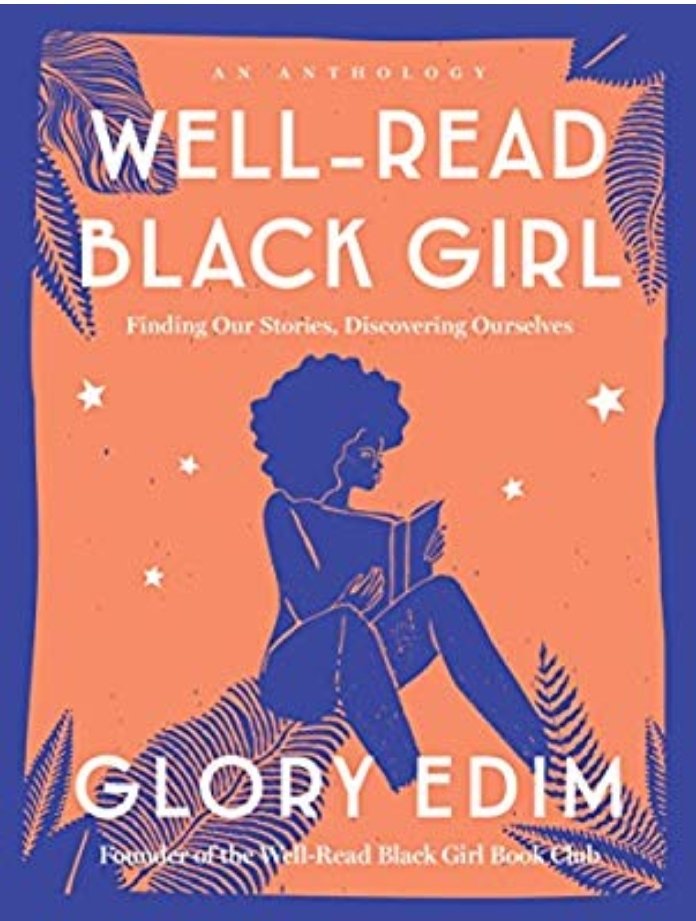
Well-Read Black Girl: Finding Our Stories, Discovering Ourselves, ed. by Glory Edim

This is a lovely collection of a wide range of voices and experiences, refreshing and bracing and joyful and gloriously various. Glory Edim is the founder of the Well-Read Black Girl book club (and later, the same-titled online community and conference), and here she has solicited and collected essays by Black women about their reading lives and the literary voices where they found identity and inspiration. This means lots of different things, and that’s the beauty of this book, I think. I loved that the authors of these essays ranged so wildly, as do their lived and literary experiences and the books and writers that they highlight – I confess, Roald Dahl wasn’t one I’d expected, but aren’t surprises fun? Between essays appear reading lists, naturally: the book club’s selections; classic novels by Black women; books on Black feminism; sci-fi, fantasy, plays, and poetry by Black women; books about Black girlhood and friendship. An appendix also lists all the books in this book. If there’s one thing about readers, we do tend to like a list of books.

The contributors’ list is star-studded: N. K. Jemisin, Rebecca Walker, Jesmyn Ward (), Jacqueline Woodson, Tayari Jones, Lynn Nottage, and many more. Veronica Chambers’ essay “Why I Keep Coming Back to Jamaica” I will definitely be using in my Short Fiction class this spring to discuss representation, what it means and why it matters. Woodson writes, “It’s difficult to be a reader and not be a writer,” and I like that as an encapsulation of the intersection of the two pursuits that I feel helps to define this book. There are no readers without writers and no writers without readers. Jesmyn Ward writes, “I never found the book that allowed me entry, granted me succor in story, and a home after the last page until I wrote my own.” That’s about empowerment, also a key point of this collection. Jemisin writes,

In the future, as in the present, as in the past, black people will build many new worlds.

This is true. I will make it so. And you will help me.

And why haven’t I read any more Jemisin since The City We Became impressed me so much?? (I just checked – there still isn’t a second book in that trilogy. But I now have The Fifth Season coming to me from my local bookstore.)

Much to love here in celebrating Black women as readers and as writers, and recognition of how far we’ve come, never ignoring how far we have yet to go in terms of representation and opportunities. And plenty of fodder for our to-be-read lists. I’m thrilled I found Well-Read Black Girl.


Rating: 8 library books.

Real Life by Brandon Taylor

Real Life centers around Wallace, a biochemistry graduate student in an unnamed Midwestern town. He feels unmoored and isolated despite having a group of “friends” (he’s not sure how true this term really feels) from school; he is one of the only Black people in this town, running from a traumatic past in Alabama. This novel takes place over the course of one weekend, when Wallace (who is gay) hooks up with one of his male friends (who insists he is straight), and tries to navigate this intrusion into his closely protected personal sphere alongside micro- and macroaggressions at work and among the friend group. The title refers to Wallace’s persistent worry that what he is living is somehow not “real life”; he is considering leaving graduate school but doesn’t know where to turn instead.

What gazes up out of the lapping black sea of his anger? What strange dark stones make themselves known to him?

It is a book of few joys, certainly. Rather, Wallace and his friends experiences large and small traumas and frustrations, hurting themselves and each other. It is a book of beauty, though, in its precise, quietly evocative writing and close observations. As Wallace carefully watches the miniscule creatures he breeds and destroys in the university lab, he likewise tracks the moves, desires and motivations of the people around him, from whom he feels removed. His tennis partner has just discovered that his boyfriend is on “that gay app” and may be cheating on him. A female friend is on the rocks with her Tolstoy-studying boyfriend. His colleagues are generally toxic, mildly if not overtly racist, except for the one woman of color, who is horrified that Wallace would consider leaving her there alone.

Gifted is the sweetness meant to make the bitterness of failure palatable–that a person can fail again and again, but it’s all right, because they’re gifted, they’re worth something. That’s what it all tracks back to, isn’t it, Wallace thinks. That if the world has made up its mind about what you have to offer, if the world has decided it wants you, needs you, then it doesn’t matter how many times you mess up. What Wallace wants to know is where the limit is. When is it no longer forgivable to be so terrible? When does the time come when you’ve got to deliver on your gifts?

A friend-of-friends is blatantly racist, and none of the group (all white) will speak up to even the most obviously offensive comments. We get the sense that Wallace would happily quit this scene if he could identify another option in the world.

The most unfair part of it, Wallace thinks, is that when you tell white people that something is racist, they hold it up to the light and try to discern if you are telling the truth. As if they can tell by the grain if something is racist or not, and they always trust their own judgment. It’s unfair because white people have a vested interest in underestimating racism, its amount, its intensity, its shape, its effects. They are the fox in the henhouse.

These characters are compelling and memorable, and the writing is indisputably fine. If there is a final takeaway, perhaps it is that this is real life – all of life is – and that we are all more or less miserable, whether quietly or demonstrably. It’s an admirable book but not a pleasurable one.


Rating: 7 nematodes.

Yolk by Mary H. K. Choi 

This review from Shelf Awareness prompted me to buy and read this book, and it delivered. I felt fully involved and invested in the lives of Jayne and June Baek, Korean-American sisters born in Seoul and raised in San Antonio, Texas, now living as young adults in New York City. They haven’t been close for years, and now Jayne (our first-person narrator) avoids her sister’s phone calls as she does their mother’s, until June tracks her down on a disastrous third-wheel date and demands they meet. June is very sick. Outwardly, Jayne is the sister with more obvious problems – self-loathing, squalor, harmful sexual practices, generally low functioning as an adult (and some more serious issues that are only gradually revealed). Now that they are sharing increasing challenges, the estranged sisters might just come together again.

As an only child, I have always been fascinated by siblings, whose various dynamics I can only watch from outside, generally with jealousy. One of my favorite things about this novel is its intimate, insider look at the sisters’ relationship, which is troubled (but aren’t they all), love and dislike intertwined with violence and yearning. One of Yolk‘s great strengths overall is immediacy and intimacy, how close we feel to Jayne, in all her messes and flaws. I also really appreciated the writing about place. New York feels right to me, but what do I know; brief sojourns home to San Antonio I am in a better position to judge, and I think Choi (who shares geographical background with her characters) gets it just right. The humid night air and the big skies make me a little homesick, too. The tone of young twenty-somethings dealing with all the madness of life feels pitch-perfect.

Choi includes a brief note at the book’s beginning about some difficult subject matter, acknowledging that she shares some of Jayne’s difficulties and that “for those struggling with body image and food, this story might be emotionally expensive for you.” I had to pause at that phrase, emotionally expensive: I like it. “Sensitivity is a superpower,” Choi instructs us. It is not a novel with an overt message, but I appreciated this one.

I also need to note the loveliness of this hardback book as a physical object: I love the design, the dust jacket, what’s under the dust jacket, and the print on the edges of the pages that continues the image on both dust cover and hardcover. It’s a beautiful piece that feels good in the hand and I’m glad to own it.

Sensitive, funny, raw and often painful – I worried a little early on that I’d taken on something sadder than I needed at this time. But Yolk is a beautiful book about love and hope, too, and with a thread of unlikely romance to it as well. I found it delightful and do recommend.


Rating: 8 glasses of water.

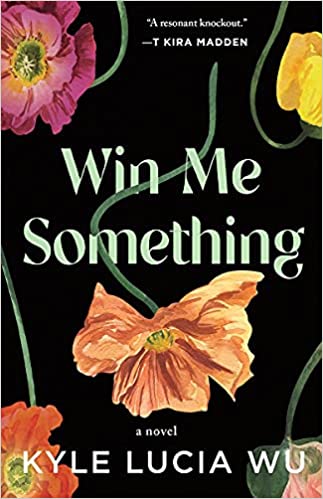
Win Me Something by Kyle Lucia Wu

A young woman must chart her own way, even while quietly craving belonging and home, in this subtle, wise debut.

Kyle Lucia Wu’s first novel, Win Me Something, is a wrenching evocation of yearning in a slim, artful package. The story of Willa Chen, a young woman unmoored in New York City, is defined by liminal spaces and a wish to belong.

In the opening pages, Willa interviews to become a nanny to a wealthy family in Tribeca, even though she can’t quite conceive of what a nanny does. “Maybe I couldn’t imagine these moments because when someone asked about my childhood, my mind clenched and closed like two fists in a pool–fingers squeezing for something to come up with when everything around them was a different kind of matter.”

Willa’s father is a Chinese American immigrant whom she barely knows, her mother a blonde-haired white woman, detached and depressed, who can’t comprehend the microaggressions her daughter faces. Since their divorce when Willa was very young, each has begun a new family, and she feels she belongs to neither. Thus adrift, she enters the Adriens’ household, where she cares for the charming, innocently privileged, nine-year-old Bijou, who studies Mandarin and the violin and cooks coq au vin. Willa feels as unbelonging as ever, but also entranced by the family’s ease, their wealth, their things. “When I looked around their apartment, my veins filled with rushes of want, as if I could see the price tags on everything, as if they would increase my own value.” It’s not that Willa is materialistic, but that she is drawn to the idea of worth suggested by those around her: “I often found myself in friendships with people like this, self-absorbed and sparkling.”

Readers will be engrossed by Willa’s troubled desire to please and her pervasive unease, as she seeks and then deflects the slightest attempt at connection. As she begins to meld into the Adriens’ household, she reconsiders her own childhood and family homes in a series of flashbacks. The subtle racism she encounters is but one thread of Willa’s distress; her estrangement from both of her half-families, and her half-hearted attempts to join the Adriens’, presents a greater challenge on its face, but also stands in for the larger estrangement she feels everywhere she goes, as the in-between spaces of family and race in culture echo each other.

With an eye for just the right detail, Wu offers an understated protagonist, self-defeating but still searching. Win Me Something is a nuanced story of longing, of the paired desires to belong and to strike one’s own path. Willa is a quiet heroine, but unforgettable.


This review originally ran in the September 28, 2021 issue of Shelf Awareness for the Book Trade. To subscribe, click here.


Rating: 7 dresses.

Maximum Shelf: Olga Dies Dreaming by Xochitl Gonzalez

Maximum Shelf is the weekly Shelf Awareness feature focusing on an upcoming title we love and believe will be a great handselling opportunity for booksellers everywhere. The features are written by our editors and reviewers and the publisher has helped support the issue.

This review was published by Shelf Awareness on September 15, 2021.


Xochitl Gonzalez’s Olga Dies Dreaming is a scintillating, eye-opening story of family, legacies, and political and individual struggles, set in contemporary New York City and Puerto Rico. Readers will be entirely captured by Olga and her family, friends and associates as this spellbinding narrative twists, turns and unfolds over the years and miles. Gonzalez’s stunning first novel feels far more expansive than its not-quite-400 pages.

Olga Isabel Acevedo, Brooklyn-born child of Puerto Rican parents, is an ambitious, status-conscious wedding planner to New York City’s upper echelon. “Using a traditional American metric for measuring success,” she is winning: she left the family home for a fancy New England college, has her own business and enjoys a certain amount of fame via glossy magazine and television appearances. She has a large, close-knit family still based in Brooklyn’s Sunset Park, but with several holes in it: her loving and beloved father, once a proud political activist and member of the Young Lords, now dead from drug addiction and AIDS; her late grandmother who raised her; and most troublingly, Olga’s mother, Blanca, a militant radical who left the family when Olga was not quite 13. “Achieving liberation will require sacrifice,” Blanca wrote to her young daughter. Olga’s involuntary sacrifice in service of Puerto Rican liberation was to give up her mother to the cause.

Crucially, Olga still has her older brother, Prieto, with whom she is very close. If Olga is a star as wedding planner to Manhattan’s upper crust, Prieto is a supernova, the handsome, popular young congressman representing their neighborhood in Washington: “He wasn’t quite code-switching so much as he managed, miraculously, to speak several languages simultaneously, creating a linguistic creole of hip-hop, academia, contemporary slang and high-level policy points that made Olga marvel…. Olga herself had never learned this linguistic mezcla that her brother had perfected; this ability to be all facets of herself at once. She always had to choose which Olga she would be in any given situation, in any given moment.”

However well her career is going, Olga feels a void. Blanca writes to her frequently (via go-betweens, from an undisclosed location) to excoriate Olga for pursuing the meaningless, superficial goals of white society rather than working toward liberation for la raza. Prieto, apparently fighting the good fight (if only, their mother writes to him in turn, from inside a broken system), has his own demons and secrets as well.

The plot of Olga Dies Dreaming sees several delicate balances begin to upset. Olga’s surface-level achievements show cracks as she questions what she’s actually working toward. She meets a man she may truly like, which exposes a weakness: her people skills, so polished at work, don’t hold up to a situation with real stakes. Prieto’s carefully maintained façade falters, one of his secret insecurities threatened. When Puerto Rico is gutted by the one-two punch of Hurricanes Irma and then Maria, Olga takes a few hits herself. Can she navigate a romantic relationship? Will her brother withstand the latest storm in his private life–and is their bond up to the challenge? Perhaps most significantly: what does Olga have to gain–or lose–if her long-absent mother chooses these turbulent times to make a reappearance?

The masterful Olga Dies Dreaming roams far and wide, encompassing the most obnoxiously petty, overindulged weddings of the 1% and the dire straits of rural Puerto Ricans lacking clean drinking water, food or electricity. Such range could get unwieldy in less capable hands, but Gonzalez has a firm grasp of her plot threads. With lively, clever prose and adept political commentary, this novel asks questions about race and assimilation, about government corruption and capitalism, about gentrification and family duty. Olga, Prieto, their aunts and uncles and cousins, Olga’s work associates, casual sexual partners and her new bae: likeable, appalling and everything in between, these characters sparkle with authentic detail. While this is Olga’s story, the point of view does sometimes shift to offer Prieto’s perspective and a few others. Readers (uncomfortably) get inside the head of a deeply unpleasant man of great privilege, for example–aptly named Dick–as well as that of our heroine. Gonzalez is also expert with setting, as her novel travels from the peculiarly organized hoarder apartment of Olga’s love interest to an impressively high-tech rebel compound in the Puerto Rican jungle, an opulent Easthampton beach house and more.

From Blanca’s mysterious and blistering missives come political and ideological rhetoric and intellectual challenges. Olga was named for Olga Garriga, activist for Puerto Rican nationalism, but also hanging over her is the story of Olga from poet Pedro Pietri’s “Puerto Rican Obituary,” who “died waiting dreaming and hating.” These are the extreme options she’s been offered: Blanca’s rigid revolutionary ideal or the unattainable, swank American dream. Instead, in the end, Olga must chart her own path to a third option, one where she might finally find peace.

This novel positively glitters with truth, wit, humor, pathos, trauma, love and pain. Gonzalez’s narrative operates with consummate skill on the level of the individual, the family and the political system. There is much to learn and ponder here about colonialism, corruption and policy. And on a more personal level, Olga casts a spell that will linger with readers long after these pages are closed. Olga Dies Dreaming is simply unforgettable.


Rating: 10 songs.

Come back Monday for my interview with Gonzalez.

I’m Possible: A Story of Survival, a Tuba, and the Small Miracle of a Big Dream by Richard Antoine White

After a childhood of homelessness and few options, the narrator of this rousing memoir becomes a professional orchestra musician and an inspiration.

Richard Antoine White’s memoir I’m Possible: A Story of Survival, a Tuba, and the Small Miracle of a Big Dream begins onstage, with a professional orchestra performance facing “the plumage of red seats,” then flashes back to the narrator’s childhood, homeless on the streets of the Sandtown neighborhood in Baltimore, Md. The tension between these two scenes outlines his story. White is the first African American to earn a doctorate of music in tuba performance; his family and community background has included addiction, violence, poverty, instability and racism. In his prologue, he sets the upbeat tone he’ll hold throughout this memoir. “I want you to read this story and feel like you are a superhero,” he writes. “I am possible. You are possible. Everything is possible.”

White recounts how he survived his mother’s addiction, childhood homelessness, unforgiving Baltimore winters and much more. He was lucky to find family in more senses than the biological, and lucky to find the trumpet (in fourth grade) and, later, the tuba. He journey takes him from Sandtown to the suburbs to the Baltimore School for the Arts, then to the Peabody Institute at Johns Hopkins, graduate school at Indiana University and eventually the New Mexico Symphony Orchestra. He enjoys strong friendships and excellent mentorships, and becomes a hard worker. Music is an escape, “a light going on in the dark. Like seeing a star for the first time.”

White writes passionately about his studies and relationships, his tone disarmingly direct, with flashes of lyric brilliance: “The look on her face was flint and it struck against the steel in me and sparked.” I’m Possible is both a life story and a series of character sketches; White conveys his love for his biological mother and then for the couple who raised him, whom he calls Mom and Dad, and his many friends, mentors and students shine as well. (Look for a cameo by “a skinny upperclassman with a raspy voice named Tupac Shakur, who schooled me.”) White’s message is tirelessly uplifting: he is no genius, he insists, “although I do possess a profound belief in what is possible and a deep gratitude for how I came to be here,” and he reliably credits those who helped him along the way.

This is a story of perseverance, hard work and a little luck; of love of music and the importance of community and both built and biological families. White also comments throughout on the role of racism in his experience and in that of so many in the United States. His casual, earnest storytelling style beautifully suits this moving narrative, and admirably achieves a tone that is stirring but not saccharine. Readers will find his account touching and inspirational.


This review originally ran in the September 7, 2021 issue of Shelf Awareness for the Book Trade. To subscribe, click here.


Rating: 7 Cup Noodles.

movie: Summer of Soul (2021)

I got to see this back at the Pickford in Bellingham with my parents, and it was a real treat.

All the voices I’ve been hearing about this movie, from friends and from reviews, have been unanimous, and I’m in agreement: this is a very special film, from a few angles. Summer of Soul is a documentary mining archival footage, never before seen, from 1969’s Harlem Cultural Festival. Never heard of it? That’s not surprising. The footage sat in storage for some 50 years; the same summer, Woodstock stole the spotlight, and this historic event (or events – the festival took place over six weekends) faded away like so much Black American history has. It’s thanks to Questlove, of the Roots, director of this film, that we’re learning about it now. The festival showcased jazz, funk, gospel, blues and soul, via names like Stevie Wonder, BB King, Mavis Staples, Gladys Knight, Mahalia Jackson, Sly and the Family Stone, Fifth Dimension, and many more. These performers played to tens of thousands in Harlem each weekend (an estimated 300,000 total). Here we see original footage spliced with recent interviews with performers and audience members, and other historical footage for context, so that the music is set against the Vietnam War, the civil rights movement, the moon landing, the assassinations of the 1960s, and more.

The festival footage is entrancing, and the music is transcendent, and if the film had stuck to that content, it would have been worth seeing. But including the historical context lifts it up several levels, making it not only a joy to see but Important. The context is a little harder to watch – it’s serious, especially because it highlights how far we haven’t come. But the music remains an absolute joy, too. If there are moments that might make you cry (Jesse Jackson recounting Martin Luther King, Jr.’s final moments to the crowd), the footage of the sublime musical performances rarely failed to make me smile wide, as the crowd did – I loved those shots of so many joyful people of all ages and appearances. Many of those interviewed, both musicians and audience, commented on how significant it was to look out at a crowd of that many Black people gathered together. (There were non-Black attendees, but very few.) I guess I was a little surprised that Harlemites would feel that way; but the gathering itself was unprecedented, wasn’t it. This felt like an important point, especially because so many mentioned it.

Depending on age and background, some viewers will find this film very educational; even those familiar with the time, place and milieu will find something enlightening, and the music is sure to blow every mind. It sent me out of that theatre feeling more full and nourished than I went in. It also comments on ever-relevant parts of our ongoing history as a nation. Very strongly recommended, for music fans and for us all.


Rating: 9 smiling faces.

Valentine by Elizabeth Wetmore (audio)

This audiobook, also part of my cross-country travels, was a birthday gift from my mom. Thanks, Mom!

Valentine is a powerful novel. It’s set in Odessa, Texas in 1976: a central West Texas oil town in a harsh environment filled with hard-edged, struggling people. The setting is definitely part of the appeal, as I know Odessa a little and its region a little better, and Elizabeth Wetmore’s striking writing about place I found very affecting and authentic. Mostly, this place comes across as rough, stark, unbeautiful; but a close read will reveal appreciation for the natural world and the people who find something to love in it. These characters are really well done, too. Chapters shift between the points of view of a number of them, with a firmer focus on three or four. All are women: men are only viewed through their eyes. As a woman, in a world of books historically over-focused on men, I appreciated this, too.

Let me get in a content warning before we go too much further: the event the book opens with, which is also the event that the entire narrative centers around, is a brutal and violent rape. It’s described in what I’d call moderate detail, which is plenty disturbing. Readers for whom this may present a problem should avoid the whole thing.

This rape and its aftermath affects all our characters in various ways. Even those who are initially unsympathetic become three-dimensional and complicated when they get their own chapters, in that way that I love: all people are complex, no one all good or bad, no perfect heroes or villains. I love a complication like nothing else. There is even a brief – failed – attempt to understand the perpetrator of the rape; that impulse and its failure both feel real and right to me.

Gloria, or Glory, Ramirez rightfully opens and closes the book. Fourteen years old, the US-born child of an undocumented Mexican immigrant mother, Glory’s life brings race and racism into the story. Valentine is centrally concerned with women’s lives and violence against women, but this layer is important and (of course) related. Then there is Mary Rose Whitehead, young mother of a young daughter, drawn into Glory’s life by circumstance. She rebels against many of the structures of the world around her, in ways that we applaud, but this is no fairy tale, so she will not necessarily triumph. Next comes Corrine Shepard, an older woman, recently widowed and handling her grief with booze, cigarettes and not giving two sh*ts what you think about any of it, which serves her well, to a point. I think of these three women as the core, although there are probably other interpretations – I haven’t counted chapters. Again, there are others who get less spotlight but make important contributions: I’m thinking of the bartender/babysitter/waitress we get to hear from near the very end.

This book covers so much. Race and racism and immigration, women’s lives and violence against women, economics patterns and the dire straits it puts all kinds of people in; the cultural and ecological milieu of a particular place, in a particular time, including what it looks like for an oil boom to hit a town like Odessa, which my friends who live in the region today tell me about: it sounds like it looks awfully the same after more than 40 years. Valentine‘s contents contain a lot of ugliness, brutality, violence, hate, tragedy: beware. But it’s also a beautifully rendered novel. And I appreciate its glimpses of beauty even in Odessa in 1976. It’s masterful, in other words. I’m very impressed, and I’ll be thinking about these characters for a long time.

Thanks again, Mom. Good pick.


Rating: 8 pistols in purses.