Homegoing by Yaa Gyasi

I’ve had this one on my list(s) for a while now, but as it increasingly appeared in credits from books I enjoyed – as inspiration, as research, as most admired – I knew I needed to get to it sooner. Homegoing deserves the accolades. It’s both expansive and easy to read, in how beautifully it flows – although the subject matter is not generally easy.

There’s a helpful family tree in the front matter, as in These Ghosts are Family (which is one that refers to this book in an interview with the author at the end). This lets readers track the connections as we move through generations. Each chapter is titled for the character it focuses on, and each character appears in the family tree; they are featured chronologically across centuries. At the head of this tree is a woman called Maame who lived in what is now Ghana in the mid-1700s. We slowly learn that she had two husbands and two daughters at two different points in her life in Fante and Asante territories respectively. The daughters, Esi and Effia, did not know about each other, and their lives led in different directions. Near the novel’s beginning they are found under the same roof but in very different circumstances: one as the wife of a white British slaver, the other imprisoned in the dungeon underground. One is able to stay in her home region (Gold Coast as a British colony), while the other is kidnapped and carried across an ocean to become a slave in America. Later chapters follow their descendants until more or less contemporary times – everyone on the family tree gets a focus chapter except for Maame herself, whose story we learn only in pieces. These lives are filled with color and detail and struggle and pain, and love and music and beauty; in every iteration they continue to witness racism, colorism and the enduring legacies of slavery and colonialism, in different ways. I of course failed to mark the quotation that said so eloquently how the same prejudices were ongoing but in subtler and more insidious ways in later times than they had been in slavery’s heyday.

Homegoing is a beautiful, absorbing novel. Every one of the featured lives is so finely wrought, I spent at least half the book lost in each of them individually; it took me most of the book to begin anticipating their connections, although I was aware of those connections all along. They are all filled with such detail and richness, but it is possible that earlier chapters stand alone more securely than later ones. Some readers call this a novel in connected stories, and I do feel that each character’s story is a whole work in itself. But there’s no question in my mind that it is more novel than collection.

Aside from realistic portrayals of lives across a remarkable span of years and locations, Gyasi also offers threads of something mythic or otherworldly: there are persistent suggestions that this family may be cursed by ill luck and fire, and its members may have a special gift of foresight. Indeed, some coincidences are difficult to explain. On the more real-world side, Homegoing is very much about the legacy of slavery from African roots to American “improvement” of the system. It has big thoughts and observations to make while still being first a story about individual people.

The New Yorker is rather harder on this book in Laura Miller’s review, and I confess that she has some points, particularly about typing in the American characters versus the African ones. The larger impression I walk away with is much more positive than Miller’s seems to have been. But I am entirely on board with her optimism about Gyasi’s future work.


Rating: 9 cocoa nuts.

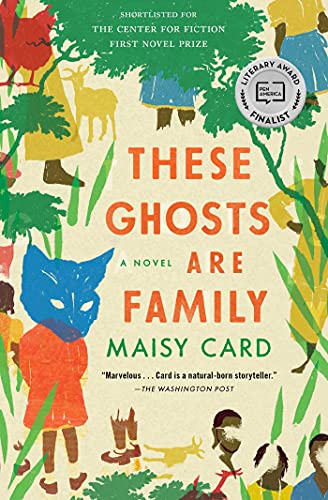
These Ghosts Are Family by Maisie Card

This was a fascinating journey. These Ghosts Are Family follows a family for generations, from slavery in Jamaica, through emancipation and decades of struggle with old class systems, immigration to London and New York, through permutations of relations, including a fresh start with a new identity (or, if you like, identity theft). The timeline jumps around and the focus and point of view shift, so that readers see this extended family at different times and from different perspectives. Issues of class, race and colorism and the relationships between privileged and less privileged classes, including but not limited to enslavement, will be obvious themes; we know that rape and issues of gender arise under these conditions too. The characters are infinitely fascinating. I was not so much expecting the question of supernatural elements: duppies or ghosts and Ol’ Hige, “a Caribbean version of a vampire story.” By the book’s end, I was left reeling with all the possibilities. There is plenty of heaviness: children abused, spouses failing to see eye to eye, parents and children letting each other down. But there are some quietly loving relationships scattered throughout. As I close the final pages, I’m a bit at a loss because there’s so much to consider. (And because we ended with a decidedly weird trio of spooky vampire children living in the woods.)

The book begins with a family tree, which I did refer to throughout. It presented me with a confusion that was answered on the first page. I’m going to spoil that one here because, again, first page of the novel (and it’s also given away on the back of the book and in most blurbs): the aged Stanford Solomon reveals, on his deathbed, that in fact he is (or was) also Abel Paisley, presumed dead some thirty-five years ago, at which point he took the identity of his friend Stanford. “Stanford” has both a wife and daughter and another daughter out of wedlock, all in New York; Abel left behind a wife and two children in Jamaica when he supposedly died. Stanford/Abel’s revelation obviously affects those around him. But I’m going to diverge from the blurbs here, and say that this is not the event around which the book revolves, and by its end, Stanford is by no means the central character. Rather, he is one branch on the family tree that is the book’s center. He’s just one link, and I don’t think he earns the role the blurb says he plays. Rather, I find the book more about larger patterns – slavery, class and race and colorism following slavery, migration and immigration, gender roles, the persistent damages of all these institutions and systems, trauma, and family dynamics. It’s about the multiple generations of this single family, for sure, but their combined story is very much about those larger patterns and systems. There’s nothing preachy or intentional-feeling about this, but the Paisley/Stanford family is inextricable from larger issues. I put Stanford/Abel at its center only in that he opens the book and occurs at the more-or-less center of the family tree as we find it here. The book ends somewhere very different, and that feels right.

In between, the story is told by numerous voices spanning some 200 years. That multiplicity of voices was a great choice for this story. (I have just said the same about a brilliant novel whose review is still forthcoming: Lookout by Christine Byl.) I love the kaleidoscopic or triangulated perspective on events offered by the different views. And for a novel whose focus is so broad – generations of a family across continents, countries, and centuries – it makes sense to move around like this. I guess such a big story told by one voice (with some kind of time-traveling power, I suppose) would be a different kind of accomplishment, and I can imagine it done beautifully, but Card’s choice feels just perfect here. The multiple voices also allow her to give us different dialects, which add to the texture and richness of the whole.

This adventure into these varied lives is expertly done, not always comfortable because of the subject matter, but engrossing and well worth the immersive experience. Card is a talent.


Rating: 7 names.

The Ballad of Black Tom by Victor LaValle

People who move to New York always make the same mistake… They come looking for magic, whether evil or good, and nothing will convince them it isn’t here.

The year is 1924, and Charles Thomas Tester wouldn’t call himself a con man; he thinks of himself as an entertainer. He’s not much of a musician, unlike his beloved father, but he knows how to put on the right look and scrape a living where he can. It helps to leave Harlem, where he supports his father and himself in a tenement apartment, and travel to the likes of Red Hook and Flushing. There’s risk there for a Black man, but more to be gained, too. Charles plays off wealthier New Yorkers’ search for magic–until he gets into more than he’d bargained for. In Flatbush he meets a wealthy eccentric named Robert Suydam with ideas about how to change the world. An anxious, sensitive police detective and a burly bully of a private investigator are on the tail of the unlikely allies, Charles and Suydam; between them they will certainly change the shape of the world, in unexpected ways.

The Ballad of Black Tom has magic and race and racism and wishes and love and violence and simple street entertainers’ illusions. There are characters from different walks of life – I love the varieties of ethnic foods available in the Victoria Society. Charles Thomas Tester is both a straightforwardly relatable character – loves his father, just wants a little financial wiggle room – and a dangerous enigma. This book is short, but it casts a spell. Victor LaValle continues to intrigue me. Recall that I loved one book of his and couldn’t finish the next. This one is compelling. I have The Devil in Silver waiting on my shelf. We shall see.

Meanwhile, Black Tom will keep me thinking for a while – not least with its final prophecy.


Rating: 7 pages.

Gone Missing in Harlem by Karla FC Holloway

This one’s a bit genre-defying. I really enjoyed it. Gone Missing in Harlem looked like a mystery at its outset, but it turned out to be broader than that. Historical fiction, clearly: it’s set in Harlem during the Great Depression, with flashbacks to Carolina (North or South, I’m not sure we ever know), highlighting the Great Migration of Black Americans from the rural South to northern cities. It handles mental health issues in several threads, and the challenges of parenting through traumas and breaking cycles. It ranges widely.

We see the title event in the very first chapter. A young mother, Selma, parks her pram just outside a grocery for a very short time while she pays for some apples; when she comes out, it is discovered that her baby is gone. An uproar immediately ensues. Harlem’s residents are horrified, excited, titillated, and incensed at the lackluster response from the police department: the city is still reeling from the disappearance and death of the Lindbergh baby, and Harlem can easily see the difference in how a poor baby from their community is treated. We do have the city’s first Black policeman on the job (and with a fresh Black cadet in tow), and he is both clever and committed. But weeks and months pass, and Selma’s baby Chloe is not recovered.

One of the things I loved best about this book was the constant shifting of perspective. While I’m fairly certain we never get a first-person point of view, chapters switch focuses in close third person perspectives between a large number of characters: Selma; the police officer; Selma’s brother Percy (aka June Bug); their mother (a central figure), DeLilah, aka Lilah, Mama Lil, or Mrs. Mosby; several members of the wealthy white family Lilah works for; the social-climbing Black woman she works for later; a neighbor down the hall; and others. (The policeman and his apprentice form a delightful Holmes-and-Watson pair – indeed with reference to their famous counterparts – and appreciate libraries, librarians and book research most pleasingly.) This multiplicity of perspectives enriches the narrative like nothing else might have, and help take this story from the (deceptively simple) mystery it might have been to a whole complex tapestry of questions, in the best way. Class is arguably as important as race, and race is complicated by colorism. Several generations address the difficulties of parenting; the complexities of love, fear, and aspiration; and the importance of making a plan. As for that deceptively simple mystery, there is a big surprise near the novel’s end that had me entirely, literally slack-jawed. I did stumble upon a handful of grammatical errors that I wish had been caught in editing, but that’s a small issue (and likely only for a few readers). I’m very impressed at the absorbing story, the wealth of those multiple POVs, and the tender handling of a broad range of issues.


Rating: 7 needles.

The Last Karankawas by Kimberly Garza

Another very fine one on Liz‘s recommendation.

The Last Karankawas has a lot going for it. And yes, for me personally a significant part of the appeal is personal: it’s set in Galveston, Texas (the beach town nearest my hometown of Houston, so a place where I spent a lot of time growing up), with ventures into the Texas Hill Country (where I lived last in my home state). These familiar locations are really well done (Garza’s bio note says “born in Galveston, raised in Uvalde,” giving her greater cred than my own): detailed, specific, absolutely recognizable. You know I’m a sucker for a strong sense of place in any location, but when that place also feels like home, you can bet this won my heart and gave me some homesickness (also a theme of the novel). So, sense of place and detailed execution of setting are objectives strengths here; my personal connections give me a more subjective love on top of that.

It’s a striking novel, not least in form. It could be considered a novel-in-stories: twelve characters each get chapters in their perspective (some first-person, some close third), plus the first chapter told in that unusual first-person plural “we” voice, by the Filipino-American women of Galveston’s Sacred Heart Catholic Church; one chapter focuses on two characters together. As the following image shows, the story centers on one in particular: Carly Castillo is the heart of the story. (I quibble mildly with this graphic because I think those people who relate to Carly through Jess, or others, should be graphically shown as connecting through those other names. Small issue.) Carly and Jess are the only characters who get more than one chapter’s perspective (and Jess only barely, with a second, very short one). Sometimes the connections back to Carly are tenuous, but they’re there. And the book ends with “A Glossary & Guide for the Uninitiated Traveler” to Galveston, which is a delightful piece of hermit-crab-style formal play, and includes the best definition of “state of Texas” I have ever read – hint: it includes multiple entries, some strikethrough text, “none of the above” and “all of the above.” To return to an earlier point, the evocation of place in all its complications and contradictions is absolutely one of my favorite things in literature.

Carly is born in Galveston to a Filipino immigrant mother and a first-generation Mexican-American father. Both parents leave when she is still small; she is raised by her paternal grandmother. We meet her first when she is a small child through the eyes of the church ladies where her maternal grandmother and mother attended. We know her as a teenager and young adult. Carly and the surrounding, orbiting characters are diverse, appropriate for the setting: Filipino and Mexican immigrants and their descendants, mostly. They work in nursing, in restaurants, on shrimp and oyster boats, or driving buses. They navigate class, race, immigration, family ties and ties to place; many wrestle with the opposing pressures to stay and to leave. The novel’s action comes to a head around 2008’s Hurricane Ike, which is catastrophic for Galveston and life-changing for our characters (and which I remember well in its lesser but still significant effects in Houston). It even visits with Isaac Cline, whom some readers will know from Erik Larson’s book Isaac’s Storm: A Man, a Time, and the Deadliest Hurricane in History. The title refers to the Karankawa Indians who were native to the Texas Gulf Coast region. Yes: there is a lot going on.

It’s a novel with things to say about many themes – class, race, immigration, family, place, community, coping with disaster – but also an emotionally evocative novel about people and relationships. Detail and voice are gorgeously rendered, including the tricks of bilingual culture. It is beautifully done and I won’t forget it anytime soon. Strongly recommend.


Rating: 9 pitches.

Citizen: An American Lyric by Claudia Rankine

Claudia Rankine’s voice is as powerful as you’ve heard, and Citizen is many things, in ways that can be challenging but also make it a rewarding meditation. A slim book, it rewards slower-paced reading, because there’s a lot to think about (and look at). I think I had envisioned a book of poetry in more traditional fashion, which would be challenging for me (because I find poetry difficult; I think I look too hard for literal readings). What I found was a little more form-bending, which mostly made it a little easier to take in. Lyric essays intersperse with poetry, and there are a handful of images of visual art as well, and references to other media, including YouTube videos and Rankine’s own “situation videos.” Predictably, I follow along better in the prose-ier sections than the poetry-leaning ones, and the former come first in the book, which I think made the transition a little harder. This is a problem on my end (when will I get over my fear of poems?). I sort of wish for a reading guide, although that runs the risk of prescriptivism.

Citizen is about race, or about race in America, or about what it is like to be Black in America. It relates macro- and microaggressions so that they build up: does the reader feel shocked? weary? angry? reading them? Well, maybe that’s the point. The small, everyday experiences have cumulative effect. The narrator spends a chapter (essay?) describing what it is to sigh incessantly, and be shushed in her sighs. She spends time observing Serena Williams: her play, the aggressions she experiences, when she does and does not react with outrage, and how the world reacts to her reactions. There is a chapter of scripts for Rankine’s situation videos, about which she says on her website: “It is our feeling that both devastating images and racist statements need management.” (I couldn’t figure out how to watch the actual videos on her website, although some are on YouTube.) There is a list of names of Black men and women killed by police; it fades out into gray text because the list is too long. The visual images that come in between the text sections might be said to offer a break, but it’s more like a different way of looking.

On the cover image, I most like these words from The New Yorker‘s review: “The book’s cover, an image of a black hood suspended in white space, seems to be a direct reference to Trayvon Martin’s death, but the image is of a work from 1993, two years after Rodney King was beaten senseless by members of the L.A.P.D. It’s called ‘In the Hood,’ and it suggests that racism passes freely among homonyms: the white imagination readily turns hoods into hoods. The image also makes you think of the hoods in fairy tales and illustrated books, part of the regalia of childhood. But its white backdrop recalls the haunting quotation from Zora Neale Hurston that keeps cropping up in Citizen: ‘I feel most colored when I am thrown against a sharp white background.’ The hood becomes an executioner’s headdress, too.”

In the end after finishing the book and trying to review, I find my impression is more of poetry than of prose, because there’s an overall feeling even between the moments where I was frustrated because I couldn’t always parse the literal meaning. (Maybe Vince will show up to explain it to me.) Not for the first time, the poet is smarter than I am. But it was a hell of an experience, and I’d read more. Her reputation is deserved.


Rating: 7 lessons.

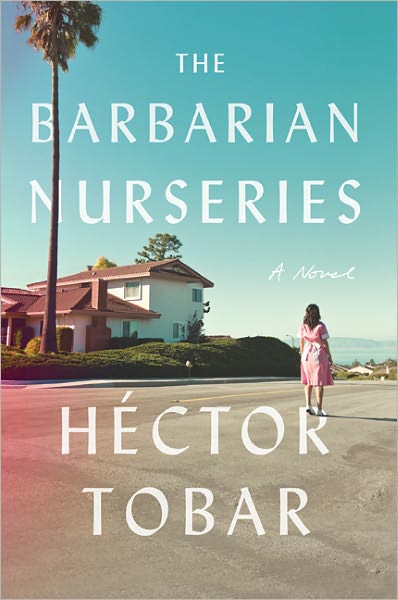
rerun: The Barbarian Nurseries by Héctor Tobar

A deceptively quiet story, with swift currents running deep beneath its surface, considers the fate of an unprepared Mexican housekeeper in Orange County left to care for her employers’ young children.

Pulitzer Prize-winning journalist Héctor Tobar’s second novel tackles the ambitious goal of characterizing Southern California’s multicultural schizophrenia and achieves it admirably.

Araceli is quietly comfortable in her role as housemaid to the Torres-Thompson household in Orange County, one of three Mexican domestics; but when the gardener and nanny are suddenly dismissed, she is puzzled to find herself expected to care of three children she considers strangers. Worse, she wakes up one morning to find both her employers gone with their baby–-leaving her alone in the house with two young boys. In desperation, she sets off with them on a daunting trek through diverse and unfamiliar Los Angeles to try to find their estranged paternal grandfather.

Tobar creates an intriguing juxtaposition of cultures, as the Torres-Thompson children are thrust into a huge, unfamiliar, multiethnic city. Most observations are from Araceli’s perplexed, amused, lyrically bilingual perspective. At other times, we look through the boys’ eyes, with all the wonder of the new, including evidence of poverty they’ve never before encountered. The older boy (age 11), in particular, has a unique way of clinically interpreting new experiences through books he’s read, imbuing the world with fantasy. The adventure with the boys is a comedy of errors–-Araceli becomes suddenly famous as a symbol of racial politics, and her fate depends upon forces outside her control.

The Barbarian Nurseries is a beautifully written, contemplative and thought-provoking view into Southern California’s diversity and contradictions, as well as a fascinating and well-presented story.


This review originally ran in the September 23, 2011 issue of Shelf Awareness for Readers. To subscribe, click here, and you’ll receive two issues per week of book reviews and other bookish news.


I decided to skip the post-dated rating on this one, as it’s been a while and I’m genuinely curious as to how it’s aged. I did call it one of the best books of the year. Anybody have a more recent reading to report?

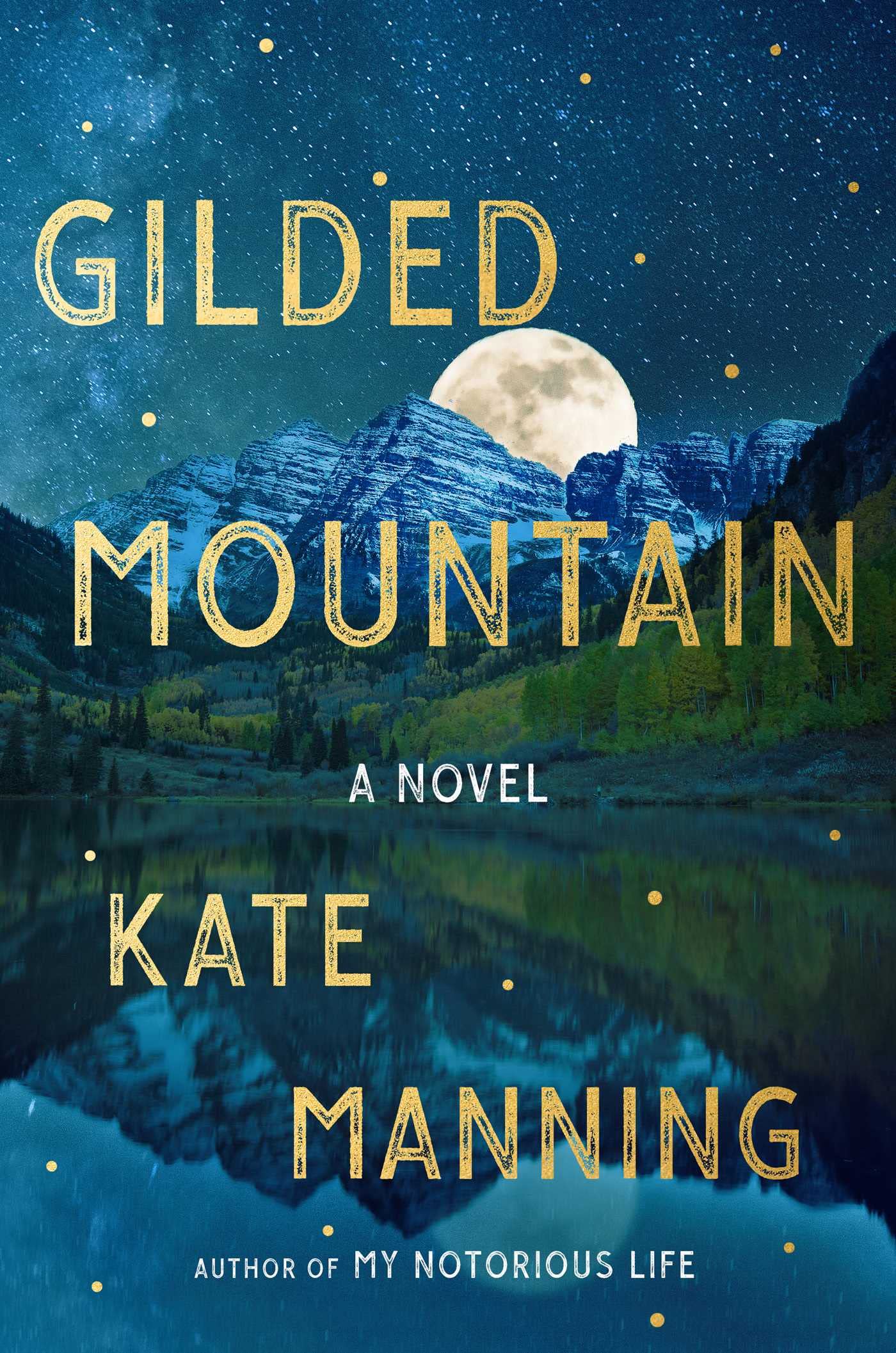
Gilded Mountain by Kate Manning

This gorgeously evocative novel of the early-1900s American West takes on issues of race, class, labor and women’s rights via a remarkable young woman’s coming of age.

“Strikes are all the same. Same songs. Same reasons. Same hope and rage. In those years it was struggle and strife all over the mountains, in the cities and on the plains of the country, wherever there was industry or toil.” Gilded Mountain by Kate Manning (Whitegirl; My Notorious Life) is an expansive novel of passions: love, beauty, suffering; struggles for labor rights, women’s equality and the rights of formerly enslaved people. Set in the early-1900s Colorado mountains, this enthralling story stars Sylvie Pelletier, who travels west at age 17 to find the world broader, more lovely and more terrible than she’d imagined. Gilded Mountain tracks her coming of age and the troubles of her family and the marble miners of Moonstone.

Sylvie’s father, Jacques, is beloved by his family and his coworkers in the marble quarry, who call him “Frenchy,” but Sylvie’s mother fears he will again meet danger with his union organizing. Sylvie graduates from high school and apprentices as “printer’s devil” to the freethinking K.T. Redmond, who further shocks townspeople by being a newspaperwoman. As conditions in the mines deteriorate and K.T. nurtures Sylvie’s rebellious streak, the young protagonist is also invited into the household of Company owner Duke Padgett and his wife, the Countess. Their royal titles are self-assigned, but their wealth is real. The Duke’s son, Jace, becomes something of a romantic interest, but there is also United Mine Workers’ representative George Lonahan. Sylvie is torn between her principles and love for her family, her class and her boss, and the temptations of the other life. “I forgot to observe with the sharp eyes of a printer’s devil because my sight was dulled by sugar and awe,” she realizes. “My loyalties gnarled and snared me.”

Gilded Mountain is an ambitious novel, swelling to encompass labor rights (complete with Pinkerton Detective Agency goons), women’s rights, the societal role of the free press, the rights of Black Americans immediately following the Civil War, lynching, immigration and more. Starring real characters from history (union organizer Mother Jones, Belgium’s King Leopold II), it contains romance, historical fiction and inspired, high-minded thinking on important issues. Moonstone, Colo., is a fictionalized composite town, but its marble mining and the standard operating procedures of the Company are well based in historical fact. It also contains lovely writing about the natural world: “[T]he Diamond River overflowed its banks and rushed downhill, rooks sang in the trees, and leaves unfurled like new little salads on the ends of their branches. A corduroy of greens softened the hard folds of the mountains, and the meadows bloomed with swaths of blue columbine and dashes of yellow sneezeweed.” The result is a painfully beautiful novel of big ideals, heartbreaks and tragedies, sewn together by an admirable and unforgettable heroine.


This review originally ran in the September 15, 2022 issue of Shelf Awareness for the Book Trade. To subscribe, click here.


Rating: 8 maraschino cherries.

Mother Country by Jacinda Townsend

To crib a disclosure I found over at Tor.com: “The author is a friend, but if I didn’t like her book, I just wouldn’t review it here.”


And what, after all, to make of a choice?

Shannon is an American woman traveling, for the second time, in Morocco with her husband Vladimir, “a man she felt she could never know from Adam.” They have their troubles: Shannon suffers severe chronic pain following a serious car wreck; she is hiding substantial student and medical debt from her husband, who is wealthy, distant and not terribly likeable. They are unable to get pregnant (for layers of reasons and with layers of results, including Shannon’s increasing baby fever). Shannon is privileged but more or less miserable, between the pain, her marijuana habit (hidden from Vladimir), the traumas of her own upbringing, and her desire for what she can’t have. She feels a bit lost, “but it was a nice lost, like being found was just around the corner in some dusty recess of the medina.”

Souria is a teenager from Mauritania, where she has been beset: her mother dead, she is kidnapped and enslaved; escapes, is enslaved again, escapes again; arrives in Marrakech friendless and pregnant, where the abuses persist until she escapes to begin a hard, simple life under her own power in Essaouira, “that frat boy of Moroccan cities” on the coast. She names her daughter Yumni, “good fortune. Success in this life,” and the child is happy and deeply loved.

To Shannon’s American eyes, however, she appears dirty and free-ranging on the sidewalks outside the shop where Souria works. And so the older, richer woman just… takes her. Vladimir’s money and their American passports transform Yumni to an American adopted daughter. The two women look remarkably alike; the child looks like her adoptive mother, such that the other parents in Louisville assume she is Shannon’s own.

I love this novel for its use of repeated lines and concepts, and questions about the nature of choice. The two threads, which eventually meet, are mostly told in the close third person perspectives of Shannon and Souria, although we get brief glimpses of Vladimir and of Yumni (later Mardi). These two main characters are well developed, but I judge them not equally sympathetic: Shannon’s life has certainly been difficult, but I judge her more harshly in the end than I do Souria, who’s had fewer options. There are parallels, though, and both women have the complexity of being neither martyr nor villain. The stories are well told, and the plot is heartbreaking, but the novel is character driven in the end, as well as being about those choices we are cued to in the first line. Secondary characters are delightfully drawn as well, which I always appreciate.

The title teases us, at first, to think about the Black American couple traveling to Africa, but it’s also a hint to themes about motherhood. The child at center winds up with something like two mothers, although a little short on fathers – her biological father is more or less a rapist and more or less unknown, and Vladimir is neither cut out for nor in love with the role. Shannon’s mother is not a benevolent force, and the loss of Souria’s mother when she was young is directly linked to what happens to her from then on. The country of Morocco is important as setting, as cultural backdrop, as a place where Shannon and Vladimir can take what they want. (I also happen to know it’s an important place in the life of the novelist, which maybe doesn’t figure in the novel, except that this writer knows her subject well.)

There are capital-I Issues here, like trafficking, colorism, American privilege, and meditations on motherhood. I don’t find the ethical question to be terribly puzzling – I think kidnapping is wrong whether it’s Souria or her daughter being taken. White Americans adopting African babies creates a problematic picture that’s too easy; I appreciate Shannon’s more complicated role as Black American, and with her own traumas and challenges. The male-female relationships are both beautifully drawn and upsetting in how universally problematic they are.

Jacinda Townsend has perhaps topped her lovely, musical Saint Monkey. This is a beauty, and timely, wise, and real.


Rating: 8 bears.

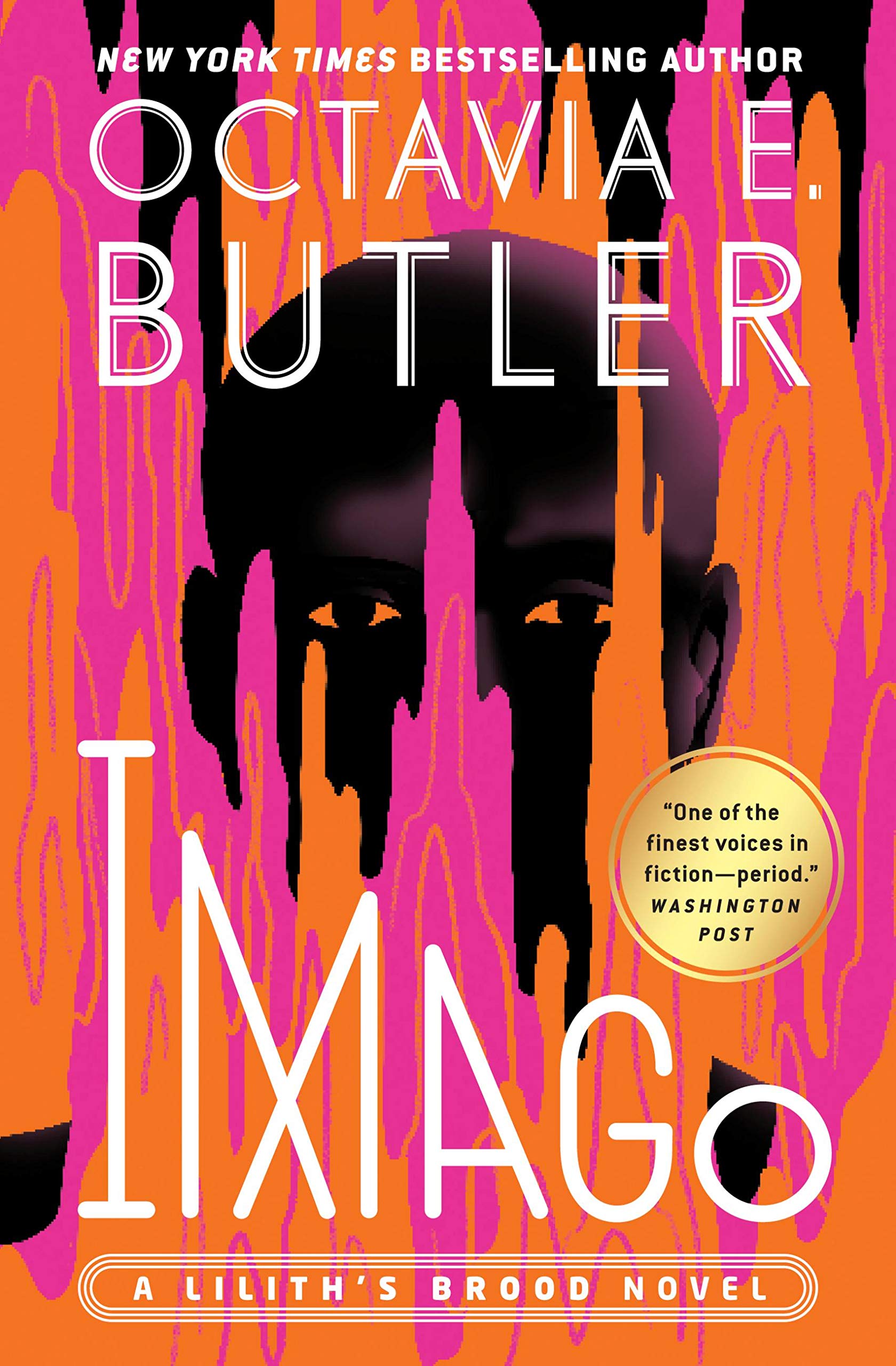
Imago by Octavia Butler

Following Dawn and Adulthood Rites is Imago, the final book in this trilogy, which I am sorry to see the end of. We’ve shifted narrators again: Lilith brought us through book one, then Akin for book two, and now we meet Jodahs, another first of its kind. Like Akin, Jodahs is a child of Lilith’s family, and her own (human-born). When Jodahs reaches metamorphosis, when Oankali and constructs (Oankali/human offspring) reach sexual maturity, a surprise: instead of becoming male as was expected, Jodahs begins to become ooloi, the Oankali third gender that is neither male nor female. Ooloi have extensive abilities to heal and changes themselves and others, and it had been thought still too risky to introduce human-born ooloi at this stage of the two species’ trade. Jodahs is a mistake, and a potentially dangerous one. But it quickly becomes clear that in its uniqueness it may have some special abilities to offer as well.

Imago is told from Jodahs’ point of view, as it struggles with its own needs and the challenges of coming of age. One early solution that is offered to the problem of Jodahs’ very existence is that it be exiled to a ship away from Earth; but Jodahs is a native of Earth, and quite reasonably pushes back against this idea. It’s the first of its kind, not wanted where it is from, and threatened with being sent “back” to a place it is not from. (The parallels to slavery are unmistakable.) It has overwhelmingly strong urges, toward sexual and other connections, but its people don’t want to allow it to pursue these urges, which are natural but also unprecedented (because Jodahs is unprecedented). I am still marveling at Butler’s worldbuilding here, that I’m so absorbed and bought into the rules of her invented peoples. It’s lovely.

There is commentary on human nature: the old human contradiction, as Oankali see it, of intelligence with hierarchical behaviors. Humans among themselves struggle with racism, xenophobia, sexism and sexual assault, and homophobia. When faced with Oankali – that is, something different, non-human – humans frequently react with fear and hostility. Even when they feel drawn to an ooloi, for example (and the ooloi have this power, to make themselves irresistible), they can feel revulsion mixed in. The trilogy has much to say about xenophobia and race, colonialism, agency and freedom of choice, and also gender. I love that the ooloi have to repeat that they are not male and female, not both, but a whole other thing. They still get misgendered and mis-pronouned. Jodah is asked if it wants to be male: “Had I ever wanted to be male? I had just assumed I was male, and would have no choice in the matter.” It’s also about community-building in ways that I love. Building communities, families and societies is just as hard in Butler’s fictional world as it is in any other dystopia I’ve encountered, real or fictional (because people). This is all good commentary on human tendencies, while at the same time being very fine, escapist fiction.

For more, especially some excellent thoughts on the book’s title, check out Erika Nelson’s “Playing Human” essay at Tor.com.

I love this series and think everyone should read it.


Rating: 8 tubers.