



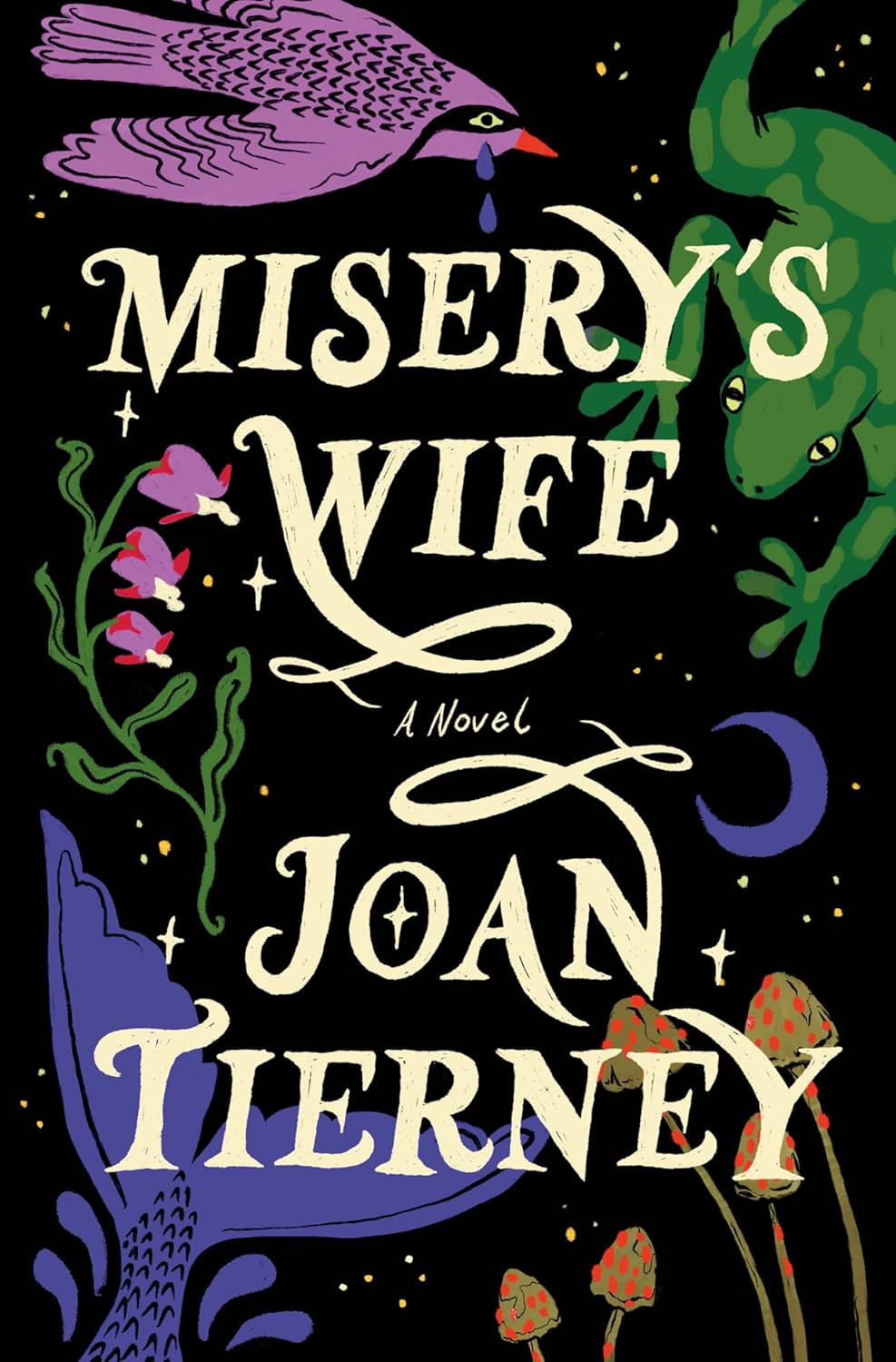
Misery’s Wife by Joan Tierney

Misery’s Wife is a lovely, off-kilter fable about family, sisterhood, love, transformation, and humans’ relationship with the rest of the world. It uses repetition and sets of threes in ways that feel familiar to a fairy tale tradition. I think I was expecting something referencing Persephone or Eurydice, but it turns out that Tierney here recasts a Portuguese folktale, with foods, names and language from that culture. I was unfamiliar but still found it all accessible and enjoyable.

We first meet the parents of three sisters. Agueda and Jaco have three girls, and during each pregnancy, Jaco goes on a mini-quest to ease his beloved wife’s discomforts, and each time, this results in the newborn daughter’s allegiance: Adelina is a child of the night and the sea; Borboleta is a child of the day and the sky; and Dores is a child of the wind and rain, “and Misery itself will bend to kiss her feet.” They grow respectively into a young woman who adores all things strange; one who admires and exudes beauty; and one who is mild-tempered and shy, given to daydreams. In a single day, Adelina elopes with the King of the Ocean. Borboleta runs away with the King of the Sky. And Dores declines the offer of the King of Misery, but he abducts her anyway.

Years pass. Agueda and Jaco mourn their three lost daughters. But lo (the book surprises us), there is a fourth, younger sister, a child of luck and fortune. “There was also the mistaken belief, in those early years, that Elixane was in fact a son rather than daughter… these things happen, and are remedied easily enough once the child themself can put voice to the truth.” As Elixane grows into a young woman, she receives three mysterious messages, one from sea, one from sky, and then a final message from the queen of Misery. “She asks that you find her and save her from her king.” As she prepares for this quest, Elixane meets Luck, who has (naturally) followed her all her life; he is accompanied by his sister, Jinx. Off and on, the pair will accompany her as she meets with each sister in turn, and endeavors to rescue Dores from Misery, as well as lifting a curse and generally improving circumstances in the kingdoms of sea and sky, and that of land and humans as well. Misery’s Wife is set in a future world badly damaged by anthropogenic climate change, which, like Elixane’s identity as a trans woman, is treated only glancingly.

I liked this story, although the stretches set in the kingdom of Misery were sometimes hard to read. I liked the representations of the love and devotion of family, of sisters and of friends, as well as the loving marriages (“When you marry someone, you marry their battles, too”), contrasted to Misery’s abuse (“Dores’s skin was pockmarked with bruises… The cat looked at the bruises and then looked at her eyes and said, ‘This is how it starts'”). I found the folk formula – repetitions in threes, quests and codes and riddles – soothing in its familiarity, which did not prevent plot twists. And I loved the decidedly happy ending. By that conclusion, I’d say that despite some comforting framing, Tierney has given us a surprising, thought-provoking fable that I will not soon forget.


Rating: 7 roosters.

The People Could Fly: American Black Folktales told by Virginia Hamilton, illus. by Leo and Diane Dillon

I got this title from Well-Read Black Girl, although the cover was familiar enough that I wonder if I had it as a child at some point. (I definitely recognized some of the characters, like Brer Rabbit and the Tar Baby, if not these particular stories.) In a larger format, with a number of rich, grayscale illustrations, it offers a selection of folktales passed down as oral tradition from the Americas’ earliest Black residents: enslaved Africans and their descendants. Virginia Hamilton has done good work in compiling these stories, of course, but an equally important contribution is her brief notes about what each one represents and where it falls in the larger scheme of storytelling traditions in time and geography. (I really appreciated the occasional personal note, too.) She notes the families each story falls into and her choice to use more or less dialect, and the global traditions that contribute to each.

These stories appear in sections, headed by a title story and then grouped by type: animal stories, tales of the supernatural, tales of the real, extravagant, and fanciful, and slave stories of freedom. This last section finishes with the title story, “The People Could Fly,” and I think it’s the right note to end on. The illustrations really did add something – just look at that cover, where I find the facial expressions evocative; I feel like it conveys the movement and inspiration of the title story.

I love the animal stories, which perhaps felt most familiar – not only do I know Brer Rabbit, as mentioned, but these recall Aesop’s fables and many other storytelling traditions. I do love a tall tale, like “Papa John’s Tall Tale.” And I was pleased by the “grisly realism” of “The Two Johns” – just as a matter of personal taste, I suppose. There’s a general sense of rural settings close to nature, that I think comes of the enslaved experience (as Hamilton notes about the animal tales in particular); there’s a feeling common to all folktales and traditional storytelling, of trying to explain the world through stories. There’s something comforting about that effort, even when the resulting explanation is discomfiting.

I enjoyed the stories, but I think what makes this book special is Hamilton’s work, in her footnotes, to put them in context. I especially enjoyed the geography, or the references to global patterns in storytelling – that the opening story, “He Lion, Bruh Bear, and Bruh Rabbit,” for example, “ranges throughout North and South America, Europe, and Africa.” It’s pretty wild to think about how stories can encompass so much of the world: that they are that important and elemental.

With its moving illustrations, excellent and concise footnoting, and its range of fine stories, I think this is an essential book for any home library – for children and adults. Glad I came across it.


Rating: 7 clever rabbits.

Foxfire Story: Oral Tradition in Southern Appalachia ed. by T. J. Smith

Decades of carefully collected oral storytelling and local lore from Southern Appalachian culture offer a singular perspective.

Since 1966, Foxfire has been educating and working to preserve local heritage in Georgia’s Rabun County. The organization has published the Foxfire magazine for over 50 years, and more than 20 books. But Foxfire’s archives are still rich and deep enough to furnish mostly never-before-published material in Foxfire Story: Oral Tradition in Southern Appalachia, a collection of folktales, stories, mountain speech, pranks, jests and much more gathered over the decades.

Editor T.J. Smith–Georgia mountain native, Ph.D, folklorist and Foxfire’s executive director–groups these materials into categories: anecdotes come from personal experience and often contain a punch line; folk beliefs connect us to cultural or religious communities and are sometimes known by the pejorative “superstition.” Proverbs and sayin’s include colloquial comparisons: sharp as a tack, a needle, a briar, a pegging awl. Legends include ghost stories and tales of treasure hunts. In a second, shorter section, Smith organizes additional storytelling by the teller. Here, Ronda Reno recounts the tradition in her family of the “granny witch,” or herbalist/midwife/community healer. Cherokee storyteller Lloyd Arneach describes his art form and how it grew, almost by accident, into a career.

The legends, folktales, songs and stories in this collection are often unsophisticated, portraying ways of life that are dying out or already gone. They shed light on endangered occupations, economies and ecological niches. With Smith’s commentary, these unaffected narratives and usages (git-fiddle: “term for guitar in the context of old-time string music”) offer a glimpse of a world otherwise unavailable to many readers.


This review originally ran in the May 1, 2020 issue of Shelf Awareness for Readers. To subscribe, click here, and you’ll receive two issues per week of book reviews and other bookish news.


Rating: 5 panthers.