Teaser Tuesdays: One Day I Will Write About This Place by Binyavanga Wainaina


Teaser Tuesdays is a weekly bookish meme, hosted by MizB of Should Be Reading. Anyone can play along! Just do the following:

* Grab your current read
* Open to a random page
* Share two (2) “teaser” sentences from somewhere on that page
* BE CAREFUL NOT TO INCLUDE SPOILERS! (make sure that what you share doesn’t give too much away! You don’t want to ruin the book for others!)
* Share the title & author, too, so that other TT participants can add the book to their TBR Lists if they like your teasers!

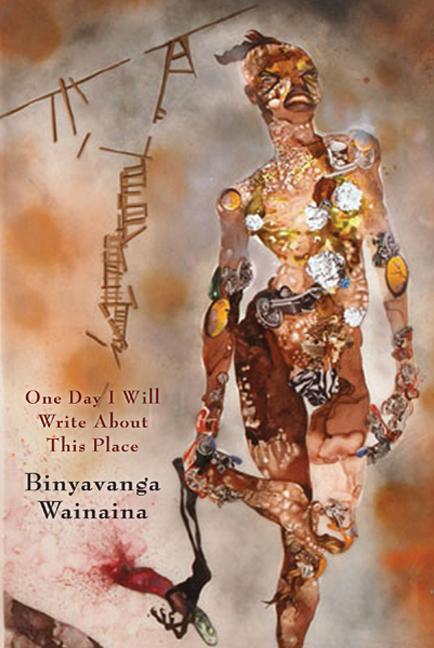
Would you look at this beautiful, complex cover? Very interesting – perhaps overwhelming, or perhaps thought-provoking, depending on your day! I found it a bit intimidating at first but after just a few pages, I feel that it fits the story. This book is a memoir of the author’s life in Africa, and his growth as a writer. My teaser is a good example of what I’ve found, and like, so far. From page 10 (of my pre-publication proof, so pending change before final publication):

…just when your marble is wheeling along, groovily swinging up the walls of your trough and back down again, challenging the edge, whistling and gum chewing and downhill biking and yo-yo bouncy and American – gravel pounded by rain outside your bedroom window becomes sausages frying, and sausages frying can shift and become squirming bloody intestines or an army of bristling mustachioed accordions chasing you, laughing like Idi Amin.

I am finding this a most interesting read.

hemingWay of the Day: on bicycles

It is by riding a bicycle that you learn the contours of a country best, since you have to sweat up the hills and can coast down them. Thus you remember them as they actually are, while in a motorcar only a high hill impresses you, and you have no such accurate remembrance of country you have driven through as you gain by riding a bicycle.

from Battle for Paris, printed in Collier’s on September 30, 1944

Iphigenia in Forest Hills: Anatomy of a Murder Trial by Janet Malcolm

So, Janet Malcolm is a journalist and writes for the New Yorker as well as having published a number of acclaimed works of nonfiction and biography. I have been interested for some time in reading The Silent Woman (biography of Sylvia Plath), and actually own Two Lives (of Gertrude Stein and Alice B. Toklas), although I have not yet read it. Her latest release is Iphigenia in Forest Hills, and I was interested enough to buy it at once, for the library, and to take it to lunch with my on the day of its arrival to start reading it.

First impressions: I guess the cover is boring to you here in image form, but I find it striking and respectable in its simplicity. I wish more books would try this style of straightforwardness; not that I don’t appreciate beautiful, elegant, well-designed covers that involve color and images, but this slim, simple, black book is very eye-catching in a world of graphics.

It starts off very strong. I’ve said before, my kind of nonfiction is narrative style; this is just right for me. Malcolm has a voice in her own story, including occasionally referring to herself: how she would have reacted to a certain question in the jury selection process, for example. Or, later in the book, how she interacted with the families in question during interviews; or her discussion of the different journalists and their interactions during the trial. I like that Malcolm plays a part in the book. It seems more realistic that way. Who can help being a part of the story she writes, especially in a case such as this? Malcolm followed the case for many months. She couldn’t have helped but be involved on some level.

The story is this. NYC is home to a community of Bukharan Jews in a neighborhood called Forest Hills, in Queens. Boy meets girl; they marry, and have a baby girl. Four years later, husband Daniel is murdered while handing off daughter to ex-wife. She stands trial for his murder, along with the man who allegedly fired the gun, as her hired hit man.

There are accusations that Daniel physically abused his wife and sexually abused their young daughter. There is a heated custody battle and suspicions of emotional neglect and attempts to turn her against one parent or another. The event that allegedly pushes the wife to have the husband killed, is that a custody judge chooses to remove the child from her mother’s care and place her with her father. This looks like a crazy decision, since the child barely knows her father and he was not asking for custody, merely visitation rights. There is questionable evidence; both the prosecuting and defense attorneys come in confident of victory. There are issues of culture. I learned a lot about the Bukharan sect of Jews, which I knew nothing about before reading this book.

Iphigenia in Forest Hills reads a little bit like a courtroom-procedural novel of criminal intrigue. Our questions, however, are not finally answered, as they almost certainly would be in a novel. Malcolm is not sure whether Mazeltuv Borukhova did, in fact, hire Mikhail Mallayev to kill her ex-husband Daniel Malakov. (Her title, by the way, is part of what initially attracted me to this book, along with Malcolm’s excellent reputation as an author of biographical nonfiction. It references the story of Agamemnon and his family, which I know best, and love, as told by Aeschylus. Of which, more below.*) I love that Malcolm interviews and interacts with both families and both sides involved in the legal battle, while noting her personal reactions including any bias she sees herself develop. She recognizes and gives weight to emotional reactions and personalities. It’s not a sterile treatment – because our legal justice system is far from sterile. In the end, she doesn’t tell us what really happened, because she doesn’t know. The blurb inside the front cover begins with the defining quotation of the book:

She couldn’t have done it and she must have done it.

So there you have it. A story of ambiguities and questions, beautifully and insightfully told, from myriad angles. My first Malcolm read has come far too late, and I’m more eager than ever to get into more of hers.


*The Oresteia by Aeschylus is a trilogy of ancient Greek tragedies: The Agamemnon, The Libation Bearers, and The Eumenides. I could go on all day; I love ancient Greek drama. But I’ll try to be brief. Iphigenia’s story:

As the Greeks prepare to sail to Troy (to lay seige, in the Trojan War, to recover Helen, wife of Agamemnon’s brother, stolen by Paris), the winds are against them; to appease an angry goddess, they choose to sacrifice Agamemnon’s daughter, Iphigenia. She is brought to the harbor in a wedding dress, believing she will marry Achilles, but instead is killed by her father, who then sails for Troy. Upon Agamemnon’s triumphant return ten years later, his wife (Iphigenia’s mother), Clytemnestra, along with her new lover, entrap and kill Agamemnon.

Thus, Malcolm’s title suggests that the mother in this story, Borukhova, is so angered by the “theft” of her daughter (through custody court, not sacrificial slaughter) by the girl’s father that she has him killed (by a man implied to be her new lover). As I said, I was drawn in by this allusive title. I find the allegory a bit weak in the end: the daughter in Malcolm’s story is not murdered (although there is some question that she might have been raped!); and the title’s implication suggests a bias that Malcolm generally does not profess in the body of the book. But still, it is a dramatic title, one that got my attention; and it makes a larger point, that this tale is one of epic tragedy and does no one good in the end. There is no victor; no one’s lot is improved by these sordid events (as the victim’s father points out repeatedly), regardless of whether Daniel Malakov was a good man and doctor or a deplorable and sick abuser.

I recommend Janet Malcolm’s Iphigenia in Forest Hills; and I also recommend Aeschylus!!

hemingWay of the Day: on uniforms

The first time we [Hem with French guerrillas] had entered the town all but two were naked from the waist up, and the populace did not greet us with any degree of fervor. The second time I went in with them, everyone was uniformed and we were cheered considerably. The third time we went through the town the men were all helmeted and we were cheered wildly, kissed extensively and heavily champagned, and we made our headquarters in the Hotel du Grand Veneur, which had an excellent wine cellar.

from Battle for Paris, printed in Collier’s on September 30, 1944

I like this not only because of the evident power of uniform, but also because of that final aside that the Hotel had an excellent wine cellar. So much is implied by this brief phrase.

The Heroine’s Bookshelf by Erin Blakemore

I have a delightful little book to share with you today! I mightily enjoyed Erin Blakemore’s The Heroine’s Bookshelf: Life Lessons, from Jane Austen to Laura Ingalls Wilder.

Blakemore’s message is this: we are all heroines in our daily lives, or at least we can and should be; and we have a wealth of heroines to learn from. These are the women of our favorite books. She organizes her book by chapters which each deal with one lesson or attribute (including dignity, happiness, and simplicity), represented by one author (all are women) and one female character, from one book or series. I would love to list them all here for you but feel I should leave you something to discover when (not if!) you pick this book up yourself; so I shall tease you with Alice Walker and Margaret Mitchell, on top of the two authors Blakemore names in her subtitle.

It’s a very sweet, comforting, and comfortable little book. Twelve chapters explore twelve women’s literary impact on our world. Eleven of them I definitely call classics; one I’d never heard of! but of course I don’t know everything. Blakemore’s approach is intimate and loving and a touch incisive. It’s not an academic or intellectual book, but it’s not what you might call “fluffy”, either. She did do some research, I’m sure, as she discusses not only what’s between the pages of the books in question, but also notes biographical details about the authors and draws some conclusions. For instance, I didn’t know about the 2008 revelation by the descendants of Lucy Maud Montgomery about her death. This book is not too serious – a light read – but an important one, at the same time.

I am absolutely inspired to read, and re-read, the books examined here. I share Blakemore’s love for Jo March, and I wonder at her selection of Jane Eyre over Wuthering Heights, but we’re all unique, individual heroines, aren’t we. I marvel at her call to compare Frances Hodgson Burnett to Britney Spears and Amy Winehouse! but I admire her for it, too. Again, the adjectives that come to mind are comfortable, almost warm-n-fuzzy.

I need to own this book; the library’s copy will not suffice. And I think YOU should own it, too. Who am I talking to here? Well, I readily accept that many of these books are “girls’ books” (or women’s). But some are absolutely essential to us all: A Tree Grows in Brooklyn, for example, is an important book all around. This book is directed at women, but is not necessarily to be enjoyed by them exclusively. I’m sure you know who you are.

I can almost see a book club (or reading blog) project coming out of this. I would be very happy to shelve this book, in my home library, next to its twelve objects of study, and read them all in a streak of thirteen, with a mind to discussion. This would be a lovely thing to share with other women – and a willing man or two if they could be located. I don’t have the energy to put this together at this time, but do invite me if you decide to. 🙂

I’m so glad I found this little jewel. I hope you’ll find it, and enjoy it, too.


Edit: My mother asked who this author is, and I had to go looking for the answer, so here it is, Mom: she calls herself “a writer, entrepreneur, and inveterate bookworm” on her website, and I was immediately drawn in to her blog and have added it to the list of blogs I follow.

hemingWay of the Day: on robots

Lots of people call this weapon the doodlebug, the robot bomb, the buzz bomb and other names hatched in the brains of the keener Fleet Street types, but so far nobody I have ever known who has fought him has referred to Joe Louis as Toots. So we will continue to refer to this weapon as the pilotless aircraft in this release from your pilotless-aircraft editor, and you can call it any of those quaint or coy names you wish, but only when you are alone.

from London Fights the Robots, printed in Collier’s on August 19, 1944

(please catch the irony in the title of his article! did he get to name it himself?)

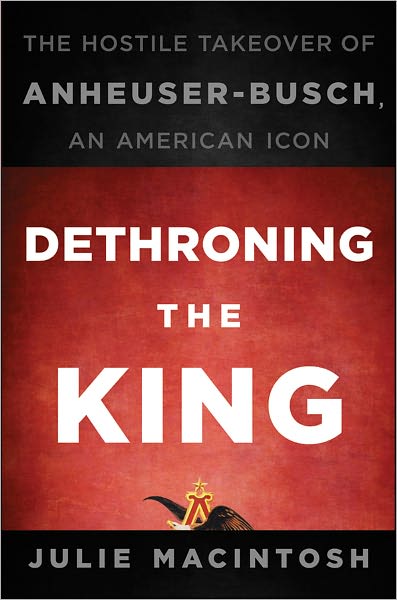
Dethroning the King: the hostile takeover of Anheuser-Busch, an American icon, by Julie Macintosh


Wow. Where to begin? I found this book riveting, cover to cover. I took my time, and I took breaks, and I read other books – all this is true. But my interest in this one never waned. I have been raving a bit manically to anyone who will listen ever since I finished it last Friday night. I’ve taken my time writing about it here because I was trying to be less hysterical in my praise.

I’ll give you a quick synopsis if the subject area is unfamiliar to you:

Anheuser-Busch was the last U.S.-owned big beer company in 2008, and was also still family-controlled, by the Busches. (Coors was already part of Canadian-owned Molson-Coors, and Miller was part of South-African-owned SAB-Miller.) A few Brazilian bankers had started, years earlier, by buying out Brazilian Brahma beer, but they quickly grew into a large brewing concern known as AmBev who then joined with Belgian brewers Interbrew to become InBev, which ended up Belgian-based, but mostly Brazilian-controlled. In 2008, AB was suffering, and InBev made their play by offering an impressive bid. AB made a rather half-hearted effort to defend itself by merging with Mexican brewing powerhouse Modelo, but ended up selling to InBev to create Anheuser-Busch InBev (ABI).

Macintosh is the journalist who covered the takeover of Anheuser-Busch by InBev, for the Financial Times. She had me right from the start, when she described (in the Author’s Note) her experience as a woman – and a visibly pregnant one, at that – in the doubly male-dominated worlds of finance and beer. This resonated with me, as I’ve worked in beer and in bicycles in the past and am also familiar with the concept of male-dominated industries. This personal relationship to her work foreshadowed to me that she was going to handle her subject from a human perspective, and she did. I like my nonfiction full of narrative and personalities – human characters. This was a fascinating treatment of a story I was already prepared to be interested in. My ties to beer, and the beer industry, originally drew me to this book. But I stayed for the human element.

This story is full of characters. (Forgive me for broadly generalizing, but people in Big Beer and finance are wealthy, and wealthy people tend to be eccentric, yes?) Macintosh kindly includes a “Cast of Characters” (and I also referred to the index to flip back to the earliest mention of a character here and there) to help us keep them straight; but really I had minimal trouble. They’re all so quirky and real (notice I didn’t necessarily say likeable! but interesting, yes). Like I said, the beer got me in the door; but the people and the plot twists kept me in my seat.

The world of finance is thoroughly new and mysterious to me. (I have been harassing my finance-friends to help me understand certain concepts. They have been mostly helpful; or, unavailable. Probably on purpose. That’s you Will.) But it speaks to my engagement in this book, that I am now hyper-motivated to learn all about mergers & acquisitions (independent v. dependent board members… fiduciary duty… private equity firms…) JUST so I can better follow the action in this plot. For me to have found a book of finance this unputdownable seems rather a feat. I can’t recommend it enough.

The more I try and explain my appreciation, the more I think this story wears several hats. It’s actually suspenseful and full of intrigue, like a lot of the novels I enjoy – like a murder/mystery/international intrigue. It also has certain elements of classic tragedy – ambition and hubris being (among) the tragic flaws of the Busch players. And the fate of Anheuser, in mid- and late-2008, is also an allegory for what the United States went through simultaneously. Our national hubris and feeling of this-can’t-happen-to-us led to a shocking (to varying degrees I suppose) downfall. Of course I’m just paraphrasing Macintosh in this; she says on page 22,

Anheuser’s hubris and naivete had led to its fall from grace, and it provided an apt comparison to the broader state of American at the time.

Or again, page 341, in the words of an (unnamed) advisor to AB,

The way this played out was Shakespearean in nature. I haven’t decided which play. The dynamic between father and son was just Shakespearean and tragic.

(The father and son referred to here are August Busch III and IV.)

My notes at the end of reading this book say, “I ❤ gray areas." It's always easy to love and hate characters in books when they're all good or all bad; but isn't it more satisfying to feel conflict? Aren’t they more human and thereby more evocative of complex emotions, when they have redeeming characteristics, or confuse us a little bit? These are, of course, real humans; but it’s Macintosh’s journalistic thoroughness that rounds them out. I didn’t find it easy, in the end, to see any of these characters in black and white. Instead, the complexities and gray areas make it echo for me.

If you’re interested in big business, or finance, or the beer industry, or the consolidation of the world market into very few giant conglomerates, or U.S. businesses’ place in an international world, or if you enjoy readable nonfiction… I really can’t overestimate my recommendation of this book.

Teaser Tuesdays: Dethroning the King


Teaser Tuesdays is a weekly bookish meme, hosted by MizB of Should Be Reading. Anyone can play along! Just do the following:

* Grab your current read
* Open to a random page
* Share two (2) “teaser” sentences from somewhere on that page
* BE CAREFUL NOT TO INCLUDE SPOILERS! (make sure that what you share doesn’t give too much away! You don’t want to ruin the book for others!)
* Share the title & author, too, so that other TT participants can add the book to their TBR Lists if they like your teasers!

You got the book beginning(s) on Friday; today you get a teaser from the middle. I did a fair amount of reading this weekend and am halfway through. I promise this one won’t take me weeks like Mr. Playboy did! I hope to be done by the weekend, because The Paris Wife is here teasing me, along with so many other good ones stacked all around…

“Randomly” selected from page 191, where I am reading today:

When she inherited her father’s Modelo ownership, Maria had been unemployed and raising two children, and had almost no business experience. She decided to throw herself into the family business rather than letting others control her fate, and from an office the size of a broom closet, she made two of Modelo’s bankrupt yeast companies profitable within a year of taking them over.

I liked this quotation because it highlights two things: one, author Macintosh’s attractive ability to treat the players in this nonfiction tale as interesting, engaging characters, painting them as complete people who we learn to care about (one way or the other); and two, the rare female character in this extraordinarily (but not surprisingly) male-dominated story.

I raved about this book last Friday upon beginning it, and I’m no less enthusiastic today. This is a story that fascinates me, both personally because of my relationship with beer and the beer industry, and as an important story in our national history. Macintosh writes in an accessible, narrative style that draws me in and just sneaks all the learning about economics, business, and politics right past without me noticing. I can’t over-recommend this book, really.

book beginnings on Friday: Dethroning the King

Thanks to Katy at A Few More Pages for hosting this meme. To participate: Share the first line (or two) of the book you are currently reading on your blog or in the comments. Include the title and the author so we know what you’re reading. Then, if you feel so moved, let us know what your first impressions were based on that first line, and let us know if you liked or did not like the sentence. (You might also consider visiting the original post where you can link to your own book beginning.)

I am so very excited about the book I’ve just started! Dethroning the King is my favorite kind of nonfiction: narrative nonfiction, written by an author (in this case, a journalist) who gets personally involved in her story and becomes a real voice in it. I’m only 30-ish pages in, but I’m really enjoying the style in which Macintosh tells the story, as well as the story itself.

You get three beginnings today, oh joy! First, from the Author’s Note:

The summer of 2008 is one many people wish they could forget. In the immediate aftermath of the collapse of Bear Stearns in March, the global financial markets briefly looked as though they might stabilize.

And from the Prologue:

Some men golf when they’re looking to unwind. Others take their sports cars out for a drive or toss a few steaks on the grill. August A. Busch III liked to shoot things – ducks in the fall and quail in the winter.

And from Chapter 1:

Wednesday, June 11, 2008, was forecast to be hot and sticky in St. Louis, with afternoon temperatures rising well above 80 degrees. None of the Anheuser-Busch executives who pulled into the parking lot of the soccer park in Fenton that morning expected to see much sunlight for the next 48 hours, however.

Now, if you think three book beginnings is overkill, please bear with me. I think all three beginnings illustrate my point: that Macintosh writes in an accessible, narrative style. Don’t all three sort of grab you and make you wonder what comes next? As opposed to a nonfiction book that starts off, “X was born on Monday, November 3, 1942. His parents were X and X.”

I’m very excited about reading this book because I am especially interested in the beer industry, used to work in it, and have a friend who worked for A-B for years and has (at least a little bit) an insider’s view. I think this story is fascinating. While I don’t actually like the product A-B makes, I have respect for the business and, more so, find the lifespan of it relevant and interesting. Macintosh makes a fair case that the fate of A-B is a metaphor for our country’s economic and political well-being in a changing world, and that both entities fell victim to hubris in a class Greek tragic sense.

What are you reading today? I have my eye on Heather Gudenkauf’s These Things Hidden next, but I also have to admit that the moment Paula McLain’s The Paris Wife shows up, I’m all over it! Happy Friday!

back from the weekend, with very little reading, just a touch of Hemingway.

Hello friends. Thanks for bearing with me. Life is busy. I have this job, see. And I’m taking this class in Database Searching which is fab but takes up time. And I’m trying to be back on this bike and train for the Ouachita Challenge, and we took that vacation, and, and. Thanks for bearing with me.

I had a great weekend, very productive. On Saturday I got to ride bikes with the Husband who made it home from Newark earlier than expected; we planted a tree and did some yard stuff; my mother brought us a beautiful quilt she made for us; and I finally photographed for you of a beautiful set of bookshelves the Husband made (several weeks ago now). Pictures:

Mother and Husband with swamp cypress oak and whimsical wheelbarrow herb garden


whimsical wheelbarrow herb garden with dragonfly


Encyclopaedia Britannica bookshelves, courtesy of Husband (please ignore electronic mess)


close-up Encyclopaedia Britannica shelves


beautiful "union" t-shirt quilt courtesy of Mother


This is an elaborate, beautifully crafted quilt made up of (cycling) event t-shirts belonging to the Husband and myself. It is our wedding gift (we will soon be married 3 years, this is not a fast process) from my Mother and it’s a “union” quilt because it symbolizes our union, combining our two histories of bicycle racing as it does. It’s so lovely, we don’t know what to do with the little dogs who like to muss up bedcoverings.

close-up of quilt: notice Chihuahuan Desert Challenge (earlier incarnation of the trip we just took to Big Bend) and above, the Warda Race (earlier incarnation of the race I did yesterday)

Aren’t I a lucky girl? And that was Saturday.

Yesterday – Sunday – I headed out to race Bikesport Presents the Warda Race. Without boring you too much (hopefully), I will say that I have gotten fat & out of shape while being off the bike for an unexpectedly long time this past fall & winter, and I knew this race would be a rude awakening. So, I did the reasonable thing and signed up for not the Category 2 Men, not the Category 1 Women, but the Pro Women’s race. This got me an extra lap of pain and suffering and embarrassment in my currently-undersized spandex. It went as expected. But, this kind of pain and suffering is going to get me back on track. I’m now less than 5 weeks away from the Ouachita Challenge, so it’s time to get to work.

This busy, productive, and happy weekend did not leave time for much reading. I don’t think I did any reading, in fact. So today I’m back on By-Line: Ernest Hemingway, and very happy to be. I shall make a few bookish remarks so this blog doesn’t seem too much a sham, ok?

I really enjoy reading Hemingway’s short articles and dispatches. I can’t believe it took me this long to pick up on this little pleasure. I have always loved him and have devoured all his novels, several of his nonfiction works (and I think you really have to love Hemingway to get through Death in the Afternoon – or bull-fighting, perhaps – but I actually did enjoy it), and I THINK I’ve read all his short stories – I’ve got a collection of collections. But somehow this collection of his journalism has eluded me til now.

These are short pieces of writing, covering his international travels, war and international politics, fishing, hunting, and general lifestyle. It seems that then, as now, this man’s life was of some interest; he had outrageous adventures (how much he’s elaborated or exaggerated them, would be a subject for another post) and saw outrageous sights. Hemingway’s fiction was heavily based on fact, and I fear his journalism might be tinged with fiction, especially where the Exploits of Papa are concerned. This is one of the mysteries and controversies of Hemingway. It may not be a popular feminist position to take, but I adore Hemingway for his work, even if he wasn’t a savory character – let alone a good husband. To any of his wives.

I was contemplating today, as I read some hunting-and-fishing stories he wrote for Esquire, that one of the Hemingway’s most beautiful and rare talents, is that he makes me care about things I don’t care about. I don’t care for hunting or fishing. These activities are not interesting to me; and in some cases I find hunting downright distasteful. But when Hemingway describes the way a fish, or a bird, moves, or the battle between the fisherman and his prey a la The Old Man and the Sea, or when he describes the experience of the bottle of icy cold white wine he’s had stuck down in the cold trout stream all day – I can taste the wine, and I care about the fish. He makes me taste and feel things very vibrantly, even things I’ve never experienced. He’s a very visceral writer.

In the same way, I’ve always said one of my favorite things about the Drive-by Truckers is their ability to make me care about things I don’t care about. For example, car racing is not interesting to me. But just about every time I hear a recording of them playing Daddy’s Cup (and I’ve heard it a lot), I cry. Take a moment and listen, yourself. (The video portion of this video is just filler. You’re there for the audio. Close your eyes.)

I’ve even sent the Husband (who does care about fishing) a short article by Hemingway to read, and the Husband, who doesn’t read, did enjoy it. The Husband prefers to DO things rather than sit around and read about them (we don’t watch movies, because two hours is too long to sit down – I love that he’s a do-er), but perhaps he can appreciate that Hemingway makes his reader feel the action, the doing of it.

I may be moving slowly these days, but a nice compilation like this, of short stories, or newspaper articles, or what have you, is just the thing for a part-time reader. Thanks for bearing with me and my busy life, and have a happy Monday!