did not finish: New by Winifred Gallagher

The subtitle of New is “Understanding Our Need for Novelty and Change,” and I was interested; I think I visualized a work of social commentary, on our society’s driving need and demand for bigger and “better”, for “progress” for its own sake. That’s not what Winifred Gallagher has given us, though.

Instead, this is a work of anthropology and psychology, observing the variety of personality types and behaviors present in our human race. She refers to neophobes, neophiles, and neophiliacs. The change-fearing first category, and the adventure-seeking third, make up some 20-30% of our population; the majority of us represent a more moderate reaction to novelty. As a population, this makes us well-suited to survival and evolution and, in fact, explains (says Gallagher) why Homo sapiens survived when our brethren did not: the thrill-seekers pushed us to new and better solutions to the problems of survival, the anxious ones kept us safe, and the majority kept us wisely moving towards new opportunities with intelligent caution.

This phenomenon is explored in our history, in psychological studies, in case studies, in lab studies with other species (those poor mice with the cocaine addictions! very sad), and finally in a look at the “Old Order” (Amish and Mennonite communities) in comparison to the smart-iProduct-tech-gadget-addicted majority population of… where, exactly? It’s my impression that Gallagher is looking at the US or Western world here, but I still somehow feel that she’s overestimated the saturation of smartphones in today’s world. Even in the US I know there are still plenty of us without them (!) and if we’re going world-wide, her supposition gets even more ridiculous. (As an aside, her asseration that “whether you’re rich or poor, black or white, male or female, young or old, expert or beginner, the answer to your question is as close as the nearest computer – a truly democratizing force that’s apparent in any public library,” while true, seems to disregard the fact that those computers are not very nearby to a huge majority of the world’s population, like most of the poor and disproportionately many of the black population; and the libraries are being shut down at alarming rates, so yes, while it’s a “democratizing” force, it’s also not a very forceful force.)

And while the basic idea – that we are either neophobes, neophiles, or neophiliacs, in approximately a 20/60/20 proportion – was an interesting one, I got that from the first six pages. Literally. The rest of the book just bored me, and offered nothing (ha) New. And then there were sentences like this one (this quotation comes from my advanced reader’s copy and is therefore subject to change):

Finally, to the creative personality’s recipe of good intelligence, robust neophilia, self-directedness, and the toughness that he describes as a low level of “harm avoidance,” C. Robert Cloninger, a psychiatrist and neuroscientist at Washington University in Saint Louis who developed the highly regarded Temperament and Character Inventory personality model, would add a big dollop of “reward dependence,” or desire for approval.

And I ask you, are you not bored and thrown off by such a sentence structure? With such a list of such concepts, and such a bit fat clause in the middle, and such jargon? Sigh.

I did not finish New, but I almost did; I read about half the book and then flipped and skimmed the rest pretty thoroughly, so I feel confident in my conclusion that this book has rather little to say but rather many words to say it with. Not for me.


I was sent a copy of this book for review.

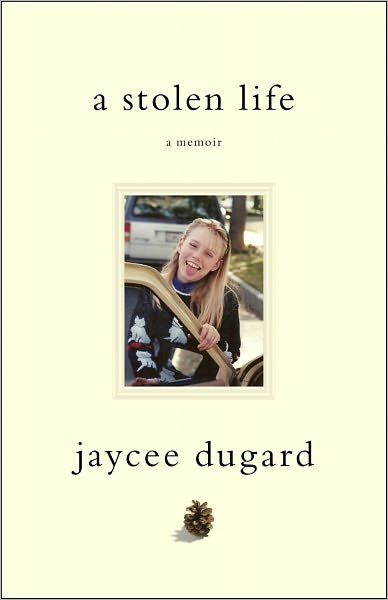
A Stolen Life by Jaycee Dugard

Jaycee Lee Dugard was kidnapped while walking to school in 1991. She was 11 years old. She was held by her captor, Phillip, and his wife Nancy, for 18 years, until 2009, when she was discovered very much by accident. By this time she had two daughters, products of Phillip’s repeatedly raping her while she was in captivity. This is her memoir.

She begins with her childhood, briefly; she grew up in California and then moved to Tahoe with her mother, new stepfather, and baby (half-)sister. Then she was kidnapped. Phillip was a sex offender on parole; he had two small sheds, and eventually a series of tents, built in a “secret” backyard, hidden by fencing and foliage, where he kept Jaycee and her daughters. Nancy was complicit in his crime. Jaycee was so young when she was kidnapped, lived with Phillip for so many of her formative years, that she was very confused – some would say “brainwashed” I suppose. She knew he was bad, that he hurt her, that what he did was wrong, but she was also convinced that he was trying to protect her and her girls, that the world out there was bad and frightening. In her increasing freedom, she may have been able to escape or to ask for help from the outside world, but she was confused and scared. When she was finally rescued and her true identity known, it took quite a bit of adjustment and therapy to help rebuild her family (her mother, sister, and aunt were very supportive when finally reconnected) and adjust to the larger world. She always loved animals, placing great store in pets – and she was eventually allowed to keep a small menagerie in Phillip’s backyard. Now, she has established a foundation (the JAYC Foundation, which stands for “Just Ask Yourself to Care”) to help families recover from trauma, using animal therapy.

Jaycee’s memoir is, most obviously, heart-wrenching and horrific and tragic; I don’t need to explain that aspect to you. It is also very raw and real. Jaycee has only a 5th grade education, and this book appears to have gone straight to print from her own rough writing. It is full of run-on sentences, fragments, ramblings that change tense throughout, grammatical errors, etc. I found this distracting at first, but ultimately I can’t help but respect how fully and authentically she’s put herself out there. The decision to publish her memoir must have been a difficult one. She speaks of wanting to publicize the bad things that Phillip and Nancy did, to not let them get away with it (or get away with thinking it was okay, or that Phillip was a victim – ugh). Also, some proceeds from the sale of the book go to the JAYC Foundation.

She tells her story very candidly and discusses her feelings very candidly. It has rather a different feeling than most memoirs you’ll find; it reads like a journal, unpolished. But again, once you get used to it, it makes for a unique experience.

What led me to pick this book up, you ask? I’m still wondering, myself. I felt a little weird reading it: voyeuristic, prurient, icky. I guess it’s the same as the train wreck you can’t look away from. My heart certainly goes out to Jaycee. She works very hard to stay positive and hopeful, and states that she doesn’t harbor hatred for the people who’ve done this to her; she doesn’t have time for hate, it’s wasteful, she wants to move forward and live and think positively. Good for her. She’s definitely still innocent, inexperienced, and lacking in formal education. But I’m impressed with her attitude, and she seems to have a really excellent support system in place; her family sounds great. I think she’ll be okay; she certainly has my best wishes.

This was a quick and easy read, and good for helping us be grateful for what we have in life (to put it mildly).

Teaser Tuesdays: A Stolen Life by Jaycee Dugard

Teaser Tuesdays is a weekly bookish meme, hosted by MizB of Should Be Reading. Anyone can play along! Just open your current read to a random page and share a few sentences. Be careful not to include spoilers!

A Stolen Life is Jaycee Dugard’s memoir of trauma. Remember Jaycee? She was kidnapped from Tahoe in 1991, at 11 years old, and discovered 18 years later (18!) still living in captivity and with several children. It’s a shocking story. I’m not sure what makes me want to read about this; am I sick? But I found a copy and picked it up. Let me warn you: Jaycee wrote this book herself and apparently without much editing; it is implied that it was important to her to tell it her own way. I find it a little bit distracting to read, because there are numerous errors of grammar, sentence structure, and just sort of simplistic writing. But I’m ultimately okay with it; it feels very authentically like Jaycee’s own voice, and I guess that’s what I came for.

Here’s your teaser:

Today I sometimes struggle with feelings of loneliness even when I am not alone. I think this feeling began in that room Phillip put me in. Hours turned into days, days to weeks, and weeks to months and then years. I have spent a lifetime alone, or so it seems to me sometimes.

Not surprisingly, this is a sad and painful book. But she is very positive and hopeful in her message, too. I wondered at her choice to write a book – and she says she didn’t intend to at first. But the proceeds go to a foundation she’s put together, to help families recover from trauma. It ultimately feels like a brave thing she’s done.

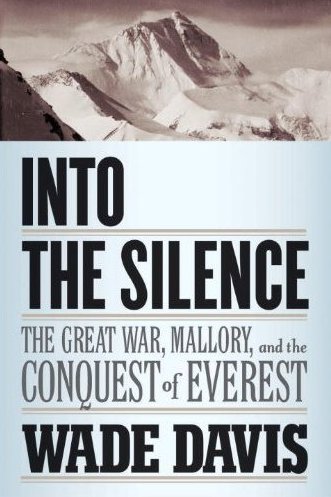
Into the Silence by Wade Davis

An epic history of adventure and adversity, of one man and a nation’s quest for redemption.

In Into the Silence, Wade Davis (The Wayfinders, The Serpent and the Rainbow) portrays several attempts to climb Mount Everest during the 1920s within the context of the state of the British Empire after the First World War. With the benefit of new access to primary sources, he begins with visceral descriptions of the Great War in all its horrifying violence, as seen through the eyes of several players in the later Everest drama, and then follows these men through the postwar numbness of a Britain that had lost the bulk of a generation. Davis makes a convincing argument that the assault on Everest was “the ultimate gesture of imperial redemption.”

George Mallory was the star of three successive attempts to summit a mountain that was at the time a complete mystery–its weather patterns and geography entirely unknown, the cultures that surrounded it viewed by the British with a misguided paternalism. Along with a host of fellow climbers, adventurers and scientists, Mallory was driven toward an accomplishment that the nation came to grasp as an outlet for its frustrations and a hopeful liberating triumph. While he was the principal character in the eyes of his contemporaries and in history, the other explorers also receive well-deserved and detailed attention in Davis’s account.

Into the Silence is a book about mountaineering and a respectable adventure epic with all the alpinist details, but it’s also so much more: a heartbreaking portrayal of war; the story of more than a dozen individuals whose lives were rocked by a war and a mountain; and finally, a history of a nation watching its own imperial era come to an end.


This review originally ran in the November 4, 2011 issue of Shelf Awareness for Readers. To subscribe, click here, and you’ll receive two issues per week of book reviews and other bookish fun!

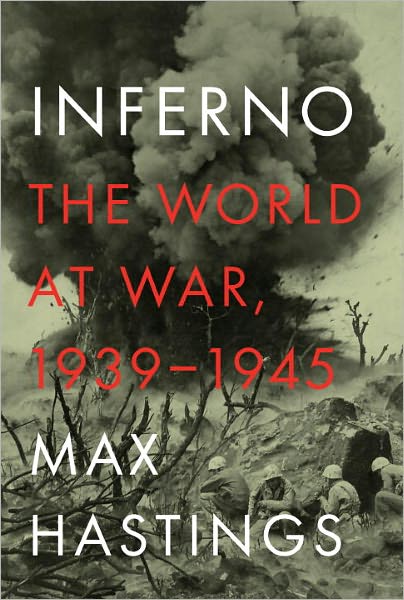
Teaser Tuesdays: Inferno: The World at War, 1939-1945 by Max Hastings

Teaser Tuesdays is a weekly bookish meme, hosted by MizB of Should Be Reading. Anyone can play along! Just open your current read to a random page and share a few sentences. Be careful not to include spoilers!

For our teaser today, from this chunky nonfiction volume of WWII, I give you the beginning of chapter 8, from page 178:

The people of the United States observed the first twenty-seven months of the struggle in Europe with mingled fascination, horror and disdain. The chief character in J.P. Marquand’s contemporary novel So Little Time says: “You could get away from the war for a little while, but not for long, because it was everywhere, even in the sunlight. It lay behind everything you said or did. You could taste it in your food, you could hear it in music.”

Perhaps not a cheerful book. But rich with history! Do you like to read books about war?

This quotation comes from an uncorrected advance proof and is subject to change.

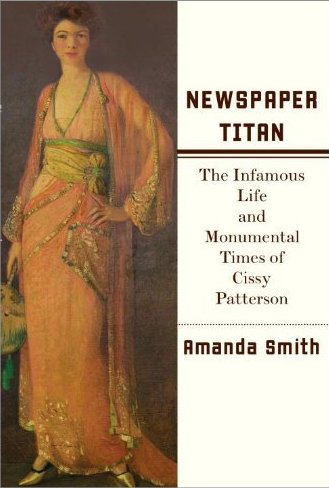
Newspaper Titan: The Infamous Life and Monumental Times of Cissy Patterson by Amanda Smith

The exhaustive–but not exhausting–biography of a complicated and difficult woman, heiress to a newspaper dynasty and a fascinating and controversial figure.

Amanda Smith’s (Hostage to Fortune: The Letters of Joseph P. Kennedy) exhaustively researched biography of Cissy Patterson begins several decades before her birth, with her grandfather Joseph Medill and his creation of the Chicago Tribune. The extended family of Medills, Pattersons and McCormicks would be newspaper royalty for several generations; but perhaps none cut a stranger figure than Cissy.

Eleanor Medill Patterson, known as Cissy, led was born in 1881 into a fractious, influential newspaper family and married a dissolute Polish count who turned out to be broke and who kidnapped their daughter, Felicia. With great effort and the interventions of powerful political figures from around the world, she regained her daughter and divorced. The countess then had a series of unsatisfying relationships and grew estranged from Felicia; published two acclaimed novels; and married a Jewish man despite her apparent anti-Semitism and eventual sympathy with the Nazi cause in World War II. Late in life, she began a newspaper career as journalist, editor and, finally, publisher and owner of the enormously successful Washington (D.C.) Times-Herald, which she created out of two failing papers. When she died in 1948, alcoholic, vindictive and erratic Cissy left a fortune, including ownership of the Times-Herald, whose disposition was held up by court battles sparked by conflicting wills and accusations of her insanity.

Called “perhaps the most powerful” and the “most hated” woman in America in the 1940s, Cissy’s fascinating and curious life is examined here in detail. But this lengthy book is never boring, because its subject is such an outrageously flamboyant and historically significant figure.


This review originally ran in the September 20, 2011 issue of Shelf Awareness for Readers. To subscribe, click here, and you’ll receive two issues per week of book reviews and other bookish fun!

Hemingway’s Boat by Paul Hendrickson

A lyrical, textured, and meticulously researched meditation on Hemingway from a fresh new angle.

Paul Hendrickson, NBCC award-winning nonfiction author for Sons of Mississippi, pulls off the remarkable feat of finding a fresh, new angle from which to approach Ernest Hemingway: his boat Pilar. Purchased in 1934 with an advance from his longtime publisher Scribner, she saw him through three wives, great achievements and critical failures in his writing career, big fish and little ones, and the beginnings and the endings of many relationships. Hendrickson suggests that Pilar may have been the love of Hemingway’s life.

This is not a biography but a careful and compassionate rumination on the man through the lens of the boat. Hendrickson has brought to his readers a Hemingway who is neither object of worship nor monster, but a full and complex human who made serious mistakes in his relationships and fought pitched battles against his own demons, and finally lost.

The Hemingway fan will be enthralled with new details of his life, and the study of figures previously treated as minor but now revealing new facets of the man. The less familiar reader will be fascinated by this comprehensive account of the master and his complex spiderweb of varied effects on so many lives, large and small. Hendrickson presents his unusual and noteworthy story with beautifully quiet intensity and contemplation. Hemingway’s Boat achieves a terrific feat in reworking Hemingway’s story.


This review originally ran in the September 23, 2011 issue of Shelf Awareness for Readers. To subscribe, click here, and you’ll receive two issues per week of book reviews and other bookish fun!


Further notes… I can’t tell you how much this book moved me. Perhaps you have noticed that pagesofjulia is a raving fan of Hemingway. I’ve read several biographies, works of literary criticism, and other spinoffs (see The Hemingway Hoax and The Paris Wife); I’m a little obsessive. But Hemingway’s Boat holds a very special place for me. Hendrickson (PH) treats Papa (EH) sort of gently, but doesn’t spare EH in his moments of monstrosity… PH comes from several different angles, interviewing different people who knew EH more or less well, unearthing some new details. PH approaches EH with the relatively unique concept that he was just a man – a great artist, but also human, with flaws and moments of everyday beauty. This book was noteworthy in all my reading of EH and the surrounding literature. It made me laugh and cry; I treasure this galley copy, where I usually pass them on as soon as I’ve turned in my review. This book alone has made my recent career as Shelf Awareness book reviewer worthwhile. (PH also recently came around here to comment on a post, which I found very exciting. Hi Paul!) I wholeheartedly recommend this book for fans of Hemingway, or of literary biography, or of well-written nonfiction, or for those looking for vignettes in Key West or Havana history.

On Bicycles ed. by Amy Walker

An exhaustive how-to manual and impassioned plea on behalf of riding bicycles for transportation and as a way of life.

Editor Amy Walker is joined by some 30 authors–policy-makers, researchers, business owners, activists, parents and/or cyclists–in this instructive manual. On Bicycles is not concerned with colorful Spandex, racing bikes or speed. Rather, this is a handbook for North Americans who want to use bicycles for commuting, transportation and fun.

The book covers a range of subjects and possible needs. First, why we ride: for better health, for the environment, for a better connection with our communities. Next, chapters cover what gear is needed, how to ride safely in various conditions, how to make the transition away from the car; how to transport kids by bike and how to get them on bikes themselves; how to use a bicycle for cargo needs; different kinds of bicycles; community services and connections including and beyond the retail bike shop; and redesigning our infrastructure and culture to allow for more and better biking. Your experienced-cyclist-and-book-reviewer learned new things; the novice rider will be thoroughly equipped with information and empowered by the enthusiasm pouring off these pages.

Walker’s examples come largely from that exemplary bike town, Portland, Ore., and some of her discussion feels a bit removed for cyclists in, say, Houston–but her arguments and advice are more, rather than less, relevant for cities (and riders) with further to go before reaching cycling nirvana. The only caveat: if you are in the camp that occasionally resents Portland’s reputed smugness, you may find a touch of that here. But it might be worth the stellar and scrupulous advice.


This review originally ran in the September 20, 2011 issue of Shelf Awareness for Readers. To subscribe, click here, and you’ll receive two issues per week of book reviews and other bookish fun!

fiction vs. non

I’ve talked a few times recently here at pagesofjulia about fiction and nonfiction. (See for example my discussion of the value of fiction.) Most recently, in my review of In Cold Blood, I ponder the fine line between the two. Sometimes it’s difficult to tell. How do we draw the line? Here at the library, for cataloging purposes, I use OCLC’s bibliographic record; but there is often room for debate. Ernest Hemingway (obviously) is my go-to example of an author of fiction which is so highly autobiographical as to raise eyebrows; and for that matter, he was also an author of nonfiction that may have fudged here and there (i.e. his journalism in times of war in which he claimed a heroic or brave role for himself). And then there are the James Freys and Greg Mortensons of the world, who claimed to be writing nonfiction and later were accused of either smudging their facts or wholly making things up. So, my point is, the line between fiction and nonfiction (a) can be fuzzy and (b) is an important line to be aware of – even when we can’t draw it firmly.

I came across a short article the other day that I want to share it with you here. Robert Gray’s column at Shelf Awareness, is called “Deeper Understanding.” He recently wrote Conquering Our National Fear of Fiction, in which he notes that President Obama has been criticized for reading fiction. He then makes arguments – and quotes studies – in favor of reading fiction for education, and for improving ourselves. His message is one I definitely get behind (again, see my discussion of the value of fiction).

I love reading nonfiction. I think I love it more every year. There’s so much in the history of our world – and in what’s happening in our world today – that’s fascinating and that we should be aware of. Of course, I’m not doing an exceptional job of keeping up on everything. There’s too much to know. But I do enjoy nonfiction. In fact, I feel like I’ve read an awful lot of it this year – but when I look back at my Books Read log, I see that fiction still massively outnumbers nonfiction. Maybe I had a misconception because so much of the fiction I read is very short, and some of nonfiction is quite long, so the time spent on each might be closer to equal… maybe I’m making excuses. My point is, I have nothing against nonfiction, and should read more than I do. But! Fiction! Not an ugly stepchild at all!

So, for discussion here if you please: Do you read mostly fiction, or non? What is the value of each? In other words, is fiction frivolous and nonfiction valuable, or does fiction have a great deal to offer us as people, as a society? Why? What authors have you come across who smudge the line between the two? How strongly do you feel about defining the line, and how do you go about it? For example, is In Cold Blood fiction or non? Or some strange hybrid?


For your reference, I’ve linked here to a few of my favorite nonfiction reads of the last year or two…
Around the World on Two Wheels: Annie Londonderry’s Extraordinary Ride, Peter Zheutlin
Dethroning the King, Julie Macintosh
The Devil in the White City, Erik Larson
Fire Season, Philip Connors
Heroine’s Bookshelf, Erin Blakemore
Iphigenia in Forest Hills, Janet Malcolm
Mr. Playboy, Steven Watts
Hemingway’s Boat, Paul Hendrickson
Newspaper Titan by Amanda Smith

book beginnings on Friday: Into the Silence by Wade Davis


Thanks to Katy at A Few More Pages for hosting this meme. To participate, share the first line or two of the book you are currently reading and, if you feel so moved, let us know what your first impressions were based on that first line.

Into the Silence: The Great War, Mallory, and the Conquest of Everest appears to be a largeish, well-researched, exhaustive coverage of its three overlapping subjects. I’m just a bit into it but am finding it to be gripping, and painful in its discussions of the tragedy that was WWI. You know, I feel like we say this about just about all the wars (and rightfully), but what an awful thing it was…

I am going to give you a double beginning today. The prologue:

On the morning of June 6, 1924, at a camp perched at 23,000 feet on an ice ledge high above the East Rongbuk Glacier and just below the lip of Everest’s North Col, expedition leader Lieutenant Colonel Edward Norton said farewell to two men about the make a final desperate attempt for the summit. At thirty-seven, George Leigh Mallory was Britain’s most illustrious climber.

And chapter one:

On the very day that George Mallory and Sandy Irvine disappeared on Everest, another party of British climbers slowly made their way to the summit of a quite different mountain and in very different circumstances. At 2,949 feet, Great Gable was not a serious or difficult climb, but it was said to be “the most completely beautiful of English mountains.”

So you can see the juxtaposition set up. I find this to be an effective way of linking his topics (see the subtitle) right from the start.

A word on nonfiction book beginnings: Unlike in fiction, where I feel the first lines should always grab or surprise the reader and interest her, I think nonfiction can take one of two routes. I do like to be grabbed in the first lines, of course, and extra points are given for this. But it’s extra credit, not required work. Sometimes nonfiction begins quietly, stating a date, a place, arranging a background, and this I find effective, too. Somehow, with nonfiction, I’m comfortable settling into things with this understated approach, which I think the above falls into.

What are your thoughts? And what are you reading this weekend?

These quotations come from an uncorrected advance proof and are subject to change.