book beginnings on Friday: My Life as Laura by Kelly Kathleen Ferguson

Thanks to Katy at A Few More Pages for hosting this meme. To participate, share the first line or two of the book you are currently reading and, if you feel so moved, let us know what your first impressions were based on that first line.

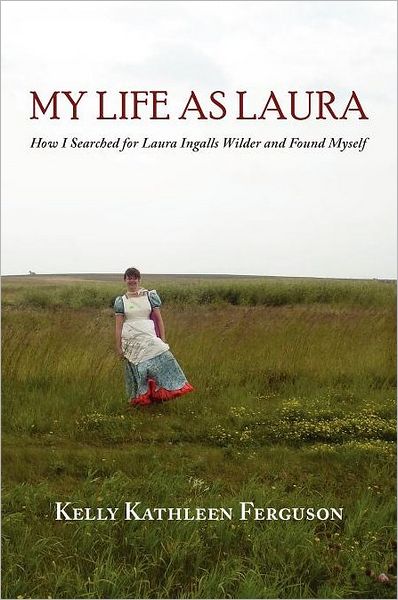
Today I’m giving you the beginning of My Life as Laura, a memoir of Kelly Kathleen Ferguson’s journey in the footsteps of Laura Ingalls Wilder as given in her Little House books. She begins:

I admit that the origin of the dress mandate was fuzzy at best. All I can say is the instant I decided to retrace the pioneer journey of Laura Ingalls Wilder, I knew I would wear a Laura dress.

And thus we meet the dress and begin the journey. I’ll keep you posted!

What are you reading this weekend?

A Room of One’s Own by Virginia Woolf

A Room of One’s Own is a compilation and expansion of two papers Virginia Woolf presented in response to the prompt, “Women and Fiction.” It’s an essay of just over 100 pages, in my edition, in which she meditates on the subject, does a little research, and muses as to what we can expect from women in the world of fiction, what we’ve gotten from them in the past, and why. The final conclusion drawn, which forms the title, is that if a woman has five hundred a year and a room of her own she can be another Shakespeare. She points out that these requirements are symbolic: “five hundred a year stands for the power to contemplate… a lock on the door means the power to think for oneself.” She acknowledges that her demands are rather materialistic, and defends them by pointing out that resources are required for great art, that all our greatest artists and poets have been (almost entirely) men of means.

She makes some interesting arguments about the differences between men and women, and claims that women shouldn’t try to write like men; we are different, she says, and shouldn’t try to be the same. I guess this is a liberating argument in some ways, and I certainly agree that women shouldn’t try to be men; but in some ways this argument strikes me in a separate-but-equal fashion. I don’t necessarily appreciate having the “innate” differences harped upon, between sexes or ethnic groups or any of it. Part of celebrating diversity is about recognizing the diversity of the different groups, meaning their innate differences, yes, but part of tolerance and acceptance of diversity is about acknowledging our basic sameness too, right? It actually reminded me a little bit of VS Naipaul’s extraordinary and controversial remarks about female writers last year. Some of the response to his ignorant statement that women writers are always inferior to men came in the form of quizzes where, given a short excerpt of writing, the quiz-taker was to guess the writer’s sex. We all got a lot of them wrong, proving that a good writer is not necessarily a “woman writer” or a “man writer” but just a writer, which is a position I tend to agree with. (Same goes for poor writers, too, of course.) It’s odd to me that she also spends a certain amount of time exhorting women not to react to men’s exclusion or prejudice, but to write, as it were, in a vacuum, to not let the “opposition” color their work – either by apologizing or aggressing. Also a strong point, but seemingly a little at odds with her “women are different” point, perhaps. I got a little muddled here.

All in all I did not have the reaction to A Room of One’s Own that I expected to. I wholeheartedly applaud her basic sentiments, and I respect her for being the female writer in the face of male disapproval that she was. But some of her arguments got a little bit questionable to me; I suspect they may be a little dated. The course of the essay, too, was a touch rambling for my taste. As a persuasive essay it was a little more poetic and meandering than I was expecting. Is this slightly genre-bending? Maybe I came at it from a strange angle. At any rate, I respect it, I enjoyed it somewhat, and I congratulate Woolf; but I was not enraptured.

Teaser Tuesdays: A Room of One’s Own by Virginia Woolf

Teaser Tuesdays is a weekly bookish meme, hosted by MizB of Should Be Reading. Anyone can play along! Just open your current read to a random page and share a few sentences. Be careful not to include spoilers!

From Woolf’s famous essay on women and fiction, how’s this for a turn of phrase:

…it is doubtful whether poetry can come out of an incubator. The Fascist poem, one may fear, will be a horrid little abortion such as one sees in a glass jar in the museum of some county town.

Eye-catching and evocative! Poetry as abortion! Might be fitting imagery for the odd concept of “fascist poetry,” though. Woolf has some interesting points, I will say that for her.

What are you reading today?

Spokesongs: Bicycle Adventures on Three Continents by Willie Weir

This slim (140-page) volume is less traditional travel memoir and more a series of one-to-two page reports on individual experiences, or meditations on what it means to be a cycle-tourist in underdeveloped areas. The eponymous three “continents” of India, South Africa and the Balkans make up only a small portion of Weir’s experience as a cyclist and as a cycle-tourist (that is, someone traveling by bicycle). He also has experience as a bicycle courier in Seattle, something which will always increase credibility in my eyes. (I did the same in Houston for a few years, in an earlier life.) He calls his brief vignettes “verbal songs of the road,” which I think is a nice turn of phrase.

Each episode or anecdote tells a very simple, brief story; as a whole they don’t make up much of a sum narrative, which is not a criticism. This could be a coffee-table book, to be picked up time and again at random. It’s very easy, an effortless glimpse into one man’s adventures, with a touch of a love story coming in at the end. The writing isn’t sophisticated (nor even consistently correct, grammatically) but it’s sweet, and it’s real. While there are certainly far more complete, involved stories of bicycle adventures of various kinds, this might be the simplest to enjoy and one of the briefest. It was a gift from our buddy Fil to Husband, the Not-Reader, and I think it actually has a chance of being read by him, at least in parts, which is saying something. I recommend it for what it is: a brief look at cycle-touring in the developing world, or a collection of brief, captivating experiences.

The Castrato and His Wife by Helen Berry

An intriguing story of a castrato’s unprecedented marriage and its implications for society at large.


Giusto Ferdinando Tenducci was an 18th-century Italian opera singer and a celebrity in England. Part of his mystique and mystery, and the reason both for his reportedly divine voice and his unusual social standing, was his status as a castrato. Tenducci had been castrated as a young boy in the hopes that he would make his fortune out of his singing. As historian Helen Berry explains, a surprising number of Italian youths underwent this dangerous operation in Tenducci’s day, although (like today’s hopeful rock stars) few actually succeeded. Tenducci not only beat the odds by making a (sometimes tenuous) fortune in opera, but also accomplished a surprising feat: he married a young English girl of good family.

The Castrato and His Wife is the story of that brief marriage and its annulment in an extremely curious extended legal case. It is also the story of Italian opera in the 1700s, both as an institution and as a business; of castration and its relationship with the Catholic Church; and of the institution of marriage and society’s changing concepts thereof. Berry’s prose can be a touch long-winded and academic at times, but Tenducci’s heart-wrenching story is unusual and evocative. Berry addresses a topic we still find mysterious, and Tenducci’s distinctive situation is surprisingly relevant to the ongoing question of what constitutes legal marriage.


This review originally ran in the January 6, 2012 issue of Shelf Awareness for Readers. To subscribe, click here, and you’ll receive two issues per week of book reviews and other bookish fun!

book beginnings on Friday: The First Lady of Fleet Street by Eilat Negev and Yehuda Koren

Thanks to Katy at A Few More Pages for hosting this meme. To participate, share the first line or two of the book you are currently reading and, if you feel so moved, let us know what your first impressions were based on that first line.

Today I’m reading The First Lady of Fleet Street: The Life of Rachel Beer: Crusading Heiress and Newspaper Pioneer. I’m intrigued for several reasons: I tend to appreciate biographies of semi-obscure figures (if they’re well done, which I can’t yet judge of this one); this will be my second newspaperwoman biography of the year (here‘s the first); and I like Rachel’s last name. 🙂 The book begins with a prologue:

Late May 1903. Earl’s Court, a two-storey stone mansion in Tunbridge Wells.

A slight woman sits erect in her chair, nearly swallowed by her weighty crepe mourning dress. Heavily framed mirrors, priceless paintings, dim-gilt Chinese cabinets, and fresh lilies and orchids adorn every inch of the spacious drawing room.

Well done, I say, and I am optimistic.

What are you reading this weekend?

This quotation comes from an uncorrected advance proof and is subject to change.

Italian Racing Bicycles by Guido Rubino

A beautiful book of pictures and stories about everything related to the fine art of Italian race bikes.

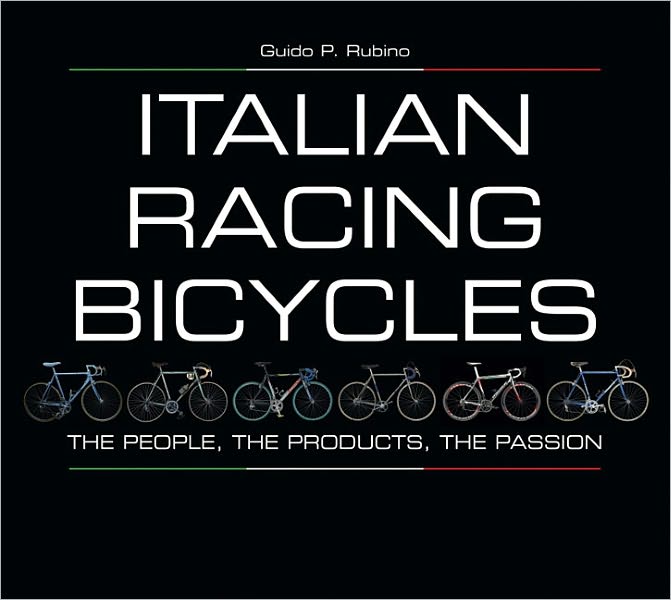
Passionate fans of Italian bicycles, professional bicycle racing, the history of the sport and/or fine craftsmanship must add Italian Racing Bicycles to their collections. It’s not just about bicycles, as the title suggests, but about the companies that made (and still make) them and about the Italian cyclists who ride competitively. Top-of-the-line Italian bikes are works of art as well as masterpieces of function, and Guido Rubino considers 40 of the finest manufacturers: their histories, likely futures, personalities and history-making products. The indispensable Colnago, Campagnolo and Bianchi brands are covered, as are the men who originally bore those names. Racing greats such as Coppi, Pantani, Sarroni and Bartali, whose performances helped establish the legacies of these companies, receive well-deserved attention here as well (along with select non-Italians like Eddy Merckx). Plenty of beautiful pictures complete this lovely coffee-table book.


This review originally ran in the December 6, 2011 issue of Shelf Awareness for Readers. To subscribe, click here, and you’ll receive two issues per week of book reviews and other bookish fun!

Medal of Honor: Portraits of Valor Beyond the Call of Duty

A respectful and compelling salute to Medal of Honor winners through brief profiles and striking portraits.

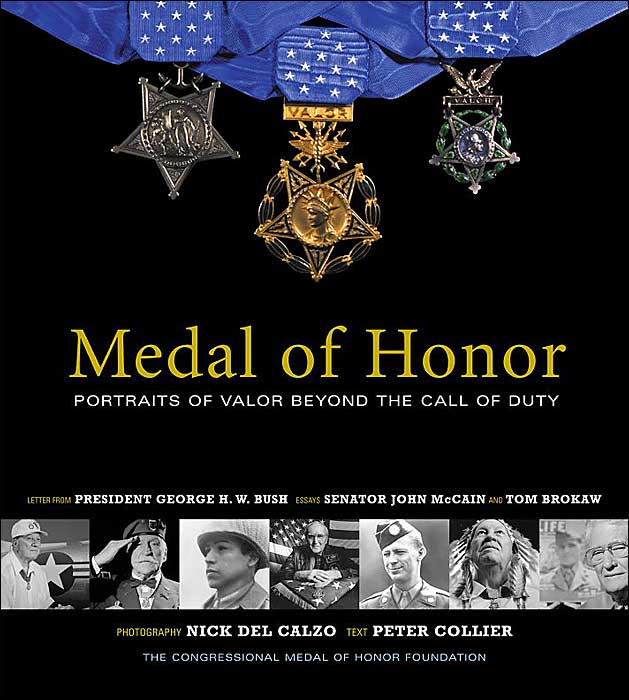
Medal of Honor begins with a thoughtful, detailed yet succinct history of the Congressional Medal of Honor, providing an excellent introduction to the subject; later chapters include letters from every living U.S. president and short essays on wars from World War II through Afghanistan. But Peter Collier’s real achievement lies in the 144 profiles of Medal of Honor recipients, representing every branch of the military, accompanied by Nick Del Calzo’s stunningly beautiful photographic portraits. Collier’s profiles tell of the circumstances leading to each citation, along with details of the recipients’ lives that illuminate themes of humility, friendship and service. With one page devoted to each, Medal of Honor makes for easy coffee-table reading, and it’s tempting to read them all in one sitting. This incredibly touching commemoration transcends politics to celebrate the contributions of brave, and selfless individuals in simple, glowing stories.


This review originally ran in the December 6, 2011 issue of Shelf Awareness for Readers. To subscribe, click here, and you’ll receive two issues per week of book reviews and other bookish fun!

The Autobiography of Benjamin Franklin

I have heard that this was an important, well-written and interesting autobiography. I don’t recall where I heard it, but I made a note and it stuck in my head. So I found the audiobook and gave it a try.

What I learned was a more detailed version of what I knew: Benjamin Franklin was an interesting, hard-working, thoughtful man who helped shape our nation’s history. He was an indentured servant, a runaway, a businessman, an entrepreneur, a diplomat, a politician, an inventor, an author, a militiaman, a scholar and a philosopher, and a father. He invented many items, large and small, that improved the everyday life of people in his time, showing an intelligence and curiosity about how things work that I admire. He was also instrumental in beginning both a school (which became both the University of Pennsylvania, and a free school for poor kids) and a public hospital in his adopted hometown of Philadelphia. He did a lot of good things and had some interesting ideas. He was a moralist, and wrote tracts in which he espoused a “right way” of living.

The style of his autobiography is unfortunately stiff and pompous, though. I think that perhaps the narration of my Mission Audio edition didn’t help. The language in which this book was written is necessarily dated and sounds odd to the modern ear; but if today’s actors can make Shakespeare palatable, for gosh sake, you’d think they could have found a narrator who would bring Franklin to life, too. Instead they went with a sort of whuffling, sedate, staid voice that emphasized not this senior statesman’s timeless wisdom and accessibility – which I think might be there, hidden in the text – but the distance from which he speaks. The long pauses and bombastic tone went a long way towards ruining this experience for me.

I didn’t enjoy this autobiography at all, which was a disappointment. Actually I’m not quite sure why I finished it (Husband asked, and I couldn’t answer); maybe I had that much faith in the long-lost recommendation, or maybe I was just mesmerized by the monotonous narration… I didn’t even get the consolation of learning new bits about Franklin. I came away with the same vague notion of who he was and what his legacy was that I’d started with. For educational purposes, I actually got more out of the “timeline of his life” appended at the end than I did out of the bulk of the book. I feel that the autobiography itself was probably flawed, in that it leans towards anecdotes of little consequence, moralizing, and self-congratulations. But the narration was the final straw. Unfortunately I cannot recommend this book; and if you do decide to seek it out (in which case, let me know if it goes any better for you!), for the love of Dog, avoid the Mission Audio version.

Teaser Tuesdays: The Autobiography of Benjamin Franklin

Teaser Tuesdays is a weekly bookish meme, hosted by MizB of Should Be Reading. Anyone can play along! Just open your current read to a random page and share a few sentences. Be careful not to include spoilers!


I’ve chosen you a teaser today from Benjamin Franklin’s Autobiography, which I’ve heard repeatedly is worth reading.

I disliked the trade [his father’s, of being a tallow-chandler or candle-maker], and had a strong inclination for the sea, but my father declared against it; however, living near the water, I was much in and about it, learnt early to swim well, and to manage boats; and when in a boat or canoe with other boys, I was commonly allowed to govern, especially in any case of difficulty; and upon other occasions I was generally a leader among the boys, and sometimes led them into scrapes, of which I will mention one instance, as it shows an early projecting public spirit, tho’ not then justly conducted.

He then goes on to explain that, needing a wharf to fish off of to keep their feet out of the mud, he and the other local boys – at his urging – purloined some building supplies from a nearby construction site and built themselves a stone wharf. They do get caught.