book beginnings on Friday: The Great Psychedelic Armadillo Picnic by Kinky Friedman

Thanks to Rose City Reader for hosting this meme. To participate, share the first line or two of the book you are currently reading and, if you feel so moved, let us know what your first impressions were based on that first line.

Here’s an odd little nonfiction mashup, if I can say that, by an odd Texas personality. It is subtitled, “a ‘walk’ in Austin,” and it begins:

Time, they say, changes the river. Time changes the city, too. Over the years, many people have helped Austin to shine in the spotlight, bask in the limelight, and skinny-dip in the moonlight.

Welcome to Austin, Texas, which has birthed the Republic of Texas, Janis Joplin (okay, she was born in Orange, but Austin helped bring her up), Willie Nelson, and (shudder) George W. Bush. Kinky Friedman is an appropriately eccentric guide. What are you reading this weekend?

To the Last Breath by Francis Slakey

What begins as a self-satisfied adventure story becomes an account of personal transformation.

Francis Slakey was a physics professor at Georgetown University who paid more attention to his blackboard than he did to his students. He described himself as withdrawn and considered it a good thing. Then, as he tells it in his memoir, To the Last Breath, a chip on his shoulder sends him hunting a world record. His goal–to climb the highest peak on every continent and surf every ocean–was intended to be a physical test, a self-absorbed, even narcissistic pursuit of excellence in sport.

Along the way, though, Slakey experiences many cultures, flirts with spiritual enlightenment and comes to suspect that seeming coincidences along the way mean something. The physical challenge turns out to be the least significant aspect of his journey, as the threat of guerrilla warfare becomes as real as the fear of falling off a cliff. Slakey ends up changing his ideas about what matters most in life; his experiences with the power of nature and the power of human contact turn his world upside down–for the better.

Slakey brings a scientist’s matter-of-fact treatment to a tale of international travel and cultural interaction. He transports his reader to Yosemite, Kilimanjaro and Everest (as well as Antarctica), encounters violence in Indonesia and terrifying driving habits in Morocco and returns home more intact than he began. A love story, an athletic journey, an introspective process of discovery, To the Last Breath is Slakey’s evolution.


This review originally ran as a *starred review* in the May 22, 2012 issue of Shelf Awareness for Readers. To subscribe, click here, and you’ll receive two issues per week of book reviews and other bookish fun!


Rating: 5 mountains scaled.

A Queer and Pleasant Danger: The True Story of a Nice Jewish Boy who Joins the Church of Scientology and Leaves Twelve Years Later to Become the Lovely Lady She is Today by Kate Bornstein

A radical gender theorist and performance artist’s memoir makes its eye-catching subtitle look staid.


Kate Bornstein started life as Albert, a Jewish kid on the Jersey shore who knew when he was four and a half years old that he wasn’t a boy. Bornstein’s path was predictably complicated from there, but the lengthy list of problems she lists in her prologue astounds: she suffers from leukemia as well as anorexia, borderline personality disorder, post-traumatic stress syndrome and a history of cutting; she’s a sadomasochist, a transsexual and a former member of the Church of Scientology. Furthermore, A Queer and Pleasant Danger states from the outset its purpose of hopefully someday introducing Kate to her daughter and grandchildren, currently estranged.

If this list of disorders and minority statuses sounds alarming, never fear. Bornstein is funny, flippant, irreverent and witty. We follow Albert as a child in Jersey, a student at Brown, post-graduate studies in theater at Brandeis and the search for meaning that brought him to Scientology; then on his journey to become Kate, through a new life in San Francisco, Seattle and finally New York, with a series of relationships of every arrangement imaginable (and unimaginable). She generally has a good time, especially after becoming Kate, and her story ends on a positive note. Her tone is most serious in discussing the world of Scientology, which she presents as decidedly distressing and wacky, but her voice overall is impertinent and great fun. A Queer and Pleasant Danger is not for the faint-hearted, for reasons that become fairly evident (see: sadomasochism), but is ultimately uplifting, hopeful, even joyous–and always droll.


This review originally ran in the May 11, 2012 issue of Shelf Awareness for Readers. To subscribe, click here, and you’ll receive two issues per week of book reviews and other bookish fun!


Rating: 6 upheavals.

A Difficult Woman: The Challenging Life and Times of Lillian Hellman by Alice Kessler-Harris

Lillian Hellman’s paradoxical, powerful personality set against the backdrop of a turbulent century.

Lillian Hellman (1905-1984) was many things: a successful playwright, screenwriter and memoirist; a suspected Communist (maligned as an unrepentant Stalinist) who stood up against political intimidation in the 1950s; a labor organizer and civil rights activist; partner to Dashiell Hammett for more than 30 years; a woman criticized for being manlike and grasping, but simultaneously overly feminine and stylish; a New Orleans-born resident of New York, Hollywood and Martha’s Vineyard who persisted in calling herself a Southerner. She was respected for her literary contributions, hailed as a hero by a feminist movement that she largely rejected, praised and excoriated for her politics and, ultimately, vilified for what came to be seen as the outrageous mendacity of her memoirs. It would be difficult to locate a biographical subject more contradictory or complex. In A Difficult Woman, Alice Kessler-Harris makes an excellent case that Hellman represents the complexities and changing mores of the 20th century.

The contradictions in her personality and politics are brought into relief by her written work–including plays still popular in repertory theater today–which always included strong moral statements. The concepts of truth and deception, or betrayal and loyalty, play large roles in her work and this insightful biography, rich with context, shows how they were also themes that defined her life. Not an apologia, but an exploration of nuances, A Difficult Woman gives us an infinitely more complex Hellman than the popular image that has survived her.


This review originally ran in the May 1, 2012 issue of Shelf Awareness for Readers. To subscribe, click here, and you’ll receive two issues per week of book reviews and other bookish fun!


Rating: 9 ambiguities.

did not finish: The Bar Mitzvah and the Beast by Matt Biers-Ariel

I tried to read this on my trip to Ireland and gave up. Just a few brief notes as to why.

Backstory: the author’s son, at twelve, states that he will not be having a bar mitzvah because he is an atheist. The author still wants him to have a coming-of-age event, and suggest a cycling trip cross-country. Mom, Dad and both sons (the younger is 8 and will ride on the back of his dad’s tandem) start planning, and undertake a cause to attach to the trip: they will ride to Washington, D.C. gathering signatures on a petition to do something about global warming. My interest, of course, is in the cycling angle.

But Biers-Ariel failed to make me care about his admittedly heartfelt and well-meaning journey. The hope for anti-global-warming legislation is sympathetic, but a bit naive. Prosaic prose, simplified concepts, and jokes that fell flat wore on me; I read 53 pages, didn’t care what happened next, and was annoyed by author’s voice, but I wish him well. Did the family make it? You’ll have to read the book to find out for yourself.

Walking It Off by Doug Peacock

My path to this book feels so very obvious: I have become a big fan of Edward Abbey, and of The Monkey Wrench Gang, and it seems a very natural step to pick up Walking It Off. Peacock was one of Abbey’s closest friends, viewed him as a father figure of sorts, and this memoir focuses in part on their relationship, which was made pricklier by publication of The Monkey Wrench Gang: Peacock was the model for the hero-character George Hayduke, making Peacock a cult figure unto himself. Therefore nothing could be more natural, as I read up on Abbey and his ilk, than to read Peacock. I wonder how many people come to Walking It Off on other paths? There are other paths, of course. First of all, I must give Peacock credit for being a gifted writer himself; it’s not just that he has a powerful story to tell. Nor is Abbey the only object of consideration here; another subject is Peacock’s experience as a Green Beret in Vietnam (which he shares with Hayduke, of course) and the PTSD he suffers ever after. And finally, it is a lovely piece of nature writing, and a contemplation of death – not for the first time am I reminded of Hemingway, who like Abbey spent much time and ink meditating on the meaning of death, preparation for a “good” death, and considering suicide.

The subtitle of this book is “A Veteran’s Chronicle of War and Wilderness,” and that it is. Abbey is a thread that Peacock picks up and puts down, but more constantly, we follow him through wilderness walks and his process of trying to live with what he experienced in Vietnam. I would not have thought that there would be such a connection between war and wilderness, but it makes sense now that I’ve read this book.

After my war, home was the Rocky Mountains. I wasn’t looking for grizzlies but found them anyway. What was invaluable was the way the bears dominated the psychic landscape. After Vietnam, nothing less would anchor the attention. The grizzly instilled enforced humility; you were living with a creature of great beauty married to mystery who could chew your ass off anytime it chose.

Over the course of this memoir, Peacock walks and camps in various wild spaces; we jump around in time, revisiting a mountain-climbing trip in Nepal that nearly killed him. We revisit Abbey, too; early on, Peacock describes Abbey’s death in a fair amount of detail, and the burial, and the conflict of not wanting to let go of a dearly beloved friend who was more ready for his own death than Peacock was ready to lose him. Later, he remembers Abbey, reads some of his journal passages for the first time, and finally, many years after its publication, he struggles to read Hayduke Lives!, the sequel to The Monkey Wrench Gang. But it turns out that Abbey plays a smaller role than I had perhaps expected, and that is more than okay, because this book has so much to offer. I’m doing my own considering of wilderness, its value to us urbanized humanfolk, and the appropriate treatment of our natural spaces, and Peacock gave me still more to think about. From Aldo Leopold’s A Sand County Almanac:

All conservation of wildness is self-defeating, for to cherish we must see and fondle, and when enough have seen and fondled, there is no wilderness left to cherish.

Which is a very fair point about limiting our use. From Peacock:

You don’t visit the Grizzly Hilton for the salve of gentle nature, a relief from your real life at the office. Here, you live within the land with all its creatures; you engage with it. You have no choice in this realm but to enter the ancient flow of life. This is not the sort of place to compose a wilderness journal of self-reflection.

The Grizzly Hilton is Peacock’s name for a tiny haven of perfect grizzly habitat that he likes to visit; his first book was the result of many years studying the bears, called Grizzly Years and recommended by Phil Connors. Virtually all the action in this book takes place in wilderness areas, on wilderness walks, most of them solo; it’s only inside Peacock’s head, in his contemplation, that we see war, Abbey, other options. We see his first marriage end, and we see him struggle to be the best father he can be. Peacock is a difficult character, a difficult man. How much of this we attribute to the PTSD is I suppose a cause for debate; I would imagine a lot, but perhaps it’s a moot point.

The aging warrior was weary of his own predictable behaviors and emotional tightness fueled by senseless rage. I detested this legacy of anger and, aware that its deeper roots lay in war, knew it wouldn’t be easy to shake. I wanted to stalk this elusive center, using my primitive tools of self-examination – walking, solitude, wildness – to reach back in and touch the source of my wound. Of course I was a poor candidate for a meditative life. My life was a catalogue of psychotic twitches and addictions: official government-sanctioned post-traumatic stress disorder, a combat disability, borderline attention deficit disorder, marginal Tourette’s syndrome, occasional depression, a borderline schizoid paranoiac, a history of alcohol abuse. Guys like that don’t become Zen masters.

But it’s funny, because in a way he does offer Zen. Peacock’s musings on wilderness are thoughtful, beautifully composed, and rooted in history, considerate of ancient cultures and of differences. This is an intelligent book, a lovely consideration of war and its ugliness and also nature and its beauty – and, as a necessary corollary, the ugliness again of humans’ and industry’s effects on nature. Walking It Off is Peacock’s continuing quest for redemption and peace. It is much better than I expected, and I recommend it.


Rating: 9 grizzly bears.

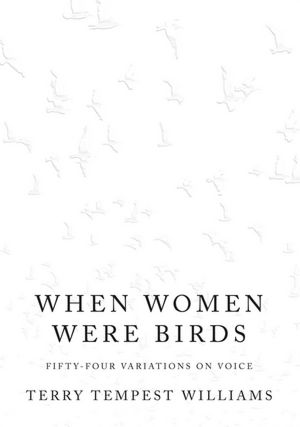
When Women Were Birds by Terry Tempest Williams

Terry Tempest Williams’s thoughtful, melodious meditations on the contents of her mother’s journals.


Terry Tempest Williams (Leap, Refuge, etc.) approaches a very personal subject in When Women Were Birds. The opening scene sets the stage: Williams’s mother, on her deathbed, directs Williams to her journals (of which the author was unaware). They turn out to be empty–and the rest of the book is a series of ruminations on this mystery.

Williams contemplates the meaning of a person’s (or more specifically, a woman’s) “voice,” in the sense in which a writer might use the term and in its more literal sense. She contemplates mothers and daughters and the meaning of their relationship, sharing some of the traditions of her own family and of the Mormon faith in which she was brought up. She also shares anecdotes from her marriage, so that the book follows her (in nonlinear fashion) from her foremothers through her childhood and into the present. There are lots of women in this book, as well as lots of birds. Williams touches on serious topics–including abortion, environmental activism and ax murderers–but always with a respectful, quiet, lyrical tone.

Often as much poetry as prose, and full of lists, quotations and letters, When Women Were Birds is truly a tribute to several generations of the strong, inspiring and interesting women of Williams’s tribe. It is a loving creation, showing all the musical, reflective intelligence we expect from Williams, and a lovely example of her own voice.


This review originally ran in the April 20, 2012 issue of Shelf Awareness for Readers. To subscribe, click here, and you’ll receive two issues per week of book reviews and other bookish fun!


Rating: 7 pagesofjulia.

Aldo Leopold on divine power

The Lord giveth, and the Lord taketh away, but He is no longer the only one to do so. When some remote ancestor of ours invented the shovel, he became a giver: he could plant a tree. And when the axe was invented, he became a taker: he could chop it down. Whoever owns land has thus assumed, whether he knows it or not, the divine functions of creating and destroying plants.

Other ancestors, less remote, have since invented other tools, but each of these, upon close scrutiny, proves to be either an elaboration of, or an accessory to, the original pair of basic implements. We classify ourselves into vocations, each of which either wields some particular tool, or sells it, or repairs it, or sharpens it, or dispenses advice on how to do so; by such division of labors we avoid responsibility for the misuse of any tool save our own. But there is one vocation – philosophy – which knows that all men, by what they think about and wish for, in effect wield all tools. It knows that men thus determine, by their manner of thinking and wishing, whether it is worth while to wield any.

–from “Axe-in-Hand”, A Sand County Almanac

I like this understanding of our power. We humans have armed ourselves with such tools of creation and destruction that we wield an almost divine power; and with this power has come the responsibility to use it wisely. This may be where we are in danger of going fatally awry. I also like the definition of philosophy. And finally, isn’t this a lovely sample of his thoughtful writing? I highly recommend A Sand County Almanac.

A Sand County Almanac: With Essays on Conservation by Aldo Leopold

First, let me say a word about this edition. I requested A Sand County Almanac from my local public library, and took what they gave me. It was only by luck (or, more to the point, the wise purchasing decisions of said library) that I got this lovely anniversary edition, with introduction by Charles W. Schwartz and photographs by Michael Sewell. The introduction explains that Schwartz & Sewell spent time on Leopold’s ranch, the place where Leopold wrote, and that he wrote about; all the photographs were taken either on the ranch or in the surrounding environs (where Leopold wandered as well). If you can get a hold of this edition, by all means DO: the photos are to die for, and really add something to the text itself, and I found Schwartz’s introduction to be helpful in placing, and appreciating, Leopold’s work. I’m not completely clear on what’s included in every edition of the title ‘A Sand County Almanac‘, so please ‘scuse my ignorance, but this edition did include two essays following the twelve-month formatted almanac: “Marshland Elegy” and “The Land Ethic.” I’m not sure they’re included in every edition.

I was drawn to this book by its place in the genre of literary nature writings that I am recently enamored of; starting with Fire Season of course, which then led me through Edward Abbey and miscellaneous others. It was also recommended on the Gila National Forest’s recommended reading page (scroll to bottom), which I’ve been referencing in preparation for a trip there this summer.

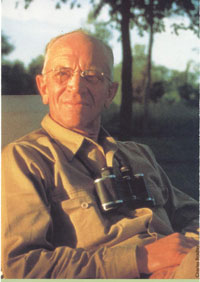
Aldo Leopold was an pioneer in the conservation and restoration movement, early in the definition and creation of ecology or environmentalism. His Almanac belongs in line with the works of Muir, Thoreau, Rachel Carson, and Edward Abbey. This is a beautiful book. Leopold is among the best of his genre: he writes lyrically, passionately, bringing to life and recognition the smallest and most seemingly insignificant pieces of his world. There is humor, celebration, and thoughtful consideration and development of a philosophy for the burgeoning movement; Leopold is one of its fathers, without question (see Schwartz’s discussion in the introduction of how far his influence extends today). This book is filled with calls to action, as well as quiet, reverent praise and celebration of the minutest members of the natural world.

Leopold writes from his ranch in the “sand counties” of Wisconsin, where he dedicated himself on weekends to restoring the land and its inhabitants to their previous state of nature, before agriculture, cattle ranching, and industry encroached. Schwartz’s introduction emphasizes that Leopold’s great work on conservation and restoration is now perhaps best applicable to restoration, as “almost all the wilderness that can be saved has been saved. For the duration of our time on the planet – for whatever piece of eternity we have left here – restoration will be the great task” (Schwartz). Leopold was quite successful on the 120 acres under his care. “On the road to extinction, traffic travels both ways,” writes Schwartz, noting the repopulation of sandhill cranes in the state of Wisconsin since Leopold’s day.

The loving and thoughtful process Leopold undertook on this ranch is contemplated in this book, first in twelve month-chapters, January – December, in which he describes what he sees and discusses the significance of the passing seasons, the migrations of the sandhill cranes, the felling of “the good oak.” Thus the reader is let inside the process, not only of Leopold’s growing and maturing love for his world, but of the development of ecological philosophy. As Schwartz points out, the philosophy has continued to develop beyond Leopold’s understanding: for example, he overplanted pines on his land at the expense of other trees; he was an avid hunter, which habit would at least come under discussion today. But his legacy is palpable. Following the twelve-month almanac, in two essays, he further develops eco-philosophies, for example, the concept of the pyramid of life, in which he takes our well-known concept of food chains and ties these innumerable chains together into an infinitely complex pyramid.

I found much to appreciate in this book. Leopold is thoughtful, writes beautifully, poignantly, evocatively, makes me want to see and touch and smell the world he describes. Sewell’s accompanying photographs complete the experience; the only thing better would be to be there, myself. It is an important work; despite being more than 50 years old now, the philosophies Leopold develops are, heart-breakingly, more relevant than ever.

I’ll leave you with one of my favorite lines:

Books on nature seldom mention wind; they are written behind stoves.

Leopold has gotten out into the draft to bring back to us the sensation of movement. Read him!


Rating: 9 lovely drifting leaves.

Down the River by Edward Abbey

Down the River is a collection of Abbey’s essays, mostly (if not all) previously published in various publications but generally (if not always) reworked for latter publications, as was his habit. The theme here, of course, is rivers; but he uses his theme lightly and spreads it out wide. The collection has four parts. Part I, “Thoreau and Other Friends,” gives us “Down the River with Henry Thoreau,” a lengthy study of that man over the course of Abbey’s ten-day trip down the Green River in Utah with friends. “A crusty character, Thoreau. An unpeeled man. A man with the bark on him.” …about which the same could be said of Abbey himself. Also in this first section appears “Watching the Birds: the Windhover,” about a season spent as a fire lookout, looking out also for birds, in which he gives us this lovely image:

The redtail hawk is a handsome character. I enjoyed watching the local hunter come planing through the pass between our mountaintop and the adjoining peak, there to catch the wind and hover in place for a while, head twitching back and forth as it scans the forest below. When he – or she – spots something live and edible, down she goes at an angle of forty-five degrees, feet first, talons extended, wings uplifted, feathers all aflutter, looking like a Victorian lady in skirts and ruffled pantaloons jumping off a bridge.

Part II is “Politicks and Rivers” and earns its name; here Abbey waxes philosophical and praises nature while criticizing our treatment of her. Part III, “Places and Rivers,” tells more stories of Abbey’s river trips, to which I am especially partial; his descriptions of lost (or soon-to-be-lost) rivers and valleys and canyons are poignant and might in fact make you cry. Finally, Part IV, “People, Books and Rivers” contains “Footrace in the Desert,” detailing possibly Abbey’s first and last running race, and a lovely portrait of John de Puys (“My Friend Debris”), Abbey’s good friend. It finishes with “Floating,” another dirge for lost rivers.

Repeatedly Abbey is funny, even ridiculous, and often lecherous. But this is also a man who has me looking up words like ‘gelid’ (‘very cold, icy, or frosty’), ‘dithyrambic’ (‘wildly enthusiastic; wildly irregular in form’), ‘oleaginous’ (‘rich in, covered with, or producing oil’), and who uses phrases like ‘concupiscent scrivener’ (definition: Edward Abbey). Remember, he had a master’s degree in philosophy. But he also writes, in “Meeting the Bear,”

Though a sucker for philosophy all of my life I am not a thinker but – a toucher. A feeler, groping his way with the white cane of the senses through the hairy jungle of life. I believe in nothing that I cannot touch, kiss, embrace – whether a woman, a child, a rock, a tree, a bear, a shaggy dog. The rest is hearsay. If God is not present in this young prickly pear jabbing its spines into my shin, then God will have to get by without my help. I’m sorry but that’s the way I feel. The message in the bottle is not for me.

This collection, like *almost all the Abbey I’ve read, I highly recommend. It offers a great and varied example of his best nonfiction; it’s poignant, funny, light-hearted and deathly serious, and beautifully, beautifully done. I hope you love it as much as I do.


*Continue to beware of Black Sun for its self-indulgent and unrealistic fantasy of the middle-aged man landing a sex-hungry teenaged virgin for wild romps in a natural paradise.


Rating: 8 raft trips.