The Perfect Storm by Sebastian Junger (audio)

In October 1991, a number of factors converged to create a storm of inconceivable strength off the Massachusetts coast. Vessels large and small struggled in its path, and a few didn’t make it out. Sebastian Junger follows a few of the men, women and boats involved in this remarkable work of nonfiction. He begins by introducing us to Bobby Shatford and his girlfriend Chris, and their town of Gloucester, Mass. Bobby and Chris wake up hungover – Bobby has a black eye – and drive around town, visiting with friends and Bobby’s mother Ethel, bartender at the Crow’s Nest, and making final arrangements for Bobby’s departure on the Andrea Gail, a small fishing boat with a crew of six. We then follow Bobby’s path and that of his fellow fishermen: the two men who get funny feelings and refuse to sail with the Andrea Gail, and the five who join him on her for an intended 4-week fishing trip. We track their fishing, the decisions made by their captain Billy Tyne, the radio communications between Tyne and other fishing boat captains. We watch the storm approach, checking in with meteorologists and getting quick lessons in storm formation, and we visit other boats as well, including the Satori, a 32-foot sailboat, and the Eishin Maru, a Japanese longliner, both fated to have complications and exciting moments. We also get to know two rescue crews, made up of Air National Guard pararescue jumpers and Coast Guard rescue swimmers. I won’t give too much away (although, all of this being a matter of historical record, it’s out there), but not all of the characters introduced survive the storm.

That’s about all I want to say about the events detailed here; you can find out more by reading the book yourself (or listening to the audio, as I did – more on that in a bit), which I highly recommend. And here’s why. This is an incredibly adrenaline-pumping adventure tale. There are sad endings for some of the men and women involved, yes, but there is also great heroism, amazing skin-of-your-teeth survival, drama, even a love story or two mixed in. The human interest, in other words, is huge. For excitement, really, could you ask for more than rescue swimmers jumping out of a helicopter into the storm of the century to rescue men and women from sinking ships or from the open ocean? I submit that you could not.

In addition, the story is told in a unique way. Junger jumps subjects throughout: we meet a few characters in Gloucester, then we review the fishing history of the town of Gloucester, then we study up on commercial fishing for a bit, back to the characters… eventually we get lessons in meteorology, the physics of boat building, wave formation, and what exactly happens when a person drowns. As I wrote before, Junger is fairly strict and journalistic in following the facts. Where parts of the story he tells are unknown, he doesn’t claim to know, but he does interview people who have been through similar scenarios and survived; so we get an educated estimation of what the players might have been through, while making nothing up. It’s a method I respect; I found it both dramatic and fully-wrought, and reliable.

The audiobook I listened to is excellent, too. Read by Richard M. Davidson, it has all the taut, tense action it needs without ever feeling over-dramatized. And as a bonus, it includes a recording of the author speaking about the making of the book. This flows like his-side-only of an interview; I imagined someone in between asking specific question. Like the foreword, I found this a substantial addition. At the time of the storm, in 1991, Junger was working as a high climber, taking trees down for a tree company, and selling freelance magazine articles for a living. The storm inspired him, and he wrote a chapter about it, initially for a book he conceived about various dangerous jobs: the commercial fishermen of Gloucester would have been joined by loggers, smokejumpers, forest-fire fighters and the like. But his agent landed him a deal for a whole book about “the perfect storm” – whereupon Junger became anxious. How would he fill a whole book with just the storm? he wondered. (I loved hearing the author, in his own voice, discuss his nerves! And the whole process, really.) So he decided to follow all the sub-plots and related topics he could, to flesh it out, and this is why we are treated to the lessons in weather, boats, the fishing industry, etc. What struck me about this is that it is a rather Moby-Dick method, and ironically, while that classic work of fiction is notoriously difficult to read (come on, even its fans admit this, right?), this work of nonfiction – even though readers often fear nonfiction will be dry or cumbersome – flowed delightfully and effortlessly. Those subplots mightily enriched the whole. Even the questions left unanswered, about the fates of those who disappeared and whose remains were never found, Junger turns to advantage. As he says, because he investigated the experiences of others who lived through similar situations, we get a richer, more layered story than had he interviewed a sole surviving fisherman.

Sorry for another long review! (Usually this means I really liked the book.) In a nutshell: moving, emotional, adrenalizing, scientific, faithful, thrilling! Check it out.


Rating: 8 swordfish.

EDIT: I also reviewed the movie, here.

revisiting the question of history vs. historical fiction

The value of fiction, the pitfalls and dangers of historical fiction, and the concept of the proper way to read historical fiction, are topics I’ve discussed here from time to time. [See bottom of post for links.] I like to read nonfiction, and I like to read historical fiction, and I find it interesting to ponder that deceptive and elusive line where fact meets fiction. Even within “nonfiction,” in fact, I think it’s important to question the boundaries. [Just the other day, in my review of Blaine Harden’s Escape From Camp 14, I mused over the hidden impact of the interpreter to Harden’s interviews of his subject.] Memoir is famously a genre of nonfiction where that line is blurred and amorphous; often the narrator/memoirist is the only one who can confirm what s/he writes, and as we all know, memory is a faulty beast. The relatively new genre of “narrative nonfiction” to me refers to nonfiction that is written with a more literary voice, and is usually more readable to a general audience that tends to balk at nonfiction; but some have suggested that it is less reliable and factual than traditional (drier) nonfiction. I enjoy the entire range of work – from historical fiction to memoir and creative nonfiction to textbook-style, heavily cited, academic writings – and mean to disparage no one here; I just find it interesting to poke and prod at the distinctions.

I always appreciate it when an author addresses the issue head-on. [See Sharon Kay Penman’s author’s notes at the back of her books. She does a lovely job.] And so I was intrigued by the foreword to Sebastian Junger’s The Perfect Storm. Here is the first paragraph:

Recreating the last days of six men who disappeared at sea presented some obvious problems for me. On the one hand, I wanted to write a completely factual book that would stand on its own as a piece of journalism. On the other hand, I didn’t want the narrative to asphyxiate under a mass of technical detail and conjecture. I toyed with the idea of fictionalizing minor parts of the story – conversations, personal thoughts, day-to-day routines – to make it more readable, but that risked diminishing the value of whatever facts I was able to determine. In the end I wound up sticking strictly to the facts, but in as wide-ranging a way as possible. If I didn’t know exactly what happened aboard the doomed boat, for example, I would interview people who had been through similar situations, and survived. Their experiences, I felt, would provide a fairly good description of what the six men on the Andrea Gail had gone through, and said, and perhaps even felt.

From here he indicates which dialogue he has confirmed from recorded interviews (in quotation marks), what dialogue has been reconstructed from the memories of those involved (without quotation marks), and where radio conversations have been recalled from memory (in italics). While I appreciate the effort, I should note, these guidelines did me little good in listening to the audiobook! That’s all right, though. I’m comfortable knowing that Junger paid such close attention and stuck to self-imposed guidelines. Knowing that, until I have a research paper to write on this subject, I am content to let the line between confirmed & merely recalled blur in my mind.

Most importantly, I appreciate that Junger acknowledged the challenge here, and I acknowledge it back at him: recreating a real-life experience at which he was not present does present some concerns, and I respect his plan here. Moreover, I think it turned out really well. His narrative telling of the events leading up to the “perfect storm” (recreated largely through interviews with the surviving players) flowed very nicely. He frequently interjects bits of local or regional history, or the accounts of people with unrelated but similar experiences, as mentioned above. In this way, the structure of this story is similar to that of Escape from Camp 14. I feel that it worked well in both cases: narrative storyline interrupted by backstory that expanded my understanding. And I was confident in my storyteller, thanks in part to his helpful and brief foreword.

I guess the point of this post is just to nod my head to the question of fact meeting up with conjecture, in various genres of writing, and mention one way of dealing with it. Is this something you think about as you read?


If you’re interested, here are a few past posts where I’ve contemplated this issue.

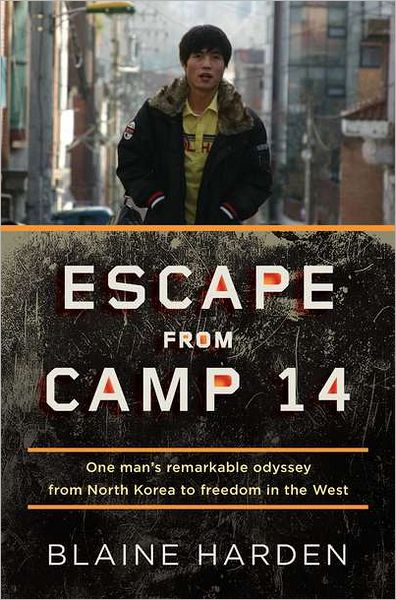
Escape From Camp 14 by Blaine Harden (audio)

Shin Dong-hyuk was born in 1982 inside Camp 14, one of North Korea’s no-exit political prison labor camps. He was raised in the camp, starving, ill, beaten, and forced to work for his life. His education was meager and consisted of the bare understanding of camp politics necessary to make him a compliant worker; he was trained from birth to snitch, to betray his classmates and relatives, to serve his masters. The concepts of love, kindness, trust, and familial relationships were unknown to him. At age 23, he escaped the camp and traveled on foot out of North Korea, into China, and would eventually make his way to South Korea and later, the United States. As far as we know, Shin is the only prisoner ever born in one of these camps to escape.

Blaine Harden is an experienced journalist, who covered North Korea for years, as well as other declining nations. He tells Shin’s story in a professional manner. Many of the details of Shin’s life, and camp life generally, cannot be confirmed or denied, because we have so few sources of information on the subject. (North Korea maintains that there are no such camps, although they are visible on satellite photographs.) Harden treats this information as a professional journalist, researching and confirming where possible, and giving his well-thought-out reasons for believing (or not) those details that are not confirmable. More difficultly, in this book, Shin recants an important fact about his life as he had claimed it for years. I felt that Harden made a reasoned case for believing the later story given. I was impressed with how he handled the problems of his source’s reliability, which I found an interesting issue. Additionally, Shin does not speak English, so Harden conducted his many interviews with interpreters; this of course raises new questions. When Harden says Shin chooses a certain word to describe a certain time in his life, I wonder who in fact chose that word. Naturally it was the interpreter who chose the word, and not knowing Korean, I can’t know how literal a translation it was, or whether there were several English words that might have been used. I don’t mean this as a criticism of Harden’s (or the interpreter’s) work; I just want to note that I’m always intrigued by the questions raised.

Shin states that Kim Jong-Il (and his successor) is worse than Hitler, because while Hitler tortured and killed his enemies, North Korea does so with its own people. This book makes that argument: the atrocities committed at these labor camps are appalling. It’s true, I was not well educated on North Korean conditions before I found this book. I suspect there are many of us who could learn a lot on this subject. I am not sure I can communicate to you here how shocking the details are – I’d really rather you go out and get a copy of this book – but I will tell you that no one is spared, no human dignities are allowed, there is murder and torture. These details are not spared, either, so be prepared for the graphic explanation of the torture Shin endured leading up to his mother’s execution. It’s not an easy book; but I do think it’s important that we know, so still I recommend it.

Shin’s story is mind-boggling. It is perhaps too obvious to state, but he had terrible luck to be born in the camp, and terrible things happened to him there; but his escape began a run of rather astonishing good luck. Harden puts the escape, and Shin’s overland journey (as well as many other parts of this story) in perspective by interjecting the accounts of other escaped prisoners and scholars on the subject. In this case, he describes the political climate at the time of Shin’s escape, showing how much luck it took for him to make it out of the country as he did. His good luck, though, mostly applies to his physical escape. Not surprisingly, his mental, emotional, psychological escape is still underway. As Harden points out at the beginning, most survivors of the Nazi death camps, the Soviet labor camps, and other centers of atrocities tell a story that has three parts: a relatively good life before capture; horrors on the inside; and then attempts at recovery after escape or release. Shin’s story is fundamentally different. Having been raised for 23 years on the inside, from birth, his release was to a world unknown. The trauma he is still trying to repair is staggering, unimaginable to the rest of us. Apparently Shin is like many North Korean defectors in being inclined to refuse psychological treatment – related to difficulties with trust – and his road has never been an easy one. His story as told here does end with a modicum of hope. But he is still struggling.

Again, this is a deeply disturbing book to read (or in my case, listen to), but I think it’s important to know what Shin and other North Koreans are going through. Please look out for Escape from Camp 14. I recommend the audiobook, which Harden reads himself. His delivery is matter-of-fact but that serves his story well.


Rating: 8 grains of rice.

Teaser Tuesdays: The Perfect Storm by Sebastian Junger

Teaser Tuesdays is a weekly bookish meme, hosted by MizB of Should Be Reading. Anyone can play along! Just open your current read to a random page and share a few sentences. Be careful not to include spoilers!

I’m listening to Sebastian Junger’s The Perfect Storm on audiobook, read by Richard M. Davidson. I find it quite interesting so far. Some of the passages I’m enjoying the most describe life in the small fishing town of Gloucester, Massachusetts, and I’ve chosen a teaser for you today that depicts the role one special bar plays in the lives of fishermen.

Fishermen who don’t have bank accounts cash paychecks at the Crow’s Nest (it helps if they owe the bar money), and fishermen who don’t have mailing addresses can have things sent right to the bar. This puts them at a distinct advantage over the IRS, a lawyer, or an ex-wife. The bartender, of course, takes messages, screens calls, and might even lie. The pay phone at the door has the same number as the house phone, and when it rings, customer signal to Ethel whether they’re in or not.

A proper home away from home, hm?

What are you reading this week?

Dream Team: How Magic, Michael, Larry, Charles and the Greatest Team of All Time Conquered the World and Changed the Sport of Basketball Forever by Jack McCallum

A funny, respectful, expert, complete–and literary–examination of 1992’s Olympic Dream Team and its permanent effects on basketball.


The U.S. Olympic basketball team of 1992 was known as the Dream Team because it included the game’s biggest stars, including Magic Johnson, Larry Bird, Charles Barkley and Michael Jordan.

Sports Illustrated‘s Jack McCallum (Seven Seconds or Less, Unfinished Business) brings these colorful personalities to life as he recounts the creation of the Dream Team and its path to Olympic gold. When a meat inspector from Belgrade came up with the idea of rescinding the amateurs-only clause of Olympics competition, it made it possible for the U.S. men’s basketball team, traditionally made up of college players, to become a squad of NBA All-Stars, characterized by outrageous and iconic players and an unusual vision of the game. As McCallum tells it, this team took its ambassadorial role seriously, as the superstars relinquished their playing minutes to the greater goals of victory, teamwork and honor in a manner arguably absent from today’s game.

Dream Team‘s tone is occasionally reverent, but just as McCallum begins to speak in mythic terms, he reminds us that these men were only human, tapping into their personal lives and private sides (when his shared history with them allows). McCallum is nothing if not opinionated, but always fair in his analyses, and the quotations and one-liners that pepper his text are pure gold in terms of entertainment as well as illumination of the fine sport of basketball.


This review originally ran as a *starred review* in the July 17, 2012 issue of Shelf Awareness for Readers. To subscribe, click here, and you’ll receive two issues per week of book reviews and other bookish fun!


Rating: 7 points.

City of Ravens: London, the Tower and Its Famous Birds by Boria Sax

A bird’s-eye view of the Tower of London’s famous raven residents and their role in history and myth.


The Tower of London combines commercial tourism, history and myth in a single site, and its iconic ravens are a part of all three functions. Legend has it that when the ravens leave the Tower, Britain will fall. Boria Sax’s City of Ravens blends a highly readable narrative style with academic research into Britain’s history, the study of birds and Sax’s own interest in animal-human relationships. Sax examines the ravens’ changing significance in London’s imagination, from being harbingers of death and doom as they fed off the bodies of those executed at the Tower to being heralded as guardians of Britain’s Empire–likely due to their role, during the Blitz, of warning of incoming bombs.

Sax’s research largely dispels the popular belief that ravens had been pets at the Tower since medieval times, and he is ambivalent about the accuracy of the historical raven record. After highlighting a few individual ravens’ personal histories, he finishes by considering the ecological questions raised by the captive birds whose wild counterparts have begun to repopulate London, weighing the options for protecting both the ravens and their mythical standing.

These musings, admittedly conjectural at times, draw on diverse resources including newspaper archives, popular literature, early tourist guides to the Tower and other historical sources–as well as fictional accounts. Part history, part deconstruction of myth, part bird study, always lovingly respectful of the birds themselves, City of Ravens is a whimsical, entertaining and informative journey into London legend.


This review originally ran in the July 13, 2012 issue of Shelf Awareness for Readers. To subscribe, click here, and you’ll receive two issues per week of book reviews and other bookish fun!


Rating: 5 wings.

Houston Beer: A Heady History of Brewing in the Bayou City by Ronnie Crocker

If you know anything about me, you should realize that Houston + beer = I will read your book. I am so enthused about my hometown, and about beer, and about my hometown beer (that is experiencing a huge boom as we speak – more on that to come, obviously), that all you would have to do to gain my undivided attention is write a book about Houston + beer. Even poorly written and sloppy. Luckily, I can say that this book goes a step further and does it properly.

Ronnie Crocker writes for the Houston Chronicle, and blogs for same under the name Beer, TX. His book is slim – under 150 pages – but not lightweight; he did his research, and uncovers new details about the history of beer in Houston. This is a surprisingly undersung (and under-researched) topic, apparently.

Beginning with the beginnings of the city (see my earlier teaser), Crocker studies us as a drinking city, and those who have served our thirst. Like many cities in this country, we had something of a boom going before Prohibition, and struggled to make a comeback after that failed experiment. We were a Bud town for a while, and Anheuser-Busch (in its new InBev-conglomerate form) still brews in Houston today, to the tune of …so many millions of barrels that it boggles the mind, and I can’t hold numbers that big in my head. [For more on the AB-InBev merger, check out my review of the excellent Dethroning the King.] Fast forward still more, and we’re seeing a veritable, and delightful, renaissance: the long-standing Saint Arnold Brewing Company (hey, seriously, 18 years is a long time in this business in these parts) joined by a promising handful of new brewers. My favorite is Karbach, of course, but I give a head-nod to Southern Star, No Label, and Buffalo Bayou, too. And I’m still anxiously awaiting the announcement that Yard Sale is in business!

Crocker’s book is admittedly reluctant to criticize; it leans towards the positive, even approaching boosterism. And it ends strangely, with an exhortation to support (i.e. buy from) your locals. But I’m with him! I, too, am excited about Houston beer. So, perhaps Houston Beer isn’t impartial journalism – but it’s an invaluable, unique history. I found it enjoyable, just what I wanted and no, never poorly written or relying on my devotion to the subject to keep me engaged. And it was great fun to see a number of people I know pictured, as a bonus!


Rating: 5 pints.

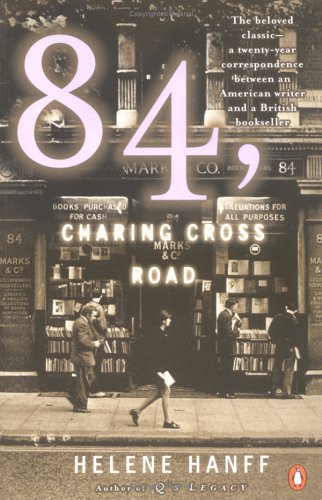
84, Charing Cross Road by Helene Hanff

This is a truly delightful collection of correspondence. At the time these letters were written, Helene Hanff was living in New York City and scraping together a living writing freelance. She opens with a letter to a bookshop at the titular address in London, naming herself a struggling writer with a taste for difficult-to-find, often out-of-print books, and asking for inexpensive copies of several. This begins a 20-year conversation with several bookshop employees and various others (family, friends) that is rich in many aspects. For one thing, Hanff is often hilarious. She pokes and needles her main correspondent, Frank Doel, “trying to puncture that proper British reserve.” She rails about inferior translations and offensive abridgements. The friendships that develop are heartfelt and helpful: during the years following World War II, when the British rationed meat, eggs, and nylons, Hanff sends her new friends care packages regularly. They reciprocate with lovely, thoughtful gifts, including (of course) books. The bookish angle is, obviously, not the least of this volume’s charms – we are all book nuts, no? My reading actually does not intersect Helene’s (I am switching to her first name, as do Frank et al, as I feel we are now friends) very often, but I appreciate the sentiment, and her reading certainly gives me a feeling for her personality. Yet another angle of interest is the cultural divide: Helene requests that her bills be “translated” into dollars as “I don’t add too well in plain American, I haven’t a prayer of ever mastering bilingual arithmetic.” Currencies form only one of the challenges, of course. Later, Frank’s wife will instruct Helene in making a Yorkshire pudding. (For which I thank her, as I know understand a little better what that is supposed to be.)

A very easy read, these 90-ish pages took me just over an hour. (Remember they’re letters, mostly short ones, so very few of those pages are filled with text.) I found this to be a book of great sentiment. It is sweet, heartfelt, funny, and made me nostalgic for what was in some ways a simpler time.


If you’re interested in a little further reading, there is a website here dedicated to research of the bookstore and its employees, the characters in the drama that is 84, Charing Cross Road.


To whatever book blogger it was that made me go out and buy this book, thank you. It was worth it.


Rating: 6 pagesofjulia.

book beginnings on Friday: Escape From Camp 14 by Blaine Harden

Thanks to Rose City Reader for hosting this meme. To participate, share the first line or two of the book you are currently reading and, if you feel so moved, let us know what your first impressions were based on that first line.

Happy Friday! I have a book to share with you today that is not so happy, though. Journalist Blaine Harden narrates this audiobook himself, which I find to be a fine choice. I’ll let the book beginning introduce you:

Nine years after his mother’s hanging, Shin squirmed through an electric fence and ran off through the snow. It was January 2, 2005. Before then, no one born in a North Korean political prison camp had ever escaped. As far as can be determined, Shin is still the only one to do it.

And this is the story of Shin Dong-hyuk. So far I am discovering my own very poor knowledge of North Korea, and marveling at the atrocities. But it looks to be a great book, and an important one in that we could all stand to be better educated about North Korean human rights abuses. So, happy Friday indeed.

What are you reading this weekend?

Teaser Tuesdays: 84, Charing Cross Road by Helene Hanff

Teaser Tuesdays is a weekly bookish meme, hosted by MizB of Should Be Reading. Anyone can play along! Just open your current read to a random page and share a few sentences. Be careful not to include spoilers!

Friends, the hype was correct. (Okay, maybe it’s quiet, bookish hype, but there is hype, I tell you.) 84, Charing Cross Road is sweet, hilarious, and apt. I love it. It’s a collection of correspondence between writer Helene Hanff, living in New York City and scraping together a living, and an antiquarian bookshop in London, from 1949 until… I’m still reading. I highly recommend it. For example, from Hanff’s letter of August 15, 1959:

I have these guilts about never having read Chaucer but I was talked out of learning Early Anglo-Saxon/Middle English by a friend who had to take it for her Ph.D. They told her to write an essay in Early Anglo-Saxon on any-subject-of-her-own-choosing. “Which is all very well,” she said bitterly, “but the only essay subject you can find enough Early Anglo-Saxon words for is ‘How to Slaughter a Thousand Men in a Mead Hall.'”

Funny stuff, no? Today’s teaser is in special honor of my mother, who has an advanced degree in linguistics and may have an intelligent response for us. Happy Tuesday!