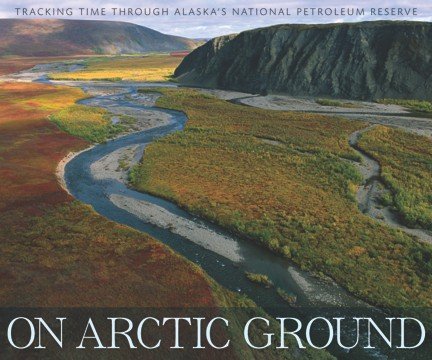
On Arctic Ground: Tracking Time Through Alaska’s National Petroleum Reserve by Debbie S. Miller

A call for the preservation of Alaska’s natural heritage, with exquisite photos.

At 23 million acres, Alaska’s National Petroleum Reserve is the largest single unit of public lands in the United States, none of it permanently protected. Rich in oil, gas and coal, it is also home to an astounding diversity of plants and animals, many endangered and threatened; the migratory birds of six continents begin their lives in the Reserve. Debbie S. Miller’s On Arctic Ground is a striking plea for the conservation of this irreplaceable natural space.

Although it can be read cover to cover, the best way to enjoy this book is to take its short chapters one by one. Each provides mind-boggling details–like the bar-tailed godwit’s nonstop, 7,000-mile migration from western Alaska to New Zealand–and makes the starkly moving point that this incomparable area is highly vulnerable. Breathtaking full-page pictures throughout offer stunning portrayals of the Reserve’s strange and spectacular life forms.


This review originally ran in the Nov. 23, 2012 issue of Shelf Awareness for Readers. To subscribe, click here, and you’ll receive two issues per week of book reviews and other bookish fun!


Rating: 8 caribou.

Teaser Tuesdays: On Arctic Ground by Debbie S. Miller

Teaser Tuesdays is a weekly bookish meme, hosted by MizB of Should Be Reading. Anyone can play along! Just open your current read to a random page and share a few sentences. Be careful not to include spoilers!

This is a beautiful coffee table book, chock full of stunning photographs as well as short essays about the glories of the Alaskan Arctic.

“Wow! Bumblebee on a lousewort!” Patrick Endres shouts through the wind, so excited that you think he’s just spotted his first grizzly bear. For a photographer like Patrick, small is just as important as big.

I read this vignette as allegory: one of the points of this book, in fact, is that small (flowers, birds, linguistic groups) matters as much as big (oil, industry, money). But seriously, go get it for the photos, if nothing else!

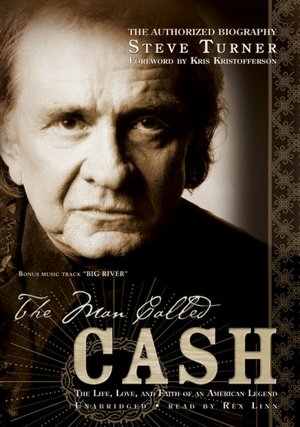
The Man Called Cash: The Life, Love, and Faith of an American Legend by Steve Turner (audio)

How could a biography of Johnny Cash not be extraordinary? (Well, the question of whether we seek out biographies of interesting people, versus interesting biographies of any old people, is another blog post.) I was excited to start this one. But warning, folks: it hits hard, and early. The first chapter is about the death of June Carter Cash after 35 years of marriage to the Man in Black, and I cried.

Johnny Cash is truly larger-than-life, as a celebrity and a public figure as well as in his music career. I’m a fan, but not a scholar of Cash’s life: prior to this book, what I knew of him was general cultural knowledge, or gleaned from his songs and the movie Walk the Line (which I enjoyed). So now I know a great deal more.

He was born in Arkansas and grew up in a town called Dyess (which Cash jokingly refers to as a socialist experiment – it was designed under FDR’s New Deal) in the midst of the Great Depression, and after high school, joined the Air Force and served in Germany; he returned to the South to marry a girl named Vivian whom he had met just weeks before shipping out. Cash and Vivian would have four daughters.

His music career came about in an interesting way. Cash had always been passionate about music, from childhood; his mother shared and inspired this love. He was not particularly gifted as a singer, and he was a mediocre guitar player who mostly learned from his Air Force buddies; but his songwriting did impress his peers from the beginning. Back in the southern US, he teamed up with a few coworkers of his brother’s, and formed Johnny Cash and the Tennessee Two, recorded his first single apparently on the strength of will alone, and… things took off from there. Names like Carl Perkins, Sam Phillips, and Elvis Presley figure in the early years of his career.

The shape of his musical career surprised me the most in the story of Cash’s life. He was always an innovator: he played an integral role in the birth of rock-n-roll; he blended styles and approached subject matter previously deemed inappropriate; and even in the final years before his death broke new ground. But I never realized how sort of unguided and hesitant those innovations were. He needed musicians, producers, and sound engineers around him to help shape his creativity. I say none of this to take away from the genius of Johnny Cash: he was unique, and his art remains unparalleled. I just hadn’t realized that he didn’t do what he did in a vacuum, that he had no great image or plan for his work, that he didn’t see the bigger picture himself. He needed help for that.

On tour in the 1960’s, Cash became close to fellow musical artist June Carter; they carried on an affair until Cash’s divorce from Vivian. During the same period, he struggled with methamphetamine addiction, and June wouldn’t marry him until he was clean, which turned out to be 1968. The drug use came and went for many years, but his marriage to June was steady. They had one child together, John Carter Cash.

I enjoyed learning about Johnny Cash. As it turned out, for me, this book’s greatest strength was its subject: rather than being an excellent biography, it detailed an excellent life. One minor gripe I have is in its handling of Cash’s religious life. Now, let it be said, Christianity played a huge role in Cash’s life: he was devout as a young man; struggled with his faith during the years of drug abuse and adultery; found a stronger religious foundation in his years of happy marriage to June; made a great deal of religious music and spoke publicly of his faith; and in many ways led a truly Christian life in terms of charity, compassion, and standing up for the disadvantaged. Handling Cash’s religious life is obligatory in any biography of the man. However, this biography approaches it from a certain perspective: it takes for granted that Christianity is good, and any strayings from the church are bad. See mentions of Billy Graham as an absolutely virtuous figure; praise of June Carter Cash for her total devotion to her husband (with religious references); and straightforward use of “light” and “dark” or “good times and bad” in reference to Cash’s more and less religious periods.

Author Steve Turner never takes on a voice of his own in his book; and I think that, if he were going to take a religious position as he has, that he should have spoken to that in his own voice. Does that make sense? To write as a Christian is not to write from a journalistically neutral place. The fact is that not all Turner’s readers are Christians; and he has done them a disservice in failing to zoom out to a neutral position from which to view his subject. I feel it would have been more honest to acknowledge a personal perspective.

The Christian leaning did not ruin this book for me; but I noticed it. And in noticing it, I was distracted from the fascinating story Turner had to tell. I guess I should have taken warning from the subtitle of the book: The Man Called Cash: The Life, Love, and Faith of an American Legend. Ah well. Silly me: I thought faith could be covered from a faith-neutral perspective. My final judgment on this question is that if you’re seeking a neutral and non-faith-based reading of Johnny Cash’s life, you should seek elsewhere. There are far too many biographies of this enormous figure to settle for one with such a bias.

Similarly, Turner’s perspective assumes that Cash was basically a good man. His mistakes, his “sins” if you will, his lapses, are all forgiven in advance. Turner turns a fundamentally uncritical eye on his subject. This bothered me far less than the Christian angle; in fact I noticed it far less, for the vital fact that I am a Cash fan who was sympathetic to the assumption that he was a force of good. But that doesn’t make it any less an error of journalistic neutrality. Again, there are different ways to skin this horse. Christians may appreciate this reading; fans may appreciate this reading. Those seeking a neutral and critical examination of Cash’s life should seek elsewhere. The Man Called Cash is a fan’s biography.

How about the narration? Rex Linn reads this book for us, and his deep voice and southern vowel sounds evoke Cash, which is pleasant. But he doesn’t do different voices for different characters at all; and some of the pauses between phrases are disjointed. I got the feeling that there may be some sloppy audio-editing involved. It was fine, but not the finest audio narration I’ve encountered, by a long shot.

I have made three criticisms here: two on the biased perspective of the author as a Christian and as a fan of Cash, and one on the audio reading. I feel these are worth noting. But I still enjoyed the book, again, mainly for the strength of Cash’s life. I recommend it with qualifications. If the issues I’ve outlined here bother you, by all means look for another Cash biographer as there are plenty! But this one does the job, too.

I’ll end with a strength. As I said, the book opens with the death of June Carter Cash in 2003. Her final weeks and those following her death are detailed finely; we get to know the Cash family as affected by losing its matriarch, and it is a beautiful and thorough and moving introduction. Its emotional impact opens the story forcefully. From here, we rewind to Cash’s origins, and then follow his life chronologically; when we come back to June’s death again, we can pass over it more quickly, having studied it earlier, and focus more on its impact on Cash himself. I found this structure very effective and powerful, and I am impressed by Turner’s planning in this regard.

Final verdict: obviously mixed. Draw your own conclusions.


Rating: 5 hit singles.

book beginnings on Friday: The Man Called Cash by Steve Turner

Thanks to Rose City Reader for hosting this meme. To participate, share the first line or two of the book you are currently reading and, if you feel so moved, let us know what your first impressions were based on that first line.

Today I’m pulling this “book beginning” from the foreword to this biography, by Kris Kristofferson:

Johnny Cash is a true American hero, who rose from a beginning as humble as Abraham Lincoln’s to become a friend and an inspiration to prisoners and presidents – respected and beloved the world over for his courage, his integrity, and his genuine love for his fellow man. Like Muhammad Ali, he was bigger than the profession that brought him to the world’s attention, and his spirit transcended the boundaries of ordinary artistic stardom. But he was wonderfully, charmingly human.

The beginning of the book itself is good (although sad); but this beginning of the foreword, by a friend of the man himself, was too good to pass up. I find it’s both personal and touching, and a grand sweeping expression of Cash, all at once.

I’m super excited about this biography, mostly because I am excited about its subject; it also comes recommended from a friend.

And what are you reading this weekend?

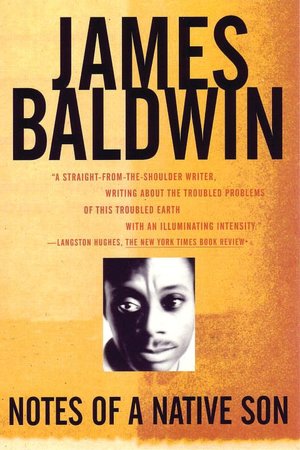
Notes of a Native Son by James Baldwin

Notes of a Native Son is a 1955 collection of James Baldwin’s essays and articles, all previously published elsewhere as I understand it. Their subjects range over books, movies, personal history, and social commentary; what each piece has in common is a consideration of race relations in the United States. He is concerned with the American “Negro” (this is no longer considered the right word, but I’m tempted to use it here, because he did) and the relationships amongst Americans, white and black. A persistent question he ponders is that of the black man’s search for identity in a nation that variously rejects him, resents him, or feels guilt over its treatment of him, made more difficult by the loss of his own personal history pre-slavery.

There are some heavy bits here, unsurprisingly. While not exactly academic, some of it is definitely on the philosophic side of things. When Baldwin dives deeply into literary criticism, he loses me (I guess I’m rusty on literary criticism; I used to find such articles much easier to read!): “Everybody’s Protest Novel” and “Many Thousands Gone” nearly made me quit the collection. In “Carmen Jones: The Dark Is Light Enough,” he discusses a movie, and actors, so unfamiliar to me that I was only reading on the surface – where I rather enjoyed the essay, it is true, but where I certainly failed to understand fully what he had to say. On the other hand, “The Harlem Ghetto” struck me as intelligent, occasionally amusing, and relevant today. And as you know, I am always thrilled to make connections across seemingly unrelated books I’ve read or historical figures I’ve studied. Before I was halfway through this book, I’d seen mention of Lillian Hellman (see a recent biography, one of my favorite books of the year) and the Patterson family (another), not to mention of course threads that take me back to The Warmth of Other Suns, which is how I got to this book in the first place. Ah, the circularity of things: it amazes and thrills me.

My favorite pieces in this collection were the autobiographical ones. I like Baldwin’s voice very much: he is wry and funny even when discussing the serious and the tragic. And I was most interested in learning more about him. My edition begins with a “Preface to the 1984 Edition” followed by “Autobiographical Notes,” both of which set the bar high. The titular essay comes about midway through and is also excellent. But my very favorites were the last two. “Equal in Paris” relates Baldwin’s experience being arrested in Paris and tried for possessing a bedsheet from the wrong hotel. It was hilarious, and ended chillingly. And “Stranger in the Village” covers his time spent in a tiny Swiss village where the residents had never seen a black man before, and is where I felt he made his most sweeping and hopeful statements about our present and our future. It was tragic, but forward-looking.

I really enjoyed Notes of a Native Son, although there were a few moments where I got bogged down. Baldwin’s voice charmed me. I recommend him.


Rating: 7 blocks in Harlem.

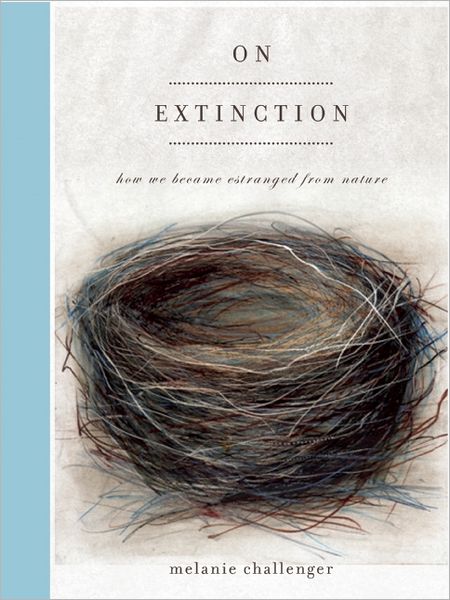
Teaser Tuesdays: On Extinction by Melanie Challenger

Teaser Tuesdays is a weekly bookish meme, hosted by MizB of Should Be Reading. Anyone can play along! Just open your current read to a random page and share a few sentences. Be careful not to include spoilers!

On Extinction has been out in the UK for a year or so now, but is just coming to the US in December. Its subjects are several, but I find the nature writing to be some of the loveliest parts.

Above me, the skies were blue but for the tightrope of the horizon balancing a giant rhombus-shaped raincloud. The scuffing of the waves across the riveted stone of the cove was like a dare.

Don’t you agree?

And what did the waves dare her to do? Stay tuned!

This quotation comes from an uncorrected advance proof and is subject to change.

Teaser Tuesdays: Notes of a Native Son by James Baldwin

Teaser Tuesdays is a weekly bookish meme, hosted by MizB of Should Be Reading. Anyone can play along! Just open your current read to a random page and share a few sentences. Be careful not to include spoilers!

In this striking collection of essays by James Baldwin, I found several noteworthy passages, truths, maxims; but I chose this one especially for you, because of its unique and arresting imagery. He’s describing various categories, by age, of the inmates he encounters in a Parisian prison.

And men not so old, with faces the color of lead and the consistency of oatmeal, eyes that made me think of stale cafe-au-lait spiked with arsenic, bodies which could take in food and water – any food and water – and pass it out, but which could not do anything more, except possibly, at midnight, along the riverbank where rats scurried, rape.

If that doesn’t paint a picture and send a shiver up you, I don’t know what to say.

Walden by Henry David Thoreau

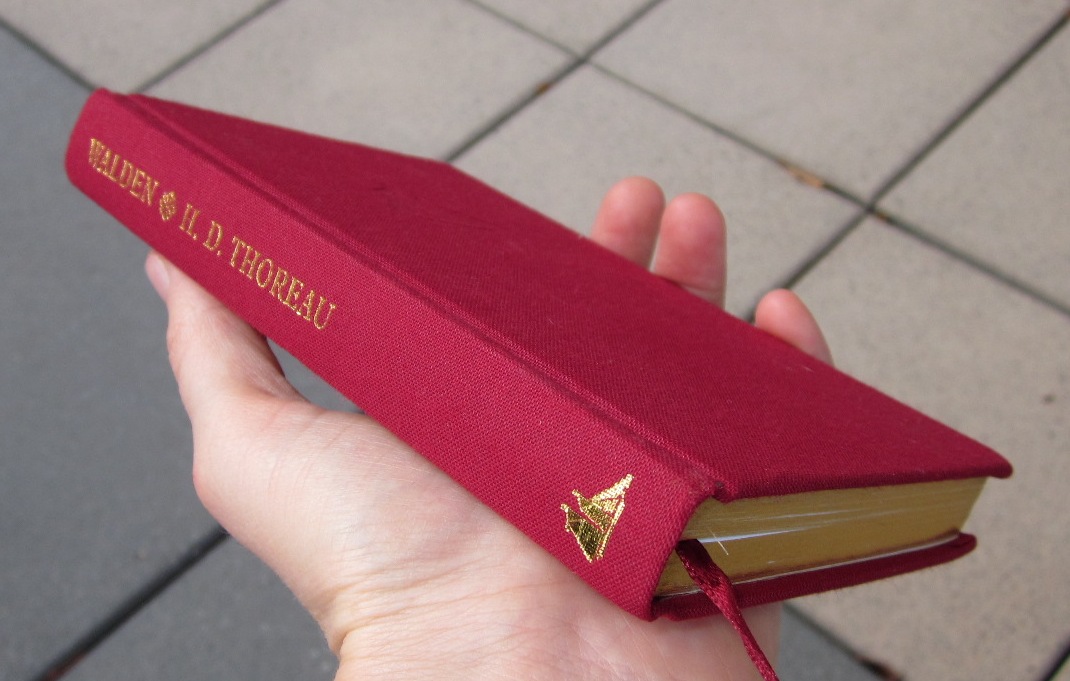
my charming little copy of Walden


I have been thinking this review over carefully. Walden is an “important” book. I had some troubles with it, particularly about midway through, when I stalled for several days and was sure I was going to give up. This was while visiting Concord and Walden Pond, no less! I think I owe my father credit: he recommended that I just read it through, with less attention to note-taking and interpretation at every page along the way. And on my long travel day home, I got back into it.

What is it that made this book a little difficult for me? Well, the language is somewhat dated, and the sentences tend to be long and rambling. Picture several long clauses strung together, and then having to look back up half a page to see what the subject was that this verb, finally, is acting upon. That will slow a person down. And the subject matter, the thoughts being communicated, are often quite dense. When Thoreau writes descriptions of his natural surroundings, I can settle into the imagery and the poetry, and float along pleasantly. But when he philosophizes, I am often in trouble. Large ideas are presented here, regarding our relationship with the natural world, politics, and religion. Thoreau jumps around between these subjects. Perhaps this begins to help you understand my trouble.

The first chapter, “Economy,” is lengthy. In my edition it occupies 80 pages, of 350. And no later chapter runs longer than 20 pages. I enjoyed “Economy”: I sympathize with the points Thoreau makes therein. But maybe I was wearied by it. It wasn’t until 200+ pages that I stalled badly. And once I got back into it, I enjoyed it again. I can’t entirely explain that pattern, and I’m sure yours was/will be different. I think the biggest help I got was visiting Walden Pond. This is obvious, no? When my mother and I toured The Wayside, our park ranger/tour guide quoted Nathaniel Hawthorne (and I wish I could find the quotation) on visiting authors’ homes. The gist was that visiting the home of an author is the best way to better understand his or her work, and my (limited) experience visiting authors’ homes certainly backs this up. In this way, walking around Walden Pond enriched my appreciation of Walden and renewed my interest in it.

Walden is a memoir; a political tract; a geographical study; a fine piece of nature writing; and a poetic rambling by a unique sort of Renaissance man. I found it rather effortful reading, but worth it in the end. For those who enjoy thought-provoking, challenging, lyrical writings (and longish sentences), it should be a big hit. For those who find these characteristics a little daunting, but are interested in the legacy of Henry David Thoreau, I recommend giving it a go just the same. I’m glad I did. And go see the place in question if you can, too!


Rating: 6 fallen leaves.

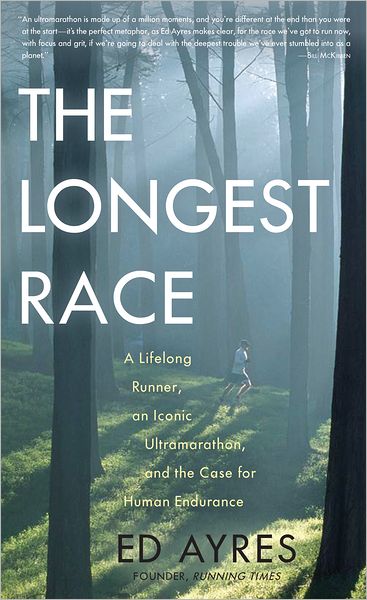
The Longest Race: A Lifelong Runner, an Iconic Ultramarathon, and the Case for Human Endurance by Ed Ayres

An ultramarathon, run by a master of the sport, becomes a metaphor for the race for human sustainability we are all running.

Ed Ayres has been running competitively for more than half a century. On a professional basis, he’s also studied climate change, sustainability and a variety of issues facing the future of the human race and our planet. The Longest Race is the story of his 2001 run at the JFK 50 Mile, the United States’ oldest ultramarathon. As Ayres attempts, at age 60, to set a new age-group course record, he contemplates the relationship of human endurance to the sustainability of human life in a fast-changing world.

Ayres’s recollections a decade later are heavy on metaphor. The ultramarathon is a symbol not just for his life, but for any man or woman’s life, and ultimately for the lifespan of humanity. The attributes that work toward sustainability at an individual level are equally valuable in a large society, Ayres says, and today’s “sprint culture” would do well to reconsider the concept of pacing. He also touches on the atom bomb, human evolution, the U.S. crisis in physical fitness and the reasons for following a vegetarian diet. But for all its peripatetic allegory, The Longest Race is always the story of one epic 50-mile race in all its technical and visceral elements, and also a celebration of the sport of running and of our ability to keep running in changing times. For those readers inspired by his story, the appendix offers practical advice to the aspiring ultrarunner.


This review originally ran in the October 19, 2012 issue of Shelf Awareness for Readers. To subscribe, click here, and you’ll receive two issues per week of book reviews and other bookish fun!


Rating: 8 miles to go.

EDIT: See also my father’s glowing review of same.

Master of the Mountain by Henry Wiencek

The sad but enlightening story of Thomas Jefferson, a dedicated slaveowner masquerading as an emancipationist. Henry Wiencek studied George Washington’s convoluted relationship to slavery in An Imperfect God; with Master of the Mountain, he turns his attention to Thomas Jefferson. As one would expect, Sally Hemings is a crucial part of the story, but Wiencek also meticulously records the experiences of many others among the more than 600 slaves Jefferson owned in his life, offering a detailed portrait of daily life at Monticello.

After speaking out eloquently about the need for emancipation early in his life, Jefferson not only let pass several opportunities to push for abolition but worked to maintain the existence of slavery, noting the profits to be had–even though in public writings and correspondence with anti-slavery activists, Jefferson continued to claim a devotion to human rights and disgust with the “peculiar institution.” Wiencek appears briefly to consider the forgiving popular characterization of Jefferson’s relationship with slavery as “compartmentalized” or “complex.” But as Jefferson devolves from a youthful, idealistic opponent to a staunch defender of slavery, Wiencek firmly condemns Jefferson’s pretense of virtue, put to the lie by the abuses at Monticello. Master of the Mountain is well-documented and detailed without being tedious. The stories of real people come alive, making Jefferson’s wrongs all the more painful and his hypocrisy the more outrageous. The final chapter calls this founding father to account in no uncertain terms.


This review originally ran in the October 26, 2012 issue of Shelf Awareness for Readers. To subscribe, click here, and you’ll receive two issues per week of book reviews and other bookish fun!


Rating: 6 advantages taken.