Teaser Tuesdays: The Honored Society by Petra Reski

Teaser Tuesdays is a weekly bookish meme, hosted by MizB of Should Be Reading. Anyone can play along! Just open your current read to a random page and share a few sentences. Be careful not to include spoilers!

honoredsociety

This is an interesting book. Its subject is the Italian Mafia and its global role; and most of the prose is straightforward. But it occasionally meanders into fancy, even poetry, as here:

In the middle of Piazza Marina there’s a huge magnolia fig tree that has grown into a vast and magical forest. The trunk is reddish brown, like the Sicilian soil, and has transformed itself into some fabulous creature that consists of knotted, frozen snakes, dragons half hidden in the ground, and elongated elephants. Every time I turn my back on this tree I half expect it to stretch out its arms and grab me.

I am charmed. And the Mafia bits are fine, too. 🙂

This quotation comes from an uncorrected advance proof and is subject to change.

multimedia journalism from the NYT: “Snow Fall” by John Branch

I have a librarian coworker, Liz, who always finds the coolest latest thing, and is expert at sending me articles (etc.) that will interest me. Recently, that was an article from the New York Times that blew my mind in a few different ways. For one, the story is striking: in February 2012 an avalanche in Washington state had tragic consequences for a group of skiers. The story of that day is told in this article in a structure that I very much appreciate. In a manner reminiscent of Jon Krakauer’s Into Thin Air (a book that started as an article in Outside magazine) and Sebastian Junger’s The Perfect Storm, journalist John Branch approaches his subject from various angles. He informs us on the science of weather and snowpack and how avalanches form; the latest trends in backcountry skiing; the biographies of the individuals involved. As a text article, it would be very impressive, and very moving.

But that’s not the full story on this story. As presented online, Branch’s article uses a variety of media: still images and animations, video and audio clips, computer-generated demonstrations of (for example) avalanche activity. And, as Liz points out, all the media are combined in such a way that, as one scrolls to read the article, it all flows and combines smoothly without distracting the reader. How many times have you seen this done the wrong way, where flashing images pull your eyes and/or mind away from the content you’re trying to access? I think I can say that this is the finest multimedia presentation I’ve seen online. Combined with the incredibly powerful story Branch has to tell, this is a unique experience you don’t want to miss.

And with that long introduction…


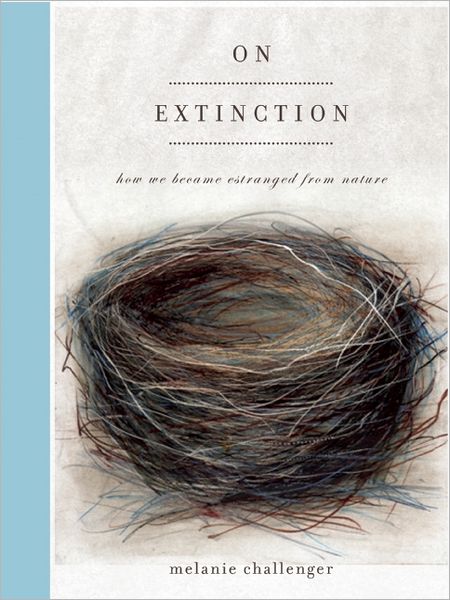
On Extinction by Melanie Challenger

A lyrical contemplation of biological and cultural extinctions and their significance in our human future.

Poet Melanie Challenger (Galatea) was alarmed to note that while she knew both her grandmother’s and her mother’s favorite wildflower, she did not have a favorite because she didn’t know enough wildflowers from which to choose. In On Extinction, she travels to places that embody the history of human connections to nature and muses on our growing estrangement from our environment.

The title suggests Challenger’s initial focus on extinctions: not only of plants and animals, but of cultures, languages and industries. She quickly discovers a growing secondary interest in nostalgia, like our attraction to extinctions, which makes the dodo bird the subject of so much curiosity. In her travels through the Arctic and the Antarctic, England, South America and Canada, she attempts to reunite with nature and find her own favorite wildflower. She also asks: Can humans live productively in this world without destroying it? She is made hopeful by our reverence for the past and for natural beauty.

Challenger brings a loving sense of wonder to the natural world, realizing how little she knows and relishing the process of learning. She looks backwards with the intent of remaking our future relationship with the planet. She does, as one might expect, discuss Muir and Thoreau, but she also turns to Locke, J.S. Mill, Rousseau and especially Darwin, seeking a philosophy of the natural world and our place in it. Highly literate with a lovely, almost reverent tone, On Extinction notes human threats to our environment but ultimately remains hopeful that we can reestablish a healthy relationship with the Earth.


This review originally ran in the December 21, 2012 issue of Shelf Awareness for Readers. To subscribe, click here, and you’ll receive two issues per week of book reviews and other bookish fun!


Rating: 6 falling leaves.

guest review: Born to Run by Christopher McDougall, from Pops

Pops joins us again today to write about a book firmly within his area of expertise: running. We’ve all heard something about Born to Run, I believe. I’ve certainly heard good things; but have never been strongly inclined to pick it up. Pops may change my mind, though.

borntorunI am writing to make a public apology to myself for not reading this book three years ago; and to make a few personal comments for what they’re worth. It’s not coincidence that I pulled it from the shelf soon after reading Ayers’ The Longest Race; that book reminded me that McDougall’s work might contain some of the same magic, which I had (indeed!) delayed for too long. That instinct was accurate; there are similarities between the two that I really appreciated: inspiring depictions of running, fascinating science & history and a wonderful (though different) voice.

Much has already been written about this book, mostly positive and in great thoroughness. I won’t add much to that effort. Another place to look for insight would be McDougall’s website where you can peruse selected readers’ comments; this book has literally changed lives and inspired people. There are also some wonderful photos, which illustrate that this really is non-fiction, as absurd as that may seem while reading it.

I have mentioned before that I collect books about running, particularly in an often frustrating search for good fiction. This is one of the best running books I have ever read. In spite of its connection to reality, it reflects some of fiction’s best elements: humbly heroic characters who are larger than life; a compelling story that defies reality; a romantic adventurous heart; a witty rollicking storyteller’s voice; and sexy women running hard & kicking ass.

I knew bits & pieces about many of the characters in this story, about the ultra running culture and community, about the barefoot running revolution it stimulated and about the Tarahumara Indians. None of that prepared me for such a fun, informative, exciting and ultimately poignant journey. It is always risky to compare writers or books, but I must say that McDougall’s work reminded me in some ways of both Tom Wolfe and Hunter S. Thompson. I kept stopping to think “I know this is based on fact, but it’s so wild and so much fun I can’t believe it!”

Arnulfo Quimare, “elite” Tarahumara runner

Arnulfo Quimare, “elite” Tarahumara runner


The poignant part of the story actually arrives outside the book, sharply in the realm of real life but in some ways as hard to believe. This probably qualifies as a spoiler so stop right now if you want to read the book first; but for me it is an important part of the tale. It’s almost like McDougall should write the sequel.

Here is a relevant quote from the book that sets up the surrealistic “real life” conclusion. The main character in the book, Caballo Blanco, is speaking (he worshiped Geronimo as a kid and retained great respect for the Apache warrior.)

“When I get too old to work, I’ll do what Geronimo would’ve if they’d left him alone… I’ll walk off into the deep canyons and find a quiet place to lie down.”

The author then comments: “There was no melodrama or self-pity in the way Caballo said this, just the understanding that someday, the life he’d chosen would require one last disappearance.”

In March of this year (2012) Caballo was visiting southwest New Mexico so he could run the rugged mountain trails in the Gila Wilderness. One day he planned an easy solo run of 12 miles or so – and he never returned. The Forest Service began a search, and many of his friends (including the author and many characters from the book) arrived from around the country to join the hunt by running the trails. On search day 5, it was a group of Caballo’s running friends who found him off an obscure trail near a stream, dead from heart failure apparently unrelated to any disease or abnormality. He was 58 years old.

(This is also a curious “synchronicity” for blog readers who remember our family fixation with Fire Season, which is set only a few miles away from where Caballo met his end.)

You can read more about this sorrowful ending on the author’s web site, various other online sources, or this NY Times story. The author told his own version of this ending in a piece for Outside Magazine.

Caballo Blanco, RIP.

Caballo Blanco, RIP.

Thanks for another solid review, Pops. You make a strong case. Narrative nonfiction (aka “creative nonfiction”) about exciting, culturally diverse, outdoorsy, unbelievable experiences is right up my alley.

Encounters from a Kayak: Native People, Sacred Places, and Hungry Polar Bears by Nigel Foster

One man’s reminiscences of flora, fauna and miscellanea encountered while paddling the globe.

For decades, Nigel Foster has been kayaking the world’s oceans, lakes and canals–as well as teaching the skill, designing the equipment and writing about his experiences. Encounters from a Kayak collects more than three dozen of his articles in a single volume, many of them never previously published. Each examines a moment in time in which Foster–sometimes alone, sometimes with fellow enthusiasts–interacts with the natural world and its inhabitants from his small craft. It is one of the strengths of the collection that not even the oldest pieces (extending as far back as the early 1980s) feel dated.

The stories are organized thematically around creatures, people, places, and flotsam and jetsam; the diversity and scope of Foster’s contacts in all these categories are impressive. In his encounters with historic artifacts in Scotland, local police in Shanghai and monkeys in the Florida Keys, Foster brings a sense of humble wonder to his environment. Naturally, he considers issues of ecology and conservation in his travels, but he never lectures. Rather, in unadorned prose, he delivers the experiences themselves: the glow of bioluminescence, the ordeal of a Dutchman’s flight from Nazi occupation by kayak, the history of a sleepy Minnesota town and the real-life Scylla and Charybdis of Scarba and Corryvreckan, just off the Scottish coast. Foster’s unassuming consideration of his surroundings is charming, simple and occasionally poetic. Natural history, human history, birds, jellyfish, thunderstorms and more come together to entertain and educate in Encounters from a Kayak.


This review originally ran as a *starred review* in the December 14, 2012 issue of Shelf Awareness for Readers. To subscribe, click here, and you’ll receive two issues per week of book reviews and other bookish fun!


Rating: 5 campfires.

book beginnings on Friday: The Lady and Her Monsters by Roseanne Montillo

Thanks to Rose City Reader for hosting this meme. To participate, share the first line or two of the book you are currently reading and, if you feel so moved, let us know what your first impressions were based on that first line.

monsters

The Lady and Her Monsters: A Tale of Dissections, Real-Life Dr. Frankensteins, and the Creation of Mary Shelley’s Masterpiece is a fascinating title, isn’t it? I was attracted immediately. It begins:

Camillo’s footsteps echoed loudly as he crossed the empty cobblestone streets of Bologna toward his uncle’s house. The afternoon was hot, and the scorching heat, coupled with that lazy midafternoon spell between noon and evening, allowed him to go by virtually unnoticed.

Although this is a work of nonfiction, I think these atmospheric opening lines are appropriate, since its subject is something of a gothic ghost story.

Happy reading to you this weekend!

This quotation comes from an uncorrected advance proof and is subject to change.

Real Man Adventures by T Cooper

A dryly witty journey from female to male, with musings on what it means to be a man.

T Cooper, the author of several successful novels (including The Beaufort Diaries and Lipshitz 6), is fascinated by masculinity, perhaps in part because he’s had to work a little harder than the average man to get there: he was born female. Yet even as he explores the essence of masculinity and his own experiences with gender in Real Man Adventures, he expresses some reluctance to delve into the personal.

There is definitely some autobiographical content, but Cooper takes his own privacy seriously, as well as that of his wife and daughters, and is less interested in hashing out the details of his own life than he is in exploring the meaning and role of masculinity in society and the difficulties facing transgender men and women. Real Man Adventures sidesteps the concept of a straightforward memoir, instead compiling a whimsical collection of miscellanea: letters, interviews, lists and original art all help Cooper and his readers explore together what makes a man. This structure works perfectly, and feels like a conversation with Cooper himself.

Deeply honest, even while guarding a few precious items of privacy, Real Man Adventures is a brave book. Cooper does a great service not only to transgender people whose paths might be made a little clearer, but also to their loved ones, neighbors and acquaintances, who should find it a little easier to navigate relationships and communications thanks to this frank discussion. And the irreverent, wry humor throughout keeps Cooper’s brash personality at center stage, where it belongs.


This review originally ran as a *starred review* in the Nov. 27, 2012 issue of Shelf Awareness for Readers. To subscribe, click here, and you’ll receive two issues per week of book reviews and other bookish fun!


Rating: 8 pronouns.

Teaser Tuesdays: The World Until Yesterday by Jared Diamond

Teaser Tuesdays is a weekly bookish meme, hosted by MizB of Should Be Reading. Anyone can play along! Just open your current read to a random page and share a few sentences. Be careful not to include spoilers!

I am transfixed by Jared Diamond’s new book. For example:

Although the specific role of TV has not been quantified in India, a study in Australia found that each hour per day spent watching TV is associated with an 18% increase in cardiovascular mortality (much of it related to diabetes), even after controlling for other risk factors such as waist circumference, smoking, alcohol intake, and diet. But those factors notoriously increase with TV watching time, so the true figure must be even larger than that 18% estimate.

This is the kind of statement I find fascinating, shocking, and utterly unsurprising all at once. Although sinister, it does make me want to read more! How about you?

This quotation comes from an uncorrected advance proof and is subject to change.

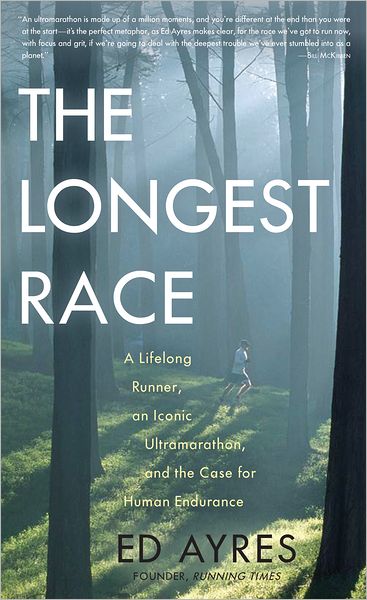
guest review: The Longest Race by Ed Ayres, from Pops

As I read The Longest Race, I thought of my father throughout. He is a marathon runner and a trail runner, and has been contemplating issues of climate change, sustainable living, and humans’ place in nature quite a bit recently. I thought this would be a perfect book for him in its combination of themes, which you can read about in my review. Here, he responds. [His page numbers come from my advance review copy.]

Julia has already done her usual commendable job reviewing this book; my personal interest in Ayres’ two main themes – running, and human degradation of our earthly habitat – compel me to comment further (as she knew it would.) At the same time, I want to parse her use of “metaphor” to describe how running and human development are related in Ayres’ story. While he does often employ metaphor, I believe in many cases he is saying that running actually is part of human development and does have an impact on how we relate to the world. Such is the hubris that plays a part in his tale.

For the above reasons, I really enjoyed this read. That doesn’t mean I found it uniformly superb or satisfying, but the book’s strengths were more than enough to keep me going.

Using a 50-mile ultra to structure his narrative worked better than I expected. There were few threads about his race that required following intently, and those were not lost as we periodically reconnect to that story. The more esoteric subjects he contemplates along the way vary greatly – just as would one’s thoughts during the hours of such an endurance event. In fact, that is an example of the athletic authenticity I found throughout. While I was only familiar with Ayres generally as editor of the early magazine “Running Times,” his deep experience as a lifelong runner shows through. His mental meanderings during a 50-miler – and their sometimes-questionable lucidity – are a familiar element of “running long.”

I was not familiar with Ayres’ background in the themes of human impact on the earth; he worked for the Worldwatch Institute and describes how this commitment evolved from a Quaker upbringing and through a lifetime’s experience. Along the run, we gather bits of his own back-story and “meet” such characters as Mohammed Ali, Mikhail Gorbachev and Ted Taylor (nuclear weapon physicist); such moments are fun and interesting – and chilling, as with his quotation from Taylor evoking the cold war’s nuclear terror (p.94). Also chilling is Ayres’ observation that for those who study the science of ecology, the survival of modern human society is “not just an abstract, academic concept;” it is very immediate.

We learn with him on his journey; e.g. Jared Diamond’s observation that agriculture is “in many ways a catastrophe from which we have never recovered” (p.102) – or “anthropomorphism as a major root cause of the ecological crisis” as noted by many literary luminaries over the years (p.106) – or the 1992 consensus-scientists’ dire & explicit climate change declaration so long ago (p.163) – or a reminder that the regressive “progress” of a suburban lifestyle model may prove to be a mere 2-generation phenomenon. We also meet such authorities as Paul Shepard, Rachel Carson and Wendell Berry along the way.

Similarly, Ayres has much to offer about running itself – not just practical stuff, but history and science as well. He met and/or learned from such names as Joan Benoit, Ted Corbitt and George Sheehan. He cites a Joe Henderson article that I know I read at the same time 25 years ago. Ayres is not the namedropper – that’s my doing throughout here – but rather all these names simply arise as part of his story.

His introduction to the JFK ultra event’s origin unwinds into a period piece on the Kennedy Physical Fitness campaign (which I too experienced), including analysis of JFK’s civic motivation and his 1960 column in Sports Illustrated (who knew?!). I loved learning of David Carrier’s fascinating theory of primitive “persistence hunting,” where humans demonstrated the superior endurance trait that we runners still attempt to conjure (Ch.4). In fact, the role of endurance running throughout early history is compelling – including the Chasquis, the Inca runner-messengers.
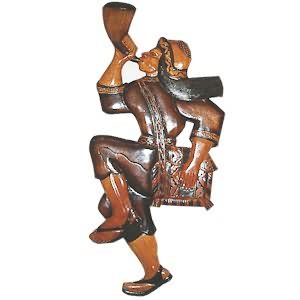
Chasqui runner

Chasqui runner


The brief 23 page Appendix, “Notes for an Aspiring Ultrarunner,” is an worthy overview but any really interested reader will do well to research the many other references available.

All together, I enjoyed the blending of themes, emotions and ideas in Ayres’ book. Here is a single passage where Ayres is so nicely able to blend his heritage, running and science:
“The last sounds of the spectators faded, and, after a period of silence that could have been either five minutes or the hundred years it takes for a Quaker kid to sit through Sunday meeting, I found myself glancing left and right, the way I’d been taught as a teenager to drive a car – keep your eyes moving, don’t get fixated on the road ahead. Maybe that was a vestige of the hunter-gatherer’s need to read his surroundings.”

While it is different in some ways, a reader drawn to Ayres book may also appreciate Long Distance, by Bill McKibben. Here you would find a foremost climate change writer who instead writes about his experience pursuing an endurance goal (cross-country skiing) and the lessons he derives for surviving in our every day lives. (Interestingly, the one promotional blurb on the cover of Ayres’ book is a McKibben quote.)

Finally, I must note two of my own favorite observations about running, which he mentions along the way. One is the uncanny and almost inexplicable way that a seasoned trail runner, moving quicker than the eyes seem to process, can cover rough ground dense with rocks & roots – and yet every footstep survives the gauntlet (“almost inexplicable” because there is a scientific story, of course); this phenomenon is well-captured in the exclamation “do my feet have eyes of their own?!” (p.58)

The other fave comes after he has related the many challenges that can test a runner’s resolve and motivation, all the aches & pains & setbacks – which are all so easily overcome by the most sublime moments (or preferably hours!) This he also captures with a mere phrase: “When running is good, there is nothing like it.” (p.98) Alas, as we age, it becomes harder to remember that lesson – but after 35 years it can still be good, and there is still nothing like it.

So glad you liked it, Pops. Thanks for sharing.

book beginnings on Friday: The World Until Yesterday by Jared Diamond

Thanks to Rose City Reader for hosting this meme. To participate, share the first line or two of the book you are currently reading and, if you feel so moved, let us know what your first impressions were based on that first line.

Jared Diamond, author of Collapse and Guns, Germs and Steel, has a new book coming out with the new year. It is subtitled “what can we learn from traditional societies?” and seeks to answer that question. It begins:

April 30, 2006, 7:00 A.M. I’m in an airport’s check-in hall, gripping my baggage cart while being jostled by a crowd of other people also checking in for that morning’s first flights. The scene is familiar: hundreds of travelers carrying suitcases, boxes, backpacks, and babies, forming parallel lines approaching a long counter, behind which stand uniformed airline employees at their computers.

Unfortunately the passage is too long to quote in its entirety, so take my word for it that Diamond begins making deeply thought-provoking points within just a few pages. Keep your eyes open for this one, kids.

This quotation comes from an uncorrected advance proof and is subject to change.