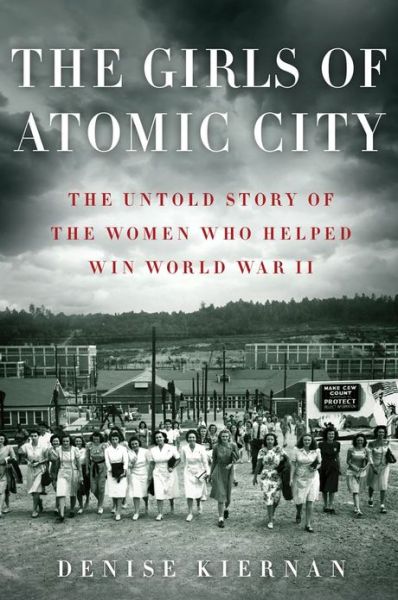
book beginnings on Friday: The Girls of Atomic City by Denise Kiernan

Thanks to Rose City Reader for hosting this meme. To participate, share the first line or two of the book you are currently reading and, if you feel so moved, let us know what your first impressions were based on that first line.

atomic

Friends, I am quite excited about this book. The subtitle reads: “the untold story of the women who helped win World War II,” and the blurbs indicate that this is the story of Oak Ridge, Tennessee, where much work on the Manhattan Project took place in a secret purpose-build city; and the stars are the female workers in particular. I will also say that the fact that this is a finely-bound, good-looking galley doesn’t hurt my first impressions, either.

Speaking of first impressions:

There have long been secrets buried deep in the southern Appalachians, covered in layers of shale and coal, lying beneath the ancient hills of the Cumberlands, and lurking in the shadow of the Smokies at the tail end of the mountainous spine that ripples down the East Coast. This land of the Cherokee gave way to treaties and settlers and land grants. Newcomers traversed the Cumberland Gap to establish small farms and big lives in a region where alternating ridges and valleys cradle newborn communities in the nooks and crannies of the earth. Isolated. Independent. Hidden.

That is a striking beginning, I’m sure you will agree. As soon as I read those lines I knew I wanted to share them here.

I hope you’re equally excited about your reading choice(s) this weekend!

This quotation comes from an uncorrected advance proof and is subject to change.

Team of Rivals by Doris Kearns Goodwin (audio)

teamofrivalsMostly I read books first and then (maybe) watch the movie, later. This time I did it backwards: I recently saw the new movie Lincoln (with Daniel Day Lewis), and then began listening to this book on audio, on which the movie was based. Not that there’s any shortage of Lincoln histories out there; but this is the one Spielberg turned into film. So please forgive me if this review is a little heavy on comparisons to the movie…

Beginning with which, the movie begins on the eve of the battle to ratify the 13th amendment, but the book starts much earlier, with Lincoln struggling to get the Republican Party’s nomination for presidential candidate. We follow Lincoln through his nomination, his campaign, and the setting up of his cabinet. The title of the book, appropriately, describes its subject: not Lincoln himself so much (as in the movie), but his skillful political alignment of his rivals for the Republican nomination in his cabinet. We get to know these other characters much better in the book than we did in the movie (which was also appropriately titled. Its focus was different). As this book effectively communicates, one of Lincoln’s political strengths was in placing his rivals where their strong points could best play to his administration’s advantage, and where their animosity toward him could best be neutralized.

Just as with the movie, I worried a little about an overly patriotic, positive portrayal of Lincoln. As in the movie, he is depicted as being strongly concerned about the black man or woman’s natural right to liberty; and while this is a sentiment we applaud today, I am afraid it was not at the center of the Civil War or Lincoln’s personal priorities. In other words, it’s something we love to think about our lauded 16th president today, but it’s not entirely historically accurate. Along these lines, I noted repeatedly that Goodwin uses rather many superlatives, which decreased my confidence in her neutrality slightly.

These concerns aside, I enjoyed the story. Not only Lincoln and his wife and children, but the characters (along with their families) of Bates, Chase, and Seward are evoked, and it made this critical moment in my nation’s history come alive. It was an absolutely entertaining story to listen to; and Goodwin’s great reputation (she has a Pulitzer to her name) and the reasoned pace & structure give me confidence that this is a responsible piece of historical writing… but I still felt that there was some positive slant, as above.

The audio narration by Richard Thomas was everything it should have been. This is a fine book, very readable, which makes Lincoln’s White House history accessible and makes the story come alive. But it might not be hard-edged journalism, for what that’s worth.


Rating: 6 machinations.

The Honored Society by Petra Reski

An intriguing and sensational, but not sensationalist, study of the Italian Mafia through character sketches.

Petra Reski had covered the Mafia as an investigative journalist in Germany for years, to the minimal interest of her editors and readers, who considered it an Italian problem. Then, in 2007, six Calabrians were executed in the town of Duisburg, and suddenly the German public was interested in the Mafia.

In The Honored Society, Reski composes character studies of various players both within the Mafia and fighting against it, based on her reminiscences of meetings and interviews. In addition to mafiosi and police investigators, her subjects include public prosecutors, defense lawyers, priests, fellow journalists and Mafia wives and daughters. Accompanied by her cabbie, Salvo, and her photographer, Shobha (as well as Shobha’s mother, a famous anti-Mafia photographer in her own right), Reski travels the streets of Italy and recalls the personalities she’s known. Her sketches of these “bad guys” and their adversaries are intimate and contemplative, rooted in years of experience. Even while excoriating the actions and influence of the Mafia, she seems to feel respect, even affection, toward certain individuals, revealing a conflicted relationship much like the one she describes between the Italian public and its famous criminal organization.

Generally, Shaun Whiteside’s translation of Reski’s work (from the German original of 2008) reads as straightforward, simple prose; but a quiet poetry lurks in certain turns of phrase and carefully crafted images. The Honored Society is an unusually structured view into the strange and powerful world of the Italian Mafia.


This review originally ran in the January 15, 2013 issue of Shelf Awareness for Readers. To subscribe, click here, and you’ll receive two issues per week of book reviews and other bookish fun!


Rating: 6 expensive handbags.

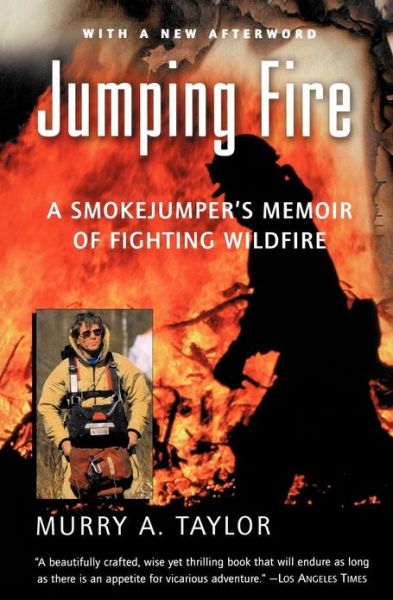
Jumping Fire: A Smokejumper’s Memoir of Fighting Wildfire by Murray A. Taylor

jumpingfire

I was not aware of smokejumping as a career until I read Phil Connors’s Fire Season a few years ago, but I was fascinated. Further, when I read Sebastian Junger’s The Perfect Storm in 2012, I learned (in the author’s interview at the end of my audio edition) that he had originally conceived a book that would contain chapters on each of a number of highly hazardous jobs. These were to include smokejumpers as well as the swordfishermen that ended up starring in his highly regarded book.

I believe it was my friend Don who recommended this book when I raved about Fire Season. [Thanks, Don!] Jumping Fire is a memoir by the oldest smokejumper ever to work the job (at least when this book is published – I cannot swear that his record still holds, but it seems to). As the name indicates, smokejumpers are wilderness firefighters who reach their dangerous destinations in dangerous fashion: parachuting out of aircraft adapted for the purpose. Taylor was 56 when he retired after an especially hot season in 2000.

I took one overwhelming early impression from this book: these smokejumpers are crazy! We’re talking about people jumping out of airplanes into forest fires! The ways in which they can die or be maimed are myriad on their way to the ground; and assuming they get there safely, they then have to fight a forest fire and, sometimes, hike back out again. Frequently they remain onsite for days, sometimes weeks, fighting fires around the clock on very little sleep and often with few rations (food & water have to be parachuted in, as well). They breathe smoke, suffer burns, dodge falling flaming trees, steer around rocks and trees and rivers upon their descents from the clouds. On the other hand, when not jumping or fighting fires, there’s a lot of waiting: “Bob Quillin [a fellow smokejumper] once described smokejumping as ‘prolonged periods of boredom punctuated by moments of stark terror.'” (I found that cute.) On top of which, the training is insane: “former marines who have become smokejumpers all agree that Alaska rookie training is tougher than anything they saw in boot camp.” So they have to really want to do this job. I am awed. I think they are nuts, without question. But it’s nice to know there are men (and women, too) out there willing to do such a crazy job. I can’t understand you, Taylor, but I take my hat off.

Taylor has rather many tales to relate of danger, injury, death and tragedy to relate; I had to close the book several times to stare into space and absorb the difficult moments. By all means, this lip-biting adrenaline rush is one of the admirable qualities of the book. But Taylor is also quite the romantic, and his love affair with a much younger woman occupies a number of pages, while his pining for her occupies still more. The firefighting/jumping remains at center stage, never fear; but there is a thread of wistful romance woven in. One is almost reminded of Abbey’s somewhat unfortunate Black Sun, although I hate to say such a thing. Taylor is rather more tasteful and less fantastic in his love affair, which is after all (if we believe him, and I have no reason not to) real. Page space is also devoted to a certain amount of (very natural) musing on human life and the wisdom of doing this hazardous work, when smokejumpers have wives and children at home who suffer when they are hurt or killed, and as Taylor ages and his knees complain about all those hard contacts with the ground. Or, on the challenges of the job:

Jumpers rarely speak openly about how they handle extreme fatigue, but when they do, they joke about it and claim to be the weakest in the bunch. At such times I just keep my mouth shut. For me, it’s always the same. Beyond the fatigue comes the sorrow and with the sorrow comes the loneliness. At the hour of my greatest exhaustion, I am lonely, emotionally frail, and at a loss to do much about it. No matter who claims to be the weakest, in the deep, dark pit of my soul, I know that it is me.

I found this a poignant consideration of his own weakness; but he also seems to acknowledge the universality of feeling inadequate, which is sort of a comment on humanity. And, of course, there’s no shortage of macho avoidance of such confessions.

Jumping Fire is the story of an absolutely fantastic, absolutely real occupation that very few of us will ever see face to face, and it is exhilarating and fascinating as such. But Taylor is also a fine writer, and contemplations of natural beauty and the tension between seeking comfort and seeking thrill and hardship are a great strength of this book, as well. I found it riveting, enjoyable, and thoughtful – recommended.


Rating: 8 racing hearts.

The Greater Journey: Americans in Paris by David McCullough (audio)

greaterjourneyThis is my first experience with the very well-respected David McCullough. “Americans in Paris” is a huge topic; but if anyone can do it justice, we’re told, McCullough might be that one. This feels like a quite comprehensive study of Americans in Paris in the 1800’s, complete with name-dropping and historical context. (I say “feels like” because I don’t have the historical knowledge myself to confirm or question McCullough’s comprehensiveness!)

McCullough follows Americans in Paris more or less chronologically, starting with the 1830’s and following through the end of the century. His subjects range over various disciplines and the story he tells seems to ramble, from art & literature, to medicine, to culture, war, and back to art. In the 1830’s we meet those who were among the first to make the journey, including Ralph Waldo Emerson, James Fenimore Cooper, Samuel Morse, and Oliver Wendell Holmes. A number of chapters are devoted to visual artists and writers, and the artistic superiority of France and the Continent which was only beginning to be challenged by Americans. Samuel Morse not only painted his masterpiece in Paris, but began work on what would become the telegraph; Harriet Beecher Stowe sought escape from the publicity following Uncle Tom’s Cabin; the first American female medical students studied there; and Charles Sumner’s observation of black students in Paris would lead him to a new understanding of black Americans’ abilities, and help him become one of our first abolitionist Congressmen. Rather fewer chapters* are devoted to the medicals, but I enjoyed very much McCullough’s descriptions of the École de Médecine and the American students who studied there. At the time, France was the place to study medicine, and the personalities who taught it loomed large; their role in this section of the book was very entertaining to me. (Also, I thought of The Lady and Her Monsters as McCullough discussed the dissection of cadavers, and their sources.)

Moving forward a few decades, later waves of American visitors to Paris would more commonly bring their families with them to live a fuller life than that of the student or artist; and there would be many more of them. One of the strongest sections of The Greater Journey describes the Franco-Prussian War (1870-71), and the role of American ambassador Elihu Washburne. He was the only ambassador who stayed, and he saved innumerable Americans as well as Germans, helping them evacuate and generally organizing and supporting – literally, in many cases, as he fed & boarded a number of the displaced. He was well regarded for this work, above and beyond the call of duty. The Franco-Prussian War (which felt vaguely familiar to me from my recent readings of de Maupassant), is well told; and McCullough’s description the Paris Commune is evocative and powerful.

Another figure that receives personal attention is sculptor Augustus Saint-Gaudens, an Irish-American kid from a family of decidedly modest means who travels to Paris and becomes a world-renowned artist. You may know him for his bronze Robert Gould Shaw Memorial on Boston Common and his statue of William Tecumseh Sherman at a corner in New York’s Central Park. Saint-Gaudens’ life is examined from his youth through his old age and death; I found this study of an artist to be a very interesting sub-story within The Greater Journey. Likewise the life of Mary Cassatt, an American painter famous for Impressionism who was significantly shaped by Paris.

In other words, while McCullough seems almost to ramble amongst various people, disciplines, and issues, each of his individual subjects is well-treated and fascinating; and any seeming lack of structure is happily tolerated because all the stories are so enjoyable. It’s not really that the book lacks structure, only that following Parisian Americans chronologically takes us through all these twists and turns. The whole is highly readable and a good primer in French/American history in the 1800’s. For example, one consistent thread throughout is the close relationship shared by our two countries during this century, beginning with General Lafayette’s support of the American Revolution in 1776.

The Greater Journey is an interesting and enjoyable read, a good central place to learn a number of individual facts and anecdotes about Americans traveling and living in Paris in 1830-1900. I have the impression that McCullough’s research is good; I am charmed.

*I am not entirely clear on the proportions of the book devoted to each subject, because I listened to the audio and thus could not grab chunks of pages for visual comparison. It is a shortcoming of the audio format. You get only my impressions.


Rating: 7 croissants.

book beginnings on Friday: Team of Rivals by Doris Kearns Goodwin

Thanks to Rose City Reader for hosting this meme. To participate, share the first line or two of the book you are currently reading and, if you feel so moved, let us know what your first impressions were based on that first line.

teamofrivals

After recently seeing the movie Lincoln, I have been ready to finally listen to this book, upon which the movie was based. It begins:

On May 18, 1860, the day when the Republican Party would nominate its candidate for president, Abraham Lincoln was up early. As he climbed the stairs to his plainly furnished law office on the west side of the public square in Springfield, Illinois, breakfast was being served at the 130-room Chenery House on Fourth Street.

Simple enough, yes, but I think this is an example of slipping details and impressions upon the reader in what reads like a straightforward few sentences. Picture a man who’s up early on this day: is he nervous? That would be understandable. His office is plainly furnished, and they’re serving breakfast elsewhere. He’s a man of the people rather than an aristocrat, perhaps.

I’m excited about this read. I will say that Goodwin uses rather many superlatives, so far, and there’s a danger, when someone is portrayed as being masterful, expert, the most and the best, of wearing me out a little. But I’ll wait and see. It’s easy to get excited about Abraham Lincoln, of course.

That’s my new read – and what are you reading this weekend?

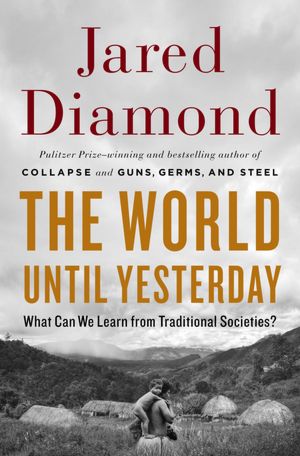
The World Until Yesterday by Jared Diamond

An ambitious but effective–and charming–exploration of the salutary lessons offered by traditional societies.

For many decades, Pulitzer Prize-winner Jared Diamond (Collapse; Guns, Germs and Steel) has split his time between his native United States and the traditional societies of New Guinea. In The World Until Yesterday, he compares traditional ways of life with “WEIRD” (“Western, educated, industrialized, rich, democratic”) methods of problem-solving. Recognizing the daunting breadth of such a subject, he selects a few areas for examination, including dispute resolution, child-rearing, elder care, religion and the connection between lifestyle and non-communicable diseases like Type II diabetes. In each area, he compares traditional practices with modern ones, considering the evidence from angles both strictly scientific and personal.

Diamond supplements his extensive fieldwork with substantial research to draw credible conclusions and posit plausible theories. But he writes conversationally, using the first person liberally as he meanders across disciplines such as anthropology, sociology, geography, statistics and evolutionary biology. This disarmingly personal tone is one of the greatest strengths of the book. Diamond also discusses preconceived notions that he and the reader may have, then moves on to new theoretical ground. While acknowledging aspects of traditional societies to which we do not wish to return–cyclical violence, infanticide, frequent starvation–he identifies certain strengths as well, like negligible rates of heart disease and restorative justice systems. “What can we learn from traditional societies?” Diamond asks in his subtitle; his plan to discover the wisdom and experimentation of more than 10,000 years of human society is well-executed.


This review originally ran as a *starred review* in the January 4, 2013 issue of Shelf Awareness for Readers. To subscribe, click here, and you’ll receive two issues per week of book reviews and other bookish fun!


Rating: 8 yams.

Teaser Tuesdays: Vera Gran: The Accused by Agata Tuszyńska

Teaser Tuesdays is a weekly bookish meme, hosted by MizB of Should Be Reading. The idea is to open your current read to a random page and share a few sentences. And try not to include spoilers!

veragran

What an interesting study of a woman I’d never heard of – which has turned out to be a genre I really enjoy, in fact. (Biographies of women I’ve never heard of, that is.) And one of the central themes is the nature, and limitations, of memory:

Perhaps memory is only an element of the process, and memory modifies itself when being evoked. Perhaps memory does not weave a tapestry but runs along a particular strand, uniquely under the influence of the moment.

I am sure we can all sympathize with the shortcomings of our memories; but perhaps few have paid a price like the one Vera Gran paid. Stay tuned for my review.

This quotation comes from an uncorrected advance proof and is subject to change.

Life Below Stairs: True Lives of Edwardian Servants by Alison Maloney

A simple but thorough glimpse into the lives of British house servants in the early 1900s.

In the wake of Downton Abbey‘s wild success, Alison Maloney’s Life Below Stairs offers an in-depth look at the lives of the serving class in the era of King Edward VII (1901-1910) and the Great War. She examines all aspects of servants’ place in society and relationships to their masters and one another, including social backgrounds, the responsibilities of each servant in households large and small–from the lowly house or hall boy and the maid-of-all-work to the butler and housekeeper–and their working conditions. She also provides details on fine dining, complete with table service instructions and menus that boggle the mind. Finally, she describes servants’ opportunities for retirement or marriage out of service, giving the modern reader an idea of exactly how limited their lives could be. Many poor children and teens would feel lucky to get a position in a “good house,” and not feel dishonored by such a post–in contrast, a contemporary source relates, “service [was] considered rather degrading in America.”

Although comprehensive in its survey of staff’s lives, options, and conditions, Life Below Stairs is a surprisingly easy read. Short chapters and accompanying tables, contemporary newspaper clippings and illustrations make this an accessible and charming way to study the lives of Edwardian servants. As a companion to Downton Abbey or simply a dip into another time, Maloney’s study satisfies.


This review originally ran in the January 4, 2013 issue of Shelf Awareness for Readers. To subscribe, click here, and you’ll receive two issues per week of book reviews and other bookish fun!


Rating: 6 eyes lowered.

article from Orion magazine: “Dark Ecology” by Paul Kingsnorth

This article came to me from coworker Liz (who always recommends good stuff), and simultaneously from Pops, who also thought it was great. That should be testimony enough; but I am unstoppable and will say just a few words myself, too.

Paul Kingsnorth writes about the future of ecology, conservationism, “green” thinking, or whatever you’d like to call it. This is “dark” ecology because the news is not good. I’ll let him give you the real dish because he does it better – as Pops says, “the good news is that Kingsnorth is a writer first, not a social scientist, so it reads pretty well” – but I really appreciated his willingness to look forward to what’s ahead and what we have to do differently than the old guard of environmentalism, which sadly hasn’t worked. And his ideas about what’s ahead and what we might do in anticipation, however dark, resonated with me. Plus, he writes beautiful thinking lines like these:

Our human relationship to the rest of nature is not akin to the analysis of bacteria in a petri dish; it is more like the complex, love-hate relationship we might have with lovers or parents or siblings. It is who we are, unspoken and felt and frustrating and inspiring and vital and impossible to peer-review. You can reach part of it with the analytical mind, but the rest will remain buried in the ancient woodland floor of human evolution and in the depths of our old ape brains, which see in pictures and think in stories. Civilization has always been a project of control, but you can’t win a war against the wild within yourself.

I give you: