hemingWay of the Day: on being drunk


I am hoping to pick up some Hemingway next week while I’m on vacation. It’s been a while since I’ve read any, and I miss him. To inspire myself (and maybe you?) I have chosen a rather classic few lines from my favorite of his books, For Whom the Bell Tolls.

“No,” Pablo said, dipping up another cup. “I am drunk, seest thou? When I am not drunk I do not talk. You have never heard me talk much. But an intelligent man is sometimes forced to be drunk to spend his time with fools.”

“Go and obscenity in the milk of thy cowardice,” Pilar said to him.

This is classic Papa because 1. it involves drunkenness; 2. it includes that oh-so-quotable line, “an intelligent man is sometimes forced to be drunk to spend his time with fools” (which I picture as one of those I’m-with-stupid t-shirts, but the literary version); and 3. Pilar’s line is on the one hand crass and on the other hand, linguistically interesting. Hemingway has used the word “obscenity” in place of a presumed (ahem) obscenity, like bleeping it out; and “thy” translates the Spanish “tu.” For Whom the Bell Tolls also features some interesting Spanish-language word order, to emphasize the feeling that these Spaniards’ dialogue has been translated for our benefit. I like the flavor that that adds to the book.

That’s our short taste of Hemingway today. Hopefully I’ll have more to tell you about soon!

Teaser Tuesdays: Walden by Henry David Thoreau

Teaser Tuesdays is a weekly bookish meme, hosted by MizB of Should Be Reading. Anyone can play along! Just open your current read to a random page and share a few sentences. Be careful not to include spoilers!

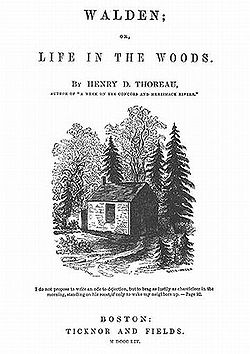
As I’ll be in Concord, Mass. in just a few days to visit the very place (!), I am reading Walden this week. It shouldn’t have taken me this long! There is no shortage of quotable moments in this American classic, many of which you would recognize even if you never knew their provenance; but I chose one I thought especially clever, and a little humorous as well:

I say, beware of all enterprises that require new clothes, and not rather a new wearer of clothes.

Here, here, Mr. Thoreau. One of many gems.

For any Walden fans out there (like my friend I got to visit with this past weekend), I have a recommendation for further reading: I really enjoyed Edward Abbey’s short piece entitled “Down the River with Henry Thoreau.” I read it in the Abbey collection, Down the River, but you can also read it online here.

And what are YOU reading?

footnotes, endnotes, othernotes

I teased you recently, in my review of On a Farther Shore (the new Rachel Carson biography by William Souder) with some thoughts on Notes. You may notice that this is my third post concerning Souder’s book. It has been rather thought-provoking, which is always nice.

Authors of nonfiction should cite their sources. I don’t think there’s much disagreement on this point. But to the question of how they should do it, there are several answers. The most common use a superscript number or other symbol in the text to refer the reader to more information elsewhere. Footnotes reside at the “foot” of the page, and endnotes are collected at the end of a chapter or a book. (I don’t read e-books, but surely there’s a clever way to imbed notes in the text in the form of little hyperlinks so that the reader can reference the note on the spot if she so chooses, which sounds convenient and reasonable [except that she’d have to be reading an e-book, so there’s a compromise].) The content of notes is often bibliographical, giving credit to the author’s source for a piece of information, but can also allow the author to further discuss a point, like a long parenthetical outside of the text itself.

There are pros and cons to footnotes and endnotes. Footnotes take up space on the page, and may be annoying to readers who don’t care about them. Endnotes can be inconveniently remote, for readers who do care – I’ve been known to use two bookmarks, one for where I’m reading in the main text and one for where I’m reading in the endnotes, so that I can quickly find the next note I’m directed to. I guess the main question, then, is whether the reader cares about the content of the notes in the first place. I suspect I’m fairly typical in that I am more likely to care about notes that offer further thoughts on the main text, than notes that only cite sources.

William Souder, in On a Farther Shore, uses endnotes, gathered all together in one long section (75 pages) at the end of the main text. At a glance, they appeared to be works cited, and I was going to leave it at that. Normally at the end of a nonfiction read, I look at the Acknowledgements, Notes, and sundry further thoughts, and read as much of it as attracts my attention (often most of it). In this case, I found that I had been wrong about the notes: most of them were citations, but there were some parenthetical-style remarks by Souder, describing his experience in researching the book (descendents of Carson and her friend Dorothy Freeman hosted him at their homes on the ocean; he wrote a chapter at Carson’s own desk) or expanding upon the text of the book. This was valuable! For example, I learned in a note that “in the 1950’s and 60’s it was common for doctors to discuss a cancer diagnosis with a woman’s husband and not with the patient herself – a disturbing practice that left the unmarried Carson in the dark about her condition.” (Souder notes in the main text that Carson’s ignorance about her condition and treatment options was all the more ironic and tragic because, as a scientist, she was more capable than the average man of understanding that information and using it to make decisions about her care.) This shocking detail seems important to me! I’m glad I came across it by accident – after which I read the notes through, and found other tidbits of value. For example, Souder emerges as a person with feelings and personal impressions only in his notes.

My point here is that I almost missed the notes that were valuable to me because I misunderstood their content. This isn’t necessarily an argument for footnotes over endnotes; but at least I might wish that Souder had made it a little more clear that there’s more than citations in that exhaustive 75 pages of notes at the back of his book. Keep your eyes open, kids.

What are your feelings about footnotes, endnotes, or othernotes?

On a Farther Shore: The Life and Legacy of Rachel Carson by William Souder

Rachel Carson was born in 1927 and by the 1950’s was the author of several bestsellers, a national hero for her lyrical, literary, scientifically accurate books about the ocean. She also published myriad magazine and newspaper articles, both as a government employee and as a freelance writer. In 1962 she published a somewhat different kind of book. Silent Spring retained the literary style for which she was well loved, but its subject – while still the natural world – took a different tone. Carson wrote about the then-widely-used pesticide DDT and its sinister effects, not just on the insects it claimed to target, but on wildlife generally including many fish and birds (hence the title) and even human life.

The immediate reaction to her book was mixed. Critical reviews were more positive than negative, but the government (to varying degrees) and the pesticide industry (predictably and totally) offered less praise. Carson came under attack as a hysterical nature faddist and Communist sympathizer, even as Silent Spring topped bestseller lists and initiated federal investigations. Today, the ecology and environmental movements credit Rachel Carson and Silent Spring with helping to establish what is now a central issue of our times.

William Souder’s new biography of Carson, published on Silent Spring‘s 50th anniversary, begins with the conjecture that Carson’s name is now “unknown to almost anyone under the age of fifty.” There are a few of us, of course (although I confess my personal poll may not constitute a random sampling), but his point is well taken: in 2012, Carson is less on our minds. But even if DDT is no longer sprayed on kids playing at the beach and the rivers we catch our fish out of, environmental issues are among the most pressing of our day. (I am thinking of climate change, overpopulation, water tables, land use, urban sprawl, species extinction…)

That’s the argument for Carson as a biographer’s subject. Now, how did Souder do? As observed yesterday, his style is rather a traditional one. Souder himself does not enter into the story as a character; he doesn’t give us his own impressions (unless you delve into the Notes at the back of the book, on which more is coming in a later post). I am a fan of the newer style of “creative nonfiction” exemplified most recently at pagesofjulia by Soundings, but that doesn’t mean the straightforward sort of biography is necessarily dry, either.

Souder brings his subject to life. His plentiful research (again see those Notes) clearly and exhaustively outlines Carson’s background and personality, and enigmas. For instance, he notes the weekend in college when she went one two dates with a boy from another school, and then as far as we can tell, never dated again. He writes eloquently of her strange single-mindedness, for example in reading Henry Williamson for his nature writing (which she loved) while totally ignoring his frank Nazi sympathies.

I will mention one angle that I noted as absent: there is nothing in Souder’s book about Carson suffering for her sex in the field of science. This seemed like a natural obstacle for her to have faced as a science writer in the 1950’s and 1960’s, and I wonder at its absence, particularly in comparison to Soundings, where Tharp’s professional limitations as a woman are one of the central issues. Did Carson not feel that she was held back? Did Souder miss something? His work feels thorough. I am hesitant to think he missed such an important angle, but it makes me wonder. There are a few references by her contemporaries to her status as a “spinster,” but even these don’t feel particularly biting. And apparently her critics entirely missed the lesbian question. Carson had a very close female friend for the final 10-12 years of her life with whom she exchanged ardent letters. Whether they had a sexual relationship is not known, although Souder makes the case that it’s unlikely; but that’s irrelevant in looking for contemporary criticism of her for it. It seems like such an obvious way for her detractors to attack her. I just wonder.

Despite my questions about the role sexism might have played in Carson’s career, this biography feels well-researched, thoughtful, and finely wrought. It can also serve as a fairly good quick introduction to the history of ecology, environmentalism, and nature writing: Aldo Leopold, John Muir, and Teddy Roosevelt all get put into context. In fact, context is one of its strengths (again, see yesterday’s post). I feel like I know Carson much better now, which is of course what I was looking for, but it was also an enjoyable read. I recommend On a Farther Shore, because Rachel Carson is every bit as relevant today as ever.


Rating: 7 birds’ eggs.

Let’s Pretend This Never Happened by Jenny Lawson (audio)

I was already a fan of The Bloggess, Jenny Lawson’s blog-alias. And her local connection (she’s Texas, with some time logged in a Houston suburb) didn’t hurt, either. Well, now having listened to her book as an audio read by the lovely Jenny herself, I can even more wholeheartedly recommend her to you.

Jenny has a quirky, crass sense of humor: she is fond of the word “vagina” and curses a fair amount. These things do not bother me, but fair warning. She combines that style, however, with an occasional earnestness that is endearing and captivating. This is her “mostly true memoir” (which I think is a great way to speak of memoir, in general! my impression is this one is as “true” as most), and therefore it’s the story of her childhood, growing up, marriage, and family life with husband Victor and daughter Hailey, including moving around the state. One emphasis is the crazy upbringing she experienced in a tiny tiny Texas town with an eccentric taxidermist father (whose idea of a loving welcome is tossing a baby bobcat at her new boyfriend) and long-suffering mother. Another is the mental illness Jenny suffers from, including generalized anxiety disorder and post-traumatic stress. (Disclaimer: I have no print version of this book at hand and am going by memory. But I am fairly confident in my memory.)

Her handling of these subjects is on the one hand hilarious, outlandish, and obscene, and on the other, as mentioned earlier, serious and thoughtful. For someone who suffers fairly debilitating bouts of depression and mental illness, Jenny is surprisingly positive in her interpretation of her own experiences. Presumably her feelings in the moment are often much less cheery; but in the format of this book, where she got to think it through and get it right, her philosophies are refreshing, graceful, helpful, optimistic. She comes across in the end as damaged, yes, but also hopeful, wise, and fun. I want to be her friend. In other words, I give Jenny, her book, and her website my ringing endorsement! Oh, and do check out the audio version if you can. She reads it herself (and sings all the chapter titles), there’s a blooper reel at the end (really just a bunch of off-color ramblings), and I always like to get things in the author’s own voice if possible – in a memoir most of all. In fact, I will pay her the compliment of putting Let’s Pretend This Never Happened up next to Tina Fey’s Bossypants, also read by the author and also hilarious. Go check out Jenny Lawson because she is unique and bizarre in the best possible way.


Rating: 8 self-reflections.

Lost Antarctica: Adventures in a Disappearing Land by James McClintock

A warning about climate change wrapped in a tender package of stories about penguin chicks and fur seals.

Zoologist James McClintock has spent his career in the Antarctic, lovingly examining and meticulously documenting the wildlife, from the leopard seals and emperor penguins to the tiny sea butterflies and plankton, while recording changes in ocean conditions. Lost Antarctica collects a selection of his experiences: deep-sea diving, storms at sea, sightings of creatures large and small and other discoveries of tiny, crucial instances of evolutionary genius. Although he takes his time getting there, McClintock’s most important point is cautionary: Antarctica, he says, is an early warning for the rest of our world.

McClintock has observed climate change firsthand and can lend his firsthand knowledge to other studies that document and explain the crisis. He also addresses “the other CO2 problem”–the increasing levels of carbon dioxide in our oceans that lower the water’s pH levels. The combination of ocean acidification, rising temperatures and melting ice threatens many species and their delicate relationships with one another–and the consequences extend even further, as some organisms that live only in Antarctica have been shown to yield chemicals that can help fight cancer and influenza.

While Lost Antarctica is an alert about climate change and ocean acidification, it ends on a surprisingly hopeful note. McClintock’s message is reasoned and well documented–and his descriptions of a wondrous world of coral, starfish, sea sponges, fish, crabs, penguins and birds of prey make this important scientific message accessible to the general reader.


This review originally ran as a *starred review* in the Sept. 21, 2012 issue of Shelf Awareness for Readers. To subscribe, click here, and you’ll receive two issues per week of book reviews and other bookish fun!


Rating: 6 degrees Fahrenheit.

Teaser Tuesdays: Let’s Pretend This Never Happened by Jenny Lawson

Teaser Tuesdays is a weekly bookish meme, hosted by MizB of Should Be Reading. Anyone can play along! Just open your current read to a random page and share a few sentences. Be careful not to include spoilers!

So after quitting on Gold, I am enthused and relieved to be listening to Jenny Lawson’s “mostly true memoir” (probably a great, and safe, description of many memoirs), Let’s Pretend This Never Happened. You may know Jenny better as the Bloggess. She’s hilarious.

My father lifted the large bird off of the hood with more than a little exertion and tucked him under his arm, saying, with a surprising amount of dignity for a man with a turkey under his arm, “Sir, this bird is a quail, and his name is Jenkins.”

I confess I chose this teaser not only for its bizarre quality which so perfectly represents this book as a whole, but for the name Jenkins, which happens to be Husband’s name as well, making this whole chapter (entitled “Jenkins, You Motherf*ker”) extra funny to me personally.

I recommend Jenny’s work (blog and book) because although it’s bizarre and hilarious, it also has a serious message to impart. More to come in my review, soon.

book beginnings on Friday: Real Man Adventures by T Cooper

Thanks to Rose City Reader for hosting this meme. To participate, share the first line or two of the book you are currently reading and, if you feel so moved, let us know what your first impressions were based on that first line.

This book begins with an appropriate quotation, and I’m going to share that with you as well as the beginning of Cooper’s writing.

“It goes a long way back, some twenty years. All my life I had been looking for something, and everywhere I turned someone tried to tell me what it was. I accepted their answers too, thought they were often in contradiction and even self-contradictory.” –Ralph Ellison, Invisible Man

I am a visible man. By all appearances white, middle-class, heterosexual. Male.

I like the parallel drawn, and the contrast noted, to Ellison’s work. I haven’t read Invisible Man, but I’d like to. (It fits into a recent reading pattern of mine. And I’ve finally worked out Ellison’s Invisible Man vs. H.G. Wells’s, whew.) I think the essence of this book is well foreshadowed in those brief words of Cooper’s, too.

What are you reading this week?

This quotation comes from an uncorrected advance proof and is subject to change.

Keep It Real: Everything You Need to Know About Researching and Writing Creative Nonfiction, edited by Lee Gutkind

This is an excellent and succinct tool. It first offers some discussion of the parameters of creative nonfiction by a man “often referred to as ‘the godfather behind creative nonfiction,'” Lee Gutkind. It’s just what I was looking for. Gutkind’s introduction muses on the definition of the genre (difficult to pin down, of course, as these things always are), and addresses the concerns sometimes raised about the conflict between creativity and nonfiction. He also acknowledges some of the literary controversies (James Frey, Stephen Glass, Jayson Blair, etc.) that have hurt the genre’s credibility. And then the bulk of the book begins: writing advice. “The ABCs of Creative Nonfiction” move from “Acknowledgement of Sources” through “Writers’ Responsibility to Subjects” (the contributing writers apparently didn’t want to force the issue by contriving a Z, for which I respect them).

Each of these sections is concise – the whole book barely makes 150 pages – but packed with good advice. Legal and ethical issues receive more than a few pages, which I think is appropriate. Although the central recommendation there seems to be “when in doubt, get a lawyer,” there’s more to it than that: they cite legal precedent and explore the definition of libel, which I found useful and informative. There were also sections addressing interview techniques and the pros and cons of note-taking vs. tape recording (or other audio recordings). There are bits of creative-nonfiction-specific guidance, like how to get inside the heads of characters who are not you and still stick to the facts. And finally, certain chapters deliver straightforward writing advice: how to show, not tell; find a voice; structure a story; and set a scene.

This is not a book for a professional journalist, necessarily, although I could be wrong; maybe those professionals should read this book, too. It’s certainly brief and informative. But I get the impression that it is more geared towards people like me: laypersons without journalism backgrounds who are interested in writing creative nonfiction and want to know the basics. I found it a valuable piece of instruction at just my level; it gave me things to think about, books to put on my list, and actually inspired me to jot a few passages down towards my own project. I recommend it.


Rating: 7 pagesofjulia.

Teaser Tuesdays: Keep It Real, edited by Lee Gutkind

Teaser Tuesdays is a weekly bookish meme, hosted by MizB of Should Be Reading. Anyone can play along! Just open your current read to a random page and share a few sentences. Be careful not to include spoilers!

What a quick-reading gem of nonfiction writing advice I’ve found here. I like this one for its imagery:

Brevity editor Dinty W. Moore asks his writers for sharp description and careful distillation. “I like to imagine a brush fire, deep inside a national park,” he explains. “The reader is a firefighter, and the writer’s job is to parachute that reader directly to the edge of the blaze to encounter flame and smoke immediately. There is no time for the long hike in.”

I confess my interest in fires and firefighting, especially in the national parks, didn’t hurt the effect this passage had on me. Review coming shortly. I will be recommending this one.