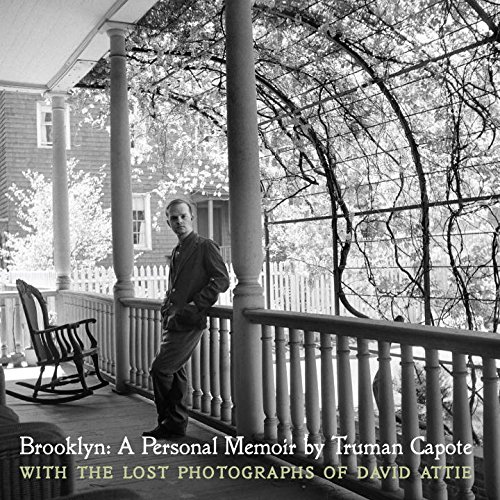
Brooklyn: A Personal Memoir: With the lost photographs of David Attie by Truman Capote

A superb Capote essay with never-before-seen photographs originally commissioned to accompany it make an ideal match–and a great story.

brooklyn

Truman Capote’s essay about Brooklyn Heights, N.Y., filled with clever observations in his familiar style, was first published by Holiday magazine in the 1950s. It was reprinted in 2001, with a foreword by George Plimpton, which is included here. However, the singular contribution of Brooklyn: A Personal Memoir: With the Lost Photographs of David Attie is those photographs, discovered in 2014 by the late photographer’s son in dusty wooden boxes. The story Eli Attie tells in his afterword is as compelling as Capote’s witty and winning portrait of Brooklyn. Capote’s career was distinctly tied to Attie’s when the latter was hired to photo-illustrate Breakfast at Tiffany’s for its scheduled appearance in Harper’s Bazaar, which Eli learned only decades after his father’s death.

Capote’s essay is of course brilliant in its scenes, characters and language. “Sunstruck scraps of reflected river-shine” and the lovely alliteration of “plenipotentiaries from the pearl-floored palace of Poseidon or mariners merely” exhibit his decorative, evocative way with words. The historic contribution of this glimpse at a place in time is significant; and the same must be said of Attie’s documentary photographs, which perfectly complement Capote’s text. Since Harper’s Bazaar ultimately cut the novella, the included images went unpublished, including several of a young Capote, framed against the “beautiful staircase floating upward in white, swan-simple curves to a skylight of sunny amber-gold glass” in the house where Capote lived (in the basement).

This marriage of Capote’s glimmering words with Attie’s harmonizing photographs is perfected by the younger Attie’s narrative, in this unparalleled addition to the Capote canon.


This review originally ran in the November 17, 2015 issue of Shelf Awareness for Readers. To subscribe, click here, and you’ll receive two issues per week of book reviews and other bookish fun!


Rating: 8 local institutions.

reread: Pieces of White Shell by Terry Tempest Williams

pieces of white shellThis memory from my childhood was every bit as good this time around. Terry Tempest Williams is a curator at the Utah Museum of Natural History in the early 1980’s, and in encountering Navajo people and their stories, she begins to learn her own natural history, her own and her (Mormon) culture’s connections to the earth, and how to find and tell stories herself. The tone is fanciful, but also grounded in the literal ground of her local environment in the Utah desert. In her first chapter, she shakes a small leather pouch out onto her desk and finds a sprig of sage; rocks, sand, and seeds; turquoise, obsidian, coral; pieces of white shell; yucca; a bouquet of feathers bound by yarn; coyote fur; a bone from Black Mountain; deerskin; wool; a potshard and some corn pollen; and the Storyteller, a clay figurine from Jemez. These objects, collected during her communion with people and place, form the chapters of her book. I’m not sure whether to call these stories or essays; they are both. There is an element of dreaminess: she is sure she heard the drums of the Anasazi, and tells of transforming into Flea to hide out and listen to the stories the animals tell on Black Mountain. These are not literal truths in the scientific world as we understand it. Does that make these stories fiction? Allegory? Spiritual journeys? I’ll leave it to you. I am not a spiritual person by any standard definition, but Terry Tempest Williams holds me in thrall. This book is still the one of hers that touches me most deeply.

I don’t know how many times I read this book as a child, but it clearly made a deep impression on me. Several lines echoed like I just read them yesterday, or like I’d copied them into countless margins and scrawled them in notebooks over the years. “How could I tell him the mind creates those things that exist. I couldn’t, and so I concentrated on birdlife to avoid a confrontation.” “No one culture has dominion over birdsong. We all share the same sky.” “If we all live, and continue to increase as we have done, the earth will soon be too small to hold us, and there will be no room for the cornfields” (says Coyote in one of the Navajo stories). And new lines jumped out at me on this reading. Because I’m working on processing my relationship with place: “Sometimes you have to disclaim your country and inhabit another before you can return to your own.” “Each of us harbors a homeland. The stories that are rooted there push themselves up like native grasses and crack the sidewalks.” Like all the best books, then, I’m continuing to discover it.

The stories Williams tells in each chapter of this book are from her life, living and working at the very four corners of the four corners states. A Utah Mormon, she gets to know the Navajo and their stories, and sees certain similarities between these two cultures which share a place. She explores Navajo stories and the storytelling tradition, the animals and plants and places they interact with, and uses these to map her own life; she explores story as tool for communication, history-building, and wise and respectful relationships with our earth, and its human and nonhuman inhabitants. In reading these stories, as a child, I was enchanted by the stories of animals like Coyote, Bear, and Badger, and characters like Monster Slayer and Child-of-the-Waters, who were twin sons born to Sun and Changing Woman. I learned about the flora and fauna of New Mexico and Utah deserts (quite exotic to me then, and now). In rereading the same stories as an adult, I get more of Williams’s search for answers about the world, about her family, her homeland, its significance, and her spiritual and cross-cultural questions. It is a rich experience.

My mother asks if this is a children’s book. I did first find it as a child and loved it then, in elementary school. Its origins in my family are unknown; I feel like it just appeared on a bookshelf. Someone must have bought it – for me specifically, it seems likely. I am an only child. But we don’t know. Neither of my parents remembers it. As it turns out, Pieces of White Shell is not marketed as a children’s book. But Williams worked with children (as well as adults) when she wrote it, and in the stories she tells. It is certainly accessible to a child, in its tone of wonderment and simple joy and careful observation.

This was published in 1984, and Refuge in 1991, and I can see some of the evolution. In Pieces of White Shell, Williams is still getting to know her world; in the later work, she more confidently moves in it and speaks of it, although she has retained her capacity for wonder (still alive and well in her recent retelling, The Story of My Heart). Refuge is also necessarily much sadder, as it studies personal loss while Pieces of White Shell takes pleasure in discovery.

Terry Tempest Williams was and is a remarkable, completely singular voice. “You always hear wings,” her family tells her in an anecdote in her prologue. I marvel, and I continue to learn from this deceptively simple grouping of stories. She is better known for other works but this is still my gold standard.


Rating: 9 coyotes.

Thunder & Lightning: Weather Past, Present, Future by Lauren Redniss

Superb illustrations accompany fascinating tidbits about weather and the world in this lovely, distinctive book.

thunder lightning

Lauren Redniss (Radioactive) offers a gorgeously rendered and singular piece of work with Thunder & Lightning: Weather Past, Present, Future. Her original artwork is stunning, dreamy and evocative, the perfect complement to facts about weather and carefully selected interview excerpts and quotations.

Redniss’s “Note on the Art” describes her media: copper plate photogravure etchings and photopolymer process prints, hand-colored, and a few drawings in oil pastel. She comments on the artistic tradition that inspired her: artist/scientists whose devotion to precision and accuracy have historically paired with “a sensation of strangeness, wonder, terror.” Her work is certainly worthy of that tradition; drawings of wildfires recall Picasso’s Guernica, and the chapter entitled “Sky” contains only striking illustrations and no text. These drawings are both otherworldly and very much of our world.

Redniss’s text, based on scientific research and cultural traditions, riffs on weather phenomena rather than offering a comprehensive study. Her chapters cover conditions (cold, rain, heat, fog) as well as concepts (dominion, war, profit), and span the planet and various peoples throughout history. She considers weather that has been blamed on witches or credited to gods; the use of cloud seeding as a weapon by the United States against Vietnam; and weather derivatives and insurance. Redniss’s subjects are quirky and entertaining; her chapter “Forecast” is as concerned with the Old Farmer’s Almanac as with the National Oceanic and Atmospheric Administration. That tone of marvel and whimsy, plus exquisite illustrations, make Thunder & Lightning both remarkably beautiful and pleasingly informative.


This review originally ran in the November 10, 2015 issue of Shelf Awareness for Readers. To subscribe, click here, and you’ll receive two issues per week of book reviews and other bookish fun!


Rating: 8 gorgeous interpretive hand-colored prints.

Wild by Cheryl Strayed (audio)

wildI took my time getting around to this, because I wasn’t convinced it was really worth my time. But I’m glad I did get around to it.

Then I took my time listening to it, because (as I’ve been saying for several audiobooks now), my listening time is much diminished these days by my lack of commute. In fact, after this one, I’ve decided to lay off audiobooks for a while except for long road trips.

Happily, though, Wild worked just fine with my slow pace and long breaks. The story Cheryl Strayed has to tell is that of her solo hike over much of the Pacific Crest Trail (PCT), at age 26, following a series of self-destructive behaviors and personal tragedies beginning with her mother’s death and including a divorce and a heroin habit. The chronology jumps around: we first see her late in her hike, when she loses her hiking boots; we then flash back to learn much of her history: her childhood, close relationship with her mother, her mother’s death and her struggles afterward. In part because of its episodic nature, it was okay to move into and out of this story over time. If I’d lost track of her momentary situation, I knew she was hiking the PCT and struggling somewhat; and in just a few seconds, I’d placed her again. Credit for this ease is also due, of course, to the engaging and memorable story she has to tell. Her mother is a sympathetic, interesting and engaging character; her brother, sister, stepfather and ex-husband are less developed but still present as individuals. Cheryl’s own voice is clearly portrayed, and while she frustrated me at times (only natural, I promise), she was ultimately absolutely a compelling, likeable and very real person.

Where Bill Bryon’s A Walk in the Woods was a little exasperating in its silliness, Wild achieves the right blend of humor and real struggle. She is definitely hapless; she has definitely made some serious blunders in getting out there on her own, with a wildly heavy pack, and no preparation. But she persists. She won my respect – I am tempted to say my grudging respect; call it semi-grudging – but better than that, she wins her own.

The writing is expressive, occasionally a little overwrought but only (I believe) as Cheryl was herself overwrought in those moments; it is descriptive and plain. I began to write that the writing is not the achievement of this book, that it is rather Cheryl’s distinctive story that carries it; but that’s not actually true or fair. The structure of this book, the pacing and order in which she reveals herself to us, are intelligently put together. The disordered chronology was carefully considered. The writing is not a straightforward narrative but includes metaphors and images that help bring the story to life. It’s more that the writing fades away and the reader experiences the story starkly: I forget I’m listening to a book and just see the journey unfold before me. This is indeed an accomplishment of writing, but it is an accomplishment of invisible writing rather than the decorative sort employed by Amy Leach, Brian Doyle or Terry Tempest Williams, which I also enjoy and which is easier to see.

I’m sorry for my earlier hesitation: pop sensation it may be, but Wild is also an example of fine writing, well-designed structure, and a hell of a story. I’m glad I studied it. Oh, and Bernadette Dunne’s reading on this audio edition felt like it captured the right voice, for me, of a young Cheryl Strayed. I happily recommend this format as well as this book.


Rating: 7 cold glass bottles of lemonade.

Refuge: An Unnatural History of Family and Place by Terry Tempest Williams

I am slowly, painfully discovering that my refuge is not found in my mother, my grandmother, or even the birds of Bear River. My refuge exists in my capacity to love. If I can learn to love death then I can begin to find refuge in change.

refugeWhen I read this book, I was continually reminded of the first Terry Tempest Williams book that I loved, as a child: Pieces of White Shell. I knew immediately that I would need to follow this book with a reread of that one. For me, Refuge is the more personal, more intimate, more grown-up and more exacting version of the kinds of things I found in Pieces of White Shell. I think I found this one more difficult, more thought-provoking and challenging; the other was both sparer, and offered clearer, more accessible comforts. Refuge is stripped, exposed pain. If there are balms for its wounds, they are more complex. Pieces of White Shell is metaphorical, symbolic, spiritual, seeking wisdom and humbly finding some of it; Refuge is bared emotions and loss. It is many birds. Each chapter is headed by the name of a bird – burrowing owls, killdeer, sanderlings, avocets and stilts, on and on – and by a level of Great Salt Lake.

Over the years in which the story of Refuge takes place, Great Salt Lake rises beyond its usual depths and boundaries. I learned in this reading that this Lake is shallow and covers a great area; therefore a few feet of rise can cover miles, and cause great destruction. Terry Tempest Williams saw her mother die of cancer as she saw her beloved Bear River Migratory Bird Refuge overtaken by saltwater, the birds displaced and many of them lost. In Refuge, she meditates on both losses and the relationship between them, how the Refuge offers refuge to her and to her mother, how they are linked – birds and women (clearly presaging her later When Women Were Birds), people and place (Terry’s Mormon family with the Great Basin and Utah), the cancer that runs in her family (“the clan of one-breasted women”) and their home (neighboring nuclear test sites).

Refuge involves nature, of course, and Terry educates us with precision about the birds she loves. It involves people, and society, and our interactions. It is beautifully written, with poetry, and with liberal gaps in which the reader may draw her own connections. Terry has an imaginative and generously interpretive mind, more so than mine.

The cancer process is not unlike the creative process. Ideas emerge slowly, quietly, invisibly at first. They are most often abnormal thoughts, thoughts that disrupt the quotidian, the accustomed. They divide and multiply, become invasive. With time, they congeal, consolidate, and make themselves conscious. An ideas surfaces and demands total attention. I take it from my body and give it away.

She finds wisdom in the world, as her mother and grandmother did; and of course, centrally, she finds refuge, which is not quite to say recovery or redemption, although those arguments can be made.

Terry Tempest Williams is a lovely writer. The story of her mother’s life and death, their relationship, and the difficulties and beauty of letting go, are all well accompanied by the pain and beauty of the migratory birds of the Great Basin that Terry knows well.


Rating: 7 phalaropes.

Things That Are by Amy Leach

Warning: raving follows. This is the best book.

THINGS THAT ARE by Amy Leach.Amy Leach’s Things That Are is a collection of essays that address creatures and natural phenomena, philosophy and the stars; they are as fanciful and wondrous and wondering as anything I’ve ever read, delightfully imaginative and fun to read, and illuminating. I learned facts and was made to consider concepts, and the package was unbelievably beautiful.

Amy Leach introduces her reader to beavers that “affably yield not”; music that sweeps you “juggled into its furious torrents, jostled into into its foamy jokes, assuming its sparklyblue or greenweedy or brownmuddy tinges”; peas that grow too tall to support themselves and must “grow madly wending tendrils, to sweep the air for lattices – just as teetery marionettes will grow marionette cords to sweep the air for marionetteers.” I marked many such quotations to share with you for their whimsy, their unique perspective, or their lingual tricks. Sometimes I failed and just noted that the whole essay should be studied and loved, as with “Talent” and “Warbler Delight” and “The Safari” and oh, the essay called “Pea Madness”…

Leach describes peas, which are self-contained until they grow tall enough that they must reach for external support. At this point she describes their tendrils, their reaching: your yearning, she writes, “can horse or unhorse you.” If you yearn for lattice and find one, you have won; if you reach not at all, you will lose; if you reach and find nothing, “your looking apparatus topples you over.” And some of us may have a lattice standing nearby, “installed with you in mind,” that we never find, although we come within an inch. The pathos! She writes that the yearning of peas is extrasensory: they do not know for what they reach; and

lattices are not the only things that are extrasensory. When you cast your small, questioning arms into the opaque universe, you may find a trellis to tether yourself to; or you may find a tree sticky with birdlime; or a snuffling piglet; or a trapeze artist swinging by who takes you for an aerialist and collects you – then alas, unless you have excellent timing and a leotard, you will be a lost cause.

This writing is funny and approaches our known world from a wholly unique angle; and its message is so powerful that I am nearly immobilized.

In “Silly Lilies,” Leach teaches us about gravitropic mutants, who send their shoots into the ground and their roots into the air, “like a demented boat that insists on sailing upside down, draggling underwater its silky sail.” (Yes, she wrote ‘draggling.’ Also ‘circumgallop,’ and ‘vasty,’ which she defines in her Glossary: “Has approximately the same meaning as ‘biggy,’ ‘hugey,’ and ‘giganticky.’ Do not let anyone tell you these words are not words; all words are words.” I think this is part of why she is compared to Lewis Carroll.) To describe lotuses in a windstorm, she evokes an image of slam-dancing hula girls. This is outrageous stuff. “Bluebirds defect, like bubbles and luck.” “Stars, like thoughts, are not inevitable.” I could go on. In “Twinkle Twinkle,” an essay from the section on “Things of Heaven,” she writes: “The incandescent cauliflower-ballerina is made of dust plus deep light; take away either ingredient and you have no celestial vegetables tripping the light fantastic in a laser tutu.” And I promise, in the context of the whole essay, this sentence makes perfect sense. It would take such a long quotation to illuminate to you that I would fear copyright violations; you should just go get a copy of this book yourself, and learn.

With all these playful poetics, I hope I haven’t given you the impression that Leach is only a whacky fun manipulator of language – because she is that, but she is much more than that. These essays examine and interrogate concepts larger than the ones we meet in everyday life. She forces her reader to question, and I have marked several of her passages to come back and continue to reflect upon.

I am smitten, you see. I found both the writing and the content perfectly formed and singular. Oh, and there are illustrations. I enjoyed the illustrator’s story of The Evolution of the Cover, and then, of course, this interview with Leach herself. And as my final bid to make you buy this book, listen to this lovely piece of work, in which Leach reads her essay “God” to a bluegrass accompaniment.

Best book of 2015, obviously.


Rating: 10 fireflakes.

Teaser Tuesdays: Refuge by Terry Tempest Williams

Teaser Tuesdays is a weekly bookish meme, hosted by MizB of Should Be Reading.

I am pleased to have found the time, finally, to pick up more work by Terry Tempest Williams. Refuge is her well-regarded memoir of her mother’s life and death within the region of Great Salt Lake, in Utah.
refuge

Today I chose a few lines that not only tell succinctly what this book is about, but speak to me personally as I work through my own relationship to place.

Most of the women in my family are dead. Cancer. At thirty-four, I became the matriarch of my family. The losses I encountered at the Bear River Migratory Bird Refuge as Great Salt Lake was rising helped me to face the losses within my family. When most people had given up on the Refuge, saying the birds were gone, I was drawn further into its essence. In the same way that when someone is dying many retreat, I chose to stay.

I am, of course, very excited about this book, as Terry Tempest Williams consistently impresses me. I am also already planning to reread one I loved as a kid: Pieces of White Shell. So look out for that one to come.

book beginnings on Friday: Things That Are by Amy Leach

Thanks to Rose City Reader for hosting this meme. To participate, share the first line or two of the book you are currently reading and, if you feel so moved, let us know what your first impressions were based on that first line.

I am fairly certain that it was Hali Felt, author of the outstanding Soundings, that recommended this book. I’ve had it on my shelf for years, and am so glad now that I have finally gotten around to reading it.

THINGS THAT ARE by Amy Leach.Things That Are is already sort of blowing my mind, and feels right up my alley: fanciful, dreamy, but also very rooted in the real world; whimsically lovely writing. I’ve only just begun, so stay tuned for the review: we’ll see if it sticks. But for now, wow. It begins with a chapter called Donkey Derby:

Usually all we have to do when we go a-conquering is build a boat, find a benefactress, recruit a ribald crew, and wear radiant glinting helmets. With these four easy steps my kind has conquered far-away lands, and seas and moons and molecules.

And I have the impression she will mine all those fields, that is, far-away lands, seas, moons and molecules (and maybe some of the implications of going a-conquering, too). Let us hope.

Red Dirt Women: At Home on the Oklahoma Plains by Susan Kates

The reasons so many pioneer women did not desert Oklahoma’s Dust Bowl days are the same reasons Kates was able to find an unlikely peace there, and cannot be succinctly rationalized or explained–except perhaps in this collection of sensitive, thoughtful, grounded musings.

red dirt women

Red Dirt Women is a collection of essays examining the Oklahoma plains and its people, particularly its women, by a transplant who has found home there. Susan Kates is an Ohio native, and professor at the University of Oklahoma. As she relates in these stories, her transition to a dusty otherworld was not always smooth, but over time the Oklahoma landscape and population opened up to her. One message of her collection as a whole is that this place and people are richer than the stereotypes of bonnets and cowboy hats suggest. Kates’s essays vary slightly in their form, but run toward profiles of people and culture. The women she describes include barrel racers, a Vietnamese jeweler, a hippie preschool teacher, gamblers, a birdwatcher, and roller derby players. A brief foreword by Rilla Askew recommends the journey Kates portrays within.

This is just a stub: my full review of Red Dirt Women was published in the fall issue of Concho River Review. You can subscribe or purchase a single issue by clicking that link. Or, don’t hesitate to run out to find a copy of the book itself: I recommend it.


Rating: 8 Queens.

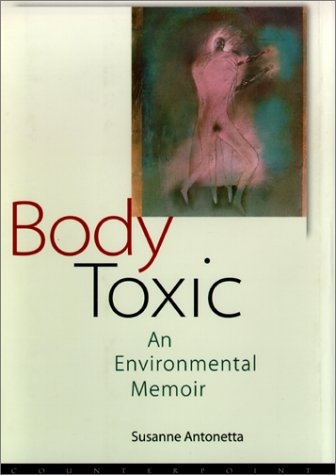
Body Toxic: An Environmental Memoir by Susanne Antonetta

Body Toxic is a striking book, both in the story it has to tell and in the manner in which it’s told. I am impressed, and challenged. It’s complicated.

body toxicSusanne Antonetta grew up in New Jersey, in the Pine Barrens region, a bogland unique in several senses: culturally isolated, and environmentally contaminated on a shocking, unimaginable scale. She and other members of her family have suffered from a list of medical complaints: asthma, endometriosis, a double uterus, growths on the liver, allergies, tumors and cysts, sterility, seizures, manic depression, various cancers; an extremely rare quadruple pregnancy that ended in miscarriage. The families she is descended from include Italian immigrants and those from Barbados, who nevertheless self-identify as English. Both sides of her family exhibit a predilection for silence, non-communication or the glossing over of undesirable details. The legacies Antonetta has inherited, then, are many and complex: cultural (in terms of countries of origin, and the culture of the New Jersey Pine Barrens, and immediate family cultures), environmental and medical (oh, the prodigious and horrifying list), and psychological (mental illness and perspective on the world). Oh, and Susanne Antonetta is not her real name, but an “alter ego”: “I’ve used five or six different pseudonyms in my life. The name I’m using now is not my name but the name of a recovered female relative, a lost woman, and as a recovered woman she’s just a skeleton that must be fleshed out by the same process of fantasizing and filling in that I resist.” Indeed, identity – multiple identities, our attempts to define ourselves and others’ attempts to define us – is another theme throughout.

And that is the complexity of this book, that so much is going on. The story is itself obviously gripping, and brimming with evocative and provocative anecdote. Indeed, Antonetta tells us, “I wrote a piece about the miscarriage and an editor sent it back, calling it ‘raw.’ He suggested I lose the death or the multiple pregnancy, or both… The poem of this body is a bad poem, trite.” The enormous irony, of course, being that she can’t “lose” the death or the multiple pregnancy, or countless other maladies, complaints. All this material aside, though, Body Toxic shines entirely for another reason too: the writing is bold and nuanced, presses and pulls back, reflecting a little the manic depression (or, these days, bipolar disorder) that also waxes and wanes throughout Antonetta’s story. It is, of course, poetic: the author is an acclaimed poet as well, under the name Suzanne Paola.

There are so many threads. Business and government disposed of chemical and radiation waste in Antonetta’s childhood beaches and bogs, through a combination of ignorant, unethical and criminal irresponsibility. (Thus Rachel Carson is named by comparison.) Antonetta’s extended family makes a series of decisions about how to live in this environment, in which they were underinformed but also trusting, stubborn, or willfully ignored the signs. (They mostly still won’t talk about the negative effects.) The family incubates a sexist tradition, favoring the eldest, male grandchild, repeatedly reminding Antonetta explicitly and implicitly of her “place.” She explores her identity as woman: “I spent a lot of my eleventh and twelfth years pining for my menstruation to begin. I can’t remember why”; and later in her inability to reproduce, and what this means for the family at large. (When her family visits relatives back in the Italian community of her father’s origin, his cousin tells him, “You have big children, but I have grandchildren.” There is an implied failure there, which Antonetta ascribes to environmental poisoning, but the family seems to ascribe to Antonetta herself.) There is the fallibility of memory, a theme so common to memoir but one I never tire of, because it – like memory – is different in each interpretation: each memoirist has something new to say. In this case, Antonetta did a lot of drugs, presumably compounding the muddiness of some of her early memories; luckily she was an avid journaler, which allows her to interrogate those documents, artifacts of a young woman she barely knows, itself an interesting and fruitful technique. And then there are all those identities. I love the idea of her father constantly referencing “my daughter” when speaking to her: she finally lets his declarations about that daughter stand, having realized that her father’s daughter is a different person from herself.

I could keep going. This was the challenge and the allure of this book, and the reason I will not quickly forget it: many threads, many layers, told in an ever-evolving voice, ebbing and flowing. The meandering structure made me work to pull it all together, but it was worth it.

I am taking a writing class from the author (under another name, that of the poet, Suzanne Paola) in the coming months, which is why I came to this book in the first place, and now I am both more excited than ever, and intimidated. I recommend Body Toxic for a reading experience to get lost in; for a richly fertile field of topics for discussion with family, book clubs, community groups; for the study of craft; and for the story it (quite disturbingly) tells about the New Jersey Pine Barrens, immigrant experiences, and one woman’s outlandish life.


Rating: 8 newspaper clippings.