Other-Wordly: Words Both Strange and Lovely From Around the World by Yee-Lum Mak, illustrated by Kelsey Garrity-Riley

otherwordlyWhat a perfectly charming little book.

Other-Wordly is fewer than 60 pages long, and its spreads are adorned with appealing illustrations, so that it is easily flipped through in no time at all. It invites the reader, though, to pause and explore. Vocabulary words from a wide range of languages are offered to satisfy us when we say, I need a word for that thing, you know when… I was delighted to find a word that a friend of mine has more than once looked for. How gratifying, to pass that along!

The words are great fun, and some will be useful (others merely fun). For example, check out Tartle (verb, Scots): to hesitate while introducing or meeting someone because you have forgotten their name. Or Nunchi (noun, Korean): the subtle art of evaluating others’ moods from their unspoken communications and knowing what not to say in a certain social situation. The illustrations are lovely, filled with personality and feeling, and I loved how words are grouped together with a drawing that serves to illustrate each in turn. For example, Sturmfrei (German, obviously), Cwtch (Welsh, perhaps just as obviously) and Abditory (English) share a young girl just peeking out from a door under a staircase, looking pleased with her hiding place. Yes, there are English words in here, too, but only three had meaning to me before reading. (Those were offing, inglenook and scintilla, if you’re wondering.) Other languages featured run from the expected European ones through Bantu and Yaghan (what is Yaghan?). The Japanese language seems to have a special knack for that there’s-a-word-for-it thing.

Brief, informative, great fun, sweetly illustrated: a fine coffee table book and one I will pull out frequently. By all means. My only request now is more, please.


Rating: 8 Erlebnisse.

Brewing Revolution: Pioneering the Craft Beer Movement by Frank Appleton

This personal history of Canada’s craft beer movement, from a distinctive and accomplished participant, amuses as well as instructs.

brewing-revolution

Books on craft beer and the craft beer movement abound, and readers may feel underwhelmed at the prospect of another. But Frank Appleton’s memoir, Brewing Revolution: Pioneering the Craft Beer Movement, is different. For one, his focus is on British Columbia, rather than the much-discussed scene in the United States. And Appleton’s unapologetic, lively personality communicates a story both personal and national, even global, in scope. Brewing Revolution also expands into an impassioned indictment of mass-market adjunct lagers, as well as a manual for the next generation of brewers.

Appleton, a native of Manchester, England, applied his studies in microbiology to food science and later, after immigrating to Vancouver, B.C., to brewing. His science background, appetite for innovation and uncompromising insistence on quality in food and drink led him through an unplanned but inspired career. He began in one of Canada’s “Big Three” brewing conglomerates, where he developed a scorn for adjunct ingredients (or “added junk”) like corn, rice and corn syrup, where traditional, quality brews use only malted grains like barley.

Retiring in frustration to a cabin in the woods, he learns that an article he’d written comparing adjunct lagers with “tasteless white bread and the universal cardboard hamburger,” and calling for a do-it-yourself response, has drawn the attention of an ambitious pub owner. From there, Appleton’s career as a consultant begins. After helping to open the first craft brewery in Canada–which required lobbying for a change in legislation–he consults on the design and launches of dozens of new breweries in Canada, several in the United States and one in France. Along the way, he trains new brewers, invents new equipment and creatively tackles problems in brewing-related architecture, physics, sanitation, welding, human resources and more.

While Appleton is occasionally acerbic in railing against brewing practices and certain former employers, he stops short of bitterness. This distinctive voice may be off-putting for some, but his readers will likely share his disdain for adjuncts and his passion for the details of malt, hops, yeast and water. Enjoying the irreverence of Appleton’s fervent campaigning, craft beer fans will find his character amusing, quirky and sympathetic.

Brewing Revolution tells the story of a country’s craft beer movement and of the author’s life work, but it doesn’t stop there. In his enthusiasm, Appleton can’t help but offer troubleshooting advice for ambitious brewers, and a healthy review of brewing techniques, including the niceties of equipment, yeast cultivation and malting. Humorous asides include Appleton’s dodging of U.S. customs agents and his exasperation with the hired help in Lyon, France. As a history of a movement and a personal memoir brimming with zeal, Brewing Revolution is educational, entertaining and, perhaps most of all, thirst-inducing.


This review originally ran in the November 8, 2016 issue of Shelf Awareness for the Book Trade. To subscribe, click here.


Rating: 7 liters.

Teaser Tuesdays: Otherwordly: Words Both Strange and Lovely From Around the World by Yee-Lum Mak, illustrated by Kelsey Garrity-Riley

Teaser Tuesdays is a weekly bookish meme, hosted by MizB of Books and a Beat.

Teaser

Otherwordly is a lovely book, which I came across when Shelf Awareness sent me this blog post from Chronicle Books. I immediately bought the book.

otherwordly
It’s just a slim little thing, easily flipped through in a sitting, but I’m taking my time browsing back and forth. Here’s a sample word:

Nefelibata (noun, m+f, Spanish and Portugese): lit. “cloud-walker”; one who lives in the clouds of their own imagination or dreams, or one who does not obey the conventions of society, literature, or art

And the illustrations are perfect, too. I wish you could see the illustration that accompanies this (and one other) word on this spread: a crowd of people in dark somber colors, raincoat and umbrellas, and the one young woman with her head bare, a red ribbon in it, a red coat, holding a bunch of tulips. Her head is raised slightly to the sky and she has a hint of a smile on her lips.

My review to come.

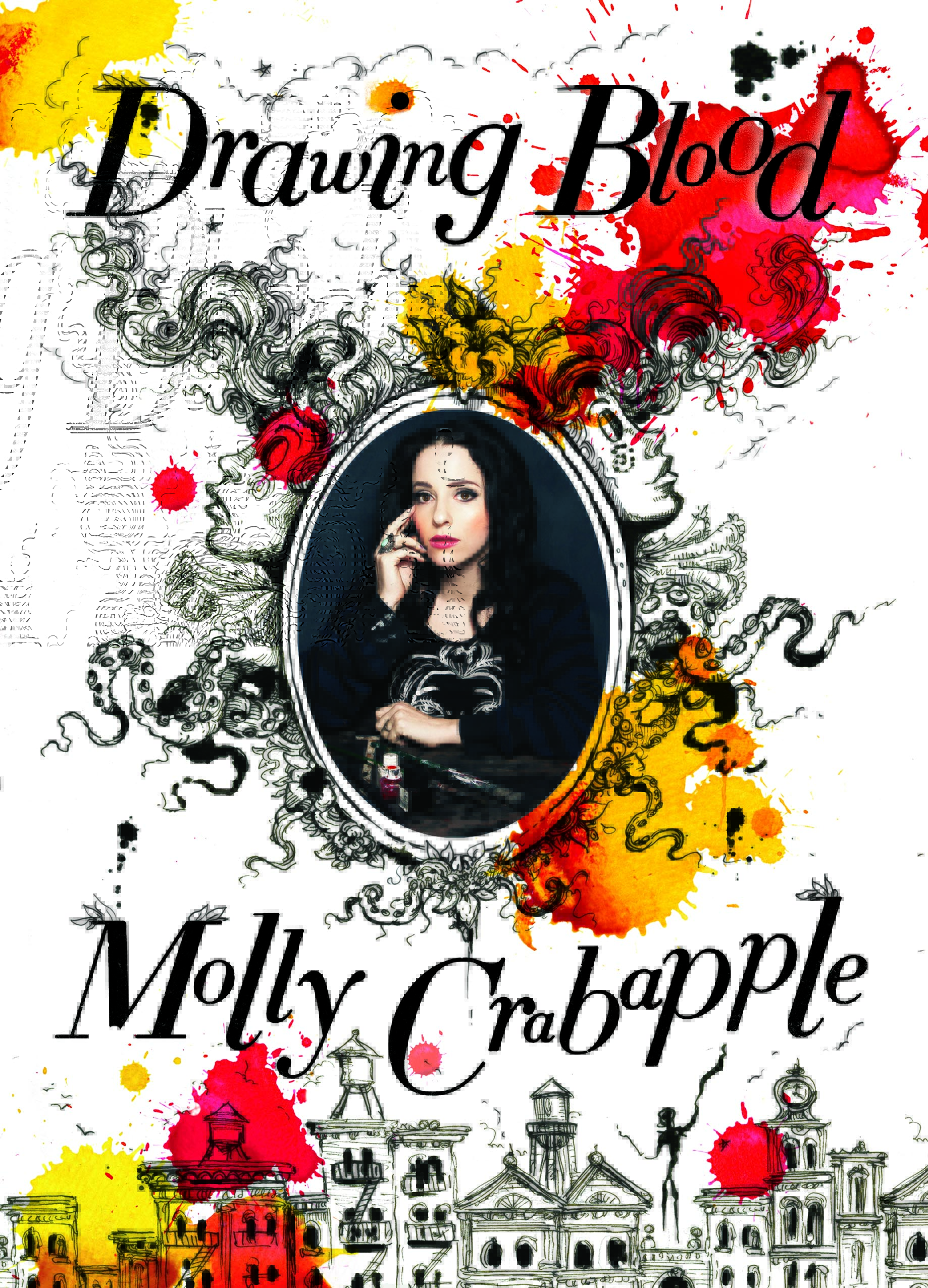
Drawing Blood by Molly Crabapple

Extra-long review for an extra-interesting work; thanks for hanging in there.


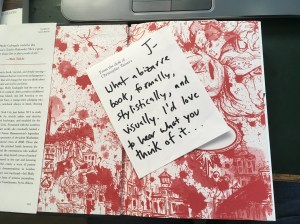
My buddy Tassava sent me this book.
14883459_10210715123423109_770058997331595632_o

I featured its book beginning, so we all know that it begins in Guantánamo. That fact is perhaps a little misleading, though. Let me explain.

drawing-bloodDrawing Blood is a memoir by Molly Crabapple, a visual artist who has created posters, comics, illustrations and murals; her favorite medium is ink, and she tends toward highly detailed, lush, saturated work. Among her influences are Where’s Waldo? and Toulouse-Latrec. (My attempt to encapsulate, not hers; and encapsulation will always fall short, anyway.)

This is her life story: from childhood, which she rather hated for its helplessness, to world travel, various forms of naked modeling and activism for sex workers, a long struggle to make it as an artist, a political awakening, and a more or less successful (and ongoing) artistic career. She has done a laundry list of strange, improbable and brave things, from living on a bunk in Paris’s storied Shakespeare & Company bookstore, to organizing and event promotion in New York City’s elitist art scene (she founded Dr. Sketchy’s), to covering Occupy Wall Street, London and Greece street protests, and, yes, Guantánamo, with her pen and ink: that is, as a journalist as well as a visual artist. Part of my criticism with her opening lines is just this: she’s done so much odd and impressive stuff that she didn’t need the sensationalism. Also, by the time she makes it to Guantánamo in her book’s final 20 pages, we can feel the story wrapping up. (She’s still a young woman. I just mean that the book wraps up. Her life is going strong.) The Guantánamo storyline is just a snippet at the end; the meat of the thing happens elsewhere, so I felt the opening lines were misleading in a few ways. And ultimately, they sell short what all else she has to say.

That was a long tangent. Let me start over: I really enjoyed this book. Molly Crabapple (a chosen name, not the one she was born with) is a large personality. She had big ideas from a young age. She traveled Paris, Spain and Morocco alone as a teenager. Her emotions loom large, resulting in entanglements and the inevitable hurt feelings; but she lives, sucks all the marrow of life, et cetera. Once we got out of that odd and contextless glass cage at Guantánamo, I remained spellbound for the book’s entire length.

Tassava did not have an entirely positive experience, though. He writes,

Molly Crabapple’s memoir of living on the rough edges of American society in the early 21st century is full of engrossing stories of sex work and social protest, of pointed critiques of the haves by a have-not, and of incredible drawings, both journalistic and artistic. But I (admittedly, a fairly square, middle-aged white guy) thought that the memoir was overall too eager to shock and to scold and too reticent to draw satisfying conclusions about her own life at the micro level and about America as the macro level. Perhaps I am sinning by critiquing the book I wanted or expected to read instead of the book as written. But I don’t think that Drawing Blood delivers on her promise, or her capacity, to use her writing and her drawing to illuminate contemporary America’s special kind of craziness.

As I see it, some of Crabapple’s central points include… the difficulties of being a woman, including the enormous extent to which our bodies precede us and we struggle to be heard over them; the difficulties of making it as an artist without funds, expanded to the difficulties of making it as anything without funds; global economic injustice; and the beauty of art and love. I found her most articulate on the issues that were specific and personal – for example, how women are treated by men, based on her own experiences – and a little less so on the economy of Greece in 2011. By which I mean, she’s only human. And she articulates the difficulty of documenting Greek financial breakdown as an individual woman from the United States: she sees her shortcoming there, which for me to some extent excuses it. (She’s trying harder to understand these things than many of us are.) This memoir does use shock value to get our attention, to a degree. But I think Tassava is wise to acknowledge that mileage may vary: we are all shockable to different degrees, and I suspect I found a few of these details less shocking than he did (others maybe more so, who knows). To be clear, Crabapple has sexual affairs with both men and women, not all of them monogamous. There is no graphic description of the sex she has. There is plenty of discussion of the work of sex workers, and burlesque performances, some of which is described rather more graphically. Frankly, the only place where I felt she used sensationalism to her detriment was as mentioned, by opening with Guantánamo Bay.

In a word, I sort of feel like Tassava and I read the same book and reacted to it in two different ways – rather than feeling that we read two different books, which sometimes happens when two people disagree in their reactions. The only place he lost me a little is in regards to Crabapple’s promise “to use her writing and her drawing to illuminate contemporary America’s special kind of craziness.” I guess I didn’t perceive that as a promise at all. I thought this was a memoir: one woman’s life story, with commentary on what she sees around her. Maybe it’s just that I sympathize with her inability to draw conclusions. I, too, find it easier to see what’s wrong than how to make it right.

And now I’ve ignored the visual aspect of this book for far too long. The text memoir is accompanied by Crabapple’s illustrations, some journalistic, as Tassava noted (illustrating what happened, rather than photographing it, which in some cases is impractical or disallowed, ahem Guantánamo), and much of it artistic. Unsurprisingly, since she’s now largely “made it” as an artist, her work is lovely: expert, detailed, realistic and stylized to different degrees, and clearly expressive of a personal style. Before her political interests took her farther out into a high-stakes real world, her subject matter tended toward the Victorian, fantastic, pin-up, or p0rn-ish. I freakin’ love it. (In fact, I’ve already purchased a print of one of the illustrations featured in this book. You can consider doing so here.) It bears noting that the illustrations here are necessarily smaller and thus have less room for fine detail than the large, intricate pieces that form her later work. What I found in the book served to tease me: I hope one day I get the chance to see some of her grander scale original art someday.

Tassava would like to note that he also loved the art: “Every illustration was great, and I too would love to see her work up close.”

I’ve also failed to note one of the more surprising achievements of this book: for all that Crabapple defines herself as a visual artist, her prose writing is startlingly crystalline, exact, probing and lyrical. “His letters were as fine as spiders. They looked like they might crawl away.” “The bar was blood dark, the walls covered with graffiti and band stickers glazed with beer.” “When I hung the drawings, they seemed like crude little things, staring back at me from the gallery’s walls. Feather-clad homunculi, malformed but proud.” “My step-mother saw me get off the school bus one day and described me as a little black smudge against the bucolic forest leaves.”

A fascinating strange story, an important if imperfect critique of one woman’s life and of the larger world: Drawing Blood is an honest effort gorgeously rendered. This book and its author are not perfect. Who is? I finished this book feeling like I’d made a friend, something only possible with human beings, not saints. The Molly Crabapple I felt like I came to know off these pages is vulnerable, self-doubting, loyal and loving, smart and stylish. I love her, and I love this book.


Rating: 8 nibs.

book beginnings on Friday: Modern Death: How Medicine Changed the End of Life by Haider Warraich

Thanks to Rose City Reader for hosting this meme. To participate, share the first line or two of the book you are currently reading and, if you feel so moved, let us know what your first impressions were based on that first line.

I do enjoy learning more about end-of-life issues, medical and legal and ethical. This one seems to be for me.

modern-death

The opening chapter, “How Cells Die,” begins:

It had been the longest of months–in both the best and the worst possible ways. Brockton is a small town about a half-hour drive south of Boston, but in many ways it seems a world apart.

A little out of context, it seems, but we are just beginning. I like that it’s not a dry, thesis-sentence sort of beginning. Reading on, Haider Warraich does seem to grasp the idea of narrative writing, making his storytelling immediate and personal; and he does have a personal story to tell, being an MD. I am optimistic.

Modern Death is forthcoming in February. Stick around!


This quotation comes from an uncorrected advance proof and is subject to change.

Speaking American: How Y’all, Youse, and You Guys Talk: An Illustrated Guide by Josh Katz

Regional linguistic patterns in the U.S. are explained with intelligence, whimsy and visual aids.

speaking american

In December 2013, the New York Times published an online dialect quiz that became the paper’s most-viewed page. Times graphics editor Josh Katz expands that quiz’s contents and the powerful response it elicited with Speaking American: How Y’all, Youse, and You Guys Talk: An Illustrated Guide.

This large-format book organizes United States dialect patterns by subject matter: how we live, what we eat, where we go and more. Two-page color-shaded maps visually communicate regional usages, like the predilection for “rummage sale” in southeastern Wisconsin, over “garage sale” and “yard sale.” Maps and text zoom in for unusual local outliers, like Pittsburgh’s distinctive use of “yins” for the plural “you.” Katz notes the rare case where gender is predictive of usage (women are more likely than men to say “bless you,” or anything at all, when someone sneezes) as well as the “linguistic fault line running from Texas up through Arkansas, then tracking the Ohio River… toward the Mason-Dixon line,” credited to white settlers’ expansion patterns. Besides seriously investigating the questions of sneaker vs. tennis shoe, doodle bug vs. roly-poly, semi vs. 18-wheeler and more, Katz clearly enjoys his subject: especially amusing are the “How to Pretend You’re From…” sections. For Nebraska, you might pick up some “pickles” at the store–not pickled cucumbers, but a form of legal gambling.

Offering some new material since the famous quiz and elucidating the original, Speaking American is a fascinating survey of U.S. dialects as well as a fun, humorous exploration of a nation.


This review originally ran in the November 4, 2016 issue of Shelf Awareness for Readers. To subscribe, click here, and you’ll receive two issues per week of book reviews and other bookish news.


Rating: 8 potato bugs.

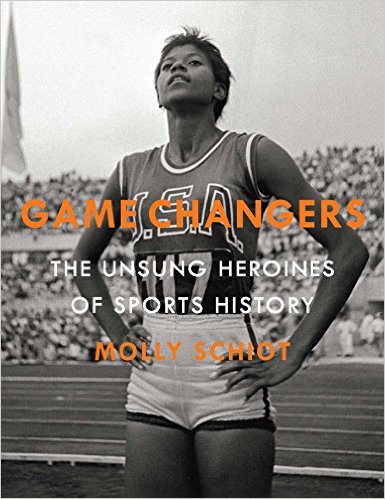
Gamechangers: The Unsung Heroines of Sports History by Molly Schiot

This photographic survey of trailblazing female athletes through history celebrates a diverse range of inspirational talents.

gamechangers

Molly Schiot created the Instagram account @theunsungheroines to celebrate pioneering female athletes the world has scarcely heard of. Game Changers expands that concept: a collection of historic photos Schiot found in libraries and archives, paired with short narratives of a page or less, tell the stories of groundbreaking and little-known female athletes.

The women featured here include some better-known names like Kathrine Switzer, Wilma Rudolph, Billie Jean King and Nadia Comăneci. These are joined by early mountaineer Annie Smith Peck, powerboat racer Betty Cook, judo champion (and mother to Ronda Rousey) AnnMaria De Mars, the “Sea Women” of the Korean island of Jeju and many more: boxers, billiard players, swimmers, skateboarders, players of team sports, Olympians, referees and umpires, sports journalists, coaches and policy makers (for example, the legislators behind Title IX). While women from the United States dominate these pages, every continent is represented except Antarctica. Women of color and those of non-binary genders are given special consideration as well. Among the strange and wonderful, don’t miss the first woman to hike the Appalachian Trail’s entire length in one season: she was 67 years old at the time.

These stories are brief but breathtaking. Not only athletes, these women were often activists and advocates as well as accomplished in business and the arts. Their photographs, naturally, speak volumes on their own. To be read in small pieces or cover-to-cover, Game Changers is an obviously indispensable choice for athletes, fans, parents or anyone else stirred by courage, talent and determination.


This review originally ran in the October 28, 2016 issue of Shelf Awareness for Readers. To subscribe, click here, and you’ll receive two issues per week of book reviews and other bookish news.


Rating: 6 balls.

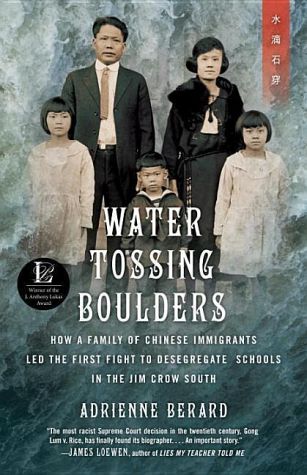
Water Tossing Boulders: How a Family of Chinese Immigrants Led the First Fight to Desegregate Schools in the Jim Crow South by Adrienne Berard

Chinese immigrants to Mississippi challenged school segregation a generation before the famous Brown v. Board of Education case.

water tossing boulders

Thirty years before the Brown v. Board of Education decision made school segregation unconstitutional, a case originated in small-town Mississippi to challenge the same injustices. Journalist Adrienne Berard’s Water Tossing Boulders reveals the little-known experience of the Mississippi Delta Chinese population, including the Lum family, whose two daughters were sent home from the local white school they attended in Rosedale, Miss. The resulting case, Gong Lum v. Rice (1924), made it as far as the United States Supreme Court, but failed.

Berard has done rigorous research, as detailed in her author’s note, and offers a storytelling style with momentum. She expertly evokes her characters. Jeu Gong Lum and his wife, Katherine Wong, were Chinese immigrants who met and married in the Delta; their daughters had divergent personalities, Berda rebellious and Martha an ardent scholar. Their lawyer, Earl Brewer, spent his career fighting for social reforms. Ultimately an anti-lynching campaign would take his attention away from the Lums’ case, perhaps ruinously. Other legal players are profiled, including Supreme Court Justice Louis D. Brandeis and Chief Justice William Howard Taft, who penned the Court’s unanimous decision in favor of segregation. This is the story of the Fourteenth Amendment to the United States Constitution and the tortured arguments of eugenics, racism and segregation as much as it is the story of a family who simply wanted a decent education for their children. Told with precision, sympathy and context, Water Tossing Boulders is a brief but incisive history of great significance.


This review originally ran in the October 28, 2016 issue of Shelf Awareness for Readers. To subscribe, click here, and you’ll receive two issues per week of book reviews and other bookish news.


Rating: 7 children.

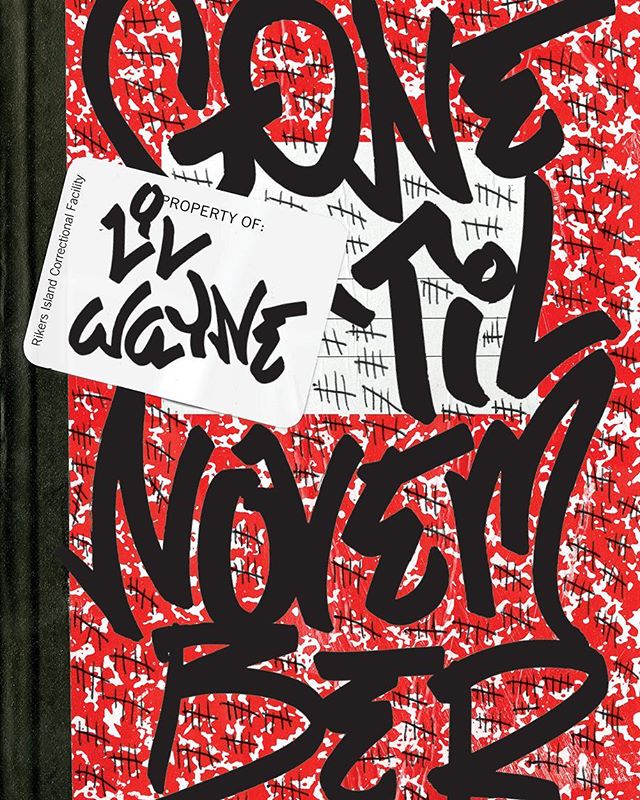
Gone ‘Til November: A Journal of Rikers Island by Lil Wayne

Lil Wayne’s prison diary gives a day-to-day account of his time in Rikers Island and a taste of the rapper’s offstage voice.

gone til november

In 2010, Lil Wayne entered New York’s Rikers Island Prison Complex to serve a yearlong sentence for illegal possession of a firearm. The New Orleans rapper was in the midst of a record-breaking career: multiple platinum records, Grammy Awards and financial success. In the eight months he spent in Rikers, Wayne kept a slim journal, published as Gone ‘Til November.

Wayne repeats himself: what he eats day to day varies little (the theme is burritos filled with chicken, rice, noodles, Doritos or Ruffles, beef jerky), and each night he does pushups, prays, reads his Bible and listens to ESPN. This monotony is to be expected in a prison diary, and is broken by the minor dramas of Wayne’s visitors, fellow inmates and the corrections officers he befriends. While the odd mention is made of violence occurring in other wings, the celebrity rapper has a relatively safe experience, plagued mostly by boredom. Entries are undated, requiring close attention to mark the time Wayne was incarcerated, from March through November. His slangy, informal tone shines vibrantly throughout.

A diary in which not much happens may sound less than gripping: this memoir will appeal most to Wayne’s many fans, who will find references to other rappers, future projects and Wayne’s lovers and children. But as an account of daily life in prison and its discontents, and as an exhortation to avoid incarceration, Gone ‘Til November offers a rare perspective for general readers as well.


This review originally ran in the October 25, 2016 issue of Shelf Awareness for Readers. To subscribe, click here, and you’ll receive two issues per week of book reviews and other bookish news.


Rating: 6 burritos.

Bayou Magazine, issue 65 (fall 2016)

bayou mag 65Bayou, from the University of New Orleans, is one of the briefer lit journals, which I confess leaves me sort of relieved: easier to get through in a sitting. In turn I’ll pass that brevity on to you.

Three essays grace these pages. “Holiday” by Ann Hillesland is, again, brief (a theme!), and takes a look at a movie that interested the writer when she was a teen, its commentary on her life; she comments in turn. I am sympathetic with this kind of writing, as a book reviewer. “Lifeline” by Patricia Feeney recalls Pat Conroy’s The Death of Santini, for its elegiac look at a rather unloveable family member. In ten pages, it manages a great deal of pulled-back perspective and passage of time; there’s a lot of movement.

My favorite was “The Mending Wall,” by Andrew Bertaina, who is undertaking something like what I hope to undertake in writing about my own mother: seeking the parts we can by definition never know. It also yielded the remarkable lines,

Perhaps you cannot mend things when you are still broken. I will never understand love or people: we are collections of moments, of opinions, of thoughts, not whole.

Overall, these pieces feel a tad less polished than the essays that appear in The Believer or Oxford American, which is not all bad: I’ve written before about the value of amateur art, the feeling of community and of real people efforting, and of movement and progress: we start here, and we improve. It can’t all be Broadway and the NBA; it is heartening to see community theatre and Division III college ball. Also, there has to be somewhere for us amateurs to submit to. I hope this doesn’t sound like faint praise: I enjoyed my time spent with Bayou, and you’ll see more of it here.


Rating: 7 showtimes.