Hood by Alison Kinney

This is the third that I’ve read in the Object Lessons series (Sock, Souvenir).

Kinney examines the hood’s sinister appearances in history: worn by executioners, torturers, and (not by choice) their victims; worn by the Ku Klux Klan; given as an excuse for the murder of Trayvon Martin. This last – the hoodie – was, for me, the most obvious application of ‘hood’ and the one I was most expecting (to what extent this was suggested by the cover, I can’t say), and none of these focal points surprised me. I was a little surprised to learn that the executioner and the torturer did not wear hoods til pretty modern times – our attribution of the hood to the medieval bad guys is a modern error (or, perhaps, a calculated strategy). But I was more surprised that Kinney’s hood is so consistently an image of violence. She mentions the hoods worn by professors, judges, and academics – the honorable hood – but only as a point of contrast.

In the opening pages, Kinney lists the hood’s uses: by “judges, athletes, rappers, torturers, politicians, and toddlers… to attend school, commute… go to war or protests, take a hike, walk the dog, ride the Maid of the Mist, or visit our grannies in the woods… coaches, firefighters, fishers, boxers, beekeepers, and Mark Zuckerberg… skaters, cosplayers, fetishests, presidents, and the entire Knowles-Carter family.” She apologizes: “Sorry, but you’ll have to wait for the sequel to get car hoods, stove hoods, and Mount Hood.” This promise of exhaustivity is not carried through, however. I recall Sock, wherein Kim Adrian reached back to the origins – the invention of the sock. That part of the hood’s story is missing here. I guess Sock and Souvenir had conditioned me to expect a really broad, start-to-finish, far-reaching treatment, and that’s not what Hood does. Hood focuses on injustice, violence, death, and abuses of power. It’s an important story; I’m not necessarily against Kinney’s approach, but it’s not what I’d been expecting.

The other way in which this book differs from the others I’ve read is that Kinney, as narrator, as researcher, and as holder of opinions, was lacking from her narrative. It has long been a reading preference of mine to find the author in her work; in nonfiction, I find it essentially dishonest to act like an impartial observer or researcher, because there’s no such thing. In this book, in particular, because Kinney takes decided political stances on a variety of issues, I really felt the hole left by her absence. Let it be said that I agree with her politics. But I regret that she didn’t reveal something of herself in stating them. I think it would have strengthened the book.

I’m interested to learn that the Object Lessons series takes more varied forms than those I’ve already encountered. I think I prefer the other model: the exhaustive, whimsical, present-narrator one. But Hood has much to offer, including a strong indictment of capital punishment, a chilling glimpse into Abu Ghraib, and a discussion of the black bloc of protesters at the Seattle WTO meeting and beyond.


Rating: 7 images.

The Body: An Essay by Jenny Boully

The Body is an essay in footnotes. Footnotes to a body text which is absent. Just the footnotes.

Pages are often more blank than not, with a line demarcating the footnote section of the page, and then (in rather small font) the text below. Some footnotes are nothing more than Ibid., with a page number. Does this sound infuriating? Yes.

Some of the footnotes are long enough and weird enough to get lost in, themselves; when I consider them poetry and dwell in the moment, there is something to be enjoyed. But overall, not a concept that works for me. Other, better-known writers and readers than I have found much to value here. A meditation on the concept of absence, loss or disappearance, etc. But it was too weird for this reader. I was here for the body, if you will, and not its leavings.

For me a fail, but I’m certainly interested to know if you are differently minded. If any of my readers have enjoyed this book? Please explain.


Rating: 4 quotations.

Souvenir by Rolf Potts

Another from Bloomsbury’s Object Lessons series to follow Sock, which so delighted me.

And this book only deepens my feelings about objects, and about this series. Perhaps what I love most about Souvenir–even more than the enormous wealth of history, theory, and cultural trappings Potts has researched and illuminated for me–is its meta-ness, the fact that it’s about objects functioning wholly as objects, as ciphers or representatives of more. This little book has inspired me immensely.

Potts, a travel writer, brings his own souvenirs and their stories to this study. He begins by defining ‘souvenir’ for the book’s purposes: “objects that are collected for personal reasons during the course of a journey.” Academic researchers, he writes, have split souvenirs into five categories. “Piece-of-the-rock” items are physical fragments of the travel destination or experience itself: rocks, sticks, flowers; ticket stubs and emptied bottles that were purchased full. “Local products” are just that; and these first two categories pre-date a tourism industry creating them purpose-made. Next, “pictorial images” (postcards, posters); “markers” (“which includes T-shirts, coffee mugs, and other products branded to the location”); and “symbolic shorthand,” which refers to recognizable images: the Eiffel Tower, Seattle’s Space Needle, the Astrodome.

Potts moves through categories and experiences and controversies: for example, soldiers bringing home souvenirs of war (including body parts and stolen antiquities), or the commercialization of disaster (New York’s September 11 Museum did not receive federal funding, and so raised money by selling 9/11-themed umbrellas, key chains, tote bags, and cheese plates). He examines the concept of authenticity, and how we grade it. Is a terra-cotta jug equally authentic when made for a tourist market as when made for carrying water? What if the materials, methods and final product are identical but for intended use? In other words, what and who confers authenticity? He relates tales of villages that put on an act of “primitive” “authenticity” for the tourists (wearing traditional clothing and carrying spears for the photographs), then return to blue jeans and television sets once the tourists have moved on. Which of these more authentic: the appearance that agrees with a Westerner’s preconceived notion, or the way modern African villagers really live?

I really appreciated thinking about an object’s transition from souvenir to museum piece, from private and associative meanings to public and interpretive ones, in which (I offer) something is lost and something is gained. And you know I especially enjoyed the concept of Wunderkammern (German, ‘wonder chambers’), small museum-like rooms maintained by individuals. This puts a word to an idea I’ve been writing about, obsessing over, and building for myself over the last semester.

I get carried away listing the ideas that sparked my mind. Postcard as “part object, part information.” Attribution of authenticity as a form of cultural appropriation, with all the usual arguments to be made: that culture is nothing but an accumulation of appropriations. Different cultural definitions of what a souvenir is, is about, is for: that the Japanese fulfill established expectations with souvenirs, that they seek not creativity, not “authenticity” in the way that many Westerners define it, but the performance of a formula: green-tea-flavored sweets from Kyoto, apple-flavored pastries from Aomori. My imagination is alive.

For years, I brought a dear friend pieces of the natural landscape when I visited beaches all over the world: a shell from Scheveningen, sand from southern California, rocks from Bellingham Bay. I used to work with a woman who collected feminine hygiene products from various countries and cultures, marveling at the variety of ways we deal with menstrual blood. Knowing these friends’ preferences made them easy to “shop” for. When I collect souvenirs, for myself or for others like this, as gifts, I note (as Potts has), that in the end it’s about the story that the thing reminds me of, much more than it is about the thing itself. Certainly, we can do workaday shopping while traveling: at an outdoors shop in Ireland I bought a sleeping bag and some hiking pants that are just those utilitarian things, although I don’t forget where I got them, either. But these are not “pure” souvenirs. Pure souvenirs are about narrative. “Everyone who collects souvenirs ends up creating these object-narratives, which resonate with private meanings no written autobiography could ever achieve.”

I can already see that I’m in danger of investing in every book in this series.

Like Sock, Souvenir is a mixture of personal essay (Potts’s own travels, his own souvenirs and stories), history, anthropology, and so much more. The object-as-object subject here was especially close to my own heart, although I venture that Potts indulged in a little less poetry and whimsy than Adrian did. At any rate, I’m in love, and hungry for more. I can’t recommend highly enough these tiny little books that open enormous worlds, through everyday things.


Rating: 9 masks.

Cutty, One Rock: Low Characters and Strange Places, Gently Explained by August Kleinzahler

I bought this book nearly two years ago, on the recommendation of my friend Doug.

Cutty, One Rock has four parts in this edition (three in the original). Generally, the book deals with Kleinzahler’s background–family, hometown and neighborhood–in a Mob-rough New Jersey; it deals with place, relationships with people, and eventually with art. His parents live a middle-to-upper-middle class life, concerned somewhat with appearances; his mother is devoted to Shakespeare. The back of the book calls them “both cultivated and deranged,” which I think is apt. Early in the book, these parents figure as central influences, central characters in the child’s upbringing, but stay tuned for another important family member to come later in the book.

The adult Kleinzahler is an expatriate Jerseyite living in California’s Bay Area, and the differences between these two places, the baggage he carries between them, is another central feature. Here he is describing the “swagger, a bluff air of menace that many of the males wear”:

Once, after leaving a restaurant in North Beach, here in San Francisco, I gave a panhandler a dollar, a middle-aged black guy with some amusing riff or other.

“Thanks, Jersey,” he said, to the great amusement of my companions.

“How did you know I was from Jersey?” I asked.

“Are you kidding?” he said.

The narrator does substantial traveling beyond these two points, east and west, and these other locations and the nature of travel itself offer another recurring thread. The essay “East/West Variations” opens:

There’s a window, thirty-six hours or so, not even, when traveling by air between places, places where you’ve lived for a long time. After you’ve landed and into the next day, perhaps the evening–then you begin to lose it. It goes very quickly, decaying like a tone in the air. But for a while, inside that window, you’re hyperawake.

He goes on to describe this “window,” which I couldn’t help but conflate with the window you look out of when traveling by air–which I was doing, as it happens, while reading this book. He concludes on the next page that “places are conditions of mind.” By the end of this wide-ranging essay (which catalogs several romantic interests and his hard-nosed mother’s reactions to these women), we deal directly with a parent’s mortality. It’s a hell of an undertaking, and I’m not sure I followed him everywhere he tried to take me, but I appreciate the ambitious handling of place and people, and their intersection.

Part three tackles the subject of poetry, and poets. Kleinzahler is a poet; but he’s a rough-and-tumble Jersey poet, with no patience for poetry readings or academia. He writes a particularly scathing send-up of Garrison Keillor’s Good Poems; a profile of Allen Ginsberg (reminding me, not for the first time, of Joseph Mitchell); and a lovely elegy of Thom Gunn. The Keillor criticism, “No Antonin Artaud with the Flapjacks, Please,” is clever, and the Ginsberg profile is incisive; but I love Kleinzahler’s voice best when he writes with love, as he does of Gunn.

Kleinzahler is derisive toward intellectuals,

particularly university intellectuals, [who] indulge in pissing contests over how much they’ve read, quoting at length by heart and so on. No wonder they have no friend off-campus. Thom could more than hold his own if sucked into one or another of these contests, but it wasn’t his sport.

And it’s not Kleinzahler’s sport, either, but I do want to point out that he had me noting (and in some cases looking up) terms like diabase, tibouchina, carillon, cloaca, tatterdemalion (great fun, that one), superannuated, and–very happily–sprezzatura, which I remember from John McPhee’s Draft No. 4, in which McPhee expresses a sense of total consternation at this untranslatable and mysterious term. So there, Kleinzahler.

While there are many fine essays here–like “The Bus,” about public transportation, class in cities, and the invisible weirdness of strip centers–this book held two exceptional highlights for me. One was the essay, in part two, “The Zam Zam Room.” It offers a profile of a bar, a dark and smoky bar with a characterful bartender/owner who professionally throws people out.

When David Letterman came to town to do a week of shows, his advance people phoned Bruno to see if he would throw Letterman out of the bar on the show. “No, I’m sorry, thank you,” Bruno said over the phone. “Who’s David Letterman?” he asked us. “I don’t know this person. Why do these people bother me? He must be some New York person.”

Perfect descriptions of place, local culture, and especially a singular personality, make for an essay I love–but if it’s also set in a bar, I’m really sold.

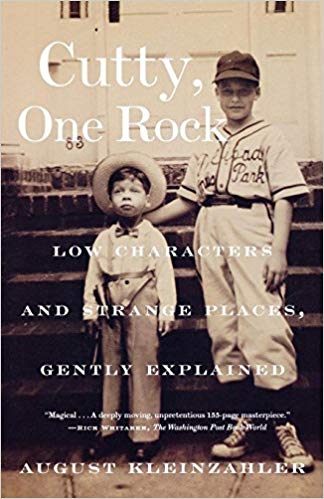
The finest thing in these pages, though, is part four. Where the first three parts contain three to four essays apiece, this is a single essay, which shares the book’s title, “Cutty, One Rock.” That’s what Kleinzahler’s older brother always ordered when he went out, which he did, just about all night and every night until he died young and tragic. I heard echoes and rhymes of Norman Maclean’s “A River Runs Through It” loud and clear throughout. This deeply loving study of a loved brother, its close attention and reluctant acknowledgement of flaws, its worship–because the narrator was the much younger brother, always looking up–is so good it hurts. That’s them on the front cover.

This book is worth reading from cover to cover, but that final section really blew me apart. Booze; sense of place; difficult families and unbeautiful homes. Also, memoirs by poets. Good stuff. Thanks, Doug.


Rating: 8 dry martinis.

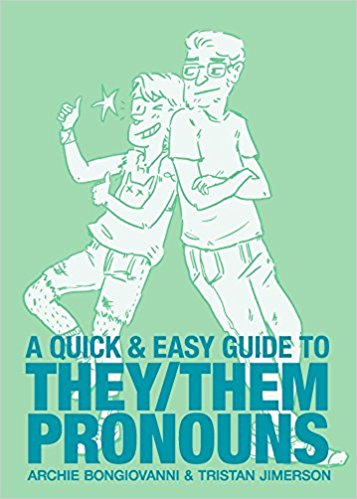
A Quick and Easy Guide to They/Them Pronouns by Archie Bongiovanni and Tristan Jimerson

A concise, friendly, illustrated guide to gender-neutral pronouns written by a likable pair of friends.

The coauthors of A Quick & Easy Guide to They/Them Pronouns are friends. Archie Bongiovanni identifies as nonbinary and uses they/them pronouns; Tristan Jimerson (he/him) knew them before they came out as nonbinary, so Bongiovanni asked him to help communicate with a mainstream population who might have trouble with the concept. Bongiovanni and Jimerson make a jolly, jokey team in this graphic how-to manual, with Bongiovanni’s illustrations, but despite their often playful tone, they take this topic seriously. They agree that being told one’s pronouns don’t matter is “basically telling you that you don’t matter.”

A Quick & Easy Guide addresses what a pronoun is; why people might want to use gender-neutral pronouns; how to ask for and give one’s pronouns; how to change one’s language and how to handle mistakes; and how to integrate these lessons into professional and retail settings. It’s written both for a general readership that may be confused by they/them pronouns, and (in a special section by Bongiovanni) for nonbinary folks. It even includes sample scripts and signs to post in places of business.

This is a short, easy-to-read, affordable guide, because the authors hope it will be widely distributed and handed out on the street. It meets its goals neatly: just the facts, but in a friendly, approachable tone, enhanced by the true friendship of its authors. A Quick & Easy Guide is for everyone, because as Bongiovanni and Jimerson point out, we encounter nonbinary folks every day, whether we know it or not.


This review originally ran in the July 10, 2018 issue of Shelf Awareness for Readers. To subscribe, click here, and you’ll receive two issues per week of book reviews and other bookish news.


Rating: 7 arrows of good intent.

residency readings, part II


Note: I am just returning from residency this week and slowly reentering regular life (whatever that means). I’ll be back on regular comment response, etc., very soon. Thanks as always for your patience and for reading!


I see a pattern with Richard Schmitt, who tends to teach us about the mechanics of story: process, form, scene, plot, and now dialog. His reading packet was concise, comprising two short stories, by Katherine Mansfield and Sam Shepard respectively. They were excellent reading! I do recommend both: good examples of dialog, yes, but also just fast-paced good reading. I think these are exemplars of what dialog can do for story, and I’m looking forward to this seminar.

Surprise! The poetry segment went fine! Guest poetry faculty Remica Bingham-Risher assigned a packet of ten poems and a micro-essay, and they read easily–musically, of course, but also comprehensibly, which I found a rare treat. Her seminar is on “mining the spark,” or using research to “find inspiration but balance creativity with the facts.” I like this idea: inspiration in research, as well as groundedness and appropriate detail, but retaining the creative flair, too. Perhaps because these poems were so well grounded in reality (history, research, detail), they worked well for me, which you know is somewhat rare. I’m excited.

Nathan Poole (who wrote Father Brother Keeper – talk about making connections) assigned a nice variety of stories starring marginalized characters: Chekhov’s “Gooseberries,” Baldwin’s “Sonny’s Blues,” and Gogol’s “The Overcoat,” all worth reading and studying for their beauty and pain and detail and universality… but oh, the final story, “Kidding Season,” by Lydia Peele. I am nearly dead with heartbreak. I am upset with Peele, and upset with Poole for assigning this story. A fine piece of literature, I’m sure, but not for us tenderhearted people. I can’t take it. I’m devastated.

Nathan Poole, you have some talking to do at residency to make this up to me.

Doug Van Gundy assigned two chapters from Hugo’s The Triggering Town, which I rated highly but on this reading, I must say, I don’t remember there being so many pretty girls, emphasis on the prettiness (or not) of the girls, the importance of prettiness to girls and to men. Aside from that, I believe I can see where Doug is headed and I look forward to hearing more. His packet was completed by a perfectly lovely James Wright poem about places. (Doug’s seminar is “The Line in the Landscape”: right up my alley.)

And finally my dear friend Delaney McLemore, who is graduating at this residency and therefore teaching us a seminar on her way out, assigned a book AND a packet: always the overachiever! (I’m teasing. As she points out at the start of the readings, this book is under 100 pages, with pictures.) I dutifully reread Two or Three Things I Know For Sure, and I think I did get more out of it this time. I marked more lovely lines, like “…the yellow kitchens of our childhood, where Mama hung her flowered curtains every time we moved, as if they were not cotton but spirit.” I noted for the first time that this book began as a performance piece. I made some notes about the placement of pictures, in anticipation of Delaney’s seminar: she’s teaching on “art and artifacts,” and I know she has a special interest in photographs in particular. I didn’t really find that the photographs in this book did much more for me on this read than they did the first time, though: I think I’m liable to glance and skim past them. I’m interested in what she’ll teach us.

The essay she assigned, “Proof of Life: Memoir, Truth, and Documentary Evidence” by Carolyn Kraus, I found fascinating. Kraus writes of her work on a memoir of her father’s life, which was necessarily an act of speculation, because of how little she knew about her father. This gave her discomfort, and she searched first for the concrete, official, public sort of documentation that would both inform her work and give it legitimacy in the age of James Frey; but these documents were nearly nonexistent. She ended up with a collection of far more obfuscating private documents, which informed her work some, but better, gave her confidence. (And, of course, the story of seeking documentation, and the story of what she did and didn’t find and how it all happened, becomes part of the larger story, which is a feature in memoir I always appreciate.) It’s almost as if the mere existence of such documents, even if they don’t give much new information, adds something: look, here is his handwriting. He existed.

Finally, I did read the optional essay as well – “Telling Stories in Dorothy Allison’s Two or Three Things I Know for Sure” – by Tim Dow Adams, and I’m glad I did. He had some thoughts in particular about the photographs that make me feel better prepared for this session.

I got to feeling that I was behind on my reading for this residency, but I wasn’t really – just behind my own usual schedule. By the time you’re reading this, residency has already concluded; but as I’m writing this, I’m really looking forward to it. I’m sure I’ll have a report for you soon, and I’m sure I’ll be enthused again about another semester – my last in this program. Thanks for following along.

residency readings, part I


Note: I am away for my residency period at school for two weeks or so. This is a previously scheduled post. I will respond to comments, but not as quickly as usual. Thanks for your patience, and thanks as always for stopping by.


As I’ve done before, I’m going to run through some of the reading I did to prepare for this summer’s residency. For more information, check out the schedule I’ll be keeping and the seminars I’ll be attending, including some information about assigned readings.

Going in order:

I tackled first Jon Corcoran‘s assigned packet of three stories by Alice Elliot Dark, Ursula K. Le Guin, and Flannery O’Connor. This was an easy, quick, and very enjoyable packet; all three stories were riveting. The O’Connor, “A Good Man Is Hard to Find,” was the only one I was familiar with, and my least favorite of the three, with its unpleasant characters and dark themes; I’m looking forward to having some guidance with this one. The stories by Dark and Le Guin were pure pleasure, even though they too involve some darkness. I loved the realism of “In the Gloaming” contrasted with the fancy of “The Ones Who Walk Away From Omelas,” with its twist at the end. The topic of Corcoran’s seminar is endings, and I struggle with this, myself, so I’m very much looking forward to it. (Although what I write are more essays than stories, less contained narrative – does this make my job harder? will his seminar offer me as much as it does the fiction writer?) Also, Jon Corcoran has been a visiting faculty member at our program before, and I liked him very much when we met last.

Next came Mesha Maren‘s packet for her seminar on language. I’m a fan of Mesha’s, too, and find her reading, speaking, and teaching very poised and impressive; I love language for its own sake, and I love a good neologism like ‘hishing’ (in her seminar’s title), so I came to this with anticipation. The packet opens with a 100-page book excerpt that nearly killed me, though. I think I took a week to read these 100 pages, which began so dry and (as far as I could tell) far from the content of this program that I thought maybe I was being pranked. It got better, but remained a challenge til the end. I am still trying to synthesize what I found in these pages from David Abram’s The Spell of the Sensuous.

This book strikes me as a sort of ecologic philosophy of language and especially of written language: what it means for humans to communicate as we do, in pre-historic/oral times and later, in what Abram calls alphabetic cultures. There are also different kinds of writing, from pictographic to rebuslike to the alphabet we know now, and the significant distinctions here are about how far away from sensorial the letters get: that is, from a pictograph that directly references a paw print or a cloud, to a letter like Q, referencing nothing (until you get into the history of the letter Q, that is). Abram is concerned with how far we get from nature and from a participatory, cooperative relationship with the more-than-human world. It gets to be interesting stuff, for sure, as arguments are presented for how oral versus written languages change how we think, as well as how we relate. In preparing for this seminar, I’ve made notes about the philosophies of Husserl, Merleau-Ponty, Saussure, and Socrates, as Abram presents them. This excerpt was hard to get through because it’s rather academic in tone, and lacked context, starting in the middle as it did–except actually, it starts with chapter 2, on page 31. Maybe I needed whatever introduction Abram originally included. At any rate, I trust in Mesha to lead us through.

The rest of her packet looked up quite a bit. A lovely lyric piece by Susan Brind Morrow; a somewhat academic, impassioned piece on “The Language of African Literature” by Ngũgĩ wa Thiong’o; some extraordinary stories by Ann Pancake, a West Virginia writer who I (shamefully) have still not read outside of assigned excerpts like this one. (From her astonishing “Wappatomaka” comes the title of Mesha’s seminar, “hishing in the riffle.”) Anne Carson’s essays and poetry weirded out on me a little. I think I can remember having trouble with her before. And finally, Raymond Queneau’s exercises in style, which were interesting and, mercifully at the end of this long packet, easy to take in. Wait no, one final piece by Georges Perec, but my brain was too tired for this absurdism. Again, I trust in Mesha, and look forward to her illumination of this wild collection.

Matt Randal O’Wain‘s radio essay assignments were a change. I listen to podcasts when I can (having put audiobooks on hold pretty much for the duration of this MFA program, as my brain can only hold so much), so this was friendly. I appreciated being able to “read” for school while I cleaned the house and cooked and stuff. And six of the seven assigned radio essays I found very enjoyable. In fact, I often forgot to look for craft, finding myself so involved in the stories presented by (for example) This American Life‘s “Unconditional Love,” or Howard Dully’s “My Lobotomy.” I’m really excited about what this seminar has to offer.

Next Jessie van Eerden‘s assigned readings in the epistolary form, which began gently with one I’ve read before, Jane McCafferty’s “Thank You for the Music,” which is lovely. Actually, every item in this packet was lovely, although naturally my comprehension broke down with the poetry midway through (sigh). I didn’t even break stride with the optional reading by Alice Munro, and I recommend that piece (“Carried Away”) as much as any in the packet. Thank you, Jessie, for such a transcendent, and easy to read, experience.

She also assigned some questions to consider while reading and a writing assignment too, though, and I found myself out of practice. But that was probably the point: good to stretch those muscles again, as I head off to school.

I’m going to break this terribly long post here, and continue next week with the rest of the assigned readings. By then I’ll be home from residency, but not yet recovered! so it’ll have to hold you over. Stay tuned for another wide-ranging collection of fiction, nonfiction, poetry, visual art, and sundry. Happy weekend, friends.

Sock by Kim Adrian


Note: I am away for my residency period at school for two weeks or so. This is a previously scheduled post. I will respond to comments, but not as quickly as usual. Thanks for your patience, and thanks as always for stopping by.


Sock! What a treat! I know I just posted some predictions for best books of the year, but we have a new contender. This was a wildly fun, engrossing little volume.

Sock is part of Bloomsbury’s Object Lessons series, which appeals to me for reasons I assume are obvious now, after this increasingly object-obsessive semester. When I found out about the series, I exercised restraint and purchased only three books: Sock, Hood, and Souvenir.

Kim Adrian’s task here was to write about the sock. What is a sock, what is its job in the world, where did it come from, what is its significance? You know, just the basics. It’s a remarkable ambition in the first place, for any object (others in the series include Burger, Shopping Mall, Eye Chart, Tree, Cigarette Lighter… as well as the less object-like Silence and Doctor). To quote one of the book’s blurbs:

The Object Lessons series achieves something very close to magic: the books take ordinary–even banal–objects and animate them with a rich history of invention, political struggle, science, and popular mythology. Filled with fascinating details and conveyed in sharp, accessible prose, the books make the everyday world come to life. Be warned: once you’ve read a few of these, you’ll start walking around your house, picking up random objects, and musing aloud: ‘I wonder what the story is behind this thing?’ (Steven Johnson, author of Where Good Ideas Come From and How We Got to Now.)

I couldn’t have said it better myself, so I didn’t.

So, the sock. Adrian’s table of contents offers an introduction and three sections: “Socks and evolution,” “Socks and desire,” “Socks and industry,” followed by a postscript: “Instructions for darning a sock.” (The back-of-book blurb begins, “Kim Adrian’s Sock is the darndest thing,” and that gave me FITS.) Adrian acknowledges the weirdness of her project. She can’t really account for her interest in socks, except that they are “intimate and essentially domestic,” and the domestic has always appealed to her. She usually writes about personal subjects, she tells us (“personal essays, memoir, that sort of thing”), and figured socks would fit in, because they are personal, in the sense that we wear them against our skin and they smell of us; but in fact this was a wildly wide-ranging research project. To paraphrase Johnson’s blurb, above, this book wanders through human anatomy and evolution, world history, politics, sex, and industry. If Adrian is fixated on domesticity, I am fascinated by trivia, such as (on page 9) the fact that we get our understanding of when humans first began wearing clothing from the study of lice. Textiles are perishable; but the evolution of specialized lice species, and their development into head lice, pubic lice, and body lice respectively, allows archaeologists to track textile development. This fact made me exclaim joyfully aloud, and I got to read the passage to a roomful of brewery employees. We were in a sensory class about the history of yeast species, so it’s all related, after all.

Adrian moves on to human anatomy and our unique position as vertically aligned bipedal creatures, its effect on our sexual practices and the way we walk, balance, the importance of the big toe, and much more. Skeletal structure has much to do with socks. Then there is the history, of course, of socks: from hay stuffed in a shoe-like cage, to woven foot wrappings, to fitted and knitted socks. She touches on the Industrial Revolution, delayed by Queen Elizabeth’s denial of a certain patent, which if granted, Adrian speculates, might have moved that Revolution up by some two centuries, and “what strange wormhole of alternate reality we might have tumbled down” in that case! Next we have sock and foot fetishes (the latter properly not a fetishism but a partialism), and sex; Jung and Freud, and the art of Egon Schiele, an Austrian Expressionist who left the feet off many human subjects but put socks on his trees. Finally, the sock industry takes us into concepts of fast fashion and slow fashion (a sort of throwback movement that depends on surpluses of both time and money). Here Adrian returns to an earlier concern with knitting socks, something she’s tried and not much succeeded at; she has great respect for those who do knit socks. Then the promised primer on darning.

All this in under 120 pages, and every moment of it was a delight to read, in Adrian’s mildly self-deprecating, often humorous, but absolutely serious-about-socks prose.

Some of my personal highlights on this wild ride included learning that Ned Ludd–he of the Luddite Rebellion–was a stocking maker, and started his movement by smashing two stocking frames in Nottingham. Did y’all know that? Also Adrian’s attention to words: ‘mundane’ (as in socks) comes from the French mondaine, or ‘of this world,’ and links us back to ‘pedestrian,’ as in Latin ped, as in foot. And ‘prosaic’ from ‘prose’ comes from Latin provorsus, which is pro– (forward) and vorsus (turned), as in oriented in forward-facing fashion, as in walking. Can’t make this stuff up, folks. Or, did you know that our feet possess even more nerve endings than our genitals?

I feel like I’ve written half as many words now as Adrian put into her whole book, this slim little marvel of trivia and attention to the overlooked. I am reminded of Mark Doty’s devout study of small details, his appreciation that “in still life the familiar is limned with an almost hallucinatory clarity, nothing glanced over or elided, nothing subordinate to the impression of the whole.” In other words, this book was a near-religious experience for me. I can’t wait to read more Object Lessons.

I can’t believe I’m doing it for the third time this year already, but here we are…


Rating: 10 stitches.

Without Getting Killed or Caught: The Life and Music of Guy Clark by Tamara Saviano

Extra brief today, and then you can get back to your Wednesday and I’ll get back to some better reading.

This book got away from me a little bit, in that I waited too long after finishing it to write this review. But that’s okay, because of my reaction to the book itself: I think it will be an easier-than-usual review to write. In a word, I love Guy Clark, and enjoyed learning more about his life and music. But as a book, I’m not blown away.

Tamara Saviano is a co-producer of the two-disc album This One’s For Him: A Tribute to Guy Clark, for which I’m very grateful, and she’s made other contribution to Clark’s and other musical legacies. But I feel that this authorized biography fell into the trap that they tend to fall into. It’s overly praising of its subject, and not critical enough, in the sense not that I want Guy criticized but that I want him critiqued. I want to know the finer points, the rough edges, the ambiguities and the anecdotes that don’t fit into the picture that we fans have developed of him. I wanted to find a Guy Clark who was more Hemingway or Hefner–more complicated, contradictory, and intermittently less-than-likeable–and less a saint.

I’m a big Guy Clark fan, and I loved seeing views of him at different ages, through his life: helping to repair boats in Rockport, meeting guests at his grandmother’s hotel in Monahans, playing music in my old neighborhood in Houston, meeting Susanna under the worst of circumstances. It was good to learn more about his life (and the lives of Townes and Susanna, each of them inextricable from the other two). It felt nice to sort of roll around in Guy Clark while I read this book. I loved the pictures. And I especially reveled in the details that tie Guy’s life to my own: the Montrose neighborhood in Houston where his music career got started and where I lived in high school and for some years after; the cancer hospital where I worked, and where he spent a summer working on a National Science Foundation award; the southeast-side neighborhood where he recorded “Cotton Mill Girls” just down the road from my childhood home. I used to ride my bicycle down that street, where the recording studio was. I’ve said it before: there is nothing like a strong sense of place, especially when the place in question is real and matters to the reader, to make a story feel authentic and important. These ties to Guy Clark mean the world to me.

There was value here, clearly, but it felt more like reading a lengthy pamphlet produced by the late artist’s estate, than a book with artistic value for its own sake. Maybe I’ve been in creative nonfiction for too long and forgotten how to appreciate “straight” biography. I wonder what I’d find if I reread Mr. Playboy or one of the Hemingway biographies I’ve enjoyed in years past. But I really think the problem here for me was the stance taken on the subject: that this is a fan’s authorized biography, and not a close and clear look at a multifaceted human being. In the end, while I enjoyed some aspects of what I found, I’m disappointed.

I marked this line, attributed to Guy by Roseanne Cash: “You have to throw out the best line of your song if it doesn’t serve the rest of the song.” Fine advice for a writer. This book feels like it tried to serve Guy Clark’s memory more than its own song.


Rating: generously, 6 fifths of Palomino Whiskey, if I give credit for the subject matter.

movie: Milk (2008)

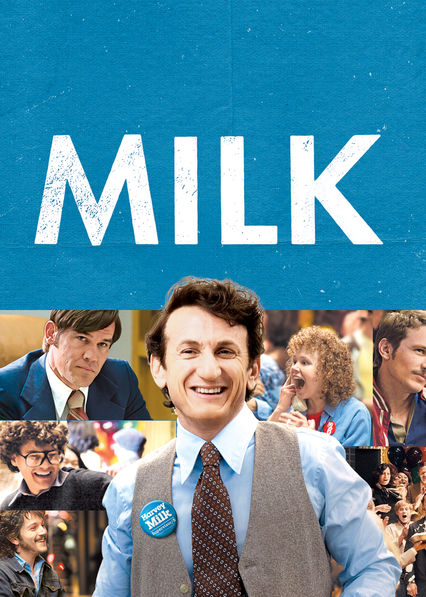
While I recognize it’s risky to learn history from a biopic, I really appreciated all I learned about Harvey Milk and his fine work in this movie, which was visually pleasing and well-done–through heart-wrenching–as well as educational. I do recommend it.

Milk begins with Harvey Milk’s fortieth birthday in New York, then quickly follows him to San Francisco, where he gets involved with politics, and through to his end by assassination. Sean Penn plays a beautiful Milk, and his partners played by James Franco and Diego Luna make striking, attractive characters as well. I found the acting all-around admirable. I loved the characters of Cleve Jones and Anne Kronenberg; and I appreciated the way Dan White was handled. He comes off not as a straight villain, but as a flawed, a troubled human being. His actions are hard to stomach. But I appreciate the nuance with which he was handled in this film.

San Francisco and the Castro feel real to me (and what do I know about how authentic they are here; but I bought it). The styles felt right for the time (same caveat). In other words, I was convinced and in fact spellbound by the whole thing; and that’s before saying that obviously I find Harvey Milk’s life and work inspirational, and his demise saddening. I would watch this movie again. You should watch it, too.


Rating: 8 votes.