Maximum Shelf: Finding Freedom: A Cook’s Story: Remaking a Life From Scratch by Erin French

Maximum Shelf is the weekly Shelf Awareness feature focusing on an upcoming title we love and believe will be a great handselling opportunity for booksellers everywhere. The features are written by our editors and reviewers and the publisher has helped support the issue.

This review was published by Shelf Awareness on November 30, 2020.


Erin French grew up in rural Maine, in the outdoors and in her father’s diner, where she began helping out in the kitchen at age 12. After a few years at college, she returned home to Maine, and faced challenges including young single motherhood; a difficult marriage and more difficult divorce; opening and then losing her first small restaurant; addiction and recovery. Eventually French moved back to her hometown of Freedom, where she would start again with her wildly successful The Lost Kitchen. These travels, pitfalls and victories she recounts in Finding Freedom: A Cook’s Story; Remaking a Life from Scratch. Renovation and redemption–of spaces and of herself–are central to her story.

This memoir begins mid-scene, with the nine-months-pregnant narrator, age 21, on break from a 16-hour shift at the family diner. The opening showcases the detailed, richly sensory food writing that permeates these pages, then flashes back, to describe French first entering the diner at age five; observing her father’s love for his work, his drinking and his limited ability to show love for his family; working in the kitchen and dreaming of escape. Finding Freedom centers around food, from childhood in the diner to young motherhood, when French supported herself with a small business baking cakes, cookies and pies, working retail in a cooking supply store and for a catering company. French picks up skills and ideas along the way and builds confidence until she is able to open a supper club and then the first The Lost Kitchen on the Maine coast. By this time, she has also picked up a husband, Tom, who turns out to be a heavy drinker, controlling and eventually abusive. From her problems with depression and anxiety, and the excruciating hard work and long days of restaurant work, she picks up prescriptions for Xanax, Ambien, Klonopin and more. This chapter of French’s story ends in rehab, with Tom seizing custody of her child and shuttering The Lost Kitchen, including “every whisk, every spoon, every spatula, and knife.”

But the cook (French resists the title “chef,” having no culinary degree or formal training) is scrappy, hard-working and resourceful. She adopts a dog, moves into a cabin without electricity or running water, fights for custody of her son and gets back into the kitchen. She first converts a dilapidated Airstream into a food truck for roving outdoor fine dining events on farms, in orchards and fields. And then another opportunity shows itself: the old mill in Freedom is finally gutted and renovated into the perfect, romantic setting for a small but picturesque dining room. The Lost Kitchen is reborn. Within a few short seasons, its limited reservations must be filled by postal lottery, more than 20,000 postcards “pouring in as though it were the North Pole.”

The spaces French occupies are lovingly built and restored. The first The Lost Kitchen is housed in a former bank building, a three-story gothic flatiron she describes in tender, glowing terms: “One by one I folded back the old wooden shutters and flung open the tall windows, letting light into spaces that had been dark for so long…. The place was dripping with character, with its hardwood floors, high ceilings, thick period molding, and doors with frosted glass and heavy hardware.” Its owners choose to take a chance on renting to French after a personal meeting and homemade meal. This process repeats with The Lost Kitchen’s reincarnation in Freedom: “The quiet rumors had been spreading around town about the old mill’s restoration, the same way they had about me.” In between, French must clean out and redecorate the cabin she lives in post-rehab on her parents’ land, and the Airstream trailer she uses to get on her cooking feet again. As the book closes, she has just purchased an old fixer-upper farmhouse “the color of strawberries.”

French excels in describing her passion for cooking and for pleasing people via food; she’s at her best detailing the foods themselves, and her mouth-watering writing is the heart of this memoir: “Hard-boiled quail eggs as bar snacks that you could peel-n-eat and dunk in a dust of celery salt.” “Fresh-from-the-fryer nutmeg-laced doughnuts.” “Fried chicken. Served cold, crispy, and juicy…. We could just hold it up in the air as the boat screamed through the waves to catch a bit of salty breeze before devouring it to the bone.”

Cooking and baking, flower arranging, the fine art of plating and the writing of this memoir contribute to a profile of a woman driven to create beauty even out of pain. The narrator’s voice is vulnerable, her trauma is real and visceral but, by the end, this is a delicious, feel-good redemption tale.


Rating: 6 nasturtiums.

Come back Friday for my interview with French.

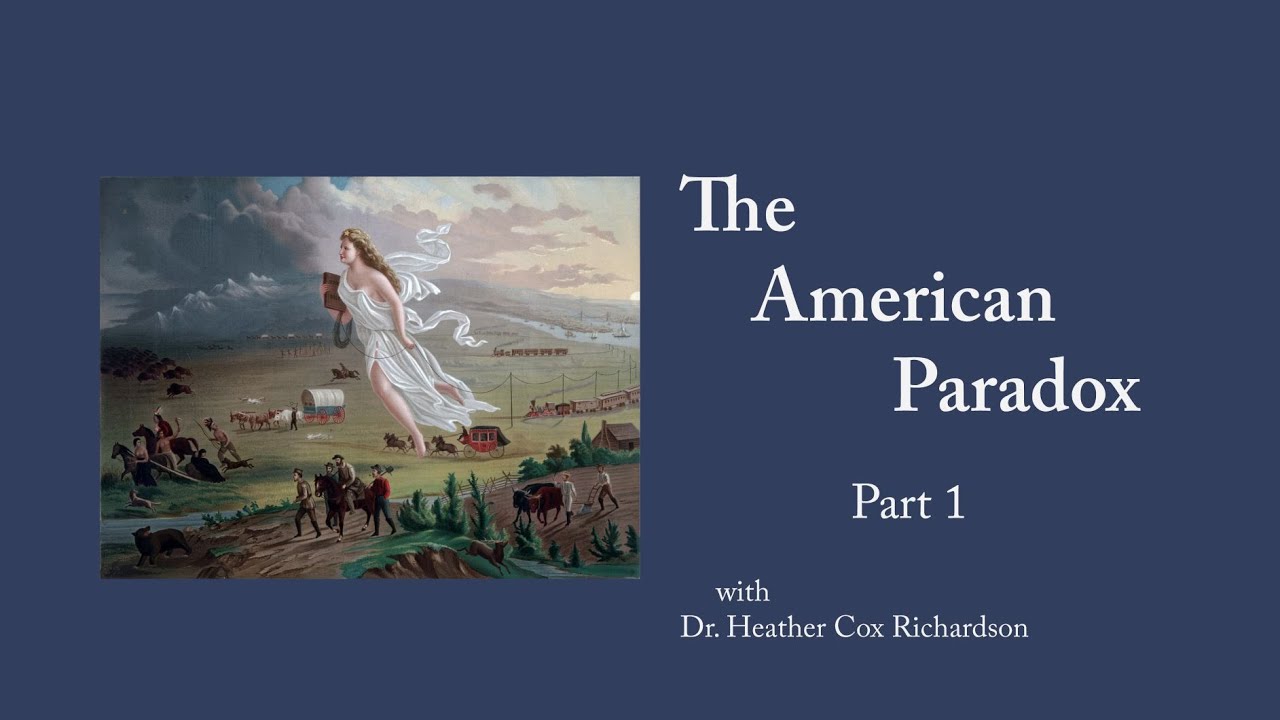
“The American Paradox,” lectures by Heather Cox Richardson

If you haven’t been receiving Heather Cox Richardson’s daily email “Letters from an American,” you’ve been missing out. She’s also been producing (prodigiously) several series of lectures on YouTube, including “American Paradox,” which we’re told follows the main themes and points of her recent book, How the South Won the Civil War. The paradox Richardson refers to is baked thoroughly into this country: that “all men are created equal” but that “all” doesn’t mean “all”; non-white men, and non-men, as well as certain classes of men, have been excluded from the beginning, and quite purposefully so. As we’ve moved as a country toward the idea that more people should receive equal chances in life, there has been a traditional pushback that is still alive and well, based in the fear that more equality for some people somehow means less equality for the original “all men,” meaning white men with a certain amount of money and power. Richardson portrays these points through storytelling, beginning well before the founding of the U.S., and catching up with Trump’s presidency. This lecture series has nine installments of about an hour apiece.

I listened to Richardson speak while working around the house, which means she didn’t always have my total attention, but I still got a lot out of the experience. I love her infectious enthusiasm for her subject – I feel there’s nothing so inspirational as an expert really excited about their field, and she definitely qualifies. As she occasionally reminds us, she delivers these lectures without notes. It’s astonishing the depth of her knowledge, and I am very comfortable with the trade-off that she is sometimes unsure of a precise date. I also really love the connections Richardson makes across disciplines (something I’ve been working to show my students this past semester), like noting the trajectory of Shakespeare’s playwriting career against world history and technologies, as in: The Tempest‘s setting in the Bahamas places that late-career play in time, as England colonizes that part of the world, a project made possible by new designs in sails and therefore in the shapes of boats. Literature, world history, and shipbuilding technologies are all a part of the same story! This exhilarates me. She also includes references to popular books, movies and television at different points in history, noting their subtle political or ideological contributions to culture, which is a method I recognize from Stamped, where I also appreciated it.

The central paradox in our country-as-concept didn’t feel like a new idea to me, but I think she presents it so logically that this series could serve as an introduction. (Who doesn’t hear the irony in “all men are created equal,” I don’t know, but I guess they’re out there.) For me the most exciting aspects of these talks were Richardson’s mastery of her material, how neatly she integrates interdisciplinary material into a single thread, her avid storytelling, and the big-picture perspectives she brings (which is what I love most about her email Letters). She is definitely, as my father says, a “history wonk,” a geek (I say in the most loving spirit) who excels at and loves storytelling. As my father again notes, this can “result in some enthusiastic ‘really cool!’ diversions into personalities and anecdotes that risk diluting her narrative,” and she sometimes has to pause to clarify that a story might be ‘really cool’ in terms of research and meaning-making, while being abhorrent in terms of what actually happened. This can be a bit jarring, but I think if we accept Richardson’s history-geekness, we can appreciate what she has to offer, which is an extraordinary body of knowledge and ability to draw connections and see patterns, and a boundless, contagious love for her work. I’d take a history class with her any day.

If you’re still learning our history (and who isn’t?) and if you feel that it sheds light on our present and future (which I think it certainly does), I highly recommend Richardson’s expert teachings, free and online for the taking.


Rating: 9 mules downstream.

Stamped: Racism, Antiracism, and You by Ibram X. Kendi and Jason Reynolds

Liz recommended this book to me (in the audio format) as an excellent, succinct, accessible history of racism (including its purposeful invention) and antiracism, and she was (as usual) right. This is an outstanding introduction to, or review of, the concepts of race and racism in this country, in the context of world history. It’s truly for everyone: those new to such a history will find it manageable, and those not new will learn something new or at least have that larger picture – race in America within world history – clarified in useful ways. The audiobook is just four hours long, and every minute of it is engrossing. I wholeheartedly second Liz’s recommendation.

Stamped: Racism, Antiracism, and You is a “remix” of Ibrim X. Kendi’s highly-regarded Stamped From the Beginning: The Definitive History of Racist Ideas in America. It’s approximately half the length (300 vs. 600 pages). I have not read the latter, fuller version, but my father should be finishing it anytime, and he’s appreciative; perhaps he’ll give us a review to partner with this one. Tables of contents show that the content of each books lines up neatly; they do appear to be two versions of the same material, and I think it’s a real service to give both versions to the world. For this remix, Kendi is joined by young adult novelist Jason Reynolds, who also narrates the audio version (excepting the introduction, delivered by Kendi). It’s my impression that Reynolds does the remixing of Kendi’s original work, bringing his facility with younger readers. The book is labeled for ages 12 and up, but to characterize this as a book for younger readers is too limiting; it’s great for adults, too.

The opening chapter begins,

This is not a history book. I repeat, this is not a history book. At least not like the ones you’re used to reading in school. The ones that feel more like a list of dates (there will be some), with an occasional war here and there, a declaration (definitely gotta mention that), a constitution (that too), a court case or two, and, of course, the paragraph that’s read during Black History Month (Harriet! Rosa! Martin!). This isn’t that. This isn’t a history book. Or, at least, it’s not that kind of history book. Instead, what this is, is a book that contains history. A history directly connected to our lives as we live them right this minute. This is a present book.

And I want to start there because I’m interested in that characterization of what makes a history book. Between you and me, I would like to assert that this is a history book, but I get what the authors are up to here: for those younger readers (or for all of us!), they’re trying to distance themselves from the dry and boring history book, the traditional history book, that separates “history” from what matters in the here-and-now. I think this is a history book, in all the best ways – one for history books to emulate.

Having gotten that out of the way: five sections organize the broad scope of this history. They are organized by years. “Section 1: 1415-1728” opens with “The Story of the World’s First Racist.” (In Stamped From the Beginning [SFtB], Part I is titled “Cotton Mather.” He is not the world’s first racist – that title goes to Gomes Eanes de Zurara.) “Section 2: 1743-1826” corresponds to SFtB‘s “Thomas Jefferson.” “Section 3: 1826-1879” corresponds to William Lloyd Garrison; “Section 4: 1868-1963” is W.E.B. Du Bois, and “Section 5: 1963-Today” is Angela Davis. Those section headings from SFtB appeal to me. Obviously the date ranges handle more than the lives of each individual, but I appreciate the choice of an individual for each section of history, and of the progress of racism in America. Methodically, then, Kendi & Reynolds move through history from the 1400s, and Zurara’s invention of racism (in Europe), to the present day. They hit the highlights in terms of events, personalities, laws, cultural shifts, and theories of race and racism and antiracism, the intellectual arguments offered for why some people should be kept under the boots of other people. I love that they note the markers in media and art for racist thinking, too, commenting on the timing and context of Uncle Tom’s Cabin, To Kill a Mockingbird, Birth of a Nation, Tarzan, and Planet of the Apes. I’m a big fan of spotting the connections across (what we think of as) disparate threads of history and study: movies, literature, history. I think it deepens our understanding of each to see how they fit together.

I found Reynolds’s audio narration completely lovely, and would listen to anything else he reads.

I understand that SFtB is an excellent, deep, rich, dense study. I know I have a lot to learn from it, and I hope to get to it sooner than later. The work of a book like that is important. But I’m so grateful that Stamped exists, too. It’s a truly masterful achievement to make such a swath of history so accessible in just 300 pages, and there are some pretty involved theories and concepts expressed here in a package that I think anyone can grasp (again, it’s labeled for ages 12 and up). I think this book is likely to reach even more people than SFtB. As Liz suggested, I can realistically recommend this one to my first-year college students. This is a book for anyone and everyone. It proves, through history and observations and stories, that we are not living in a post-racial world; racism (and a caste system based upon race) is alive and well in this country and culture, even if it’s learned to disguise itself – that just makes it more important that we learn how to recognize it in its trickier forms. Stamped is the book to help us begin that work. Recommended for everyone.


Rating: 9 privileges.

A Silent Fury: The El Bordo Mine Fire by Yuri Herrera, trans. by Lisa Dillman

Having loved Yuri Herrera’s trilogy of novellas, I was excited to learn he had a new book out this year, his first nonfiction, and again translated by the outstanding Lisa Dillman. A Silent Fury is a slim history of a 100-years-ago tragedy in Herrera’s hometown of Pachuca, Hidalgo, in central Mexico. It is minimalist because records are minimal, but it is lyrical and powerful in its minimalism, and a righteous fury does shine through it. I’m ready to follow Herrera (and Dillman) anywhere.

The El Bordo mine, owned by a subsidiary of the United States Smelting, Refining and Mining Company, caught fire on March 10, 1920. Within hours, the company estimated that “no more than ten” men remained inside, and that they were certainly dead; they ordered all three mine shafts sealed. Six days later, when the mines was reopened, seven men came out alive. Some eighty-seven were dead.

The story is full of problems, horrors, holes. How did the fire start? When did the fire start? What made the company so sure there were no survivors (when they would turn out to be so horrifically wrong)? How many died because of their decision to seal the shafts? What responsibility does the company bear? (The appointed investigation would go out of its way to swear up and down that the company was blameless.) There exist almost no documents bearing the voices of mine workers, survivors of the fire, or families of those lost. Herrera pieces together what he can from a case file and a few news stories.

But there are also oral accounts, given by miners and their families, and it was through these that I learned about the fire: there are at least two crónicas, one by Félix Castillo, the other by José Luis Islas; and a novel by Rodolfo Benavides. All were written years afterwards.

This book, like those accounts, refuses the judicial truth that reduces this history to a file in the archive. But none of these words are mine.

Instead, Herrera writes, he reconstructs events using the accounts available, choosing the most credible version where there are several, and pointing out contradictions and omissions. “Silence is not the absence of history, it’s a history hidden beneath shapes that must be deciphered.” For me, then, this book is in part a commentary on what history is. There is certainly commentary; it is not literally true that none of these words are Herrera’s. Of the surviving seven miners who came out of the sealed shaft after six days, the company’s doctor and local officials agreed

that the miners were “in a perfect state of health and had no internal or external injuries,” save for the fact that a few were in “an advanced state of starvation.” They really said that: in a perfect state of health but starving to death. Rarely has a boss expressed so honestly what, in his opinion, the perfect worker is like.

We hear Herrera’s quiet (but not silent) anger again when he recounts the struggles of the family members of the dead miners, in a section titled “The Women’s Fire.” Wives, common-law wives, daughters, mothers, and grandmothers were asked to prove their relationships to the deceased, in order to qualify for compensation. “Every single one of the qualified witnesses called in to vouch for the truthfulness of their testimony was male.” This kind of simple sentence communicates a great deal of emotion.

Silence is a recurrent thread in this story. The title occurs verbatim in just one moment: in a photograph of the seven survivors, Herrera tells us that “they don’t look like they just escaped from hell… with the exception of one, the first man on the left, who seems to betray a silent fury: lips clamped together, brows arched. But, again, no one recorded what they thought or felt at that moment.”

I say again: they sealed the mine shafts on nearly one hundred men, for six days.

This book is deeply moving in its brevity, with a clear grasp of the power of white spaces, what is left unsaid – silence. Herrera is the right writer to probe this story again. It’s beautiful and heart-breaking.


Rating: 8 signatures.

Buried in the Bitter Waters: The Hidden History of Racial Cleansing in America by Elliot Jaspin

I came to this book from the podcast series “Seeing White,” where Elliot Jaspin spoke briefly about one of the cases handled in his book. I made a note of the title and got it through the college where I teach, via interlibrary loan. I love interlibrary loan. The subject of Buried in the Bitter Water is the instances in American history where a community has run its Black residents out of town. This is a very specific kind of occurrence, as Jaspin lays out in his fascinating introduction. I think it’s worth telling that story, of how this project began.

In the late 1990s, Jaspin visits a small town in northwest Arkansas. He observes that, despite a history of Black residents, he doesn’t see any in the present time. He asks and is told that “the Klan keeps them out.” Using census data over the last century, he goes looking for counties where the Black population shows a sudden drop – the standard he uses is a drop of fifty percent in a decade. He begins with Southern states but expands his search to include “thirty-one states in the South, Midwest, and Mid-Atlantic where I thought I would be most likely to find racial cleansings.” (I wonder what he missed in the remaining nineteen states!) Census data, at least at the time of his research, was only available by county, so that’s the unit of measurement he uses, while speculating that he’s probably missing instances involving smaller communities – towns, villages. Having identified counties with suspicious numbers, he cross-checks contemporary newspaper records, and indeed he finds stories like those in Berryville, Arkansas (where he’s visiting at the start of this story) and Corbin, Kentucky (which was the story featured on “Seeing White”).

A word on language: Jaspin writes that the term ‘ethnic cleansings’ was coined in the early 1990s by Croatians fleeing Serb-dominated Yugoslavia. He acknowledges that it is problematic in its assumption that a place is ‘cleaner’ without an out-of-favor ethnic group, but concludes that it’s okay because it was coined by its victims. I’m not terribly comfortable with that, myself, but I appreciate that he at least considers the question. I feel like it at least needs “scare quotes” (if not a better term, please?), and I’ll use them in this review, as in: Elliot Jaspin has done some important original research on “racial cleansings” in American history.

And he has. For the book, he identifies a dozen of the “very worst” cases, and tells those stories in twelve chapters. In many cases he’s interviewed local residents, descendants of those residents who were run out of town, or even survivors. It’s part of the book’s thesis that these histories have never before been told, and based on Jaspin’s research I believe that to be true. So his work is important – this is primary research beginning to tell a story of American history that we absolutely need to get on the record. The case studies are predictably horrifying.

But they’re hard to read for another reason, too. Back to those problems of language. Buried in the Bitter Waters was published in 2007, but it feels older than that because Jaspin frequently makes errors in sensitivity. This is important research, but it’s important how we write it up, too. For one thing, he uses ‘black’ as a noun throughout, for people: the blacks lived here, the blacks did this and that. I’m pretty sure it’s been a part of social justice training since before 2007 that we should refer to people as people: Black employees of the mine, Black students in the school, Black people, as opposed to simply ‘blacks,’ which reduces them to perceived race and nothing else. This usage is all over every page of the book, and it grated at me, and affected my ability to concentrate on the stories Jaspin was telling. Now, 2007 was a long time ago in wokeness terms, and I’m trying to be patient with Jaspin, but I found this hard to take. He also makes a common error in naming the race of Black people, while other characters in the history might just be men, women, people. (We are left to assume that they’re white. It’s not always clear.)

It gets worse: a county is noted to have “lynched their own black seven years earlier,” a line which makes me shudder. And “if young Charles Stinnett had not decided to rob the spinster Emma Lovett, there might still be a black community in Boone County, Arkansas.” I am positive we knew what victim blaming looked like in 2007, and this is an excellent example of it. What made the white residents of Boone County run their Black neighbors out of town was not the alleged crime of an individual Black man. It was the white residents’ racism. Later, the six-day trial, conviction, and sentencing to death of Charles Stinnett is referred to (by Jaspin) as “speedy justice.” In reference to events in the early 2000s he writes that “a century earlier, segregation, disenfranchisement, and racial cleansings had established a white man’s country.” I would like to point out that this country was established as a white man’s country well before the early 1900s – in fact, before it was a country, the earliest white settlers were working to establish it as such, more than four centuries ago.

I’m not trying to pick on Jaspin, who I think is well-meaning, and earnest in his search for truth and justice. But I think it’s an important feature of this book that he doesn’t address all the baggage he brings up, including his own. We’re all on our own paths of discovery, hopefully all moving toward ever better awareness of social justice, and that process is never finished. I don’t know it all or get it all right, certainly. We have to keep learning; thinking we’re done with it is the easiest way to stop learning. I’m not here to crucify Jaspin for what he got wrong in 2007, but it’s part of my review of this book that he got a lot wrong, in how he writes about Black people and how he assesses the results of his research. His work is a contribution to research in this field, and future historians will consult it and add to it – and I hope rewrite it in better and clearer terms, soon. It’s only been thirteen years, but it’s time.

Jaspin details his twelve chosen case studies of ‘racial cleansings’ in eight states. They are hard to read, both for the right reasons (because this history is shameful and disturbing) and because I often cringed at Jaspin’s terms. He makes some astute points about the factors at play here, obviously including racism but also including, for example, economic factors, and capitalism’s successful pitting of poor white workers against poor Black ones. He finishes with a lengthy conclusion that felt a bit out of place for me: he tells the story of how this material was intended for the newspaper chain he worked for, but it got edited to death and/or left unused, because the chain included the Atlanta paper that badly mishandled its coverage of Klan activity in north Georgia in the 1980s, which is part of the continuing story of the ‘racial cleansing’ that took place there. (Whew.) This detailed story of a failure of journalistic integrity struck me as a little off-topic, and a little personal for the author, in ways that didn’t necessarily serve the broader goals of the book. (The related point is that we’re still not doing the self-examination of history that we need to do, which is valid. But it gets a bit wide of the mark, in my reading.)

Final assessment? This was a complicated one for me. I appreciate Jaspin’s introduction, in which he details his discovery of this phenomenon, and his research methods. (Note the limited capabilities of internet research in the late 1990s and early 2000s.) I think his primary research into under- or unexamined ‘racial cleansings’ is deeply important to the field of American history. The scholarship in this book is significant, and will bear further study. I’m glad for Jaspin’s contributions. But I’m also bothered by the shortcomings in his language, and his occasional failure to question the given narrative. I think the next scholar to take up this work can and should do better.


Rating: 5 times words matter.

movie: The Dark Divide (2020)

Click that beautiful image to enlarge. Go ahead. Isn’t it lovely?

This film is definitely visually pleasing, but that’s not all it has to offer. The Dark Divide is based on a Robert Michael Pyle book, Where Bigfoot Walks: Crossing the Dark Divide. I have not read this book, but I have it on my shelf, and I know that I appreciate Bob Pyle’s writing. (Small disclosure, I guess: I’ve met Bob a few times.) A film based on a memoir by a writer I admire is always a solid bet. Plus, a small part is played by somebody else I admire.

Patterson Hood is more or less as niche as Bob Pyle, I guess, and it’s just downright fun that they’ve ended up in a project together, certainly in part because Patterson now lives in the same Pacific Northwest region. At any rate, this was enough to bring me in.

The story is this. Bob Pyle is an academic, lepidopterist and writer, portrayed here as pretty bumbling and goofy. His beloved wife Thea is dying of cancer, and his colleagues are ribbing him about this great butterfly hunting expedition he talks about but never undertakes. Shortly after losing Thea, he gets a grant from the Guggenheim to actually do it: hike from route 12 in southern Washington state, over Mt. Adams to the Columbia Gorge, seeking butterflies (and moths) along the way. It’s intended to be a 30-day trip. “You’ve been camping before, right?” ask Bob’s colleagues. “Cub scouts, or…?” They’re being a little mean, actually, especially in light of the Thea situation, but the viewer has to admit that Bob is unconvincing as a backcountry hiker. (Because I barely-a-little-bit know Bob, and like him, I was a little sorry to see him made fun of. But then, he wrote the book.)

The film follows Bob’s hike through the Gifford Pinchot National Forest (aka the dark divide), with flashbacks to life with Thea. There is not a ton of dialog, because for much of the time Bob is alone. He talks to himself a little (less than one might expect), and he occasionally meets with other humans, although this rarely turns out to be a good thing. As a ranger tells him when he asks about Bigfoot: “If you were one of them, wouldn’t you hide from us? I know I would.”

It’s a charmingly simple story. Beautiful scenery, elemental challenges (bear, food, water, weather, gravity at cliff’s edge), stark human grief, scant dialog. Look at these stunning views, consider the horror of losing one’s life partner. See the rare endangered species, howl for help from the bottom of a cave. An encounter with a crew of loggers encapsulates some conflicts – a bit simplified, but effective. There are some logical or factual goofs, like the fact that Bob seems to carry a solitary quart-sized water bottle (Nalgene, of course), and we never see him refill it (except when the rangers do so for him). But this isn’t meant to be hyperrealism, nor a how-to-backpack guide (seriously, don’t use this movie as a how-to).

Visually stunning, thoughtful, poignant, funny, honest, and a decent introduction to the Bob Pyle character. Recommended.


Rating: 8 hoots.

My Life as a Villainess: Essays by Laura Lippman

I entered this collection at the end, because Liz recommended to me the final essay, “Men Explain The Wire to Me.” (My post about a few favorite television shows is forthcoming.) I liked it, so she recommended a few more which I also liked, and then I went back to the beginning and read the collection cover to cover. It’s not a perfect book; the best essays are very good and the less compelling ones are not very good, which was maybe Liz’s point. But I’m left feeling close to the author in a way that’s rare for me, and full credit for that.

I guess I would say that there’s nothing earth-shattering about the writing itself. But Lippman’s experiences, the conclusions she draws from them, and her sharing of all of it is very appealing to me. To call someone’s writing ‘relatable’ in a workshop isn’t always seen as meaningful praise, but I’m not sure why; I think getting the reader to relate is a pretty important goal, not necessarily easily accomplished. I say these essays are relatable as hell, and I mean that as a compliment. I think that Lippman is correct that loving one’s own face and body, as a woman in this culture (let alone as a sixty-year-old woman), is indeed a radical act. I appreciate her observations about gender and power and privilege, and work and parenting. I appreciate that she concedes her own villainy without wallowing in it; she remains more or less a good girl, even while pissing some people off.

Some of these essays can feel a little pat, a little neat in their concluding lines, like there is a trick at work in the writing and the trick shows through the weave of it. But the heart is good, and the observations and philosophies are real and of value. I want to be friends with the woman who wrote these essays; I feel like we could be friends; I feel a little bit like we are friends, which is pretty unusual for me and totally weird but comforting. (Perhaps if her writing were transcendent I wouldn’t be able to feel this. To every cloud, a lining.) This is plenty good enough for me.

If you’re interested in dipping in slowly like I did, here are the essays Liz especially recommended to me: “The Art of Losing Friends and Alienating People,” “My Father’s Bar,” “The Waco Kid” (about moving to Texas for work), and of course that finisher which is where I started, “Men Explain The Wire to Me.” I agree with these recommendations, although I think I’ll add “A Fine Bromance” and “Saving Mrs. Banks.” I’d read more essays by Laura Lippman.


Rating: 7 tennis volleys.

podcast: the “Seeing White” series from Scene on Radio

“Seeing White” is a 2017 series on the podcast Scene on Radio, from the Center for Documentary Studies at Duke University (in a very podcast-rich part of the country, it seems to me). Host John Biewen (a white guy) is upset by racial injustice in the United States, and curious about the invisible forces that go beyond simple, mean, interpersonal racism and account for the systemic, institutional forms that do still more damage and are less easily identified. Noting that our discussions about race tend to manifest as discussions of people or communities of color, he wants to “turn the lens” back on whiteness. What the heck is that?

My father recommended this podcast series to me, pretty forcefully, and my first reaction was to say, 2017? His recommendation came in the height of this summer, the summer of George Floyd and Breonna Taylor and a new energy behind BLM protests, and it felt a little weird to look back three years for an angle on these events. Three years is kind of a short time, but also rather a long time, in the evolution of our (national-level) thinking on race. Well, I was wrong about the timeliness concern. While the most recent event markers have changed – Charlottesville being the landmark event when this podcast was released – the conversations we need have not. I’m adding my voice to my dad’s: this podcast presents ideas, facts, and history to help along that conversation, one that I found thought-provoking and useful, and that I absolutely still think is useful – nay, imperative – in 2020.

John Biewen and Chenjerai Kumanyika

Biewen examines whiteness via conversations with experts and scholars, including historians, researchers, and educators. On each episode (save one, I think), he then consults and reviews his new content with Dr. Chenjerai Kumanyika, professor of critical cultural media studies, cultural industries, “and things like that” at Clemson University and then Rutgers. Kumanyika (a Black man) serves as a sounding board and a gut-check for Biewen, there to offer both a personal and an expert perspective and make sure Biewen doesn’t head off in any funky directions; he’s the Black friend, which is a concept that should give us some pause. (I hope he got paid for his role here.) But the two are friends in the real world, and Kumanyika signs on for this project eyes-open. The two do share a joke about his role: “You’re not asking me to speak for all people of color, are you?” “Yes! of course!” “Well good. Because that’s what I do…”

Big, complicated topics here; writing this review/response is intimidating, but here’s my best effort.

I thank my parents and my upbringing for the fact that I’m not new to concerns about race and racism. But it’s clear to me, too, that nobody (and most particularly no white person) can sit back contented, thinking that she’s got it all worked out. To be a good anti-racist means being constantly ready to keep learning and finding out where I’ve been wrong. One of the greatest offerings of “Seeing White,” for me, was its help in wrestling with a certain concept. 1) I see and understand that race is a social construct in our society, rather than a biological fact; that makes sense to me. 2) And yet race is also a reality in our society and culture: it affects people’s experiences in education, law enforcement, finance, real estate, health care, and so much more; we have a (wildly imperfect) system of identifying people by race just by looking at them. So 3) How can race be both made up and a reality at the same time? …I don’t think I would have articulated this philosophical puzzle before listening to the podcast, but it’s definitely been a puzzle for me for some time. After listening, I feel like I have a better handle on it. Race is indeed both a reality within our culture, and something we made up. We’ve manifested it. Suzanne Plihcik of the Racial Equity Institute, episode 2:

We know, for example, since the human genome project, that we are 99.9% genetically the same. There is more genetic variation in a flock of penguins than there is in the human race. There is more genetic variation within groups that have come to be called races than there is across groups that have come to be called races.

However, after more than 400 years of entrenched racism, discrimination, and enforced segregation on this continent, we have built in differences that weren’t there. Health disparities are not a result of racial difference, but a result of different treatment over lifetimes and generations.

From episode 8, Dorothy Roberts, professor of law, Africana Studies and sociology at the University of Pennsylvania and leading scholar on racial science:

The sickle cell example is the resort of people who know that there’s a mountain of evidence showing that race is an invented category, and so they grasp at sickle cell all the time… Peoples who live in areas where there’s malaria have developed this mutation, or have a higher prevalence of this mutation, because it protects against malaria. But it’s not confined to Africa, it’s not present in all of Africa, and so it simply is not a ‘Black’ disease. It just says nothing about race whatsoever. It’s linked to groups that developed in areas where there’s a lot of malaria, that’s all.

This was a lightbulb moment for me: sickle cell has nothing to do with race! It’s about where the mosquitoes are!

So yes, 1) race is a social construct and simultaneously 2) race is a reality in our culture because 3) we have made it one, over centuries of social construction. Which means that 4) we have to consciously, purposefully, effortfully, and over years, decades, possibly more centuries, deconstruct it. Race and racism will not go away because we wish them to, and they certainly won’t go away because we turn our gazes in another direction and claim to not see color. We made this, and it’s now on us to unmake it, at personal and collective cost.

There is much to be gained and learned here, no matter how openminded you think you are.

I think perhaps the best single episode to catch might be the penultimate, episode 13: “White Affirmative Action.” This episode spells out in hard facts and figures and a thorough study of history how white people have gotten ahead, methodically, throughout American history, how we’ve been given advantages at the expense of other groups. It offers some good answers to those who would say “How could I owe reparations? I was born in 19–. My people didn’t even own slaves. My people only came over in (whatever year).” Etc. Answer: if you’ve been white in this country for more than a few minutes, you’ve benefitted from institutional racism, period. Even if you’re well meaning. Even if you didn’t want to. Even if you’re not, personally, racist. Even if you grew up poor! (I’ve linked to it before, but still good: “Explaining White Privilege to a Broke White Person.”) To become better versed in explaining this concept, I highly recommend episode 13. (For the record, I am absolutely in favor of paying reparations to Black Americans.)

I’m barely scratching the surface of what’s available in these 14 podcast episodes, of course. I am not particularly qualified to teach this content to you, but what I can do is offer my review: this is deep and rich and complicated content, excellently explained and articulated and discussed, in fairly manageable chunks. Spend some time with it. Improve yourself and try and improve the world.

Good tip, Pops. Thanks.


Rating: 9 questions to sit with.

Nature Matrix: New and Selected Essays by Robert Michael Pyle

Collected essays arguing for nature as a unified matrix serve as an excellent introduction to the work of this veteran writer, or a continuing pleasure for readers in the know.

After decades of writing and naturalist study, Robert Michael Pyle (Wintergreen; Where Bigfoot Walks) thoughtfully collects essays on a theme in Nature Matrix: New and Selected Essays. He conceives of a single, interconnected whole, not a binary of natural and non-natural worlds, but an organism of which humans are an inextricable (if often unaware) part. He explores the “extinction of experience” that threatens our future, defines his religion as “Alltheism” (with nods to Darwin, Muir and Kurt Cobain) and envisions wilderness as a continuum, with some version of the wild existing in every vacant lot and on every street corner. The introduction, “Pyrex, Postcards, and Panzers,” makes the point nicely: it took both pretty pictures and tanks to teach the author about the interrelatedness of the natural world–which is to say, simply, the world.

With 24 books to his credit and having studied, written, lived and taught all over the world, Pyle has a broad and rich body of work to draw on for this collection, first conceived of (by this title) in the late 1960s. Nature Matrix as published in 2020 may contain different essays than 1970’s would have, but the principle remains faithful. These 15 essays (ranging back to 1969, five of them previously unpublished) cover classic Pyle territory: butterflies, conservation, quiet appreciation of the outdoors.

Also included are a profile of John Jacob Astor I and arguments for reading hardcopy books rather than screens and for Bright Lights, Big City as an “elegant ethology of one species of upright hominoid ape under the influence of one species of plant in the contemporary canyonlands.” Nabokov is a recurring character (for his literary and visual arts and his lepidoptery), alongside “the High Line Canal, an irrigation ditch coursing the altitudinal contours across the landscapes of Greater Denver, carrying Platte River water from its mouth at the edge of the Rockies out onto the plains near the present Denver International Airport,” where the author as a child first learned to observe and love the details of the natural world.

Pyle’s voice varies from cantankerous to droll, awe-filled to academic; his characters and fascinations are equally wide-ranging. After all this, “In some ways am I right back where I started: fascinated by a stump on the corner.” It is the persistent note of wonder as much as his impressive depth of knowledge and passion that makes Nature Matrix a remarkable addition to Pyle’s life’s work.


This review originally ran in the August 27, 2020 issue of Shelf Awareness for the Book Trade. To subscribe, click here.


Rating: 7 twitchers.

The Wet Engine: Exploring the Mad Wild Miracle of the Heart by Brian Doyle

I am back again with another Doyle, different this time but totally recognizably him.

Here are the classic Doyle elements of celebration and beauty, but amid so much pain and loss… and I have to admit, the loss of Doyle himself felt very present for me here. I continue to feel it as a significant loss to this world, both because we will get no more of his transcendent writing, and because he just seems to be the most beautiful, loving, joyful, talented person, and we don’t have enough of those; it still hurts me that we’ve lost him. And that was right under the surface of all of these essays for me, in a way that was less true of Chicago, because that book was fiction rather than nonfiction, and also because it is not quite so explicitly about life and death in the way that The Wet Engine is, so the pain was closer to the surface for me, if that tracks.

The wet engine is the heart, often but not always the human heart, and the reason Doyle focuses here is that one heart that is important to him is in danger. His son Liam (age nine at the time of writing) was born with three chambers in his heart rather than four. He had to have several open-heart surgeries when he was an infant, and so his father learned about how hearts work and he got to know some cardiologists and surgeons. And because this father was Brian Doyle, he also did some meditating on the metaphoric meanings of heart, on all the language we use (heartbreak, heartsick, hearts swelling and leaping and failing, hearts held in hands and worn on sleeves), and on mysticism and miracle and mystery and magic. He also does research: Liam’s doctor, Dr. Dave, is profiled in considerable detail, as is Dr. Dave’s wife, Linda, and his mother, Hope. (It is through Hope that we find ourselves in an internment camp – really, a concentration camp – for Japanese Americans during World War II, in Topaz, Utah. Hope was interned there as a teenager with her family for nearly three years; she graduated from high school there. “No, I am not bitter, she says. No. Bitter is no place to be. But I do not forget.”) Shorter profiles explore other doctors and pioneers in medicine and cardiology from around the world, from the early days of the science through the present (like Dr. Dave’s colleague Hagop Hovaguimian, who can never stop working because too many people need his help). The people who people this book come not only from throughout history but from all over the world, which is frequently fun and which reinforces the feeling of enormous scope that Doyle achieves. “The doctor to my left is from Australia. He speaks Australian, a smiling sunny language which takes me a minute to get the pace and rhythm of, but then we get along swell…”

The Wet Engine is a collection of linked essays that explore these and other topics: the humans involved with hearts and their stories; the nature and power of stories; the language and metaphor and soul of the heart, and its place in our mythologies; the science of the hearts of humans and other species; Liam’s own life story, and Doyle’s navigation of it as Liam’s father. Everywhere of course is Doyle’s distinctive voice and style, made up of long lists and emotional appeals and exuberance and vulnerability. There is also God here, and my regular readers know I don’t spend a lot of time reading about God, but Doyle can get away with anything: the tone of reverence is entirely appropriate here, and his explorations (“God is not a person. God is not an idea. God is the engine. God is the beat. We are distracted by the word God…”) I can easily follow. (Also I am reminded of Amy Leach.) And I appreciate that Doyle doesn’t choose just one religious or spiritual angle of approach, but that he’s interested in holiness in a multitude of traditions.

I think what I love most about this book is that it feels like it includes all the disciplines of study. There is theology, and hard science – medicine, zoology, even botany – history, social justice, the arts – music, and his own literary genius, including some superlative descriptive work and expressions of gratitude and pain. I’m pretty interested in interdisciplinarity these days, and I’m assigning my students readings that do this work, including a short passage from The Wet Engine. (Synchronicity: I’d just given them a Joseph Mitchell essay called “Goodbye, Shirley Temple,” and then read that Hope was interned at that camp with Shirley Temple’s gardener. What?? The world is a mystery.) And all of this in Doyle’s own wild style.

I cried a lot, but it’s such a beautiful, instructive book. At scarcely over 100 pages, it is one that would bear lots of study. Again I rave.


Special recognition to Matt Ferrence for making me aware of this book a few years ago, when he assigned “Joyas Volardores,” the sixth essay, for an MFA residency. That one still stands out. Thanks, Matt.


Rating: 9 knobby knees.