
Maximum Shelf: Kin by Shawna Kay Rodenberg

Maximum Shelf is the weekly Shelf Awareness feature focusing on an upcoming title we love and believe will be a great handselling opportunity for booksellers everywhere. The features are written by our editors and reviewers and the publisher has helped support the issue.

This review was published by Shelf Awareness on February 17, 2021.
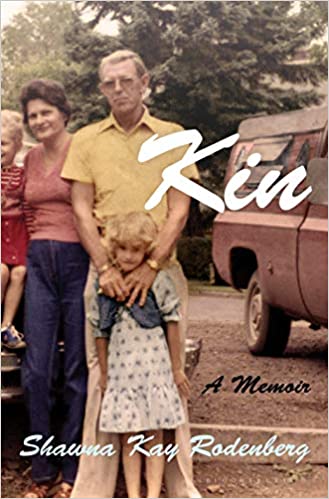

Shawna Kay Rodenberg’s harrowing memoir Kin leads the reader backward and forward in time and across an American landscape of trauma and healing. With a persistent focus on family and home, Rodenberg documents a process of learning and personal growth that is both unique and universal.

Kin opens in 2017, as the author guides CBS reporters though her native eastern Kentucky. They seek to crack open what they see as Trump country, and Rodenberg hopes to complicate that story. The backdrop is “my family’s mountain, the mountain where my grandfather mined coal, where my father was reared with great love and brutality, where I picked my grandmother’s strawberries and my grandfather’s roses… the mountain on which my family sought refuge after leaving The Body, an end-times wilderness community, cloistered in the woods of northern Minnesota, that my father joined when he was red-eyed and mad with fear, following his tour of duty in Vietnam.” The narrative then moves back in time to Rodenberg’s childhood in Grand Marais, Minn., and the purposeful deprivations of The Body.

Rodenberg’s upbringing in this strict religious sect gives her a cultural background that will make it hard for her to fit in later, and she suffers more than one form of abuse within The Body, including her father’s recurrent rages. “Instead of following in alcoholic, workaholic footsteps, he made religion his primary vice, religion that was unconventional, ecstatic, even perhaps rebellious–and virtually militaristic, which must have felt familiar.” The family eventually moves back to the secular world, to Ohio, to Kentucky and finally to the mountain of family origin. The austere, often angry influences of The Body will follow them.

This memoir recounts family stories, some from Rodenberg’s memories, some passed down. She writes of each of her parents’ childhoods, and of her aunts, uncles, cousins, grandparents and neighbors. She recounts the history of her hometown, Seco, Ky., a former coal-mining camp. Kin begins well before the traumatic story of Shawna’s birth, “bruised-ass-backward into a world of chaos.” The chronology is disjointed, jumping back and forth, shifting timelines as well as locations, which can be disorienting for the reader, but that effect feels true to the narrator’s experience: Kentucky exerts a strong pull even in Minnesota, and pains felt by generations past are ever present.

At each stage, Rodenberg struggles with the meaning and shape of love and caring, and the confusing truth that those who love us most can hurt us most. Religion will continue to play a large role in her life, complicated by her father’s movements to and away from a strict adherence to The Body’s teachings. She will continue to wrestle with sex and the aftermath of childhood sexual abuse, through her troubled first attempt at college and beyond. Kin closes with Rodenberg on the cusp of pregnancy and marriage, but hints at what is to come: “I wish I could tell [that earlier version of myself] she had come to the beginning, not the end.”

Rodenberg’s prose is graceful and effortless, vulnerable and raw, beautifully descriptive without drawing attention to itself. She emphasizes character of place, from coal country where women “kept the food covered and draped cribs with quilts to keep the dust off their babies” to “town-sized time capsules, stoppered and sealed…. Barns sank beneath fields of kudzu and the roofs of old houses bowed in the middle like the backs of the ancient, singular mares that waited outside to be fed and put away.”

While Kin is first and centrally a memoir of family, it is also about Appalachia, about histories more complicated than the opening scene’s reporters care to see. It is ultimately about forgiveness, understanding and love. Rodenberg seeks an emotional reconciliation with her parents, especially the father she has butted heads with all her life. Of that battle, “even now, writing about it fills me with worry that I might be inadvertently reengaging, and that is why talking about it, why telling was and still is the hardest thing…. This is what it means to come from people who have been broken and exploited, they see the world in sides, theirs and the other, and disloyalty is the gravest offense, the blasphemy of the mountains.” In a world of just two sides, it might be an act of rebellion to both love someone and hold them responsible.

As narrator, Rodenberg is intelligent and insightful. As character, she is resourceful, scrappy, defiant, brave and exposed. Her memoir is heart-rending and hard-won. “I didn’t know when I started writing this book that it would become my own book of Revelations, rife with warning and promise, an account of my own and other apocalypses that created me, end times that predated me but shaped me as surely as if I’d lived through them myself.” That sense of regional and filial legacy defines Kin, a work of nuance that complicates received narratives in all the best ways.


Rating: 7 skirts.

Come back Monday for my interview with Rodenberg.

Gone to the Woods: Surviving a Lost Childhood by Gary Paulsen

I had not thought of Gary Paulsen in years, until I saw the Shelf Awareness review of this new book. (Hat tip to my colleague Jen Forbus for that review.) Paulsen might have been the first author I really fixated on; I remember setting out to own all his books, and while I didn’t get very far (maybe six or eight of them), I’m pretty sure I wrote “Julie’s Gary Paulsen library” or some such inside the cover of each one, and had them set up on their own little shelf. Early signs of something, there. My favorite was Hatchet, of course, and its sequel; and I vividly remember a scene from the beginning of another book where the narrator watches a… chipmunk? eating another creature, blood down its front… what book was that?

Anyway – when I saw that he’s returned with a memoir of his own childhood, I was sold. And let me tell you. This book had me entranced from the opening lines. I wept.

Gone to the Woods has an innocence and a simplicity built into its writing style and the value system, I think, of its narrator. This makes it accessible to younger readers, but not at all to them alone. I think this is a memoir for everyone. Paulsen tells his story in the third person, calling his protagonist only ‘the boy,’ although the name ‘Gary’ is used once or twice by other characters. This helps to give the boy an elemental quality, like he’s sort of an archetypal boy, although his story is very specific. When the book opens, he is five years old, living in Chicago with his mother in 1944. She has a factory job, and coming from a small farm in northern Minnesota, is “not even remotely prepared to resist the temptations of the big city.” She lives in the bars and does not parent her small son, who she’s trained to perform for the men who try to win her favor. Grandmother hears of this lifestyle and is “critical, then concerned, and finally… past horrified and well into scandalized.” Her solution colors the boy’s method of problem-solving for life: “If it doesn’t work Here, go over There.”

The first adventure of the book, then, is the five-year-old boy’s solo journey by train from Chicago to International Falls, Minnesota. This takes several days and involves a train absolutely jam-packed with severely injured soldiers, smelling of and oozing pain and death, so that the boy is physically ill from it all – because didn’t I say, his father, who he’s never met, is a soldier off in the war. The boy becomes stuck in a train toilet, among other things, and observes out the train window the woods that will become his sanctuary. By the time he arrives at his aunt and uncle’s farm he is wrung out with exhaustion, trauma, and confusion. But the farm will be a perfect place for him, the first place he feels he belongs, is valued, is taught. He’s given his own room and bed. It’s lovely. Then it’s taken away from him.

I’ll stop summarizing here. The boy’s upbringing is one trauma after another, including a few years on the streets of American-occupied Manila, and a continuing absence of parental concern. I appreciate that the narrator is slow to judge his parents, and I think it would have been easy (narratively speaking) to be ugly about the mother’s drinking and many boyfriends, for example, but neither the young boy nor the adult man who writes these lines takes that easy road. (At least until the teenager’s perspective, at which point he thinks of both parents as vipers. But this is about the damage they do to him, rather than some puritanical judgment of mom’s moral choices.) He is an unjudgmental creature in general. Paulsen is wonderfully good at the innocent child’s perspective, elements of which are present in the teenager too.

Trauma after trauma, but with a few bright points, like the aunt and uncle in the Minnesota woods, and a saintly librarian when he is thirteen years old who makes him a gift of notebook and pencil, for whom this book might be considered a gift in return. And the woods and rivers and streams, which are always a bright point. From age five, the boy learns that the woods will allow him to take care of himself, even when he lives in a city again, keeping to the alleys and nights to avoid bullies, and escaping to the stream where he can fish for food or shoot squirrels and rabbits when his parents fail to provide for him. Even in Manila, a city of a certain sort of trauma (truly, the violence and death this child witnesses by his sixth birthday is unfathomable), he finds beauty and human kindness.

At times the events were hard for me to take in, and I wondered if younger readers were really the right audience for this. But on reflection, I think Paulsen offers just enough. I think children might take away what they need from this book – I’m no proponent of censoring life’s pains from kids – and it’s the adult mind and perspective that makes it even harder to read, if that makes sense.

The story is harrowing but also lovely, always riveting, and an important testimonial from a generation that we will eventually lose access to. It is excruciatingly beautiful in how it’s told. The immediacy of traveling with the boy is heart-rending and direct. I can’t imagine how this book could be improved upon.


Rating: 10 willow branches.

Let Me Play: The Story of Title IX by Karen Blumenthal

My Comp II classes got their library instruction early in the semester from our library director, who ran some searches on the big screen for them, including a number using Title IX as the sample topic. So I several times saw this title go across the screen, as a print, hard-copy book in the library on the topic. It’s a “juvenile” book, recommended for ages 8-12. I was curious, so I checked it out. (Why is this juvenile book in our college library? Who knows, but it got here by donation. I’m only the second person to check it out. I suspect our print collection doesn’t see much movement, even outside the juvenile shelves.)

Ages 8-12, sure; there were some points that were a little remedial for me, like the definition of a filibuster and how the legislature works, although I daresay many of us could use a review even there. And one of the points the book makes very well is that establishing federal law is wildly arduous, often a process that takes years, and much negotiation and compromise and heartache. The quest for near-consensus is admirable in theory, but in practice often means very slow or no progress.

Aside from a few issues that I didn’t need explained quite so well, though, even this ‘juvenile’ book was an excellent narrative. What the heck is Title IX? How did we get here? How far have we come? I have to say that I’ve never actually sat down to learn the story in such chronological fashion, and this book for 8-to-12-year-olds was engrossing.

When I started teaching college, I thought of Title IX as being the legislation that said girls could play sports too. When I was a little girl, that’s how I heard about it. I had some direct experience of the law, like when my middle school established a soccer team in my 8th grade year and because there was just the one team, it was necessarily coed. A few girlfriends and I got to play with the boys, and it was both a point of pride and at the same time no big deal. And I knew Title IX was the reason. But then I got to teach college, and Title IX had whole new dimensions. Nobody cares if the English professor knows the rules about equal sports opportunities, but it was very much a part of my training to know that I’m a mandatory reporter of disclosures of sexual assault, dating violence, stalking, and sexual harassment. That’s all Title IX, too: how little I knew. In its simplest form, this is legislation meant to address sex discrimination in educational settings. It’s been applied to equal pay and employment opportunities for teachers, admissions opportunities for students, access to fields of study, and more. But sports, it seems, remains the most visible and well-known area affected by Title IX, as evidenced by Blumenthal’s title.

(My classrooms are full of female athletes. I wonder if they realize how new a thing this still is.)

Let Me Play is a well-produced book. Chapters explain the context for Title IX, including the struggles for civil rights in the wider world, not only for women but for Black people and other people of color. It begins with women’s suffrage and situates events against two world wars. The text is written for a younger audience but is unafraid to use proper terminology (like filibuster!); I wonder if the finer points of government aren’t a bit complex for the stated age group, but what do I know. There are a good number of images, mostly photographs, and quick biographies of important figures along the way: mainly female athletes and legislators. Key events in history, sports, and politics flesh out the world in which Title IX was situated. I’m a fan of this model.

I also like the chapter titles, which are cute and help track progress over time.

There were a few moments I thought Blumenthal could have expanded the generally forward-thinking, inclusive nature of her book. References to “both genders” are out of date with our understanding of more than just the binary possibilities. In a sidebar she honors the dads who support their daughters, when I think the moms could probably have used a mention of their own. The author joins certain legislators in laughing at the ridiculousness of outlawing father-son and mother-daughter events, but I think that humor is misplaced, if we think about the experiences of sons with single mothers, daughters with single fathers, and all sorts of other family models (including nonbinary folks). This book was published in 2005, and times change quickly.

These instances aside, it’s a generally feel-good story about a long, fraught, painful process that has awarded girls and women options we didn’t used to enjoy. Importantly, too, Blumenthal does not stop at the feel-good story of success, but emphasizes that all is not now perfect (boys are still encouraged far more than girls are to pursue STEM subjects, for examples) and that these rights can always be stripped away. I have a lot of respect for her project here, and I find Let Me Play to be an awfully informative, moving, and important book for readers of all ages. (Also, I have never seen such copious endnotes, bibliography, research notes, further reading, and index in a book for children.) The clear storytelling and careful explanations that make it work for younger readers will benefit some older ones, too. I learned some history, and I was riveted at every moment. Definitely recommend.


Rating: 7 athletic bras.

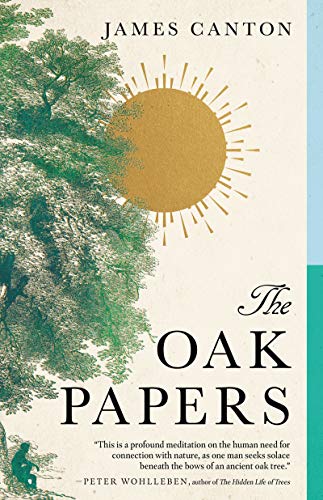
The Oak Papers by James Canton

These tender ruminations on oak trees, connections and possibilities will appeal to nature lovers, philosophers and seekers.

James Canton (Ancient Wonderings; Out of Essex) spends hours, days, months and years with one particular oak tree. Moved by its power and continually fascinated by its individuality, Canton undertook a study of the connection between oaks and people. After consulting history, mythology, spirituality, science, a number of individual woodmen and -women, and more time spent in the company of oaks, he offers The Oak Papers, part personal reflection and part research project.

The Honywood Oak, at the Marks Hall Estate near London, draws Canton in. During a period of personal turmoil, he finds himself sitting under this massive 800-year-old tree, “a mere sapling when the Magna Carta was signed.” He watches birds and insects and hares, and the changing seasons; he finds himself returning just to spend time with the Honywood Oak: “I sit on the bench and wonder a duality of desires: to care for the oak and to be cared for by the oak.” He feels a healing effect. Canton’s more purposeful studies begin in the company of the estate’s “curator of trees,” and in his readings: Dante, T.S. Eliot, Pliny, Shakespeare, Woolf, Thomas Hardy, Gary Snyder and the legends of Druids and Green Men (and Green Women and Children). He gets to know the Honywood Oak in its fine details, and then individuals he calls the Field Oak and the Stag-Headed Oak. He meets with Stephen Taylor to discuss his Oak, a collection of dozens of paintings of the same tree.

“A few more leaves have turned to paler autumn shades like the grey hairs on a father not seen for months.” The Oak Papers is meticulous and dense with detailed observations not only of oaks–the seasonal variations in their leaves, buds and acorns–but of the lives they support: heron, treecreeper, wren, goldcrest, buzzard, stiletto fly, wood butterfly, mosses, lichen, hare, gall wasp. The bulk of these papers sees Canton sitting and watching, although he also recounts visits with people who know oaks well: artists and craftspeople who work with wood, spiritual thinkers, a psychologist who specializes in nature therapies. He lovingly concludes that “there are many paths to seeking the truths about oaks,” that “we all become better beings when we step back into the woods.”

Canton meditates on oaks while sitting in oaks, seeking greater understanding or to become the oak. He does not reach a conclusion by the end of these pages, but he gets closer.


This review originally ran in the February 5, 2021 issue of Shelf Awareness for the Book Trade. To subscribe, click here.


Rating: 6 details.

Hair by Scott Lowe

Man, this Object Lessons series has been really up-and-down for me. I’ve found some transcendent books (Sock, Souvenir), but also some that failed to impress. And now this: Hair pretty much kept me angry throughout. I really thought it would be a DNF, but I just kept reading. I think I was curious to see if it would get better or if this was really it. Also, these books are short.

Scott Lowe turns out to be interested in social customs, and religion in particular, at the expense of science, or the uses of hair as object, for example. And these Object Lessons are explorations of objects from whatever angles (generally multiple ones); no foul here, but if I’d realized that Hair was a relatively single-lens study, and that that lens was religion, I might have passed. This is not my greatest criticism, but it makes the whole thing a little less appealing.

My problem was that Lowe tries to be funny, and his humor I frequently found misplaced if not offensive. Did Bloomsbury read this book before they printed it?? I found him funny one time, and made 10 notes where his treatment of race, gender, and non-Western cultures upset me (in 125 pages). I wish I could get this time back. Luckily, only 125 pages.

For the record, I’ll give a few examples. Lowe takes the time to deconstruct the myth that Jesus had long hair. But does not address the fact that Jesus was not white, and thus his hair would not have looked the way it’s frequently depicted in our culture, no matter the length? The House of David’s long-haired men’s baseball team played (as spectacle) against a short-haired lesbian women’s team, and “probably the cleverest part is that the lesbians would openly cheat, spiking and elbowing the Israelite team and engaging in outrageous dirty tricks, with the calculated effect of turning the crowds’ emotions… [toward] the House of David team to sympathetic support. It must have been great theater”! What fun, hating on the lesbians together, har har! Also women with beards are good for a laugh. Women should be uncomfortable with their furs as sex appeal (but no mention of men’s roles in this whole setup). Juxtaposition of “we moderns” against the behaviors of “a friend from Ghana, who was raised in a modern, educated Christian family.” (Nobody caught this in editing?) And probably the number one reason I read this book to the end: I was in a sustained state of disbelief that Lowe was just not going to handle the remarkable world of Black Americans’ hair. “Rather than address African hair in general,” he deals with Rastafari and Nation of Islam in a whopping 7 pages, and brushes his hands together and moves on.

I’ll try another few of these, I guess: when they’re good, they’re so good! But I’ve been frustrated a few times now. And I’m paying for each volume. You’re on notice, Bloomsbury.


Rating: 2 angry-face emojis here.

A Shape in the Dark: Living and Dying with Brown Bears by Bjorn Dihle

A lifelong Alaskan inspires awe with his beautifully written, expert portrait of the grizzly bear.

Bjorn Dihle was born and raised in the outdoors of Alaska, where he has worked for years as a brown (or grizzly) bear viewing guide. A Shape in the Dark: Living and Dying with Brown Bears is his lovely, thoughtful study on the relationship between humans and this evocative, storied species.

“There have been times I almost hated bears,” he writes. “Like most feelings of hostility, mine were rooted in fear. Yet, there is no place I love more than grizzly country, and no animal has intrigued and challenged me more than the bear.” Moving around in time, Dihle tells his own stories of encounters, from the first brown bear he ever saw–a carcass in a salmon stream when the author was four or five years old–through early trailside meetings and learning how to relate to bears, into his career seeking them out, especially on Alaska’s Admiralty Island. “There’s no way to make bears safe,” Dihle acknowledges, which is surely part of their appeal. But there are measures, such as Larry Aumiller’s “concept of habituation, which he defined as taking away the fight-or-flight response in a bear, that’s key for developing trust between our two species.”

A Shape in the Dark is an appealing, accessible memoir and a history of the interplay of bears and humans in the American West. Dihle intersperses his own and his friends’ bear encounters with those of Grizzly Adams and Teddy Roosevelt, outlining the evolution of attitudes and policy toward grizzlies. In considering the writings of John Muir and Aldo Leopold, he reviews the history of wilderness thinking beyond bears, with a ruminative style and personal perspective. He writes of famous and less famous maulings, the complexities of bear hunting, the role of grizzly bears in native cultures and the impact of climate change on Alaska and its greatest predator.

Dihle’s title hints at something elemental about our fears and the way he handles them: “After a while, much like our ancestors who’d built fires to keep away the monsters, I opened my laptop and stared at the lit-up screen, hoping the words would come.” As his subtitle suggests, Dihle deals with life and death in balanced proportions, portraying the deaths of bears and humans with similar reverence.

Quiet, meditative, wise, well informed, A Shape in the Dark is memoir, history and philosophy in one: “everything leaves a trail, whether it’s imprinted in the land, in the narratives we tell, or even in our blood.” Dihle’s love for his subject is contagious and beautifully conveyed.


This review originally ran in the February 4, 2021 issue of Shelf Awareness for the Book Trade. To subscribe, click here.


Rating: 8 wigeons.

The Cambridge Introduction to Narrative by H. Porter Abbott

In stark contrast to the academic tome I recently undertook, this one was an absolute joy. (It was also much shorter.) I’ve been looking for something to help me understand my enjoyment of certain television shows, and went looking for a guide-to-narrative, which oddly (given my MFA) I seem to have skipped along the way. This book caught my eye as it claimed to take on various fictional formats, not only books but theatre, film, and television (among others). It delivered. I was often thrilled with the examples of the concepts it set up. And I’m now excited by narratology, or narrative theory. There may be more of these in my future.

I like Abbott’s broad approach, how he begins with narrative as it exists, ubiquitous, in our lives (as I tell my students that stories are everywhere, that writing is everywhere). He defines narrative broadly; at every stage he samples the literature and signals where he follows standard understandings or argues for his own. This book really does make an excellent introduction to a field of study; it’s only 213 pages (plus notes and supplementals), so it necessarily serves as a survey, but it felt very complete in that function. Chapters cover narrative frames and paratexts; masterplots and types; closure; narration (so much to explore!); interpretation (problems, styles, main types); adaptations across media (this is an area I’m very interested in); “narrative and truth” and the blurry space between fiction and nonfiction; narrative worlds; and competing narratives (as in political campaigns, legal trials, and more). I was constantly excited to recognize ways I think about stories and storytelling and the ways we experience stories, and to have my beliefs, theories, or experiences spelled out for me in new terms. I would never have thought a work of academic theory like this could be so gripping.

I was pleased to learn of Marie-Laure Ryan’s ‘principle of minimal departure,’ for our tendency to assume that a fictional world will mimic our ‘real’ one, until we learn otherwise. I appreciated a few small, apt examples of narrative differences as examples for my Short Fiction class. I loved all the examples of primary texts (narrative works that exemplify the concepts Abbott was teaching) and secondary sources (other studies of narrative on his various topics). I made note of a few books and movies to put on my lists. Abbott’s examples are disproportionately written by men, but by no means to the radical exclusion of non-men that so irritated me about Gardner’s work.

Call this a tantalizing foray for me into a new way to study and think about stories. This is great fun and I can’t wait to learn more.


Rating: 8 adaptations.

Gay Bar: Why We Went Out by Jeremy Atherton Lin

This superb, multifaceted book takes a close look at gay bars individually and as concept, in history and in the author’s life, tackling big questions with wisdom and grace.

Jeremy Atherton Lin brings a wise, wry voice to his masterful Gay Bar: Why We Went Out. This thoughtful study is part memoir, part research project, part travelogue and a large part classic essay-as-assay, seeking answers on the page. His subtitle indicates a wondering: Why did we go out? The answers are various; they change over time and of course are personal for Lin, but he progresses toward an understanding of what the gay bar really was, is and might be. “The question arises as to what distinguishes an enclave from a quarantine, and whether either is any longer necessary.” If gay no longer needs a bar, is this a victory, or a loss?

“A salon of effete dandies engaged in witty banter, a lair of brutes in black leather, a pathetic spot on the edge of town flying a lackluster rainbow flag for its sole denizen–one lonely hard drinker. Of course, a gay bar can be all these things and more.” Gay Bar is a personal history and a history in the traditional, researched sense: it relates Lin’s coming-of-age as well as a world of gay bars, from the scintillating to the sordid, dating back hundreds of years. Seven sections are devoted to locations–bars or neighborhoods–and represent epochs, both in Lin’s life and in the lifetime of the gay bar. Lin’s specific bars are located in London, Los Angeles and San Francisco, over the course of decades. He ranges through LGBTQ topics including protests, hate crimes, the gay rights movement, relationships with law enforcement, Stonewall and Harvey Milk, and gay-bar topics of sexual consent, music, booze, poppers and pills. Lin considers race, gender and class, and questions exploitation and appropriation. His broader subjects include community and identity, bar and nightlife culture, people’s relationships to place and more–this book has something for every reader.

Lin’s writing is consistently intriguing, descriptive and lovely: “the cranes and glassy high rises hover like chaperones.” As narrator he is by turns pensive, funny, self-deprecating, exasperated and reverent; he can be delightfully suggestive. “A pipe spilled chlorinated water. The brickwork had grown mossy down the length of its trajectory, like a viridescent trail-to-adventure on the building’s belly.” Gay Bar is enriched by the voices of others–thinkers in history, philosophy, literature and queer theory–but Lin never loses his own. This exploration is personal, deeply researched, smart and essential.


This review originally ran in the January 29, 2021 issue of Shelf Awareness for the Book Trade. To subscribe, click here.


Rating: 8 mirrors.

Frames of Mind: The Theory of Multiple Intelligences by Howard E. Gardner

This is a long review of a big, fat, dense book, not particularly a fun read. But I’ve been intrigued and fascinated by the theory of multiple intelligences for years – I think my mother introduced this to me when I was a little kid. I’d read about this theory, but I’d never read Gardner’s own work; I finally decided it was time.

He has written many books, and he’s published books since this one on the MI theory (Multiple Intelligences; Intelligence Reframed), but I chose to go to the original, in its updated form. Frames of Mind was originally published in 1983. My edition has a tenth-anniversary introduction as well as a first-thirty-years introduction; it was published in 2011. (Although published in ’83, Gardner notes he did the writing in ’81, then moved into revisions.) These supplements were helpful to put Gardner’s work in some perspective and keep in my mind the time period he was originally writing in.

I’m going to try to keep it as brief as I can. In a nutshell: I still find Gardner’s theory fascinating and instructive; his thinking about intelligence types informs the way I view people in our world to a large degree. It captures my imagination. Reading this book was definitely stimulating for me. But! it was also pretty frustrating to read, mostly because of his mishandling of gender. Gardner almost entirely excludes women from a discussion of intelligences (except, of course, where we may be of use as mothers to male children). It assumes strict gender roles to an extent that seems almost laughable in 2021. I have some concerns about his treatment of cultural differences, although he’s clearly making some good efforts, but I’m less confident in my criticisms in that area, so I’ll discuss those as concerns I’m not sure about, where the gender business was downright upsetting. As I said about Buried in the Bitter Waters, there is enough good thinking here that it needs and deserves a thorough editing (and in this case, a thorough rethinking), and a rewrite for modern times. In general, a little humility and openness to being wrong is probably healthy for all of us (myself obviously included).

On that note, Gardner is quite good at humility and openness to criticism when it comes to his psychological theory of multiple intelligence, his acknowledgement that the number and identity of intelligence types may need revision, and his easy confession that in some realms he’s not qualified to carry the theory any further. (For example, what this book is not is a prescription for educational theory or practice. This is funny because one criticism of Gardner that I’ve encountered is that his educational recommendations are faulty. Again, he makes none in this book. Although maybe he does so in later works.)

Let me back up and offer you at least a little bit of summary. (This will be minimal, and I’m in a bit over my head with the harder-science side, but there are excellent summaries elsewhere online if you want to go further.) Gardner posits that human beings do not have a single intelligence, in which individuals are more or less gifted, but rather we have a number of different intelligences, or competencies, which are independent of each other; an individual can be gifted in one or more, average in others, and below average in some. In this, his original work on the theory, he introduces and details seven intelligences, defending them in neurobiological terms and with some examples. They are: verbal-linguistic, logical-mathematical, bodily-kinesthetic, musical, interpersonal and intrapersonal (grouped together as the personal intelligences), and spatial. He is careful to separate intelligence from sensory abilities, so verbal-linguistic is not tied to hearing (and hearing-impaired and deaf people can be highly intelligent in this area), and spatial is not tied to vision (same story for blind people). In testing whether an aptitude qualifies as an intelligence under his theory, he requires that it involve a skill set that leads to the ability to resolve “genuine” problems or create useful products; that it also entail the potential to find or create problems; and that it have a biological basis, meaning for example that it be potentially isolated by brain damage. A short list of further criteria: the existence of prodigies; a recognizable developmental history and “end-state performances”; an evolutionary history; support from experimental psychology and psychometry; and “susceptibility to encoding in a symbol system.” Whew. Bookending chapters on each intelligence type are chapters on earlier views of intelligence (background of other theories and schools of thought); biological foundations (hard science, and hard for me); a critique of his theory; comments on the socialization of intelligences through symbolic systems; observations about how we educate to intelligences (observations, not prescription!); and thoughts about “the application of intelligences.”

As you may be concluding, Gardner here writes for an academic audience, in that classic, dry, academic style. Against his advice, I did wade through the “biological foundations” chapter (not that I got much out of it, but I’m a completist). It was a good reminder that psychology is brain science. I would love to see this book rewritten for a more general readership. I think I was hoping for more examples of intelligences in practice – hoping to recognize myself and my friends, family, acquaintances. My interest in this theory is absolutely about armchair-analyzing the world around me, so I was hoping for a slightly different type of book than this, but that’s my mistake; Gardner is clear that this is psych theory, not a which-kind-of-fruit-would-you-be quiz. I would have loved more case studies… and I wonder, is this about my desire for narrative, owing to my individual profile of intelligent types? I especially wanted more from the bodily-kinesthetic chapter, which included only two pages about athletes.

Gardner’s language is often dated. He uses ‘Eskimo,’ ‘victim of autism’ (and clearly sees autism as a tragic disability, when I think we’re pretty far from that mindset now), and ‘idiot savant.’ The use of ‘normal’ for individuals who are neither prodigies nor ‘subnormal’ feels a little wrong to me. And, “for ease of exposition the pronoun ‘he’ will be used in its generic sense throughout this book.” Guess how that struck me. I am aware of the argument that ‘he or she’ is just too much work, and/or too awkward, for regular use, but there are other, more elegant solutions to this problem than just assuming that EVERYBODY IS MALE. You can alternate between ‘he’ and ‘she’ from case to case. You can use ‘he or she’ sparingly (really, I’ve done it, you can). You can also slip into the singular pronoun ‘they,’ which is not a new usage at all, but dates back centuries. To read more than 400 pages of thoughtful and serious social science thinking in which ‘he’ does everything and everything happens to ‘him’ is belittling, offensive, and makes me feel not just left out, but as if I don’t even exist, or these theories don’t apply to me (more on that in a minute). Words matter.

While Gardner is able to cite women as scholars and researchers in his own and related fields (education, psychology, anthropology), he is almost entirely unable to name a woman as an example of one of his proposed intelligences. I noted just four, in these 412 pages plus notes: poet Sue Lenier, ballet choreographer Martha Graham, ballet dancer Suzanne Farrell, and Eleanor Roosevelt (for the personal intelligences, held up alongside Socrates, Jesus Christ, and Mahatma Gandhi). By comparison, his male examples number in the hundreds. His chapter on verbal-linguistic intelligence names 35 men who impress him, and just the one woman: Sue Lenier, who he calls the “possessed poet” for her methods which have been criticized (so that the one woman in that chapter, and one of just four in his whole book, has her intelligence qualified, as if her poems aren’t really her own work after all). Representation matters. I am left with the clear impression that Gardner doesn’t think I could possibly be intelligent in any of seven ways. Yes, it was 1981 when he wrote this book. But some men had already figured out how to see women as people in 1981, so Gardner does not get a pass.

Gardner’s belief in clear gender roles, then, will not surprise you. The development of infants falls squarely on their mothers, and mothers are the only ones capable of playing certain roles in the lives of their infants. (Finally, something women can do.) The chapter on the personal intelligences is far too bound up in a gender binary. I am not extremely well read in gender theory, but I am not sure I buy the strict gendered division of labor and personality going back to prehumans that he sets up. I know that nonbinary gender expressions are not the brand-new item that some would have us believe now, but appear in early and traditional societies as well. I know same-sex couples raising children in exemplary fashion. I think, as a psych theorist, that Gardner is missing some significant pieces of the puzzle here.

When it comes to other cultures, I’m on even shakier ground. And I do want to acknowledge that Gardner’s made an effort to find and examine a variety of cultures, societies, educational systems, and ways of recognizing, valuing, and ‘using’ intelligences in different cultural settings; that is important work and involves his awareness that Western culture is not the only or necessarily the best culture. Sometimes his conclusions feel a little unsure to me, but my expertise on cultures other than my own (let alone in terms of sociology, anthropology, pedagogy, psychology, etc.) isn’t sufficient for me to pick Gardner’s work apart. I did find myself wondering if he wasn’t being a little reductive sometimes, though, as in the stereotypes about Japan and China, for example.

I know I’ve devoted a lot of this review to my criticisms, but these oversights in Gardner’s writing and his perspective on humanity 1) were distracting to me as I tried to take in the theory and 2) make a substantive difference in his theory, because how can one understand human intelligences if one (for example) overlooks half the population??

As a theory, Gardner’s work continues to fascinate me and to inform a lot of my thinking. I am very glad I put in the effort (and it was an effort) to read this book. As a book, it was fairly obnoxious. But as a theory, it is intriguing and evocative. I hope somebody takes on the rewrite someday, and finds some non-men to think about. Who knows–we might learn something.


Rating: 7 puzzles.

Solutions and Other Problems by Allie Brosh

I used to follow Allie Brosh’s blog, Hyperbole and a Half. (I always loved that name.) I did not read her first book, by the same name, but I love the blog. This is her second.

Solutions and Other Problems is brilliant. Brosh is so vulnerable, honest, willing to share, and hilarious. Her openness is disarming and I think healthy both for her and for her readers who are comforted by knowing that they’re not alone in their struggles. And some of what she has to share is raw and painful. But also, she makes me laugh harder than almost anything, ever. I mean I laughed until I cried, gasping, couldn’t breathe, peed on myself. I was oxygen-deprived; she nearly killed me, I laughed so hard. (The funniest bits, for me, are anything about pets, and the chapter about the car stereo system and the smartphone trying to boss her around.) I would love to be able to spend a few minutes every day laughing this hard. I guess I need to re-follow her blog.

This is a graphic work – as in graphic novel, but nonfiction. A graphic memoir-in-essays, if you will; it’s not linear, but a sampling of experiences that have been especially funny or painful or moving. Because she jumps around so much and generally gets a little silly (in all the best ways), I thought it was neatly appropriate that (as noted by a brief “Explanation” following chapter 1) Brosh’s chapters are numbered but there is no chapter four. “Because sometimes things don’t go like they should,” she explains, and because she’s exercising a little power here, and we should be grateful she didn’t take it further than she did. It’s a random little bit of ridiculousness; but it’s also expressive of the kind of fun and angst I think she excels at.

Brosh’s illustrations are also a little ridiculous, fanciful, hilarious, and distinctive. I love them. She explains the world as she experiences it, in part, through fictional monsters and fantasies. Her drawings capture the mystery and awkwardness of life in a way that feels precisely right. (And I think she has dogs down pat.) (The Oatmeal‘s pretty good at this too.)

At one point she notes,

Experiencing real loneliness for the first time is like realizing the only thing you’ve ever loved is your home planet after migrating to the moon.

and I think that’s just perfect. I recognize this feeling. I had to migrate to the moon to find out just how place mattered to me.

I find Allie Brosh’s work comforting, as well as so funny that it leaves me a little breathless and wrung out. I recommend her so strongly, and I guess I need to go back and find the first book now too. Thanks, Liz, for the recommendation.


Rating: 9 sneakponies.