“A Native Hill” by Wendell Berry

In preparation for an upcoming visit to Kentucky, and because he appears everywhere around me and I have not devoted the time yet: Wendell Berry.

More than a year ago, my father bought me a copy of the new collection, The World-Ending Fire, selected and with an introduction by Paul Kingsnorth (who I do appreciate). I regret that I have not made time for it yet; and it’s currently boxed up in a storage unit (along with so many other excellent books) and unavailable to me. But Pops still set me up with some reading, beginning with an email explaining his selections, and outlining some of Berry’s major themes: sense of place; tragedies of American history; the urban-rural divide; humility; soil; honest work; naturalism; spirituality. Then he had me read Kingsnorth’s introduction to the new collection, and one noteworthy Berry essay: “A Native Hill.”

As an overall, obviously I appreciate Wendell Berry. All the right ingredients are there: strong attachment to place, defense of the land, argument against larger society, thoughtful, lovely prose. I had always assumed I would appreciate Berry. Also, I’ve heard that he can be difficult, and dated. Kingsnorth notes in his introduction that Berry’s writing technology of choice is, firmly, the pencil: I have no problem with tried and true technologies (recall Boyle). But I am a bit pricklier about gender and race, for example. Berry (like so many) uses “man” to stand for all humanity. And he is still using “Negro” in this essay, which admittedly was published in 1968. But one notices these things, in 2019.

This reading didn’t surprise me much, then. I found a few things to quibble with, which I will lay out below. But overall, I’m going to keep reading and appreciating this man, while reserving the right to quibble.

Here are a series of quotations I marked as I read, which I’m going to let stand as my review.

Why should I love one place so much more than any other? What could be the meaning or the use of such love?

Way to jump right in and steal my heart. Why, indeed? You, faithful blog reader (thank goodness for you), know how much place matters to me as a reader and as a writer. It consumes my thoughts and dreams.

About the truism that “you can’t go home again”:

But I knew also that as the sentence was spoken to me it bore a self-dramatizing sentimentality that was absurd. Home–the place, the countryside–was still there, still pretty much as I left it, and there was not a reason in the world I could not go back to it if I wanted to.

Well lucky you, Berry, but you do realize not everyone has the luxury of this experience? The places that are left untouched from our childhoods are fewer and fewer. Mine is not still there pretty much as I left it, at all. Dog help us, they tore down Fitzgerald’s.

What… made the greatest difference was the knowledge of the few square miles in Kentucky that were mine by inheritance and by birth and by the intimacy the mind makes with the place it awakens in.

Again, lucky you. And hey, I am lucky that my parents will almost certainly leave me some piece of land, but it’s not square miles, and it’s not something I was born to; it’s something they bought later in their lives and that I admire but do not feel especially close to; it’s not where I grew up. (Not for lack of effort, on my part or theirs, to make this place feel like home.) Some of these ideals are easy to live when you’re born with the right set of circumstances, hmm? And what would you say to someone whose inheritance, birth, and intimacy lay with the heart of New York City?

I had made a significant change in my relation to the place: before, it had been mine by coincidence or accident; now it was mine by choice.

and

In this awakening there has been a good deal of pain. When I lived in other places I looked on their evils with the curious eye of a traveler; I was not responsible for them; it cost me nothing to be a critic, for I had not been there long, and I did not feel that I would stay. But here, now that I am both native and citizen, there is no immunity to what is wrong. It is impossible to escape the sense that I am involved in history.

These I feel, too, with regards to Texas.

And so here, in the place I love more than any other and where I have chosen among all other places to live my life, I am more painfully divided within myself than I could be in any other place.

Because of the quotation directly above: no place we love will ever be perfect. Kentucky and Texas have their share of sins, but if one of you lives in a place that never did harm, throw your stones now.

A path is little more than a habit that comes with knowledge of a place. It is a sort of ritual of familiarity.

By contrast, a road:

Its aspiration, as we see clearly in the example of our modern freeways, is to be a bridge.

I appreciated his medium-deep dive here into paths, trails, roads, bridges, what they mean physically and metaphorically. Trails matter to me; and they make an excellent metaphor.

The pristine America that the first white men saw is a lost continent, sunk like Atlantis in the sea.

I worry about this, as another form of deifying the past, or in this case the Native Americans. Were they really doing this world no harm? I admit to the same prejudice Berry shows here, thinking that no, they did no harm. But now I wonder if that’s true? It reeks of romanticizing what we don’t understand.

It is as though I walk knee-deep in its absence.

A lovely line; I think we all know what it is to walk knee-deep in an absence of some kind; also, I’m almost certain this line was referenced by Matt Ferrence, which endears it to me again.

Near its end, this essay reminds me of Scott Russell Sanders, specifically the hawk that closes “Buckeye.” The final section of Berry’s essay offers a series of short, nearly prose-poetry segments. Third from last of these is an event that proves, for Berry, that nature knows not only peace by joy. It stars a great blue heron (parallel to Sanders’s red-tailed hawk), a bird that is important to me personally: it’s probably the first bird I learned to identify on my own, an easy one, since it’s both large and distinctive; and they have been present in many of the places I’ve traveled in this country, remote and far-flung, as well as in the urban setting of my hometown of Houston, where I used to see them fishing in the early mornings along the bayou in the Texas Medical Center as I walked from car or train station to work. This bird Berry describes as measured, deliberate, stately, “like a dignitary,” stately again – I agree on all counts – and then he sees it turn a loop-the-loop in the air, exultant, “a benediction on the evening and on the river and on me.” This transcendent moment – and Berry’s powerful prose – affected me deeply.

And then, one evening a year later, I saw it again.

Wow.

I do recommend this essay by Berry, and I will be reading more of him – though I may have to dig through that storage unit to do so.

I could not close without referring you, as Pops referred me, to “The Peace of Wild Things”. I had encountered this poem before, but Pops points out that it’s published the same year as “A Native Hill,” and condenses and distills much of the essay’s feeling. It’s worth another look, no matter how familiar you are.


Rating: 8 threads of light and sound.

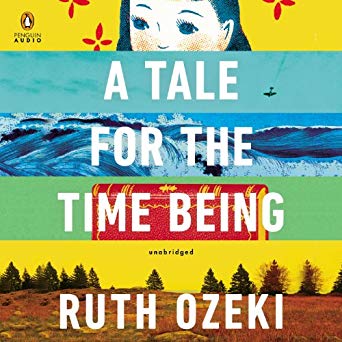
A Tale for the Time Being by Ruth Ozeki (audio)

A time being is someone who lives in time, and that means you, and me, and every one of us who is, or was, or ever will be.

My mother gave me this audiobook for my birthday. With her own print copy ready, we set out to read together. She had already very much enjoyed the audiobook. Now I’ve finished, and she hasn’t yet, so we haven’t done our final debrief together; but we have discussed as we’ve leapfrogged down the middle.

A Tale for the Time Being is unusual in a few delightful, fresh ways. The opening voice is that of Nao, a sixteen-year-old girl living in Tokyo. (In this time-obsessed novel, you can bet her name is a meaningful homonym.) Nao is Japanese but has lived most of her life in Sunnyvale, California, and the recent move to Tokyo has been very hard on her. She is the victim of criminal bullying at school, and has decided to end her life, but before she does, she wants to record the amazing life of her great-grandmother Jiko, a Buddhist nun and radical anarchist feminist. She sets out to do this in a diary. The diary is being read by Ruth, a novelist living on Canada’s west coast on a remote island with her husband Oliver and their cat, named Schrodinger but more commonly called Pest, or Pesto. (Ruth’s life matches that of author Ruth Ozeki suspiciously closely.) Ruth found the diary and a few other artifacts, well-wrapped in a barnacle-encrusted ziploc bag, on a beach near her home: the beach near Jap Ranch, as she calls it, her own Japanese heritage giving her the right and motivating her to remember the mistreatment of her people during World War II in these parts. (Oliver, who is of German heritage, cannot call it Jap Ranch.)

The story is told in alternating sections, in Ruth’s present and in Nao’s diary-recorded recent past, and then supplemented by other artifacts: documents found with the diary, and Ruth’s email correspondance as she begins searching for Nao in the present. There are several voices, then. And in several senses: there is the narrative first-person voice of Nao in her diary; Ruth’s perspective, told in third person; and then there are the voices as recorded in this audiobook. The author reads her book herself, which I love, and she does a lovely job of performing her set of characters. Oliver is stoic, a man of intellect and not emotion. Ruth is pensive; their neighbor Muriel is a bit nasal-y, and a bit annoying anyway. Nao is whimsical and impatient, sometimes immature and sometimes resignedly dour: a teenager indeed. The audio performance is absolutely perfect. It’s always comforting knowing we’re hearing the voices the author does.

The story expands and swells like a less well-packaged diary would have done in the ocean waters… We learn about Nao’s family, her depressed and defeated father, her no-nonsense mother, the deeply loveable Jiko, and more. It turns out that there is a thread of suicidal thoughts in her family: her father makes several suicide attempts, which they do not talk about; and his uncle, Nao’s great-uncle, died as a kamikaze pilot in WWII. Call that a reluctant suicide, perhaps. Three generations, then, dealing with tendencies to suicide in very different ways and originating in very different places. Meanwhile, Ruth’s family includes a now-dead mother who had Alzheimer’s but experienced a relatively sweet decline; Oliver is a decidedly quirky but, I felt, very likeable guy. He is a self-taught naturalist seeking to replant a preserve on their island so as to weather climate change. Even Pesto the cat plays an important role.

As the title indicates, this is a story about time, about moments, about whether we control the past or the future or even the present. As in the quotation that heads this review, the phrase “time being” takes on a new meaning here, in Nao’s dreamlike, imaginative ruminations. Ruth and Nao are both distant and very close together; the question of how far or near takes on a mystical quality, as Ruth worries if she is going crazy (or developing her mother’s disease – a worry I’ve seen in people I know too). Under Oliver’s wise guidance, even quantum physics comes into play late in the book, where I got quite lost but I think (hope) that I followed the ideas, the feeling of mystery and wonder.

Ruth Ozeki is a remarkable writer. This tale is multi-layered: mental health, the bendiness of time and space, linguistics (Japanese and English and also French, the bendiness of language, too), literature, and the love and personalities of animals… there is something here for everyone. For example, I thought of my father every time Oliver worries over the trees he’s planted in the preserve. Technically, the species he’s chosen violate the covenant of the trust because they are not native to the region; but he’s planted them for the climate-changing future, when species move north, and he’s put great thought into his choices, and the idea of destroying them is indeed heart-breaking. This issue is glancing within the book, but clearly opens up into something large and thought-provoking and timely – qualities that apply to every aspect of A Tale for the Time Being. Add to all of this Ozeki’s pitch-perfect performance, and I can scarcely recommend this audiobook highly enough.

And speaking of bendiness, consider the similarities between the author Ruth and the character Ruth. Of course I have 100 questions about their boundary lines. And what of Nao’s washed-up diary? What is its real-world equivalent? There are some mind-expanding puzzles here to be sure. It’s delicious.

Note: Ozeki (as herself) comments at the end that the print version includes footnotes, illustrations, annotations, and appendices. She appreciates the audio version very much for some reasons – she writes for musicality and sound, and loves its immediacy – and the print for others. Hopefully my mother, who is finishing the print version now, will have some thoughts to share with us about those differences. I suspect audio first, followed by print, is the right order.

If you love cats, trees, or people; if you’re interested in history and legacy, the power of words, or the questions posed by the passing of time – then this delightful, expansive novel is for you.


Rating: 9 crows.

The Gentle Art of Tramping by Graham Stephen Graham

From day to day you keep your log, your day-book of the soul, and you may think at first that it is a mere record of travel and of facts; but something else will be entering into it, poetry, the new poetry of your life, and it will be evident to a seeing eye that you are gradually becoming an artist in life, you are learning the gentle art of tramping, and it is giving you an artist’s joy in creation.

I wish I could remember where I heard of this book; it’s been some time, and I know I did some searching before finding my copy, from Budge Press. I’ve had it for years. I did find a hint, late in the book: a references to Richard Jefferies’s The Story of My Heart. Perhaps the recommendations for each were linked? At any rate, I finally decided it was time to read it during my own travels, though I am no tramp because I have a van and do not go on foot. (I suspect Graham would be disgusted.)

I opened this book quite blind, and not having heard of Graham Stephen Graham, although he turns out to be quite prolific (read here) with some 34 books to his name, whew! All that biographical data is not within these pages, though. All you learn from The Gentle Art of Tramping is that Graham is a passionate tramp, or walker-wanderer. (“One includes in the category ‘tramp’ all true Bohemians, pilgrims, explorers afoot, walking tourists, and the like.”) He loves sleeping outdoors, eating and living simply; he finds this lifestyle to be a high art form, and he is well-read and often eloquent, but would be unhappy within the walls of classroom or library.

This book offers an engaging mix of practical advice (how to choose a bed for the night) and poetic or passionate holding forth (the joy of, as Graham writes, sleeping à la belle étoile). There is no question how strongly this narrator believes what he writes; he positively exults in drying off by a fire after getting thoroughly soaked. (He is surprisingly exultant in the soaking, too.) He gives medical advice, though questionable: “a waterproof worn over wet clothes is a sure way to cultivate rheumatism. The damp cannot escape outwards – and so goes inward to your very bones.”

He waxes especially elegant about fire-building.

The fire in the rain is a triumph; the night fire in darkness under the stars is the happiest, but it disputes happiness with the dawn fire.

I love to see the blue smokes crawling upward in the dawn, while, with bare legs, one struts about doing the domestic work of morning out of doors. It is part of the very poetry of the tramping life. You give a proper affirmative then to Browning’s

Morning’s at seven
All’s right with the world.

Graham is much concerned with reading and writing while one tramps. He writes that “it is in description that the keeper of a diary becomes artist,” and he does some lovely describing, as in a chapter on what he calls the “zigzag walk,” where you take the first turn the the left and then the next first turn to the right, alternating, and exploring a city in this way. (Cities get their own special treatment, although Graham, of course, favors the countryside and the wilderness.) I love more his pith and cleverness, though. His explanations of how to make coffee and what to eat are interesting side notes, but it’s his life philosophy and turns of phrase that capture me best. Here, a series of quotations to illustrate.

The best companions are those who make you freest. They teach you the art of life by their readiness to accommodate themselves. After freedom, I enjoy in a companion a well-stocked mind, or observant eyes, or wood-lore of any kind. It is nice sometimes to tramp with a living book.

All books are worthwhile; perhaps especially the living ones?

If manners could be improved we should more easily get into sympathy with ‘foreigners’; if they could be perfected there would not be any foreigners.

Lovely. Although Graham does indulge in stereotypes, none were especially negative; I found these easily forgiven (this book originally published in 1926), especially with this line to wrap them up. He is remarkably well traveled, and has thoughts to offer on many countries on several continents; sometimes (unavoidably) this information is overly simplistic, but it’s interesting to see his perspective. He is especially well-versed in Russia, where he claims to have tramped several thousand miles.

Atlases are not so good. You have to take them down from a shelf and consult them. Wall maps spare you the trouble; they consult you.

Who doesn’t love a map that is consulting you when you’re not looking?

And, in answer to that other book that I guess I’m still irritated about, Graham on class:

Class is the most disgusting institution of civilisation, because it puts barriers between man and man.

Leaving aside the ‘man’ usage (again, dated), another fine philosophy.

I found this book a slow read, but I’m not sure why; perhaps a low point in the cycles of my own attention span. Graham certainly rambles on the page as on the land. And some of his how-to advice is either obsolete, or personally irrelevant; and I am not at all convinced of the joys to be had in getting totally soaked in a deluge, while hiking or while sleeping, thank you very much. But clearly there is much to be loved, and consulted at length, in these pages. I do recommend.

I will end as Graham ends, with his final, ecstatic paragraph.

I am still on that zigzag way, pursuing the diagonal between the reason and the heart; the chart could be made by drawing lines from star to star in the night sky, not forgetting many dim, shy, fitfully glimmering out-of-the-way stars, which one would not purpose visiting. I said we would not enter a maze, but we have made one and and are in one, a maze of Andalusia and Dalmatia, of Anahuac and Anatolia, of Seven Rivers Land and Seven Kings. The first to the left, the next to the right! No blind alleys. A long way. Beaucoup zigzag, eh!


Rating: 7 coffeepots.

The Way Home: Tales from a Life Without Technology by Mark Boyle

This memoir about living off the grid and tech-free in County Galway will inspire, connect and slow down the most impatient of readers, and that is a very good thing.

Mark Boyle was The Moneyless Man in his memoir of that title, about the first of three years he spent living without money. The Way Home: Tales from a Life Without Technology covers another first year: Boyle has now made the shift to a life without modern technology in County Galway, Ireland. What is modern technology? Obviously, definitions are complicated, but for Boyle his new way of living means hauling his own water; fishing, foraging and gardening for his food; making his own beer and wine; and traveling by bicycle, by hitchhiking and on foot. (He beats himself up about monofilament fishing line but, within the book’s timeline, has not yet found an alternative.)

Organized as the diary of a year in its four seasons, The Way Home is a thoughtful study, often wise but always questioning and seeking. With frequent references to Edward Abbey, John Muir, Aldo Leopold, Robert Macfarlane, Wendell Berry, Henry David Thoreau and others, Boyle places himself in a grand tradition of intellectual naturalists and thinkers. He also makes repeated forays (both literally and in imagination and research) to Great Blasket Island, an unusually literary place where a technology-free lifestyle only recently ended. He aims to query every decision, investigate its outcomes: while writing this book using a pencil, he stops to consider the making of that tool–its wood and graphite and paint, the extraction of these materials and the transportation of the workers who made it. Boyle, stymied by the ecological impact of such a simple technology as a pencil, is a former vegan who now eats fish and venison. He is a man willing to rethink his outlook.

Boyle has a sense of humor as well as a deep sensitivity to the needs of people as well as the planet and its ecosystems. “Rome,” he reflects, “wasn’t demolished in a day,” as he gardens with the (plastic) tools available and plans for the future. His writing style is pensive and unhurried. His lifestyle is in many ways “slow,” as in slow food and slow transportation, and he observes that writing by hand after a longtime addiction to computers has slowed his thought processes, for the better. “Just as carpenters always recommend measuring twice and cutting once, I’ve begun thinking twice and writing once.”

The result is a deeply appealing examination of nearly all aspects of modern human life, by a thorough, careful, concerned narrator. Readers already considering various forms of disconnection from modern technologies–in favor of a reconnection with local plants, animals, soil and people–will be goaded and inspired. Those less attracted to composting their own feces will nonetheless be entranced by Boyle’s unusual lifestyle, and perhaps moved a little closer to the earth.


This review originally ran in the March 5, 2019 issue of Shelf Awareness for the Book Trade. To subscribe, click here.


Rating: 7 scythe blades.

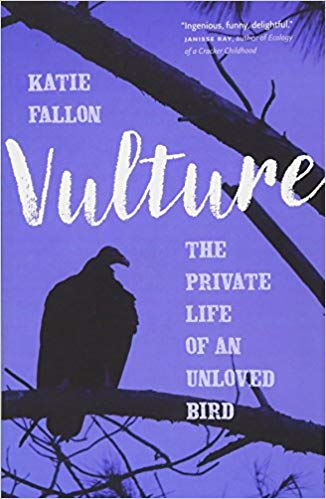
Vulture: The Private Life of an Unloved Bird by Katie Fallon

Disclosure: Katie Fallon was my first semester advisor at WVWC, and is a friend.


I have been looking forward to reading Vulture for years! I read Katie’s Cerulean Blues first, because Vulture was still awaiting publication; but if I’m honest, the bigger bird is the one I’m more naturally drawn to, and I know the turkey vulture was Ed Abbey’s favorite bird and all. I was really looking forward to this one.

And it had all the pleasant notes offered by familiarity, because by now I’ve heard Katie read from it a few times, so certain passages felt like old friends; and the personal content was familiar as well, because I know Katie personally (the names of her three daughters, for example, although only the first two come along within the timeline of this book). Reading this therefore felt a little like coming home, and you know how I like to feel at home in a book.

This is a book about vultures: the world over, but in particular the turkey vulture, which is Katie’s own favorite. It is also a personal memoir, about the author’s own life and coming-to-terms. As she considers the vulture’s place in mythology and historical relationships – often including associations with women and with motherhood – and observes vulture mothers caring for their young, she experiences her own much-desired first pregnancy. The places she goes in her own life, both geographically and emotionally, mirror the places she takes her reader in relationship to her subject. Along with her husband Jesse (a veterinarian specializing in birds), she travels to real-world locations in search of vultures: Hinckley, Ohio, for their “Return of the Buzzards” celebration; Pennsylvania’s Meadowcroft Rockshelter and Hawk Mountain Sanctuary; the Grand Canyon; India’s Hill of the Sacred Eagles; Gettysburg; and more. She also visits with an impressive array of vulture experts worldwide. This may be a beginner’s or introductory version of the vulture’s story, but it is also an authoritative and detailed one.

The book hits what I feel is a perfect balance between personal content (Katie’s life, family, and personal reasons for vulture adoration) and scientific. I remember Katie telling the story of (gulp) reading online reviews, the user-generated kind on Amazon and Goodreads and whatnot, and being bemused to see that everyone with negative feedback either found it had too much science or too much personal: in other words, they wanted an absolute, a commitment to one side or the other of that spectrum. This was funny to me because I thought her balancing of these two elements was perhaps the book’s most graceful accomplishment. Can’t please them all, can we.

For a final element, she adds a touch of speculation about the vulture’s inner life. Each chapter opens with a brief, italicized (and illustrated) paragraph featuring an imagined vulture at the center of the book. I found these so lovely, and a beautiful contribution. (Somewhere out there another reviewer is complaining that they ruined everything, I’m sure.) Katie occasionally anthropomorphizes within her chapters, too, but always with self-awareness and some hesitation: here is what she might be feeling, Katie might muse, even while acknowledging that birds are not people and this speculation is perhaps silly – but also natural, I think. Don’t we all anthropomorphize the animals we love best?

I’d like to close this review with a snippet of the final italicized from-a-vulture’s-eyes section.

She knew the seasons in her bones. She felt the length of days, the sun’s movements, the changes in the winds. Knew the smells of mud, gasoline, fish, rot. Knew palms, aspens, oceans, deserts. All were reborn in her, all connected. She held the whole world in her eyes.

Recommended.


Rating: 7 backpacks.

Little personal crossover: I’ve been keeping notes on a few birds over at my van-travel blog.

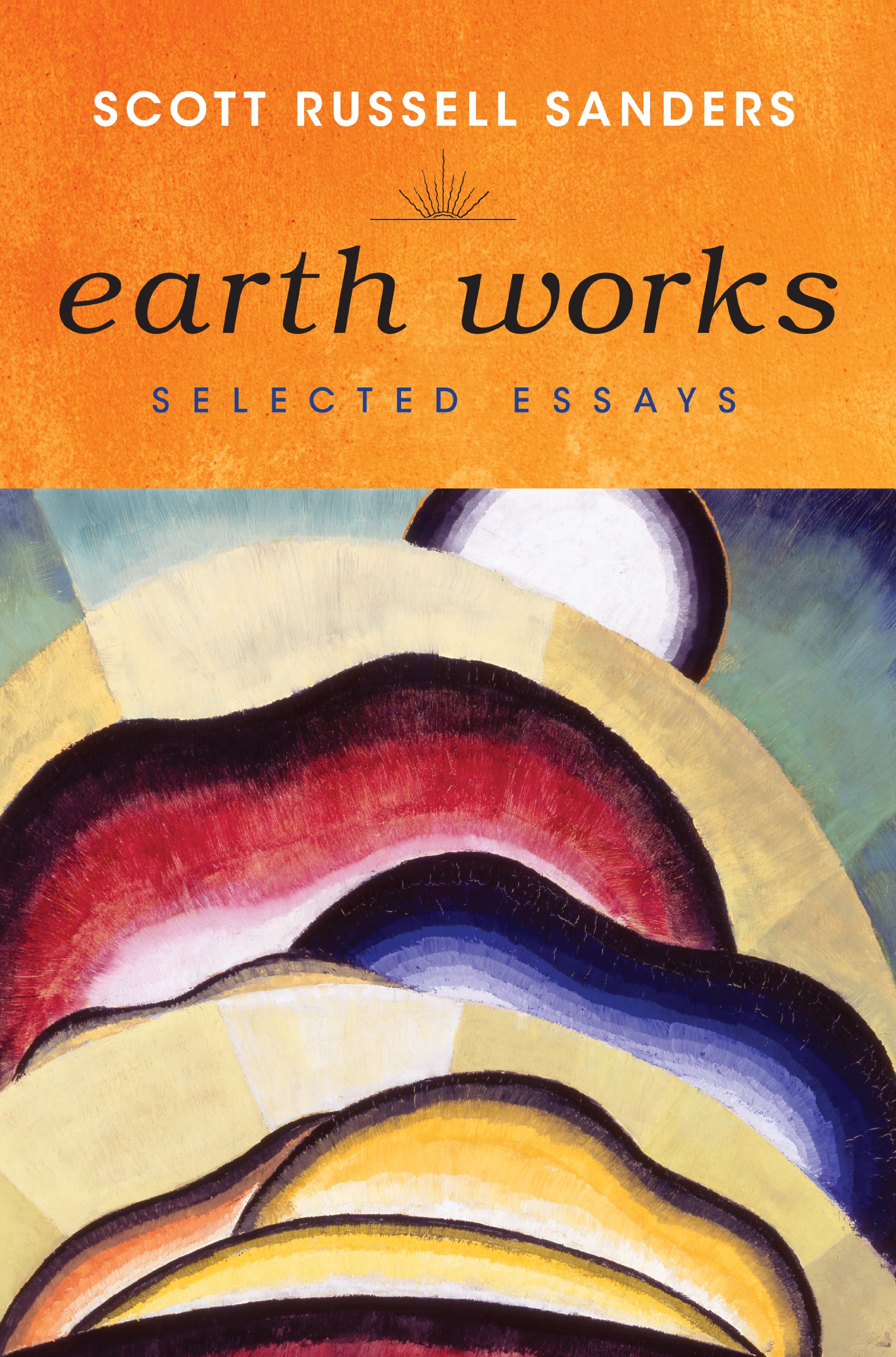
guest review: Earth Works by Scott Russell Sanders, from Pops

I originally reviewed Scott Russell Sanders’s Earth Works in two parts. I also sent a copy to my Pops, because I felt he needed it. I’m glad to have heard back from him now.

Thanks for the book! A few weeks ago I finally dabbled my way through the whole thing. At first I expected to read only those essays that were new to me; but I found the continuous approach irresistible.

As did I, on both counts, actually. A well-organized collection, then!

I blame summer rather than Sanders for taking this long, but Sanders deserves some credit for all the time I took in contemplation and consideration. This collection is indeed challenging in its range and subject matter, but mostly for Sanders’ unguarded candor and intimacy. He is quite simply baring his soul; whether we choose to appreciate what he has to say is up to us. In other words, I had to remember ‘how’ to read him, accepting the variety of both subject matter, and the responses he may arouse for the reader. The wide range of those things is central to the attraction, I think. He is boldly and humbly naked in his writing.

Which is why I wanted to respond to your ‘part one’ blog comments here, because I got as far as “The Men we Carry…” and wish to rise, not to defend him, but explain my reading of it.

Actually, there is no defending, and you did an excellent job of explicating that. And we still don’t know if he has reconsidered his words here. But as I read the essay, his Preface words were fresh in my mind; you quoted those briefly, but here a bit more complete, with my emphasis: “I have refrained from making significant revisions, allowing the essays to remain, for better or worse, essentially as they were when they appeared in print.”

As I suggested earlier, this candor, with all its risk and embarrassment so well exposed, is part of the masala, the potpourri – and the challenge – of reading Sanders essays. In some others earlier, he has already disappointed, frustrated and angered me; I am now unsurprised. I have resolved to consider time and place and context, accept it as material helping me understand this complicated and flawed person (as are we all), whose thoughts I am now invested in.

It’s the difference, if you will, between reading to examine what’s inside an author’s head, versus critique or enjoyment of content only. Increasingly, as my reading has become more intentional, it seems to lean towards the former, while I still enjoy the latter.

Mostly, I appreciate how such dissonance inspires me to better understand my own thoughts and values – for better or worse. Your own thoughtful response to his mansplaining is perhaps an example, with your values now in print with such clarity.

Pleasantly, with Sanders his best are still very rewarding.

FYI: By the numbers:
There are 30 essays here, covering 3 decades;
21 were published in other collections, the others only in periodicals;
I marked 12 favorites out of the lot, including 7 that I had already read elsewhere (including 3 of the 4 from Staying Put.)
But I read every single one, for a complete journey. Favorites tended to be most personal about family and father; nature and its human impacts; existential questioning. Interestingly, the ‘others’ tended to be similar ground but pursued in excess, taking me a bit over the edge, and often simply too personal and intimate – or dissonant.

I love a good numbers round-up, so thanks for that last section!

Glad that my comments made sense to you (I’m not the least bit surprised). From a distance now of nine or ten months, I remember this collection as a whole and as a reading experience, rather than in its particulars, and that overall impression is positive: I would say I like Sanders very much. But I do remember the essay that upset me, too.

The point you make in quoting the Preface is well taken, and I’m glad he made that statement. But I guess the distress and anger I felt in reading that essay was strong enough that I think it should have warranted a response from him – maybe let the essay stand as originally published but write an addendum, letting us know how wrong he got it and how much he’s grown and learned. If Sanders were reading this, that would be my request of him: republish; but now respond to your own writing, too. Well, I won’t hold my breath, but as you said, I’m glad I have gotten my own response out there, however small my platform.

I think there is an ongoing question of how to handle writings that seem wise in many ways but require of us that we make allowances for attitudes like racism, sexism, colonialism, classism, etc. and on and on. To what extent do we accept that something is “dated” and still find a way to enjoy it or to find value? I keep reminding myself that in every era somebody has been enlightened enough to see past the values of the time. It’s something I’m still doing battle with, myself. (Stay tuned, one of these days, for my troubles with Wendell Berry.)

Thanks for yet another thoughtful guest review, Pops.

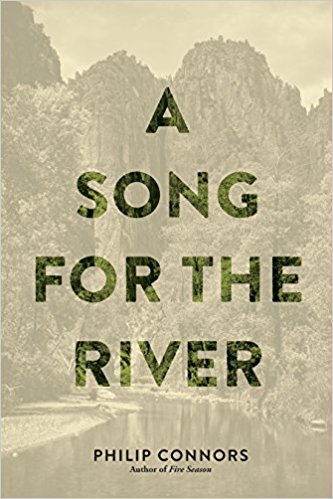
A Song for the River by Philip Connors

Today a simple repost of my review from back in June. Philip Connors’s A Song for the River was released yesterday, and you should get yourself a copy.

Connors writes,

On one quiet stretch of water I looked up at the tiered mesas above us and felt it might be true that my life was both a fire and a river, depending on the moment and the vantage from which it was viewed–and never more like a river than in moments like this.

My review, again, is here. Thank you.

A Song for the River by Philip Connors

Philip Connors’s first book, Fire Season, changed my life and the way I thought a book could work. I’m still reeling. I need to find time to reread it someday.

His second, All the Wrong Places, worked on me differently but still impressed.

Along the way I got to meet the author and consider him a friend, although not one I’ve kept in touch with closely in the last few years. His new publisher’s email about a third book actually caught me by surprise–very, very happy surprise. I was of course thrilled to get an advanced reader’s copy, in exchange for my honest review (although I can’t at this point claim I’m unbiased about Phil’s work).

A Song for the River is a sort of sequel to Fire Season. In one sense, it’s a third memoir, and therefore refers to the events of the first two books, because all three track the life of an individual. But they do more work than that, too.

Fire Season was about the narrator’s work as a fire lookout in the Gila National Forest. It’s a personal story, a memoir, yes; but it’s also about the history of fire management in the United States, the flora and fauna of one mountain in one forest, about solitude and philosophy and the ways we deal with grief, and so much more. It’s nature writing, political writing, personal writing. All the Wrong Places concentrates more, on a particular loss: a brother’s suicide, and the narrator’s search for answers, and his self-destructive behaviors along the way. A Song for the River returns to Connors’s mountain and forest, and to some of the larger themes and breadth of Fire Season.

Since the timeline of that first book, the narrator has been through a divorce; suffered severe medical issues; lost several people he loved deeply; and seen epic wildfires tear through the wilderness he’s come to feel a part of. Amid loss and pain, he writes, “I found I wanted nothing so much as to be near moving water.” In ways that feel familiar to fans of Fire Season, Connors tracks a number of themes and challenges–pain, grief, personal inquiries–through the physical space of the Gila, with detailed attention to its trees, mosses, grasses, flowers, insects, birds, fish, and mammals. Where in his first book he devoted space to fire management policies and their effect on the natural world, here he adds a new concern: attempts to dam the Gila River, the last wild river in New Mexico and one of a small and shrinking number nationally. Among the people he mourns in this book are a dear friend and fellow fire lookout, “a forest guardian while he lived,” and a young woman he calls an inspiration, “a river guardian while she lived.” He undertakes to help protect the wild river in their honor, and to be closer to them, “gone before me in ash down the river.”

As he visits and revisits a river and travels through this wide range of topics, Connors profiles a number of people: the two in particular that he mourns, as well as other fire lookouts and sundry characters. He studies griefs, and physical pains and ailments, and questions what does and does not belong in nature writing (not, he feels sure, a discussion of his prostate troubles, and yet here they are). He explores themes of empathy and humility, ponders Catholicism, and investigates the nature of friendship and the unavoidable blank and blurred spaces in any attempt to write about a life.

There are refrains.

I reviewed my life and it was also a river, Herman Hesse wrote, in the voice of Siddhartha, a line that stayed with me through the years. Whenever I recalled it, I felt an impulse to revise it for my own purposes and replace the word river with the word fire: I reviewed my life and it was also a fire.

More than a hundred pages later,

On one quiet stretch of water I looked up at the tiered mesas above us and felt it might be true that my life was both a fire and a river, depending on the moment and the vantage from which it was viewed–and never more like a river than in moments like this.

To me, this pair of lines brings together so much of all three of Connors’s books: fire, river, duality and commonality, the connectedness of all things, human and nonhuman, from the obvious and literal fire in book one to river in book three and through the figurative fires of book two, ending in a synthesis: fire and river being one in the way that watershed and ash are part of a unified cycle. Late in the book, Connors references Puebloan beliefs: water moving from sky to earth to soil to plant to animal to death to sky again as a cycle. “The ebb and flow of drought and flood are like the pulse in a human body,” water as blood and nutrients moving through arterial systems in body and on earth. As a writer and a student of writing, the way this book closes these circles is deeply admirable to me. This kind of work can be done too neatly, but Phil allows the world to stay complicated.

I remember feeling this way when I tried to review Fire Season: I am not up to this task, putting into words why these words are so powerful. A Song for the River is deeply sad but deeply beautiful, full of love and truth. I expect it’s something like what Phil felt, trying to properly eulogize, honor, and remember his friends, and feeling less than able to do the job they deserved. This book is essential. I hope you love it, too.


Rating: 10 firm and well-placed fingers.

guest review: The Solace of Open Spaces by Gretel Ehrlich, from Pops

Pops has been making his way through my backlist. See, while we’re at it, his comments on Dream Team. Here, he’s sent a full discussion of The Solace of Open Spaces, which I reviewed here (see his comments there, too). Thanks as always for weighing in, Pops!

Thanks for yet another good recommendation, although belatedly honored.

Ehrlich’s work is as special as you describe, although you commended it with one more cowboy than I might have, likely accounted for by personal taste and happenstance, that nebulous coincidence of reading the right book at the right time (or not).

Two other, little things I noticed. One is her occasional unabashed use of urban references in metaphors or similes describing wild and natural (albeit inhabited) places. This is not so typical in literary works about the wild, but it works well here supporting her personal story as a ‘straddler,’ as she once refers to herself, shifting between places.

The other is a brief mention in her chapter “To Live in Two Worlds,” a title with meaning for her book’s personal backstory, but also for the chapter’s subject describing the parallel Wyoming culture of native Indian tribes. She attends two tribal events; one is the annual Crow Fair, where an Indian friend remarks on tribal mythology about a ‘berdache’ (p.123), a French word which she parenthetically defines as transvestite.

I have read that the American Indian or First Nation usage of a French word derives from French voyageurs, the French trappers in early North American history who were the first European contacts with many native tribes, who then adopted many French terms in their learning of English. The voyageurs encountered the cultural fact of native gender ambiguity, and recognizing a common social reference, contributed their word to an emerging hybrid language of native, English and French words.

From multiple references I have read, Wiktionary seems to get it right: berdache is “a person who identifies with any of a variety of gender identities which are not exclusively those of their biological sex.” An added comment there goes beyond what I have seen elsewhere: “Considered offensive by many Native American communities because of its pejorative and non-American etymology, berdache began to fall out of use in the 1990s; two-spirit and various tribe-specific terms are now used instead.” The latter is wonderfully explicated here by a gay blogger in Montana.

Nevertheless, I find the history fascinating, including that last reference with very helpful context: the contemporaneous accounts, from both Indians and early explorers, suggest both surprising awareness and a more tolerant acceptance of a cultural and social issue that US culture still wrestles with today.

In reading northwest history I have seen berdache, as a word and cultural phenomenon, repeated in things I’ve read lately. Notable are two excellent works of creative non-fiction history, Jack Nisbet’s Sources of the River and Peter Stark’s Astoria. The narrative lines of the two books briefly but importantly overlap, and a berdache is, remarkably, at the center of that historical confluence.

Nisbet’s work references contemporaneous journals of Scot-Canadian David Thompson, who led (and amazingly, accurately mapped) the first European expedition from Columbia River headwaters in Canada to its mouth near Portland, Oregon, in 1811 immediately after Lewis & Clark journeyed overland to the mouth. In his journeys through true wilderness, meeting some tribal parties who have never seen a white person, Thomson first hears tales of a berdache, then meets the person named Qánqon – twice! First is early in the trip, near the headwaters; second is later, at the mouth.

Astoria describes a complicated American expedition of the same period (they and Thompson were vaguely mutually aware), which involved two groups, overland and by sea, converging on the mouth of the river. All three parties converge in the summer of 1811 at the Astorian camp near present-day Portland – and, defying odds, the mysterious Qánqon also arrives, with a companion, to make it four. This motley combination clashes to provide a bit of historical human drama and political intrigue. And it all makes for wonderful reading.

So that’s what I know about berdache. And thanks to Ehrlich for providing yet another reference to an interesting historical thread.

What a turn this review took! I did not remember the term berdache at all, so there you have it. (Also, that was five years and how many hundreds of books ago? Probably nearing a thousand?) Also, although we all know I do not have time for more titles added to my list, I love a review that comes with additional reading recommendations. Thanks as always for weighing in, Pops!

part two of two-part review: Earth Works by Scott Russell Sanders

Following up on part one.


Thanks for bearing with my lengthy review. I’m picking back up with a brief (!) list of a few of my favorite essays, in order of appearance in this collection.

  • “Doing Time in the Thirteenth Chair,” about being an alternate juror in a small-time drug-dealing case starring a confidential informer
  • “The Inheritance of Tools,” previously mentioned, about his late father’s legacy in the form of tools, literal and figurative
  • “Staying Put,” about attaching oneself to place, weathering the storm
  • “Letter to a Reader,” a life history, as man and as writer
  • “Buckeye,” my longtime favorite of his, more father’s legacy in objects
  • “The Common Life,” about what is basic and good in life, like making bread with loved ones
  • “Mountain Music,” about a fight with his teenage son that opens his eyes to a mistake he’s made (and inspires an essay collection)
  • “Silence,” an interesting one to appeal to me because it references faith and religion, topics that usually make me twitchy; about the Quakers’ silent worship
  • “A Private History of Awe,” about the things he finds moving in the world
  • “Buffalo Eddy,” a visit to a sacred place that inspires related musings, in a structure I appreciate: linking of concepts reminiscent of Eula Biss
  • “Mind in the Forest,” similar contemplation based in place.

There were other essays that gave me trouble, too. “The Uses of Muscle” makes some efforts (“I have a much greater appreciation now for the bodily strength of women”) but ultimately returns repeatedly to ideas of men using their muscles, or not, and the societal concerns with each possibility: “Fortunately for the peace of society, many boys play sports…” “How might boys and young men–or, for that matter, men of any age–use their muscles for something besides recreation or mischief?” You know this made me grumble. “Honoring the Ordinary” responded to certain critiques of the memoir genre in a manner I found a little broad and simplistic, but I should forgive this because Sanders’s audience for such writing was presumably a mainstream less tuned in than I am to this topic. But then the notes say that it was composed for a conference on the art of the memoir, so, hm. (On the other hand, both the early “The Singular First Person” and the later “Letter to a Reader” do a better job with this subject, in my opinion.)

If I nitpick, it is only because this essay collection engaged me so. The overall impression is excellent; if there are essays here I need to interrogate, it’s only because the whole is so impressive that I hold Sanders to a high standard. From another writer, “The Men We Carry In Our Minds” would have turned me away entirely, and I wouldn’t have finished the book.

Do I still have your attention? May I share a few favorite lines, for final good measure?

From “The Inheritance of Tools”:

I look at my claw hammer, the distillation of a hundred generations of carpenters, and consider that it holds up well beside those other classics–Greek vases, Gregorian chants, Don Quixote, barbed fish hooks, candles, spoons.

I ardently love a list, and Sanders is good at them. He chooses his items for alliteration, juxtaposition, sounds, and themes, with both poetry and meaning-making in few syllables. This concept of classics is one of the finest lists in this collection.

From “Staying Put”:

How can you value other places if you do not have one of your own? If you are not yourself placed, then you wander the world like a sightseer, a collector of sensations, with no gauge for measuring what you see. Local knowledge is the grounding for global knowledge.

From “Wayland”:

There is more to be seen at any crossroads than one can see in a lifetime of looking.

This for me recalls Annie Dillard, or Terry Tempest Williams, down on hands and knees, really looking into the grass where a casual looker would say there was nothing.

My encounters in Wayland shaped me first as I lived through them, then again as I recalled them during my visit, and now as I write them down.

In “Honoring the Ordinary,” I was struck by a concept which matches one from Still Life With Oysters and Lemon. Referencing his own earlier book, A Private History of Awe, Sanders writes,

I wished to honor ordinary experience, not by making it seem exotic, but by peeling away the rind of familiarity that keeps us from seeing the true power and beauty and wonder and terror of it.

Doty writes:

These [still life] paintings reside in domestic, physical, fleshly space… it is so startling… that everything in this up-close, bodily space is delineated with such clarity. We’re accustomed to not seeing what is so near to us; we do not need to look at things that are at hand, because they are at hand every day. That is what makes home so safe and so appealing, that we do not need to look at it. Novelty recedes, in the face of the daily, and we’re free to relax, to drift, to focus inward. But in still life the familiar is limned with an almost hallucinatory clarity, nothing glanced over or elided, nothing subordinate to the impression of the whole.

(Bold emphasis is mine, italics are his.) When I come across the corresponding line in Sanders, then, I’m struck not only by the sentiment, such a neat parallel to Doty’s, but also by the turn of phrase, the rind of familiarity, so evocative of Doty’s beloved lemons and their luxuriant, sensual peels.

From “Buffalo Eddy”:

We cannot know what moved those vanished artists to carve their language into stone, but I imagine it is akin to the impulse that will move Bill to write a poem about our visit to Buffalo Eddy and will prompt me to write this essay. Such writing is like breathing, an exhaling that follows inhaling, as natural as that.

That is as lovely and natural an ending as any for my thoughts here. Forgive my quibbles. Sanders is on the whole an essayist to admire and emulate. I appreciate his subject matter and the frank, humble, wondering nature of his prose: a man after E.B. White, even, with perhaps more gravity and less humorous witticism. I’m a fan.


Rating: 7 crows.