article from Orion magazine: “Dark Ecology” by Paul Kingsnorth

This article came to me from coworker Liz (who always recommends good stuff), and simultaneously from Pops, who also thought it was great. That should be testimony enough; but I am unstoppable and will say just a few words myself, too.

Paul Kingsnorth writes about the future of ecology, conservationism, “green” thinking, or whatever you’d like to call it. This is “dark” ecology because the news is not good. I’ll let him give you the real dish because he does it better – as Pops says, “the good news is that Kingsnorth is a writer first, not a social scientist, so it reads pretty well” – but I really appreciated his willingness to look forward to what’s ahead and what we have to do differently than the old guard of environmentalism, which sadly hasn’t worked. And his ideas about what’s ahead and what we might do in anticipation, however dark, resonated with me. Plus, he writes beautiful thinking lines like these:

Our human relationship to the rest of nature is not akin to the analysis of bacteria in a petri dish; it is more like the complex, love-hate relationship we might have with lovers or parents or siblings. It is who we are, unspoken and felt and frustrating and inspiring and vital and impossible to peer-review. You can reach part of it with the analytical mind, but the rest will remain buried in the ancient woodland floor of human evolution and in the depths of our old ape brains, which see in pictures and think in stories. Civilization has always been a project of control, but you can’t win a war against the wild within yourself.

I give you:

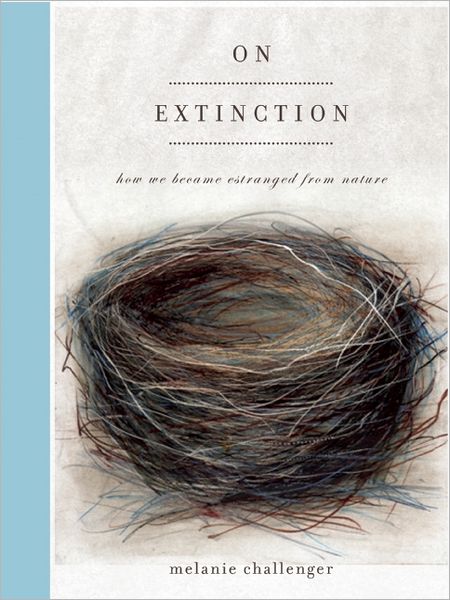
On Extinction by Melanie Challenger

A lyrical contemplation of biological and cultural extinctions and their significance in our human future.

Poet Melanie Challenger (Galatea) was alarmed to note that while she knew both her grandmother’s and her mother’s favorite wildflower, she did not have a favorite because she didn’t know enough wildflowers from which to choose. In On Extinction, she travels to places that embody the history of human connections to nature and muses on our growing estrangement from our environment.

The title suggests Challenger’s initial focus on extinctions: not only of plants and animals, but of cultures, languages and industries. She quickly discovers a growing secondary interest in nostalgia, like our attraction to extinctions, which makes the dodo bird the subject of so much curiosity. In her travels through the Arctic and the Antarctic, England, South America and Canada, she attempts to reunite with nature and find her own favorite wildflower. She also asks: Can humans live productively in this world without destroying it? She is made hopeful by our reverence for the past and for natural beauty.

Challenger brings a loving sense of wonder to the natural world, realizing how little she knows and relishing the process of learning. She looks backwards with the intent of remaking our future relationship with the planet. She does, as one might expect, discuss Muir and Thoreau, but she also turns to Locke, J.S. Mill, Rousseau and especially Darwin, seeking a philosophy of the natural world and our place in it. Highly literate with a lovely, almost reverent tone, On Extinction notes human threats to our environment but ultimately remains hopeful that we can reestablish a healthy relationship with the Earth.


This review originally ran in the December 21, 2012 issue of Shelf Awareness for Readers. To subscribe, click here, and you’ll receive two issues per week of book reviews and other bookish fun!


Rating: 6 falling leaves.

Encounters from a Kayak: Native People, Sacred Places, and Hungry Polar Bears by Nigel Foster

One man’s reminiscences of flora, fauna and miscellanea encountered while paddling the globe.

For decades, Nigel Foster has been kayaking the world’s oceans, lakes and canals–as well as teaching the skill, designing the equipment and writing about his experiences. Encounters from a Kayak collects more than three dozen of his articles in a single volume, many of them never previously published. Each examines a moment in time in which Foster–sometimes alone, sometimes with fellow enthusiasts–interacts with the natural world and its inhabitants from his small craft. It is one of the strengths of the collection that not even the oldest pieces (extending as far back as the early 1980s) feel dated.

The stories are organized thematically around creatures, people, places, and flotsam and jetsam; the diversity and scope of Foster’s contacts in all these categories are impressive. In his encounters with historic artifacts in Scotland, local police in Shanghai and monkeys in the Florida Keys, Foster brings a sense of humble wonder to his environment. Naturally, he considers issues of ecology and conservation in his travels, but he never lectures. Rather, in unadorned prose, he delivers the experiences themselves: the glow of bioluminescence, the ordeal of a Dutchman’s flight from Nazi occupation by kayak, the history of a sleepy Minnesota town and the real-life Scylla and Charybdis of Scarba and Corryvreckan, just off the Scottish coast. Foster’s unassuming consideration of his surroundings is charming, simple and occasionally poetic. Natural history, human history, birds, jellyfish, thunderstorms and more come together to entertain and educate in Encounters from a Kayak.


This review originally ran as a *starred review* in the December 14, 2012 issue of Shelf Awareness for Readers. To subscribe, click here, and you’ll receive two issues per week of book reviews and other bookish fun!


Rating: 5 campfires.

guest review: The Longest Race by Ed Ayres, from Pops

As I read The Longest Race, I thought of my father throughout. He is a marathon runner and a trail runner, and has been contemplating issues of climate change, sustainable living, and humans’ place in nature quite a bit recently. I thought this would be a perfect book for him in its combination of themes, which you can read about in my review. Here, he responds. [His page numbers come from my advance review copy.]

Julia has already done her usual commendable job reviewing this book; my personal interest in Ayres’ two main themes – running, and human degradation of our earthly habitat – compel me to comment further (as she knew it would.) At the same time, I want to parse her use of “metaphor” to describe how running and human development are related in Ayres’ story. While he does often employ metaphor, I believe in many cases he is saying that running actually is part of human development and does have an impact on how we relate to the world. Such is the hubris that plays a part in his tale.

For the above reasons, I really enjoyed this read. That doesn’t mean I found it uniformly superb or satisfying, but the book’s strengths were more than enough to keep me going.

Using a 50-mile ultra to structure his narrative worked better than I expected. There were few threads about his race that required following intently, and those were not lost as we periodically reconnect to that story. The more esoteric subjects he contemplates along the way vary greatly – just as would one’s thoughts during the hours of such an endurance event. In fact, that is an example of the athletic authenticity I found throughout. While I was only familiar with Ayres generally as editor of the early magazine “Running Times,” his deep experience as a lifelong runner shows through. His mental meanderings during a 50-miler – and their sometimes-questionable lucidity – are a familiar element of “running long.”

I was not familiar with Ayres’ background in the themes of human impact on the earth; he worked for the Worldwatch Institute and describes how this commitment evolved from a Quaker upbringing and through a lifetime’s experience. Along the run, we gather bits of his own back-story and “meet” such characters as Mohammed Ali, Mikhail Gorbachev and Ted Taylor (nuclear weapon physicist); such moments are fun and interesting – and chilling, as with his quotation from Taylor evoking the cold war’s nuclear terror (p.94). Also chilling is Ayres’ observation that for those who study the science of ecology, the survival of modern human society is “not just an abstract, academic concept;” it is very immediate.

We learn with him on his journey; e.g. Jared Diamond’s observation that agriculture is “in many ways a catastrophe from which we have never recovered” (p.102) – or “anthropomorphism as a major root cause of the ecological crisis” as noted by many literary luminaries over the years (p.106) – or the 1992 consensus-scientists’ dire & explicit climate change declaration so long ago (p.163) – or a reminder that the regressive “progress” of a suburban lifestyle model may prove to be a mere 2-generation phenomenon. We also meet such authorities as Paul Shepard, Rachel Carson and Wendell Berry along the way.

Similarly, Ayres has much to offer about running itself – not just practical stuff, but history and science as well. He met and/or learned from such names as Joan Benoit, Ted Corbitt and George Sheehan. He cites a Joe Henderson article that I know I read at the same time 25 years ago. Ayres is not the namedropper – that’s my doing throughout here – but rather all these names simply arise as part of his story.

His introduction to the JFK ultra event’s origin unwinds into a period piece on the Kennedy Physical Fitness campaign (which I too experienced), including analysis of JFK’s civic motivation and his 1960 column in Sports Illustrated (who knew?!). I loved learning of David Carrier’s fascinating theory of primitive “persistence hunting,” where humans demonstrated the superior endurance trait that we runners still attempt to conjure (Ch.4). In fact, the role of endurance running throughout early history is compelling – including the Chasquis, the Inca runner-messengers.

Chasqui runner

Chasqui runner


The brief 23 page Appendix, “Notes for an Aspiring Ultrarunner,” is an worthy overview but any really interested reader will do well to research the many other references available.

All together, I enjoyed the blending of themes, emotions and ideas in Ayres’ book. Here is a single passage where Ayres is so nicely able to blend his heritage, running and science:
“The last sounds of the spectators faded, and, after a period of silence that could have been either five minutes or the hundred years it takes for a Quaker kid to sit through Sunday meeting, I found myself glancing left and right, the way I’d been taught as a teenager to drive a car – keep your eyes moving, don’t get fixated on the road ahead. Maybe that was a vestige of the hunter-gatherer’s need to read his surroundings.”

While it is different in some ways, a reader drawn to Ayres book may also appreciate Long Distance, by Bill McKibben. Here you would find a foremost climate change writer who instead writes about his experience pursuing an endurance goal (cross-country skiing) and the lessons he derives for surviving in our every day lives. (Interestingly, the one promotional blurb on the cover of Ayres’ book is a McKibben quote.)

Finally, I must note two of my own favorite observations about running, which he mentions along the way. One is the uncanny and almost inexplicable way that a seasoned trail runner, moving quicker than the eyes seem to process, can cover rough ground dense with rocks & roots – and yet every footstep survives the gauntlet (“almost inexplicable” because there is a scientific story, of course); this phenomenon is well-captured in the exclamation “do my feet have eyes of their own?!” (p.58)

The other fave comes after he has related the many challenges that can test a runner’s resolve and motivation, all the aches & pains & setbacks – which are all so easily overcome by the most sublime moments (or preferably hours!) This he also captures with a mere phrase: “When running is good, there is nothing like it.” (p.98) Alas, as we age, it becomes harder to remember that lesson – but after 35 years it can still be good, and there is still nothing like it.

So glad you liked it, Pops. Thanks for sharing.

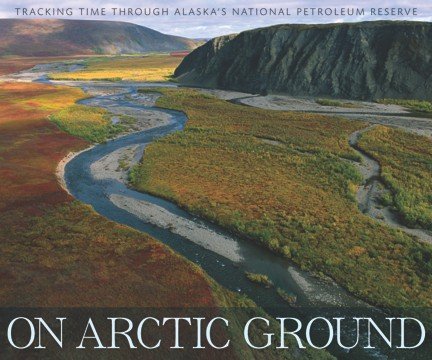
On Arctic Ground: Tracking Time Through Alaska’s National Petroleum Reserve by Debbie S. Miller

A call for the preservation of Alaska’s natural heritage, with exquisite photos.

At 23 million acres, Alaska’s National Petroleum Reserve is the largest single unit of public lands in the United States, none of it permanently protected. Rich in oil, gas and coal, it is also home to an astounding diversity of plants and animals, many endangered and threatened; the migratory birds of six continents begin their lives in the Reserve. Debbie S. Miller’s On Arctic Ground is a striking plea for the conservation of this irreplaceable natural space.

Although it can be read cover to cover, the best way to enjoy this book is to take its short chapters one by one. Each provides mind-boggling details–like the bar-tailed godwit’s nonstop, 7,000-mile migration from western Alaska to New Zealand–and makes the starkly moving point that this incomparable area is highly vulnerable. Breathtaking full-page pictures throughout offer stunning portrayals of the Reserve’s strange and spectacular life forms.


This review originally ran in the Nov. 23, 2012 issue of Shelf Awareness for Readers. To subscribe, click here, and you’ll receive two issues per week of book reviews and other bookish fun!


Rating: 8 caribou.

Teaser Tuesdays: On Arctic Ground by Debbie S. Miller

Teaser Tuesdays is a weekly bookish meme, hosted by MizB of Should Be Reading. Anyone can play along! Just open your current read to a random page and share a few sentences. Be careful not to include spoilers!

This is a beautiful coffee table book, chock full of stunning photographs as well as short essays about the glories of the Alaskan Arctic.

“Wow! Bumblebee on a lousewort!” Patrick Endres shouts through the wind, so excited that you think he’s just spotted his first grizzly bear. For a photographer like Patrick, small is just as important as big.

I read this vignette as allegory: one of the points of this book, in fact, is that small (flowers, birds, linguistic groups) matters as much as big (oil, industry, money). But seriously, go get it for the photos, if nothing else!

Teaser Tuesdays: On Extinction by Melanie Challenger

Teaser Tuesdays is a weekly bookish meme, hosted by MizB of Should Be Reading. Anyone can play along! Just open your current read to a random page and share a few sentences. Be careful not to include spoilers!

On Extinction has been out in the UK for a year or so now, but is just coming to the US in December. Its subjects are several, but I find the nature writing to be some of the loveliest parts.

Above me, the skies were blue but for the tightrope of the horizon balancing a giant rhombus-shaped raincloud. The scuffing of the waves across the riveted stone of the cove was like a dare.

Don’t you agree?

And what did the waves dare her to do? Stay tuned!

This quotation comes from an uncorrected advance proof and is subject to change.

selected quotations from Walden, with a qualification

Henry David Thoreau’s Walden is a highly quotable and oft-quoted book. I found myself marking passages rather more often than usual, sometimes because I was charmed and wanted to share a line with you later, and sometimes because I noted the origin of a maxim I was familiar with, whose author I hadn’t known before. I’ve already reviewed Walden, and now I want to share a selection of quotations with you too. But first, a qualification.

A friend & coworker sent me this article, which chiefly makes the point that Thoreau was a very complicated man who wore many hats (figuratively. who knows, maybe literally as well). The author notes the danger of quoting Thoreau: so many people know him through his reputation and these handpicked quotations, while rather few have read his work; and his work being so many things at once, so contradictory, handpicked quotations can be a dangerous tool. In other words, many of us may be thrown off by the quotations alone without reading the work. I’ve now read Walden, but the man was so terrifically prolific that I am hardly any closer to knowing Thoreau than I was before! So, fair warning. But I will now share my quotations just the same.

In order of their appearance (page numbers come from my pocket-sized red Barnes & Noble Collector’s Library edition). The book opens:

When I wrote the following pages, or rather the bulk of them, I lived alone, in the woods, a mile from any neighbour, in a house which I had built myself, on the shore of Walden Pond, in Concord, Massachusetts, and earned my living by the labour of my hands only. I lived there two years and two months. At present I am a sojourner in civilised life again. (7)

The mass of men lead lives of quiet desperation. What is called resignation is confirmed desperation. From the desperate city you go into the desperate country, and have to console yourself with the bravery of minks and muskrats. (12)

I say, beware of all enterprises that require new clothes, and not rather a new wearer of clothes. (28)

I had three pieces of limestone on my desk, but I was terrified to find that they required to be dusted daily, when the furniture of my mind was all undusted still, and threw them out the window in disgust. (42)

…a man is rich in proportion to the number of things which he can afford to let alone. (88)

I went to the woods because I wished to live deliberately, to front only the essential facts of life, and see if I could not learn what it had to teach, and not, when I came to die, discover that I had not lived. (98)

I wanted to live deep and suck out all the marrow of life, to live so sturdily and Spartan-like as to put to rout all that was not life, to cut a broad swath and shave close, to drive life into a corner, and reduce it to its lowest terms, and, if it proved to be mean, why then to get the whole and genuine meanness of it, and publish its meanness to the world; or if it were sublime, to know it by experience, and be able to give a true account of it in my next excursion. (98)

Simplicity, simplicity, simplicity! I say, let your affairs be as two or three, and not a hundred or a thousand; instead of a million count half a dozen, and keep your accounts on your thumb-nail. (98)

My house never pleased my eye so much after it was plastered, though I was obliged to confess that it was more comfortable. (256)

The stove not only took up room and scented the house, but it concealed the fire, and I felt as if I had lost a companion. You can always see a face in the fire. (269)

Our village life would stagnate if it were not for the unexplored forests and meadows which surround it. We need the tonic of wildness – to wade sometimes in marshes where the bittern and the meadow-hen lurk, and hear the booming of the snipe; to smell the whispering sedge where only some wilder and more solitary fowl builds her nest, and the mink crawls with its belly close to the ground. At the same time that we are earnest to explore and learn all things, we require that all things be mysterious and unexplorable, that land and sea be infinitely wild, unsurveyed and unfathomed by us because unfathomable. We can never have enough of nature. (334)

I will not try to improve upon this. Good day.

Walden by Henry David Thoreau

my charming little copy of Walden


I have been thinking this review over carefully. Walden is an “important” book. I had some troubles with it, particularly about midway through, when I stalled for several days and was sure I was going to give up. This was while visiting Concord and Walden Pond, no less! I think I owe my father credit: he recommended that I just read it through, with less attention to note-taking and interpretation at every page along the way. And on my long travel day home, I got back into it.

What is it that made this book a little difficult for me? Well, the language is somewhat dated, and the sentences tend to be long and rambling. Picture several long clauses strung together, and then having to look back up half a page to see what the subject was that this verb, finally, is acting upon. That will slow a person down. And the subject matter, the thoughts being communicated, are often quite dense. When Thoreau writes descriptions of his natural surroundings, I can settle into the imagery and the poetry, and float along pleasantly. But when he philosophizes, I am often in trouble. Large ideas are presented here, regarding our relationship with the natural world, politics, and religion. Thoreau jumps around between these subjects. Perhaps this begins to help you understand my trouble.

The first chapter, “Economy,” is lengthy. In my edition it occupies 80 pages, of 350. And no later chapter runs longer than 20 pages. I enjoyed “Economy”: I sympathize with the points Thoreau makes therein. But maybe I was wearied by it. It wasn’t until 200+ pages that I stalled badly. And once I got back into it, I enjoyed it again. I can’t entirely explain that pattern, and I’m sure yours was/will be different. I think the biggest help I got was visiting Walden Pond. This is obvious, no? When my mother and I toured The Wayside, our park ranger/tour guide quoted Nathaniel Hawthorne (and I wish I could find the quotation) on visiting authors’ homes. The gist was that visiting the home of an author is the best way to better understand his or her work, and my (limited) experience visiting authors’ homes certainly backs this up. In this way, walking around Walden Pond enriched my appreciation of Walden and renewed my interest in it.

Walden is a memoir; a political tract; a geographical study; a fine piece of nature writing; and a poetic rambling by a unique sort of Renaissance man. I found it rather effortful reading, but worth it in the end. For those who enjoy thought-provoking, challenging, lyrical writings (and longish sentences), it should be a big hit. For those who find these characteristics a little daunting, but are interested in the legacy of Henry David Thoreau, I recommend giving it a go just the same. I’m glad I did. And go see the place in question if you can, too!


Rating: 6 fallen leaves.

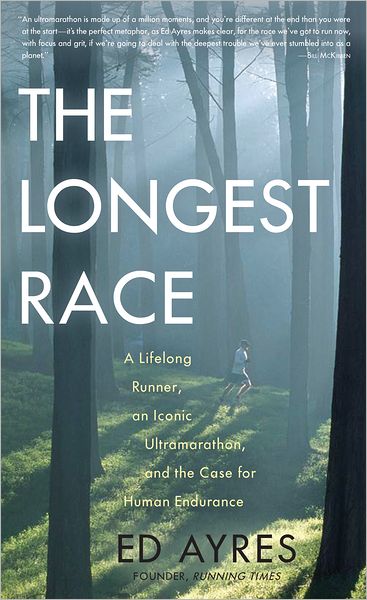
The Longest Race: A Lifelong Runner, an Iconic Ultramarathon, and the Case for Human Endurance by Ed Ayres

An ultramarathon, run by a master of the sport, becomes a metaphor for the race for human sustainability we are all running.

Ed Ayres has been running competitively for more than half a century. On a professional basis, he’s also studied climate change, sustainability and a variety of issues facing the future of the human race and our planet. The Longest Race is the story of his 2001 run at the JFK 50 Mile, the United States’ oldest ultramarathon. As Ayres attempts, at age 60, to set a new age-group course record, he contemplates the relationship of human endurance to the sustainability of human life in a fast-changing world.

Ayres’s recollections a decade later are heavy on metaphor. The ultramarathon is a symbol not just for his life, but for any man or woman’s life, and ultimately for the lifespan of humanity. The attributes that work toward sustainability at an individual level are equally valuable in a large society, Ayres says, and today’s “sprint culture” would do well to reconsider the concept of pacing. He also touches on the atom bomb, human evolution, the U.S. crisis in physical fitness and the reasons for following a vegetarian diet. But for all its peripatetic allegory, The Longest Race is always the story of one epic 50-mile race in all its technical and visceral elements, and also a celebration of the sport of running and of our ability to keep running in changing times. For those readers inspired by his story, the appendix offers practical advice to the aspiring ultrarunner.


This review originally ran in the October 19, 2012 issue of Shelf Awareness for Readers. To subscribe, click here, and you’ll receive two issues per week of book reviews and other bookish fun!


Rating: 8 miles to go.

EDIT: See also my father’s glowing review of same.