The Solace of Open Spaces by Gretel Ehrlich

Edit: see Pops’s review here.


solaceThe observation that sticks with me most from this slim, beautiful book is: it’s interesting how poetic nature writing never grows old for me, even though in some ways Ehrlich’s work here is not particularly new. She is unique, like every one of us snowflakes – I don’t mean to call her derivative; read on – but she definitely follows in a tradition; and what I’m trying to say is, I am always ready for another literary descendant of Thoreau, Leopold and Abbey. Especially when she’s a woman and offers a little different take in that respect.

Gretel Ehrlich is decidedly special, for all that I’ve compared her to the greats that she has followed. For one thing, her writing is exquisite, like perfect drops of water with points of light shining on them. Her story is her own, too. She was a filmmaker in New York City who traveled to Wyoming in 1976 to shoot a film, and also to escape the way in which her life was falling apart: the man she loves, her business partner, had just been given only a few months to live. She hangs around sheep ranches until she becomes one of them, a sheepherder, a ranch hand, a rancher. She visits with the dying man, keeps in touch, in pain, and then he dies far away while she’s preparing to fly home to see him. So her time in Wyoming, in the wild, on the frontier, with animals and laconic men, is a time of mourning and healing, as in Mountains of Light, or somewhat as in Fire Season.

Ehrlich’s wild is not Ed Abbey’s, or Phil Connors’, or Derrick Jensen’s, or Aldo Leopold’s wild; hers is populated by humans, nonnative stock animals and plant species, and irrigation. But it is far wilder than New York City, and far wilder than most of our country then and certainly most if not all of it now. It retained a wildness, including a human wildness. I love her descriptions of the human and animal personalities she comes to know. I also love her discussion of what it is to be a cowboy (or cowgirl, of which there are also several stunning examples).

But the best part has got to be her writing. And as I’m inclined to do in such cases, I’m trying to write less myself and share more of her lovely thoughts and phrases.

Disfigurement is synonymous with the whole idea of a frontier. As soon as we lay our hands on it, the freedom we thought it represented is quickly gone.

The old conundrum. We love it; we want to save and preserve and conserve it so we can enjoy it; but every act of enjoying is a failure of preservation. If we all lived in the wild it would be gone. (Which we’re headed towards, anyway.)

True solace is finding none, which is to say, it is everywhere.

As the title indicates, Erhlich is seeking solace – in the mourning of her lost partner, but also in the need for change more generally, I think.

Because she is the granddaughter of Ralph Waldo Emerson, I imagined she possessed unusual reserves of hardiness. But she protested. “I don’t do a very good job of it,” she said modestly. “I get in these hoarding moods and get mad at myself for all the stupid things I do. Then I pick up this old kaleidoscope and give it a whirl. See, it’s impossible to keep just one thing in view. It gives way to other things and they’re all beautiful.”

Isn’t that lovely? It’s always changing, and always beautiful. (Can’t say I’m not partial to an Emerson allusion, either.)

Winter scarified me. Under each cheekbone I thought I could feel claw marks and scar tissue.

Great imagery here, about the harshness of the world out there, in a Wyoming winter.

The seasons are a Jacob’s ladder climbed by migrating elk and deer. Our ranch is one of their resting places. If I was leery about being an owner, a possessor of land, now I have to understand the ways in which the place possesses me. Mowing hayfields feels like mowing myself. I wake up mornings expecting to find my hair shorn. The pastures bend into me; the water I ushered over hard ground becomes one drink of grass. Later in the year, feeding the bales of hay we’ve put up is a regurgitative act: thrown down from a high stack on chill days they break open in front of the horses like loaves of hot bread.

Derrick Jensen would like that. Ever since I read him (and before; but especially since), I’ve been thinking about the concept of land ownership, so this struck a chord.

And finally –

Leaves are verbs that conjugate the seasons.

Could a person ask for more than this? Leaves as verbs. Gretel Ehrlich, you have won me over.


Rating: 9 cowboys.

Teaser Tuesdays: A River Runs Through It, and other stories by Norman Maclean

Teaser Tuesdays is a weekly bookish meme, hosted by MizB of Should Be Reading. The idea is to open your current read to a random page and share a few sentences. And try not to include spoilers!

river

It has taken me too long to find Norman Maclean. Those who recommended him were, of course, oh so right; and now I can’t wait to get a hold of Young Men and Fire.

My 25th anniversary edition of A River Runs Through It includes three stories, but the titular one is the bulk of the book. It is from that story that I’ve taken this lovely teaser for you today.

It was so hot that the mirages on the river melted into each other. It was hard to know whether the utterances I had heard were delphic.

Of course I’m a sucker for the classical reference in the use of the word ‘delphic’. And now I will try to bite my tongue and save it for my review; but let me say, this is a beautiful book.

book beginnings on Friday: The Solace of Open Spaces by Gretel Ehrlich

Thanks to Rose City Reader for hosting this meme. To participate, share the first line or two of the book you are currently reading and, if you feel so moved, let us know what your first impressions were based on that first line.

solace

Fil wins again with this outstanding and unknown (to me, and I’m pretty sure he said to him as well) little book. Gretel Ehrlich writes beautifully and I love it. She begins:

It’s May and I’ve just awakened from a nap, curled against sagebrush the way my dog taught me to sleep – sheltered from wind. A front is pulling the huge sky over me, and from the dark a hailstone has hit me on the head.

She’s writing about living in Wyoming, nearer nature than most of us do, working as a sheepherder and a ranch hand and escaping her life in New York City and a recent personal tragedy. It’s lovely. I marvel at how I can’t get enough of lyrical nature writing; and this is a woman’s story of dealing with life, to boot. I recommend it. Review to come.

As usual, thank you, Fil.

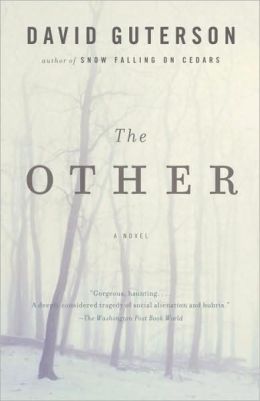
guest review of sorts: The Other by David Guterson, from Pops

In the same spirit in which we both read Endgame and Ishmael, Pops has recently read David Guterson’s The Other, and I have some snippets of his thoughts to share with you. For a little background, I read The Other too, a number of years ago (and pre-blog). I liked it very much; I found it thought-provoking and wise, and it reminded me of a very dear friend. I later read Guterson’s better-known Snow Falling on Cedars, and found it fine but not comparable – so there’s yet another case in which the general opinion differs from mine. Now I will turn this over to Pops, whose thoughts are just represented in brief passages here for you, along with those bits from the book that he found memorable. As ever, thank you Dad for sharing with us.

other

I just finished reading The Other, and it was quite stunning. In fact, it was nearly literally stunning. (Starting a book with a story about a couple runners is quite a hook for me anyway!)

Why did I wait this long to pick this book up? It has been on my shelf for years and I almost discarded it unread several times without ever knowing why I kept it other than a vague knowledge that it came recommended. I’m embarrassed to find that Julia even referenced it in publishing my comments about Fire Season! How could I have overlooked it for so long? Was this book exercising an independent will, waiting for a certain moment?

I don’t remember terribly many details of the plot from my years-ago reading, but I’ll try to assemble a quick synopsis from memory: two young men, Neil and John William, are friends in high school. They run together. After high school ends and they transition towards adulthood, they head in different directions. Neil becomes a teacher, and John William retreats towards the wild. He camps out in the woods, hikes, lives off the land. He is simultaneously very cerebral, reads poetry, discusses it with Neil; they correspond. They play chess. John William is the superior player. Gradually, JW withdraws more and more from society and from his family; he enlists Neil’s help in disappearing entirely. He wastes away out in the mountains alone in ways that look unhealthy to our eyes as trained by society. He also rejects some things but not others, in a way that looks hypocritical but, I came to feel, highlights the contradictions in us all, in society, in what the world has to offer us. I’m not expressing that well; I blame my distant and vague recollection of the book. JW comes to a less than savory end, and Neil is left with his own compromises.

My father does not discuss plot much here. He and I may have to have our own, off-the-record discussion; as I said in my review of Endgame (link at the top of this post), these issues are very personal, and at some point fall outside the scope of this blog. But in the briefest, sketchiest way possible, Pops says…

What is this book about? Why the impact?

• Two runners with a life long bond
• Seattle, the Olympics and other northwest locations evoked with affection and an insider’s eye
• Timing: in the midst of a streak of eerily connected non-fiction, a novel that matches the others for relevance
• Particularly & effectively juxtaposed with my other current read: E.O. Wilson’s The Social Conquest of Earth (an informed scientific look at “who we are”)
• John William, the character focus of much attention, seeks and ultimately sees too clearly the reality of human’s place on earth, and suffers the fate of such seekers; he becomes an isolated loner in an insane world, tragically fated to be branded insane himself (“the other”)
• Neil, the other character and narrator, who is painfully wedded to the civilization torturing his friend yet arguably as alienated in his own way, and ultimately as tortured by his addiction, notwithstanding sudden wealth
• Though only tantalizingly developed, I loved the character of his wife, Jamie.
• Why are Neil’s sons never named? There are more significant characters in the book, all named; but these are the beloved offspring of our narrator!
• Inspiring contemplation on humanity’s endless, frivolous and prideful introspection in pursuit of explaining who we are, while we never grasp the greater tragedy of our puny yet destructive role in the natural world
• The futility of wealth solving any of our problems – and thus the trivial & sad quest for it
• Brouwer’s, the notable Belgian beer bar in the UW area, is specifically described.

Following are some passages, to offer just a few places where I stopped to reread and contemplate.

This paragraph I reread many times, due to the language and the message hidden there; not an easy one to parse out!

“A light he was to no one but himself” – that’s a line from a Frost poem, “An Old Man’s Winter Night,” which a lot of students don’t respond to very strongly. “A light he was to no one but himself” – I wouldn’t choose that, and if I have to suffer it one day, because of circumstances, I’m fairly certain it will lead to my demise, because that cast, that illumination, is foreign to me – I’m finally saddled with my take on things as ineluctably as I’m slowed, and pained, by the neuroma in my foot. So be it. I have the beauty that I have, and none other, in the meantime. One thing has led to the next in my life, but like lines of a poem. I suppose I’ve thrown in my lot with love, and don’t know any other way to go on breathing. I embrace this world – the world my friend hated – and suffer it consciously for its compensations, and fully expect to awake one day to the consequences of this bargain I’ve struck, since life, eventually, closes in.

On heading into the woods, only to find that your mind is not quite with the program for some reason…

The place felt sinister though. Your imagination can get the better of you where a road ends against a forest. It’s easy to feel trapped with your back against trees. Vulnerable to all of this, I got on the trail and tried loving my solitude, but this was a futile and self-conscious effort. I didn’t want to be there, by myself, while the sun went down. I didn’t want to be hiking in such a tense silence. The maple leaves were youthfully green, but that didn’t ameliorate my nervous view of things. Before dark, I bivouacked, tentless, by the river, banking up a fire in front of a boulder and basking in its heat with my journal and The Collected Eliot, 1909-1962, which an excitable professor had asked me to scour, and although all of that might sound pleasant enough, or not a bad way to pass evening hours – especially with the din of water on the gravel bars and my view of stars illuminated silhouetted hills – I didn’t enjoy being there. I suppose you could say that my aloneness got the better of me, or that I felt fear that night, by the river, by myself – but fear of life, and not of animals or the forest. “The Hollow Men” didn’t help, because I couldn’t disown its mood, or break its hold on my thoughts, as I lay in my sleeping bag by those smoking coals, and though this temper made me tired, it also left me agitated enough to prod, more often than I needed to, the sticks I was burning. I mostly felt wistful. I didn’t want to have behind, already, some experiences I couldn’t have again. Reading Eliot by flashlight was like deciphering runes, and made it more difficult to sleep.

On how ephemeral is “reality” about ourselves (individually or as humanity), and how our “advanced” minds can create such enormous conceit out of nothing…

…maybe the truth is that truth is too complicated. If I extrapolate from myself, there’s a lot of deceit in the world without a beginning, middle, or end. The way it really works, a lot of the time, is that you suffer from the weight of what happened, from what you said and did, so you lie as therapy. Now the story you make up starts to take up space otherwise reserved for reality. For phenomena you substitute epiphenomena. Skew becomes ascendant. The secondary becomes primary. When it’s time to confess, you don’t know what you’re saying. Are you telling the truth, or do you confuse your lies with reality? The question is comical. The answer is lost in the maelstroms of consciousness. It’s even possible to pretend, eventually, that the question wasn’t asked. You’ve been kidding yourself about yourself for so long, you’re someone else. Your you is just a fragile fabrication. Every morning, you have to wake up, assemble this busy, dissembling monster, and get him or her on his or her feet again for another round of fantasy. Is this what some sutras by Buddhists are about? Maybe. The book-length bromides on mental health? At times. The biographies on politicians? Take Nixon or Clinton. Anyway, I don’t know anything about Rand or Ginnie. I don’t know if anyone tried to strangle John William. I don’t really know who tormented whom, or why, or if anyone was even tormented at all. I don’t even know much about myself. I only know that Ginnie protested with Chronic Obsessions pressed against her bibbed chest. Then she kicked me out.

And finally, two paragraphs near the book’s end, set apart in a section on their own, on the emptiness of wealth against a background of questioning…

Jamie and I turned in the ’92 Civic and bought a hybrid, which we recently took to the Canadian Okanagan – the Napa of the North that Wiley and Erin told us about. We walked, swam, biked, sunned, tasted wines, ate well, bought pottery, and watched the sun go down, and though all of this was fun, none of it made us happy. We both wanted something else that was unnameable. It might be forever unnameable. In this regard, money changes nothing, which Jamie and I knew before we had it.

When I think about my friend, I think about someone who followed through, and then I’m glad not to have followed through, to still be breathing, to still be here with people, to still be walking in the mountains, and to still be uncertain – even with all this cash on hand – in a way I seem to have no choice about. I’m a hypocrite, of course, and I live with that, but I live.

Powerful stuff.

It is powerful stuff. I realize we haven’t given you much of a review to speak of, here. But I hope we have expressed that Guterson tells a unique tale in an evocative fashion, that has managed at least to provoke two of us to further reflection and discussion.

Endgame, Volume 1: The Problem of Civilization by Derrick Jensen

endgameHow to write about this book for you here? Derrick Jensen fearlessly assesses the terrifying state of our world, for us as people and as not-the-only inhabitants of a globe that is sick with our presence and practices. It is difficult to write about what he has to say and my reactions to it; it’s very personal, because I and/or people I love may or may not be trying to follow some of Jensen’s teachings even as we speak. What I really want to say in this so-called “book review” is, go read Jensen now, and then do something about it.

The concept of endgame is familiar to me from chess. The idea is that we’re trying to get to a final outcome of this chess match, trying to establish a winner and a loser, and there’s no sense hanging on to all these pieces and stretching things out. Instead, I will happily give up my bishops (knights, rooks, queen, all of ’em) in exchange for yours, in order to hurry up the desirable end of the game. Endgame takes the same concept – a desirable hurrying of this game onto its inevitable finish – and applies it to our world, or rather, to civilization. He tells his reader why and how our civilization or culture is hopelessly, insanely f*cked up. He argues that we ARE headed for an end to civilization – and quite appropriately and desirably so – and that we should be hastening this end, the sooner that we can then begin living more sanely (if there’s any “we” left), and the healthier that the planet and anything left on it will be post-endgame.

This may very well sounds nuts to you, if you haven’t given things like global warming, mass extinctions, water shortage, and worldwide social injustices much thought. But it might make a great deal of sense – especially if you let Derrick Jensen tell it, which I really recommend, as he does a far better job of it than I do. Perhaps my first surprise in reading Endgame is that there were no surprises. Jensen makes these arguments so incredibly articulately, cleverly, even funnily, and backs them up so solidly, that I am wowed; but nothing he had to say was entirely new or surprising to me (sadly). He does a really fabulous job of expressing clearly what I already knew, suspected or feared. He also presented some new angles that I hadn’t much considered; and he expands the scope and scale of our problems in a way that I appreciate and found thought-provoking. Make no mistake: Jensen is a philosopher, a thinker, a cerebral guy who has clearly done copious research and spent time talking with some of the smartest people out there. Would that we all had time to do this kind of research and thinking! (Since we don’t, read Endgame.) My father has noted that even climate change experts like Bill McKibben stop short of the dire predictions Jensen posits. I think considering these scary truths is useful, instructive, and constructive, even while it’s sad and terrifying.

If you believe that we just need to drill for more oil; that those with lots of money have the right (and the duty) to protect what’s theirs; and that poor people in poor countries that still have some trees (oil, etc.) left should just move over for those of us that know better – Jensen is unlikely to convince you otherwise. He doesn’t really bother with you, in fact: you are not his audience. (“I was going to suggest those who think the U.S. invasion [of Iraq] has nothing to do with oil should put the book down, but realized they’ve probably already tired of the big words.”) And maybe that’s as it should be, too. Convincing those people is a big job – possibly an impossible one – and there’s other important work to be done. I don’t know that we should be wasting our Derrick Jensens on convincing the hardline fans of civilization that they’re wrong.

Aside from the clearly central issue that I appreciate what he had to say, see the wisdom of his arguments, and applaud his articulations, I also really enjoy Jensen’s conversational style. He can somewhat ramble, but is abundantly coherent for all that; maybe it was just my deep interest and passion for what he was saying (I’m nodding and saying “yea, yea!” as I read), but it all flowed very well even while jumping around a little. Of course I must say too that I loved his love for parentheticals (he mentions how much this frustrates his editor!) because, can you tell, I share it. I believe it was on his website that I read that he completes each page (or several), completely, before moving on to the next: that is, when he’s writing page 11, pages 1-10 are done. I find this fascinating. (I’m always interested in the mechanics of my favorite writers.) And it allows for a journal-like feel: he’ll break off from an argument he’s making to tell an anecdote, like “tonight I gave a talk, and at the end a woman said…”, and the reader is right there in the present with him. He wrote that paragraph on the night that that woman said that thing.

I would also like to make a contrast to yesterday’s DNF book, and say that a key piece of Jensen’s structure here is in stating at the start 20 premises he believes in. He writes,

I want to lay them out as clearly as I can, for you to accept or reject. Part of the reason I want to do this is that the questions I’m exploring regarding civilization are the most important questions we as a culture and as individuals have ever been forced to face. I don’t want to cheat. I want to convince neither you nor me unfairly (nor, for that matter, do I want to convince either of us at all), but instead to help us both better understand what to do (or not do) and how to do it (or why not). This goal will be best served by as much transparency – and honesty – as I can muster.

He then spends 450 pages proving his premises.

I appreciate this clarity. Frankly, I was already on board with his assumptions, but agree wholeheartedly that this is far too important a problem to make assumptions about; the intellectual exercise of questioning our assumptions is absolutely necessary. I like that he is so reflective, asking questions he can’t answer, reconsidering. This is too important a moment for blustering false positivity. Therefore, even though I was willing to buy into premises like, “The culture as a whole and most of its members are insane. The culture is driven by a death urge, an urge to destroy life,” I still value having them proven to me. Jensen questions himself and his own motives. And that’s something I respect.

A solid ‘A’ for style, then, but the real ‘eureka’ for his thoughts and arguments and philosophies. I can’t wait to read Volume II: what we’re going to do about it.


Rating: take note: 10 salmon.

Ishmael by Daniel Quinn

ishmaelIshmael comes recommended by my father, and that’s enough for me.

It’s an environmental novel published in 1992. So, dated? Or prophetic? I’m afraid it stands firm today; we can debate whether it’s overly alarmist (ha) or overly optimistic (sigh), but I didn’t run across anything that dated it especially for me. The premise is: our narrator (who, I’m pretty sure, remains nameless) is a disillusioned 30-something who, as a teen, had looked for someone to guide his idealistic, revolutionary, 1970’s-style environmentalism, and come out disappointed and cynical. Now that it’s “too late”, he’s frustrated to find the following advertisement in the newspaper:

TEACHER seeks pupil. Must have an earnest desire to save the world. Apply in person.

(Is “newspaper” the term that dates this story?) Narrator responds jadedly, assuming this is a charlatan, a scammer; but still he goes to the address listed, because he has to satisfy his curiosity (and presumably because some part of him hopes that someone out there can really teach him how to save the world). In this anonymous retail space, he finds… a gorilla. A big, scary gorilla behind a glass wall; and on Narrator’s side of the wall, a chair. He eventually sits, and our gorilla – Ishmael – “speaks” telepathically to him. Ishmael relates his life story, and they begin discussing What’s Wrong With The World And What We Can Do About It.

Leaving aside the rather strange element of the telepathic and exceptionally well-read gorilla, the structure of this story is much like Sophie’s World, a novel I read pre-blog (thus no review here, sorry) and really, deeply loathed. It is credit to my faith in my father that I picked up Ishmael, knowing it was at all like that other. The structure I’m referring to is part of what I disliked about Sophie, although it works slightly better here: there is no plot, no action in the story, and no character development, because our characters don’t do anything. They form a didactic construction that allows Quinn, in ill-disguised fashion, to voice his own thoughts. If he were doing this in dialogue form, it would make a little more sense; but unfortunately the dialogue mostly consists of many paragraphs by one character, punctuated by the occasional “yes,” “true,” or “I don’t quite understand that part; can you tell me more?” from the other. Now, I liked what Quinn had to say, and I frankly liked the gorilla Ishmael, and so this framing element bothered me far less than it did with Sophie (shudder). But I still felt that it was unnecessary, distracting, and ill-concealed. I’d rather Quinn had just written a manifesto frankly stated as his own.

Quinn’s thesis in a nutshell is that our world is badly f*ed; humans have done it by behaving badly; and we need to change quickly if we hope to salvage the earth itself, its very deserving fellow occupants like butterflies, tigers, flowers and rocks, and any of ourselves. I find this thesis abundantly easy to follow. For decades we’ve known that we were badly screwing up this planet (unless you’re Big Oil and have found a way to put your head under the sand (to look for more oil) in which case you’re probably not reading Ishmael, or this blog). Actually I found the third part of the thesis – that we need to hurry up and change so that we can save the world – hardest to follow, because I think things are worse off than Quinn paints them to be. Of course, I’m writing this more than 20 years later, so I’ll give him a pass there.

That said, the friendly gorilla and the simply stated philosophical approach that he shares with our Narrator make an accessible argument. I could see this being a good entry-level discussion piece – or a jumping-off point for further discussion in a reading group or classroom setting. Ishmael is likeable, and the philosophy is mostly sound (at least until the part about how we can change; I am less hopeful than Ishmael is), and readable.

I am not sorry I read this. But I like Derrick Jensen’s Endgame better, even though it doesn’t have as happy an ending. More on that book to come.


Rating: 5 sessions.

book beginnings on Friday: Ishmael by Daniel Quinn

Thanks to Rose City Reader for hosting this meme. To participate, share the first line or two of the book you are currently reading and, if you feel so moved, let us know what your first impressions were based on that first line.

ishmael

This novel looks to be one of those lesser-known classics, with sort of a cult following but not generally known to the public consciousness. (My local public library does have it shelved under Classics.) Have you heard of it? I only recently did, but it comes recommended from my Pops, so here we are. It begins:

The first time I read the ad, I choked and cursed and spat and threw the paper to the floor. Since even this didn’t seem to be quite enough, I snatched it up, marched into the kitchen, and shoved it into the trash.

Strong feelings, no? I like that our attention is grabbed right at the start!

Happy Friday and happy reading, kids!

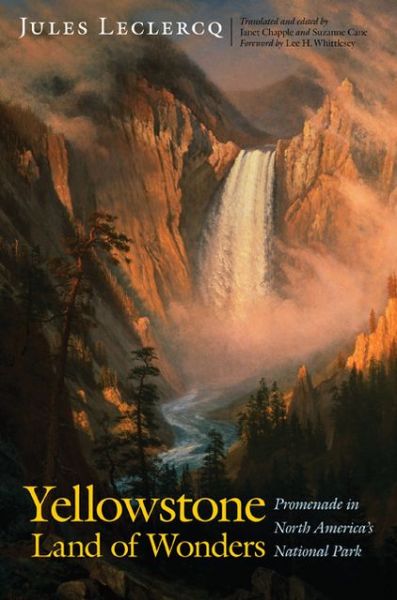
Yellowstone, Land of Wonders: Promenade in North America’s National Park by Jules Leclercq

An unprecedented English translation of a travel narrative from the early years of Yellowstone National Park.

yellowstone
In 1883, a well-traveled French lawyer, writer and judge named Jules Leclercq explored the newly designated Yellowstone National Park on horseback. Three years later, he published a book praising the area’s strange and wondrous marvels–but the book is not simply a lovely appreciation of natural scenery. Leclercq also researched the history of the region and its people in order to write a scholarly study, a snapshot of a place in time. And yet there has never been a complete English-language translation of his original text until Janet Chapple and Suzanne Cane’s Yellowstone, Land of Wonders.

Leclercq is most fascinated by Yellowstone’s geysers: “The mind is so occupied with the extraordinary geological phenomena bursting upon one at every step,” he writes, “that one views the scenery only abstractedly.” He does, however, turn his pen to Yellowstone Lake and Falls; he considers the latter far superior to Niagara. He also includes a chapter on the park’s wildlife, and warns that whole species will be exterminated if hunting continues unchecked.

Leclercq’s narrative is imperfect. He sometimes quotes without attribution from contemporary sources and gets geological details wrong. But Chapple and Cane meticulously keep readers informed on such points. Their translation and editing–with copious notes–is thorough in confirming and expanding Leclercq’s points, offering commentary not just on Yellowstone but on the author and his era. The result has more than just historical value; as Leclercq concludes (and as is still true today), “All this grandeur inspires grave and religious thoughts.”


This review originally ran in the May 10, 2013 issue of Shelf Awareness for Readers. To subscribe, click here, and you’ll receive two issues per week of book reviews and other bookish fun!


Rating: 6 geysers.

A White Heron by Sarah Orne Jewett

I found this story online, for free, here. Thanks to the Open Library project.


thanks to the Boston Public Library for sharing

thanks to the Boston Public Library for sharing

I finally got around to this one, and I’m so glad I did. I’ve seen it referenced before, but it was in Iodine that I saw the allusion that finally got me. And it was pretty easy to find online in full-text form, so no excuses.

It is a simple story. A girl named Sylvia (Sylvy) lives with her grandmother in the woods; she is fortunate to have been the one of a “houseful of children” to be chosen for this life, because she was very unhappy with people and in the city, and now she blossoms. The birds and trees are her friends. She meets a hunter, a pleasant enough young man, who initially scares Sylvy (because he is people) but who she comes to like and esteem. He is seeking a rare bird, a white heron, who does not usually roost in these parts but who Sylvy has seen and knows. In her admiration for the hunter, Sylvy climbs a very tall tree before dawn – a feat of great proportions – to locate the heron’s nest. Perhaps you can see where the central conflict comes from.

This is a very fine example of the art of the short story. It is a brief tale, and simple, but layered and allegorical and very moving. There are only three human characters, of whom the hunter remains unnamed and the grandmother is usually referred to simply as “the grandmother”; only Sylvy consistently gets a name. This adds to the simplistic, and the symbolic, effect. On the other hand, the natural world is well characterized. I love the cow:

…though she wore a loud bell she had made the discovery that if one stood perfectly still it would not ring.

Or the tree Sylvy climbs:

…it must truly have been amazed that morning through all its ponderous frame as it felt this determined spark of human spirit wending its way from higher branch to branch… The old pine must have loved his new dependent.

We can see here the important role that nature plays. Indeed, Sylvy herself is part bird:

…her bare feet and fingers… pinched and held like bird’s claws to the monstrous ladder [of the tree] reaching up, up, almost to the sky itself.

Her tree-climbing adventure seems to me to clearly be an epic journey of a rather religious nature; but I am inexpert in religious texts & symbolism, so I’m not sure I can articulate that for you.

Part of what I love about this story is the deceptive ease with which we sympathize with the bird over the hunter. I read this story in the car, and Husband expressed an interest, so I summarized it for him (which was a pleasure in itself), and he took it for granted that we want the bird, as it were, to win. Well, that’s an easy conclusion to come to; we’re animal lovers, he rescues baby birds that fall out of nests (I call him St. Francis), we like the woods. And this hunter, after all, is a sporting sort, interested in bagging a rare species, rather than feeding his family. But I don’t think the same sympathies would have occurred, let alone been obvious, to Jewett’s original audience (in 1886); they certainly aren’t obvious to the hunter and the grandmother in the story. In other words, Husband and I had very clear-cut sympathies, but I think we read this story differently than it would have read in 1886. The fact that it is moving to us today as it presumably was then, but in a different way, is remarkable to me, and thought-provoking.

This is a lovely little short story in the style of realism, in praise of nature over human industry, allegorical and sweet and very powerful. I have left quite a bit unsaid – like, the ending – because I want you to read it. The link’s at the top of this post, and it won’t take long. Go.


Rating: 9 breaths of fresh air.

book beginnings on Friday: Yellowstone, Land of Wonders by Jules Leclercq; with notes

Thanks to Rose City Reader for hosting this meme. To participate, share the first line or two of the book you are currently reading and, if you feel so moved, let us know what your first impressions were based on that first line.

yellowstone

I am having a difficult time deciding where to “begin” this book, because it opens with not just a foreword or introduction, but:

  • Foreword
  • Acknowledgements
  • Translators’ Introduction
  • Translation and Editorial Method
  • A Note on the Illustrators
  • Preface (by the original author), and…
  • Chapter 1.

All of which is not a problem for me; I read each of these sections happily (most were 2-3 pages); but how to design today’s book beginning? Let’s start with chapter 1:

In 1871 the American geologist Hayden revealed the existence of one of the most phenomenal regions on earth. It was named the “Land of Wonders.”

This quotation comes from an uncorrected advance proof and is subject to change.

As I learned in the copious introductory remarks, this is the first-ever English translation in full of an 1886 publication in French, La Terre des Merveilles, by a renaissance man who spent 10 days in Yellowstone in 1883. It is billed as being remarkable and unique in many ways, and I am looking forward to it.

In the first few pages alone I learned several interesting pieces of trivia, including that Yellowstone is roughly one third the size of Belgium (at least as they both looked in 1886!); that geyser is an Icelandic word; and the definition of the word ‘diadem’ (I was thinking something like jewelry or a tiara, and I was right). And speaking of notes – as I’ve written before, I keep notes while I read: passages I want to quote, words or concepts I want to look up, thoughts I want to include in a review. I have also written before about footnotes; and on this subject I have some observations to make here. For one thing, the endnotes are copious. By the time chapter 2 ended on page 21, I had been cued to reference 47 endnotes. That’s two-and-a-quarter per page! And they are endnotes, meaning they occur at the end of the book rather than throughout; and while some direct the reader to a source for the information given, some make substantive contributions to the text, so that I can’t know to always refer to them or always ignore them; and this makes for a great deal of flipping around. Also, while we’re keeping track, I’ve made only 4 notes myself in those 21 pages (plus 6 pages of notes!), so there you are. This is looking like… are you ready for it?… a noteworthy read.

And what are you reading this weekend?