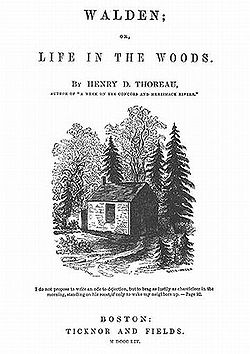
Walden by Henry David Thoreau

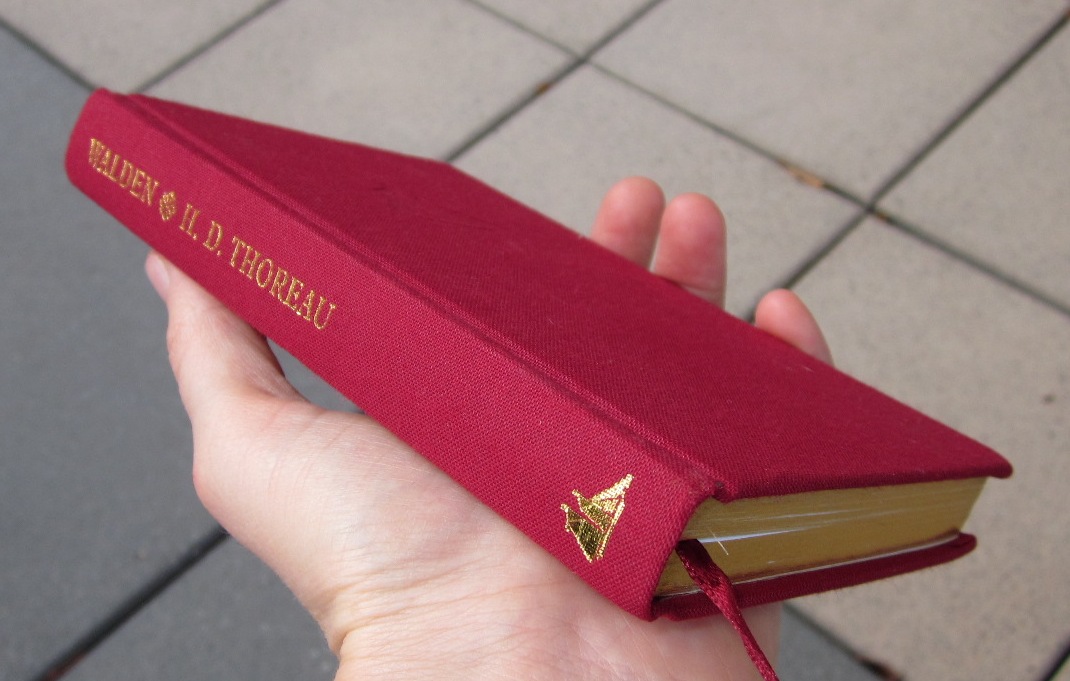
my charming little copy of Walden


I have been thinking this review over carefully. Walden is an “important” book. I had some troubles with it, particularly about midway through, when I stalled for several days and was sure I was going to give up. This was while visiting Concord and Walden Pond, no less! I think I owe my father credit: he recommended that I just read it through, with less attention to note-taking and interpretation at every page along the way. And on my long travel day home, I got back into it.

What is it that made this book a little difficult for me? Well, the language is somewhat dated, and the sentences tend to be long and rambling. Picture several long clauses strung together, and then having to look back up half a page to see what the subject was that this verb, finally, is acting upon. That will slow a person down. And the subject matter, the thoughts being communicated, are often quite dense. When Thoreau writes descriptions of his natural surroundings, I can settle into the imagery and the poetry, and float along pleasantly. But when he philosophizes, I am often in trouble. Large ideas are presented here, regarding our relationship with the natural world, politics, and religion. Thoreau jumps around between these subjects. Perhaps this begins to help you understand my trouble.

The first chapter, “Economy,” is lengthy. In my edition it occupies 80 pages, of 350. And no later chapter runs longer than 20 pages. I enjoyed “Economy”: I sympathize with the points Thoreau makes therein. But maybe I was wearied by it. It wasn’t until 200+ pages that I stalled badly. And once I got back into it, I enjoyed it again. I can’t entirely explain that pattern, and I’m sure yours was/will be different. I think the biggest help I got was visiting Walden Pond. This is obvious, no? When my mother and I toured The Wayside, our park ranger/tour guide quoted Nathaniel Hawthorne (and I wish I could find the quotation) on visiting authors’ homes. The gist was that visiting the home of an author is the best way to better understand his or her work, and my (limited) experience visiting authors’ homes certainly backs this up. In this way, walking around Walden Pond enriched my appreciation of Walden and renewed my interest in it.

Walden is a memoir; a political tract; a geographical study; a fine piece of nature writing; and a poetic rambling by a unique sort of Renaissance man. I found it rather effortful reading, but worth it in the end. For those who enjoy thought-provoking, challenging, lyrical writings (and longish sentences), it should be a big hit. For those who find these characteristics a little daunting, but are interested in the legacy of Henry David Thoreau, I recommend giving it a go just the same. I’m glad I did. And go see the place in question if you can, too!


Rating: 6 fallen leaves.

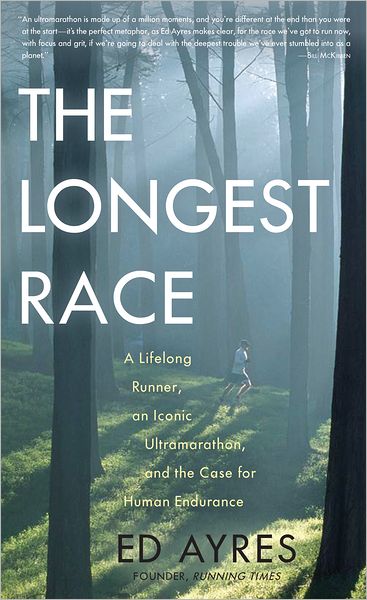
The Longest Race: A Lifelong Runner, an Iconic Ultramarathon, and the Case for Human Endurance by Ed Ayres

An ultramarathon, run by a master of the sport, becomes a metaphor for the race for human sustainability we are all running.

Ed Ayres has been running competitively for more than half a century. On a professional basis, he’s also studied climate change, sustainability and a variety of issues facing the future of the human race and our planet. The Longest Race is the story of his 2001 run at the JFK 50 Mile, the United States’ oldest ultramarathon. As Ayres attempts, at age 60, to set a new age-group course record, he contemplates the relationship of human endurance to the sustainability of human life in a fast-changing world.

Ayres’s recollections a decade later are heavy on metaphor. The ultramarathon is a symbol not just for his life, but for any man or woman’s life, and ultimately for the lifespan of humanity. The attributes that work toward sustainability at an individual level are equally valuable in a large society, Ayres says, and today’s “sprint culture” would do well to reconsider the concept of pacing. He also touches on the atom bomb, human evolution, the U.S. crisis in physical fitness and the reasons for following a vegetarian diet. But for all its peripatetic allegory, The Longest Race is always the story of one epic 50-mile race in all its technical and visceral elements, and also a celebration of the sport of running and of our ability to keep running in changing times. For those readers inspired by his story, the appendix offers practical advice to the aspiring ultrarunner.


This review originally ran in the October 19, 2012 issue of Shelf Awareness for Readers. To subscribe, click here, and you’ll receive two issues per week of book reviews and other bookish fun!


Rating: 8 miles to go.

EDIT: See also my father’s glowing review of same.

Teaser Tuesdays: Walden by Henry David Thoreau

Teaser Tuesdays is a weekly bookish meme, hosted by MizB of Should Be Reading. Anyone can play along! Just open your current read to a random page and share a few sentences. Be careful not to include spoilers!

As I’ll be in Concord, Mass. in just a few days to visit the very place (!), I am reading Walden this week. It shouldn’t have taken me this long! There is no shortage of quotable moments in this American classic, many of which you would recognize even if you never knew their provenance; but I chose one I thought especially clever, and a little humorous as well:

I say, beware of all enterprises that require new clothes, and not rather a new wearer of clothes.

Here, here, Mr. Thoreau. One of many gems.

For any Walden fans out there (like my friend I got to visit with this past weekend), I have a recommendation for further reading: I really enjoyed Edward Abbey’s short piece entitled “Down the River with Henry Thoreau.” I read it in the Abbey collection, Down the River, but you can also read it online here.

And what are YOU reading?

On a Farther Shore: The Life and Legacy of Rachel Carson by William Souder

Rachel Carson was born in 1927 and by the 1950’s was the author of several bestsellers, a national hero for her lyrical, literary, scientifically accurate books about the ocean. She also published myriad magazine and newspaper articles, both as a government employee and as a freelance writer. In 1962 she published a somewhat different kind of book. Silent Spring retained the literary style for which she was well loved, but its subject – while still the natural world – took a different tone. Carson wrote about the then-widely-used pesticide DDT and its sinister effects, not just on the insects it claimed to target, but on wildlife generally including many fish and birds (hence the title) and even human life.

The immediate reaction to her book was mixed. Critical reviews were more positive than negative, but the government (to varying degrees) and the pesticide industry (predictably and totally) offered less praise. Carson came under attack as a hysterical nature faddist and Communist sympathizer, even as Silent Spring topped bestseller lists and initiated federal investigations. Today, the ecology and environmental movements credit Rachel Carson and Silent Spring with helping to establish what is now a central issue of our times.

William Souder’s new biography of Carson, published on Silent Spring‘s 50th anniversary, begins with the conjecture that Carson’s name is now “unknown to almost anyone under the age of fifty.” There are a few of us, of course (although I confess my personal poll may not constitute a random sampling), but his point is well taken: in 2012, Carson is less on our minds. But even if DDT is no longer sprayed on kids playing at the beach and the rivers we catch our fish out of, environmental issues are among the most pressing of our day. (I am thinking of climate change, overpopulation, water tables, land use, urban sprawl, species extinction…)

That’s the argument for Carson as a biographer’s subject. Now, how did Souder do? As observed yesterday, his style is rather a traditional one. Souder himself does not enter into the story as a character; he doesn’t give us his own impressions (unless you delve into the Notes at the back of the book, on which more is coming in a later post). I am a fan of the newer style of “creative nonfiction” exemplified most recently at pagesofjulia by Soundings, but that doesn’t mean the straightforward sort of biography is necessarily dry, either.

Souder brings his subject to life. His plentiful research (again see those Notes) clearly and exhaustively outlines Carson’s background and personality, and enigmas. For instance, he notes the weekend in college when she went one two dates with a boy from another school, and then as far as we can tell, never dated again. He writes eloquently of her strange single-mindedness, for example in reading Henry Williamson for his nature writing (which she loved) while totally ignoring his frank Nazi sympathies.

I will mention one angle that I noted as absent: there is nothing in Souder’s book about Carson suffering for her sex in the field of science. This seemed like a natural obstacle for her to have faced as a science writer in the 1950’s and 1960’s, and I wonder at its absence, particularly in comparison to Soundings, where Tharp’s professional limitations as a woman are one of the central issues. Did Carson not feel that she was held back? Did Souder miss something? His work feels thorough. I am hesitant to think he missed such an important angle, but it makes me wonder. There are a few references by her contemporaries to her status as a “spinster,” but even these don’t feel particularly biting. And apparently her critics entirely missed the lesbian question. Carson had a very close female friend for the final 10-12 years of her life with whom she exchanged ardent letters. Whether they had a sexual relationship is not known, although Souder makes the case that it’s unlikely; but that’s irrelevant in looking for contemporary criticism of her for it. It seems like such an obvious way for her detractors to attack her. I just wonder.

Despite my questions about the role sexism might have played in Carson’s career, this biography feels well-researched, thoughtful, and finely wrought. It can also serve as a fairly good quick introduction to the history of ecology, environmentalism, and nature writing: Aldo Leopold, John Muir, and Teddy Roosevelt all get put into context. In fact, context is one of its strengths (again, see yesterday’s post). I feel like I know Carson much better now, which is of course what I was looking for, but it was also an enjoyable read. I recommend On a Farther Shore, because Rachel Carson is every bit as relevant today as ever.


Rating: 7 birds’ eggs.

Lost Antarctica: Adventures in a Disappearing Land by James McClintock

A warning about climate change wrapped in a tender package of stories about penguin chicks and fur seals.

Zoologist James McClintock has spent his career in the Antarctic, lovingly examining and meticulously documenting the wildlife, from the leopard seals and emperor penguins to the tiny sea butterflies and plankton, while recording changes in ocean conditions. Lost Antarctica collects a selection of his experiences: deep-sea diving, storms at sea, sightings of creatures large and small and other discoveries of tiny, crucial instances of evolutionary genius. Although he takes his time getting there, McClintock’s most important point is cautionary: Antarctica, he says, is an early warning for the rest of our world.

McClintock has observed climate change firsthand and can lend his firsthand knowledge to other studies that document and explain the crisis. He also addresses “the other CO2 problem”–the increasing levels of carbon dioxide in our oceans that lower the water’s pH levels. The combination of ocean acidification, rising temperatures and melting ice threatens many species and their delicate relationships with one another–and the consequences extend even further, as some organisms that live only in Antarctica have been shown to yield chemicals that can help fight cancer and influenza.

While Lost Antarctica is an alert about climate change and ocean acidification, it ends on a surprisingly hopeful note. McClintock’s message is reasoned and well documented–and his descriptions of a wondrous world of coral, starfish, sea sponges, fish, crabs, penguins and birds of prey make this important scientific message accessible to the general reader.


This review originally ran as a *starred review* in the Sept. 21, 2012 issue of Shelf Awareness for Readers. To subscribe, click here, and you’ll receive two issues per week of book reviews and other bookish fun!


Rating: 6 degrees Fahrenheit.

Meat Eater by Steven Rinella

A loving exploration of hunting–and meat–in human history, and its role in our lives today, from the host of the Travel Channel’s The Wild Within.


Steven Rinella (American Buffalo) grew up hunting, trapping and fishing with his two older brothers. Hunting has played many roles in his life, from a source of income and food to a form of recreation and lifestyle. In a world that increasingly gets its meat from a supermarket, Rinella offers a passionate and reasoned ode to what he calls humankind’s oldest endeavor.

In a series of vignettes, Rinella recounts experiences from childhood through parenthood. He relates the first buck he didn’t get and the experience of trailing mountain lions in Arizona and Dall sheep in Alaska. He describes his first entrepreneurial scheme to trap small mammals and sell their fur, as well as a regretted dalliance with illegal hunting methods. He discusses hunters’ ethics, the rules upon which they do not universally agree, and the idea of “fair chase.” Occasionally, he offers tasting notes on various animals’ flesh, which may be useful to his fellow hunters along with his instructions on preparation–they may also help non-hunters understand the appeal of eating, say, squirrel (not to mention “camp meat”).

“Hunting stories are the oldest and most widespread form of story on earth,” Rinella observes; thus historical anecdotes about Daniel Boone and early hunter-gatherers accompany him in his evolution from hunting for fun and profit to hunting as a way to feed his own family efficiently and mindfully. Meat Eater is a book for the nature lover or the hunter as well as the uninitiated.


This review originally ran in the Sept. 10, 2012 issue of Shelf Awareness for Readers. To subscribe, click here, and you’ll receive two issues per week of book reviews and other bookish fun!


Further thoughts: I just wanted to expand upon the above review, written for Shelf Awareness, and share my personal reaction. I came to this book not entirely ready to ally with the idea of hunting (or even meat eating) as a lifestyle. I eat meat – but I am sympathetic to the vegetarian’s and the vegan’s position, and I was curious about Rinella’s perspective. So what did I find? I found that his arguments and his outlook were both reasonable and well-presented. I was able to sympathize with just about all he had to say. Even my best vegan buddy states that, if he were to eat meat, better that it should be hunted in the wild than captured from one’s grocery store. Still, the facts of our present-day situation – a limited amount of land space and a huge and still-growing population – make a plant-based diet much more efficient. It takes less land to feed a human plants than it takes to feed the animals that will then feed the human. This is more an argument in favor of agriculture than against hunting wild creatures, I know. But still, Rinella’s method works best because he is the tiny minority that he is. We can’t all go hunting in the backcountry for our dinners; the world would not support us all in that way. And just because our ancestors did things a certain way for hundreds or thousands of years, doesn’t mean we should do it that way today. In fact, just the opposite: the world has changed so greatly that it requires different methods of us.

Also, I had to part ways with Rinella when it came to hunting mountain lions. I’m going to stick firmly with Edward Abbey on this issue.

But all that said, this was a good book: well-presented arguments, relatively convincing (even though I’m not ready to sign up for the Rinella Way, he earns my agreement with many of his points), and enjoyable to read, not to mention educational. I had no problem writing the complimentary review, above.


Rating: 7 squirrels.

Almost Somewhere by Suzanne Roberts

A contemplation of women relating to one another in nature, nestled within the tale of a backpacking trip.


In 1993, Suzanne Roberts was a college graduate lacking a firm plan for the future when she agreed to hike the John Muir Trail with two other women. Almost Somewhere is a travelogue of that month-long hike, but it’s also a woman’s foray into the male-dominated worlds of hiking and nature writing and a contemplation of the cattiness and competition that limits women’s attempts to connect with one another. Roberts is not gentle to herself or her companions as she describes their flaws and failures to support one another; she is frank about the bounds of their friendship. But she has a triumphant story to tell, because despite swollen joints, bugs, infighting and the doubts of fellow trail users, these three women hiked the John Muir Trail in its entirety and lived to tell about it.

Roberts writes plainly about gender issues, as the women (“we had gone through puberty a long time ago and, really, we were no longer girls”) consult a guidebook written by a man filled with language of “conquering” or “assaulting” mountains. She seeks not only meaningful relationships with other women, but also a feminine understanding of nature, having read nature writing only by men (Muir, Thoreau, Edward Abbey) up until this point. Her understanding of her experience is clear-headed and self-aware in retrospect, and she is considerate of her companions even in her criticism. Almost Somewhere is a contribution to the growing body of women’s nature writing, and a worthwhile, entertaining and occasionally funny story of the California wilderness.


This review originally ran as a *starred review* in the Sept. 4, 2012 issue of Shelf Awareness for Readers. To subscribe, click here, and you’ll receive two issues per week of book reviews and other bookish fun!


Rating: 6 small but important steps.

book beginnings on Friday: Almost Somewhere by Suzanne Roberts

Thanks to Rose City Reader for hosting this meme. To participate, share the first line or two of the book you are currently reading and, if you feel so moved, let us know what your first impressions were based on that first line.

Two beginnings for you here. From the Preface:

After college I set off on a hike that I imagined would be a diversion from thinking about my future. The year was 1993, the United States was in a recession, and most college graduates were finding it difficult to secure jobs.

And from the start of the book, Day 1 in diary format:

Going on twenty-three, I fancied myself a self-stylized naturalist, thought I knew about the wilderness, about wildness, because I had been an avid reader of John Muir and Henry David Thoreau.

Suzanne Roberts herself has given you a good idea of what this book is about in those two short selections, but here’s the final element: she did this hike one of three women, which remains unique today but was especially unusual in the early 1990’s, and the relationship between these women is an important part of her story, as well. I’ve only just started but am enjoying this book very much! Happy reading weekend, friends.

These quotations come from an uncorrected advance proof and are subject to change.

Hayduke Lives! by Edward Abbey

Hayduke Lives! What fun! I have been looking forward to this one – with some trepidation, yes, since lovers of The Monkey Wrench Gang tend to be disappointed; but also with good cheer, because even if it’s not the bible of eco-warriors that the other is, I have faith in Abbey and his sense of humor. And my instincts were more or less correct.

We follow a few different plots in this installment. One: George Washington Hayduke is, yes, alive and well, and trying to reconnect with his fellow monkey-wrenchers Bonnie, Doc, and Seldom Seen. Bonnie and Doc have married and have a second child on the way, and Seldom Seen is trying to (ha) lay low and play family man to all three of his wives; none wants to be pulled back into criminal activity, but each is eventually sympathetic to the cause (naturally). Two: A new, younger generation of eco-activists, including the nascent Earth First!, is organizing (sort of) to stop the latest earth-terrorizing mega machine, in this case the Arizona GEM (Giant Earth Mover). [And this is getting kind of meta, since EF! in real life came about after publication of The Monkey Wrench Gang, inspired by it. Abbey never refers to the first book or his own role, in this second book.] Three: An unnamed government organization is working with local Utahn Mormon yahoo J. Oral Hatch and (from book 1) Bishop Love to try to infiltrate and undermine EF!. Hatch and Love are both total boobs, in their own ways, and provide much of the comic relief of this book.

As in TMWG, Abbey portrays a bumbling but good-hearted, solid, self-deprecating love of Mother Earth, some action, and some laughs. What doesn’t carry over is plot: I could sort of feel that Abbey was riding the popularity of TMWG, playing around with the well-loved characters and theme, without crafting the same total package. The first was not only a good story, with a little more plot to it, but also a remarkable magic chemical confluence of characters; I think part of what we fell in love with was the odd foursome that made up the Gang, and the way they all clicked. Where the first book was already a little silly, farcical, juvenile, and heavy on the penis jokes (and don’t get me wrong, I loved it), this book is practically only those things. Enjoyable? Yes, absolutely. As important as Monkey Wrench? Not by a long shot. But I have no regrets that I (appropriately) spent part of my camping-out-in-New-Mexico vacation time reading this silly romp; it was worth every minute.

And yes, I have already purchased my bumper sticker.


Rating: 6 raucous whoops.

book beginnings on Friday: Hayduke Lives! by Edward Abbey

Thanks to Rose City Reader for hosting this meme. To participate, share the first line or two of the book you are currently reading and, if you feel so moved, let us know what your first impressions were based on that first line.

Hayduke Lives! is more than just a bumper sticker: it’s the sequel to The Monkey Wrench Gang, published at the very end of Abbey’s life. It begins:

Old man turtle ambles along the deerpath, seeking breakfast. A strand of wild ricegrass dangles from his pincer-like beak. His small wise droll redrimmed eyes look from side to side, bright and wary and shrewd. He walks on long leathery legs, fully extended from the walnut-colored hump of shell, the ventral skid-plate clear of the sand. His shell is big as a cowboy’s skillet, a gardener’s spade, a Tommy’s helmet. He is 145 years old – middleaged. He has fathered many children and will beget more. Maybe.

…so we don’t meet Hayduke and the gang immediately. But I love this opening paragraph for its eccentric descriptive style, and clear love of the land, which is what really defines Abbey.

What are you reading this weekend?