Eating Dirt: Deep Forests, Big Timber, and Life with the Tree-Planting Tribe by Charlotte Gill

eating dirtDoubly recommended by the authors of Fire Season and Dirt Work, this one moved to the top of the list.

Eating Dirt is the memoir of a tree planter. Charlotte Gill works seasonally planting trees in the Canadian west. She is employed by a company of tree planters, who contract in turn with big business – mostly logging – to replant sections of clear-cut land, usually. The daily job is to travel out to the plot in question (via beat-up truck, or boat, or by foot), load up one’s bags – a belted & suspendered piece involving two side saddle-bags and one at the rear, at hip height – with seedlings, stomp around on varying surfaces, and use a shovel and one’s hands to repeatedly insert seedlings in soil (clay, gravel, duff). It involves much bending, and the loss of fingernails. They encounter cougars, bears, muck, dirt, rain, bugs, rocks, and unspeakably sore muscles.

Gill has quite a bit in common with Christine Byl of Dirt Work: the dirty, male-dominated outdoor environment, the satisfaction of a job well done in a world populated by trees, twigs, green and brown and wild things. Not to overemphasize these two books’ similarities – because each is unique and lovely on its own and neither is derivative – but they both caused the same combined reaction in me, of yearning jealousy and thankfulness that I don’t do that for a living. What can I say. I love to be outside and wish I spent more days and nights there, but I also fret enough over my bad knees with my office job, and I like taking a shower and feeling clean after being dirty. In fact, the question at the front of my mind as I’ve finished this book is: what did clean mean in those years that make up the majority of human history, in which we didn’t have seemingly endless showers at our command?

Dirtiness aside, Gill writes with humor and wisdom and the kind of occasionally zoomed-out perspective that I like in a nature-based memoir. A little research into the history of earth, trees, and people – and the relationships between them – brings her perspective, that of just one person, into focus within a larger picture. And as a bonus, she’s based in the same general region that my parents recently moved to. We have all been learning about the Pacific Northwest – including the trees of the area – and this book offered some welcome insights to that end.

One of the more surprising subjects of Eating Dirt, for me, was the ambiguous or controversial nature of the work. I read “tree-planting tribe” and expected that it would be all green-ness and good; but as I said in my opening synopsis, Gill’s employers are most often logging companies, banking on the profitability of trees, not their inherent worth as trees themselves.

And we got paid… by the very same business that cut the trees down, which canceled the altruism right out of the equation.

Any good they provide, then, is already offset by those who paid for their planting. It’s not as simple as it seems at first glance, and Gill wastes no time in making that point.

Her voice is gritty, and her perspective not so much unapologetic in general as clear-eyed about its dual nature. She’s funny and clearly likeable – like Byl, someone I’d like to know, although I’d be intimidated by both women’s toughness. I enjoyed what I learned about the world from Gill, but also very much value what she’s encouraged me to think about.

Nature has done its big job. Like a ball thrown up in the air, all has risen, crested, and begun its arc back down into earth. After many years spent outside we come to see this – the parabola – as the contour of life itself. It’s the path the sun takes across the sky. The shape of a story. Ours included. Beginning, middle, and end.

Right up there with some of my favorites of the past few years. Recommended.


Rating: 7 red tree voles.

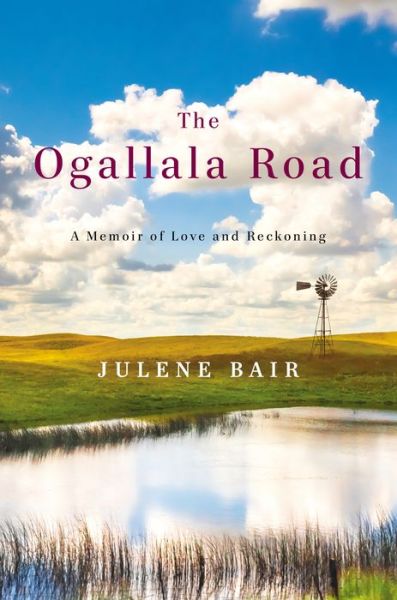
Teaser Tuesdays: The Ogallala Road by Julene Bair

Teaser Tuesdays is a weekly bookish meme, hosted by MizB of Should Be Reading.

ogallala

I found very thought-provoking Julene Bair’s memoir of returning with mixed feelings to the family farm. My full review will not be out until a little closer to its March publication date, but for now, a few lines that got me thinking:

Our sense of beauty is a survival instinct, telling us that a place can sustain us for generations to come. I’d always known this in my bones, but it wasn’t until many years after I left Kansas and discovered my passion for wilderness that the intuition became conscious. This creek was now ugly. That didn’t bode well for the underlying aquifer’s ability to support life in the future.

Part of me nods firmly at this, and part of me wonders if beauty is really the same thing as lifegiving. Perhaps it’s all in the eye of the beholder? Please weigh in, Pops.

This quotation comes from an uncorrected advance proof and is subject to change.

book beginnings on Friday: Eating Dirt by Charlotte Gill

Thanks to Rose City Reader for hosting this meme. To participate, share the first line or two of the book you are currently reading and, if you feel so moved, let us know what your first impressions were based on that first line.

eating dirt

This book came recommended from two authors I’ve fallen in love with in recent years: Phil Connors and Christine Byl. That was enough for me. Charlotte Gill begins:

We fall out of bed and into our rags, still crusted with the grime of yesterday. We’re earth stained on our thighs and shoulders, and muddy bands circle our waists, like grunge rings on the sides of a bathtub. Permadirt, we call it. Disposable clothes, too dirty for the laundry.

Hers is a memoir of planting trees, and that’s about all I know so far, but I think I’m going to love it.

Happy Friday and what are you reading this weekend?

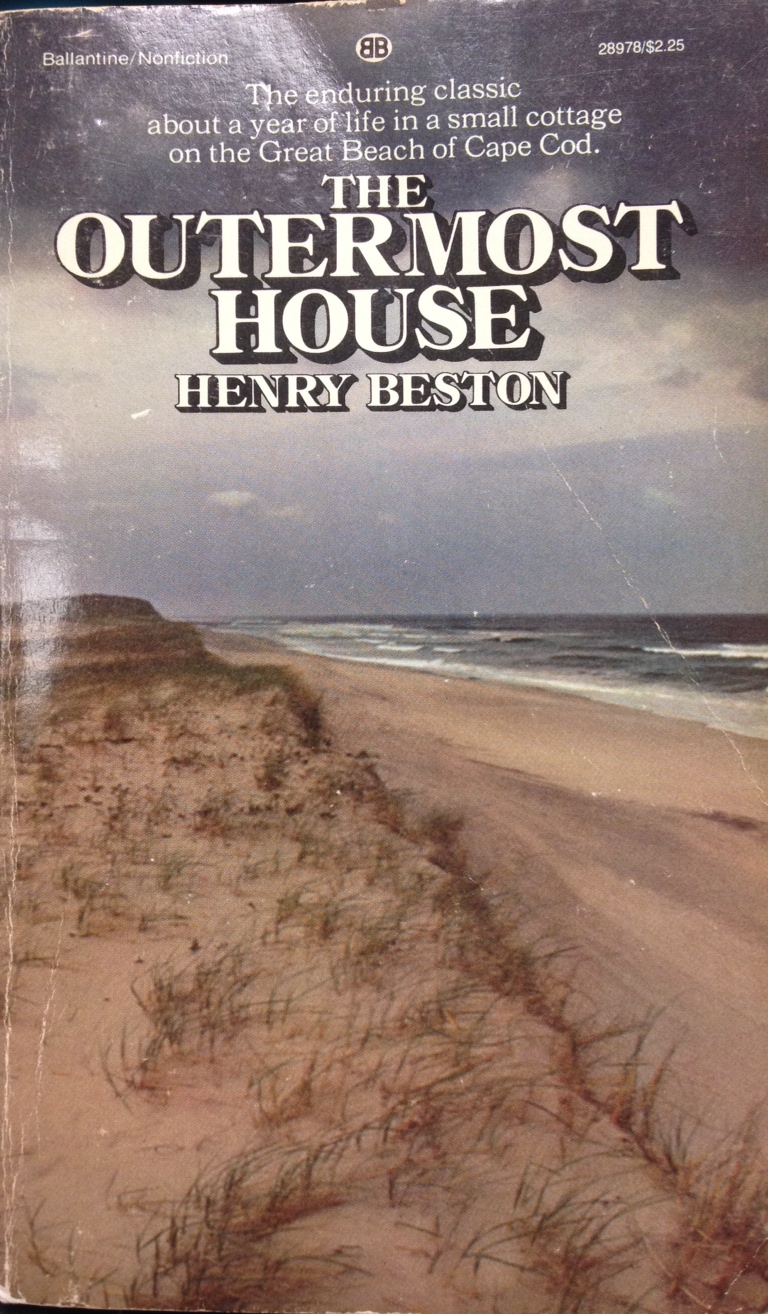
The Outermost House by Henry Beston

photo (1)This book came to me recommended by Rachel Carson. I’m relatively sure that I came up with this title in my reading of On a Farther Shore, a recent biography of the author of Silent Spring. And by that convoluted path, here we are.

The first thing that struck me about The Outermost House, and certainly the most striking overall, is its similarity to Thoreau’s Walden. I have been describing it as “Walden Pond on Cape Cod.” Henry Beston wrote this book in 1928 about a year he spent, rather by accident, on the island; he had a small, humble cabin constructed on a remote dune for the purpose of visiting more often, and moved in in the fall, thinking he’d be there only a matter of weeks but staying a full year. (My edition also contains a new foreword from 1949.) That Thoreau would be well-known to Beston, his literary descendant of just a few decades in the same region, is clear, even if he weren’t mentioned by name around page 100. The similarities are many (more below), but I don’t mean that to take away from Beston’s work. I think Walden bears some imitation, and Cape Cod is different enough from the Concord locale to justify its own study.

The next thing that struck me is Beston’s comfortable observation that, although “man” has altered & damaged the world mightily, “Nature” is overall impervious, and Cape Cod in specific remains untouched. I congratulate Beston that in 1928 (and ’49) he was able to feel such confidence. Today, sadly, he would not.

Like Thoreau, Beston describes his home in some detail, for its details are hugely relevant to his year on the outer beach. Like Thoreau, he sees his fire as a friend and companion, a major force in withstanding solitude. And like Thoreau, he overstates that solitude, first writing of how very, very alone he was – how very rare was a human face in his year out there in the wild – and in the next breath, shamelessly, noting that he saw his Coast Guard buddies from up the beach almost daily, and walked into town for groceries once or twice a week. Having come to terms with this dissonance in Walden, I just smiled at it. Solitude is clearly relative, and he’s enjoyed far more than I have experimented with.

The Outermost House is perhaps most lyrical and pensive in its contemplation of bird life and waves, and equally thoughtful in its treatment of the Cape Cod locals and the solidarity they feel with wrecked vessels on its shore. He seems to refer to a “god,” although not by name; he is very concerned with “man”‘s relationship to Nature (always the capital N), and how sick we get when we disconnect. These themes are timeless and not dated at all.

For those who enjoyed Walden, this will undoubtedly be a great pleasure. If anything, Beston is less pretentious and self-congratulatory than Thoreau was. His descriptions of the migratory birds of Cape Cod’s seasons are lovely and, I imagine, useful for scientists & natural historians. It’s well-written, short (under 200 pages), and solid.

I will let Beston himself close, with a few of my favorite lines.

Glorious white birds in the blue October heights over the solemn unrest of ocean – their passing was more than music, and from their wings descended the old loveliness of earth which both affirms and heals.

…today’s civilization is full of people who have not the slightest notion of the character or the poetry of night, who have never even seen night. Yet to live thus, to know only artificial night, is as absurd and evil as to know only artificial day.


Rating: 6 tseeps.

The Hunted Whale by James McGuane

An evocative photographic study of historic whaling tools and techniques.

huntedwhale

“The hunt is one of man’s most ancient endeavors,” begins The Hunted Whale. James McGuane’s photographic exploration into the bygone practice of whaling transports the reader back in time, when whale oil lit the streetlights of the world’s major cities and lubricated the burgeoning textile industry. Whaling was a significant economy unto itself, employing countless young men who were convinced to ship out for years at a time by employment agents known as “land sharks.” It was a trade performed by hand, and McGuane examines its many aspects: hunt, ship, whaleboat, crew, whale, tools and more.

McGuane’s text is accompanied by more than 200 fine, detailed color photographs depicting whaling artifacts, including several examples of scrimshaw–the art of painted, engraved or carved whalebone or teeth. Photographs of twisted and mangled–but intact–harpoons give visceral evidence of the whale’s power to resist human efforts, and McGuane details the methods in practice. Also showcased are innovative technologies, such as toggled harpoons or “irons.”

Selections from Logbook for Grace, a diary kept by naturalist Robert Cushman Murphy aboard the whaleship Daisy in 1912, add a valuable firsthand perspective and bring McGuane’s subject to life. With all its salty flavor, The Hunted Whale is an obvious choice for fans of Moby-Dick, but history or naval buffs and fans of pre-mechanized times will be equally charmed by this detailed pictorial view of the ancient industry of whaling.


This review originally ran in the November 5, 2013 issue of Shelf Awareness for Readers. To subscribe, click here, and you’ll receive two issues per week of book reviews and other bookish fun!


Rating: 5 scrimshanders.

art and dirt

[I recently read Theo Pauline Nestor’s Writing Is My Drink, but my review won’t be published at Shelf Awareness for another week or two.]

I remember from Natalie Goldberg this thing that I also recognize in Theo Pauline Nestor: an aversion to the outdoors, a lack of appreciation for nature. It is apparently something to be avoided, cleaned off your shoes if you accidentally step in it, and this is every bit as disturbing to me as the people who react to the idea of exercise by saying that they “don’t like to sweat.” What!! What a bizarre concept, to not like to sweat. Sweat is not the first or primary goal of exercise, I want to tell them, any more than getting dirty is the primary goal of going outside; but both results (and they cross over quite a bit) feel good because they are of the nature of their parent: exercise, and the outdoors.

Nestor writes, of camping: “life’s hard enough; why turn it into a three-ring circus by trying to rub sticks together just so you can boil water for morning coffee?” And then later, in praise of her medium: “writing comes from the wild place, from the home of the undomesticated, the untamed, the feral.” As if that is a good thing. How can the undomesticated, the untamed, the feral, the wild place, be a good thing if camping is a bad thing? And oh how simplistic (and ill-informed) her picture of camping: that it involves rubbing sticks together, for chrissakes, to make coffee!

Why the disconnect? Why does art have to take place in clean and civilized environs? Don’t get me wrong, I like a good coffeeshop too; but I worry that there’s something missing from a person who appreciates art and beauty and yet thinks camping is an unnecessary complication. Some of us feel that camping is a necessary reduction in complications, in fact: think on that for a moment. You can even forgo the coffee and use trees and sky as your stimulant! I want to be clear that I very much enjoyed Goldberg’s Writing Down the Bones and Nestor’s Writing Is My Drink, and I found both useful. But I think I’m bound to identify better with Philip Connors and Christine Byl, artists unafraid to get dirty.

book beginnings on Friday: The Hunted Whale by James McGuane

Thanks to Rose City Reader for hosting this meme. To participate, share the first line or two of the book you are currently reading and, if you feel so moved, let us know what your first impressions were based on that first line.

huntedwhale

The title recalls a certain famous fictional white whale, or is that just me? This is a coffee-table style book, I expect (my copy is pre-publication), and filled with images. It begins:

The hunt is one of man’s most ancient endeavors. One can barely imagine an early time when man was free from the need to find nutritious food or eliminate a dangerous predator. It’s been posited that language itself grew out of the need for precise communication as men stalked and hunted prey.

No argument there, I don’t think. And I like that McGuane pulls language into his opening lines – this being a work of written artistry, after all. But The Hunted Whale promises to star the whale, as well as the hunt, so stay tuned.

These quotation comes from an uncorrected advance proof and is subject to change.

a few short pieces


“A Shirt Full of Bees” by Bill McKibben

My father sent me a copy of this essay, but it’s not shareable under copyright restrictions; and I couldn’t find a publicly accessible version I was happy with. I’m sorry. If you can track down this issue of Utne Reader, through your local library for example, you can read the article yourself.

How strange the way things come together. I’ve just recently been enjoying Annie Dillard’s Pilgrim at Tinker Creek; and my favorite parts of that book are her in-depth, lengthy examinations of parts of nature. One of those subjects she gets good and lost in is newts. And here is Bill McKibben, opening “A Shirt Full of Bees” with an episode starring Terry Tempest Williams (When Women Were Birds; I also loved her Pieces of White Shell) and a newt. Williams crouched on her haunches for half an hour examining the newt, “lost in the world of the newt” in McKibben’s words, and he found himself bored, restless, ready to keep walking, to reach the summit – something we do constantly, of course. And then, on another day, he steps on a yellow jacket nest, and as he erupts in hives and dashes down-mountain for medical aid – “My dog was the best dog I’ve ever had, but I doubted she was up to surgery” – McKibben sees more clearly the beauty around him. That’s the larger point in this short essay: we are always pushing for the summit, and too busy to examine the newts on our path. As I observed in Oil and Honey (the only one of his books I’ve read; but my father is rather an expert), McKibben is a gifted writer. He pulls together two anecdotes – his walk in the the woods with Williams and the newt; his walk in the woods with his dog and the yellow jackets – in a lovely, poignant, meaningful, beautifully written and well-structured essay of three pages. This is the goods, right here.


“Confessions of a Recovering Environmentalist” by Paul Kingsnorth

Pops reminds us that Kingsnorth was the author of “Dark Ecology” that I discussed back in January. This latest is available here.

Kingsnorth opens charmingly with recollections from his youth, ages 12, 19, and 22, in natural settings. These are the experiences that taught him to love “the other-than-human world.” He became an “environmentalist,” that radical thing. And now he laments what “environmentalism” has been bastardized into: a quest for zero-carbon emissions, for alternative energy sources, for sustainability – all good things, doubtless, except that “sustainability,” he argues, is code for finding a different way to do the same things we do now. In other words, we need to release less carbon, so we need to find another energy source so that I can still have my lights and electricity and drive my car and buy my cheaply made clothing at the mall. He points out that we seek a way to sustain our lifestyle – not to sustain the earth, which is sort of what we claim to be seeking. And of course there is the central, painful irony, that “the farmers are being edged out by south-country refugees like me, trying to escape but bringing with us the things we flee from.” He even addresses the touchy subject of “industrial wind power stations (which are usually referred to, in a nice Orwellian touch, as wind ‘farms’)” which McKibben has also struggled with. Are “wind farms” environmentalist?? There is an argument.

Kingsnorth is clever in his criticisms: “these days I tend to consider the entire bird with a kind of frustrated detachment” (that is, the oft-cited bird that has a left wing and a right wing), with which I certainly sympathize; “the colonization of the greens by the reds” characterizes all those myriad left-wingers (“disillusioned socialists, Trots, Marxists, and a ragbag of fellow travelers who could no longer believe in communism or the Labour Party or even George Galloway…”) who’ve taken over his movement. But don’t let his wittiness distract you from the fact that he is right. Again ironically, the problem seems to lie in the success of the “green movement”: save-the-planet is now a perfectly respectable, mainstream concept that you can now find on 3 out of 4 cereal boxes, and that bringing of Kingsnorth’s environmentalism into centrist politics has weakened it, watered it down, naturally, as centrism does.

Like the earlier Kingsnorth piece I read, this one gives quite a dark view in examining “environmentalism.” But like that other pessimistic-or-realistic writer, Derrick Jensen, I see his points, and I’m rather more inclined to follow him than I am to follow McKibben’s optimism.


“A Tough Flower Girl” by Phillip Connors

I am not yet done following Phil Connors. This is not a new piece, but one I’ve had to reread now that I am an affirmed follower of Norman Maclean. Connors’ article is available here.

Another fine piece of writing: Connors explores what we find so moving, timeless, and important in Maclean, but he also creates a piece of art in its own right. This short article is an excellent introduction to Maclean, in his best-known A River Runs Through It (and the two accompanying stories), in Young Men and Fire (better-loved, I think, by both Connors and myself), and in The Norman Maclean Reader (imperative for those of us left wanting more by the first two). It is an incisive piece of literary criticism and appreciation; but it also includes a personal story, as Connors opens by pointing out his biographical similarities to the great Maclean. If it is indeed “uncool to admit an enthusiasm based in part on biography”, call me uncool. Not that I share biographical parallels with my literary idols (ha), but I certainly consider their biographies integral to my appreciation. Funnily, I have just finished searching for a good Maclean biography, and am disappointed by the lack. Somebody please write this book. Phil?

Read this article because it says true things about an amazing writer, but also because it is in itself a sparkling, crystalline beauty.


“Smoke” by Phillip Connors

A new piece from Connors, available here.

I am reminded of how much I love Connors’ voice, that he isn’t afraid to have one, first of all, and that he is both intellectual and casual in it. He acknowledges that “self-quotation is a dishonorable habit, but it sounds a little smug to say I saw it coming and leave it at that,” and so he self-quotes from Fire Season, that book I loved so much, in which he predicts that “the big one” is coming. “If you live on a peak in fire-prone country, as I do every summer in the Black Range of New Mexico’s Gila National Forest, the big one will eventually come for you.” This very short piece is the story of that fire beginning, and beginning to be fought, and its victory: it burned over two hundred square miles, just this past summer of 2013. There is always a conflict in considering these events. Fire is nature, a natural part of a forest’s life cycle, healthy. But we the human influence have thrown that cycle off until the fires we finally earn and reap are less healthy for the world we’ve come to love, and that’s part of the tragedy that Connors has to share. He ends this piece, appropriately, on a conflicted, hopeful, tragic note. At least he has those memories.

I’m looking forward to the next book that he is reportedly working on now.

remarkable bits from Pilgrim at Tinker Creek

Correct: we are still not done with Annie Dillard. I may have to make her a tag as I have done for Abbey and Hemingway. (…Haven Kimmel, Norman Maclean…)

EDIT: here we are.

On top of my reviews, I felt the need to share some of my favorite lines and passages with just a few notes. Enjoy.

There are seven or eight categories of phenomena in the world that are worth talking about, and one of them is the weather.

One wonders very much what else would make her list!!

I want to think about trees. Trees have a curious relationship to the subject of the present moment. There are many created things in the universe that outlive us, that outlive the sun, even, but I can’t think about them. I live with trees. There are creatures under our feet, creatures that live over our heads, but trees live quite convincingly in the same filament of air we inhabit, and in addition, they extend impressively in both directions, up and down, shearing rock and fanning air, doing their real business just out of reach. A blind man’s idea of hugeness is a tree. They have their sturdy bodies and special skills; they garner fresh water; they abide. This sycamore above me, below me, by Tinker Creek, is a case in point; the sight of it crowds my brain with an assortment of diverting thoughts, all as present to me as these slivers of pressure from grass on my elbow’s skin.

I loved this because I, too, love trees; and this is a well-articulated (but still rather charmingly airy, too) explanation why. Also, I enjoy Dillard’s use of the semi-colon, my personal favorite punctuation mark. (Yes. I’m a librarian and a reader and writer. I have a favorite punctuation mark.)

My God, I look at the creek. It is the answer to Merton’s prayer, “Give us time!” It never stops. If I seek the senses and skill of children, the information of a thousand books, the innocence of puppies, even the insights of my own city past, I do so only, solely, and entirely that I might look well at the creek.

“It never stops.” Golly, I hope she’s right. Climate change has us receiving too much rain here and not enough rain there; the forests are burning; the glaciers are melting; I fear the creeks are stopping (and starting up elsewhere). But in 1974, I can understand this thinking.

I suspect that the real moral thinkers end up, wherever they may start, in botany.

This, too, is charming: a nerdy confirmation of the power of trees and other green things (and non-green things as well).

John Cowper Powys said, “We have no reason for denying to the world of plants a certain slow, dim, vague, large, leisurely semi-consciousness.” He may not be right, but I like his adjectives. The patch of bluets in the grass may not be long on brains, but they might be, at least in a very small way, awake.

Who is Dillard to say that he may not be right? Goodness, with all the time travel and metaphoric “patting the puppy” she gushes and coos, why not let trees have a certain semi-consciousness? And those complaints aside, does anyone else hear the Ents walking through those lines? Lovely.

All the green in the planted world consists of these whole, rounded chloroplasts wending their ways in water. If you analyze a molecule of chlorophyll itself, what you get is one hundred thirty-six atoms of hydrogen, carbon, oxygen, and nitrogen arranged in an exact and complex relationship around a central ring. At the ring’s center is a single atom of magnesium. Now: If you remove the atom of magnesium and in its exact place put an atom of iron, you get a molecule of hemoglobin. The iron atom combines with all the other atoms to make red blood, the streaming red dots in the goldfish’s tail.

And that blows my mind: a scientific, tiny-scale, real-life confirmation, like a metaphor but grounded in reality on the molecular level, of our intricate connection as living, breathing, animal things to living, breathing green things. I love that.

vocabulary lessons: Pilgrim at Tinker Creek

Annie Dillard had me quite active with my note-taking for later looking up. I have included only the highlights here for you.

anchorite: “An anchorite’s hermitage is called an anchor-hold; some anchor-holds were simple sheds clamped to the side of a church like a barnacle to a rock. I think of this house clamped to the side of Tinker Creek as an anchor-hold.”

discalced: “[The effort to] gag the commentator, to hush the voice of useless interior babble that keeps me from seeing… marks the literature of saints and monks of every order East and West, under every rule and no rule, discalced and shod.”

spate: “I live for… the moment when the mountains open and a new light roars in spate through the crack, and the mountains slam.”

oriflamme: “The flight [of a flock of starlings] extended like a fluttering banner, an unfurled oriflamme…”

sonant and surd: “The wind shrieks and hisses down the valley, sonant and surd…”

scry: “…I had better be scrying the signs.”

eidetic: “…we have feelings, a memory for information and an eidetic memory for the imagery of our own pasts.”

obelisk: “We run around under these obelisk-creatures, teetering on our soft, small feet.” (She’s referring to trees.) and, 20 pages later: “A tree stands… mute and rigid as an obelisk.”

pavane: “An even frailer, dimmer movement, a pavane, is being performed deep under me now.”

neutrinos: “I imagine neutrinos passing through [a bird’s] feathers and into its heart and lungs…”

racemes: “Long racemes of white flowers hung from the locust trees.”

a two-for-one, etiolated and lambent: “The leaf was so thin and etiolated it was translucent, but at the same time it was lambent, minutely, with a kind of pale and sufficient light.”

eutrophic: “The duck pond is a small eutrophic pond on cleared land…”

phylactery: “…the microscope at my forehead is a kind of phylactery, a constant reminder of the facts of creation that I would just as soon forget.”

cofferdam: “…pouring wet plaster into the cofferdam…”

stet: “If the creature makes it, it gets a ‘stet’.”

shmoo: “Generally, whenever he was out of water he assumed the shape of a shmoo…” (referring to a muskrat).

enow: “The Lucas place is paradise enow.”

lorn: “A bobwhite who is still calling in summer is lorn…”


See other “vocabulary lessons” posts here.