Death on the Riviera by John Bude

A quirky cast and scenic setting characterize this long-out-of-print British classic mystery.

death on the riveria

The British Library’s Crime Classics series, with Poisoned Pen Press, presents a mystery that was out of print for decades: Death on the Riviera by John Bude. Originally published in 1952, Bude’s novel benefits from an introduction offering context and a brief biography of the author.

The titular death does not occur until late in the story, which is mostly concerned instead with a counterfeiting ring. Scotland Yard’s Detective Inspector William Meredith and inexperienced Acting-Sergeant Freddy Strang take an alluring trip to the French Riviera to track down an Englishman suspected to be an expert engraver of false bank notes. There they enjoy sunshine, food and drink, and Strang pursues a potential romantic interest. Meredith and Strang contemplate their case aloud, sharing their investigation with distinctive French colleagues like the rotund and self-indulgent, but able, Inspector Blampignon. They’re repeatedly drawn into the household of a complacent, moneyed widow, her estate peopled by eccentric hangers-on: a romantically bohemian artist, a bored niece, a spoiled young playboy and an unwelcome beauty.

Bude employs period-specific usages and references, which add color and amuse. Death on the Riviera is recommended particularly for fans of classic or playful mysteries seeking a nostalgic experience. The mystery itself is less puzzling than its modern counterparts; rather than presenting a true challenge as a whodunit, it gives Meredith and Strang the opportunity to explore an appealing setting and a cast of whimsical characters. Bude offers a funny, light-hearted read, and marks a point in the historical development of the murder mystery.


This review originally ran in the March 11, 2016 issue of Shelf Awareness for Readers. To subscribe, click here, and you’ll receive two issues per week of book reviews and other bookish news.


Rating: 6 sunny days.

did not finish: Ripper by Isabel Allende (audio)

ripperAll right, I give up, a little bit, on Allende. The Japanese Lover was stronger on language than on character, and Maya’s Notebook even more so. Not since Inés of My Soul have I been bowled over by the whole package of story, character and language.

Ripper starts out intriguingly, as noted. But I only made it about 10% through the book before finding myself frustrated by the characters. The voluptuous, beautiful blonde with a heart of gold who is blind to people’s flaws; the materialistic rich guy she dates; the obnoxious teen (really, I find this one a lot. I know they can be difficult – I was – but they have to be more complex than this); etc. And then the unrealistic details (which I noted in Maya’s Notebook), as when our teenaged sleuth demands all the details of an ongoing murder investigation, because “it’s public record”: not so.* This kind of disregard for facts, in an otherwise realistic setting, bugs me; and combined with the flat characters, I couldn’t keep going.

Allende is one of the best when it comes to description and language. But that’s not always enough, for me at least. I’ll hold out for her next critically acclaimed work before I come back.


Unrated.

*I felt like I knew this from watching crime shows on television. Obviously not a strong source, so I found some stronger ones, below. The gist of it is, specific details of a crime whose investigation is ongoing are exempt from public records legislation, where the release of those details might jeopardize the investigation. For example, the details of specifically what was done to a murder victim might be held back so that the police can distinguish real confessions from fake ones. This is classic crime fiction stuff, but also fact. “Most states exempt from disclosure law enforcement investigatory records,” from the Connecticut General Assembly’s Office of Legislative Research, reporting on states’ laws. The LA Times refers to “investigative records exempt from public release under California’s public records law.” “Specified facts from investigatory or security records, without disclosure of the records themselves, must be disclosed unless disclosure would endanger the successful completion of an investigation, or related investigation, or endanger a person involved in the investigation. Cal. Gov’t Code §§ 6254(f)(1), (f)(2) and (f)(3),” from Reporters Committee for Freedom of the Press. “Information that may jeopardize an investigation, related investigation or law enforcement proceeding” are exempt from public records access, according to the LAPD. “Law enforcement investigative files may be withheld, but not the basic facts.” Californians Aware, The Center for Public Forum Rights. Etc.

book beginnings on Friday: Ripper by Isabel Allende (audio)

Thanks to Rose City Reader for hosting this meme. To participate, share the first line or two of the book you are currently reading and, if you feel so moved, let us know what your first impressions were based on that first line.

ripper

She is not perfect: I found The Japanese Lover to be, not bad, but less than she is capable of. But I still look forward to reading Isabel Allende.

Ripper begins:

“Mom is still alive, but she’s going to be murdered at midnight on Good Friday,” Amanda Martín told the deputy chief, who didn’t even think to question the girl. She’d already proved she knew more than he and all his colleagues in Homicide put together.

I thought that was a hell of an opening, and the pages that follow are equally engaging. Stick around.

The Red Storm by Grant Bywaters

The case of a disgruntled P.I. with mysterious enemies is set in atmospheric 1930s New Orleans.

red storm

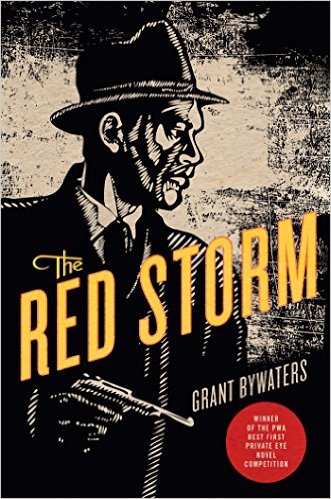
Grant Bywaters employs his expertise as a licensed private investigator in his first novel, The Red Storm. William Fletcher was a 1920s black prizefighter whose ambitions for the heavyweight title were frustrated by the prejudices of his day. After the end of his boxing career, he becomes a P.I. in New Orleans, a city Fletcher credits with a “more lax view on segregation.” He struggles to make a living, though, so when a contact from his old life shows up more than 15 years later requesting help, Fletcher reluctantly agrees to investigate, even though Bill Storm is a wanted murderer. Storm wants to find his estranged daughter. But as soon as Fletcher contacts her, violence breaks out around both Fletcher and Zella Storm. What, exactly, has Storm gotten him into?

Fletcher is a loner, with racial tensions adding to the distinctive anti-authority stance his profession tends to take. Zella is a peppery character, with an ambitious career singing in French Quarter establishments that would rather she just take her clothes off. Bywaters evokes a recognizable New Orleans and surrounding swamps, and the police are hard beset by organized crime, both local and inbound from New York City. Fletcher may be just the man to help out, if he can keep himself and Zella alive. The Red Storm‘s plot is solid, but it is the setting in both time and place that distinguish this classically styled noir P.I. story, which Bywaters flavors with period slang as liberally as a Creole cook spices food.


This review originally ran in the December 22, 2015 issue of Shelf Awareness for Readers. To subscribe, click here, and you’ll receive two issues per week of book reviews and other bookish fun!


Rating: 6 songs.

movie: Rear Window (1954)

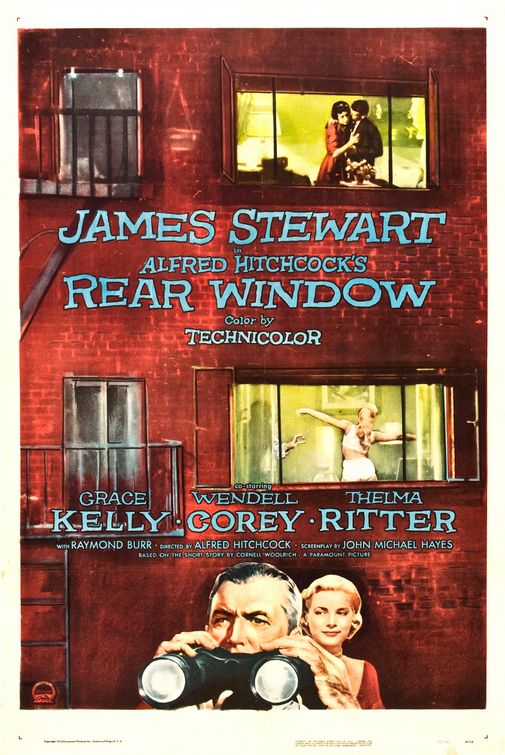
Happily, after some disappointment with The Birds the other night, I moved directly into another Hitchcock film that pleased me far more. I found Rear Window entertaining, clever, funny, and visually pleasing. Jimmy Stewart and Grace Kelly don’t hurt, of course. But fundamentally, I think murder-mystery ages better than horror, and that is what Rear Window is: not horror, but a noir murder mystery, which is one of my favorite things.

rear windowJames Stewart is L.B. Jefferies (“Jeff”), successful photographer of the adventurous sort, known for action shots, combat and the like. He is laid up with a broken leg, in a wheelchair, in his apartment, which suits him poorly, of course. Also irksome is his girlfriend and would-be fiancé, the lovely Lisa (Grace Kelly), a wealthy socialite he feels can’t possibly accept his life on the edge. Bored and bothered, he takes to spying on his neighbors out the window. The entire movie takes place from this perspective: we only ever see the inside of Jeff’s apartment, and the view he sees out its window, into a courtyard and the windows that also look upon it. There’s a middle-aged couple with a little dog; a female sculptor; a young ballerina who entertains many men; a slightly older, lonely woman; a composer struggling with his latest work; and a salesman who appears to be entirely tired of caring for his invalid wife. Jeff is visited by Lisa as well as a nurse, and a police detective friend he calls on for help when he thinks he’s witnessed a murder.

I loved the visuals: both James Stewart and Grace Kelly (particularly in tandem), and the vignette-style views of courtyard and other apartments, almost a shadowbox effect. I loved the survey of lives and loves provided by Jeff’s perspective. The lives he peeks into represent a range of experiences of life, different levels of contentment. I thought the suspense was well-done in a classic, thunder-and-lightning, guns-and-beautiful-ladies style. Even the puzzle itself – the whodunit – was engaging, if imperfect. The business with the flashbulbs struck me as quite ridiculous, but I laughed good-naturedly, because the overall effect of the story, the sets and the cast was so enjoyable. My fourth Hitchcock film is definitely my favorite. Fans of Agatha Christie will be pleased.


Rating: 9 little red pills.

Two Wheels by Greg Moody

two wheelsAn unusual treat: I read this book all of my own choosing.

Two Wheels is the first in Greg Moody’s series of murder mysteries framed by the professional road bike racing world. Naturally, it is set in Europe, although the main characters are Americans. Jean-Pierre Colgan is the world’s best, and leader of the accomplished Haven team, sponsored by Haven Pharmaceuticals. He is a cocky and not entirely likeable character, which is a fine thing because he dies in the opening pages when his brand-new, high-tech American toaster explodes. In the first quirky turn, we then see Colgan enter heaven – or something like heaven – where he is greeted by Il Campionissimo, Fausto Coppi. Anquetil, on the other hand, won’t speak to him.

Next we meet the American Will Ross, a washed-up retired racer drinking himself stupid in Belgium, who inexplicably gets hired to replace Colgan on the Haven team. Will is as surprised as anyone, still more so when his ex-wife turns out to be part of the team’s management. With no love lost between them, her position only makes his hiring more confounding.

Cheryl is the team soigneur, also American and regretting the recent end of her own race career. She and Will get off to a rocky start, but she will turn out to be an ally. Tomas Delgado is team mechanic, and an old friend of Will’s: good news. The rest of the Haven squad is understandably unhappy to have Will join them, but he is just starting to get the hang of things again – find his legs, and his lost passion for the sport – when the body count begins to rise. Colgan’s death, of course, was no accident. Somebody seems to have it out for the Haven team, and Will finds himself attempting an awkward impromptu investigation, in the interest of saving his own skin. Oh yes, and there is French detective Godot, who reminds us of Columbo and seems to be imitating that American icon on purposes. There is a thread throughout the story of the tension between American and French culture: television, slang, American football versus professional cycling.

Two Wheels is not quite a cozy, as the murder weapon of choice is plastic explosives and the results are pretty bloody; but it fits into the sub-genre of mysteries defined by their framing elements. The plot of the mystery itself is enjoyable, if not especially remarkable unto itself. Will is a little slow on the uptake as investigator, and a big coincidence revealed late in the book falls a bit short of credible. As a mystery, then, Two Wheels is fine but not unique. The cycling motif is more distinctive, and adequately well done; the pain and love of the sport, the pavé of Paris-Roubaix and the climbs of La Ronde van Vlaanderen are convincing. Moody is at his best when he works with Will’s self-deprecating humor; for lyrical praise of the road I recommend Tim Krabbe’s The Rider instead; but the whole package is perfectly entertaining, often funny, and overall loveable. Obviously, Two Wheels will be most appreciated by those who share Moody’s and Will’s love for the sport. I think it could be the start of a promising series.


Rating: 6 kilometers.

book beginnings on Friday: Two Wheels by Greg Moody

Thanks to Rose City Reader for hosting this meme. To participate, share the first line or two of the book you are currently reading and, if you feel so moved, let us know what your first impressions were based on that first line.


two wheels

I am having a rare break between paid reviews, and undertaking a lighter read. Two Wheels is “a cycling murder mystery,” and a bit silly, but fun. It begins:

“It’s good to be king,” he thought. Jean-Pierre Colgan stood at the window, staring out over a dazzling Paris on a drizzling late January Sunday. Despite the rain and the gray overcast, it remained a dazzling Paris because it was a Paris that belonged to him.

I like the interplay of dazzling / drizzling.

It will not be a spoiler (because it happens in the first few pages, and is stated in the back-of-the-book blurb) to tell you that Colgan is killed in a bizarre explosion involving a high-tech American toaster. (The troubled relationship between French and American cultures – centrally in television and sports – is a theme.) So, not king for long.

Stay tuned.

A is for Arsenic: The Poisons of Agatha Christie by Kathryn Harkup

A comprehensible survey of poisons and a celebration of the Queen of Crime.

a is for arsenic

Chemist Kathryn Harkup combines her scientific expertise and love of a good mystery in her first book, A Is for Arsenic: The Poisons of Agatha Christie. B is for belladonna, and C is for cyanide, as Harkup works her way through 14 mysteries and 14 discrete poisons, with meticulous and informed explanations of the science behind each toxin’s effects (an appendix contains chemical structures). Each chapter also details famous real-life cases involving these deadly substances, including those that might have inspired–or been inspired by–Christie’s work, and analyses of how accurately the Queen of Crime represented the science within her stories. Generally the renowned writer does very well: as Harkup explains, Christie worked as a volunteer nurse in World War I and showed such aptitude that she was encouraged to continue her education and training as a pharmacist. By the Second World War, her work as a dispenser left her ample time to pursue her other profession, writing bestselling stories and novels.

Harkup’s writing style is accessible to the lay reader, although she does become technical when discussing poisons’ actions on the body, with full detail at the cellular level. She keeps these explanations short, however, and general readers will be able to follow along. For Christie fans, the review of famous mysteries is great fun, and the few spoilers come with ample warning. A Is for Arsenic is both informative science and a spur to read or reread the most popular mysteries ever written.


This review originally ran in the September 25, 2015 issue of Shelf Awareness for Readers. To subscribe, click here, and you’ll receive two issues per week of book reviews and other bookish fun!


Rating: 6 grains.

Last Ragged Breath by Julia Keller

last ragged breathThis is the fourth novel in Julia Keller’s detective series starring Bell Elkins, a lawyer with a high-powered degree who has returned to small-town West Virginia to work as a prosecutor there. I tried to read (or actually, listen to) the first, A Killing in the Hills, and found the characters a bit flat. In a nutshell, Last Ragged Breath was very enjoyable, but did not entirely solve that problem.

The Buffalo Creek Flood of 1972 is a true historical event in West Virginia history, in which a coal mining company’s irresponsibility and disregard for human life led to more than 100 deaths. In this novel, a childhood survivor of that tragedy, Royce Dillard, is now a grown man, a recluse living alone in the woods with a number of rescue dogs. A tourism development company looking to build a resort in the nearby hills has been bothering him to sell a small parcel of land; when the chief botherer turns up murdered on Royce’s land, he is arrested for the crime. Although the forensic evidence is overwhelming, something about this case doesn’t sit right with prosecutor Bell Elkins. Meanwhile, she struggles with sideplots: her best friend the sheriff has just retired, and she’s not done being angry and grieved about it; she is learning to work with his replacement; and a potential love interest offers distractions.

Bell Elkins is noted as a well-developed character by many, inspiring complimentary blurbs from the likes of Michael Connelly. Sadly, I continued to feel that a few aspects of her personality felt predictable. The teenaged daughter who bothered me so much in the first novel is now mostly removed, although I recognized the same awkward dialog between the two of them when she reappeared. Other characters (like the new sheriff, and the owner of the resort-building company) also felt just a bit too typed from time to time, and scenes sometimes get a bit overwrought. This is my only complaint with the book, though, and it is a minor one (and perhaps my sense of it was heightened by that earlier experience). Overall, the story is compelling, and carries significant momentum: I was happy to spend a day and a half doing almost nothing other than finishing the book. Its comments on corporate responsibility and the complexities of coal mining’s regional legacy were well done. The people of Acker’s Gap mostly recognize that coal is dirty, and mining is dirty work; but they also need work, and see that there’s nothing to fill the hole it would leave. Nothing is simple.

An intricate plot, neatly paced suspense, and yes, likeable (if not perfectly realized) characters make for not only an enjoyable and entertaining read, but one accompanied by commentary on our real world. I’ve made my peace with the Bell Elkins series. And stay tuned for my upcoming interview with the very gracious Julia Keller.


Rating: 6 kibbles.

The Insect Farm by Stuart Prebble

A disquieting puzzle starring two odd but loving brothers with distinct fixations.

insect farm

Stuart Prebble’s U.S. debut, The Insect Farm, follows the lives of two devoted brothers, Jonathan and Roger. As boys, they were close, but as they enter adulthood they develop separate passions. Jonathan is obsessed with his stunning, brilliant wife, Harriet, and deeply, disturbingly jealous of the attentions she receives from other men. Roger is consumed with his intricate collection of insect tanks and habitats, housed in a garden shed, where he goes to lose himself for hours on end. Roger is mentally handicapped, and his ability in caring for the insect farm is much greater than his abilities in other areas of his life.

When their family circumstances change, Jonathan leaves university to care for Roger, putting Harriet at a physical distance since she stays in school. From this point, a series of misfortunes and accidents raises faint questions about the minds of each brother, as they age together in quiet companionship.

This unsettling story is told in Jonathan’s retrospective voice, as he looks back on the tragedies that have befallen his family. While each brother is a complex and subtly disconcerting character, this dubious point of view obscures them somewhat, and the reader’s suspicions accumulate.

Suspenseful and ominous, The Insect Farm sketches a world of unstable truths, while posing questions about memory, relationships, perception and intuition. Through Jonathan’s shifting narration, Prebble skillfully evokes an increasingly unnerving atmosphere, as it gradually becomes clear how little each brother really understands about the other–and about himself.


This review originally ran in the July 21, 2015 issue of Shelf Awareness for Readers. To subscribe, click here, and you’ll receive two issues per week of book reviews and other bookish fun!


Rating: 7 cockroaches.