The Solace of Leaving Early by Haven Kimmel

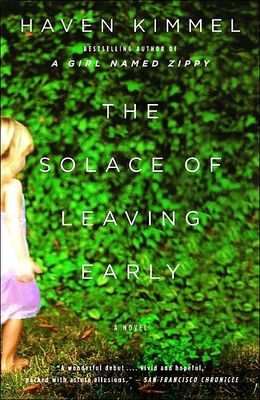
solaceofleavingLangston Braverman has recently returned to her hometown of Haddington, Indiana. Very close to receiving her PhD she walked out of her oral exams. She is a strange, exceptionally erudite but socially fragile and problematic young woman. She has a dog named Germane: “named not after Germaine Greer, but as in: Germane to this conversation.” (I love that.)

Amos Townsend is Haddington’s pastor, of only a year or two now. He is tormented by the death of a local named Alice; he feels that he should have been able to stop her death, and he is struggling with his faith, which is actually nothing new.

Alice’s two children are left in limbo; their crazy aunt Gail has turned out to be unfit, and their grandmother Beulah is clearly too near death herself to wrangle with two traumatized little girls. Upon Alice’s death, they dispose of their original names, Madeline and Eloise, and state that they are now called Immaculata and Epiphany. They wear costumes from a Renaissance drama from school, that their mother made, all the time. Complete with hats: the tall cone-shaped kind with ribbons streaming off the tops.

Langston’s mother AnnaLee picks up some of the slack, and then insists that Langston step up: she is not in school, not working, and these children need her. Of course, Amos plays a role as well, so that this village will truly raise a child.

Langston and Amos are the stars of this story (along with the striking Immaculata and Epiphany, of course). When they meet, they repel one another like magnets. Despite sharing tastes and interests in reading, philosophy, theology, and (I can’t stress this enough) their particular brands of weird, they repel. And, as is clearly a theme in Kimmel’s work, the cerebral content, the philosophies and theologies that shape this part of the story are complex and thoroughly explored. I think I said this in my last Kimmel review, but: her many references partly pique me to go off and study, and partly exhaust me, making me so glad I don’t have to read Whitehead and Tillich and Frithjof Schuon. It makes me sit back and …wonder… that all these strange, complex, learned thoughts that Langston has are thoughts that Kimmel had to have first, had to conceive to put them in her heroine’s mouth; think of that.

Immaculata and Epiphany see Mary (the Mother of God) in the dogwood tree in their grandmother Beulah’s backyard. Naturally, because that is the kind of world this is. It is very strange and is a kind of beautiful, and again I observe that Kimmel’s gift is to create a midwestern small-town world that is both hopelessly humdrum and depressing and everyday, and also strange and exalted and worthy of examination.

What happens to our exquisitely odd cast of characters should definitely remain a surprise to you, reader. It’s pretty great, though.

I love this author SO MUCH that I am struggling to write reviews; but I will keep reading her. Next up is The Used World, and I am, of course, working to get my hands on her best-known bestselling memoir, A Girl Named Zippy.

I’ll close, as I tend to with Kimmel, with a few lines from the book that particularly caught my eye. Where these have, in the past, been lovely examples of her use of language, these are more concepts that I really liked. There is a book theme here. And the language is great – observe the curry comb, is that an image or what – but it’s the concepts that I like most here:

Amos knew as well as anyone what went into writing a book, having written a master’s thesis, and he considered the process to be akin to having one’s nerves stripped with a curry comb.

Maybe he knows what goes into writing a book as well as anyone… who hasn’t written a book?

The most intractable aspect of his bachelorhood was that Amos was uncomfortable eating without reading; he felt as if he were wasting both time and food.

Me too, Amos. I’m right there with you.

Amos tapped his fingers on his bony knees. “Why do you have a book and I don’t?”

“Because I’m a woman, Amos.”

“Yes, but why do you have a book and I never do in a situation like this?”

AnnaLee put the book down. “I carry a bag. I also have safety pins and emergency money, and a package of those little wet towelettes. We live in Indiana. I could get stopped by a train, I could get bored. I always carry a book.” She went back to reading.

How perfect is that. “We live in Indiana, Amos!” Perhaps it goes without saying that I, too, try to keep a book with me at all times? I fail on safety pins and wet towelettes, though.

I’m sure I’ve failed to do this book justice. But it’s divine.


Rating: 9 ribbons on a hat.

book beginnings on Friday: The Solace of Leaving Early by Haven Kimmel

Thanks to Rose City Reader for hosting this meme. To participate, share the first line or two of the book you are currently reading and, if you feel so moved, let us know what your first impressions were based on that first line.

solaceofleaving

I am still super excited about Haven Kimmel! The other day I picked up The Used World and read the first few pages, compulsively, and only later noticed that it is (apparently) the third in a “loose” trilogy that began with The Solace of Leaving Early. So I put down the latter (effortfully), and picked up this one. (The book in the middle is Something Rising (Light and Swift), which I loved.) It begins:

It wasn’t given to Langston Braverman to know the moment she became a different person; she only knew later, looking back on the afternoon a simple storm arrived and stayed for days, the afternoon she first saw the children. The woman Langston had been was immune to visions and visitations; she was a head-dweller, an Attic Girl who could quote theologians on the abandonment of reason, but who, nonetheless, trusted reason the way one trusts one’s own skin.

I can already recognize the thinking characters that Kimmel favors. I’m ready.

Iodine by Haven Kimmel

iodineThis is my new favorite author. I can’t even tell you… I want to read this book aloud to strangers and shout and cry. I adore her. What a powerful book, and story, and what wordsmithing.

I will tell you very little about the plot of Iodine. Its protagonist is a young woman named Trace, who also goes by Ianthe. The perspective shifts between a third person view of Ianthe and a third person view of Trace and a first person voice, in which the woman who is both women narrates; and she is the quintessential unreliable narrator. She relates memories and then states that they never happened. Her story is revealed slowly and disjointedly, in such stingy scraps that I had to go back and reread, trying to wring out the detail; but the effect is more tantalizing than awkward or confusing the way mixed-up timelines can be.

It is a disturbing story. Trace, along with the other characters we slowly come to know, has a history that upsets us. There is a strong thread of incestuous and otherwise inappropriate sexual longings running through this book (as we saw in those opening lines). Be prepared to be a little uncomfortable at times; but oh, the payoff. And again I give you the beautiful language:

Her red hair was curled and teased and sprayed into an elaborate dome; there were waves and… like the outline of paisleys, it was busy, stiff, bright hair. Not the red she was born with – this was the color of a ripe cantaloupe mixed with blood.

Kimmel has many strengths. Her prose is also poetry. She can characterize a minor player in just a few lines so crisply that I recognize a thoroughly unique and yet familiar man or woman.

Scherring was less a man than a character in a short story, and it was a story Trace rather liked; she liked how the years had disappointed him, and ruined that perfect family, and revealed gin to be poison to the liver.

Her characters are very real, straight from a mundane and yet terrifying Americana, and their lives are both disturbing and everyday.

Iodine is far more a psychological thriller than was Something Rising. There is more Patricia Highsmith here and less Tennessee Williams. There is also definitely something of Bonnie Jo Campbell’s Once Upon a River, although the protagonists of the two books are different in many ways.

One aspect of Iodine that was also present in Something Rising is a study of literature, in this case of Greek myths, of archetypes, of Freud and Jung: several characters are deeply mired in academia, speaking in a language of myth & archetype, which makes for a beautiful and strange little subculture that they live in. Trace/Ianthe is both very much a part of this world, and also outside of it. I found this erudite framing element to the story very charming and also a little ridiculous, which I think is how Kimmel intended to portray it. It certainly made me interested in reading some of what Trace reads; but not all of it! (I will be looking up Sarah Orne Jewett’s A White Heron, finally, after seeing it referred to in various places before this book.)

I think I’ve made a hash of this review. I don’t want to say much about the plot, and I can’t do Kimmel’s extraordinary talent justice. She has a lovely way with words; I would read her stories about absolutely anything, but find this damaged, disturbed microcosm of the American Midwest especially enthralling. I was riveted throughout, and upon finishing, had to just sit and absorb the effect of this story. My fascination with Kimmel continues and she remains highly recommended.


Rating: 9 black dogs.

book beginnings on Friday: Iodine by Haven Kimmel

Thanks to Rose City Reader for hosting this meme. To participate, share the first line or two of the book you are currently reading and, if you feel so moved, let us know what your first impressions were based on that first line.

iodine

This appears to be, as hoped, another amazing Haven Kimmel novel. Check out these opening lines, I tell you:

I never
I never had sex with my father but I would have, if he had agreed. Once he realized how I felt he never again let me so much as lean against him while we watched television.

I think it bears pointing out that there is no typo in this excerpt: “I never” is indeed repeated once before the first full sentence. There is an element of dreamscape here.

These captivating first lines (who amongst us doesn’t now want to know more?!) are a fair representation of what’s to come. Our narrator may be the archetype, the quintessence of the unreliable narrator you hear so much about.

Stay tuned. I think this is going to be another great one.

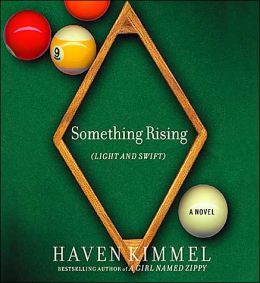
Something Rising (Light and Swift) by Haven Kimmel (audio)

somethingrisingSomething Rising (Light and Swift) was an amazing audio listening experience. I was transfixed, and need to go looking for more Haven Kimmel immediately.

This is the story of a girl named Cassie, whom we meet at, oh, ten years of age and follow until she is about 30. Her mother is from New Orleans but as a young girl followed a handsome pool player named Jimmy to a little town in Indiana, where they married. They had two daughters, Belle and Cassie, but Jimmy was a bad choice from the start, never sticking around long, mostly continuing to shack up with his prior fiance. He’s not a terribly good father to the girls, but through him Cassie learns to worship the pool table he plays on. It’s not Jimmy but his brother, Cassie’s Uncle Bud, who teaches her to play; and this is how she makes her living, supplemented by the odd day labor.

The fact that Cassie is an extraordinary pool player is not the point of her story, although it does help define her personality and her tendency to be roughly competitive. Her appreciation for geometry and order help her make sense of the world. She is also a handywoman, outdoorsy, and a good and generous friend if not loquacious. Early in life she worships Jimmy, but that will change.

Cassie reminded me of the protagonist of Once Upon a River. Both young women are untameable and live by their own rules on the edge of the civilized world. Both are sensitive and vulnerable despite being strong and capable. Laura, Cassie’s mother, is a proud, damaged Southern belle out of a Tennessee Williams play, but stronger; Belle, Cassie’s older sister, goes quite nuts under the strain of Jimmy’s failures and Laura’s anger. Laura and Belle are literary women, and Cassie by contrast feels that she is not, but she does awfully much reading & writing (partly to communicate with her mother and sister) for a woman without literary leanings of her own. I think this is something she doesn’t see in herself, but it’s there.

The story is full of drab, flat, gray American landscape and the ennui of the working class upon it, which is also a somewhat familiar theme; but it’s evoked so crisp-and-clearly, so beautifully, that it took my breath away. I shared a teaser with you the other day, but I couldn’t stop collecting more exemplary turns of phrase:

  • “Every day was a vaccination.”
  • “‘Howdy’ was always ironic, except when it became a habit. And then it was the speaker’s entire life that descended into irony, and later into self-parody. Cassie studied Wally’s face in profile but couldn’t tell where he stood.”
  • “Cassie was the daughter of a great romance, if what was meant by romance was wreckage.”
  • “CDs instead of records, but the songs she wanted to hear: if that didn’t sum up the struggle.”

A large part of what I loved about this book was Cassie, her story, the strange sad beauty of her life & her world; but another large part was the lovely way with words that Kimmel employs. This book is a poem. And the audio reading was divine as well: Chelsey Rives renders Laura’s New Orleans accent, Belle’s nervous worryings, and Cassie’s clipped tones perfectly. I didn’t want this book to end, not least because I wanted to know what happened next, but also because I wanted to hear Chelsey tell me more about the sultry Gulf Coast and the knockings of the pool balls at Uncle Bud’s.

Something Rising (Light and Swift) is a sad story, but with all the dignified grace of the greatest sad stories, and although Tennessee Williams peeks out here and there, there’s far more hope in Cassie’s world than there is in TW’s: this is also a coming-of-age story, and ends with a possible future. I wish I could follow Cassie into it.

Clearly I loved this book, and recommend the audio highly. And… I’m off to find more Haven Kimmel.


Rating: 9 cigarettes.

Teaser Tuesdays: Something Rising (Light and Swift) by Haven Kimmel

Teaser Tuesdays is a weekly bookish meme, hosted by MizB of Should Be Reading. The idea is to open your current read to a random page and share a few sentences. And try not to include spoilers!


somethingrising

I came across this audiobook as I sometimes do, with audio, entirely by accident. I was not familiar with the name Haven Kimmel. It turns out she’s the author of A Girl Named Zippy – a title that rings a bell but still doesn’t tell me much. So I am very pleasantly surprised to say that I love this book and hang on its every word. For example, a phrase like this:

The sun was a violence against Cassie’s back. Sweat ran toward her eyes.

The sun was a violence. That is attention to word choice, my friends. And the sweat didn’t run into her eyes, but toward them. It implies more motion this way, somehow, the suspense of whether the sweat will actually get into her eyes or if we’ll see some action to interrupt it. It’s attention to detail like this, along with an engaging storyline, that hook me. I hope you’re enjoying your reading this week, too!

Still Alice by Lisa Genova (audio)

stillaliceI have a favorite book of the year so far, you guys. Still Alice is one of the most remarkable books I’ve read in some time. I enjoyed Lisa Genova’s second novel, Left Neglected, very much. (I listened to that one as an audiobook, too.) But Still Alice gripped me from the first lines, and never let me go – I was riveted. Let me tell you more.

The two books have more than a few threads in common. Both feature married women, with three children, in male-dominated fields with all the requisite toughness and work ethic but also with plenty of feminine soft spots, struggling to reconcile the two; both live in Boston. One could easily surmise that these are attributes shared by the author, a Harvard-educated neuroscientist-turned-novelist. Where Sarah of Left Neglected had young children, though, Alice Howland has grown children: one lawyer trying to get pregnant, one doctor just finishing his medical training, and one relatively wayward daughter who has scorned college in favor of acting. Alice is a Harvard professor of psychology, and her husband John is also a Harvard doc, working with human cells & a possible cure for cancer. She is nearing her 50th birthday when the book opens, and shortly after it, she is diagnosed with early-onset Alzheimer’s disease. The story is concerned with the progression of her disease, the changes it wreaks on her life and the lives of her husband and three children, and their struggles (independently and as a family unit) to handle these changes. It is also centrally about Alice herself, as a person, what Alzheimer’s does to her and her reactions & dealings with that disease. Again, the author is a neuroscientist, so while I (thankfully) don’t have any experience with Alzheimer’s disease by which to judge this portrayal, I trust Genova’s ability to tell it truly.

I became deeply engrossed in this story from the very beginning. Although told in the third person, we are very much inside Alice’s head (call it third person limited, for which I like this explanation because of the example chosen!). Alice felt very much like a real, flawed-but-likeable person. I was occasionally exasperated with her choices: to fight with Lydia over her acting career, to fail to appreciate her, and to put off telling her husband about her diagnosis. But I always sympathized, and liked her throughout. I would like to spend a day or a week with this woman. In fact, in telling Husband about this story as I listened to it, I referred to her as my friend. This is not something I normally do with fictional characters.

I was deeply emotionally involved. If I was angry with Alice for not telling John she had Alzheimer’s right away, I was even angrier with John for his reaction, and his repeated failures to be supportive. I wanted to cry when they began considering their future. And I did cry, often, as the disease progressed and Alice’s family was – still flawed and imperfect, but earnest and effortful and loving in their handling of these events. I hope it’s not too much of a spoiler to say that I was charmed by the silver-lining aspect, where Alice’s relationship with Lydia grew stronger in this time of sickness. I pondered whether it was a bit too fictional-happy, to insert such a silver lining, and decided it wasn’t.

This is a sad story, certainly, and I cried more than a few times. (I finished this book in the gym, and it took great effort not to weep on the elliptical machine. What would people have thought?) But there is love, and hope, and strength; Alice keeps a certain dignity that made me love her more as she got sicker. I can see how this would be a painful read for someone whose own life has been affected by Alzheimer’s, but I’m inclined to think it might be worth the pain for the beauty it expresses.

If you’ve read the book or don’t care to, highlight the white text to read my spoiler-y discussion below; but if you intend to read this book, don’t.

I was saddened by Alice’s decision to plan her suicide, but I respected it. When she got so sick that she couldn’t execute her own plans, I found that sadder still. I wondered a little at Genova’s decision to end the story the way she did, with Alice fading into gray; I would have liked to know her final fate, when and how she died, whether John moved her to a place she never wanted to be (a “home,” or New York), but I think this way was for the best. That fade-to-gray is probably most like the end of Alice’s own understanding of things – most like Alzheimer’s disease.

Unlike Left Neglected, this book is read by the author, and when I heard that I was thrilled, because my author-narrated audiobook experiences have so far been 100% wonderful. Still Alice is no exception. Genova’s goodreads page tells us she’s an actress as well as a neuroscientist and novelist, so perhaps it’s no surprise that she delivers her characters feelingly (or that she wrote a lovely, passionate actress character into this book). For the record, I really enjoyed the audio reading of Left Neglected, too, but I would never pass up an author-read version, and highly, highly recommend this audio version of Still Alice.

This is without a doubt going to make my list of best books read in 2013. I am so relieved to see that Genova has a third novel out already, Love Anthony, and is working on a fourth – whew! I can’t say enough good things about this book. I love Alice.


Rating: 9 thingies.

movie: Lonely are the Brave (1962)

Here’s another movie I made a point to find after reading the book. Very few of Edward Abbey’s books have made it into film. His most famous novel, The Monkey-Wrench Gang, has been optioned repeatedly but appears doomed to never grace the silver screen, owing (I think rather obviously) to its anti-establishment themes: no Hollywood mogul would involve himself in something so sacrilegious. But The Brave Cowboy was made into a movie starring Kirk Douglas in 1962. Here he is fighting a one-armed man with one arm behind his back in a raunchy saloon:

fighting

The movie is faithful to the book’s plot only in its actions, and not in its motives. The cowboy Jack does ride into town on his horse with the intention of busting his old buddy Paul out of jail; he does kiss Paul’s wife in the process; he does end up in the mountains fighting an archetypal battle against the sheriff and his men, complete with military technologies and sweeping vistas.

vista

It is, in short, a fine Western. What the movie version left out, however, is Jack and Paul’s past together as political protesters. There’s no mention of what Paul’s doing in jail in the first place (dodging the draft, and refusing to take conscientious-objector status), let alone their history in anarchist organizations and their shared hatred of The Man. That would be a little too much even for our Western hero, presumably: better that he be nostalgic about the days of horse and rider herding sheep, and not specifically interested in taking down the federal government. Can’t say I’m surprised. My final gripe would be that the sheriff, Morey, was not cast nearly as fat and bumbling as he reads in the book. At least they left in the taking down of the helicopter; that was fun.

This movie is a simplified and sanitized version of the better book upon which it was based; but that’s what I mostly expect from movies made from books. Some of the dialog seems to have materialized out of thin air, most definitely in the case of Jack’s monologue about being a loner – I suspect Abbey could have rendered such a scene much finer (and funnier) if he’d wanted it in his story in the first place. But it was still a fun romp alongside an Abbey-like hero, just dumbed down. I don’t regret my 90 minutes, but it sure is nice to dream about a proper movie made of The Monkey-Wrench Gang or the like. Sigh. Not a bad film, but not too terribly close to its literary origin.


Rating: 5 stoic grins.

Closing credits: thanks to my neighbor Adrian for helping me find this not-easy-to-find movie. You get a 10-star rating, Adrian!

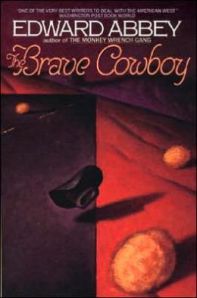
The Brave Cowboy by Edward Abbey

bravecowboyThe Brave Cowboy was Abbey’s second novel, published in 1956. It introduces Jack Burns, the eponymous cowboy, who will reappear in a number of Abbey’s works of fiction hereafter. We meet Jack as he rides into town (somewhere in New Mexico) on his horse, grumbling in typical Abbey fashion about the military-industrial complex creeping across the desert wilderness he loves. He visits a friend, Jerry, and her son Seth, to ask about her husband Paul, imprisoned in city jail awaiting transfer to a federal facility for a two-year term for draft dodging. Paul and Jack, it turns out, share a past as anarchist opposers of the war in Vietnam. Jack hides two files in his boots and proceeds to get drunk and look at people funny at a bar; this leads, predictably, to his joining Paul at the city jail, where his plan can begin to take action.

Obviously, Jack is there to bust his friend out of jail. But Paul wants to take an ideological stand, points out that he turned himself in and debated the question of his “crime” purposefully, and intends to serve out his term, not least because jailbreaking would lead to a life on the run and negatively effect his family. Jack is disgusted, frustrated, and miserable in jail himself (being something of an archetypal wild creature that cannot be caged) and breaks out the first night, alone.

Local law enforcement follow Jack and his horse into the hills, bound for the wilderness where they will be unable to track him, ultimately (Jack hopes) to Mexico, or who knows where. No spoilers here.

Jack is a symbol. He is everything that is wild and untameable, and counter to the “civilization” (I think of Huck Finn’s “sivilization”) of city & town, military test ranges, factories, and regular baths. He’s rough-n-tough and (I imagine) everything Abbey dreamed of being. He and Jerry, Paul’s wife, share a moment of sexual tension that goes unexplained; I wonder if light is ever shed on this subject in other novels, or if it’s just a gratuitous moment of sexuality – otherwise absent in this book, unusually for Abbey. The manhunt scenes in the desert canyons are excellent, and reminiscent of those in The Monkey Wrench Gang (which Abbey wouldn’t write for another nine years). And the opposing symbol to Jack Burns, the sheriff Morlin Johnson, is an exquisite picture of everything wrong: he picks his nose and scratches his armpits, grumbles at his wife on the phone, is incompetent in every way; and yet, to Abbey’s credit, he retains some humanizing characteristics as well. For example, he struggles to control the enthusiastic manhunters, reminding them that their quarry is not a murderer and should not be shot on sight.

Literary critics, I imagine, could find points to contend over. The good and evil may be a little straightforward; Abbey never bothered with subtlety in his values. The plot is simplistic. But I don’t necessarily find these to be weaknesses. Jack Burns is an archetype, yes, but he’s a strong and entertaining one. I found the ending (still no spoilers!) powerful. Abbey’s highly realistic descriptions of natural scenery, man’s crude habits and strengths and weaknesses, campsite routine, and urban decay are among the best I’ve encountered. Jack’s horse, Whisky, and the relationship they share were a charming addition. While not complicated in form or message, I found The Brave Cowboy to be an excellent read, and a fair representation of Abbey’s work.

Connections…

This book was adapted into a movie called Lonely Are the Brave, starring Kirk Douglas, in 1962, and I will now be seeking that out.

Also, a later Abbey novel called Fire on the Mountain (which I reviewed, and enjoyed) shares an ambiguous connection. The little boy in that book is named Billy, and seems to be the wrong age to grow up to be Jack Burns. But they share the same grandfather, whose ranch meets the same fate in each telling. Abbey wrote Fire later, and I have no explanation for the disjointed connection between the two stories. Are Billy & Jack brothers? Cousins? Mismatched versions of the same man, early & later in life? I am intrigued.

Another great Abbey novel. Luckily, like Hemingway, Abbey is on the one hand dead and no longer writing, but on the other hand, was prolific enough in life to keep me stocked for the time being. Keep ’em coming.


Rating: 7 stoic, unshaven stares into the middle distance.

Teaser Tuesdays: The Brave Cowboy by Edward Abbey

Teaser Tuesdays is a weekly bookish meme, hosted by MizB of Should Be Reading. Anyone can play along! Just open your current read to a random page and share a few sentences. Be careful not to include spoilers!

bravecowboy

I can’t tell you how happy I am to be reimmersed in Edward Abbey. For today’s teaser, I’ve chosen a crudely-stated bit of philosophy that I enjoyed, uttered by an unnamed character in a jailhouse scene:

Serenity is for the gods – not becoming in a mortal. Better to be partisan and passionate on this earth; be plenty objective enough when dead.

Something about this sentiment struck me. I like the idea of being partisan and passionate on this earth. Maybe because I am. 🙂