The Glass Eye by Jeannie Vanasco

A devoted, tormented daughter eulogizes a beloved father in this thought-provoking and experimental memoir.

Jeannie Vanasco’s The Glass Eye is an intense and unforgettable memoir, as fascinating for its artistry as for its subject matter.

Jeannie was 18 when her father died. Though her mother is beloved and sympathetically portrayed, it was her father who had been her hero, her perfect person. On his deathbed, Jeannie promised him she would write about him. Although there is no sign that he heard, let alone held her to it, this promise would haunt the increasingly troubled young woman for years to come.

Her father had lost his left eye and wore a prosthetic one, which was in fact plastic, “but sometimes I call it glass. Glass implies the ability to be broken.” He lost his left vocal cord, too, and her mother loses hearing in her left ear. “What will be left of me if I lose her?” Jeannie’s father had a daughter before her, from an earlier marriage, who died in a car accident. That daughter was Jeanne; the daughter who promised to write this book is Jeannie, pronounced the same but with an added i. She fills her book with meditations on glass and left.

The Glass Eye is not what the 18-year-old intended to write. In the years after her father dies, Jeannie appears to function at high levels: she receives several degrees and works for prestigious publications. However, she is hospitalized repeatedly, battling mental illness and devastating grief. Everything is about her father–“Of course I hallucinated my eyes had fallen out.” A symptom of bipolar disorder (one of several diagnoses Jeannie receives) is a preoccupation with ” ‘clang associations,’ connections between words dictated by sound rather than meaning,” although for Jeannie, eye and i and I are also connected by meaning.

Vanasco pays compulsive attention to metaphors, and to the project of writing this memoir, which becomes a meta-exercise observing itself. She wonders, “What’s my hindsight perspective? Is this my narrative present?” and plays with plot. She asks the professor in her memoir course, “What if it’s about the promise to write the book?” The Glass Eye is indeed about Vanasco’s promise, as it’s about her father, grief, loss, her dead half-sister and reckoning with her own mental illness. And it’s about itself: both memoir and writing-about-writing.

Lyric, haunted, smart and tortured, this is an obsessive love letter to a dead father as well as a singular work of literature. The Glass Eye will attract memoir fans and readers concerned with mental illness and bereavement, as well as writers concerned with craft.


This review originally ran in the September 15, 2017 issue of Shelf Awareness for the Book Trade. To subscribe, click here.


Rating: 9 dollhouses.

The Signal Flame by Andrew Krivák

This novel of love, grief and the cycles of life veils its profundity in deceptively simple everyday events.
the-signal-flame

Andrew Krivák (The Sojourn) paints indelibly rich scenes and relationships with The Signal Flame, an astonishing novel set in a small town in northeastern Pennsylvania’s Endless Mountains. A strong tie to that setting is one of the elements that binds together a community and a family struggling with loss and continued life.

The people in Dardan mourn patriarch Jozef Vinich. He is survived by his daughter, Hannah, and her son Bo; these three generations have been touched by war. Jozef lost fingers in World War I; Hannah’s husband survived World War II but returned in ignominy, a deserter later killed in a hunting accident; and Bo’s younger brother, Sam, has been missing in action in Vietnam for some months. As they grieve for Jozef and Sam, Hannah and Bo must also navigate a lingering feud with another local family, the management of a business and a farm, a natural disaster and a legacy Sam has left behind.

The town of Dardan and its inhabitants are eloquently portrayed, both in the everyday and exceptional. Krivák’s writing is beautiful, luscious but never overwrought; he recalls Norman Maclean in the understated loveliness and clarity of both language and meaning. He imbues his story with methodical pacing, a strong sense of place and a perfectly expressed sense of the quotidian: The Signal Flame takes place between Easter and Christmas of 1972, but encompasses a world of human experience. This is an extraordinary novel to be savored.


This review originally ran in the February 10, 2017 issue of Shelf Awareness for Readers. To subscribe, click here, and you’ll receive two issues per week of book reviews and other bookish news.


Rating: 9 letters.

Grief Is the Thing with Feathers by Max Porter

A minimalist meditation on loss takes an unusual slim and poetic form.

grief is the thing

Max Porter’s Grief Is the Thing with Feathers handles bereavement and the novel format in inventive ways. Scraps of poetry, dialogue and ramblings, with lots of white space, fill just over 100 pages, but this sparse little volume takes on no less than love, loss and art.

Three parts, “A Lick of Night,” “Defence of the Nest” and “Permission to Leave,” roundly sum up the grieving process. Brief segments are narrated from three characters’ perspectives: Dad, Boys and Crow. Mom has recently died, and Dad and two young sons struggle to cope until a special Crow comes along to care for them–in a manner of speaking.

The Crow’s voice tends toward the stream-of-consciousness, as a bird’s might, but there’s no questioning its agency and intelligence. Dad is an eccentric Ted Hughes scholar, struggling to write a book on deadline. Under these influences, Grief Is the Thing with Feathers resembles free verse. The Boys generally speak as “we”; despite the occasional singular, the two brothers are interchangeable. In Porter’s poetic bent and unusual usages, “They were in brother with each other.” They are nonetheless realistic and childlike; they wonder, when their mother dies, “Where are the fire engines…? Where are the strangers… screaming, flinging bits of emergency glow-in-the-dark equipment at us to try and settle us and save us?”

This is not a novel for children, with its moments of gore and sex, but it is a whimsical and ultimately pleasing perspective on grief, and utterly original.


This review originally ran in the June 3, 2016 issue of Shelf Awareness for Readers. To subscribe, click here, and you’ll receive two issues per week of book reviews and other bookish news.


Rating: 7 flecks of toothpaste.

The Song Poet: A Memoir of My Father by Kao Kalia Yang

In celebrating a father’s traditional Hmong song poetry, this memoir records the painful history of a loving family and a people.

song poet

In The Latehomecomer: A Hmong Family Memoir, Kao Kalia Yang related her family’s immigrant experience. With The Song Poet: A Memoir of My Father, she focuses on the life and art of Bee Yang: “my father raps, jazzes, and sings the blues when he dwells in the landscape of tradition Hmong song poetry.” The storytelling and emotional communication of that art form was a defining element of Bee’s contribution to his family and his culture, from their home in Laos to a refugee camp in Thailand and, finally, in the United States. When his mother died, Bee stopped singing, and Yang considers the significance of that silence as well.

As its title suggests, The Song Poet is lyrical and beautifully composed, with themes of loss and love, realistic and raw, but enriched by gentle metaphor. It is divided into “Side A” and “Side B,” the first told in Bee’s first-person perspective and the second in Yang’s. These points of view offer immersion in a Hmong culture that values family, and shares a complex system of spiritual celebrations and a way of life centered on the day-to-day necessity of growing and harvesting food. War and violence drive the family to Minnesota, where Bee and his wife do hard, dangerous labor, and are poorly equipped culturally to battle racism and exploitation. But they retain their reverence of family and tradition. The Song Poet is a message of love and thanks to a father who sacrificed for his children’s future, and a memorial to his art.


This review originally ran in the May 17, 2016 issue of Shelf Awareness for Readers. To subscribe, click here, and you’ll receive two issues per week of book reviews and other bookish news.


Rating: 8 flip-flops.

Maximum Shelf: Lily and the Octopus by Steven Rowley

Maximum Shelf is the weekly Shelf Awareness feature focusing on an upcoming title we love and believe will be a great handselling opportunity for booksellers everywhere. The features are written by our editors and reviewers and the publisher has helped support the issue.

This review was published by Shelf Awareness on May 9, 2016.


Steven Rowley’s first novel, Lily and the Octopus, is a startling, scintillating experience, both funny and emotionally wrenching: a story that shatters all expectations.

lily and the octopus

In the opening lines, narrator Ted Flask introduces his contented home life with his domestic partner, an aging dachshund named Lily. They live in Los Angeles, where Ted works from home, and they are comfortable in their routines: pizza on Sundays, Monopoly on Fridays, talking about cute boys on Thursdays. They have inside jokes, holiday traditions, and an idyllic story of love at first sight. Lily holds up her end of conversations, although as a dog she is of course distractible, and her memory can be short. Her voice is just as we expect a dog to sound. As a puppy (in flashbacks, as in the scene of their first meeting), her breathless enthusiasm comes out in all caps and exclamation points: “IT’S! A! GREAT! TIME! TO! BE! ALIVE!”

As the novel unfolds and Ted fills out as a character, though, it becomes clear that his life is not necessarily well-rounded. He has a therapist he dislikes; he finds her dim-witted, and in his head runs all her advice past his ideal, imaginary therapist. He has panic attacks. His career has stalled. A long-term relationship, ended 18 months ago, continues to haunt him; recent attempts at dating have gone poorly. Until Lily, he worried that he was unable to open up, unable to love. In Ted’s favor, he has a superlative human best friend named Trent, who always comes when called and brings Valium. And, crucially, Ted has Lily. She is the best thing in his disordered and inwardly-turned life.

Those first sentences introducing Lily also introduce the octopus. A new addition to their household, he has a death grip on Lily’s head, and he’s not going anywhere. Like Lily, the octopus talks. Ted wants him to leave, but the octopus will not let Lily go. She begins to have seizures. She weakens.

Ted dreams of an octopusectomy. The vet offers chemotherapy, radiation and surgery, but is not optimistic about Lily’s chances. Ted tries to involve her in the decision-making, but Lily is a dog: her attention span is limited (oh look, red ball!) and, anyway, at 12-and-a-half human years, she has been feeling a little run-down. She rarely speaks in caps anymore. Ted was warned by a vet that, as Lily aged, she would begin to exhibit what he called Enclosed World Syndrome; that is, her perceived world and realm of interest would shrink. It is true, her walks have gotten shorter. Of course, Ted himself has the same malady. As the octopus’s tentacles tighten around Lily’s precious small head, Ted realizes he has a battle on his hands.

It is easy to fear that the market for books about beloved dogs may be flooded, but this one does something new. Lily and the Octopus is its own beast, and the reader is not the same person at the end as at the beginning. In many ways this is the story of Steven Rowley’s life in all its emotional truth, if not in specific, literal details. Ted and Lily’s Los Angeles is a thoroughly realistic setting, but a few elements–most obviously the talking octopus–offer boggling departures. By relying on metaphor, Rowley creates a fantasy world with touches of magical realism, somehow both more affecting and more comforting than reality.

Lily and the Octopus comes with the trappings of humor, canine antics, strong characters and profound emotions. Rowley, who is also a screenwriter, peppers the story with Cate Blanchett, Ryans Gosling and Reynolds, Bradleys Cooper and Milton. Equally prominent are the literary references: Kipling’s jungle, Auden’s “Funeral Blues,” and a reading list to prepare for an octopus hunt: Hemingway, Melville, Patrick O’Brian. The book opens in the spirit of a fun read, but the tone quickly deepens to a sadder and a more intense experience. Ted and Lily’s story centers around relationships: love and life partnership, the nature of commitment and of loss, and what it looks like to fight for one’s friends. As Ted battles the octopus and tries to shore up his darling, he ends up examining every aspect of his own life, his own shortcomings and the strengths he discovers in himself, almost by surprise. His journey, then, is not only about a man and his dog but about breaking out of life’s stalemates. This introspection and interior aspect to the novel is only one of the depths that make it both more than another story about a beloved dog, and more than a whimsical work of fantasy–although it is a superb example of both.

Lily and the Octopus is literary and raw, and relentlessly heartfelt. Questions of who and how we love are at its center and, vitally, the question of how we part. Imaginative, ever-astonishing, suspenseful and wise, Rowley’s surprising novel is thoroughly gut-wrenching, but well worth the pain. With a winning dog at its robust heart, no reader could ask for more.


Rating: 9 moments with the red ball.

Come back tomorrow for my interview with Rowley.

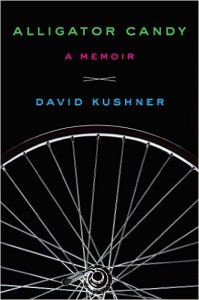
Alligator Candy by David Kushner

This tender, intimate memoir probes the childhood murder of the author’s older brother.

alligator candy

On a Sunday afternoon in 1973, 11-year-old Jon Kushner rode his bike through the woods to the 7-Eleven. His four-year-old brother, David, had asked for one kind of candy in particular. Jon’s family never saw him alive again. Journalist David Kushner still struggles to fathom his brother’s murder and his family’s experience; Alligator Candy is his memoir of investigation and connection.

Kushner lovingly portrays his hippie parents, eldest brother and Jon, who struggled with an auditory deficit disorder and was known for his compassion. Their community in Tampa, Fla., included activists and academics, and emphasized freedom and the outdoors. It was perfectly natural for a boy to ride alone through the woods. Jon’s murder presaged an end to the “ability of kids to simply get on their bikes and go,” as one family friend put it.

Alligator Candy explores how a family and community survive loss. The twin terrors of not knowing fully what happened versus knowing the horrific details of exactly what was done to Jon comprise only two reasons that this is a painful story. However, Kushner can also be funny, and he skillfully captures a child’s innocent curiosity, even in loss. He writes so simply, but this is deceptive. Alligator Candy is sensitive, insightful and understated.

Forty years later, Kushner (Bones of Marianna; Masters of Doom) still struggles with grief, isolation and guilt. In writing Alligator Candy, however, he discovers certain details of his brother’s case for the first time, begins to comprehend his family’s coping methods and, finally, achieves a long-sought connection with Jon.


This review originally ran in the March 25, 2016 issue of Shelf Awareness for Readers. To subscribe, click here, and you’ll receive two issues per week of book reviews and other bookish news.


Rating: 7 pieces of gum.

The Year of Magical Thinking by Joan Didion (audio)

I said I was laying off the audiobooks, because my present life & schedule don’t allow for enough listening time. But then I picked up another, and another. Among other things, I’ve hurt my knee again and am back in the gym. But you’re not here to hear about my knee.

year of magical thinkingI’m so glad I tuned into The Year of Magical Thinking. It’s not a feel-good story: it tracks the year in Joan Didion’s life following her husband’s death, and maps her experience with grief. It’s almost New Year’s, and Joan and husband John have been visiting their daughter in the hospital, where she is unconscious with a life-threatening case of pneumonia and septic shock. On December 30, 2003, he collapses at the dinner table, is rushed to the hospital and pronounced dead that night. John is John Gregory Dunne, also an accomplished writer, and their lifestyle has always kept them very close: working from home, together, consulting on every aspect of their lives, from work, food, family and world events to the most insignificant details. Didion is of course, obviously, shocked and unmoored. During the year that follows she experiences different types of grief, shock and bafflement. This book is a little like a diary of that time, which it charts chronologically, ending one year and one day after John’s death.

Along the way, she nimbly weaves in the research she performs on related subjects within psychology, medicine and anthropology: research on grief, on cultural relationships with death and dying, and on medical issues, as she tries to understand when, how and why John died. This last is a surprisingly opaque question, covering the time between his collapse and the doctor’s pronouncement about an hour and a half later. What had been done in the interim? What could have been done? She examines the reports of the ambulance team, the nurses and the ER doctor.

And to compound the complicated and tragic story, daughter Quintana spends most of this year in and out of hospitals, near death on multiple occasions. What we know, although Didion at the time of writing does not, is that Quintana died within the year after the book’s timeline closes. Her later memoir, Blue Nights, covers that personal loss. I haven’t read that one – yet.

The difficulty of this book, then, is obvious: it is filled with sad stuff. Didion is a deft and clever writer, though. We see more than a little joy, although much of it is remembered. We see a strong family, and we see good times. The entwining of personal experience (past and present) and research is beautifully done. Didion uses repeated phrases to draw her reader along the book’s line, to tie everything together. It’s a lovely piece of work, although I did have to turn away when I had a particularly bad day. The subject matter is what it is.

My one criticism is that Didion fails to recognize and acknowledge a certain privilege: that her life is set against the Ritz, the Royal Hawaiian Hotel in Honolulu, the fancy home in Malibu, Chanel, Brooks Brothers, an endless parade of the food, clothing, and scenery of her choice and at her command. This privilege, compounded by her failure to acknowledge it (is it possible she is unaware?), distanced me from her. She is both a fine writer and a complex and sympathetic person; it is my instinct to identify with her, and that is where this memoir shines; but that effect is lessened by her experience of the world to which she is apparently blind. Near the end, she describes a difficulty early in her marriage, when she and John had made a $50,000 down payment on a house in an L.A. suburb but hadn’t yet sold their home in Malibu: where would the money come from? They go to a luxury resort in Hawaii to think it out, then find that the Malibu home has an acceptable offer. She does speak briefly to the irony of the Hawaiian brainstorming session. We could call this a partial exception to my complaint. The episode still comes off a little tone-deaf, though.

This is a fairly small criticism. Because of this privileged position, Didion lost a few degrees of identification with her reader. On the whole, though, she is a sympathetic and fully realized character. Her story is shocking but true; it is beautifully structured and well written, and I will definitely read more Didion.

Barbara Caruso’s narration felt spot-on to me.


Rating: 7 leis.

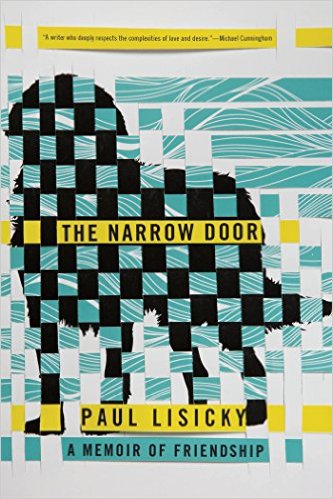
The Narrow Door by Paul Lisicky

The Narrow Door is literary, smart and poignant, an extended eulogy for a friend and a meditation on friendship.

narrow door

The Narrow Door is a striking memoir of love and loss by Paul Lisicky (Lawnboy; The Burning House). At its center are the life and death of Denise, Paul’s longtime best friend; in parallel, Paul and his husband slowly pull apart and finally break up. The ups and downs of these two relationships define the story Lisicky tells, but they also give him space to muse on larger questions: the craft of writing, competition among writers, the meaning of love and events in the larger world.

Paul met Denise in the early 1980s, when they were both teaching assistants at Rutgers. They became fast friends, talking on the phone for hours, sharing the pain and joy of writing. Denise becomes a published novelist first, but Paul’s later success threatens her. A tender passage about “Vincent” and Gauguin, about the painters’ competitive feelings and their wrecked friendship, helps Paul deal with his struggle with instincts leaning both toward and away from competition with Denise. This is only one example of the wide range of Lisicky’s subject: the Deepwater oil spill and the Haitian earthquake likewise influence his reactions to Denise’s cancer diagnosis and other immediate concerns. Paul and Denise are Joni Mitchell fans, and their story is guided by her music. When a hotel in Atlantic City is demolished, Lisicky writes, “It comes down as a person would…. I take it personally.” These disparate threads are tied together expertly, with tenderness, in careful prose.

Paul’s husband, identified simply as M, is a successful poet and has his own, weaker friendship with Denise. He supports Paul when she dies, but soon after, the couple begin their drift apart. The Narrow Door employs a disordered chronology, in sections headed by year: 1983, when Denise and Paul’s friendship is budding; 2008, when she dies; 2010, when Paul and M are at their rockiest; and times in between, as these relationships grow, change, climb and descend. When he fights with Denise, Lisicky considers losing a friend, as opposed to breaking up with a lover: “Sure, it might feel like rage, but aren’t rage and love part of the same water?”

This is an artistic work, poetic and layered and carefully structured. The tangled sequence of events emphasizes the ever-changing nature of relationships and emotional reactions. Lisicky’s tone is sometimes elegiac, sometimes gently humorous, and consistently introspective, questioning. The Narrow Door is not a long book; nonetheless, it requests the reader’s measured consideration of language, pitch, philosophy and emotion. This portrait of a friend in all her complexities is lyrical, intellectual and occasionally challenging. In an austere mood, Lisicky avoids the idea of comfort for its own sake but asks, “Couldn’t there be some rigor to comfort?” The Narrow Door answers with both, in a compelling package.


This review originally ran in the January 4, 2016 issue of Shelf Awareness for the Book Trade. To subscribe, click here.


Rating: 8 cups of coffee.

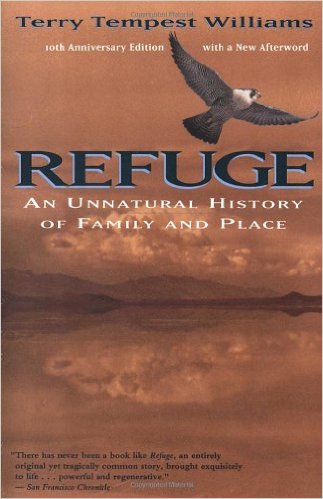
Refuge: An Unnatural History of Family and Place by Terry Tempest Williams

I am slowly, painfully discovering that my refuge is not found in my mother, my grandmother, or even the birds of Bear River. My refuge exists in my capacity to love. If I can learn to love death then I can begin to find refuge in change.

refugeWhen I read this book, I was continually reminded of the first Terry Tempest Williams book that I loved, as a child: Pieces of White Shell. I knew immediately that I would need to follow this book with a reread of that one. For me, Refuge is the more personal, more intimate, more grown-up and more exacting version of the kinds of things I found in Pieces of White Shell. I think I found this one more difficult, more thought-provoking and challenging; the other was both sparer, and offered clearer, more accessible comforts. Refuge is stripped, exposed pain. If there are balms for its wounds, they are more complex. Pieces of White Shell is metaphorical, symbolic, spiritual, seeking wisdom and humbly finding some of it; Refuge is bared emotions and loss. It is many birds. Each chapter is headed by the name of a bird – burrowing owls, killdeer, sanderlings, avocets and stilts, on and on – and by a level of Great Salt Lake.

Over the years in which the story of Refuge takes place, Great Salt Lake rises beyond its usual depths and boundaries. I learned in this reading that this Lake is shallow and covers a great area; therefore a few feet of rise can cover miles, and cause great destruction. Terry Tempest Williams saw her mother die of cancer as she saw her beloved Bear River Migratory Bird Refuge overtaken by saltwater, the birds displaced and many of them lost. In Refuge, she meditates on both losses and the relationship between them, how the Refuge offers refuge to her and to her mother, how they are linked – birds and women (clearly presaging her later When Women Were Birds), people and place (Terry’s Mormon family with the Great Basin and Utah), the cancer that runs in her family (“the clan of one-breasted women”) and their home (neighboring nuclear test sites).

Refuge involves nature, of course, and Terry educates us with precision about the birds she loves. It involves people, and society, and our interactions. It is beautifully written, with poetry, and with liberal gaps in which the reader may draw her own connections. Terry has an imaginative and generously interpretive mind, more so than mine.

The cancer process is not unlike the creative process. Ideas emerge slowly, quietly, invisibly at first. They are most often abnormal thoughts, thoughts that disrupt the quotidian, the accustomed. They divide and multiply, become invasive. With time, they congeal, consolidate, and make themselves conscious. An ideas surfaces and demands total attention. I take it from my body and give it away.

She finds wisdom in the world, as her mother and grandmother did; and of course, centrally, she finds refuge, which is not quite to say recovery or redemption, although those arguments can be made.

Terry Tempest Williams is a lovely writer. The story of her mother’s life and death, their relationship, and the difficulties and beauty of letting go, are all well accompanied by the pain and beauty of the migratory birds of the Great Basin that Terry knows well.


Rating: 7 phalaropes.

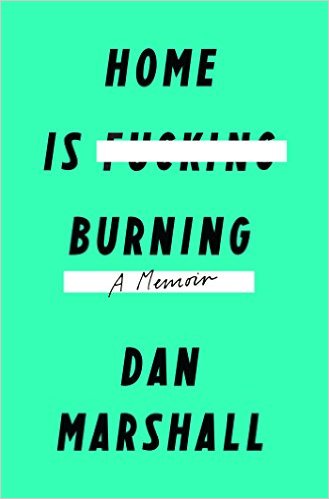
Maximum Shelf: Home is Burning by Dan Marshall

Maximum Shelf is the weekly Shelf Awareness feature focusing on an upcoming title we love and believe will be a great handselling opportunity for booksellers everywhere. The features are written by our editors and reviewers and the publisher has helped support the issue.

This review was published by Shelf Awareness on September 2, 2015.


home is burningDan Marshall’s life was pretty heavy on privilege. A self-described spoiled white kid with money, he grew up in Salt Lake City and then graduated from UC Berkeley, and was busy enjoying his first real job in Los Angeles and his first real girlfriend, Abby. His family–mom, dad and four siblings–wasn’t perfect, but they were happy, loving and shared a strong if quirky sense of humor, based on fart jokes and four-letter words. His mother had had “terminal” cancer well managed for nearly 15 years. Then came the phone call, while Dan was on vacation with Abby, announcing that his capable, marathon-running father had been diagnosed with something called ALS.

ALS stands for amyotrophic lateral sclerosis, more commonly known as Lou Gehrig’s disease. It’s a terminal neurodegenerative disease that kills off motor neurons, eventually depriving the person affected of the ability to move his own limbs, eat, speak, and breathe. Dan was slow to accept the gravity of the diagnosis, but under pressure from the family, after several months, he takes a leave of absence from his job to move home at age 25 to help out around the house. Home Is Burning is his memoir of caring for two terminally ill parents at once while dealing with a houseful of rowdy siblings with problems of their own. His story is unavoidably terribly sad, but peppered with sex, drugs both prescribed and recreational, copious foul language, lots of alcohol, and deep and abiding love, the Marshall family saga is surprisingly sweet and funny as well.

Although Dan describes them as spoiled and rich, the Marshalls have had their fair share of misfortunes, from mother Debi’s cancer diagnosis and years of chemotherapy treatments to cerebral palsy and Asperger’s syndrome among the children. The eldest sibling, Tiffany, who took over some parenting duties as a teenager when Debi was sick, had become an overachiever apparently teetering at the edge of a nervous breakdown. Greg was a successful college student in Chicago, enjoying his freedom after finally coming out of the closet. Still in high school were Chelsea, a socially awkward ballerina and serious student, and Michelle, a budding alcoholic in a disturbing relationship with her soccer coach. Dan was the second child, and the last to move back to Salt Lake City for their father Bob’s remaining time, which would more likely be measured in months than years.

Dan lingered in the denial stage of the grief process. With the whole family, he’d watched Bob run his last marathon in Boston, in a time nearly twice that which he’d run to qualify. But when Dan moves home, he is dismayed to see how much his father has already deteriorated. With Tiffany living nearby but on her own, “the little girls” still in high school, and Debi inconveniently faced with her toughest round of chemo treatments yet, the bulk of Bob’s caregiving duties falls to Dan and Greg. Together they help him bathe and use the bathroom as he loses the use of his arms. They feed him through his gastrointestinal tube, and take him for walks in a wheelchair as his legs lose their strength. They hook him up periodically to his BiPAP (bilevel positive airway pressure) machine, which helps push air through his lungs. Bob chooses to delay his tracheotomy surgery–which would attach him to a respirator for the rest of his days, and quite possibly end his ability to speak–to attend his own mother’s funeral; but the ill-advised delay ends with a rush to the hospital when his breathing fails, and the procedure takes place under emergency conditions. Happily, Bob retains his speech.

For all Dan and Greg’s love and good intentions, their caregiving is sometimes alarmingly poor: Bob is dropped on the floor, his respirator tubes cracked and broken. He might be considered lucky to survive his family’s care. The household begins to fall apart: Michelle passes out in her own vomit with increasing frequency as the cats pee all over their three-story home, which has been pulled apart by construction to install an elevator and widen doorways. Dan begins drinking more heavily; Abby breaks up with him; Greg takes a full-time job, putting more pressure on Dan; Debi’s behavior grows ever more erratic, with the mental effects of her chemotherapy, her distress at losing her husband, and a new addiction to pain pills. Dan’s outlook and storytelling throughout these mounting stressors is singular. He is remarkably candid about his frustrations and resentments: he loves his father enormously, calling him his buddy, his pal, his road map through life, and describing the effortless quality time shared and advice given–but he is angry to have his own social freedoms curtailed.

The tone of Dan’s writing in this painful period, however, is astonishingly funny, loving, even lighthearted. As he moves back and forth between agony, grief and anger, he displays a fun-loving, off-color, morbid sense of humor and an almost apologetically sweet expression of love for his entire imperfect family and especially their hero, their rock, Bob. Dan interjects his narrative with fantasies in which Debi’s hair grows back, Chelsea doesn’t giggle inappropriately at looming death, Michelle doesn’t marry her soccer coach, Bob stands up and takes himself to the toilet and goes for a good long run in the mountains.

Many stories have been written about terminal illnesses, degrading deaths, and families in grief; but the loving portraits painted here of outrageous and colorful characters joking in the face of ugliness may be unique. As Bob approaches his final chapter, readers will certainly cry, but they will laugh as well. Home Is Burning is a strangely packaged gift: love and pain, death and life, sex jokes, fart jokes and plenty of booze make up an extraordinarily heartwarming love letter from “a sad dude with a big heart who really loves his dad.” In its sad ending there is unlikely joy.


Rating: 9 brimming glasses of wine.

Come back tomorrow for my interview with Marshall.