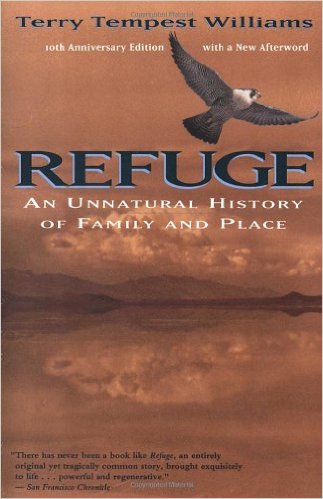
Refuge: An Unnatural History of Family and Place by Terry Tempest Williams

I am slowly, painfully discovering that my refuge is not found in my mother, my grandmother, or even the birds of Bear River. My refuge exists in my capacity to love. If I can learn to love death then I can begin to find refuge in change.

refugeWhen I read this book, I was continually reminded of the first Terry Tempest Williams book that I loved, as a child: Pieces of White Shell. I knew immediately that I would need to follow this book with a reread of that one. For me, Refuge is the more personal, more intimate, more grown-up and more exacting version of the kinds of things I found in Pieces of White Shell. I think I found this one more difficult, more thought-provoking and challenging; the other was both sparer, and offered clearer, more accessible comforts. Refuge is stripped, exposed pain. If there are balms for its wounds, they are more complex. Pieces of White Shell is metaphorical, symbolic, spiritual, seeking wisdom and humbly finding some of it; Refuge is bared emotions and loss. It is many birds. Each chapter is headed by the name of a bird – burrowing owls, killdeer, sanderlings, avocets and stilts, on and on – and by a level of Great Salt Lake.

Over the years in which the story of Refuge takes place, Great Salt Lake rises beyond its usual depths and boundaries. I learned in this reading that this Lake is shallow and covers a great area; therefore a few feet of rise can cover miles, and cause great destruction. Terry Tempest Williams saw her mother die of cancer as she saw her beloved Bear River Migratory Bird Refuge overtaken by saltwater, the birds displaced and many of them lost. In Refuge, she meditates on both losses and the relationship between them, how the Refuge offers refuge to her and to her mother, how they are linked – birds and women (clearly presaging her later When Women Were Birds), people and place (Terry’s Mormon family with the Great Basin and Utah), the cancer that runs in her family (“the clan of one-breasted women”) and their home (neighboring nuclear test sites).

Refuge involves nature, of course, and Terry educates us with precision about the birds she loves. It involves people, and society, and our interactions. It is beautifully written, with poetry, and with liberal gaps in which the reader may draw her own connections. Terry has an imaginative and generously interpretive mind, more so than mine.

The cancer process is not unlike the creative process. Ideas emerge slowly, quietly, invisibly at first. They are most often abnormal thoughts, thoughts that disrupt the quotidian, the accustomed. They divide and multiply, become invasive. With time, they congeal, consolidate, and make themselves conscious. An ideas surfaces and demands total attention. I take it from my body and give it away.

She finds wisdom in the world, as her mother and grandmother did; and of course, centrally, she finds refuge, which is not quite to say recovery or redemption, although those arguments can be made.

Terry Tempest Williams is a lovely writer. The story of her mother’s life and death, their relationship, and the difficulties and beauty of letting go, are all well accompanied by the pain and beauty of the migratory birds of the Great Basin that Terry knows well.


Rating: 7 phalaropes.

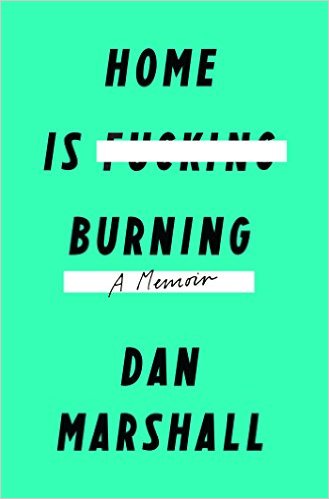
Maximum Shelf: Home is Burning by Dan Marshall

Maximum Shelf is the weekly Shelf Awareness feature focusing on an upcoming title we love and believe will be a great handselling opportunity for booksellers everywhere. The features are written by our editors and reviewers and the publisher has helped support the issue.

This review was published by Shelf Awareness on September 2, 2015.


home is burningDan Marshall’s life was pretty heavy on privilege. A self-described spoiled white kid with money, he grew up in Salt Lake City and then graduated from UC Berkeley, and was busy enjoying his first real job in Los Angeles and his first real girlfriend, Abby. His family–mom, dad and four siblings–wasn’t perfect, but they were happy, loving and shared a strong if quirky sense of humor, based on fart jokes and four-letter words. His mother had had “terminal” cancer well managed for nearly 15 years. Then came the phone call, while Dan was on vacation with Abby, announcing that his capable, marathon-running father had been diagnosed with something called ALS.

ALS stands for amyotrophic lateral sclerosis, more commonly known as Lou Gehrig’s disease. It’s a terminal neurodegenerative disease that kills off motor neurons, eventually depriving the person affected of the ability to move his own limbs, eat, speak, and breathe. Dan was slow to accept the gravity of the diagnosis, but under pressure from the family, after several months, he takes a leave of absence from his job to move home at age 25 to help out around the house. Home Is Burning is his memoir of caring for two terminally ill parents at once while dealing with a houseful of rowdy siblings with problems of their own. His story is unavoidably terribly sad, but peppered with sex, drugs both prescribed and recreational, copious foul language, lots of alcohol, and deep and abiding love, the Marshall family saga is surprisingly sweet and funny as well.

Although Dan describes them as spoiled and rich, the Marshalls have had their fair share of misfortunes, from mother Debi’s cancer diagnosis and years of chemotherapy treatments to cerebral palsy and Asperger’s syndrome among the children. The eldest sibling, Tiffany, who took over some parenting duties as a teenager when Debi was sick, had become an overachiever apparently teetering at the edge of a nervous breakdown. Greg was a successful college student in Chicago, enjoying his freedom after finally coming out of the closet. Still in high school were Chelsea, a socially awkward ballerina and serious student, and Michelle, a budding alcoholic in a disturbing relationship with her soccer coach. Dan was the second child, and the last to move back to Salt Lake City for their father Bob’s remaining time, which would more likely be measured in months than years.

Dan lingered in the denial stage of the grief process. With the whole family, he’d watched Bob run his last marathon in Boston, in a time nearly twice that which he’d run to qualify. But when Dan moves home, he is dismayed to see how much his father has already deteriorated. With Tiffany living nearby but on her own, “the little girls” still in high school, and Debi inconveniently faced with her toughest round of chemo treatments yet, the bulk of Bob’s caregiving duties falls to Dan and Greg. Together they help him bathe and use the bathroom as he loses the use of his arms. They feed him through his gastrointestinal tube, and take him for walks in a wheelchair as his legs lose their strength. They hook him up periodically to his BiPAP (bilevel positive airway pressure) machine, which helps push air through his lungs. Bob chooses to delay his tracheotomy surgery–which would attach him to a respirator for the rest of his days, and quite possibly end his ability to speak–to attend his own mother’s funeral; but the ill-advised delay ends with a rush to the hospital when his breathing fails, and the procedure takes place under emergency conditions. Happily, Bob retains his speech.

For all Dan and Greg’s love and good intentions, their caregiving is sometimes alarmingly poor: Bob is dropped on the floor, his respirator tubes cracked and broken. He might be considered lucky to survive his family’s care. The household begins to fall apart: Michelle passes out in her own vomit with increasing frequency as the cats pee all over their three-story home, which has been pulled apart by construction to install an elevator and widen doorways. Dan begins drinking more heavily; Abby breaks up with him; Greg takes a full-time job, putting more pressure on Dan; Debi’s behavior grows ever more erratic, with the mental effects of her chemotherapy, her distress at losing her husband, and a new addiction to pain pills. Dan’s outlook and storytelling throughout these mounting stressors is singular. He is remarkably candid about his frustrations and resentments: he loves his father enormously, calling him his buddy, his pal, his road map through life, and describing the effortless quality time shared and advice given–but he is angry to have his own social freedoms curtailed.

The tone of Dan’s writing in this painful period, however, is astonishingly funny, loving, even lighthearted. As he moves back and forth between agony, grief and anger, he displays a fun-loving, off-color, morbid sense of humor and an almost apologetically sweet expression of love for his entire imperfect family and especially their hero, their rock, Bob. Dan interjects his narrative with fantasies in which Debi’s hair grows back, Chelsea doesn’t giggle inappropriately at looming death, Michelle doesn’t marry her soccer coach, Bob stands up and takes himself to the toilet and goes for a good long run in the mountains.

Many stories have been written about terminal illnesses, degrading deaths, and families in grief; but the loving portraits painted here of outrageous and colorful characters joking in the face of ugliness may be unique. As Bob approaches his final chapter, readers will certainly cry, but they will laugh as well. Home Is Burning is a strangely packaged gift: love and pain, death and life, sex jokes, fart jokes and plenty of booze make up an extraordinarily heartwarming love letter from “a sad dude with a big heart who really loves his dad.” In its sad ending there is unlikely joy.


Rating: 9 brimming glasses of wine.

Come back tomorrow for my interview with Marshall.

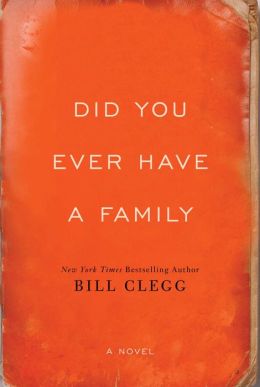
Maximum Shelf: Did You Ever Have A Family by Bill Clegg

Maximum Shelf is the weekly Shelf Awareness feature focusing on an upcoming title we love and believe will be a great handselling opportunity for booksellers everywhere. The features are written by our editors and reviewers and the publisher has helped support the issue.

This review was published by Shelf Awareness on June 10, 2015.


did you everAcclaimed memoirist Bill Clegg (Portrait of an Addict as a Young Man; Ninety Days) offers a profound jolt with his first novel, Did You Ever Have a Family, the impetus for the creation of Gallery Books’ new literary imprint, Scout Press.

June Reid’s world is splintered and lost in an instant. In the early morning of her daughter’s wedding day, her farmhouse explodes and burns, killing June’s ex-husband; her current boyfriend, Luke; her daughter, Lolly; and Lolly’s fiancé, Will. Did You Ever Have a Family maps the circumstances of the blaze and follows the aftermath of this tragedy as it affects June and other members of the families and communities of the victims.

In Clegg’s unusual composition, each chapter belongs to a different person, with the reader left to configure their connections. Some of their stories are told in first person, some in third, and almost all in flashbacks. This ever-shifting perspective highlights mistakes and misunderstandings, including June’s; other characters provide small revelations, thereby contributing to larger questions. The relatives and acquaintances of the deceased are joined by others with less clear ties, who appear to the reader in ever-widening concentric circles. Thus Clegg slowly and skillfully reveals the night of the fire and the nuances of the surrounding community in deft disclosures, through different points of view and with deep feelings.

June’s farmhouse is located in the small Connecticut town of Wells, where the locals are employed, somewhat resentfully, in serving weekend people from New York City. June had first been a weekender, and later moved in full-time. She ruffled some feathers when she began dating Luke, a handsome young man some 20 years her junior with a complicated history, about whom everyone in town had an opinion. June’s own family is not uncomplicated: following her divorce, she struggled to get along with her daughter, Lolly, a dreamy girl who apparently blamed her mother for the fracturing of the household. But June had worked to get to know Lolly’s fiancé, Will. She was counting on a future. In a moment of unguarded exasperation, she rhetorically asked Will’s sister: “Did you ever have a family?” After losing hers in such a spectacular, gruesome fashion, June eventually departs Wells carrying no identification, with only her car keys and a bank card left in the jacket she was wearing when she ran out of her house.

Early chapters focus on native Wells residents: friends, neighbors, the florist contracted for the wedding, the caterer who never got paid. But as characters gradually expand and diversify, the geography of Did You Ever Have a Family also spreads as the narrative unfolds, until its focus ranges from the east to the west coast of the United States. The lives of many are altered by the loss of June’s family; their simply expressed, easily understood emotions belie the gut-wrenchingly awful stories they tell. And each is ultimately working to build or define family, with varying degrees of success.

Lydia is Wells’s town outcast, busty and socially awkward, who gave birth years ago to a baby whose father had to have been African-American, although Lydia’s husband was red-haired and pale. That baby would grow up to be an intelligent, athletic, convicted felon–June’s boyfriend, Luke. When readers meet her, Lydia is chafing under the opinions of small, mean minds and loud voices. Town gossip holds Luke responsible for the tragedy, and thereby confirms Lydia’s low social status. Following an estrangement of several years between mother and son, June had orchestrated a tentative reconciliation. But when June leaves town following the funerals of everyone she loved, Lydia loses not only her son but her only friend. After June deserts Wells, gossip gains strength, and may yet destroy what the fire didn’t.

Supporting characters include a teenage neighbor who helped fix up the yard for the wedding and who carries his bong with him everywhere, and the family of June’s never-to-be son-in-law, Will, who return home to Washington State to mourn him. At a small seaside motel on the West Coast, a couple who have fled their own tragedy in Seattle worry over their new guest, a ghostlike woman who rents by the month and never leaves her room. And with yet another perspective, the reader learns the identity of Luke’s father, although Luke himself never did. These characters and vignettes are not disconnected, although their relationships become clear only over the course of Clegg’s masterfully woven story.

June and Lydia inhabit the center of this wondrous, grave and glorious story, but each voice that speaks up in Did You Ever Have a Family is gripping and invokes the reader’s sympathies. Every character and every small tragedy is a sensitively portrayed, complex, and compelling study on its own. What first appears to be a tale of grief in the face of unspeakable loss grows with its own momentum, until finally its scope is much wider than initially suspected. The expansive and surprising result eventually portrays the building of community and the possibility of recovery, even forgiveness. Did You Ever Have a Family is an elegant first novel, carefully composed and beautifully, hauntingly written.


Rating: 8 daisies.

Come back tomorrow for my interview with Clegg.

The Light of the World by Elizabeth Alexander

Moving, charming, delicately lovely, this memoir of a husband’s death offers solace and even joy.

light world

Poet Elizabeth Alexander (Crave Radiance; the 2009 Inaugural Poem) was enjoying a loving, creative, exultant and full life with her husband, Ficre Ghebreyesus, and their two sons, when Ficre died suddenly. The Light of the World is her record of that man–a husband and father, an artist, activist and chef–and of Alexander’s grief and gratitude for the years she shared with him and the love and family they made.

This astonishing and naturally poetic memoir of love and loss is vivid and abundant with sensory detail and bright color. Alexander includes recipes–Ficre’s, and those that comforted her after his death; gives evocative descriptions of his paintings and the food and music they both loved; counts his scars; and recounts her dreams of him. But The Light of the World is not a dream itself: Alexander is lucid and absolutely present. Perhaps to ward off the end it threatens, the story she sets out to tell starts, and starts again, and starts again: at their respective mothers’ pregnancies; at Ficre’s 50th birthday, the week of his death; when they met at a coffee shop in 1996. Alexander then resolutely travels through the tragic center of her story and into the life that follows, when her family of four becomes “a three-legged table,” as she phrased it in her first poem afterwards. In this tender, perceptive portrayal, Ficre comes alive again: an Eritrean native, a peace-lover born into war, a painter also accomplished in photography, collage and sculpture, an eager reader fluent in seven languages and who “could say hello and thank you in literally dozens of other[s],” an activist and member of African, African-American and global communities. “Your life is just like a foreign film!” a friend rightly exclaims, and Alexander’s is just the voice to portray his broadly informed, musical, painterly existence.

Short chapters and language of unrivalled beauty ease a sad story, and Alexander and her sons do make a joyful noise in the end. She feels that she carries “a Santa’s sack of gifts” of Ficre’s thoughts and impressions that belong to her alone; she celebrates the time they had. Their shared dreams, scars, meals, songs, dances, history and family are fittingly and exquisitely honored here.


This review originally ran as a *starred review* in the April 23, 2015 issue of Shelf Awareness for the Book Trade. To subscribe, click here.


Rating: 9 red lentils.

The Little Prince by Antoine de Saint-Exupéry, trans. by Richard Howard

little princeThe Little Prince is a classic children’s book that has been on my list for some time, so imagine my surprise when it appeared as well in a book I recently enjoyed, Hell and Good Company: The Spanish Civil War and the World it Made by Richard Rhodes. I had no idea that Saint-Exupéry played a role in the Spanish Civil War – apparently he volunteered there as a pilot. This helped The Little Prince jump to the top of my list, and here we are.

As it is a children’s book, it was an easy, quick read, just under 90 pages and full of delightful illustrations by Saint-Exupéry himself. These illustrations are an important part of the story: the power of art, and its greater or lesser power to realistically capture appearances. Apparently my edition is a new translation, by Richard Howard, and comes with newly restored illustrations as well. Howard opens with a brief meditation on the important work of translation that I found thought-provoking.

And then the story itself, which concerns our narrator, a pilot crashed and stranded in the African desert, and the little prince he is surprised to meet there. The prince tells us he has come from his own tiny little planet, far away. He is worried about a very special flower he left there. Thus proceeds the story of the little prince, and our pilot’s somewhat clumsy attempt to help; the prince’s departure, and the pilot’s dealing with it.

The morals here are sweet, as one might expect, and as I hadn’t expected, also offer some words about handling grief and loss. The image of one’s departed friend living in the stars and comforting us from afar is familiar and cozy. The Little Prince also comments on the strangeness of the adult world:

If you tell grown-ups, “I saw a beautiful red brick house, with geraniums at the windows and doves on the roof…,” they won’t be able to imagine such a house. You have to tell them, “I saw a house worth a hundred thousand francs.” Then they exclaim, “What a pretty house!”

…That’s the way they are. You must not hold it against them. Children should be very understanding of grown-ups.

Further allegory and comment are provided by the little prince’s bemusement at the confused values of those he meets on his interplanetary travels, before reaching Earth: the king, the vain man, the drunkard, the businessman, the lamplighter, the geographer; and those (considerably wiser) he meets on Earth before the pilot: snake, flowers, and others; and the wisest of all, a fox. It is the fox that teaches him that “anything essential is invisible to the eyes” and that “you become responsible forever for what you’ve tamed.”

A beautiful story, sweetly told and charmingly illustrated, with layers to appreciate on different readings and at different ages: everything a kid’s book should be.


Rating: 7 boas with elephants inside them.

Ajax by Sophocles, trans. by E.F. Watling

I read Ajax from my copy of Electra and Other Plays after being reminded of his tragic story by Madeline Miller’s The Song of Achilles. It is a short play, an easy read, but like so many of the greatest ancient Greek works, very sad.

Ajax was one of the great Greek heroes of the Trojan War. Indeed, Miller says several times in her book (in the voice of Patroclus) that he would have been The Greatest if it weren’t for Achilles – kind of a poignant thought. He’s like the Jan Ullrich of the Trojan War. This play by Sophocles dramatizes the action following Achilles’s death, as known to myth. The background: Achilles quarrels with Agamemnon and boycotts the war; Greeks are dying; Patroclus goes to battle disguised as Achilles to get everybody going again; Hector (the great Trojan hero) kills Patroclus. Achilles is enraged, takes the battlefield, and in turn kills Hector, thus putting into action the prophecy that Achilles himself will die shortly thereafter. He does: killed by an arrow fired by Paris, who started all this nonsense in the first place.

With the Greeks’ hero Achilles dead, it is time for Ajax to shine. But Agamemnon chooses to award Achilles’s trophies of war, not to Ajax, but to Odysseus. Ajax is furious. And now begins the play…

Ajax has determined to kills the sons of Atreus (Agamemnon and Menelaus), Odysseus, and all the Greeks who have failed to honor him as he feels he deserves. He goes on a killing spree overnight. But Athena, good friend especially to Odysseus, tricks his eyes so that he ends up killing a bunch of livestock and no human Greeks. As the play begins, she is explaining this to Odysseus, offering him the view of Ajax, mad, blind, confused, killing sheep and calling them Greek names. Odysseus balks, but we end up seeing the scene. Ajax comes to his senses, sees how he has been shamed, and immediately begins planning his suicide. The Chorus (that tool of Greek drama, the group of citizens that comments on the action) and Ajax’s wife Tecmessa try to talk him out of it, reminding him of the pain his parents would feel, and the dubious fate of Tecmessa and their son if left without husband/father. He seems to change his mind, and goes offstage. But then his brother shows up, distraught, citing a prophecy that Ajax will die today. The scene shifts to watch Ajax bury the hilt of his sword, make a short speech, and throw himself upon it.

Tecmessa and the Chorus mourn; Ajax’s brother, Teucer, mourns, and plans to bury the body. Agamemnon shows up and makes disparaging remarks, commanding that the body of Ajax not be buried at all. Now, I’ve read these things before, and (ahem Antigone) you’d think these characters would have learned by now: you have to bury the dead! The gods are mightily displeased if you do not. This is an important tenet of custom and piety. Luckily, Odysseus next arrives on the scene. He had been insulting Ajax earlier, declared him an enemy, but here he lives up to his reputation for wisdom: Odysseus talks Agamemnon into allowing a reverent burial, and the grief-stricken family of Ajax carries on with their ritual. It seems that Teucer will take care of Tecmessa and her son.

I find this to be a moving story, despite the removal of centuries and the difference of cultures… I guess I’ve read enough related myth that I have learned to identify with it. I love the stories of gods and heroes, how they’re all interrelated and how the actions of one generation can effect so many generations to come. (See the above reference to the House of Atreus. That man’s impious mistake will continue to cost his offspring – just watch what happens to Agamemnon when he gets home from war.) And I mainly read Sophocles (et al) for the stories… so I had to remind myself to slow down and appreciate the language, too. I think I prefer the poetry of Homer, but I can just imagine actually seeing this performed… that would be a treat.


Rating: 6 dramatic gasps.

The Song of Achilles by Madeline Miller

I read this book in a day, rapt and tearful and awed. Madeline Miller, I love you. Write more, please.

I expect that most people are at least vaguely familiar with the story of the Trojan War, even if you never read the Iliad, yes? The Greeks sail to Troy in pursuit of Helen, “the face that launched a thousand ships” (that’s these ships!), the most beautiful woman in the world, stolen from her king-husband Menelaus by the Trojan prince Paris. They fight at the gates of Troy for ten years before Odysseus’s characteristically clever notion of the big wooden horse (the Trojan horse of idiom) wins the war for the Greeks. Achilles is a hero of the war, on the Greeks’ side. He had been sitting the war out in protest against an offense to his pride when his close friend (and, most scholars agree, lover) Patroclus goes into battle and is killed. In the opening scene of the Iliad, Achilles is mad with grief and rage, about to rush into battle, kill Hector, and be killed by Paris.

That’s the background. Miller, a scholar of ancient languages (including Greek) and theatre has written a novel from Patroclus’s point of view. This gave her quite a bit of leeway, since Patroclus is not given much coverage in Homer or in ancient myth generally; she got to do what she wanted with him. Here, we see him grow up from a boy: he was a disappointment to his father, then was exiled in dishonor and sent away to be fostered in another kingdom, where Achilles is the prince and heir. The two boys form a decidedly unlikely friendship, with Patroclus the dishonored and weak following in the footsteps of Achilles, whose future is prophesied to be something enormous: he will be Aristos Achaion, the greatest of the Greeks.

Patroclus joins Achilles in his studies and their bond grows closer until they become lovers. They are not eager to join the Greeks and sail to Troy to fight for another king’s wife, but circumstances (and Odysseus, the crafty one) conspire to see them off. From there, you can revisit my synopsis of the Iliad, above – except that we keep Patroclus’s perspective, which actually made the Trojan War that I thought I knew so well spring fresh from the page.

And that is one of the several strengths of this book: that an ancient myth that is familiar to many readers, like me, becomes so real, new, crisp & juicy in Miller’s hands. It definitely made me want to go back and reread the Iliad, as well as other cited works. (Check out the Character Glossary, whether you think you need it or not, for background as well as mentions of other books you’ll want to go find.) The myth of the Trojan War comes alive with Patroclus as it hasn’t before.

Another great strength is the emotional impact Miller achieves. This book is moving, sweet, heartfelt, powerful, in its tragedies as in its loving moments – and the tragedies are plentiful. There is visceral wrath in Achilles’s mother Thetis and her hatred of all mortals and Patroclus in particular; that emotion comes through just as strongly as the love that makes Patroclus put aside jealousy and envy, makes him put Achilles’s needs before his own. I noticed that the first-person voice of Patroclus rarely uses the name Achilles, but just refers to his lover as “he” – thus emphasizing the extent to which Achilles is the center of his world.

As I said at the start of this review, I want more of this! It’s so well done. If you’re taking requests, Ms. Miller, I would like to read a book about what happened to the happy family of Odysseus, Penelope and Telemachus following the conclusion of the Odyssey: how does Odysseus manage to gracefully step down from power and transfer to Telemachus without sacrificing any of his machismo? Reading The Song of Achilles raised this question for me – how a king could step down and preserve his dignity and quality of life. I wonder, too, whether Penelope ever gets grumpy about all the philandering Odysseus did along his homeward journey, while she was standing strong against the suitors.

In a nutshell, this retelling of the Trojan War and the relationship between Achilles and Patroclus is lovely, loving, sweet and deeply emotional; it preserves the grand, sweeping scale and feeling of humanity and drama in the original, but brings it freshly alive in an appealingly different format. The Song of Achilles made me sigh and think and cry, and I wanted more when it was all gone. This may very well be the best book I’ve read in 2012.


Rating: a rare 10 loving caresses.

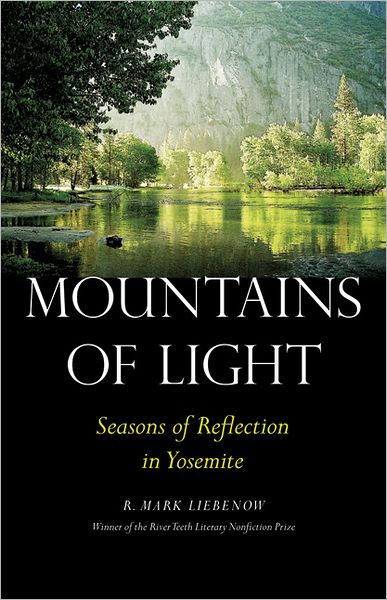
Mountains of Light by R. Mark Liebenow

A quiet, moving memoir of grief and recovery set in the Yosemite Valley.


When his wife of 18 years died, R. Mark Liebenow was overcome with grief. He sought relief by following in John Muir’s footsteps, consulting naturalists, historians, spiritual guides and artists along the way. Mountains of Light covers a year which he spends (in many short trips) in the Yosemite Valley, contemplating the natural world and the significance of death. He is “looking for the mystery of life,” he writes, “even if it can’t be solved but only hiked further into.”

Mountains of Light is lyrical and decidedly literary. Liebenow’s focus drifts: he describes a mountain vista, waxes mystical about the roles that insects and waterfalls and clouds play in the universe, quotes poetry (and Muir), confers with cutting-edge science and remembers his late wife. He includes morsels of history (particularly of Yosemite, from Native Americans through the Mariposa Battalion to the present) and catalogues plant and animal life. He considers various religious and spiritual understandings of nature and death and the mountains, mulling over his options for accepting his tragedy. The background for all this musing is dynamic, as Liebenow takes challenging hikes, explores, gets lost in the wilderness and watches his fellow campers and mountain climbers take still greater risks. The scenery changes drastically in four seasons, which Liebenow interprets metaphorically.

Part travelogue, part natural study and part memoir of grief, Mountains of Light is meditative, lovely, thought-provoking and, yes, sad–but worth it for the appreciation of this natural gem and the redemption it brings.


This review originally ran in the March 9, 2012 issue of Shelf Awareness for Readers. To subscribe, click here, and you’ll receive two issues per week of book reviews and other bookish fun!


Please note that this book makes a fine readalike for Fire Season or Edward Abbey’s Desert Solitaire. And look at that lovely cover, too!


Rating: 6 moments of contemplation.